Enforcing Trust Accountability with Backward Propagation
Pith reviewed 2026-06-27 17:19 UTC · model grok-4.3
The pith
A two-layer model couples endorsements with interactions and uses backward propagation to enforce accountability for trust signals.
A machine-rendered reading of the paper's core claim, the machinery that carries it, and where it could break.
Core claim
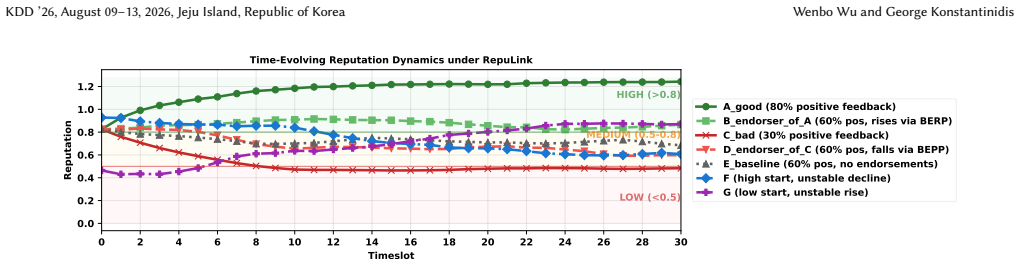
RepuLink is a two-layer reputation model that couples an endorsement network with an interaction feedback network. It integrates Backward Endorsement Penalty Propagation (BEPP), which recursively penalizes endorsers of misbehaving nodes, and Backward Endorsement Reward Propagation (BERP), which rewards endorsers of well-performing nodes. Together these mechanisms enforce endorsement accountability, create a positive interaction feedback loop, and supply explainable, endorser-weighted trust initialization for newly joined nodes.
What carries the argument
The two concurrent backward propagation mechanisms (BEPP for penalties and BERP for rewards) operating on the endorsement layer that is coupled to the interaction feedback layer.
If this is right
- Endorsers become directly accountable for the future behavior of the nodes they endorse.
- Well-performing nodes generate rewards that flow back to their endorsers, creating an incentive for careful endorsement.
- New nodes receive an initial trust value derived from the weighted trust of their endorsers rather than starting from zero or uniform values.
- The combined mechanisms form a closed positive feedback loop between endorsements and observed interactions.
- The approach maintains comparable computational cost to forward-only models while improving four evaluation metrics on real interaction data.
Where Pith is reading between the lines
- The same backward accountability idea could be tested in content-sharing platforms where users endorse posts or accounts.
- If endorsement data is sparse or noisy, the initialization benefit for new nodes would shrink, suggesting a need for hybrid initialization rules.
- The model implicitly assumes that the endorsement graph itself does not contain coordinated bad actors; detecting such clusters would require additional machinery.
- Dynamic networks with frequent node arrival and departure could be used to measure how quickly the backward signals stabilize the reputation scores.
Load-bearing premise
The model assumes that an endorsement network can be meaningfully coupled with the interaction feedback network such that backward propagation produces enforceable accountability without introducing new vulnerabilities or requiring unavailable data.
What would settle it
A dataset or live deployment in which endorsers of misbehaving nodes receive no effective penalty yet the model still claims superior metric scores, or in which the required endorsement data is missing for a large fraction of nodes.
Figures






read the original abstract
Trust and reputation management underpins reliable interactions in distributed networks, yet existing trust models rely solely on forward propagation of interaction-based trust signals. They lack robust mechanisms to enforce accountability for the propagated trust signals when negative interactions occur. In addition, such models often fail to initialize newly joined nodes with sparse interaction history, leading to the cold-start problem. In this paper, we propose RepuLink, a two-layer reputation model that couples an endorsement network with an interaction feedback network. RepuLink integrates two concurrent backward propagation mechanisms: Backward Endorsement Penalty Propagation (BEPP), which recursively penalizes endorsers of misbehaving nodes, and Backward Endorsement Reward Propagation (BERP), which rewards endorsers of well-performing nodes. Together, RepuLink enforces endorsement accountability and incentivizes positive behaviors, which form a positive interaction feedback loop. The endorsement layer further provides explainable, endorser-weighted trust initialization for newly joined nodes. Experiments on real-world datasets against representative trust propagation baselines demonstrate that RepuLink outperforms across four evaluation metrics in both interaction-only and full two-layer settings, while preserving comparable efficiency.
Editorial analysis
A structured set of objections, weighed in public.
Referee Report
Summary. The paper proposes RepuLink, a two-layer reputation model coupling an endorsement network with an interaction feedback network. It introduces concurrent backward propagation mechanisms—Backward Endorsement Penalty Propagation (BEPP) and Backward Endorsement Reward Propagation (BERP)—to enforce accountability for propagated trust signals and address the cold-start problem via endorser-weighted initialization. Experiments on real-world datasets are reported to show outperformance over trust propagation baselines across four metrics in both interaction-only and full two-layer settings, with comparable efficiency.
Significance. If the two-layer results hold and generalize, the work would be significant for trust and reputation systems in distributed networks by adding enforceable accountability through backward mechanisms and a positive feedback loop, while also providing an explainable initialization method. This extends forward-only propagation models in a way that could improve reliability in settings with misbehavior.
major comments (2)
- [Abstract] Abstract: the central claim of outperformance in the full two-layer setting (across four metrics) depends on the endorsement network being available and meaningfully coupled to the interaction logs in the real-world datasets without introducing unavailable data or new vulnerabilities. No information is provided on how this layer is obtained, constructed, or validated, which is load-bearing for attributing gains to BEPP/BERP rather than data artifacts.
- [Abstract] The assumption that an endorsement network can be coupled without new vulnerabilities is stated but not tested or analyzed for security implications in the two-layer experiments; this directly affects the enforceability claim.
Simulated Author's Rebuttal
We thank the referee for their constructive feedback on our manuscript. We address each major comment point by point below, and will incorporate revisions where appropriate to strengthen the paper.
read point-by-point responses
-
Referee: [Abstract] Abstract: the central claim of outperformance in the full two-layer setting (across four metrics) depends on the endorsement network being available and meaningfully coupled to the interaction logs in the real-world datasets without introducing unavailable data or new vulnerabilities. No information is provided on how this layer is obtained, constructed, or validated, which is load-bearing for attributing gains to BEPP/BERP rather than data artifacts.
Authors: We agree that additional details on the endorsement network are necessary to support the claims. The full manuscript describes the real-world datasets in the experimental section, but we acknowledge the abstract does not. In the revision, we will modify the abstract to include a concise description of how the endorsement networks are sourced and coupled from the datasets (e.g., from existing social or trust links in the data). We will also add validation details to ensure the performance improvements are due to the BEPP/BERP mechanisms. revision: yes
-
Referee: [Abstract] The assumption that an endorsement network can be coupled without new vulnerabilities is stated but not tested or analyzed for security implications in the two-layer experiments; this directly affects the enforceability claim.
Authors: The paper assumes the endorsement network is provided as input, similar to how interaction networks are given in standard trust models. The enforceability claim pertains to the backward propagation enforcing accountability for endorsements. We have not conducted a dedicated security analysis of potential new vulnerabilities introduced by the coupling, as the primary contribution is the reputation model itself. We will revise to explicitly state this scope and suggest security analysis as future work, but maintain that the current experiments demonstrate the model's effectiveness under the stated assumptions. revision: partial
Circularity Check
No circularity; proposal is experimental and externally falsifiable
full rationale
The abstract and available text introduce RepuLink as a new two-layer model coupling endorsement and interaction networks via BEPP/BERP mechanisms, with claims of outperformance on real-world datasets across four metrics. No equations, parameter-fitting procedures, self-citations, or derivation steps are visible that reduce any result to its own inputs by construction. The central claims rest on empirical comparison to baselines, which is externally checkable and does not rely on self-definitional or fitted-input patterns. The paper is therefore self-contained against external benchmarks.
Axiom & Free-Parameter Ledger
Reference graph
Works this paper leans on
-
[1]
Sateesh Kumar Awasthi and Yatindra Nath Singh. 2020. Absolutetrust: algorithm for aggregation of trust in peer-to-peer networks.IEEE transactions on dependable and secure computing19, 1 (2020), 176–189. doi:10.1109/TDSC.2020.2977641
-
[2]
Michail Bampatsikos, Ilias Politis, Christos Xenakis, and Stelios CA Thomopoulos
-
[3]
InProceedings of the 16th International Conference on A vailability, Reliability and Security
Solving the cold start problem in Trust Management in IoT. InProceedings of the 16th International Conference on A vailability, Reliability and Security. 1–9. doi:10.1145/3465481.3469208
-
[4]
Arti Bandhana, Tomáš Kroupa, and Sebastián García. 2024. Trust in Shapley: A Cooperative Quest for Global Trust in P2P Network. InProceedings of the 23rd International Conference on Autonomous Agents and Multiagent Systems. 132–140
2024
-
[5]
Javier Castro, Daniel Gómez, and Juan Tejada. 2009. Polynomial calculation of the Shapley value based on sampling.Computers & operations research36, 5 (2009), 1726–1730
2009
-
[6]
Hugh Chen, Ian C Covert, Scott M Lundberg, and Su-In Lee. 2023. Algorithms to estimate Shapley value feature attributions.Nature Machine Intelligence5, 6 (2023), 590–601. doi:10.1038/s42256-023-00657-x
-
[7]
Xiang Cheng, Sen Su, Zhongbao Zhang, Hanchi Wang, Fangchun Yang, Yan Luo, and Jie Wang. 2011. Virtual network embedding through topology-aware node ranking.ACM SIGCOMM Computer Communication Review41, 2 (2011), 38–47. doi:10.1145/1971162.1971168
-
[8]
Xinxin Fan, Ling Liu, Mingchu Li, and Zhiyuan Su. 2016. GroupTrust: Dependable trust management.IEEE Transactions on Parallel and Distributed Systems28, 4 (2016), 1076–1090. doi:10.1109/TPDS.2016.2611660
-
[9]
Xinxin Fan, Ling Liu, Rui Zhang, Quanliang Jing, and Jingping Bi. 2020. Decen- tralized trust management: Risk analysis and trust aggregation.ACM Computing Surveys (CSUR)53, 1 (2020), 1–33. doi:10.1145/3362168
-
[10]
Junmei Feng, Zhaoqiang Xia, Xiaoyi Feng, and Jinye Peng. 2021. RBPR: A hybrid model for the new user cold start problem in recommender systems.Knowledge- Based Systems214 (2021), 106732. doi:10.1016/j.knosys.2020.106732
-
[11]
Raul Castro Fernandez, Pranav Subramaniam, and Michael J Franklin. 2020. Data Market Platforms: Trading Data Assets to Solve Data Problems.Proceedings of the VLDB Endowment13, 11 (2020)
2020
-
[12]
Jones Granatyr, Vanderson Botelho, Otto Robert Lessing, Edson Emílio Scalabrin, Jean-Paul Barthès, and Fabrício Enembreck. 2015. Trust and reputation models for multiagent systems.ACM Computing Surveys (CSUR)48, 2 (2015), 1–42. doi:10.1145/2816826
-
[13]
Taha Gunes, Long Tran-Thanh, and Timothy Norman. 2019. Identifying vul- nerabilities in trust and reputation systems. International Joint Conferences on Artificial Intelligence. doi:10.24963/ijcai.2019/44
-
[14]
Guibing Guo, Jie Zhang, and Daniel Thalmann. 2014. Merging trust in collabora- tive filtering to alleviate data sparsity and cold start.Knowledge-Based Systems 57 (2014), 57–68. doi:10.1016/j.knosys.2013.12.007
-
[15]
Chao He, Tom H Luan, Rongxing Lu, Zhou Su, and Mianxiong Dong. 2022. Security and privacy in vehicular digital twin networks: Challenges and solutions. IEEE Wireless Communications30, 4 (2022), 154–160. doi:10.1109/MWC.002. 2200015
-
[16]
Ming Ji, Jiawei Han, and Marina Danilevsky. 2011. Ranking-based classification of heterogeneous information networks. InProceedings of the 17th ACM SIGKDD international conference on Knowledge discovery and data mining. 1298–1306. doi:10.1145/2020408.2020603
-
[17]
Wenjun Jiang, Guojun Wang, Md Zakirul Alam Bhuiyan, and Jie Wu. 2016. Understanding graph-based trust evaluation in online social networks: Method- ologies and challenges.Acm Computing Surveys (Csur)49, 1 (2016), 1–35. doi:10.1145/2906151
-
[18]
Ruoming Jin, Victor E Lee, and Hui Hong. 2011. Axiomatic ranking of network role similarity. InProceedings of the 17th ACM SIGKDD international conference on Knowledge discovery and data mining. 922–930. doi:10.1145/2020408.2020561
-
[19]
Audun Jøsang, Roslan Ismail, and Colin Boyd. 2007. A survey of trust and reputation systems for online service provision.Decision support systems43, 2 (2007), 618–644. doi:10.1016/j.dss.2005.05.019
-
[20]
Sepandar D Kamvar, Mario T Schlosser, and Hector Garcia-Molina. 2003. The eigentrust algorithm for reputation management in p2p networks. InProceedings of the 12th international conference on World Wide Web. 640–651. doi:10.1145/ 775152.775242
arXiv 2003
-
[21]
Cristobald de Kerchove and Paul Van Dooren. 2008. The pagetrust algorithm: How to rank web pages when negative links are allowed?. InProceedings of the 2008 SIAM international conference on data mining. SIAM, 346–352. doi:10.1137/1. 9781611972788.31
work page doi:10.1137/1 2008
-
[22]
Srijan Kumar, Bryan Hooi, Disha Makhija, Mohit Kumar, Christos Faloutsos, and VS Subrahmanian. 2018. Rev2: Fraudulent user prediction in rating platforms. In Proceedings of the eleventh ACM international conference on web search and data mining. 333–341
2018
-
[23]
Srijan Kumar, Francesca Spezzano, VS Subrahmanian, and Christos Faloutsos
-
[24]
In2016 IEEE 16th international conference on data mining (ICDM)
Edge weight prediction in weighted signed networks. In2016 IEEE 16th international conference on data mining (ICDM). IEEE, 221–230
-
[25]
Peter A Lofgren, Siddhartha Banerjee, Ashish Goel, and Comandur Seshadhri
-
[26]
Fast-ppr: Scaling personalized pagerank estimation for large graphs. In Proceedings of the 20th ACM SIGKDD international conference on Knowledge discovery and data mining. 1436–1445. doi:10.1145/2623330.2623745
-
[27]
Yizhou Ma, Xikun Jiang, Evan W Wu, Luis-Daniel Ibáñez, and Jian Shi. 2024. Model-based data markets: a multi-broker game theoretic approach. In2024 IEEE 23rd International Conference on Trust, Security and Privacy in Computing and Communications (TrustCom). IEEE, 2293–2301
2024
-
[28]
Xianfu Meng and Dongxu Liu. 2016. GeTrust: A guarantee-based trust model in chord-based P2P networks.IEEE Transactions on Dependable and Secure Comput- ing15, 1 (2016), 54–68. doi:10.1109/TDSC.2016.2530720
-
[29]
Xianfu Meng and Ge Zhang. 2020. TrueTrust: a feedback-based trust management model without filtering feedbacks in P2P networks.Peer-to-Peer Networking and Applications13 (2020), 175–189. doi:10.1007/s12083-019-00742-2
-
[30]
Panagiotis Metaxas. 2009. Enhancing information reliability through backwards propagation of distrust.International Journal on Advances in Security Volume 2, Numbers 2&3, 2009(2009)
2009
-
[31]
Thanh Linh Nguyen, Lam Nguyen, Thong Hoang, Dilum Bandara, Qin Wang, Qinghua Lu, Xiwei Xu, Liming Zhu, and Shiping Chen. 2025. Blockchain- empowered trustworthy data sharing: Fundamentals, applications, and challenges. Comput. Surveys57, 8 (2025), 1–36. doi:10.1145/3718082
-
[32]
1999.The PageRank citation ranking: Bringing order to the web.Technical Report
Lawrence Page, Sergey Brin, Rajeev Motwani, and Terry Winograd. 1999.The PageRank citation ranking: Bringing order to the web.Technical Report. Stanford infolab
1999
-
[33]
Josiane Xavier Parreira, Carlos Castillo, Debora Donato, Sebastian Michel, and Gerhard Weikum. 2008. The juxtaposed approximate pagerank method for robust pagerank approximation in a peer-to-peer web search network.The VLDB Journal 17 (2008), 291–313. doi:10.1007/s00778-007-0057-y
-
[34]
Josiane Xavier Parreira, Debora Donato, Sebastian Michel, and Gerhard Weikum
-
[35]
InProceedings of the 32nd international conference on Very large data bases
Efficient and decentralized pagerank approximation in a peer-to-peer web search network. InProceedings of the 32nd international conference on Very large data bases. 415–426
-
[36]
Dimitrios Rafailidis and Fabio Crestani. 2017. Learning to rank with trust and distrust in recommender systems. InProceedings of the eleventh ACM conference on recommender systems. 5–13. doi:10.1145/3109859.3109879
-
[37]
Matthew Richardson, Rakesh Agrawal, and Pedro Domingos. 2003. Trust man- agement for the semantic web. InInternational semantic Web conference. Springer, 351–368. doi:10.1007/978-3-540-39718-2_23
-
[38]
Zhiyuan Su, Ling Liu, Mingchu Li, Xinxin Fan, and Yang Zhou. 2015. Reliable and resilient trust management in distributed service provision networks.ACM Transactions on the Web (TWEB)9, 3 (2015), 1–37. doi:10.1145/2754934
-
[39]
Ugur Eray Tahta, Sevil Sen, and Ahmet Burak Can. 2015. GenTrust: A genetic trust management model for peer-to-peer systems.Applied Soft Computing34 (2015), 693–704. doi:10.1016/j.asoc.2015.04.053
-
[40]
Chenchen Tan, Xinghao Li, Longxiang Gao, Tom H Luan, Youyang Qu, Yong Xiang, and Rongxing Lu. 2023. Digital twin enabled remote data sharing for internet of vehicles: System and incentive design.IEEE Transactions on Vehicular Technology72, 10 (2023), 13474–13489. doi:10.1109/TVT.2023.3275591
-
[41]
Patricia Victor, Chris Cornelis, Ankur M Teredesai, and Martine De Cock. 2008. Whom should I trust? The impact of key figures on cold start recommendations. InProceedings of the 2008 ACM symposium on Applied computing. 2014–2018. doi:10.1145/1363686.1364174
-
[42]
Patricia Victor, Nele Verbiest, Chris Cornelis, and Martine De Cock. 2013. En- hancing the trust-based recommendation process with explicit distrust.ACM Transactions on the Web (TWEB)7, 2 (2013), 1–19. doi:10.1145/2460383
-
[43]
Monique V Vieira, Bruno M Fonseca, Rodrigo Damazio, Paulo B Golgher, Davi de Castro Reis, and Berthier Ribeiro-Neto. 2007. Efficient search ranking in social networks. InProceedings of the sixteenth ACM conference on Conference on information and knowledge management. 563–572. doi:10.1145/1321440.1321520
-
[44]
Wenbo Wu and George Konstantinidis. 2025. Trust and Reputation in Data Sharing: A Survey. arXiv:2508.14028 [cs.SI] https://arxiv.org/abs/2508.14028
arXiv 2025
-
[45]
Li Xiong and Ling Liu. 2004. Peertrust: Supporting reputation-based trust for peer-to-peer electronic communities.IEEE transactions on Knowledge and Data Engineering16, 7 (2004), 843–857. doi:10.1109/TKDE.2004.1318566
-
[46]
Jie Yin, Yang Xiao, Jie Feng, Mengmeng Yang, Qingqi Pei, and Xun Yi. 2025. DidTrust: Privacy-preserving Trust Management for Decentralized Identity.IEEE Transactions on Dependable and Secure Computing(2025). doi:10.1109/TDSC.2024. 3524760
-
[47]
Runfang Zhou and Kai Hwang. 2007. Powertrust: A robust and scalable reputation system for trusted peer-to-peer computing.IEEE Transactions on parallel and distributed systems18, 4 (2007), 460–473. doi:10.1109/TPDS.2007.1021
-
[48]
Runfang Zhou, Kai Hwang, and Min Cai. 2008. Gossiptrust for fast reputation aggregation in peer-to-peer networks.IEEE transactions on knowledge and data engineering20, 9 (2008), 1282–1295. doi:10.1109/TKDE.2008.48 Enforcing Trust Accountability with Backward Propagation KDD ’26, August 09–13, 2026, Jeju Island, Republic of Korea A Proof of Convergence We ...
discussion (0)
Sign in with ORCID, Apple, or X to comment. Anyone can read and Pith papers without signing in.