Modulation-Reaction Networks
Pith reviewed 2026-06-28 16:16 UTC · model grok-4.3
The pith
Modulation-reaction networks treat regulated reactions as primary objects by letting entities activate or inhibit specific reactions, and Modulation-Reaction Logic reasons about their structure and dynamics.
A machine-rendered reading of the paper's core claim, the machinery that carries it, and where it could break.
Core claim
MR-networks model entities that modulate reactions via activations and inhibitions. Under synchronous Boolean semantics, Modulation-Reaction Logic provides a complete characterisation of the one-step update rule and formalises biological properties including reachability, sustained production, and attractors. Model checking proceeds through an evaluation game, and a bisimulation relation on MR-networks is invariant under every MRL formula.
What carries the argument
Modulation-reaction networks, in which entities modulate reactions through activations and inhibitions under synchronous Boolean semantics, together with the hybrid modal mu-calculus MRL whose modalities capture network structure and fixed points capture temporal evolution.
If this is right
- Reachability of states, sustained production of entities, and presence of attractors can be formalised directly in MRL.
- The one-step update rule receives a complete logical characterisation.
- Model checking of MRL formulas on MR-networks is possible via an evaluation game.
- A bisimulation relation on MR-networks preserves the truth of every MRL formula.
- The framework and its developments extend in outline to an asynchronous semantics of MR-networks.
Where Pith is reading between the lines
- The separation of reaction structure from regulatory modulation may allow modular verification when only the regulation changes.
- The bisimulation could support reduction of large networks while preserving all expressible biological properties.
- Transfer to asynchronous semantics may enable reasoning about timing-dependent regulation without moving to fully stochastic models.
Load-bearing premise
The synchronous Boolean semantics chosen for MR-networks adequately abstracts regulated biochemical dynamics and the hybrid modal mu-calculus modalities and fixed points are the right primitives for the intended structural and temporal properties.
What would settle it
A concrete MR-network in which the logical characterisation of the one-step update rule fails to match the actual synchronous update computed directly from the network definition, or a biological property such as attractor presence that is observable in the dynamics but cannot be expressed by any MRL formula.
Figures

read the original abstract
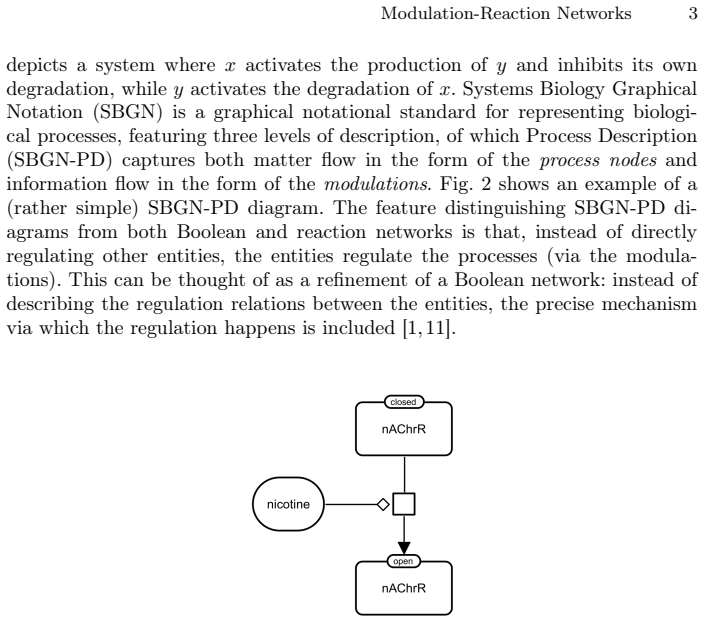
Biochemical systems involve both the flow of matter, in which entities transform into one another via reactions, and the flow of information, in which entities regulate which reactions may occur. Boolean networks capture the latter; reaction networks capture the former. Yet no unified qualitative formalism treats regulated reactions as its principal objects of study, despite their prominence in standards such as the Systems Biology Graphical Notation Process Description (SBGN-PD) language. We introduce modulation-reaction networks (MR-networks), a mathematical framework in which entities modulate reactions through activations and inhibitions, and study their synchronous Boolean semantics. To reason about MR-networks we develop Modulation-Reaction Logic (MRL), a hybrid modal $\mu$-calculus whose modalities reason about the structure of the network and whose fixed-point operators capture temporal evolution of the computation. We establish a collection of validities, including a complete characterisation of the one-step update rule, and demonstrate the expressive power of MRL by formalising properties of biological interest such as reachability, sustained production, and presence of attractors. We show that MRL admits model-checking via an evaluation game, and introduce a bisimulation relation for MR-networks, which is proved to be invariant for all MRL-formulas. As a step towards a biologically more realistic computational model, we sketch the asynchronous semantics of MR-networks, and outline how the developments for the synchronous case transfer to the study of the asynchronous one.
Editorial analysis
A structured set of objections, weighed in public.
Referee Report
Summary. The manuscript introduces modulation-reaction networks (MR-networks) as a framework unifying reaction networks (matter flow) and regulatory activations/inhibitions (information flow). It equips MR-networks with synchronous Boolean update semantics, develops Modulation-Reaction Logic (MRL) as a hybrid modal μ-calculus whose modalities capture network structure and whose fixed points capture temporal evolution, claims a collection of validities including a complete characterisation of the one-step update rule, demonstrates MRL's expressive power by encoding biological properties such as reachability, sustained production and attractors, supplies an evaluation-game model-checking procedure, proves bisimulation invariance for MRL, and sketches an asynchronous semantics together with a transfer argument for the synchronous results.
Significance. If the technical claims hold, the work supplies a qualitative formalism directly aligned with SBGN-PD Process Description diagrams and therefore fills a genuine gap between Boolean networks and reaction networks. The hybrid modal μ-calculus approach, game semantics, and bisimulation result are standard strengths that would make the logic immediately usable for automated verification. The explicit sketch of asynchronous semantics is a constructive step toward biological realism. The absence of any concrete biological example, comparison with SBML/ODE models, or parameter-free derivation, however, keeps the practical significance modest at present.
major comments (2)
- [Abstract] Abstract (asynchronous semantics paragraph): the statement that 'the developments for the synchronous case transfer to the study of the asynchronous one' is load-bearing for any claim of improved biological realism, yet the visible text supplies neither a formal definition of the asynchronous update rule nor a proof that the complete characterisation of the one-step update rule, the MRL validities, or bisimulation invariance survive the change from synchronous to asynchronous semantics.
- [Abstract] Abstract (MRL expressive-power paragraph): the claim that MRL can formalise 'reachability, sustained production, and presence of attractors' is central to the biological motivation, but no MRL formulas, no encoding of the one-step update rule, and no example network are exhibited, so it is impossible to verify that the hybrid modalities and fixed-point operators are adequate for these properties.
minor comments (2)
- The abstract refers to 'a collection of validities' without enumerating them beyond the update-rule characterisation; a short list or reference to the relevant theorem would improve readability.
- No comparison is drawn with existing qualitative frameworks (e.g., Boolean regulatory networks or Petri-net encodings of SBGN-PD), which would help situate the novelty of MR-networks.
Simulated Author's Rebuttal
We thank the referee for the careful and constructive report. The two major comments both concern the abstract's condensation of technical claims whose supporting material appears in the body of the manuscript. We respond point by point and indicate the revisions we will undertake.
read point-by-point responses
-
Referee: [Abstract] Abstract (asynchronous semantics paragraph): the statement that 'the developments for the synchronous case transfer to the study of the asynchronous one' is load-bearing for any claim of improved biological realism, yet the visible text supplies neither a formal definition of the asynchronous update rule nor a proof that the complete characterisation of the one-step update rule, the MRL validities, or bisimulation invariance survive the change from synchronous to asynchronous semantics.
Authors: Section 5 of the manuscript already sketches an asynchronous update rule and outlines a transfer argument for the synchronous results. We agree, however, that the abstract claim is insufficiently supported without a self-contained formal statement and proof. In the revision we will expand Section 5 to give an explicit definition of the asynchronous semantics and a detailed (if concise) argument showing that the one-step characterisation, the listed validities, and bisimulation invariance all carry over. The abstract will be updated to reflect the strengthened treatment. revision: yes
-
Referee: [Abstract] Abstract (MRL expressive-power paragraph): the claim that MRL can formalise 'reachability, sustained production, and presence of attractors' is central to the biological motivation, but no MRL formulas, no encoding of the one-step update rule, and no example network are exhibited, so it is impossible to verify that the hybrid modalities and fixed-point operators are adequate for these properties.
Authors: The body of the paper (Section 4) supplies explicit MRL formulas for reachability, sustained production and attractors, together with an encoding of the one-step update rule, all illustrated on a small concrete MR-network. The abstract summarises these results without reproducing the formulas. To address the referee's concern we will insert a short illustrative example (one network plus the corresponding MRL formulas) either into a revised abstract or into a new early subsection, making the encodings immediately visible. revision: yes
Circularity Check
No circularity; framework definitions and logic are self-contained.
full rationale
The paper introduces MR-networks and MRL as new definitions, then states that it establishes validities (including characterisation of the update rule) and demonstrates expressive power via formalisation of properties. No equations, fitted parameters, or self-citation chains are quoted that reduce any claimed result to its own inputs by construction. The synchronous Boolean semantics is presented as a chosen abstraction rather than derived, and the transfer to asynchronous case is sketched without load-bearing self-referential steps. This is a standard definitional contribution with independent content.
Axiom & Free-Parameter Ledger
Reference graph
Works this paper leans on
-
[1]
Compositionality6(2024)
Aduddell, R., Fairbanks, J., Kumar, A., Ocal, P.S., Patterson, E., Shapiro, B.T.: A compositional account of motifs, mechanisms, and dynamics in biochemi- cal regulatory networks. Compositionality6(2024). https://doi.org/10.32408/ compositionality-6-2
2024
-
[2]
Andersen, J.L., Flamm, C., Merkle, D., Stadler, P.F.: Chemical transformation motifs – modelling pathways as integer hyperflows. IEEE/ACM Trans. Comput. Biol. Bioinformatics16(2), 510–523 (2019). https://doi.org/10.1109/TCBB.2017. 2781724
-
[3]
In: Blackburn, P., van Benthem, J.F.A.K., Wolter, F
Areces, C., ten Cate, B.: Hybrid logics. In: Blackburn, P., van Benthem, J.F.A.K., Wolter, F. (eds.) Handbook of Modal Logic, pp. 821–868. Studies in logic and prac- tical reasoning, North-Holland (2007). https://doi.org/10.1016/S1570-2464(07) 80017-6
-
[4]
Bonchi, F., Sobociński, P., Zanasi, F.: A Survey of Compositional Signal Flow Theory, pp. 29–56. Springer International Publishing, Cham (2021). https://doi. org/10.1007/978-3-030-81701-5_2
-
[5]
Journal of The Royal Society Interface5(suppl_1), S85–S94 (2008)
Bornholdt, S.: Boolean network models of cellular regulation: prospects and lim- itations. Journal of The Royal Society Interface5(suppl_1), S85–S94 (2008). https://doi.org/10.1098/rsif.2008.0132.focus
-
[6]
Bioinformatics22(14), 1805–1807 (2006)
Calzone, L., Fages, F., Soliman, S.: Biocham: an environment for modeling bio- logical systems and formalizing experimental knowledge. Bioinformatics22(14), 1805–1807 (2006). https://doi.org/10.1093/bioinformatics/btl172
-
[7]
Chabrier-Rivier, N., Fages, F., Soliman, S.: The biochemical abstract machine biocham. In: Danos, V., Schachter, V. (eds.) Computational Methods in Sys- tems Biology. pp. 172–191. Springer Berlin Heidelberg, Berlin, Heidelberg (2005). https://doi.org/10.1007/978-3-540-25974-9_14
-
[8]
In: Fages, F., Pérès, S
Chaouiya, C., Feret, J., Tenera Roxo, P.: On model reductions of boolean net- works. In: Fages, F., Pérès, S. (eds.) Computational Methods in Systems Biology. pp. 42–60. Springer Nature Switzerland, Cham (2026). https://doi.org/10.1007/ 978-3-032-01436-8_3
2026
-
[9]
https://doi.org/10.48550/arXiv.2410.18024
Chaudhuri, A., Köhl, R., Wolkenhauer, O.: A mathematical framework to study organising principles in graphical representations of biochemical processes (2026). https://doi.org/10.48550/arXiv.2410.18024
-
[10]
Cury, J.E.R., Tenera Roxo, P., Manquinho, V., Chaouiya, C., Monteiro, P.T.: Com- putation of immediate neighbours of monotone boolean functions. In: Fages, F., Pérès, S. (eds.) Computational Methods in Systems Biology. pp. 3–22. Springer Nature Switzerland (2026). https://doi.org/10.1007/978-3-032-01436-8_1
-
[11]
Fages, F., Martinez, T., Rosenblueth, D.A., Soliman, S.: Influence networks com- pared with reaction networks: Semantics, expressivity and attractors. IEEE/ACM Trans. Comput. Biol. Bioinformatics15(4), 1138–1151 (2018). https://doi.org/10. 1109/TCBB.2018.2805686
arXiv 2018
-
[12]
Theoretical Computer Science599, 64–78 (2015)
Fages, F., Gay, S., Soliman, S.: Inferring reaction systems from ordinary differential equations. Theoretical Computer Science599, 64–78 (2015). https://doi.org/10. 1016/j.tcs.2014.07.032, advances in Computational Methods in Systems Biology Modulation-Reaction Networks 19
2015
-
[13]
Seeing the trees and their branches in the network is hard
Fages, F., Soliman, S.: Abstract interpretation and types for systems biology. Theo- reticalComputerScience403(1),52–70(2008).https://doi.org/10.1016/j.tcs.2008. 04.024
-
[14]
Journal of Theoretical Biology22(3), 437–467 (1969)
Kauffman, S.: Metabolic stability and epigenesis in randomly constructed genetic nets. Journal of Theoretical Biology22(3), 437–467 (1969). https://doi.org/10. 1016/0022-5193(69)90015-0
1969
-
[15]
Niehren, J., Vaginay, A., Versari, C.: Abstract simulation of reaction networks via boolean networks. In: Petre, I., Păun, A. (eds.) Computational Methods in SystemsBiology.pp.21–40.SpringerInternationalPublishing,Cham(2022).https: //doi.org/10.1007/978-3-031-15034-0_2
-
[16]
Mathematical Structures in Computer Sci- ence22(4), 651–685 (2012)
Paulevé, L., Magnin, M., Roux, O.: Static analysis of biological regulatory networks dynamics using abstract interpretation. Mathematical Structures in Computer Sci- ence22(4), 651–685 (2012). https://doi.org/10.1017/S0960129511000739
-
[17]
Paulevé, L., Sené, S.: Boolean Networks and Their Dynamics: The Impact of Up- dates, chap. 6, pp. 173–250. John Wiley & Sons, Ltd (2022). https://doi.org/10. 1002/9781119716600.ch6
2022
-
[18]
BMC systems biology10(1), 42– (2016)
Rougny, A., Froidevaux, C., Calzone, L., Paulevé, L.: Qualitative dynamics se- mantics for sbgn process description. BMC systems biology10(1), 42– (2016). https://doi.org/10.1186/s12918-016-0285-0
-
[19]
Journal of Integrative Bioinfor- matics16(2), 20190022 (2019)
Rougny, A., Touré, V., Moodie, S., Balaur, I., Czauderna, T., Borlinghaus, H., Do- grusoz, U., Mazein, A., Dräger, A., Blinov, M.L., Villéger, A., Haw, R., Demir, E., Mi, H., Sorokin, A., Schreiber, F., Luna, A.: Systems biology graphical notation: Process description language level 1 version 2.0. Journal of Integrative Bioinfor- matics16(2), 20190022 (20...
-
[20]
A Dynamic Recursive Unified Internet Design (DRUID),
Rutten, J.J.: A tutorial on coinductive stream calculus and signal flow graphs. Theoretical Computer Science343(3), 443–481 (2005). https://doi.org/10.1016/j. tcs.2005.06.019, formal Methods for Components and Objects
work page doi:10.1016/j 2005
-
[21]
In: Horecker, B.L., Stadtman, E.R
Savageau, M.A.: The behavior of intact biochemical control systems. In: Horecker, B.L., Stadtman, E.R. (eds.) Current Topics in Cellular Regulation, vol. 6, pp. 63–
-
[22]
https://doi.org/10.1016/B978-0-12-152806-5.50010-2
Academic Press (1972). https://doi.org/10.1016/B978-0-12-152806-5.50010-2
-
[23]
Report to National Defense Research Council, January, 1942., pp
Shannon, C.E.: The Theory and Design of Linear Differential Equation Machines. Report to National Defense Research Council, January, 1942., pp. 514–559. Wiley- IEEE Press (1942). https://doi.org/10.1109/9780470544242.ch33
-
[24]
Biosys- tems50(1), 49–59 (1999)
Thieffry, D., Romero, D.: The modularity of biological regulatory networks. Biosys- tems50(1), 49–59 (1999). https://doi.org/10.1016/S0303-2647(98)00087-2
-
[25]
Journal of Theoreti- cal Biology42(3), 563–585 (1973)
Thomas, R.: Boolean formalization of genetic control circuits. Journal of Theoreti- cal Biology42(3), 563–585 (1973). https://doi.org/10.1016/0022-5193(73)90247-6
-
[26]
International Scholarly Research Notices2013(1), 897658 (2013)
Voit, E.O.: Biochemical systems theory: A review. International Scholarly Research Notices2013(1), 897658 (2013). https://doi.org/10.1155/2013/897658
-
[27]
Physical Biology9(5), 055001 (2012)
Wang, R.S., Saadatpour, A., Albert, R.: Boolean modeling in systems biology: an overview of methodology and applications. Physical Biology9(5), 055001 (2012). https://doi.org/10.1088/1478-3975/9/5/055001
discussion (0)
Sign in with ORCID, Apple, or X to comment. Anyone can read and Pith papers without signing in.