Query-Aware Spreading Activation for Multi-Hop Retrieval over Knowledge Graphs
Pith reviewed 2026-06-30 06:55 UTC · model grok-4.3
The pith
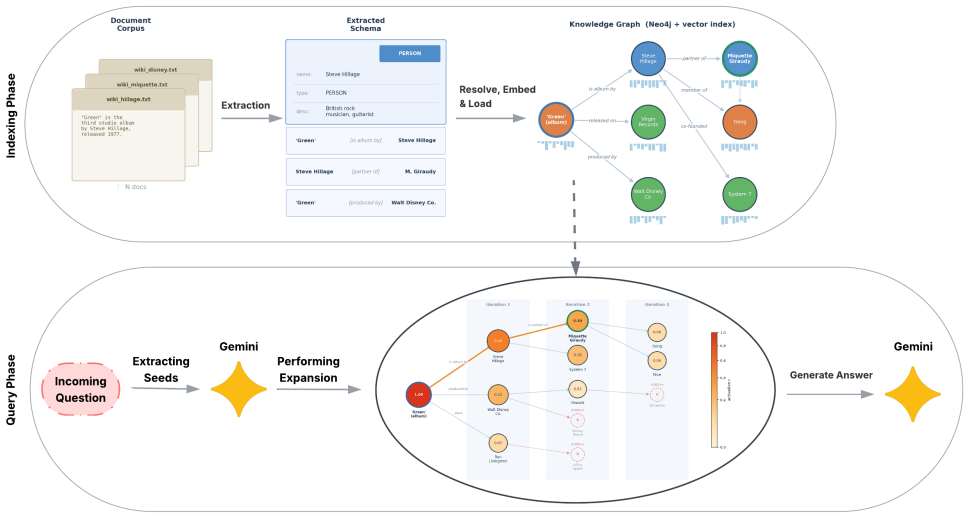
A spreading-activation method with a single semantic gate performs query-aware multi-hop retrieval over knowledge graphs as a fixed-step process inside the database.
A machine-rendered reading of the paper's core claim, the machinery that carries it, and where it could break.
Core claim
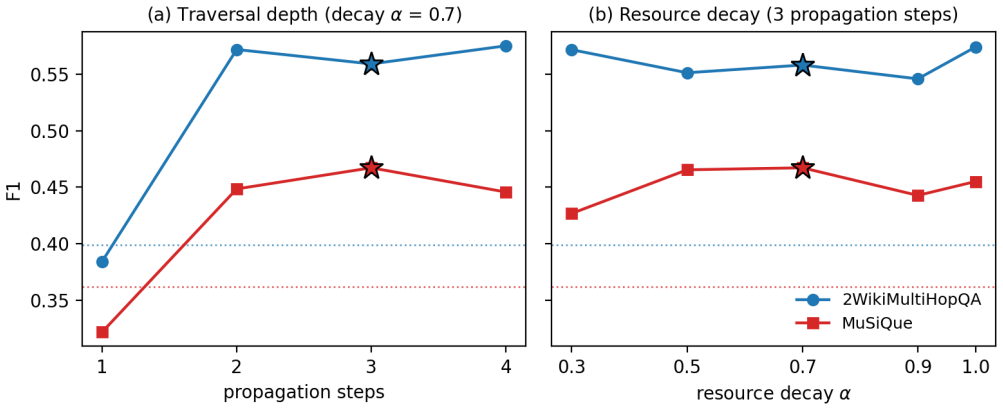
The central claim is that a spreading-activation procedure equipped with a per-step semantic gate defined by cosine similarity between entity descriptions and the question produces query-aware traversal equivalent to a flow-diffusion solver. The procedure uses a fixed number of iterations, never moves the graph out of the database, and is written as a single Cypher statement. On the MuSiQue dataset this yields exact-match scores statistically indistinguishable from the flow-diffusion baseline while exceeding a purely structural baseline by 5.3 exact-match points; an ablation that removes the gate shows simultaneous drops in answer quality and increases in latency.
What carries the argument
The semantic gate, a per-step multiplier equal to the cosine similarity between the candidate entity's description and the question, which modulates propagation strength during spreading activation.
If this is right
- Multi-hop retrieval becomes possible in a single round-trip to the graph database without materializing the full graph in application memory.
- Retrieval latency decreases by a factor between 1.5 and 4.9 compared with the ungated structural baseline.
- The same accuracy level previously obtained only by flow-diffusion solvers is reached with a fixed-iteration, database-native procedure.
- Disabling the gate simultaneously lowers answer quality and raises latency, confirming that the gate supplies both the query-awareness and the efficiency benefit.
Where Pith is reading between the lines
- The fixed-iteration design could be combined with early-stopping heuristics based on score saturation to handle graphs of varying diameter without manual tuning.
- Because the gate operates on textual descriptions, the method may transfer to graphs whose nodes carry richer metadata such as temporal or provenance attributes.
- Expressing the entire pipeline as one database query opens the possibility of pushing further post-processing steps, such as context assembly, inside the same transaction.
Load-bearing premise
Cosine similarity between stored entity descriptions and the question text supplies a reliable relevance signal at every propagation step, and a preset number of steps is enough to surface the needed entities.
What would settle it
Run the same retrieval task on the identical graph with the gate replaced by a constant weight of 1; if answer quality and latency remain unchanged or improve, the gate is not the source of the reported gains.
Figures
read the original abstract
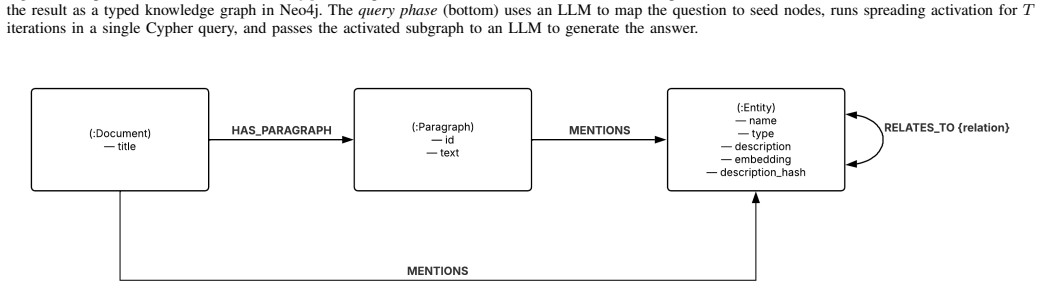
Retrieval-augmented generation built on knowledge graphs (Graph RAG) outperforms flat passage retrieval on multi-hop question answering by leveraging graph structure. In most existing systems, however, the question only sets the seed nodes; the subsequent traversal becomes "query-blind", depending solely on the graph structure. The exception is QAFD-RAG, which implements query-aware traversal via a flow-diffusion solver with combined edge re-weighting. This architecture requires loading the full graph into Python memory and an iterative solver with a variable number of iterations complicating integration with the graph database. We propose a spreading-activation method that achieves the same query-aware traversal with a single per-step semantic gate: the step weight is the cosine similarity between the candidate entity's description and the question, and the number of iterations is fixed. The whole retrieval procedure - seed mapping, propagation, top-K selection and context assembly - is expressed as a single Cypher query executed in one round-trip to Neo4j; the graph never leaves the database. On MuSiQue our method matches QAFD-RAG by exact match (32.80 vs 33.50) and outperforms the strongest purely-structural baseline in our comparison, HippoRAG, by 5.3 EM and 3.4 F1; on 2WikiMultiHopQA HippoRAG and QAFD-RAG retain an advantage due to their phrase-node architectures. An ablation with the gate disabled confirms that the gate is the source of a simultaneous F1 gain of 3.6 to 7.4 points and a retrieval-latency reduction by a factor of 1.5 to 4.9.
Editorial analysis
A structured set of objections, weighed in public.
Referee Report
Summary. The paper proposes a spreading-activation procedure for query-aware multi-hop retrieval in Graph RAG. It replaces QAFD-RAG's flow-diffusion solver with a fixed-iteration propagation whose per-step weight is the cosine similarity between each candidate entity's description and the input question; the entire pipeline (seed mapping, gated propagation, top-K selection, context assembly) is expressed as one Cypher query against Neo4j. On MuSiQue the method reports 32.80 EM (vs. 33.50 for QAFD-RAG) and outperforms HippoRAG by 5.3 EM / 3.4 F1; an ablation attributes 3.6–7.4 F1 points and a 1.5–4.9× latency reduction to the semantic gate.
Significance. If the central performance claims hold, the work supplies a practical, database-resident alternative to iterative solvers that require full-graph materialization in Python. The single-round-trip Cypher formulation and the explicit ablation of the gate are concrete strengths that could ease deployment and reproducibility.
major comments (2)
- [Abstract] Abstract: the claim that the method 'achieves the same query-aware traversal' as QAFD-RAG rests on the untested premise that cosine similarity between entity descriptions and the question reliably up-weights answer-containing paths at each hop. No per-hop similarity statistics, gold-path vs. distractor analysis, or description-quality breakdown is supplied, so the reported parity (32.80 vs 33.50 EM) could be coincidental rather than evidence of equivalent query-awareness.
- [Experimental results] Experimental results (abstract and ablation paragraph): the F1 gains attributed to the gate (3.6–7.4 points) and the latency reduction are presented without variance estimates, number of runs, or statistical significance tests, and without specifying the exact baseline configuration used for the latency comparison. These omissions make it impossible to judge whether the reported improvements are robust.
minor comments (1)
- [Abstract] The phrase 'phrase-node architectures' is used to explain the 2WikiMultiHopQA results but is not defined or referenced to prior work in the abstract or visible method description.
Simulated Author's Rebuttal
We thank the referee for the constructive feedback. We address each major comment below with clarifications and commitments to revisions that strengthen the empirical support without altering the core claims.
read point-by-point responses
-
Referee: [Abstract] Abstract: the claim that the method 'achieves the same query-aware traversal' as QAFD-RAG rests on the untested premise that cosine similarity between entity descriptions and the question reliably up-weights answer-containing paths at each hop. No per-hop similarity statistics, gold-path vs. distractor analysis, or description-quality breakdown is supplied, so the reported parity (32.80 vs 33.50 EM) could be coincidental rather than evidence of equivalent query-awareness.
Authors: The equivalence claim is grounded in the architectural analogy (query-dependent weighting at each propagation step) together with the observed performance parity and the ablation isolating the gate's contribution. We nevertheless agree that direct validation of the premise would be stronger. The revised manuscript will add a dedicated analysis subsection reporting per-hop cosine similarity distributions, gold-path versus distractor comparisons, and a brief description-quality breakdown on MuSiQue. revision: yes
-
Referee: [Experimental results] Experimental results (abstract and ablation paragraph): the F1 gains attributed to the gate (3.6–7.4 points) and the latency reduction are presented without variance estimates, number of runs, or statistical significance tests, and without specifying the exact baseline configuration used for the latency comparison. These omissions make it impossible to judge whether the reported improvements are robust.
Authors: We accept that the current reporting lacks these statistical details. The revised version will state the number of runs performed, report means with standard deviations, include paired significance tests where appropriate, and explicitly document the baseline configurations, hardware, and measurement protocol used for all latency figures. revision: yes
Circularity Check
No circularity in derivation or claims
full rationale
The paper introduces a spreading-activation procedure whose core operation (per-step multiplication by cosine similarity between entity description and query) is an explicit design choice, not derived from prior results or fitted parameters within the paper. Performance numbers are reported from direct experiments on MuSiQue and 2WikiMultiHopQA; the ablation isolating the gate is likewise an empirical measurement. No equations, uniqueness theorems, or self-citations appear that would reduce the central claim to a tautology or to the inputs by construction. The method is presented as an independent, simpler alternative to QAFD-RAG's flow-diffusion solver.
Axiom & Free-Parameter Ledger
axioms (1)
- domain assumption Cosine similarity between entity descriptions and the question is a valid measure for relevance in propagation steps.
Reference graph
Works this paper leans on
-
[1]
Retrieval-Augmented Generation for Knowledge-Intensive NLP Tasks
P. Lewiset al., “Retrieval-augmented generation for knowledge-intensive NLP tasks,” inAdvances in Neural Information Processing Systems, 2020, pp. 9459–9474. doi: 10.48550/arXiv.2005.11401
work page internal anchor Pith review Pith/arXiv arXiv doi:10.48550/arxiv.2005.11401 2020
-
[2]
Retrieval-Augmented Generation for Large Language Models: A Survey
Y . Gaoet al., “Retrieval-augmented generation for large language mod- els: A survey,”arXiv preprint, 2023. doi: 10.48550/arXiv.2312.10997
work page internal anchor Pith review Pith/arXiv arXiv doi:10.48550/arxiv.2312.10997 2023
-
[3]
Dense passage retrieval for open-domain ques- tion answering,
V . Karpukhinet al., “Dense passage retrieval for open-domain ques- tion answering,” inProc. 2020 Conf. Empirical Methods in Nat- ural Language Processing (EMNLP), 2020, pp. 6769–6781. doi: 10.18653/v1/2020.emnlp-main.550
-
[4]
From Local to Global: A Graph RAG Approach to Query-Focused Summarization
D. Edgeet al., “From local to global: A graph RAG ap- proach to query-focused summarization,”arXiv preprint, 2024. doi: 10.48550/arXiv.2404.16130
work page internal anchor Pith review Pith/arXiv arXiv doi:10.48550/arxiv.2404.16130 2024
-
[5]
LightRAG: Simple and Fast Retrieval-Augmented Generation
Z. Guo, L. Xia, Y . Yu, T. Ao, and C. Huang, “LightRAG: Sim- ple and fast retrieval-augmented generation,” inFindings of the As- sociation for Computational Linguistics: EMNLP 2025, 2025. doi: 10.48550/arXiv.2410.05779
work page internal anchor Pith review Pith/arXiv arXiv doi:10.48550/arxiv.2410.05779 2025
-
[6]
Hip- poRAG: Neurobiologically inspired long-term memory for large lan- guage models,
B. Jiménez Gutiérrez, Y . Shu, Y . Gu, M. Yasunaga, and Y . Su, “Hip- poRAG: Neurobiologically inspired long-term memory for large lan- guage models,” inAdvances in Neural Information Processing Systems,
-
[7]
doi: 10.48550/arXiv.2405.14831
-
[8]
From RAG to Memory: Non-Parametric Continual Learning for Large Language Models
B. Jiménez Gutiérrez, Y . Shu, W. Qi, S. Zhou, and Y . Su, “From RAG to memory: Non-parametric continual learning for large language models,” inProc. 42nd Int. Conf. Machine Learning (ICML), 2025. doi: 10.48550/arXiv.2502.14802
work page internal anchor Pith review Pith/arXiv arXiv doi:10.48550/arxiv.2502.14802 2025
-
[9]
PathRAG: Pruning graph-based retrieval aug- mented generation with relational paths,
B. Chenet al., “PathRAG: Pruning graph-based retrieval aug- mented generation with relational paths,”arXiv preprint, 2025. doi: 10.48550/arXiv.2502.14902
-
[10]
Query-aware flow diffusion for graph-based RAG with retrieval guarantees,
Z. Zhouet al., “Query-aware flow diffusion for graph-based RAG with retrieval guarantees,” inInt. Conf. Learning Representations (ICLR),
-
[11]
doi: 10.48550/arXiv.2605.18775
work page internal anchor Pith review Pith/arXiv arXiv doi:10.48550/arxiv.2605.18775
-
[12]
Scaling personalized web search,
G. Jeh and J. Widom, “Scaling personalized web search,” inProc. 12th Int. Conf. World Wide Web (WWW), 2003, pp. 271–279. doi: 10.1145/775152.775191
-
[13]
Liu, Kevin Lin, John Hewitt, Ashwin Paranjape, Michele Bevilacqua, Fabio Petroni, and Percy Liang
N. F. Liuet al., “Lost in the middle: How language models use long contexts,”Trans. Association for Computational Linguistics, vol. 12, pp. 157–173, 2024. doi: 10.1162/tacl_a_00638
-
[14]
Application of spreading activation techniques in informa- tion retrieval,
F. Crestani, “Application of spreading activation techniques in informa- tion retrieval,”Artificial Intelligence Review, vol. 11, no. 6, pp. 453–482,
-
[15]
doi: 10.1023/A:1006569829653
-
[16]
URLhttps://aclanthology.org/2022.tacl-1.31/
H. Trivedi, N. Balasubramanian, T. Khot, and A. Sabharwal, “MuSiQue: Multihop questions via single-hop question composition,”Trans. Asso- ciation for Computational Linguistics, vol. 10, pp. 539–554, 2022. doi: 10.1162/tacl_a_00475
-
[17]
Constructing A Multi-hop QA Dataset for Comprehensive Evaluation of Reasoning Steps
X. Ho, A.-K. Duong Nguyen, S. Sugawara, and A. Aizawa, “Construct- ing a multi-hop QA dataset for comprehensive evaluation of reasoning steps,” inProc. 28th Int. Conf. Computational Linguistics (COLING), 2020, pp. 6609–6625. doi: 10.18653/v1/2020.coling-main.580. APPENDIX: FULLTEXT OF THECYPHERQUERY The full query, which implements the procedure of Sectio...
-
[18]
YIELD node, score 13RETURNnode.nameASseed_name, scoreASseed_score 14} 15 16WITHseed_name,max(seed_score)ASseed_score 17WITHcollect({name: seed_name, score: seed_score})ASraw, 18max(seed_score)ASmx 19WITH[sINraw | s.name]ASseed_names, 20apoc.map.fromPairs([sINraw | [s.name, s.score / mx]])ASresource_map 21 22// === Fragment 2: propagation block (repeated T...
discussion (0)
Sign in with ORCID, Apple, or X to comment. Anyone can read and Pith papers without signing in.