Mesh Inference: A Formal Model of Collective Inference Without a Center
Pith reviewed 2026-06-26 18:09 UTC · model grok-4.3
The pith
Mesh inference recovers the centralized optimum from private observations alone via one admission policy.
A machine-rendered reading of the paper's core claim, the machinery that carries it, and where it could break.
Core claim
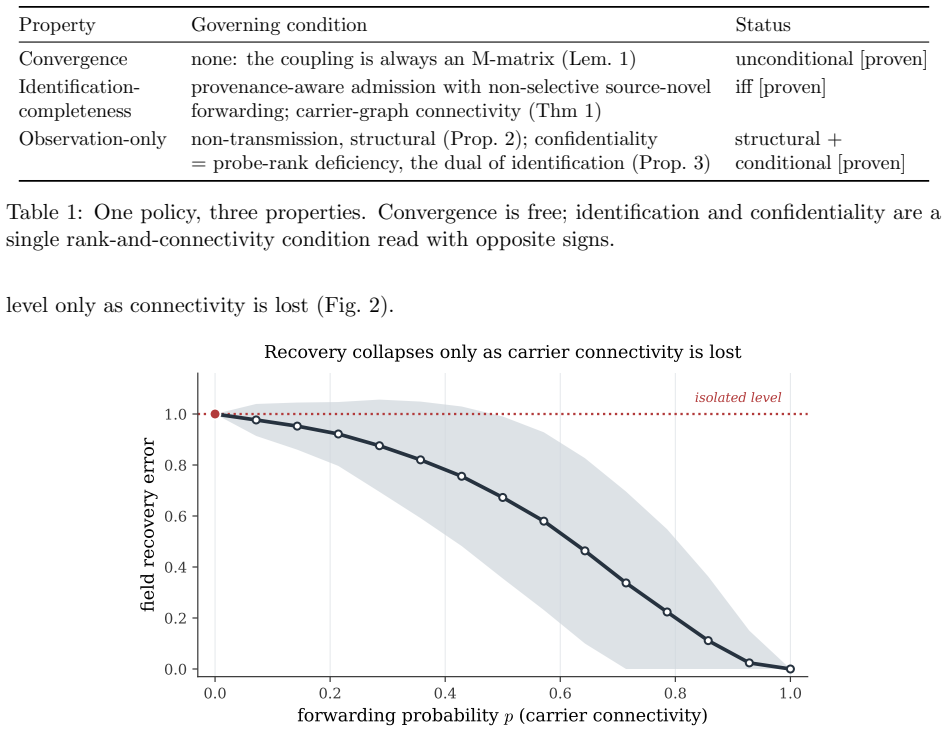
Mesh inference is governed by one admission/emission policy that ensures convergence to a unique answer via M-matrix coupling for any admission, derives the centralized optimum exactly when contributing views are carrier-connected, and maintains observation-only exchange with confidentiality as the dual of identification. In the linear-Gaussian regime answers equal the centralized optimum at O(diam squared) latency.
What carries the argument
The admission/emission policy that selects which typed observations agents exchange, inducing M-matrix coupling in the locally relaxed free-energy model.
Load-bearing premise
The coupling induced by any admission/emission policy is always an M-matrix.
What would settle it
An admission policy for which the induced coupling matrix is not an M-matrix, so that solutions are non-unique or fail to converge.
Figures


read the original abstract
We present a formal model of mesh inference: how a population of independent agents, each holding private state and exchanging only admitted, typed observations, derives a conclusion none of them holds alone, with no central coordinator and no agent exposed. No agent shares weights, gradients, or hidden state, and the agents may span different teams, networks, and organizations. Motivated by the observation that asking a model is energy-minimizing inference, we model the mesh as a coupled free energy that each agent relaxes locally. We show that a single admission/emission policy governs three properties. First, mesh inference converges to a unique answer for any admission, symmetric or not, because the coupling is always an M-matrix. Second, it is identification-complete: it derives the centralized optimum exactly when the contributing views are carrier-connected. Third, it is observation-only: no node transmits its internals, and confidentiality is the dual of identification. Content-addressed lineage is the only global side-channel. In the linear-Gaussian regime every derived answer is determined, hence equal to the centralized optimum, at O(diam^2) latency, the measured price of removing the center. One such derivation is one turn of a center-free learning loop, which we formalize as architecture rather than prove. The open problem we state is when asking improves the collective rather than corrupting it: whether the non-linear closure derives an upgraded answer or a confident error. To our knowledge, this is the first formal characterization of when a center-free, observation-only mesh recovers the centralized optimum.
Editorial analysis
A structured set of objections, weighed in public.
Referee Report
Summary. The manuscript proposes a formal model of 'mesh inference' for collective inference by independent agents exchanging only admitted observations without a central coordinator. Agents relax a coupled free energy locally. A single admission/emission policy is shown to ensure: convergence to a unique answer via M-matrix coupling for any policy; identification-completeness recovering the centralized optimum when views are carrier-connected; and observation-only operation where confidentiality is dual to identification. In the linear-Gaussian regime, answers match the centralized optimum at O(diam^2) latency. The work also describes this as one turn of a center-free learning loop and identifies an open problem on non-linear cases.
Significance. If the derivations hold, particularly the M-matrix property and identification-completeness, the paper offers a significant formal framework for center-free inference with privacy guarantees. It provides the first characterization of conditions under which decentralized meshes recover centralized optima using only observations. The linear-Gaussian analysis with latency bound is a concrete contribution. The model is parameter-free and axiomatically grounded, which strengthens its applicability to distributed systems and secure multi-party computation. The open problem on collective improvement vs. corruption is a valuable direction for future research.
major comments (1)
- [Abstract, paragraph on convergence properties] Abstract, paragraph on convergence properties: The assertion that the coupling is always an M-matrix for arbitrary admission/emission policies underpins the uniqueness and convergence claims. The manuscript should include an explicit derivation or matrix construction from the policy rules verifying non-positive off-diagonals and the M-matrix conditions (such as positive principal minors) for all policies in the class, including asymmetric ones. Without this, the load-bearing step for the central claims remains unverified.
minor comments (1)
- The term 'carrier-connected' is used in the identification-completeness claim but would benefit from a precise definition in the main text or a preliminary section.
Simulated Author's Rebuttal
We thank the referee for their careful review and for identifying the need to strengthen the presentation of the M-matrix argument. We address the single major comment below.
read point-by-point responses
-
Referee: The assertion that the coupling is always an M-matrix for arbitrary admission/emission policies underpins the uniqueness and convergence claims. The manuscript should include an explicit derivation or matrix construction from the policy rules verifying non-positive off-diagonals and the M-matrix conditions (such as positive principal minors) for all policies in the class, including asymmetric ones. Without this, the load-bearing step for the central claims remains unverified.
Authors: We agree that an explicit, self-contained derivation of the M-matrix property from the admission/emission rules is required to make the convergence argument fully transparent. In the revised manuscript we will insert a new subsection that (i) constructs the coupling matrix directly from the policy definitions, (ii) verifies that off-diagonal entries are non-positive for arbitrary (including asymmetric) policies, and (iii) confirms the remaining M-matrix conditions, such as positive principal minors, hold for the entire policy class. This addition will be placed immediately before the convergence theorem so that the load-bearing step is no longer implicit. revision: yes
Circularity Check
No significant circularity; central claims rest on asserted formal properties without reduction to inputs by construction.
full rationale
The provided abstract and excerpts present mesh inference as a formal model where a single admission/emission policy is claimed to ensure the coupling is always an M-matrix (yielding uniqueness and convergence), identification-completeness when carrier-connected, and observation-only confidentiality. No equations, self-citations, or parameter fits are quoted that reduce any prediction or uniqueness result to the inputs by definition. The linear-Gaussian regime equality to the centralized optimum is stated as following from the model at O(diam^2) latency, without evidence of fitted inputs renamed as predictions or ansatzes smuggled via self-citation. The derivation chain is therefore self-contained as a mathematical characterization.
Axiom & Free-Parameter Ledger
axioms (2)
- domain assumption The coupling is always an M-matrix for any admission policy
- domain assumption Views are carrier-connected for identification-completeness
invented entities (2)
-
mesh inference
no independent evidence
-
coupled free energy
no independent evidence
Forward citations
Cited by 1 Pith paper
-
On the Necessity of a Liquid Substrate for Mesh Intelligence
Continuous-time liquid networks are necessary for optimal estimation under irregular exogenous observations and fixed weights in mesh intelligence.
Reference graph
Works this paper leans on
-
[1]
McMahan et al
B. McMahan et al. Communication-efficient learning of deep networks from decentralized data. AISTATS, 2017
2017
-
[2]
Lowe et al
R. Lowe et al. Multi-agent actor-critic for mixed cooperative-competitive environments. NeurIPS, 2017
2017
-
[3]
R. P. N. Rao, D. H. Ballard. Predictive coding in the visual cortex. Nature Neuroscience, 1999
1999
-
[4]
K. Friston. The free-energy principle: a unified brain theory? Nature Reviews Neuroscience, 2010
2010
-
[5]
Monderer, L
D. Monderer, L. S. Shapley. Potential games. Games and Economic Behavior, 1996
1996
-
[6]
Olfati-Saber, R
R. Olfati-Saber, R. M. Murray. Consensus problems in networks of agents. IEEE TAC, 2004
2004
-
[7]
Kuramoto
Y. Kuramoto. Chemical Oscillations, Waves, and Turbulence. Springer, 1984
1984
-
[8]
J. A. Acebr´ on et al. The Kuramoto model. Reviews of Modern Physics, 2005
2005
-
[9]
Ramsauer et al
H. Ramsauer et al. Hopfield networks is all you need. ICLR, 2021
2021
-
[10]
H. Xu. Mesh Memory Protocol: Semantic Infrastructure for Multi-Agent LLM Systems. arXiv:2604.19540, 2026
Pith/arXiv arXiv 2026
-
[11]
H. Xu. Symbolic-Vector Attention Fusion for Collective Intelligence. arXiv:2604.03955, 2026
Pith/arXiv arXiv 2026
-
[12]
H. Xu. Mesh Cognition: a distributed-intelligence architectural pattern with per-node sovereignty.https://meshcognition.org, 2026
2026
-
[13]
Lewis, E
P. Lewis, E. Perez, A. Piktus, et al. Retrieval-augmented generation for knowledge-intensive NLP tasks. NeurIPS, 2020. 20
2020
-
[14]
X. Lian, C. Zhang, H. Zhang, C.-J. Hsieh, W. Zhang, J. Liu. Can decentralized algorithms outperform centralized algorithms? A case study for decentralized parallel SGD. NeurIPS, 2017
2017
-
[15]
S. Kar, J. M. F. Moura. Consensus + innovations distributed inference over networks. IEEE Signal Processing Magazine, 30(3):99–109, 2013
2013
-
[16]
D. I. Shuman, S. K. Narang, P. Frossard, A. Ortega, P. Vandergheynst. The emerging field of signal processing on graphs. IEEE Signal Processing Magazine, 30(3):83–98, 2013
2013
-
[17]
Krotov, J
D. Krotov, J. J. Hopfield. Dense associative memory for pattern recognition. NeurIPS, 2016
2016
-
[18]
D. E. Berlyne. Novelty, complexity, and hedonic value. Perception & Psychophysics, 8(5):279– 286, 1970
1970
-
[19]
D. P. Bertsekas, J. N. Tsitsiklis. Parallel and Distributed Computation: Numerical Methods. Prentice-Hall, 1989
1989
-
[20]
S. Bai, J. Z. Kolter, V. Koltun. Deep equilibrium models. NeurIPS, 2019
2019
-
[21]
Scellier, Y
B. Scellier, Y. Bengio. Equilibrium propagation: bridging the gap between energy-based models and backpropagation. Frontiers in Computational Neuroscience, 11:24, 2017
2017
-
[22]
V. Casamayor Pujol, B. Sedlak, T. Salvatori, K. Friston, S. Dustdar. Distributed Intelligence in the Computing Continuum with Active Inference. arXiv:2505.24618, 2025
arXiv 2025
- [23]
-
[24]
K. J. Friston, M. J. D. Ramstead, A. B. Kiefer, et al. Designing ecosystems of intelligence from first principles. Collective Intelligence, 3(1), 2024 (arXiv:2212.01354)
arXiv 2024
-
[25]
Kaufmann, P
R. Kaufmann, P. Gupta, J. Taylor. An active inference model of collective intelligence. Entropy, 23(7):830, 2021
2021
- [26]
-
[27]
Y. Li, A. Parashar, E. Zhou, C. Fan. Curiosity is Knowledge: Self-Consistent Learning and No-Regret Optimization with Active Inference. arXiv:2602.06029, 2026
arXiv 2026
-
[28]
J. Ruiz-Serra, P. Sweeney, M. S. Harr´ e. Factorised Active Inference for Strategic Multi-Agent Interactions. Proc. AAMAS, 2025 (arXiv:2411.07362)
arXiv 2025
-
[29]
T. Gao, K. Yang, Y. Li. FD-RAG: Federated Dual-System Retrieval-Augmented Generation. arXiv:2605.27432, 2026
Pith/arXiv arXiv 2026
-
[30]
P. Addison et al. C-FedRAG: A Confidential Federated Retrieval-Augmented Generation Sys- tem. arXiv:2412.13163, 2024
arXiv 2024
-
[31]
A. Chakraborty, C. Dahal, V. Gupta. Federated Retrieval-Augmented Generation: A System- atic Mapping Study. arXiv:2505.18906, 2025
arXiv 2025
-
[32]
B. Wang, M. Zecchin, O. Simeone. Distributed Dynamic Associative Memory via Online Con- vex Optimization. arXiv:2511.23347, 2025. 21
arXiv 2025
-
[33]
A. Alessandrelli, F. Durante, A. Ladiana, A. Lepre. A Federated Many-to-One Hopfield Model for Associative Neural Networks. arXiv:2603.19902, 2026
arXiv 2026
-
[34]
A. Ehtesham, A. Singh, G. K. Gupta, S. Kumar. A survey of agent interoperability protocols: MCP, ACP, A2A, and ANP. arXiv:2505.02279, 2025
arXiv 2025
-
[35]
D. Yuan, F. Lyu, Y. Yuan, W. Zhang, et al. Beyond Message Passing: A Semantic View of Agent Communication Protocols. arXiv:2604.02369, 2026
Pith/arXiv arXiv 2026
-
[36]
A. Y. Halevy. Answering queries using views: a survey. The VLDB Journal, 10(4):270–294, 2001
2001
-
[37]
Lenzerini
M. Lenzerini. Data integration: a theoretical perspective. Proc. PODS, 233–246, 2002
2002
-
[38]
D. M. Malioutov, J. K. Johnson, A. S. Willsky. Walk-sums and belief propagation in Gaussian graphical models. JMLR, 7:2031–2064, 2006
2031
-
[39]
M. Milakov, N. Gimelshein. Online normalizer calculation for softmax. arXiv:1805.02867, 2018
Pith/arXiv arXiv 2018
-
[40]
H. Liu, M. Zaharia, P. Abbeel. Ring Attention with blockwise transformers for near-infinite context. arXiv:2310.01889, 2023
Pith/arXiv arXiv 2023
-
[41]
Bonawitz, V
K. Bonawitz, V. Ivanov, B. Kreuter, A. Marcedone, H. B. McMahan, S. Patel, D. Ramage, A. Segal, K. Seth. Practical secure aggregation for privacy-preserving machine learning. ACM CCS, 2017
2017
-
[42]
Frontier: an enterprise platform for building, deploying, and managing AI agents
OpenAI. Frontier: an enterprise platform for building, deploying, and managing AI agents. Launched February 5, 2026.https://openai.com/business/frontier/
2026
-
[43]
Agent Framework 1.0: multi-agent orchestration across .NET and Python
Microsoft. Agent Framework 1.0: multi-agent orchestration across .NET and Python. April 2026.https://devblogs.microsoft.com/agent-framework/ microsoft-agent-framework-version-1-0/
2026
-
[44]
Enterprise Vector Store: multimodal embeddings and agentic retrieval
Teradata. Enterprise Vector Store: multimodal embeddings and agentic retrieval. Generally available April 2026.https://www.teradata.com/press-releases/2026/ teradata-enables-ai-agents
2026
-
[45]
The Inference Mesh: Silicon-Agnostic AI Workload Orchestration.https://www
Kamiwaza. The Inference Mesh: Silicon-Agnostic AI Workload Orchestration.https://www. kamiwaza.ai/the-inference-mesh. Accessed June 17, 2026. 22
2026
discussion (0)
Sign in with ORCID, Apple, or X to comment. Anyone can read and Pith papers without signing in.