Compact Spin-Charge Separated Neural Quantum States for Valence-Bond States
Pith reviewed 2026-06-27 03:00 UTC · model grok-4.3
The pith
A solvable-point-guided neural architecture represents valence-bond states with far fewer parameters than standard networks by separating spin and charge.
A machine-rendered reading of the paper's core claim, the machinery that carries it, and where it could break.
Core claim
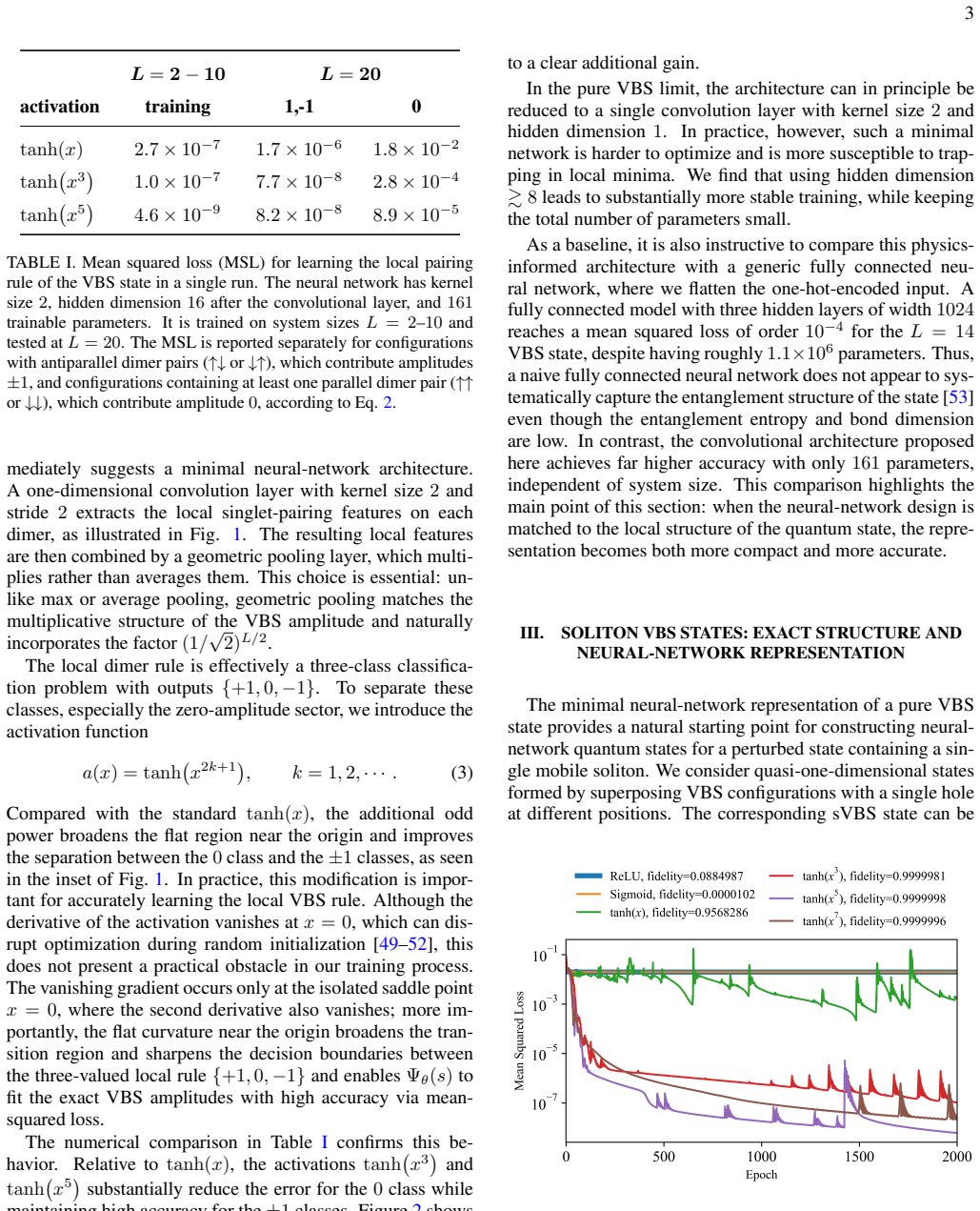
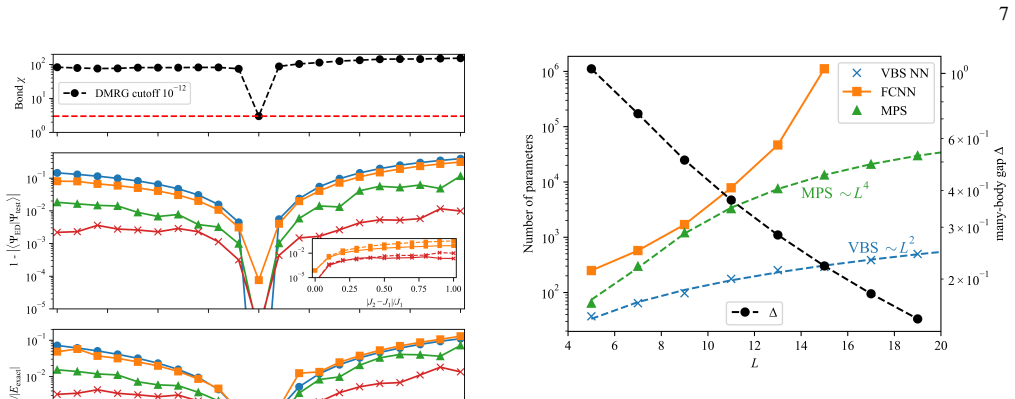
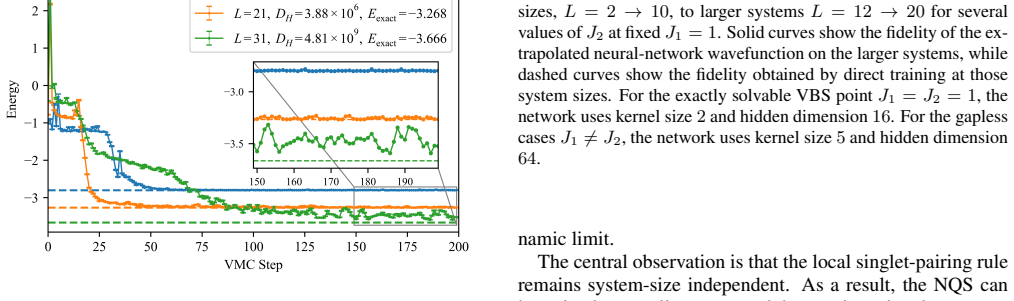
By guiding architecture design from the exact ground state of a t-J-like model, the four designs enable neural quantum states to match the solvable sVBS state at high fidelity with reduced parameters. The spin-sector local rule transfers across system sizes, accuracy improves systematically when kernel size and hidden dimension are enlarged away from the solvable point, and parameter count scales as L squared in the gapless regime.
What carries the argument
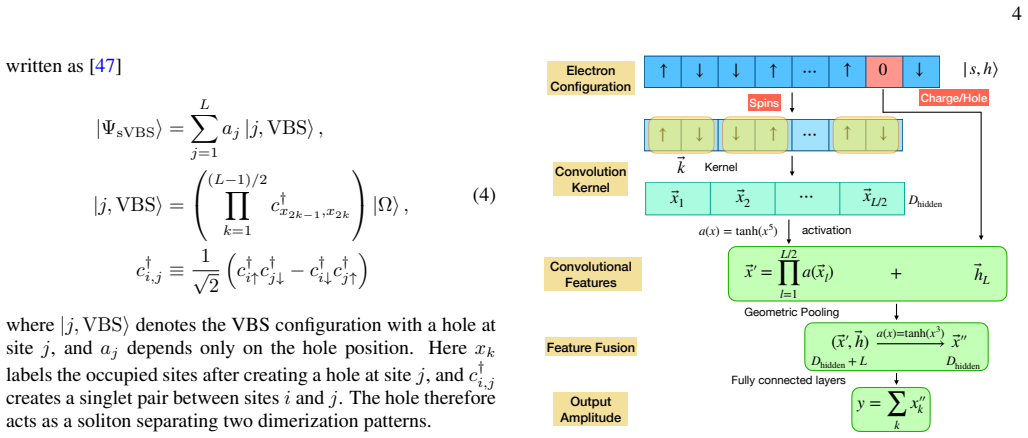
The solvable-point-guided design consisting of stride-matched local-rule convolution, geometric pooling, sign-resolving tanh(x to the 2k+1) activation, and explicit spin-hole sector separation.
If this is right
- The architecture reaches high fidelity for the exact sVBS state with substantially fewer parameters than fully connected, convolutional, and transformer baselines under the same setup.
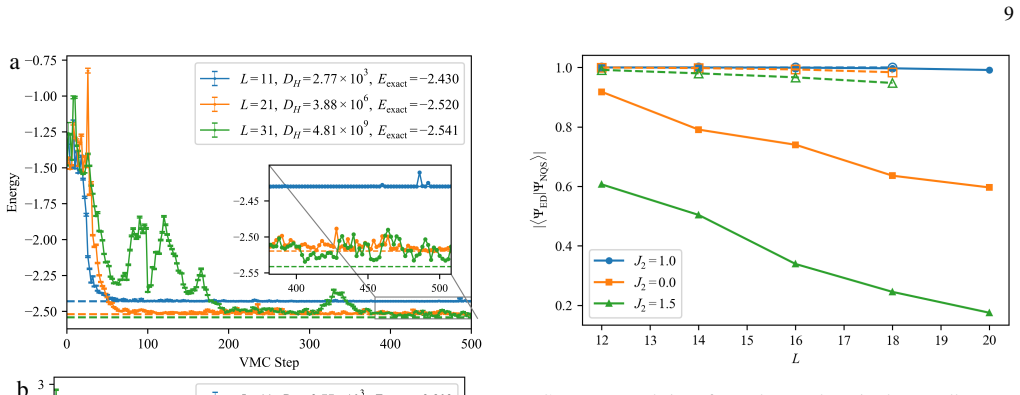
- The learned local rule in the spin sector transfers from small to larger systems without retraining.
- Increasing kernel size and hidden dimension systematically improves accuracy away from the solvable point.
- The model exhibits approximately L squared parameter scaling in the gapless regime, compared with approximately L to the fourth for matrix-product states.
Where Pith is reading between the lines
- The same design principle may apply to two-dimensional t-J models by inferring analogous local rules from small solvable clusters.
- Explicit spin-charge separation could reduce parameter counts in other models with constrained Hilbert spaces and sign structure.
- The transfer property suggests the architecture might stabilize representations when doping is increased beyond a single hole.
Load-bearing premise
The four physics-motivated designs remain sufficient when the model is enlarged only in kernel size and hidden dimension to reach the non-exact regime.
What would settle it
A direct computation showing that fidelity stops improving or the learned local rule fails to transfer when kernel size and hidden dimension are increased for systems larger than those used in training.
Figures

read the original abstract
Neural-network quantum states (NQS) provide a flexible nonlinear representation of quantum many-body wavefunctions, but their efficiency depends sensitively on whether the architecture reflects the sign structure and constrained Hilbert space of the target state. In this work, we propose a solvable-point-guided strategy: design the architecture at an exactly solvable point where the correct local rules can be read off, then refine to the non-exact regime by enlarging only the kernel size and hidden dimension. The strategy is built from four physics-motivated designs: a stride-matched local-rule convolution, geometric pooling, a sign-resolving $\tanh(x^{2k+1})$ activation, and explicit spin-hole sector separation. We test this approach on quasi-one-dimensional valence-bond-solid (VBS) states and their doped soliton variants (sVBS), the exact ground states of a $t$-$J$-like model with a single mobile hole. In finite-size benchmarks, this architecture reaches high fidelity for the exact sVBS state with substantially fewer parameters than generic fully connected, convolutional, and transformer baselines tested under the same setup. For the spin sector, the learned local rule transfers from small to larger systems without retraining. Away from the solvable point, increasing kernel size and hidden dimension systematically improves accuracy, and the model shows approximately $L^2$ parameter scaling in the gapless regime for system size $L$, compared with approximately $L^4$ for matrix-product states in the same regime. Our work establishes a recipe for compact NQS in sign-structured, constrained Hilbert spaces and paves the pathway to physics-informed architectures for the broader $t$-$J$ and Hubbard families.
Editorial analysis
A structured set of objections, weighed in public.
Referee Report
Summary. The manuscript proposes a solvable-point-guided strategy for constructing compact neural quantum states (NQS) for quasi-1D valence-bond-solid (VBS) states and their doped soliton variants (sVBS), which are exact ground states of a t-J-like model. The architecture is designed at the solvable point using four fixed components (stride-matched local-rule convolution, geometric pooling, tanh(x^{2k+1}) activation, and explicit spin-hole separation) and then refined for the non-exact regime solely by enlarging kernel size and hidden dimension. Finite-size benchmarks show high fidelity for the exact sVBS with substantially fewer parameters than fully connected, convolutional, and transformer baselines; the spin-sector local rule transfers across system sizes without retraining; and the model exhibits approximately L² parameter scaling (versus L⁴ for MPS) with systematic accuracy gains away from the solvable point.
Significance. If the reported fidelities, parameter counts, and scaling hold under the stated conditions, the work supplies a concrete recipe for physics-informed NQS that respect sign structure and Hilbert-space constraints, with explicit credit due for the solvable-point design principle, the demonstrated transfer of the learned local rule, and the favorable scaling relative to MPS. This could extend to broader t-J and Hubbard families.
major comments (2)
- [§4] §4 (finite-size benchmarks for exact sVBS): the claim that the four fixed designs suffice when the model is enlarged only in kernel size and hidden dimension to reach the non-exact regime is load-bearing for the central strategy, yet the manuscript provides no ablation that tests whether altering the activation, pooling, or separation would be required once doping or interactions move away from the solvable point.
- [§5] §5 (transfer and non-exact results): the statement that the spin-sector local rule transfers from small to larger systems without retraining is demonstrated only at the exact solvable point; no corresponding benchmarks are shown for the doped or interacting regime, leaving the sufficiency assumption untested for the broader claim.
minor comments (1)
- [Abstract] The abstract would be strengthened by including at least one concrete fidelity value, system size, and baseline comparison to allow immediate evaluation of the performance claims.
Simulated Author's Rebuttal
We thank the referee for the positive assessment of our work's significance and for the constructive comments. We address each major point below, proposing targeted revisions to clarify the manuscript's claims without altering its core results.
read point-by-point responses
-
Referee: [§4] §4 (finite-size benchmarks for exact sVBS): the claim that the four fixed designs suffice when the model is enlarged only in kernel size and hidden dimension to reach the non-exact regime is load-bearing for the central strategy, yet the manuscript provides no ablation that tests whether altering the activation, pooling, or separation would be required once doping or interactions move away from the solvable point.
Authors: The four components are derived directly from the exact solvable point (Sections 2–3), where they encode the known local rules and Hilbert-space constraints; the strategy is to keep them fixed while scaling capacity for the non-exact regime. The reported benchmarks show systematic accuracy gains under this protocol, consistent with sufficiency. We agree an explicit ablation would add value but lies beyond the present scope. In the revision we will add a clarifying paragraph in §4 explaining the solvable-point motivation for fixing the designs and noting that comprehensive ablations remain future work. revision: partial
-
Referee: [§5] §5 (transfer and non-exact results): the statement that the spin-sector local rule transfers from small to larger systems without retraining is demonstrated only at the exact solvable point; no corresponding benchmarks are shown for the doped or interacting regime, leaving the sufficiency assumption untested for the broader claim.
Authors: Transfer without retraining is shown explicitly at the exact solvable point in §5. The spin-hole separation is introduced precisely to preserve this property when doping is introduced, as the spin sector continues to obey the same local rules. While direct transfer benchmarks in the doped/interacting regime are not provided, the architecture and the observed capacity scaling away from the solvable point support the design. We will revise §5 to distinguish the demonstrated exact-point transfer from the expected behavior in the broader regime and to outline how the separation enables future tests. revision: partial
Circularity Check
No significant circularity; derivation remains self-contained against external benchmarks
full rationale
The paper motivates its four designs (stride-matched convolution, geometric pooling, tanh(x^{2k+1}), spin-hole separation) from an external solvable point and then scales only kernel size and hidden dimension; finite-size fidelity claims are benchmarked against independent generic architectures under identical conditions, and the spin-sector transfer is reported as an empirical observation rather than a definitional identity. No equation or claim reduces a reported prediction to a fitted input by construction, and no load-bearing step relies on self-citation chains or ansatzes smuggled from prior author work. The central claim therefore retains independent content relative to its inputs.
Axiom & Free-Parameter Ledger
Reference graph
Works this paper leans on
-
[1]
Away from the solvable point, the architecture remains systematically improvable by in- 7 FIG
that are accessible to ED. Away from the solvable point, the architecture remains systematically improvable by in- 7 FIG. 4. Comparison of ground states as a function ofJ 2 ∈[0,2] at fixedt 1 = 1,t 2 = 0.5, andJ 1 = 1for system sizeL= 13. The top, middle, and bottom panels show the MPS bond dimension χ, the neural-network fidelity, and the relative energy...
-
[2]
S. R. White, Density matrix formulation for quantum renormal- ization groups, Phys. Rev. Lett.69, 2863 (1992)
1992
-
[3]
Schollwock, The density-matrix renormalization group in the age of matrix product states, Ann
U. Schollwock, The density-matrix renormalization group in the age of matrix product states, Ann. Phys.326, 96 (2011). 12
2011
-
[4]
Perez-Garcia, F
D. Perez-Garcia, F. Verstraete, M. M. Wolf, and J. I. Cirac, Ma- trix product state representations, Quantum Inf. Comput.7, 401 (2007)
2007
-
[5]
J. I. Cirac and F. Verstraete, Renormalization and tensor product states in spin chains and lattices, J. Phys. A: Math. Theor.42, 504004 (2009)
2009
-
[6]
Or ´us, A practical introduction to tensor networks: Matrix product states and projected entangled pair states, J
R. Or ´us, A practical introduction to tensor networks: Matrix product states and projected entangled pair states, J. Phys. A: Math. Theor.47, 424004 (2014)
2014
-
[7]
Tagliacozzo, T
L. Tagliacozzo, T. R. de Oliveira, S. Iblisdir, and J. I. La- torre, Scaling of entanglement support for matrix product states, Phys. Rev. B78, 024410 (2008)
2008
-
[8]
Pollmann, S
F. Pollmann, S. Mukerjee, A. M. Turner, and J. E. Moore, The- ory of finite-entanglement scaling at one-dimensional quantum critical points, Phys. Rev. Lett.102, 255701 (2009)
2009
-
[9]
Vidal, J
G. Vidal, J. I. Latorre, E. Rico, and A. Kitaev, Entanglement in quantum critical phenomena, Phys. Rev. Lett.90, 227902 (2003)
2003
-
[10]
A.-K. Wu, B. Kloss, W. Krinitsin, M. T. Fishman, J. H. Pixley, and E. M. Stoudenmire, Disentangling interacting systems with fermionic gaussian circuits: Application to quantum impurity models, Phys. Rev. B111, 035119 (2025)
2025
-
[11]
Calabrese and J
P. Calabrese and J. Cardy, Entanglement entropy and quantum field theory, J. Stat. Mech.: Theory Exp.2004(06), P06002
2004
-
[12]
H. Barghathi and A. Del Maestro, Detection of a R ´enyi In- dex Dependent Transition in Entanglement Entropy Scaling, arXiv:2512.24533 (2026)
arXiv 2026
-
[13]
E. M. Stoudenmire and S. R. White, Studying two-dimensional systems with the density matrix renormalization group, Annu. Rev. Condens. Matter Phys.3, 111 (2012)
2012
-
[14]
Luo and B
D. Luo and B. K. Clark, Backflow transformations via neural networks for quantum many-body wave functions, Phys. Rev. Lett.122, 226401 (2019)
2019
-
[15]
K. Inui, Y . Kato, and Y . Motome, Determinant-free fermionic wave function using feed-forward neural networks, Phys. Rev. Research3, 043126 (2021)
2021
-
[16]
C. Roth, A. Chen, A. Sengupta, and A. Georges, Superconduc- tivity in the two-dimensional hubbard model revealed by neural quantum states, arXiv:2511.07566 (2025)
arXiv 2025
-
[17]
F. Verstraete and J. I. Cirac, Renormalization algorithms for quantum-many body systems in two and higher dimensions, arXiv:cond-mat/0407066 (2004)
Pith/arXiv arXiv 2004
-
[18]
Carrasquilla and R
J. Carrasquilla and R. G. Melko, Machine learning phases of matter, Nat. Phys.13, 431 (2017)
2017
-
[19]
Mehta, M
P. Mehta, M. Bukov, C.-H. Wang, A. G. R. Day, C. Richardson, C. K. Fisher, and D. J. Schwab, A high-bias, low-variance in- troduction to machine learning for physicists, Phys. Rep.810, 1 (2019)
2019
-
[20]
Carleo, I
G. Carleo, I. Cirac, K. Cranmer, L. Daudet, M. Schuld, N. Tishby, L. V ogt-Maranto, and L. Zdeborov´a, Machine learn- ing and the physical sciences, Rev. Mod. Phys.91, 045002 (2019)
2019
-
[21]
A.-K. Wu, L. Primeau, J. Zhang, K. Sun, Y . Zhang, and S.-Z. Lin, Modeling quantum geometry for fractional chern insulators with unsupervised learning, npj Comput. Mater. 10.1038/s41524-026-02155-1 (2026)
-
[22]
Carleo and M
G. Carleo and M. Troyer, Solving the quantum many-body problem with artificial neural networks, Science355, 602 (2017)
2017
-
[23]
Gao and L.-M
X. Gao and L.-M. Duan, Efficient representation of quantum many-body states with deep neural networks, Nat. Commun.8, 662 (2017)
2017
-
[24]
D.-L. Deng, X. Li, and S. Das Sarma, Quantum entanglement in neural network states, Phys. Rev. X7, 021021 (2017)
2017
-
[25]
Nomura, A
Y . Nomura, A. S. Darmawan, Y . Yamaji, and M. Imada, Re- stricted boltzmann machine learning for solving strongly corre- lated quantum systems, Phys. Rev. B96, 205152 (2017)
2017
-
[26]
Glasser, N
I. Glasser, N. Pancotti, M. August, I. D. Rodr ´ıguez, and J. I. Cirac, Neural-network quantum states, string-bond states, and chiral topological states, Phys. Rev. X8, 011006 (2018)
2018
-
[27]
Sharir, B
O. Sharir, B. Ovadia, G. Neuberg, I. Falkovich, O. Kiss, N. Nevo, Y . Lavy, J. Vardi, T. Shkolnik, M. Cohen, M. Geiger, N. Goldshlager, Y . Dagan, G. Carleo, and A. Shashua, Deep autoregressive models for the efficient variational simulation of many-body quantum systems, Phys. Rev. Lett.124, 020503 (2020)
2020
-
[28]
Hibat-Allah, M
M. Hibat-Allah, M. Ganahl, R. Melko, G. Carleo, and K. Choo, Recurrent neural network wave functions, Phys. Rev. Research 2, 023358 (2020)
2020
-
[29]
Chen and M
A. Chen and M. Heyl, Empowering deep neural quantum states through efficient optimization, Nat. Phys.20, 1476 (2024)
2024
-
[30]
Rende, L
R. Rende, L. L. Viteritti, L. Bardone, F. Becca, and S. Goldt, A simple linear algebra identity to optimize large-scale neural network quantum states, Commun. Phys.7, 260 (2024)
2024
-
[31]
A. Hul, M. Medvidovi ´c, and J. Carrasquilla, Neural net- work quantum states in the grand canonical ensemble, arXiv:2605.07779 (2026)
Pith/arXiv arXiv 2026
-
[32]
Hermann, Z
J. Hermann, Z. Sch ¨atzle, and F. No´e, Deep-neural-network so- lution of the electronic schr ¨odinger equation, Nat. Chem.12, 891 (2020)
2020
-
[33]
D. Pfau, J. S. Spencer, A. G. d. G. Matthews, and W. M. C. Foulkes, Ab-initio solution of the many-electron schr ¨odinger equation with deep neural networks, Phys. Rev. Research2, 033429 (2020)
2020
-
[34]
Lange, A
H. Lange, A. B ¨ohler, C. Roth, and A. Bohrdt, Simulating the two-dimensionalt−jmodel at finite doping with neural quan- tum states, Phys. Rev. Lett.135, 136504 (2025)
2025
-
[35]
Machaczek, L
M. Machaczek, L. Pollet, and K. Liu, Neural quantum state study of fracton models, SciPost Phys.18, 112 (2025)
2025
-
[36]
Y . Gu, Z. Han, W. Li, Z. Xiao, T. Xiang, M. Qin, L. Wang, and D. Lv, Pareto frontier of neural quantum states: Scalable, af- fordable, and accurate convolutional backflow for strongly cor- related lattice fermions, arXiv:2604.25775 (2026)
Pith/arXiv arXiv 2026
-
[37]
R. P. Nutakki, A. Shokry, and F. Vicentini, Design principles of deep translationally symmetric neural quantum states for frus- trated magnets, Phys. Rev. Res.7, 043099 (2025)
2025
-
[38]
K. Choo, G. Carleo, N. Regnault, and T. Neupert, Symme- tries and many-body excited states with neural-network quan- tum states, Phys. Rev. Lett.121, 167204 (2018)
2018
-
[39]
Nomura, Helping restricted boltzmann machines with quantum-state representation by restoring symmetry, J
Y . Nomura, Helping restricted boltzmann machines with quantum-state representation by restoring symmetry, J. Phys.: Condens. Matter33, 174003 (2021)
2021
-
[40]
J. R. McClean, S. Boixo, V . N. Smelyanskiy, R. Babbush, and H. Neven, Barren plateaus in quantum neural network training landscapes, Nat. Commun.9, 4812 (2018)
2018
-
[41]
Cerezo, A
M. Cerezo, A. Sone, T. V olkoff, L. Cincio, and P. J. Coles, Cost function dependent barren plateaus in shallow parametrized quantum circuits, Nat. Commun.12, 1791 (2021)
2021
-
[42]
Larocca, S
M. Larocca, S. Thanasilp, S. Wang, K. Sharma, J. Biamonte, P. J. Coles, L. Cincio, J. R. McClean,et al., Barren plateaus in variational quantum computing, Nat. Rev. Phys.7, 174 (2025)
2025
-
[43]
J.-Y . Chen, S. Cheng, H. Xie, L. Wang, and T. Xiang, Equiv- alence of restricted boltzmann machines and tensor network states, Phys. Rev. B97, 085104 (2018)
2018
-
[44]
Luo and J
D. Luo and J. Halverson, Infinite neural network quantum states: Entanglement and training dynamics, Mach. Learn.: Sci. Technol.4, 025038 (2023). 13
2023
-
[45]
R. S. Cortes, A. S. Shankar, M. Dalmonte, R. Verdel, and N. Niggemann, Basis dependence of neural quantum states for the transverse field ising model, SciPost Phys. Core9, 027 (2026)
2026
-
[46]
P. W. Anderson, Resonating valence bonds: A new kind of in- sulator?, Mater. Res. Bull.8, 153 (1973)
1973
-
[47]
Affleck, T
I. Affleck, T. Kennedy, E. H. Lieb, and H. Tasaki, Rigorous re- sults on valence-bond ground states in antiferromagnets, Phys. Rev. Lett.59, 799 (1987)
1987
-
[48]
Kim, Exact hole-induced resonating-valence-bond ground state in certainu=∞hubbard models, Phys
K.-S. Kim, Exact hole-induced resonating-valence-bond ground state in certainu=∞hubbard models, Phys. Rev. B 107, L140401 (2023)
2023
-
[49]
Glittum, A
C. Glittum, A. ˇStrkalj, D. Prabhakaran, P. A. Goddard, C. D. Batista, and C. Castelnovo, A resonant valence bond spin liquid in the dilute limit of doped frustrated mott insulators, Nat. Phys. , 1 (2025)
2025
-
[50]
Glorot and Y
X. Glorot and Y . Bengio, Understanding the difficulty of train- ing deep feedforward neural networks, inProceedings of the Thirteenth International Conference on Artificial Intelligence and Statistics(PMLR, 2010) pp. 249–256
2010
-
[51]
K. He, X. Zhang, S. Ren, and J. Sun, Delving deep into recti- fiers: Surpassing human-level performance on ImageNet clas- sification, in2015 IEEE International Conference on Computer Vision (ICCV)(IEEE, 2015) pp. 1026–1034
2015
-
[52]
R. Pascanu, T. Mikolov, and Y . Bengio, On the diffi- culty of training Recurrent Neural Networks, arXiv preprint arXiv:1211.5063 (2012)
Pith/arXiv arXiv 2012
-
[53]
Singh, M
P. Singh, M. Varshney, and V . P. Namboodiri, Cooperative Ini- tialization based Deep Neural Network Training, in2020 IEEE Winter Conference on Applications of Computer Vision (WACV) (IEEE, 2020) pp. 1130–1139
2020
-
[54]
Paul, Bound on entanglement in neural quantum states, Phys
N. Paul, Bound on entanglement in neural quantum states, Phys. Rev. Lett.136, 120403 (2026)
2026
-
[55]
Rausch, M
R. Rausch, M. Peschke, C. Plorin, J. Schnack, and C. Karrasch, Quantum spin spiral ground state of the ferrimagnetic sawtooth chain, SciPost Phys.14, 052 (2023)
2023
-
[56]
Jiang, Y .-J
J.-J. Jiang, Y .-J. Liu, F. Tang, C.-H. Yang, and Y .-B. Sheng, An- alytical and numerical studies of the one-dimensional sawtooth chain, Physica B: Condensed Matter463, 30 (2015)
2015
-
[57]
Yamaguchi, S.-L
T. Yamaguchi, S.-L. Drechsler, Y . Ohta, and S. Nishimoto, Va- riety of order-by-disorder phases in the asymmetricJ 1 −J 2 zigzag ladder: From the delta chain to theJ 1 −J 2 chain, Phys. Rev. B101, 104407 (2020)
2020
-
[58]
Monti and A
F. Monti and A. S ¨uto, Spin-12 heisenberg model onδtrees, Physics Letters A156, 197 (1991)
1991
-
[59]
Ruiz-P’erez, M
C. Ruiz-P’erez, M. Hern’andez-Molina, P. Lorenzo-Luis, F. Lloret, M. Julve, J. Cano,et al., Magnetic coupling through the carbon skeleton of malonate in two polymorphs of [Cu(bpy)(H2O)][Cu(bpy)(mal)(H2O)](clo4)2 (h2mal = mal- onic acid; bpy = 2,2’-bipyridine), Inorganic Chemistry39, 3845 (2000)
2000
-
[60]
Tonegawa and M
T. Tonegawa and M. Kaburagi, Ground-state properties of an s= 12δ-chain with ferro-and antiferromagnetic interactions, Jour- nal of Magnetism and Magnetic Materials272-276, 898 (2004), proceedings of the International Conference on Magnetism (ICM 2003)
2004
-
[61]
Kaburagi, T
M. Kaburagi, T. Tonegawa, and M. Kang, Ground state phase diagrams of an anisotropic spin-12δ-chain with ferro-and an- tiferromagnetic interactions, Journal of Applied Physics97, 10B306 (2005)
2005
-
[62]
Inagaki, Y
Y . Inagaki, Y . Narumi, K. Kindo, H. Kikuchi, T. Kamikawa, T. Kunimoto, S. Okubo, H. Ohta, T. Saito, M. Azuma, M. Takano, H. Nojiri, M. Kaburagi, and T. Tonegawa, Ferro- antiferromagnetic delta-chain system studied by high field mag- netization measurements, Journal of the Physical Society of Japan74, 2831 (2005)
2005
-
[63]
S. A. Blundell and M. D. N’u nez-Regueiro, Quantum topo- logical excitations: from the sawtooth lattice to the heisenberg chain, The European Physical Journal B31, 453 (2003)
2003
-
[64]
Fishman, S
M. Fishman, S. R. White, and E. M. Stoudenmire, The ITen- sor Software Library for Tensor Network Calculations, SciPost Phys. Codebases , 4 (2022)
2022
-
[65]
A. Dosovitskiy, L. Beyer, A. Kolesnikov, D. Weissenborn, X. Zhai, T. Unterthiner, M. Dehghani, M. Minderer, G. Heigold, S. Gelly, J. Uszkoreit, and N. Houlsby, An image is worth 16x16 words: Transformers for image recognition at scale, arXiv:2010.11929 (2021)
Pith/arXiv arXiv 2010
-
[66]
K. Yamazaki, I. Sakata, T. Konishi, and Y . Kawahara, Physics- inspired transformer quantum states via latent imaginary-time evolution, arXiv:2602.03031 (2026)
arXiv 2026
-
[67]
Metropolis, A
N. Metropolis, A. W. Rosenbluth, M. N. Rosenbluth, A. H. Teller, and E. Teller, Equation of state calculations by fast com- puting machines, J. Chem. Phys.21, 1087 (1953)
1953
-
[68]
W. K. Hastings, Monte carlo sampling methods using markov chains and their applications, Biometrika57, 97 (1970)
1970
-
[69]
Stokes, J
J. Stokes, J. Izaac, N. Killoran, and G. Carleo, Quantum Natural Gradient, Quantum4, 269 (2020)
2020
-
[70]
J. P. Provost and G. Vallee, Riemannian structure on manifolds of quantum states, Commun. Math. Phys.76, 289 (1980)
1980
-
[71]
Sorella, Green function monte carlo with stochastic reconfig- uration, Phys
S. Sorella, Green function monte carlo with stochastic reconfig- uration, Phys. Rev. Lett.80, 4558 (1998)
1998
-
[72]
Paszke, S
A. Paszke, S. Gross, F. Massa, A. Lerer, J. Bradbury, G. Chanan, T. Killeen, Z. Lin, N. Gimelshein, L. Antiga, A. Desmaison, A. Kopf, E. Yang, Z. DeVito, M. Raison, A. Te- jani, S. Chilamkurthy, B. Steiner, L. Fang, J. Bai, and S. Chin- tala, Pytorch: An imperative style, high-performance deep learning library, inAdvances in Neural Information Processing ...
2019
-
[73]
D. P. Kingma and J. Ba, Adam: A method for stochastic op- timization, International Conference on Learning Representa- tions (ICLR) (2015), arXiv:1412.6980 [cs.LG]
Pith/arXiv arXiv 2015
-
[74]
E. Merali, M. Hibat-Allah, M. Kohandel, R. T. Scalettar, and E. Khatami, Parallel scan recurrent neural quantum states for scalable variational monte carlo, arXiv:2605.13807 (2026)
Pith/arXiv arXiv 2026
-
[75]
Vicentini, D
F. Vicentini, D. Hofmann, A. Szab ´o, D. Wu, C. Roth, C. Giu- liani, G. Pescia, J. Nys, V . Vargas-Calder´on, N. Astrakhantsev, and G. Carleo, Netket 3: Machine learning toolbox for many- body quantum systems, SciPost Phys. Codebases , 7 (2022)
2022
-
[76]
Carleo, K
G. Carleo, K. Choo, D. Hofmann, J. E. Smith, T. Wester- hout, F. Alet, E. J. Davis, S. Efthymiou, I. Glasser, S.-H. Lin, M. Mauri, G. Mazzola, C. B. Pereira, and F. Vicentini, Netket: A machine learning toolkit for many-body quantum systems, SoftwareX10, 100311 (2019)
2019
discussion (0)
Sign in with ORCID, Apple, or X to comment. Anyone can read and Pith papers without signing in.