Searching for Spider-Like Pulsars from TESS Ellipsoidal Lightcurves with X-ray counterparts
Pith reviewed 2026-05-20 17:26 UTC · model grok-4.3
The pith
Four promising spider pulsar candidates, likely redbacks, have been identified by searching for ellipsoidal variations in TESS optical light curves of X-ray sources that match unassociated Fermi gamma-ray detections.
A machine-rendered reading of the paper's core claim, the machinery that carries it, and where it could break.
Core claim
A search for sinusoidal-like optical modulations in TESS data of 183 eROSITA X-ray sources coincident with unassociated Fermi-LAT gamma-ray sources led to the identification of four promising spider pulsar candidates. Optical variability periods range from 5 to 13 hours. All candidates display smooth sinusoidal-like phase light curves similar to what can be expected from ellipsoidal variation; one shows double-peaked profiles indicative of harmonics. The absence of sharp minima together with optical magnitudes of about G~14 suggests these sources are more likely redback-type binaries. One of the Fermi-LAT counterparts is included in a machine-learning catalog of unassociated gamma-ray source
What carries the argument
Multi-wavelength cross-matching of Fermi-LAT unassociated gamma-ray sources with eROSITA X-ray positions, followed by a targeted search for sinusoidal optical modulations in TESS light curves that signal ellipsoidal distortion in a binary.
If this is right
- The four candidates are now priority targets for spectroscopic follow-up to measure radial-velocity curves and confirm the binary nature.
- One source already carries a high pulsar probability in an existing machine-learning classification of Fermi sources.
- Gaia parallax measurements available for some candidates permit distance and luminosity estimates that place the systems in the typical range for redback binaries.
- The absence of sharp minima and the moderate optical brightness together distinguish these objects from the more heavily irradiated black-widow population.
Where Pith is reading between the lines
- Confirmation of even one candidate would enlarge the known redback sample and tighten constraints on the evolutionary channel that produces millisecond pulsars with non-degenerate companions.
- The same cross-match plus TESS-variability filter could be applied to the growing list of still-unassociated Fermi sources to discover additional hidden spider systems.
- If the orbital periods measured optically align with future X-ray or radio timing solutions, the systems would offer clean tests of irradiation-driven mass loss and companion ablation rates.
Load-bearing premise
The smooth sinusoidal phase light curves observed in TESS data arise from ellipsoidal variations in redback-type binary systems containing pulsars rather than from other sources of variability such as starspots, pulsations, or instrumental artifacts.
What would settle it
Deep radio timing observations that either detect pulsed emission whose spin period is consistent with the orbital period inferred from the optical light curve or place stringent upper limits on any pulsed signal would directly test the spider-pulsar interpretation.
Figures



read the original abstract
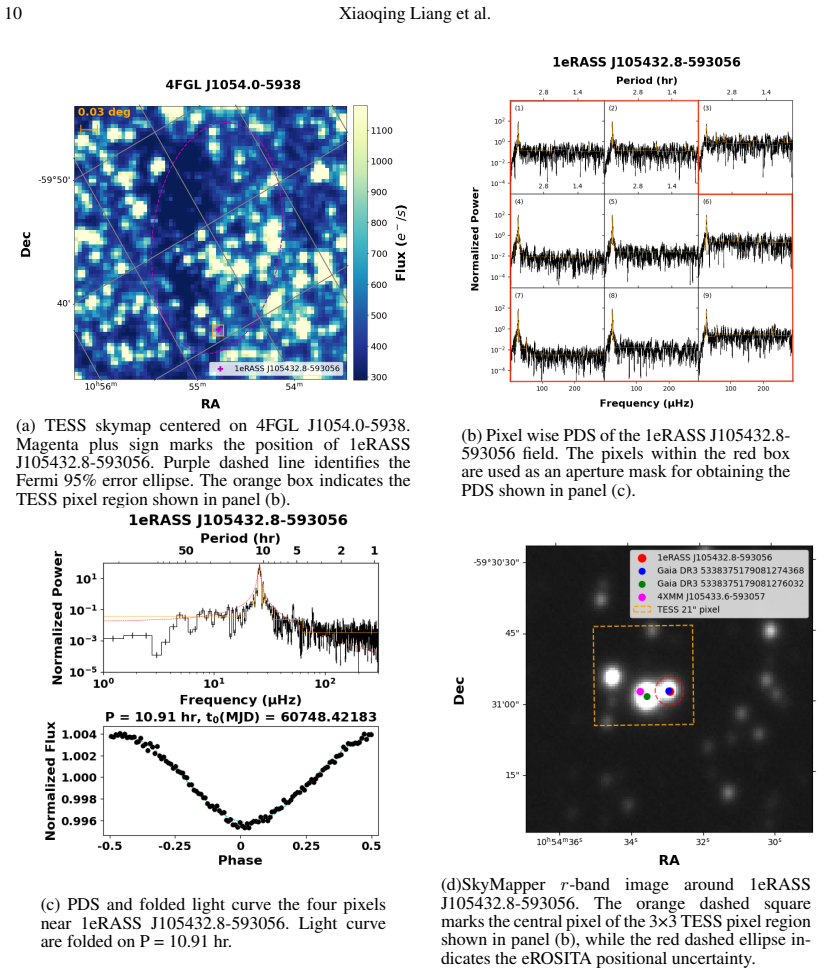
We present a search for new spider pulsar candidates through multi-wavelength cross-matching, including $\gamma$-ray, X-ray, and optical data. A search for sinusoidal-like optical modulations in TESS data of 183 eROSITA X-ray sources coincident with unassociated Fermi-LAT gamma-ray sources led to the identification of four promising spider pulsar candidates. We found optical variability periods ranging from 5 to 13 hours. All candidates display smooth sinusoidal-like phase light curves, similar to what can be expected from ellipsoidal variation; one shows double-peaked profiles indicative of harmonics. The absence of sharp minima, which are often found in black widow systems due to irradiation, together with their optical magnitudes of about G~14, suggests these sources are more likely redback-type binaries. One of the Fermi-LAT counterparts is included in a machine-learning catalog of unassociated gamma-ray sources, with relatively high pulsar probabilities. We also identify potential Gaia counterparts for several sources and estimate their distances and luminosities where parallax measurements are available. Future observations, including further spectroscopic and multi-wavelength studies, are needed to fully characterize these systems.
Editorial analysis
A structured set of objections, weighed in public.
Referee Report
Summary. The manuscript presents a multi-wavelength search for spider pulsar candidates, cross-matching 183 eROSITA X-ray sources coincident with unassociated Fermi-LAT gamma-ray sources and inspecting TESS light curves for sinusoidal-like optical modulations. This yields four promising redback-type candidates with periods of 5-13 hours that exhibit smooth sinusoidal phase-folded light curves without sharp minima, interpreted as ellipsoidal variations; one source also shows double-peaked profiles.
Significance. If the candidates are spectroscopically confirmed as spider pulsars, the work would add to the known population of gamma-ray-selected binaries and demonstrate the utility of TESS for detecting ellipsoidal modulations in X-ray/gamma-ray selected targets. The approach follows standard catalog cross-matching practices in high-energy astrophysics, but the preliminary nature of the candidate selection limits immediate impact.
major comments (2)
- [Abstract] Abstract and results description: the identification of four 'promising' candidates rests on qualitative descriptors ('smooth sinusoidal-like', 'lack of sharp minima') without reported quantitative selection thresholds such as periodogram power, false-alarm probability, or harmonic-content tests, leaving the false-positive rate from non-pulsar variables (e.g., spotted stars) unquantified.
- [Results] Candidate interpretation: the assumption that the observed 5-13 h modulations arise specifically from redback ellipsoidal variations rather than starspots, low-amplitude pulsations, or TESS systematics is not supported by a control sample of confirmed spiders or field variables, nor by explicit exclusion criteria, which is load-bearing for the central claim that these are spider pulsar candidates.
minor comments (2)
- [Results] The manuscript would benefit from explicit error bars or uncertainties on the reported periods and from a table summarizing the four candidates' key parameters (period, amplitude, Gaia distance if available).
- [Discussion] Notation for the optical magnitudes (G~14) and the machine-learning pulsar probability should be clarified with the specific catalog reference.
Simulated Author's Rebuttal
We thank the referee for the constructive feedback on our manuscript. The comments highlight important areas for improving the quantitative rigor and interpretive support of our candidate selection. We address each point below and outline the revisions we will implement.
read point-by-point responses
-
Referee: [Abstract] Abstract and results description: the identification of four 'promising' candidates rests on qualitative descriptors ('smooth sinusoidal-like', 'lack of sharp minima') without reported quantitative selection thresholds such as periodogram power, false-alarm probability, or harmonic-content tests, leaving the false-positive rate from non-pulsar variables (e.g., spotted stars) unquantified.
Authors: We agree that the manuscript would benefit from explicit quantitative thresholds. In the revised version we will report the Lomb-Scargle periodogram power values, signal-to-noise ratios, and false-alarm probabilities for the detected periods in the 5–13 h range. We will also include a brief description of the harmonic-content test used to identify double-peaked profiles and discuss how these metrics help constrain contamination from spotted stars or systematics within the TESS sample. revision: yes
-
Referee: [Results] Candidate interpretation: the assumption that the observed 5-13 h modulations arise specifically from redback ellipsoidal variations rather than starspots, low-amplitude pulsations, or TESS systematics is not supported by a control sample of confirmed spiders or field variables, nor by explicit exclusion criteria, which is load-bearing for the central claim that these are spider pulsar candidates.
Authors: We acknowledge the value of a control sample for strengthening the interpretation. Our selection relies on the joint gamma-ray/X-ray/optical coincidence rather than optical variability alone, which already suppresses many field contaminants. In revision we will add explicit morphological exclusion criteria (e.g., absence of sharp eclipses or high-amplitude spot-induced asymmetry) and compare the observed periods and amplitudes with literature examples of confirmed redbacks. A dedicated control sample of field variables is beyond the scope of the present catalog cross-match but will be noted as a limitation. revision: partial
Circularity Check
No circularity: pure observational catalog search with no derivation or self-referential steps
full rationale
The paper performs a straightforward multi-wavelength cross-match of eROSITA X-ray sources with unassociated Fermi-LAT gamma-ray sources, followed by visual inspection of TESS light curves for sinusoidal-like modulations. No equations, fitted parameters, predictions, or uniqueness theorems appear in the provided text or abstract. Candidate selection rests on qualitative descriptors such as 'smooth sinusoidal-like phase light curves' and 'absence of sharp minima,' without any self-citation chain, ansatz smuggling, or renaming of known results that would reduce the central claim to its own inputs. This is a standard observational search whose conclusions follow directly from external catalog data and light-curve morphology, with no load-bearing self-referential logic.
Axiom & Free-Parameter Ledger
axioms (1)
- domain assumption Smooth sinusoidal optical light curves indicate ellipsoidal variations due to binary companions in spider systems
Lean theorems connected to this paper
-
IndisputableMonolith/Foundation/RealityFromDistinction.leanreality_from_one_distinction unclear?
unclearRelation between the paper passage and the cited Recognition theorem.
A search for sinusoidal-like optical modulations in TESS data of 183 eROSITA X-ray sources coincident with unassociated Fermi-LAT gamma-ray sources led to the identification of four promising spider pulsar candidates... periods ranging from 5 to 13 hours... smooth sinusoidal-like phase light curves
-
IndisputableMonolith/Cost/FunctionalEquation.leanwashburn_uniqueness_aczel unclear?
unclearRelation between the paper passage and the cited Recognition theorem.
Power Density Spectra are calculated using the Lomb-Scargle method... Significant peak profiles... fitted with a Lorentzian profile
What do these tags mean?
- matches
- The paper's claim is directly supported by a theorem in the formal canon.
- supports
- The theorem supports part of the paper's argument, but the paper may add assumptions or extra steps.
- extends
- The paper goes beyond the formal theorem; the theorem is a base layer rather than the whole result.
- uses
- The paper appears to rely on the theorem as machinery.
- contradicts
- The paper's claim conflicts with a theorem or certificate in the canon.
- unclear
- Pith found a possible connection, but the passage is too broad, indirect, or ambiguous to say the theorem truly supports the claim.
Reference graph
Works this paper leans on
-
[1]
2020, The Astrophysical Journal Supplement Series, 247, 33 2
Abdollahi, S., Acero, F., Ackermann, M., et al. 2020, The Astrophysical Journal Supplement Series, 247, 33 2
work page 2020
-
[2]
Alpar, M. A., Cheng, A. F., Ruderman, M. A., & Shaham, J. 1982, Nature, 300, 728 1
work page 1982
-
[3]
Fermi Large Area Telescope Fourth Source Catalog Data Release 4 (4FGL-DR4)
Ballet, J., Bruel, P., Burnett, T. H., Lott, B., & The Fermi-LAT collaboration. 2023, arXiv e-prints, arXiv:2307.12546 2
work page internal anchor Pith review Pith/arXiv arXiv 2023
- [4]
-
[5]
Belloni, T., Psaltis, D., & van der Klis, M. 2002, ApJ, 572, 392 4
work page 2002
-
[6]
Benvenuto, O. G., De Vito, M. A., Echeveste, M., et al. 2025, A&A, 698, L5 2
work page 2025
-
[7]
Benvenuto, O. G., De Vito, M. A., & Horvath, J. E. 2012, ApJ, 753, L33 2
work page 2012
-
[8]
Bogdanov, S., van den Berg, M., Servillat, M., et al. 2011, ApJ, 730, 81 3
work page 2011
-
[9]
Brasseur, C. E., Phillip, C., Fleming, S. W., Mullally, S. E., & White, R. L. 2019, Astrocut: Tools for creating cutouts of TESS images, Astrophysics Source Code Library, record ascl:1905.007 3, 14
work page 2019
- [10]
-
[11]
F., Collier Cameron, A., Semel, M., et al
Donati, J. F., Collier Cameron, A., Semel, M., et al. 2003, MNRAS, 345, 1145 8 eds. Shaw, R., Cherinka, B., & Forshay, P. 2021, MAST 2021, MAST Portal Guide, version 2 edn., Baltimore 14
work page 2003
-
[12]
Ergma, E., & Sarna, M. J. 2003, A&A, 399, 237 2
work page 2003
-
[13]
Fruchter, A. S., Stinebring, D. R., & Taylor, J. H. 1988, Nature, 333, 237 2
work page 1988
- [14]
- [15]
-
[16]
Koljonen, K. I. I., & Linares, M. 2025, ApJ, 994, 8 2, 5, 13
work page 2025
-
[17]
Lee, J., Hui, C. Y ., Takata, J., et al. 2018, ApJ, 864, 23 6 Searching for Spider-Like Pulsars from TESS Ellipsoidal Lightcurves with X-ray counterparts 15 Lightkurve Collaboration, Cardoso, J. V . d. M., Hedges, C., et al. 2018, Lightkurve: Kepler and TESS time series analysis in Python, Astrophysics Source Code Library, record ascl:1812.013 3, 14
work page 2018
- [18]
-
[19]
Mahmud, N. I., Crockett, C. J., Johns-Krull, C. M., et al. 2011, ApJ, 736, 123 8
work page 2011
-
[20]
D., Stassun, K., Basri, G., et al
Mathieu, R. D., Stassun, K., Basri, G., et al. 1997, AJ, 113, 1841 8
work page 1997
-
[21]
Mayer, M. G. F., & Becker, W. 2024, A&A, 684, A208 5
work page 2024
- [22]
-
[23]
Onken, C. A., Wolf, C., Bessell, M. S., et al. 2019, PASA, 36, e033 3
work page 2019
- [24]
- [25]
-
[26]
Podsiadlowski, P., Rappaport, S., & Pfahl, E. D. 2002, ApJ, 565, 1107 2
work page 2002
-
[27]
2017, Research in Astronomy and Astrophysics, 17, 087 7
Qian, S.-B., He, J.-J., Zhang, J., et al. 2017, Research in Astronomy and Astrophysics, 17, 087 7
work page 2017
-
[28]
Ricker, G. R., Winn, J. N., Vanderspek, R., et al. 2015, Journal of Astronomical Telescopes, Instruments, and Systems, 1, 014003 3
work page 2015
-
[29]
Roberts, M. S. E. 2013, in IAU Symposium, V ol. 291, Neutron Stars and Pulsars: Challenges and Opportunities after 80 years, ed. J. van Leeuwen, 127 2
work page 2013
-
[30]
Scargle, J. D., Norris, J. P., Jackson, B., & Chiang, J. 2013, ApJ, 764, 167 4
work page 2013
-
[31]
Seppi, R., Comparat, J., Bulbul, E., et al. 2022, A&A, 665, A78 3
work page 2022
-
[32]
Shokry, A., Darwish, M. S., El-Sadek, M. A., et al. 2025, Scientific Reports, 15, 28369 7
work page 2025
-
[33]
A., Linares, M., Casares, J., et al
Simpson, J. A., Linares, M., Casares, J., et al. 2025, MNRAS, 536, 2169 2
work page 2025
-
[34]
Stappers, B. W., van Kerkwijk, M. H., Bell, J. F., & Kulkarni, S. R. 2001, ApJ, 548, L183 2
work page 2001
-
[35]
2024, ApJ, 977, 65 2 van den Heuvel, E
Turchetta, M., Linares, M., Koljonen, K., et al. 2024, ApJ, 977, 65 2 van den Heuvel, E. P. J., & van Paradijs, J. 1988, Nature, 334, 227 2 van der Merwe, C. J. T., Wadiasingh, Z., Venter, C., Harding, A. K., & Baring, M. G. 2020, ApJ, 904, 91 3
work page 2024
-
[36]
A., Coriat, M., Traulsen, I., et al
Webb, N. A., Coriat, M., Traulsen, I., et al. 2020, A&A, 641, A136 6
work page 2020
- [37]
-
[38]
Zhao, J., & Heinke, C. O. 2022, MNRAS, 511, 5964 6 Appendix A: MACHINE-READABLE TABLE FOR ALL CANDIDA TES ANALYSED. Table A.1: Details of Candidates analysed. The brightest probable TESS counterparts are obtained from the TIC catalog within 30 arcsec. The TESS variability is determined from flux changes in 9-pixels region around the eROSITA source positio...
work page 2022
discussion (0)
Sign in with ORCID, Apple, or X to comment. Anyone can read and Pith papers without signing in.