Grounding Generative Policies in Physics: Optimization-Guided Diffusion for Robot Control
Pith reviewed 2026-06-26 00:34 UTC · model grok-4.3
The pith
Optimization-guided denoising enforces physical constraints on robot policies during diffusion sampling without retraining.
A machine-rendered reading of the paper's core claim, the machinery that carries it, and where it could break.
Core claim
The paper claims that formulating diffusion guidance as a constrained optimization problem and inserting an optimized correction into the backward diffusion process enforces hard or soft physical constraints during sampling, matches the feasibility of projection- and gradient-guidance baselines, better preserves grasp quality, improves controller-level executability, and raises task success by up to 20 percentage points on dexterous grasping and 23 percentage points on visuomotor manipulation over the best baseline, all without retraining the diffusion model.
What carries the argument
Optimization-guided denoising, which replaces the sampling perturbation in the backward diffusion process with an optimized correction derived from a constrained optimization problem to impose physical constraints.
If this is right
- Generated grasps and trajectories satisfy reachability and collision-avoidance constraints at rates comparable to projection and gradient baselines.
- Grasp quality metrics remain higher than those obtained by the baseline guidance methods.
- Controller-level trackability improves for dynamic manipulation tasks.
- Task success rates increase by up to 20 percentage points on dexterous grasping and 23 percentage points on visuomotor manipulation across tested robot embodiments.
Where Pith is reading between the lines
- The same inference-time correction could be applied to other sampling-based generative models to enforce embodiment constraints without retraining.
- Decoupling constraint satisfaction from training may support zero-shot transfer of a single policy across a wider range of robot hardware.
- The approach suggests a route to embed additional closed-loop stability requirements directly into the sampling loop for more complex behaviors.
Load-bearing premise
An optimized correction inserted into the backward diffusion process can enforce hard or soft constraints while keeping generated samples sufficiently close to the learned prior distribution without requiring model retraining.
What would settle it
A set of runs on the dexterous grasping and visuomotor manipulation tasks where the optimized-correction samples either deviate substantially from the training distribution or produce no improvement in task success rates over the strongest projection or gradient baseline.
Figures




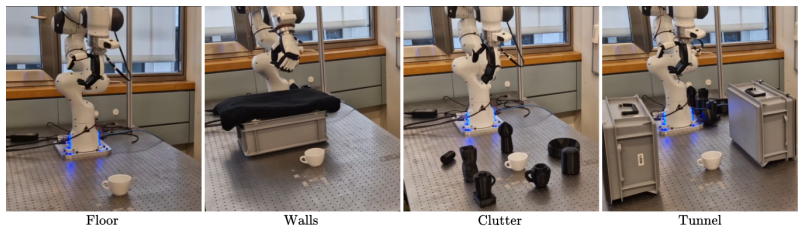
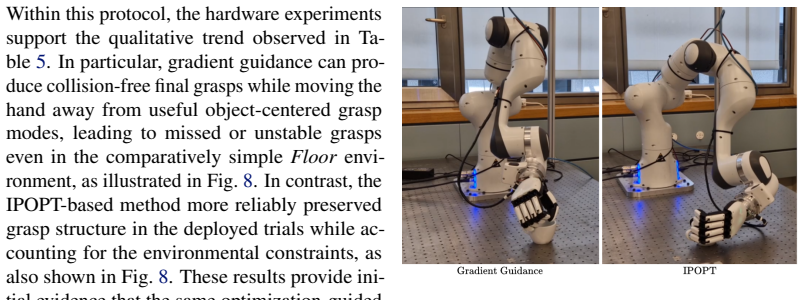
read the original abstract
Diffusion models sample effectively from high-dimensional, multimodal distributions, but their outputs may violate deployment constraints. For task-space robot policies, generated grasps, waypoints, or trajectories can be distributionally valid yet infeasible, violating reachability, collision-avoidance, or closed-loop executability requirements. This embodiment gap limits zero-shot deployment across robots, even when the task-space behavior itself is transferable. We propose an inference-time optimization framework that couples the behavior generation to physical feasibility by formulating diffusion guidance as a constrained optimization problem. Our key insight is to replace the sampling perturbation in the backward process with an optimized correction, allowing hard constraints or soft penalties to be imposed during sampling without the need to retrain the diffusion model, while keeping samples close to the learned prior. We evaluate the method on dexterous grasp synthesis with reachability and collision-avoidance constraints, and dynamic manipulation with controller-level trackability constraints. Across settings and robot embodiments, optimization-guided denoising matches the feasibility of projection- and gradient-guidance baselines while better preserving grasp quality, and improving controller-level executability and task success, with task success improving by up to 20pp. on dexterous grasping and 23pp. on visuomotor manipulation over the best baseline.
Editorial analysis
A structured set of objections, weighed in public.
Referee Report
Summary. The manuscript proposes an inference-time optimization framework for diffusion models in robot control. It formulates diffusion guidance as a constrained optimization problem, replacing the backward process perturbation with an optimized correction to enforce constraints such as reachability, collision avoidance, and trackability without retraining the model. The method is evaluated on dexterous grasp synthesis and dynamic manipulation tasks, claiming to match baseline feasibility while improving grasp quality, executability, and task success rates by up to 20 and 23 percentage points over the best baselines.
Significance. If the central assumption holds—that the per-step optimization enforces constraints while keeping generated samples close to the learned prior without distributional drift—this could offer a valuable tool for deploying generative policies across robot embodiments by addressing the embodiment gap at inference time. The no-retraining aspect is practically significant. The reported quantitative improvements suggest potential impact in robotics applications, but verification of the assumption is needed for the significance to be realized.
major comments (2)
- [Abstract] Abstract: The claim that the optimized correction keeps samples 'close to the learned prior' is central to the no-retraining advantage and preservation of grasp quality, but the abstract provides no explicit bound, distance metric, Lagrangian schedule, or regularization term to anchor this assumption (see skeptic concern on distributional validity).
- [Abstract] Abstract: Quantitative gains are reported (task success up to 20pp on dexterous grasping, 23pp on visuomotor manipulation) but without details on experimental controls, number of trials, statistical significance, or potential post-hoc choices, which undermines assessment of the soundness of the improvements over projection- and gradient-guidance baselines.
minor comments (1)
- [Abstract] Abstract: The abstract could more clearly distinguish between hard constraints and soft penalties in the optimization formulation.
Simulated Author's Rebuttal
We thank the referee for the constructive feedback. We address the two major comments on the abstract below, agreeing that additional context would strengthen the presentation while noting that the full manuscript provides the supporting details.
read point-by-point responses
-
Referee: [Abstract] Abstract: The claim that the optimized correction keeps samples 'close to the learned prior' is central to the no-retraining advantage and preservation of grasp quality, but the abstract provides no explicit bound, distance metric, Lagrangian schedule, or regularization term to anchor this assumption (see skeptic concern on distributional validity).
Authors: We agree the abstract is concise and omits explicit formulation details. The manuscript (Section 3.2) defines the correction via a constrained optimization whose objective includes a quadratic regularization term penalizing deviation from the diffusion model's mean prediction at each step; this term, combined with the step-size schedule, provides the anchoring mechanism without requiring a separate Lagrangian multiplier schedule. Empirical support appears in Section 4.3 via distribution-similarity metrics between guided and unguided samples. We will revise the abstract to reference 'via regularized constrained optimization that anchors to the diffusion prior'. revision: yes
-
Referee: [Abstract] Abstract: Quantitative gains are reported (task success up to 20pp on dexterous grasping, 23pp on visuomotor manipulation) but without details on experimental controls, number of trials, statistical significance, or potential post-hoc choices, which undermines assessment of the soundness of the improvements over projection- and gradient-guidance baselines.
Authors: The abstract summarizes results whose full experimental protocol (number of trials, controls, and significance testing) is reported in Sections 4.1–4.2. We will expand the abstract to state 'across 100 trials per condition with statistical significance (p < 0.05)'. The gains are obtained from pre-specified evaluation protocols without post-hoc selection of conditions or metrics. revision: yes
Circularity Check
No circularity in derivation chain
full rationale
The paper introduces an inference-time optimization framework that replaces the sampling perturbation in the backward diffusion process with an optimized correction to enforce constraints. No equations, derivations, or self-citations are presented that reduce the claimed improvements in feasibility, grasp quality, or task success to quantities defined by the method itself or to fitted inputs. The approach is positioned as an independent addition to standard diffusion sampling that avoids retraining, with evaluations against external baselines. The central assumption about staying close to the learned prior is stated but not derived from or equivalent to the inputs by construction.
Axiom & Free-Parameter Ledger
axioms (1)
- domain assumption Diffusion models can effectively sample from high-dimensional multimodal distributions
Reference graph
Works this paper leans on
-
[1]
C. Chi, Z. Xu, S. Feng, E. Cousineau, Y . Du, B. Burchfiel, R. Tedrake, and S. Song. Diffusion policy: Visuomotor policy learning via action diffusion.The International Journal of Robotics Research, 44(10-11):1684–1704, 2025
2025
-
[2]
M. Janner, Y . Du, J. B. Tenenbaum, and S. Levine. Planning with Diffusion for Flexible Behavior Synthesis.arXiv preprint arXiv:2205.09991, 2022
Pith/arXiv arXiv 2022
-
[3]
M. J. Kim, K. Pertsch, S. Karamcheti, T. Xiao, A. Balakrishna, S. Nair, R. Rafailov, E. Foster, G. Lam, P. Sanketi, et al. OpenVLA: An Open-Source Vision-Language-Action Model.arXiv preprint arXiv:2406.09246, 2024
Pith/arXiv arXiv 2024
-
[4]
H. Ha, Y . Gao, Z. Fu, J. Tan, and S. Song. UMI on Legs: Making Manipulation Policies Mobile with Manipulation-Centric Whole-body Controllers.arXiv preprint arXiv:2407.10353, 2024
arXiv 2024
-
[5]
R. Punamiya, S. Kareer, Z. Liu, J. Citron, R.-Z. Qiu, X. Cai, A. Gavryushin, J. Chen, D. Liconti, L. Y . Zhu, et al. EgoVerse: An Egocentric Human Dataset for Robot Learning from Around the World.arXiv preprint arXiv:2604.07607, 2026
Pith/arXiv arXiv 2026
-
[6]
J. K. Christopher, S. Baek, and F. Fioretto. Constrained Synthesis with Projected Diffusion Models.Advances in Neural Information Processing Systems, 37:89307–89333, 2024
2024
-
[7]
H. Ma, S. Bodmer, A. Carron, M. Zeilinger, and M. Muehlebach. Constraint-Aware Diffusion Guidance for Robotics: Real-Time Obstacle Avoidance for Autonomous Racing. InProceedings of the Conference on Robot Learning, pages 1756–1776, 2025
2025
-
[8]
A. Li, Z. Ding, A. B. Dieng, and R. Beeson. Constraint-Aware Diffusion Models for Trajectory Optimization. InInternational Conference on Dynamic Data Driven Applications Systems, pages 308–316, 2024
2024
-
[9]
Gupta, X
H. Gupta, X. Guo, H. Ha, C. Pan, M. Cao, D. Lee, S. Scherer, S. Song, and G. Shi. UMI-on-Air: Embodiment-Aware Guidance for Embodiment-Agnostic Visuomotor Policies, 2025
2025
-
[10]
Römer, A
R. Römer, A. v. Rohr, and A. Schoellig. Diffusion Predictive Control with Constraints. In Proceedings of Machine Learning Research, pages 1–13, 2025
2025
-
[11]
O’Neill, A
A. O’Neill, A. Rehman, A. Maddukuri, A. Gupta, A. Padalkar, A. Lee, A. Pooley, A. Gupta, A. Mandlekar, A. Jain, et al. Open X-Embodiment: Robotic Learning Datasets and RT-X Models. InProceedings of the International Conference on Robotics and Automation, pages 6892–6903, 2024
2024
-
[12]
C. Chi, Z. Xu, C. Pan, E. Cousineau, B. Burchfiel, S. Feng, R. Tedrake, and S. Song. Universal Manipulation Interface: In-The-Wild Robot Teaching Without In-The-Wild Robots, 2024
2024
-
[13]
Patel and S
A. Patel and S. Song. GET-Zero: Graph Embodiment Transformer for Zero-shot Embodiment Generalization. InProceedings of the International Conference on Robotics and Automation, pages 14262–14269, 2025
2025
-
[14]
J. Song, C. Meng, and S. Ermon. Denoising Diffusion Implicit Models.arXiv preprint arXiv:2010.02502, 2020
Pith/arXiv arXiv 2010
-
[15]
O. M. Team, D. Ghosh, H. Walke, K. Pertsch, K. Black, O. Mees, S. Dasari, J. Hejna, T. Kreiman, C. Xu, et al. Octo: An Open-Source Generalist Robot Policy.arXiv preprint arXiv:2405.12213, 2024
Pith/arXiv arXiv 2024
-
[16]
T. Chen, A. Murali, and A. Gupta. Hardware Conditioned Policies for Multi-Robot Transfer Learning. 31:1–12, 2018. 10
2018
-
[17]
T. Wang, R. Liao, J. Ba, and S. Fidler. NerveNet: Learning Structured Policy with Graph Neural Networks. InProceedings of the International Conference on Learning Representations, pages 1–26, 2018
2018
-
[18]
Huang, I
W. Huang, I. Mordatch, and D. Pathak. One Policy to Control Them All: Shared Modular Policies for Agent-Agnostic Control. InProceedings of the International Conference on Machine Learning, pages 4455–4464, 2020
2020
-
[19]
Z. Yang, J. Mao, Y . Du, J. Wu, J. B. Tenenbaum, T. Lozano-Pérez, and L. P. Kaelbling. Compo- sitional Diffusion-Based Continuous Constraint Solvers. InProceedings of the Conference on Robot Learning, pages 3242–3265, 2023
2023
-
[20]
Y . Luo, C. Sun, J. B. Tenenbaum, and Y . Du. Potential Based Diffusion Motion Planning.arXiv preprint arXiv:2407.06169, 2024
arXiv 2024
-
[21]
Du and S
M. Du and S. Song. Dynaguide: Steering Diffusion Polices with Active Dynamic Guidance. Advances in Neural Information Processing Systems, 38:44192–44221, 2026
2026
-
[22]
Graikos, N
A. Graikos, N. Malkin, N. Jojic, and D. Samaras. Diffusion models as plug-and-play priors. 35: 14715–14728, 2022
2022
-
[23]
H. Chung, J. Kim, M. T. Mccann, M. L. Klasky, and J. C. Ye. Diffusion Posterior Sampling for General Noisy Inverse Problems.arXiv preprint arXiv:2209.14687, 2022
Pith/arXiv arXiv 2022
-
[24]
Bansal, H.-M
A. Bansal, H.-M. Chu, A. Schwarzschild, R. Sengupta, M. Goldblum, J. Geiping, and T. Gold- stein. Universal Guidance for Diffusion Models. InProceedings of the International Conference on Learning Representations, pages 51304–51323, 2024
2024
-
[25]
J. Ho, A. Jain, and P. Abbeel. Denoising Diffusion Probabilistic Models.Advances in neural information processing systems, 33:6840–6851, 2020
2020
-
[26]
Pineda, T
L. Pineda, T. Fan, M. Monge, S. Venkataraman, P. Sodhi, R. T. Chen, J. Ortiz, D. DeTone, A. Wang, S. Anderson, J. Dong, B. Amos, and M. Mukadam. Theseus: A Library for Differ- entiable Nonlinear Optimization.Advances in Neural Information Processing Systems, pages 3801–3818, 2022
2022
-
[27]
R. Zurbrügg, A. Cramariuc, and M. Hutter. DexEvolve: Evolutionary Optimization for Robust and Diverse Dexterous Grasp Synthesis.arXiv preprint arXiv:2602.15201, 2026
arXiv 2026
-
[28]
Franka Panda robot arm
Franka Robotics. Franka Panda robot arm. https://franka.de/, 2024. Accessed: 2026-05-26
2024
-
[29]
DynaArm: Ultra-lightweight robotic arm
Duatic AG. DynaArm: Ultra-lightweight robotic arm. https://www.duatic.com/ dynaarm, 2024. Accessed: 2026-05-26
2024
-
[30]
B. Sundaralingam, S. K. S. Hari, A. Fishman, C. Garrett, K. Van Wyk, V . Blukis, A. Millane, H. Oleynikova, A. Handa, F. Ramos, et al. cuRoBo: Parallelized Collision-Free Minimum-Jerk Robot Motion Generation.arXiv preprint arXiv:2310.17274, 2023
arXiv 2023
-
[31]
Zurbrügg, A
R. Zurbrügg, A. Cramariuc, and M. Hutter. GraspQP: Differentiable Optimization of Force Closure for Diverse and Robust Dexterous Grasping. InProceedings of the Conference on Robot Learning, pages 2583–2602, 2025
2025
-
[32]
T. Engelbracht, R. Zurbrügg, M. Wohlrapp, M. Büchner, A. Valada, M. Pollefeys, H. Blum, and Z. Bauer. Hoi!–A Multimodal Dataset for Force-Grounded, Cross-View Articulated Manipulation.arXiv preprint arXiv:2512.04884, 2025
Pith/arXiv arXiv 2025
-
[33]
R. Zurbrugg, T. Portela, A. Bhardwaj, A. E. Vijayan, M. Wilder-Smith, and M. Hutter. VR- DAgger: Immersive VR for Dexterous Data Collection and Uncertainty-Guided On-Policy Correction.arXiv preprint arXiv:2605.27114, 2026. 11
Pith/arXiv arXiv 2026
-
[34]
B. L. Wächter A. On the implementation of an interior-point filter line-search algorithm for large-scale nonlinear programming. 106(1):25–57, 2006. 12 8 Supplementary Material Contents 8 Supplementary Material 13 8.1 Denoising Diffusion Implicit Models . . . . . . . . . . . . . . . . . . . . . . . . . 13 8.1.1 Diffusion Models Implementation Details . . ....
2006
-
[35]
18 Here, log(·)∨ : SO(3)→R 3 denotes the logarithmic map from rotations to axis-angle vectors
Task-space error.We first compute the geometric pose error between the reference pose and the current end-effector pose: ∆xt = pref t −p ee t ωerr t ∈R 6, ω err t = log Rref t Ree,⊤ t ∨ ∈R 3. 18 Here, log(·)∨ : SO(3)→R 3 denotes the logarithmic map from rotations to axis-angle vectors. Optionally, this error can be weighted by a diagonal task-space stiffn...
-
[36]
Resolved-rate joint update.The task-space error is mapped to a joint-space increment with a damped-least-squares resolved-rate update: δqt =J(q t)⊤ J(q t)J(q t)⊤ +λ 2I6 −1 ∆xt, λ= 0.05, whereJ(q t)is the geometric end-effector Jacobian
-
[37]
Authority limits.Before applying the update, we clip the joint increment to the motion that the robot can realize within one reference step. The per-joint bound is ¯δq= min ˙qmax ∆tref , τmax kjoint p ! , where ˙qmax and τmax are the robot’s velocity and effort limits, andkjoint p is the joint-space PD stiffness specified by the robot model. This bound ca...
-
[38]
PD lag and integration.Finally, we account for the fact that the low-level PD controller closes only part of the commanded joint-space gap during one reference step. We model this with a first-order lag factorα eff and integrate the clipped increment: qt+1 = clip qt +α eff ⊙clip(δq t,± ¯δq), q, q , with αeff,j = 1− 1− kjoint p,j kjoint p,j +k joint d,j /∆...
-
[39]
Interestingly,Theseusactually increases in success rate when changing from theeasytohard base pose configuration, going from 61 to 67. Additionally, whileGradient guidanceoutperforms Theseus, and almost approaches the success rate achieved byIPOPT, on the Franka arm in theeasy base pose category, scores drop significantly on thehardcategory, whereTheseusc...
discussion (0)
Sign in with ORCID, Apple, or X to comment. Anyone can read and Pith papers without signing in.