Metrical theory of signed Engel expansions
Pith reviewed 2026-06-29 10:00 UTC · model grok-4.3
The pith
Every irrational in (0,1) admits a unique signed Engel expansion with even non-decreasing digits whose growth depends on sign flips.
A machine-rendered reading of the paper's core claim, the machinery that carries it, and where it could break.
Core claim
We expand each x in (0,1) excluding the rationals uniquely as x = ε1(x)/d1(x) + ε2(x)/(d1(x)d2(x)) + ⋯ where ε1 = 1 and εn ∈ {1,-1} for n ≥ 2. The digit sequence {dn(x)} consists of even positive integers that are non-decreasing and tend to infinity, satisfying dn+1(x) ≥ dn(x) + 2 precisely when εn+1 = -εn. From this representation the law of large numbers, central limit theorem and law of the iterated logarithm hold for dn(x) and for Δn(x) = dn(x) - dn-1(x). In addition a Borel-Bernstein theorem determines when the Lebesgue measure of the set {x : Rn(x) ≥ ϕ(n) for infinitely many n} is zero or one, where Rn(x) = dn(x)/dn-1(x).
What carries the argument
The signed Engel expansion, the series with prescribed signs εn and even digits dn obeying the non-decreasing condition together with the sign-flip growth rule dn+1 ≥ dn + 2.
If this is right
- The sequence dn(x) obeys the law of large numbers, central limit theorem and law of the iterated logarithm with respect to Lebesgue measure.
- The successive differences Δn(x) obey the same three limit laws.
- The Lebesgue measure of the set where Rn(x) ≥ ϕ(n) for infinitely many n is either zero or one, depending on the function ϕ.
- These metrical statements hold uniformly for almost every x in (0,1).
Where Pith is reading between the lines
- The same uniqueness and limit-law approach could be applied directly to the unsigned Engel and Pierce expansions that motivated the signed version.
- Numerical sampling of the digit sequences for a large set of quadratic irrationals would provide a concrete check on whether the central limit theorem appears in finite samples.
- The even-digit constraint may restrict the possible approximation rates compared with unrestricted Engel expansions, offering a testable distinction between the two systems.
Load-bearing premise
Every irrational number in (0,1) possesses exactly one such signed Engel expansion when the digits are forced to be even, non-decreasing, and to obey the sign-dependent growth condition.
What would settle it
An explicit irrational x in (0,1) that either admits no sequence of even non-decreasing digits satisfying the signed expansion equation or admits two distinct such sequences.
Figures
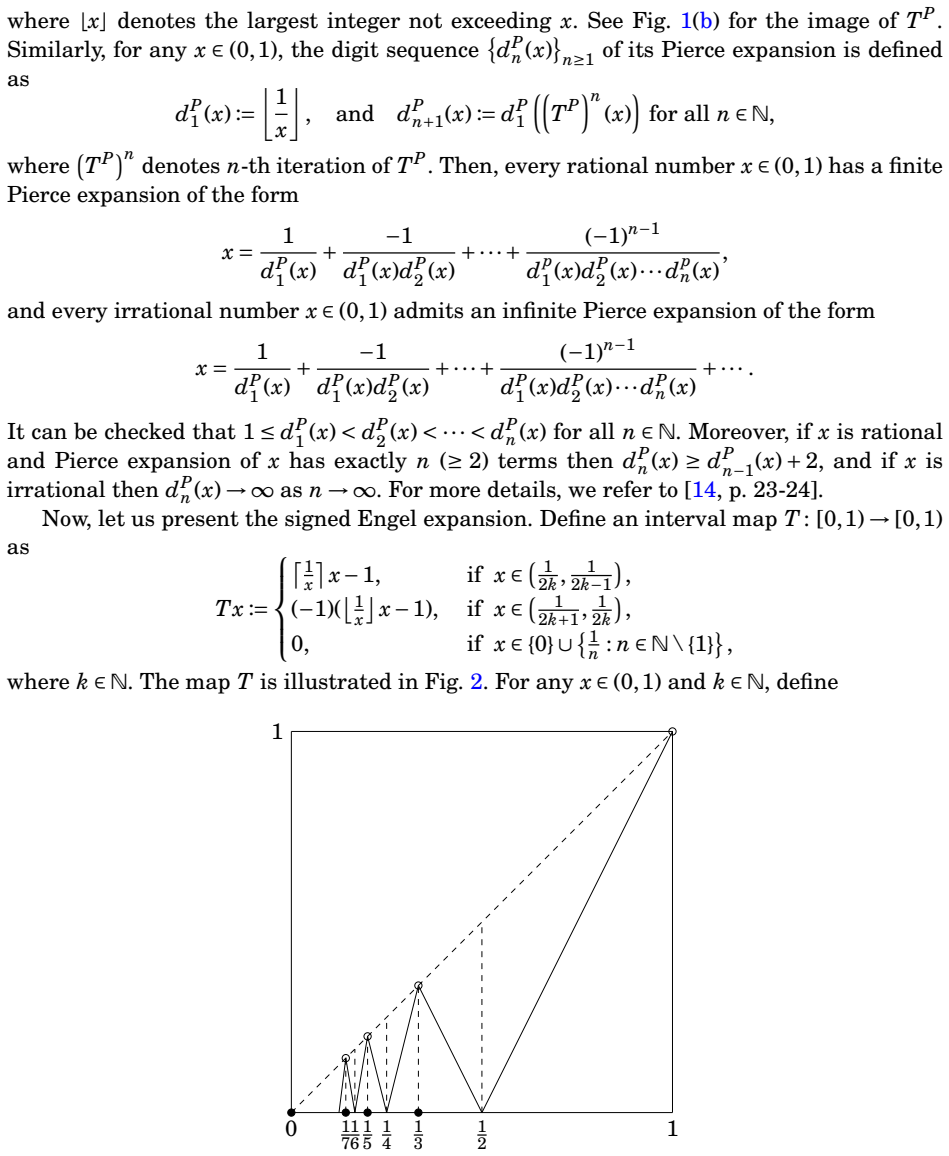
read the original abstract
Motivated by the Engel and Pierce expansions, we introduce a signed Engel expansion. We expand each $x\in(0,1)\setminus\mathbb{Q}$ uniquely as $$x=\frac{\epsilon_{1}(x)}{d_{1}(x)}+\frac{\epsilon_{2}(x)}{d_{1}(x)d_{2}(x)}+\cdots+\frac{\epsilon_{n}(x)}{d_{1}(x)d_{2}(x)\cdots d_{n}(x)}+\cdots,$$ where $\epsilon_{1}(x)\coloneqq1$ and $\epsilon_{n}(x)\in\left\{1,-1\right\}$ for $n\geq2$. The digit sequence $\left\{d_{n}(x)\right\}_{n\geq1}$ satisfying $d_{n+1}(x)\geq d_{n}(x)+2$ when $\epsilon_{n+1}(x)=-\epsilon_{n}(x)$ forms a non-decreasing sequence of even positive integers tending to infinity. On the one hand, we obtain the law of large numbers, the central limit theorem and the law of the iterated logarithm regarding $d_{n}(x)$ and $\Delta_{n}(x)\coloneqq d_{n}(x)-d_{n-1}(x)\ (n\geq2)\ (\Delta_{1}(x)\coloneqq d_{1}(x))$. On the other hand, we prove a Borel--Bernstein theorem on the zero-one law on the Lebesgue measure of the set $$\left\{x\in(0,1)\colon R_{n}(x)\geq\phi(n)\ \textnormal{ for infinity many } n\right\},$$ where $R_{n}(x)\coloneqq\frac{d_{n}(x)}{d_{n-1}(x)}\ (n\geq2)\ (R_{1}(x)\coloneqq d_{1}(x))$ and $\phi$ is an arbitrary positive function defined on the set of positive integers.
Editorial analysis
A structured set of objections, weighed in public.
Referee Report
Summary. The paper introduces a signed Engel expansion for each irrational x in (0,1), asserting a unique representation x = ε1/d1 + ε2/(d1 d2) + ⋯ with ε1 ≡ 1, εn ∈ {±1} for n ≥ 2, and {dn} a non-decreasing sequence of even positive integers tending to infinity that obeys dn+1 ≥ dn + 2 precisely when the sign flips. It then establishes the law of large numbers, central limit theorem and law of the iterated logarithm for the sequences dn(x) and Δn(x) := dn(x) − dn−1(x), together with a Borel–Bernstein zero-one law for the Lebesgue measure of the set where Rn(x) ≥ ϕ(n) for infinitely many n, with Rn(x) := dn(x)/dn−1(x).
Significance. If the uniqueness claim holds almost everywhere and the measure-theoretic arguments are carried out correctly, the work extends the metrical theory of Engel-type expansions to a signed setting and supplies standard limit theorems plus a zero-one law under Lebesgue measure. No machine-checked proofs or reproducible code are mentioned.
major comments (1)
- [Abstract and introductory definition] Abstract (first paragraph) and the definition of the expansion: the uniqueness of the representation under the stated constraints on εn and the even non-decreasing dn (with the sign-flip increment rule) is asserted without an explicit construction algorithm or proof that the constraints suffice to guarantee existence and uniqueness for every irrational x. Because every subsequent result (LLN/CLT/LIL for dn, Δn and the Borel–Bernstein statement) presupposes that the map x ↦ (dn(x), εn(x)) is single-valued Lebesgue-almost everywhere, this gap is load-bearing for the central claims.
Simulated Author's Rebuttal
We thank the referee for their careful reading of the manuscript and for identifying this foundational point. We address the comment below and outline the planned revision.
read point-by-point responses
-
Referee: [Abstract and introductory definition] Abstract (first paragraph) and the definition of the expansion: the uniqueness of the representation under the stated constraints on εn and the even non-decreasing dn (with the sign-flip increment rule) is asserted without an explicit construction algorithm or proof that the constraints suffice to guarantee existence and uniqueness for every irrational x. Because every subsequent result (LLN/CLT/LIL for dn, Δn and the Borel–Bernstein statement) presupposes that the map x ↦ (dn(x), εn(x)) is single-valued Lebesgue-almost everywhere, this gap is load-bearing for the central claims.
Authors: The manuscript contains an explicit recursive construction of the signed Engel expansion (Section 2) together with a proof that the stated constraints on the signs εn and the even non-decreasing sequence dn guarantee both existence and uniqueness for every irrational x ∈ (0,1). This is stated as Theorem 2.1, which also shows that the resulting map x ↦ (dn(x), εn(x)) is single-valued Lebesgue almost everywhere. The subsequent limit theorems and the Borel–Bernstein statement are derived from this measure-theoretic foundation. To address the referee’s concern we will add a short sentence in the abstract (and a pointer in the introduction) that explicitly references Theorem 2.1. revision: yes
Circularity Check
No circularity detected; metric results follow from new expansion definition
full rationale
The paper defines the signed Engel expansion with the stated constraints on digits (even, non-decreasing, tending to infinity, sign-flip increment rule) and asserts uniqueness for irrationals, then derives LLN/CLT/LIL for dn/Δn and the Borel-Bernstein zero-one law for Rn as consequences with respect to Lebesgue measure. No self-citations appear in the provided text, no parameters are fitted to data and renamed as predictions, and no result reduces by the paper's own equations to a tautology or input by construction. The theorems have a well-defined domain once the expansion map is established, making the derivation self-contained.
Axiom & Free-Parameter Ledger
axioms (1)
- domain assumption Lebesgue measure on (0,1) is the underlying probability measure for the zero-one law and the limit theorems
Reference graph
Works this paper leans on
-
[1]
É. Borel. Sur les développements unitaires normaux.C. R. Acad. Sci. Paris, 225:51,
-
[2]
G. Cantor. Ueber die einfachen zahlensysteme.Z. Math. Phys, 14:121–128, 1869. 1
-
[3]
Cambridge University Press, Cambridge, fifth edition, 2019
Rick Durrett.Probability—theory and examples, volume 49 ofCambridge Series in Statistical and Probabilistic Mathematics. Cambridge University Press, Cambridge, fifth edition, 2019. 13, 15
2019
-
[4]
Erdös, A
P. Erdös, A. Rényi, and P. Szüsz. On Engel’s and Sylvester’s series.Ann. Univ. Sci. Budapest. Eötvös Sect. Math., 1:7–32, 1958. 1, 2, 4
1958
-
[5]
Galambos
J. Galambos. The rate of growth of the denominators in the Oppenheim series.Proc. Amer. Math. Soc., 59(1):9–13, 1976. 6
1976
-
[6]
Galambos.Representations of real numbers by infinite series, volume Vol
J. Galambos.Representations of real numbers by infinite series, volume Vol. 502 of Lecture Notes in Mathematics. Springer-Verlag, Berlin-New York, 1976. 1, 2
1976
-
[7]
Galambos
J. Galambos. The extension of Williams’ method to the metric theory of general Oppen- heim expansions.Studia Sci. Math. Hungar., 26(2-3):321–327, 1991. 5, 22
1991
-
[8]
A. Y. Khinchin.Continued Fractions. University of Chicago Press, Chicago, Ill.-London,
-
[9]
P. Lévy. Remarques sur un théorème de M. Émile Borel.C. R. Acad. Sci. Paris, 225:918– 919, 1947. 4
1947
-
[10]
L. Lu, C. Long, and L. Shang. Limit theorems and fractal properties of digit gaps in Pierce expansions.J. Math. Anal. Appl., 555(1):Paper No. 130019, 22, 2026. 5, 15
2026
-
[11]
J. Lüroth. Ueber eine eindeutige Entwickelung von Zahlen in eine unendliche Reihe. Math. Ann., 21(3):411–423, 1883. 1
-
[12]
Oppenheim
A. Oppenheim. The representation of real numbers by infinite series of rationals.Acta Arith., 21:391–398, 1972. 1
1972
-
[13]
T. A. Pierce. On an algorithm and its use in approximating roots of algebraic equations. Amer. Math. Monthly, 36(10):523–525, 1929. 1
1929
-
[14]
J. O. Shallit. Metric theory of Pierce expansions.Fibonacci Quart., 24(1):22–40, 1986. 1, 3, 5 23
1986
-
[15]
Williams
D. Williams. On Rényi’s “record” problem and Engel’s series.Bull. London Math. Soc., 5:235–237, 1973. 4 24
1973
discussion (0)
Sign in with ORCID, Apple, or X to comment. Anyone can read and Pith papers without signing in.