Affine Disentangled GAN for Interpretable and Robust AV Perception
Pith reviewed 2026-05-25 01:53 UTC · model grok-4.3
The pith
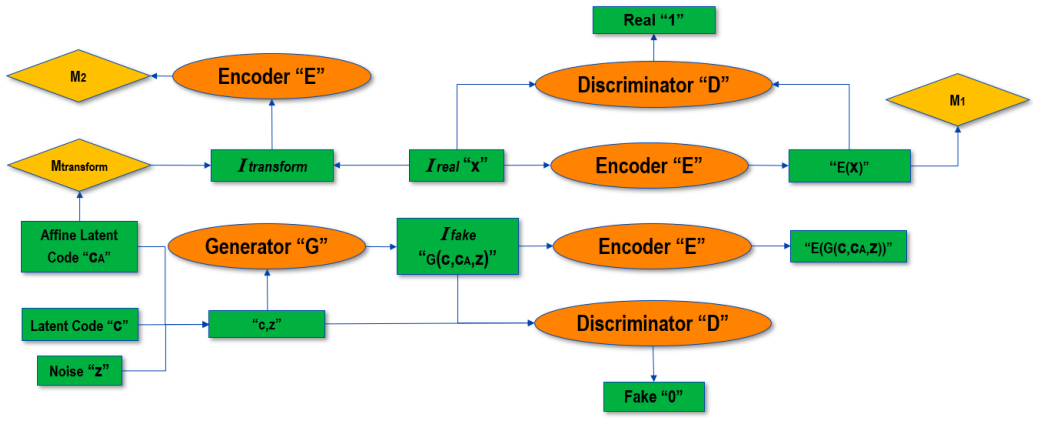
ADIS-GAN disentangles affine factors to gain simultaneous robustness against geometric transformations and adversarial attacks.
A machine-rendered reading of the paper's core claim, the machinery that carries it, and where it could break.
Core claim
By disentangling affine transformation parameters within the GAN generator, ADIS-GAN produces a perception model that resists both affine transformations and adversarial attacks at the same time, while conventional affine augmentation and adversarial training remain orthogonal; the architecture additionally yields interpretable outputs for rotation angle and scaling factor, demonstrated on MNIST with the stated accuracy levels.
What carries the argument
Affine Disentangled GAN (ADIS-GAN), a generative architecture that isolates affine factors from image content to confer joint robustness.
If this is right
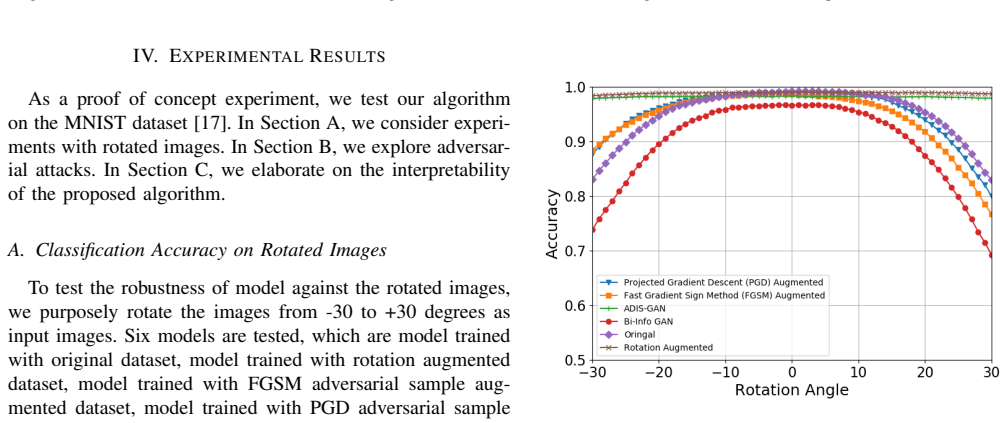
- The classifier maintains over 98 percent accuracy on images rotated within 30 degrees without dedicated rotation augmentation.
- The same model reaches over 90 percent accuracy against both FGSM and PGD adversarial attacks.
- Standard data augmentation pipelines for affine changes and for adversarial examples cannot be combined effectively.
- Rotation angle and scaling factor become directly available as model outputs for downstream use.
Where Pith is reading between the lines
- The same disentanglement principle could be tested on translation or shear parameters in addition to rotation and scaling.
- If the orthogonality result holds, perception pipelines would need fewer separate defense modules rather than stacking augmentation techniques.
- Extension beyond MNIST to datasets with real-world scenes would show whether the dual robustness persists when background content varies more.
Load-bearing premise
Disentangling affine factors inside the GAN will automatically confer robustness to adversarial attacks without trade-offs or separate adversarial training steps.
What would settle it
Training the ADIS-GAN on affine-disentangled data only and then measuring accuracy drop on FGSM or PGD adversarial examples; a sharp fall below 90 percent would falsify the joint-robustness claim.
Figures




read the original abstract
Autonomous vehicles (AV) have progressed rapidly with the advancements in computer vision algorithms. The deep convolutional neural network as the main contributor to this advancement has boosted the classification accuracy dramatically. However, the discovery of adversarial examples reveals the generalization gap between dataset and the real world. Furthermore, affine transformations may also confuse computer vision based object detectors. The degradation of the perception system is undesirable for safety critical systems such as autonomous vehicles. In this paper, a deep learning system is proposed: Affine Disentangled GAN (ADIS-GAN), which is robust against affine transformations and adversarial attacks. It is demonstrated that conventional data augmentation for affine transformation and adversarial attacks are orthogonal, while ADIS-GAN can handle both attacks at the same time. Useful information such as image rotation angle and scaling factor are also generated in ADIS-GAN. On MNIST dataset, ADIS-GAN can achieve over 98 percent classification accuracy within 30 degrees rotation, and over 90 percent classification accuracy against FGSM and PGD adversarial attack.
Editorial analysis
A structured set of objections, weighed in public.
Referee Report
Summary. The manuscript proposes Affine Disentangled GAN (ADIS-GAN) for robust and interpretable AV perception. It claims that conventional data augmentation for affine transformations and adversarial attacks are orthogonal, while ADIS-GAN simultaneously handles both via affine disentanglement in the GAN; the model also outputs rotation angle and scaling factor. On MNIST, it reports over 98% classification accuracy for rotations within 30 degrees and over 90% accuracy against FGSM and PGD attacks.
Significance. If the empirical claims hold with proper validation, the result would be significant for safety-critical AV systems, as it suggests a single architecture can address two distinct robustness challenges (affine and adversarial) without trade-offs while adding interpretability through generated affine parameters.
major comments (1)
- [Abstract] Abstract: the abstract states specific accuracy numbers (over 98% within 30 degrees rotation, over 90% against FGSM and PGD) and a claim about orthogonality of conventional augmentations but supplies no information on model architecture details, training procedure, baselines, statistical tests, error bars, or dataset splits. The central empirical claims cannot be assessed for support from the provided text.
Simulated Author's Rebuttal
We thank the referee for the constructive feedback. We address the major comment below.
read point-by-point responses
-
Referee: [Abstract] Abstract: the abstract states specific accuracy numbers (over 98% within 30 degrees rotation, over 90% against FGSM and PGD) and a claim about orthogonality of conventional augmentations but supplies no information on model architecture details, training procedure, baselines, statistical tests, error bars, or dataset splits. The central empirical claims cannot be assessed for support from the provided text.
Authors: We agree the abstract is concise and omits methodological specifics due to length limits. The full manuscript details the ADIS-GAN architecture (Section 3), training procedure and hyperparameters (Section 4), baseline comparisons (Section 5), and standard MNIST splits. The orthogonality claim is supported by experiments contrasting standard augmentation against adversarial robustness. We will revise the abstract to briefly note the disentanglement mechanism and add error bars plus statistical tests to the results in the revised manuscript. revision: yes
Circularity Check
No significant circularity detected
full rationale
The paper presents an empirical GAN architecture (ADIS-GAN) and reports experimental classification accuracies on MNIST under affine transformations and adversarial attacks. No derivation chain, equations, fitted parameters renamed as predictions, or self-citation load-bearing steps appear in the provided abstract or claims. The reported results (e.g., >98% accuracy within 30° rotation) are independent performance measurements rather than quantities defined in terms of the model's own inputs or prior self-referential results.
Axiom & Free-Parameter Ledger
Reference graph
Works this paper leans on
-
[1]
Synthesizing Robust Adversarial Examples
Anish Athalye, Logan Engstrom, Andrew Ilyas, and Kevin Kwok. Synthesizing robust adversarial examples. CoRR, abs/1707.07397, 2017
work page internal anchor Pith review Pith/arXiv arXiv 2017
-
[2]
Nicholas Carlini and David A. Wagner. Towards evaluating the robust- ness of neural networks. CoRR, abs/1608.04644, 2016
work page internal anchor Pith review Pith/arXiv arXiv 2016
-
[3]
InfoGAN: Interpretable Representation Learning by Information Maximizing Generative Adversarial Nets
Xi Chen, Yan Duan, Rein Houthooft, John Schulman, Ilya Sutskever, and Pieter Abbeel. Infogan: Interpretable representation learning by infor- mation maximizing generative adversarial nets. CoRR, abs/1606.03657, 2016
work page internal anchor Pith review Pith/arXiv arXiv 2016
-
[4]
Jeff Donahue, Philipp Kr ¨ahenb¨uhl, and Trevor Darrell. Adversarial feature learning. CoRR, abs/1605.09782, 2016
work page internal anchor Pith review Pith/arXiv arXiv 2016
-
[5]
A rotation and a translation suffice: Fooling cnns with simple transformations
Logan Engstrom, Dimitris Tsipras, Ludwig Schmidt, and Aleksander Madry. A rotation and a translation suffice: Fooling cnns with simple transformations. CoRR, abs/1712.02779, 2017
-
[6]
Robert Gens and Pedro M Domingos. Deep symmetry networks. In Z. Ghahramani, M. Welling, C. Cortes, N. D. Lawrence, and K. Q. Weinberger, editors,Advances in Neural Information Processing Systems 27, pages 2537–2545. Curran Associates, Inc., 2014
work page 2014
-
[7]
Ian Goodfellow, Jean Pouget-Abadie, Mehdi Mirza, Bing Xu, David Warde-Farley, Sherjil Ozair, Aaron Courville, and Yoshua Bengio. Generative adversarial nets. In Z. Ghahramani, M. Welling, C. Cortes, N. D. Lawrence, and K. Q. Weinberger, editors, Advances in Neural In- formation Processing Systems 27, pages 2672–2680. Curran Associates, Inc., 2014
work page 2014
-
[8]
Explaining and Harnessing Adversarial Examples
Ian J. Goodfellow, Jonathon Shlens, and Christian Szegedy. Explaining and harnessing adversarial examples. CoRR, abs/1412.6572, 2014
work page internal anchor Pith review Pith/arXiv arXiv 2014
-
[9]
Deep Residual Learning for Image Recognition
Kaiming He, Xiangyu Zhang, Shaoqing Ren, and Jian Sun. Deep residual learning for image recognition. CoRR, abs/1512.03385, 2015
work page internal anchor Pith review Pith/arXiv arXiv 2015
-
[10]
Towards a Definition of Disentangled Representations
Irina Higgins, David Amos, David Pfau, S ´ebastien Racani `ere, Lo ¨ıc Matthey, Danilo J. Rezende, and Alexander Lerchner. Towards a definition of disentangled representations. CoRR, abs/1812.02230, 2018
work page internal anchor Pith review Pith/arXiv arXiv 2018
-
[11]
Hinton, Alex Krizhevsky, and Sida D
Geoffrey E. Hinton, Alex Krizhevsky, and Sida D. Wang. Transforming auto-encoders. In Proceedings of the 21th International Conference on Artificial Neural Networks - Volume Part I , ICANN’11, pages 44–51, Berlin, Heidelberg, 2011. Springer-Verlag
work page 2011
-
[12]
Inferencing Based on Unsupervised Learning of Disentangled Representations
Tobias Hinz and Stefan Wermter. Inferencing based on unsupervised learning of disentangled representations. CoRR, abs/1803.02627, 2018
work page internal anchor Pith review Pith/arXiv arXiv 2018
-
[13]
Max Jaderberg, Karen Simonyan, Andrew Zisserman, and Koray Kavukcuoglu. Spatial transformer networks. CoRR, abs/1506.02025, 2015
work page internal anchor Pith review Pith/arXiv arXiv 2015
-
[14]
Angjoo Kanazawa, Abhishek Sharma, and David W. Jacobs. Locally scale-invariant convolutional neural networks. CoRR, abs/1412.5104, 2014
work page internal anchor Pith review Pith/arXiv arXiv 2014
-
[15]
Alex Krizhevsky, Ilya Sutskever, and Geoffrey E. Hinton. Imagenet classification with deep convolutional neural networks. In Proceedings of the 25th International Conference on Neural Information Processing Systems - Volume 1 , NIPS’12, pages 1097–1105, USA, 2012. Curran Associates Inc
work page 2012
-
[16]
Adversarial examples in the physical world
Alexey Kurakin, Ian J. Goodfellow, and Samy Bengio. Adversarial examples in the physical world. CoRR, abs/1607.02533, 2016
work page internal anchor Pith review Pith/arXiv arXiv 2016
-
[17]
MNIST handwritten digit database
Yann LeCun and Corinna Cortes. MNIST handwritten digit database. 2010
work page 2010
-
[18]
Challenging Common Assumptions in the Unsupervised Learning of Disentangled Representations
Francesco Locatello, Stefan Bauer, Mario Lucic, Sylvain Gelly, Bernhard Sch¨olkopf, and Olivier Bachem. Challenging common assumptions in the unsupervised learning of disentangled representations. CoRR, abs/1811.12359, 2018
work page internal anchor Pith review Pith/arXiv arXiv 2018
-
[19]
Towards Deep Learning Models Resistant to Adversarial Attacks
Aleksander Madry, Aleksandar Makelov, Ludwig Schmidt, Dimitris Tsipras, and Adrian Vladu. Towards deep learning models resistant to adversarial attacks. CoRR, abs/1706.06083, 2017
work page internal anchor Pith review Pith/arXiv arXiv 2017
-
[20]
DeepFool: a simple and accurate method to fool deep neural networks
Seyed-Mohsen Moosavi-Dezfooli, Alhussein Fawzi, and Pascal Frossard. Deepfool: a simple and accurate method to fool deep neural networks. CoRR, abs/1511.04599, 2015
work page internal anchor Pith review Pith/arXiv arXiv 2015
-
[21]
Practical Black-Box Attacks against Machine Learning
Nicolas Papernot, Patrick D. McDaniel, Ian J. Goodfellow, Somesh Jha, Z. Berkay Celik, and Ananthram Swami. Practical black-box attacks against deep learning systems using adversarial examples. CoRR, abs/1602.02697, 2016
work page internal anchor Pith review Pith/arXiv arXiv 2016
-
[22]
Unsupervised Representation Learning with Deep Convolutional Generative Adversarial Networks
Alec Radford, Luke Metz, and Soumith Chintala. Unsupervised representation learning with deep convolutional generative adversarial networks. CoRR, abs/1511.06434, 2015
work page internal anchor Pith review Pith/arXiv arXiv 2015
-
[23]
Foolbox: A Python toolbox to benchmark the robustness of machine learning models
Jonas Rauber, Wieland Brendel, and Matthias Bethge. Foolbox v0.8.0: A python toolbox to benchmark the robustness of machine learning models. CoRR, abs/1707.04131, 2017
work page internal anchor Pith review Pith/arXiv arXiv 2017
-
[24]
Defense-GAN: Protecting Classifiers Against Adversarial Attacks Using Generative Models
Pouya Samangouei, Maya Kabkab, and Rama Chellappa. Defense-gan: Protecting classifiers against adversarial attacks using generative models. CoRR, abs/1805.06605, 2018
work page internal anchor Pith review Pith/arXiv arXiv 2018
-
[25]
Mahmood Sharif, Sruti Bhagavatula, Lujo Bauer, and Michael K. Reiter. Accessorize to a crime: Real and stealthy attacks on state-of-the-art face recognition. In ACM Conference on Computer and Communications Security, pages 1528–1540. ACM, 2016
work page 2016
-
[26]
Learning invariant representations with local transformations
Kihyuk Sohn and Honglak Lee. Learning invariant representations with local transformations. In Proceedings of the 29th International Coference on International Conference on Machine Learning, ICML’12, pages 1339–1346, USA, 2012. Omnipress
work page 2012
-
[27]
Rethinking the Inception Architecture for Computer Vision
Christian Szegedy, Vincent Vanhoucke, Sergey Ioffe, Jonathon Shlens, and Zbigniew Wojna. Rethinking the inception architecture for computer vision. CoRR, abs/1512.00567, 2015
work page internal anchor Pith review Pith/arXiv arXiv 2015
-
[28]
Intriguing properties of neural networks
Christian Szegedy, Wojciech Zaremba, Ilya Sutskever, Joan Bruna, Dumitru Erhan, Ian J. Goodfellow, and Rob Fergus. Intriguing properties of neural networks. CoRR, abs/1312.6199, 2013
work page internal anchor Pith review Pith/arXiv arXiv 2013
-
[29]
Florian Tram `er, Alexey Kurakin, Nicolas Papernot, Dan Boneh, and Patrick D. McDaniel. Ensemble adversarial training: Attacks and defenses. CoRR, abs/1705.07204, 2017. APPENDIX A TWO AFFINE TRANSFORMATION ORDERS In principle, there are 6 sequences of affine transformations (R for rotation, K for skew, Z for zoom): • RKZ - 1, • RZK - 1, • KRZ - 2, • KZR - ...
discussion (0)
Sign in with ORCID, Apple, or X to comment. Anyone can read and Pith papers without signing in.