Yukawa-Screened Bose-Star Condensation
Pith reviewed 2026-05-25 04:28 UTC · model grok-4.3
The pith
Yukawa screening delays Bose-star condensation by replacing the Coulomb logarithm with a finite transport logarithm.
A machine-rendered reading of the paper's core claim, the machinery that carries it, and where it could break.
Core claim
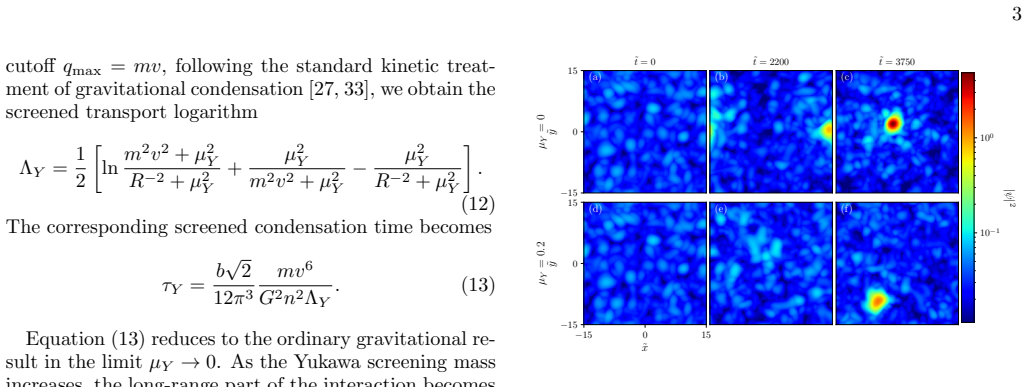
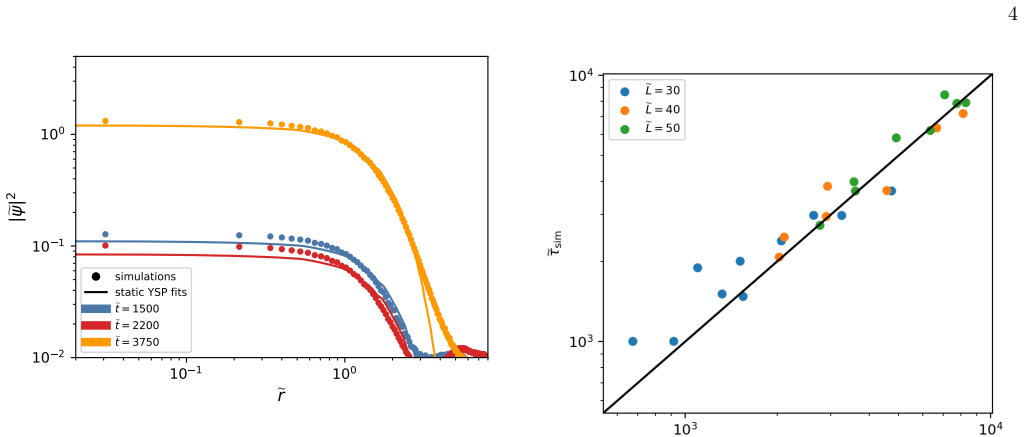
In the Yukawa-Schrödinger-Poisson system a finite interaction range suppresses the infrared kinetic relaxation that drives Bose-star condensation, replacing the divergent Coulomb logarithm with a finite Yukawa transport logarithm; the resulting analytic condensation timescale agrees with pseudospectral simulations across different screening lengths after one overall normalization is fitted, while the static equilibrium profiles become broader than their Newtonian counterparts.
What carries the argument
The screened kinetic condensation formula, obtained by replacing the gravitational Coulomb logarithm with a finite Yukawa transport logarithm.
If this is right
- Yukawa screening broadens the equilibrium Bose-star density profile relative to the Newtonian soliton.
- Condensation timescale increases systematically with the strength of Yukawa screening.
- The infrared kinetic relaxation responsible for condensation is suppressed by the finite interaction range.
- Homogeneous isotropic initial conditions produce condensation times consistent with the screened kinetic formula after normalization.
Where Pith is reading between the lines
- Models of scalar dark matter that include finite-range forces would predict later Bose-star formation than pure gravitational models.
- The same replacement of divergent logarithms by finite transport logs could be tested in other screened Poisson equations beyond the Yukawa case.
- The success of a single normalization fit suggests the kinetic description captures the dominant effect but may leave higher-order dynamical corrections unaccounted for.
Load-bearing premise
A single overall normalization parameter fitted once can be used to claim quantitative agreement between the analytic screened kinetic formula and full dynamical simulations for different screening lengths.
What would settle it
A set of simulations at varied screening lengths in which the measured condensation times deviate systematically from the single-parameter screened kinetic prediction.
Figures


read the original abstract
We study Bose-star formation in a Yukawa-Schr\"odinger-Poisson (YSP) system. A finite interaction range suppresses the infrared kinetic relaxation responsible for Bose-star condensation, modifying both the equilibrium Bose-star structure and the condensation timescale. We derive a screened kinetic condensation formula in which the ordinary gravitational Coulomb logarithm is replaced by a finite Yukawa transport logarithm. Static YSP solutions show that Yukawa screening broadens the Bose-star density profile relative to the ordinary Newtonian soliton. Fully dynamical pseudospectral simulations with homogeneous and isotropic initial conditions demonstrate that Yukawa screening systematically delays Bose-star condensation, in good agreement with the screened kinetic prediction after fitting a single overall normalization parameter.
Editorial analysis
A structured set of objections, weighed in public.
Referee Report
Summary. The paper examines Bose-star condensation in the Yukawa-Schrödinger-Poisson system. It derives a screened kinetic formula that replaces the gravitational Coulomb logarithm with a finite Yukawa transport logarithm, presents static solutions showing broadened Bose-star density profiles under screening, and reports fully dynamical pseudospectral simulations with homogeneous isotropic initial conditions that exhibit delayed condensation, stated to agree with the screened formula after fitting one overall normalization parameter.
Significance. If the central quantitative claim can be secured without post-hoc normalization fitting, the work would usefully extend kinetic-theory treatments of gravitational condensation to finite-range interactions, with possible relevance to boson-star or ultralight-dark-matter models that incorporate screening. The static YSP solutions and the pseudospectral setup with isotropic initial conditions are internally consistent with the problem formulation.
major comments (1)
- [Abstract; dynamical simulations section] Abstract and the dynamical-simulations section: the reported quantitative agreement between the screened kinetic formula and the condensation timescales is obtained only after fitting a single overall normalization parameter to the simulation data. Because this constant is adjusted to the output being compared, the comparison primarily verifies that some constant exists that aligns the curves rather than independently testing whether the Yukawa-log replacement correctly captures the dependence on screening length.
Simulated Author's Rebuttal
We thank the referee for the careful reading of the manuscript and for identifying this important point regarding the strength of the quantitative comparison. We address the major comment below.
read point-by-point responses
-
Referee: [Abstract; dynamical simulations section] Abstract and the dynamical-simulations section: the reported quantitative agreement between the screened kinetic formula and the condensation timescales is obtained only after fitting a single overall normalization parameter to the simulation data. Because this constant is adjusted to the output being compared, the comparison primarily verifies that some constant exists that aligns the curves rather than independently testing whether the Yukawa-log replacement correctly captures the dependence on screening length.
Authors: We agree that the absolute scale of the condensation timescales is aligned by fitting a single overall normalization constant. This constant is expected from the kinetic derivation, which fixes the functional form but leaves an O(1) prefactor undetermined. The constant is determined once from the full set of runs and then held fixed while the Yukawa screening length is varied. The screened kinetic formula then predicts a specific variation of the timescale with screening length through the Yukawa transport logarithm; the simulations test whether this predicted dependence is recovered. We will revise the abstract and the dynamical-simulations section to state explicitly that the normalization is not readjusted for each screening value and to emphasize that the test concerns the functional dependence on the logarithm rather than the absolute scale alone. revision: yes
Circularity Check
Fitting one overall normalization parameter reduces the claimed quantitative agreement to a fit rather than an independent prediction
specific steps
-
fitted input called prediction
[Abstract]
"Fully dynamical pseudospectral simulations with homogeneous and isotropic initial conditions demonstrate that Yukawa screening systematically delays Bose-star condensation, in good agreement with the screened kinetic prediction after fitting a single overall normalization parameter."
The analytic formula is compared to simulation output only after a free normalization constant is adjusted to the same data. The resulting agreement therefore validates the existence of some constant that aligns the curves rather than confirming that the Yukawa-log replacement correctly predicts the scaling with screening length.
full rationale
The paper derives a screened kinetic condensation formula by replacing the Coulomb logarithm with a Yukawa transport logarithm and presents static YSP solutions. These steps appear self-contained. The central claim of agreement, however, is made only after fitting a single overall normalization to the pseudospectral simulation data. This matches the fitted_input_called_prediction pattern exactly: the reported match is statistically forced by the fit and does not independently test the functional dependence on screening length. No self-citation chains, self-definitional steps, or ansatz smuggling are evident from the given text.
Axiom & Free-Parameter Ledger
free parameters (1)
- overall normalization parameter
axioms (1)
- domain assumption The kinetic condensation rate formula remains applicable when the gravitational Coulomb logarithm is replaced by a finite Yukawa transport logarithm.
Lean theorems connected to this paper
-
IndisputableMonolith/Cost/FunctionalEquation.leanwashburn_uniqueness_aczel contradicts?
contradictsCONTRADICTS: the theorem conflicts with this paper passage, or marks a claim that would need revision before publication.
τ_Y = b √2 / (12 π³) m v⁶ / (G² n² Λ_Y) after fitting b_fit≈0.54
-
IndisputableMonolith/Foundation/AlphaCoordinateFixation.leanJ_uniquely_calibrated_via_higher_derivative contradicts?
contradictsCONTRADICTS: the theorem conflicts with this paper passage, or marks a claim that would need revision before publication.
Yukawa transport logarithm Λ_Y replaces Coulomb log; single overall normalization fitted
What do these tags mean?
- matches
- The paper's claim is directly supported by a theorem in the formal canon.
- supports
- The theorem supports part of the paper's argument, but the paper may add assumptions or extra steps.
- extends
- The paper goes beyond the formal theorem; the theorem is a base layer rather than the whole result.
- uses
- The paper appears to rely on the theorem as machinery.
- contradicts
- The paper's claim conflicts with a theorem or certificate in the canon.
- unclear
- Pith found a possible connection, but the passage is too broad, indirect, or ambiguous to say the theorem truly supports the claim.
Reference graph
Works this paper leans on
-
[1]
Planck 2018 results. VI. Cosmological parameters
N. Aghanimet al.(Planck), Astron. Astrophys.641, A6 (2020), arXiv:1807.06209 [astro-ph.CO]
work page internal anchor Pith review Pith/arXiv arXiv 2020
-
[2]
R. D. Peccei, inAxions, Lecture Notes in Physics, Berlin Springer Verlag, Vol. 741, edited by M. Kuster, G. Raf- felt, and B. Beltr´ an (2008) p. 3, hep-ph/0607268
work page internal anchor Pith review Pith/arXiv arXiv 2008
- [3]
- [4]
-
[5]
J. E. Kim, Phys. Rev. Lett.43, 103 (1979)
work page 1979
-
[6]
M. A. Shifman, A. Vainshtein, and V. I. Zakharov, Nucl. Phys. B166, 493 (1980)
work page 1980
- [7]
- [8]
-
[9]
W. Hu, R. Barkana, and A. Gruzinov, Phys. Rev. Lett. 85, 1158 (2000), astro-ph/0003365
work page internal anchor Pith review Pith/arXiv arXiv 2000
-
[10]
D. J. E. Marsh, Phys. Rep.643, 1 (2016), arXiv:1510.07633
work page internal anchor Pith review Pith/arXiv arXiv 2016
-
[11]
L. Hui, J. P. Ostriker, S. Tremaine, and E. Witten, Phys. Rev.D95, 043541 (2017), arXiv:1610.08297 [astro- ph.CO]
work page internal anchor Pith review Pith/arXiv arXiv 2017
-
[12]
A search for ultra-light axions using precision cosmological data
R. Hlozek, D. Grin, D. J. E. Marsh, and P. G. Ferreira, Phys. Rev. D91, 103512 (2015), arXiv:1410.2896
work page internal anchor Pith review Pith/arXiv arXiv 2015
-
[13]
Using the Full Power of the Cosmic Microwave Background to Probe Axion Dark Matter
R. Hlozek, D. J. E. Marsh, and D. Grin, Mon. Not. Roy. Astron. Soc.476, 3063 (2018), arXiv:1708.05681 [astro- ph.CO]
work page internal anchor Pith review Pith/arXiv arXiv 2018
-
[14]
L. D. Luzio, M. Giannotti, E. Nardi, and L. Visinelli, The landscape of qcd axion models (2020), arXiv:2003.01100 [hep-ph]
work page internal anchor Pith review Pith/arXiv arXiv 2020
-
[15]
P. Sikivie, Lect. Notes Phys.741, 19 (2008), arXiv:astro- ph/0610440
-
[16]
D. J. Kaup, Physical Review172, 1331 (1968)
work page 1968
- [17]
- [18]
-
[19]
Formation of Solitonic Stars Through Gravitational Cooling
E. Seidel and W.-M. Suen, Phys. Rev. Lett.72, 2516 (1994), gr-qc/9309015
work page internal anchor Pith review Pith/arXiv arXiv 1994
- [20]
-
[21]
P. H. Chavanis and L. Delfini, Phys. Rev. D84, 043532 (2011), arXiv:1103.2054 [astro-ph.CO]
work page internal anchor Pith review Pith/arXiv arXiv 2011
- [22]
-
[23]
J. Eby, C. Kouvaris, N. G. Nielsen, and L. Wijewardhana, JHEP02, 028, arXiv:1511.04474 [hep-ph]
work page internal anchor Pith review Pith/arXiv arXiv
- [24]
-
[25]
Bose-Einstein Condensation of Dark Matter Axions
P. Sikivie and Q. Yang, Phys. Rev. Lett.103, 111301 (2009), arXiv:0901.1106 [hep-ph]
work page internal anchor Pith review Pith/arXiv arXiv 2009
-
[26]
A. H. Guth, M. P. Hertzberg, and C. Prescod-Weinstein, Phys. Rev. D92, 103513 (2015), arXiv:1412.5930
work page internal anchor Pith review Pith/arXiv arXiv 2015
-
[27]
D. G. Levkov, A. G. Panin, and I. I. Tkachev, Phys. Rev. Lett.121, 151301 (2018), arXiv:1804.05857 [astro- ph.CO]
work page internal anchor Pith review Pith/arXiv arXiv 2018
-
[28]
K. Kirkpatrick, A. E. Mirasola, and C. Prescod- Weinstein, Phys. Rev. D102, 103012 (2020), arXiv:2007.07438 [hep-ph]
-
[29]
B. Schwabe, J. C. Niemeyer, and J. F. Engels, Physical Review D94, 10.1103/physrevd.94.043513 (2016)
-
[30]
Formation and structure of ultralight bosonic dark matter halos
J. Veltmaat, J. C. Niemeyer, and B. Schwabe, Phys. Rev. D98, 043509 (2018), arXiv:1804.09647 [astro-ph.CO]
work page internal anchor Pith review Pith/arXiv arXiv 2018
-
[31]
B. Eggemeier and J. C. Niemeyer, Phys. Rev. D100, 063528 (2019), arXiv:1906.01348 [astro-ph.CO]
-
[32]
J. Chen, X. Du, E. W. Lentz, D. J. E. Marsh, and J. C. Niemeyer, Phys. Rev. D104, 083022 (2021)
work page 2021
-
[33]
J. Chen, X. Du, E. W. Lentz, and D. J. E. Marsh, Phys. Rev. D106, 023009 (2022)
work page 2022
-
[34]
N. Bar, D. Blas, K. Blum, and S. Sibiryakov, Phys. Rev. D98, 083027 (2018), arXiv:1805.00122 [astro-ph.CO]
work page internal anchor Pith review Pith/arXiv arXiv 2018
-
[35]
J. Chen, X. Du, M. Zhou, A. Benson, and D. J. E. Marsh, Phys. Rev. D108, 083021 (2023)
work page 2023
-
[36]
J. Chen, L. H. Nguyen, and D. J. E. Marsh, Phys. Rev. D111, 043031 (2025)
work page 2025
-
[37]
J. Chen and H.-Y. Zhang, Journal of Cosmology and As- troparticle Physics2024, 005
- [38]
-
[39]
Zhang, JHEP04, 174, arXiv:2406.05031 [hep-ph]
H.-Y. Zhang, JHEP04, 174, arXiv:2406.05031 [hep-ph]
-
[40]
J. T. Mendon¸ ca, Symmetry13, 1007 (2021)
work page 2021
-
[41]
L. M. Widrow and N. Kaiser, ApJLett416, L71 (1993)
work page 1993
-
[42]
Cosmic Structure as the Quantum Interference of a Coherent Dark Wave
H.-Y. Schive, T. Chiueh, and T. Broadhurst, Nature Physics10, 496 (2014), arXiv:1406.6586
work page internal anchor Pith review Pith/arXiv arXiv 2014
-
[43]
P. Mocz, M. Vogelsberger, V. Robles, J. Zavala, M. Boylan-Kolchin, and L. Hernquist, Mon. Not. Roy. Astron. Soc.471, 4559 (2017), arXiv:1705.05845 [astro- ph.CO]
work page internal anchor Pith review Pith/arXiv arXiv 2017
discussion (0)
Sign in with ORCID, Apple, or X to comment. Anyone can read and Pith papers without signing in.