Tree Containment Parameterized by Scanwidth
Pith reviewed 2026-06-28 20:25 UTC · model grok-4.3
The pith
Tree Containment can be decided in O(4^{k + k log k} n + n m^2) time given a tree-extension of width k.
A machine-rendered reading of the paper's core claim, the machinery that carries it, and where it could break.
Core claim
TREE CONTAINMENT can be solved in O(4^{k + k log k} n + n m^2) time when the input network is supplied with a tree-extension of width k, and no algorithm running in 2^{o(c log c)} n^{O(1)} time exists under the Exponential Time Hypothesis even on binary inputs, where c is the directed cutwidth.
What carries the argument
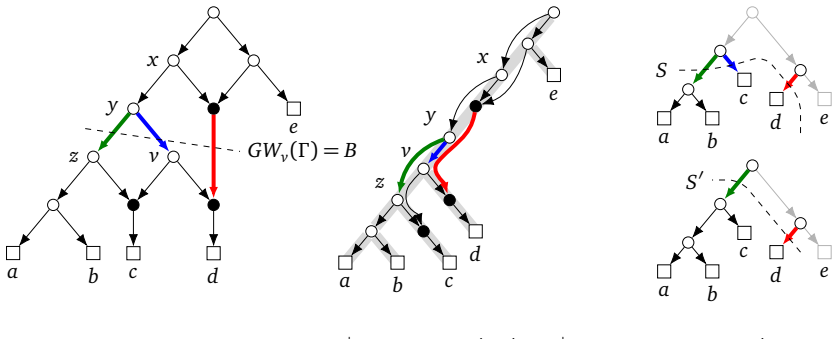
A tree-extension of width k, a rooted tree that extends the network such that at most k arcs cross any cut, used to drive dynamic programming that tracks possible embeddings of the input tree.
If this is right
- Networks whose scanwidth is bounded by a small constant admit polynomial-time solutions for Tree Containment.
- The exponential dependence on k cannot be improved to 2^{o(k log k)} under ETH.
- The same lower bound applies when the input network is required to be binary.
Where Pith is reading between the lines
- The same tree-extension technique may yield FPT algorithms for other containment-style problems on phylogenetic networks.
- Heuristics that compute or approximate small-width tree-extensions would make the algorithm practical on real data.
- The log k factor in the exponent suggests that scanwidth-based methods will require careful implementation to avoid hidden polynomial overhead.
Load-bearing premise
The network is given together with a tree-extension whose width k is small.
What would settle it
An algorithm that solves Tree Containment on binary networks in 2^{o(c log c)} n^{O(1)} time for directed cutwidth c, or an instance where the stated runtime bound is exceeded.
Figures
read the original abstract
TREE CONTAINMENT is a central decision problem in mathematical phylogenetics, asking whether a given rooted phylogenetic tree is embeddable in ("displayed by") a given rooted phylogenetic network. While the problem is NP-complete for general networks, many algorithmic advances have relied on structural parameters that capture how "tree-like" a network is. In this paper we investigate TREE CONTAINMENT under the structural parameter scanwidth, a directed width measure generalizing popular parameters measuring tree-likeness of phylogenetic networks. We first present a parameterized algorithm that solves the problem in $O(4^{k + k\log{k}} n + nm^2)$ time, where $n$ and $m$ are the numbers of nodes and arcs in the network and $k$ is the width of a given tree-extension. Complementing this upper bound, we prove a matching lower bound under the Exponential-Time Hypothesis (ETH), showing that there is no algorithm for TREE CONTAINMENT that runs in $2^{o(c\log{c})} n^{O(1)}$ time, even on binary inputs, where $c$ is the directed cutwidth of the input network, which upper-bounds the scanwidth $k$.
Editorial analysis
A structured set of objections, weighed in public.
Referee Report
Summary. The manuscript claims an FPT algorithm for TREE CONTAINMENT parameterized by the width k of a given tree-extension, with runtime O(4^{k + k log k} n + n m^2), and a matching ETH lower bound of 2^{o(c log c)} n^{O(1)} even on binary networks, where c is the directed cutwidth.
Significance. This provides a tight characterization of the parameterized complexity of TREE CONTAINMENT under scanwidth, a useful structural parameter for phylogenetic networks. The matching bounds and the fact that the lower bound holds even for binary inputs are notable strengths.
minor comments (1)
- [Abstract] The runtime bound uses 'log' without specifying the base; this should be clarified as it affects the constant factors in the exponent.
Simulated Author's Rebuttal
We thank the referee for their positive evaluation of our manuscript and for recommending acceptance. We are pleased that the tight FPT algorithm and matching ETH lower bound, including the binary case, were recognized as notable contributions to the parameterized complexity of TREE CONTAINMENT under scanwidth.
Circularity Check
No significant circularity
full rationale
The paper supplies an explicit dynamic-programming algorithm whose runtime is derived directly from the given tree-extension width k (standard FPT setup) and proves a lower bound by reduction from an external assumption (ETH) that does not depend on any fitted quantity or self-referential definition inside the paper. The directed-cutwidth parameter c is related to scanwidth only by the stated inequality c ≥ k; the matching exponent form is a deliberate design choice, not a circular reduction. No self-citation is load-bearing for the central claims, and no ansatz or renaming is used to derive the stated bounds.
Axiom & Free-Parameter Ledger
axioms (1)
- domain assumption Exponential Time Hypothesis (ETH)
Reference graph
Works this paper leans on
-
[1]
Tree containment with soft polytomies
Matthias Bentert and Mathias Weller. “Tree containment with soft polytomies”. In:Journal of Graph Algorithms and Applications25.1 (2021), pp. 417–436.DOI:10.7155/jgaa.00565
-
[2]
Scanning Phylogenetic Networks Is NP-hard
Vincent Berry, Celine Scornavacca, and Mathias Weller. “Scanning Phylogenetic Networks Is NP-hard”. In: Updated version at https : / / hal . science / hal - 02353161. Jan. 2020, pp. 519–530.DOI: 10.1007/978-3-030-38919-2_42
-
[3]
A partial k-arboretum of graphs with bounded treewidth
Hans L. Bodlaender. “A partial k-arboretum of graphs with bounded treewidth”. In:Theoretical Computer Science209.1 (1998), pp. 1–45.ISSN: 0304-3975.DOI:10.1016/S0304-3975(97)00228-4
-
[4]
Exploiting Low Scanwidth to Resolve Soft Polytomies
Sebastian Bruchhold and Mathias Weller. “Exploiting Low Scanwidth to Resolve Soft Polytomies”. In: Proceedings of the 51st International Conference on Current Trends in Theory and Practice of Computer Science, SOFSEM 2026. Lecture Notes in Computer Science. Springer, 2026, pp. 332–346.DOI: 10. 1007/978-3-032-17801-5\_25
2026
-
[5]
Parameterized Algorithms in Bioinformatics: An Overview
Laurent Bulteau and Mathias Weller. “Parameterized Algorithms in Bioinformatics: An Overview”. In: Algorithms12.12 (2019), p. 256.DOI:10.3390/A12120256. 17
-
[6]
Fixed-Parameter Tractability of Directed Multiway Cut Parameterized by the Size of the Cutset
Rajesh Chitnis, MohammadTaghi Hajiaghayi, and Dániel Marx. “Fixed-Parameter Tractability of Directed Multiway Cut Parameterized by the Size of the Cutset”. In:SIAM Journal on Computing42.4 (2013), pp. 1674–1696.DOI:10.1137/12086217X
-
[7]
Marek Cygan, Fedor V . Fomin, Łukasz Kowalik, Daniel Lokshtanov, Dániel Marx, Marcin Pilipczuk, Michał Pilipczuk, and Saket Saurabh. Springer International Publishing, 2015.ISBN: 978-3-319-21275-3.DOI: 10.1007/978-3-319-21275-3_14
-
[8]
Displaying trees across two phylogenetic networks
Janosch Döcker, Simone Linz, and Charles Semple. “Displaying trees across two phylogenetic networks”. In:Theoretical Computer Science796 (2019), pp. 129–146.ISSN: 0304-3975.DOI: 10.1016/j.tcs. 2019.09.003
-
[10]
Solving the tree containment problem in linear time for nearly stable phylogenetic networks
Philippe Gambette, Andreas D.M. Gunawan, Anthony Labarre, Stéphane Vialette, and Louxin Zhang. “Solving the tree containment problem in linear time for nearly stable phylogenetic networks”. In:Discrete Applied Mathematics246 (2018). The Combinatorics of Graphs and Strings, pp. 62–79.ISSN: 0166-218X. DOI:10.1016/j.dam.2017.07.015
-
[11]
Do branch lengths help to locate a tree in a phylogenetic network?
Philippe Gambette, Leo Van Iersel, Steven Kelk, Fabio Pardi, and Celine Scornavacca. “Do branch lengths help to locate a tree in a phylogenetic network?” In:Bulletin of mathematical biology78.9 (2016), pp. 1773–1795.DOI:10.1007/s11538-016-0199-4
-
[12]
Solving the Tree Containment Problem for Reticulation-Visible Networks in Linear Time
Andreas D. M. Gunawan. “Solving the Tree Containment Problem for Reticulation-Visible Networks in Linear Time”. In:Algorithms for Computational Biology. Cham: Springer International Publishing, 2018, pp. 24–36.ISBN: 978-3-319-91938-6.DOI:10.1007/978-3-319-91938-6_3
-
[13]
Computing the scanwidth of directed acyclic graphs
Niels Holtgrefe. “Computing the scanwidth of directed acyclic graphs”. available athttp://resolver. tudelft.nl/uuid:9c82fd2a-5841-4aac-8e40-d4d22542cdf5 . MA thesis. Delft University of Technology , Delft, The Netherlands, July 2023
2023
-
[14]
Huson, Regula Rupp, and Celine Scornavacca.Phylogenetic Networks: Concepts, Algorithms and Applications
Daniel H. Huson, Regula Rupp, and Celine Scornavacca.Phylogenetic Networks: Concepts, Algorithms and Applications. Cambridge University Press, 2010
2010
-
[15]
R. Impagliazzo and R. Paturi. “Complexity of k-SAT”. In:Proceedings of the 14th Annual IEEE Conference on Computational Complexity. 1999, pp. 237–240.DOI:10.1109/CCC.1999.766282
-
[16]
Which Problems Have Strongly Exponential Complexity?
Russell Impagliazzo, Ramamohan Paturi, and Francis Zane. “Which Problems Have Strongly Exponential Complexity?” In:Journal of Computer and System Sciences63.4 (2001), pp. 512–530.ISSN: 0022-0000. DOI:10.1006/jcss.2001.1774
-
[17]
Seeing the trees and their branches in the network is hard
Iyad A Kanj, Luay Nakhleh, Cuong Than, and Ge Xia. “Seeing the trees and their branches in the network is hard”. In:Theoretical Computer Science401.1-3 (2008), pp. 153–164.DOI: 10.1016/j.tcs.2008. 04.019
-
[18]
An Improved Parameterized Algorithm for Treewidth
Tuukka Korhonen and Daniel Lokshtanov. “An Improved Parameterized Algorithm for Treewidth”. In: Proceedings of the 55th Annual ACM Symposium on Theory of Computing. STOC 2023. Orlando, FL, USA: Association for Computing Machinery, 2023, pp. 528–541.ISBN: 9781450399135.DOI: 10.1145/ 3564246.3585245
-
[19]
Counting Trees in a Phylogenetic Network Is #P-Complete
Simone Linz, Katherine St. John, and Charles Semple. “Counting Trees in a Phylogenetic Network Is #P-Complete”. In:SIAM Journal on Computing42.4 (2013), pp. 1768–1776.DOI: 10.1137/12089394X
-
[20]
Slightly Superexponential Parameterized Prob- lems
Daniel Lokshtanov, Dániel Marx, and Saket Saurabh. “Slightly Superexponential Parameterized Prob- lems”. In:SIAM J. Comput.47.3 (2018), pp. 675–702.DOI:10.1137/16M1104834
-
[21]
Parameterized graph separation problems
Dániel Marx. “Parameterized graph separation problems”. In:Theoretical Computer Science351.3 (2006). Parameterized and Exact Computation, pp. 394–406.ISSN: 0304-3975.DOI: https://doi.org/10. 1016/j.tcs.2005.10.007
2006
- [22]
-
[23]
Locating a tree in a phylogenetic network
Leo van Iersel, Charles Semple, and Mike Steel. “Locating a tree in a phylogenetic network”. In:Informa- tion Processing Letters110.23 (2010), pp. 1037–1043.ISSN: 0020-0190.DOI: 10.1016/j.ipl.2010. 07.027. 18
-
[24]
Embedding phylogenetic trees in networks of low treewidth
Leo van Iersel, Mark Jones, and Mathias Weller. “Embedding phylogenetic trees in networks of low treewidth”. In:Discrete Mathematics & Theoretical Computer Sciencevol. 25:2, 4 (2023):Discrete Algo- rithms.ISSN: 1365-8050.DOI:10.46298/dmtcs.10116
-
[25]
Linear-Time Tree Containment in Phylogenetic Networks
Mathias Weller. “Linear-Time Tree Containment in Phylogenetic Networks”. In:Comparative Genomics. Cham: Springer International Publishing, 2018, pp. 309–323.ISBN: 978-3-030-00834-5.DOI: 10.1007/ 978-3-030-00834-5_18
2018
-
[26]
Seminar in Discrete Mathematics and Optimization, Delft University of Technology
Norbert Zeh.An FPT Algorithm for Scanwidth. Seminar in Discrete Mathematics and Optimization, Delft University of Technology. Talk given at TU Delft. Sept. 2023.URL: https://www.tudelft.nl/ en/events/2023/eemcs/diam/seminars-in-discrete-mathematics-and-optimization/ dmo-norbert-zeh-an-fpt-algorithm-for-scanwidth. 19
2023
discussion (0)
Sign in with ORCID, Apple, or X to comment. Anyone can read and Pith papers without signing in.