Gaia-Sausage-Enceladus: Lithium evolution from early red-giant-branch and main-sequence stars
Pith reviewed 2026-05-25 03:27 UTC · model grok-4.3
The pith
A chemical evolution model reproduces lithium plateaus at low metallicities in both main-sequence and early red-giant-branch stars of the Gaia-Sausage-Enceladus galaxy.
A machine-rendered reading of the paper's core claim, the machinery that carries it, and where it could break.
Core claim
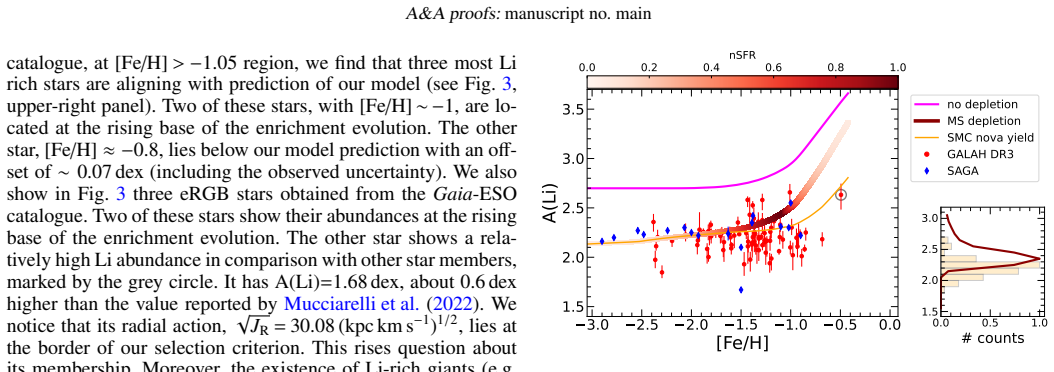
The central claim is that lithium evolution in the GSE galaxy shows the Spite plateau in metal-poor main-sequence stars and a parallel plateau in early red-giant-branch stars at low metallicities, as reproduced by a dedicated chemical evolution model that agrees with the compiled observational data. At higher metallicities the data contain candidates for lithium-enriched stars whose main source is nova explosions, while the overall sample hints at a lower nova lithium yield in GSE than in the Milky Way. The scarcity of high-metallicity GSE stars is attributed to the merger event itself.
What carries the argument
The chemical evolution model of lithium specifically constructed for the GSE galaxy, which incorporates standard stellar and nova sources and is calibrated to reproduce the observed plateaus in the compiled survey data.
If this is right
- The Spite plateau is a universal feature across galactic systems.
- The early red-giant-branch lithium plateau is also likely universal.
- Nova explosions dominate lithium production at higher metallicities.
- The merger limits the number of high-metallicity stars available for nova-yield studies.
Where Pith is reading between the lines
- Confirmation of the same plateaus in other accreted dwarfs would indicate that lithium plateaus arise independently of a galaxy's specific merger history.
- Future high-metallicity GSE members could tighten constraints on nova lithium yields once more stars are identified.
- The observed scarcity of high-metallicity stars may itself be a direct signature of how the merger truncated chemical evolution in GSE.
Load-bearing premise
The stars chosen from GALAH, Gaia-ESO and SAGA are genuine GSE members with negligible Milky Way contamination and the merger left lithium evolution unaltered in ways the model does not capture.
What would settle it
A larger sample of confirmed GSE stars at low metallicities that shows no lithium plateau in either main-sequence or early red-giant-branch stars would falsify the central claim.
Figures


read the original abstract
The combination of data from the Gaia satellite and large ground-based spectroscopic surveys recently lead to a milestone understanding of our Galaxy's formation history, marked by the identification of stellar remnants of the accreted Gaia-Sausage-Enceladus (GSE) dwarf galaxy. Lithium (Li) remains one of the most difficult elements to explain because of its complex behaviour over evolutionary timescales: both the Spite plateau observed in metal-poor main-sequence (MS) stars and the recently discovered Li plateau of early red-giant-branch (eRGB) stars in the Milky Way challenge current galactic chemical evolution models. In this article, we investigate the viability of these Li-plateau features in the GSE galaxy, using public data from current big surveys: GALAH, Gaia-ESO, and the collective SAGA database. We present a chemical evolution model of Li for GSE and find agreement with the observed data. We find the signature of Li plateau at low metallicities in both eRGB and MS stars. At higher metallicities, we see candidates of the Li-enriched stars that have their main contribution from nova explosions. These results reinforce the universality of the Spite plateau, and indicate that the eRGB Li plateau might also be a universal feature across different galactic systems. A hint of low nova Li yield in GSE is suggested by our eRGB sample from GALAH. However, the lack of stars at high metallicities, possibly caused by the merger event, prevents a precise study of nova contributions, and we expect that upcoming data will enable a more comprehensive analysis.
Editorial analysis
A structured set of objections, weighed in public.
Referee Report
Summary. The manuscript examines lithium abundances in stars associated with the Gaia-Sausage-Enceladus (GSE) accreted galaxy using public data from the GALAH, Gaia-ESO, and SAGA surveys. It presents a galactic chemical evolution model for Li in GSE, reports agreement with the observed abundances, identifies Li plateaus at low metallicities in both main-sequence (MS) and early red-giant-branch (eRGB) stars, and attributes higher-metallicity Li-enriched candidates to nova contributions. The work interprets these findings as evidence for the universality of the Spite and eRGB Li plateaus across galactic systems and suggests a low nova Li yield in GSE.
Significance. If the GSE membership selection proves robust against Milky Way contamination and the chemical evolution model is shown to be independently constrained rather than tuned to the same data, the results would provide meaningful support for the universality of Li plateaus beyond the Milky Way and offer new constraints on Li production channels in dwarf-galaxy environments. The multi-survey approach is a positive aspect of the data compilation.
major comments (2)
- [Data selection and membership criteria] Data selection and membership criteria (likely §2–3): the manuscript supplies no quantitative contamination fractions, membership probabilities, or robustness tests against alternative kinematic cuts for the low-metallicity GSE sample. This is load-bearing for the central claim of GSE-specific Li plateaus, because even moderate (20–30 %) Milky Way foreground contamination could produce the apparent plateaus without requiring GSE chemical evolution.
- [Chemical evolution model] Chemical evolution model description (abstract and model section): no equations, parameter values, or independent constraints on the nova Li yield are provided. Without these, it is impossible to determine whether the reported model-data agreement constitutes a genuine prediction or a fit whose free parameters (including nova yield) were adjusted to the same GALAH/Gaia-ESO/SAGA abundances used to claim the plateaus.
minor comments (2)
- [Abstract] The abstract introduces the acronym 'eRGB' without an explicit definition on first use.
- [Abstract and results summary] The number of stars retained after each selection cut and the precise metallicity range used for the plateau identification are not stated in the abstract or summary tables.
Simulated Author's Rebuttal
We thank the referee for the detailed review and constructive comments. We address each major comment below and will revise the manuscript accordingly where appropriate.
read point-by-point responses
-
Referee: [Data selection and membership criteria] Data selection and membership criteria (likely §2–3): the manuscript supplies no quantitative contamination fractions, membership probabilities, or robustness tests against alternative kinematic cuts for the low-metallicity GSE sample. This is load-bearing for the central claim of GSE-specific Li plateaus, because even moderate (20–30 %) Milky Way foreground contamination could produce the apparent plateaus without requiring GSE chemical evolution.
Authors: We agree that quantitative estimates of contamination are important for the robustness of our results. In the revised version, we will add a section discussing the membership selection criteria in more detail, including estimates of potential Milky Way contamination based on the kinematic cuts used and tests with alternative selections. We will also provide membership probabilities where possible using the available data. revision: yes
-
Referee: [Chemical evolution model] Chemical evolution model description (abstract and model section): no equations, parameter values, or independent constraints on the nova Li yield are provided. Without these, it is impossible to determine whether the reported model-data agreement constitutes a genuine prediction or a fit whose free parameters (including nova yield) were adjusted to the same GALAH/Gaia-ESO/SAGA abundances used to claim the plateaus.
Authors: We acknowledge that the model description in the current manuscript lacks explicit equations and parameter values. The chemical evolution model follows standard prescriptions for Li production, with the nova yield adjusted to provide the best match to the observed data in GSE, as the hint of low yield is derived from the comparison. In the revision, we will include the full model equations, list all parameter values used, and clarify which parameters are independently constrained from literature and which are informed by the GSE data. This will allow readers to assess the nature of the agreement. revision: yes
Circularity Check
No significant circularity detected; model application is self-contained
full rationale
The paper applies a standard galactic chemical evolution model to GSE stellar data from GALAH, Gaia-ESO and SAGA, reporting agreement with observed Li plateaus at low metallicity and nova contributions at higher metallicity. No equations, parameter fits, or self-citations are shown in the abstract that would make any prediction equivalent to its inputs by construction. The derivation chain consists of population selection followed by model comparison, with no load-bearing step reducing to a fitted parameter renamed as a prediction or to an author-derived uniqueness theorem. The result is therefore an independent application of existing GCE frameworks rather than a tautological re-expression of the input data.
Axiom & Free-Parameter Ledger
free parameters (1)
- nova Li yield
axioms (1)
- domain assumption Standard galactic chemical evolution model assumptions (star formation history, yields, mixing) apply without modification to GSE.
Reference graph
Works this paper leans on
-
[1]
Gaia Data Release 2: Observational Hertzsprung-Russell diagrams
Gaia Data Release 2. Observational Hertzsprung-Russell diagrams. , keywords =. doi:10.1051/0004-6361/201832843 , archivePrefix =. 1804.09378 , primaryClass =
work page internal anchor Pith review Pith/arXiv arXiv doi:10.1051/0004-6361/201832843
-
[2]
Atomic Diffusion and Mixing in Old Stars. I. Very Large Telescope FLAMES-UVES Observations of Stars in NGC 6397. , keywords =. doi:10.1086/523098 , archivePrefix =. 0709.0639 , primaryClass =
work page internal anchor Pith review Pith/arXiv arXiv doi:10.1086/523098
-
[3]
Lithium evolution in metal-poor stars: from Pre-Main Sequence to the Spite plateau
Lithium evolution in metal-poor stars: from pre-main sequence to the Spite plateau. , keywords =. doi:10.1093/mnras/stv1384 , archivePrefix =. 1506.05993 , primaryClass =
work page internal anchor Pith review Pith/arXiv arXiv doi:10.1093/mnras/stv1384
-
[4]
, year = 1959, month = mar, volume =
The Rate of Star Formation. , year = 1959, month = mar, volume =. doi:10.1086/146614 , adsurl =
-
[5]
On star formation and chemical evolution in the Galactic disc
On star formation and chemical evolution in the Galactic disc. , keywords =. doi:10.48550/arXiv.astro-ph/9908326 , archivePrefix =. astro-ph/9908326 , primaryClass =
work page internal anchor Pith review Pith/arXiv arXiv doi:10.48550/arxiv.astro-ph/9908326
-
[6]
The Global Schmidt Law in Star Forming Galaxies
The Global Schmidt Law in Star-forming Galaxies. , keywords =. doi:10.1086/305588 , archivePrefix =. astro-ph/9712213 , primaryClass =
work page internal anchor Pith review Pith/arXiv arXiv doi:10.1086/305588
-
[7]
Lithium in the closest satellite of our Milky Way. , keywords =. doi:10.48550/arXiv.2004.06606 , archivePrefix =. 2004.06606 , primaryClass =
-
[8]
The Chemical Evolution of the Galaxy: the two-infall model
The Chemical Evolution of the Galaxy: The Two-Infall Model. , keywords =. doi:10.1086/303726 , archivePrefix =. astro-ph/9609199 , primaryClass =
work page internal anchor Pith review Pith/arXiv arXiv doi:10.1086/303726
-
[9]
Magrini, L. and Lagarde, N. and Charbonnel, C. and Franciosini, E. and Randich, S. and Smiljanic, R. and Casali, G. and Viscasillas Vázquez, C. and Spina, L. and Biazzo, K. and Pasquini, L. and Bragaglia, A. and Van der Swaelmen, M. and Tautvaišienė, G. and Inno, L. and Sanna, N. and Prisinzano, L. and Degl’Innocenti, S. and Prada Moroni, P. and Roccatagl...
-
[10]
Suda, Takuma and Katsuta, Yutaka and Yamada, Shimako and Suwa, Tamon and Ishizuka, Chikako and Komiya, Yutaka and Sorai, Kazuo and Aikawa, Masayuki and Fujimoto, Masayuki Y. , journal =. Stellar Abundances for the Galactic Archeology (SAGA) Database — Compilation of the Characteristics of Known Extremely Metal-Poor Stars , year =. doi:10.1093/pasj/60.5.11...
-
[11]
Summary of the content and survey properties
A&A , title =. 2023 , issn =. doi:10.1051/0004-6361/202243940 , publisher =
-
[12]
Hourihane, A. and François, P. and Worley, C. C. and Magrini, L. and Gonneau, A. and Casey, A. R. and Gilmore, G. and Randich, S. and Sacco, G. G. and Recio-Blanco, A. and Korn, A. J. and Allende Prieto, C. and Smiljanic, R. and Blomme, R. and Bragaglia, A. and Walton, N. A. and Van Eck, S. and Bensby, T. and Lanzafame, A. and Frasca, A. and Franciosini, ...
-
[13]
galpy: A Python Library for Galactic Dynamics
Bovy, Jo , journal =. galpy: A python LIBRARY FOR GALACTIC DYNAMICS , year =. doi:10.1088/0067-0049/216/2/29 , publisher =
work page internal anchor Pith review doi:10.1088/0067-0049/216/2/29
-
[14]
Binney, James , journal =. Actions for axisymmetric potentials: Actions for axisymmetric potentials , year =. doi:10.1111/j.1365-2966.2012.21757.x , publisher =
-
[15]
Feuillet, Diane K and Sahlholdt, Christian L and Feltzing, Sofia and Casagrande, Luca , journal =. Selecting accreted populations: metallicity, elemental abundances, and ages of the Gaia-Sausage-Enceladus and Sequoia populations , year =. doi:10.1093/mnras/stab2614 , publisher =
-
[16]
Schönrich, Ralph and Binney, James and Dehnen, Walter , journal =. Local kinematics and the local standard of rest , year =. doi:10.1111/j.1365-2966.2010.16253.x , publisher =
-
[17]
ApJ , title =. 2008 , issn =. doi:10.1086/523619 , publisher =
-
[18]
and Bizyaev, Dmitry and da Costa, Luiz N
Bovy, Jo and Allende Prieto, Carlos and Beers, Timothy C. and Bizyaev, Dmitry and da Costa, Luiz N. and Cunha, Katia and Ebelke, Garrett L. and Eisenstein, Daniel J. and Frinchaboy, Peter M. and García Pérez, Ana Elia and Girardi, Léo and Hearty, Fred R. and Hogg, David W. and Holtzman, Jon and Maia, Marcio A. G. and Majewski, Steven R. and Malanushenko, ...
-
[19]
3D NLTE Lithium abundances for late-type stars in GALAH DR3. , keywords =. doi:10.1093/mnras/stae385 , archivePrefix =. 2402.02669 , primaryClass =
-
[20]
The GALAH+ survey: Third data release. , keywords =. doi:10.1093/mnras/stab1242 , archivePrefix =. 2011.02505 , primaryClass =
-
[21]
$^{7}$Li evolution in the thin and thick disks of the Milky Way
^ 7 Li evolution in the thin and thick discs of the Milky Way. , keywords =. doi:10.1093/mnras/sty2967 , archivePrefix =. 1810.12215 , primaryClass =
work page internal anchor Pith review Pith/arXiv arXiv doi:10.1093/mnras/sty2967
-
[22]
Lithium evolution in the Galactic thin disc from main-sequence and early red-giant-branch stars. , keywords =. doi:10.1051/0004-6361/202556562 , archivePrefix =. 2508.14594 , primaryClass =
-
[23]
^ 7 Be detection in the 2021 outburst of RS Oph. , keywords =. doi:10.1093/mnras/stac2708 , archivePrefix =. 2209.11008 , primaryClass =
-
[24]
Possible evidence for the 478 keV emission line from ^ 7 Be decay during the outburst phases of V1369 Cen. , keywords =. doi:10.1051/0004-6361/202453220 , archivePrefix =. 2504.20866 , primaryClass =
-
[25]
Seven-Year Wilkinson Microwave Anisotropy Probe (WMAP) Observations: Cosmological Interpretation
Seven-year Wilkinson Microwave Anisotropy Probe (WMAP) Observations: Cosmological Interpretation. , keywords =. doi:10.1088/0067-0049/192/2/18 , archivePrefix =. 1001.4538 , primaryClass =
work page internal anchor Pith review Pith/arXiv arXiv doi:10.1088/0067-0049/192/2/18
-
[26]
Standard big bang nucleosynthesis and primordial CNO Abundances after Planck
Standard big bang nucleosynthesis and primordial CNO abundances after Planck. JCAP , keywords =. doi:10.1088/1475-7516/2014/10/050 , archivePrefix =. 1403.6694 , primaryClass =
work page internal anchor Pith review Pith/arXiv arXiv doi:10.1088/1475-7516/2014/10/050 2014
-
[27]
On the variation of the initial mass function. , keywords =. doi:10.1046/j.1365-8711.2001.04022.x , archivePrefix =. astro-ph/0009005 , primaryClass =
-
[28]
A combined study of thermohaline mixing and envelope overshooting with PARSEC: Calibration to NGC 6397 and M4. , keywords =. doi:10.1051/0004-6361/202451847 , archivePrefix =. 2408.05039 , primaryClass =
-
[29]
The impact of metallicity on nova populations. , keywords =. doi:10.1093/mnras/stab3103 , archivePrefix =. 2110.13396 , primaryClass =
-
[30]
Nova contributions to the chemical evolution of the Milky Way. , keywords =. doi:10.1051/0004-6361/202450800 , archivePrefix =. 2407.18718 , primaryClass =
-
[31]
The lithium content of Centauri. New clues to the cosmological Li problem from old stars in external galaxies. , keywords =. doi:10.1051/0004-6361/201015162 , archivePrefix =. 1008.1817 , primaryClass =
work page internal anchor Pith review Pith/arXiv arXiv doi:10.1051/0004-6361/201015162
-
[32]
The evolution of Lithium: implications of a universal Spite plateau. , keywords =. doi:10.1093/mnras/stab1234 , archivePrefix =. 2104.11504 , primaryClass =
-
[33]
Lithium and beryllium in the Gaia-Enceladus galaxy. , keywords =. doi:10.1093/mnras/staa1653 , archivePrefix =. 2006.00787 , primaryClass =
-
[34]
The merger that led to the formation of the Milky Way's inner stellar halo and thick disk
The merger that led to the formation of the Milky Way's inner stellar halo and thick disk. , keywords =. doi:10.1038/s41586-018-0625-x , archivePrefix =. 1806.06038 , primaryClass =
work page internal anchor Pith review Pith/arXiv arXiv doi:10.1038/s41586-018-0625-x
-
[35]
Discovery of a thin lithium plateau among metal-poor red giant branch stars. , keywords =. doi:10.1051/0004-6361/202142889 , archivePrefix =. 2203.10347 , primaryClass =
-
[36]
Observational evidence for a broken Li Spite plateau and mass-dependent Li depletion
Observational evidence for a broken Li Spite plateau and mass-dependent Li depletion. , keywords =. doi:10.1051/0004-6361/200913047 , archivePrefix =. 1005.2944 , primaryClass =
work page internal anchor Pith review Pith/arXiv arXiv doi:10.1051/0004-6361/200913047
-
[37]
Beryllium abundances and star formation in the halo and in the thick disk
Beryllium abundances and star formation in the halo and in the thick disk. , keywords =. doi:10.1051/0004-6361/200810592 , archivePrefix =. 0902.0483 , primaryClass =
work page internal anchor Pith review Pith/arXiv arXiv doi:10.1051/0004-6361/200810592
-
[38]
Lithium isotopic abundances in metal-poor halo stars
Lithium Isotopic Abundances in Metal-poor Halo Stars. , keywords =. doi:10.1086/503538 , archivePrefix =. astro-ph/0510636 , primaryClass =
work page internal anchor Pith review Pith/arXiv arXiv doi:10.1086/503538
-
[39]
First stars. XIII. Two extremely metal-poor RR Lyrae stars. , keywords =. doi:10.1051/0004-6361/201015076 , archivePrefix =. 1101.2207 , primaryClass =
work page internal anchor Pith review Pith/arXiv arXiv doi:10.1051/0004-6361/201015076
-
[40]
Lithium abundances in CEMP stars
Lithium Abundances in Carbon-enhanced Metal-poor Stars. , keywords =. doi:10.1088/0004-637X/751/1/14 , archivePrefix =. 1203.3295 , primaryClass =
work page internal anchor Pith review Pith/arXiv arXiv doi:10.1088/0004-637x/751/1/14
-
[41]
The metal-poor end of the Spite plateau. I. Stellar parameters, metallicities, and lithium abundances. , keywords =. doi:10.1051/0004-6361/200913282 , archivePrefix =. 1003.4510 , primaryClass =
work page internal anchor Pith review Pith/arXiv arXiv doi:10.1051/0004-6361/200913282
-
[42]
Beryllium in Ultra-Lithium-Deficient Halo Stars - The Blue Straggler Connection
Beryllium in Ultra-Lithium-Deficient Halo Stars: The Blue Straggler Connection. , keywords =. doi:10.1086/521075 , archivePrefix =. 0705.1551 , primaryClass =
work page internal anchor Pith review Pith/arXiv arXiv doi:10.1086/521075
-
[43]
Exploring the Origin of Lithium, Carbon, Strontium and Barium with four new Ultra Metal-Poor Stars
Exploring the Origin of Lithium, Carbon, Strontium, and Barium with Four New Ultra Metal-poor Stars. , keywords =. doi:10.1088/0004-637X/787/2/162 , archivePrefix =. 1405.5846 , primaryClass =
work page internal anchor Pith review Pith/arXiv arXiv doi:10.1088/0004-637x/787/2/162
-
[44]
An Elemental Assay of Very, Extremely, and Ultra Metal-Poor Stars
An Elemental Assay of Very, Extremely, and Ultra-metal-poor Stars. , keywords =. doi:10.1088/0004-637X/807/2/173 , archivePrefix =. 1506.00579 , primaryClass =
work page internal anchor Pith review Pith/arXiv arXiv doi:10.1088/0004-637x/807/2/173
-
[45]
The R-Process Alliance: First Release from the Northern Search for r-process-enhanced Metal-poor Stars in the Galactic Halo. , keywords =. doi:10.3847/1538-4357/aae9df , archivePrefix =. 1809.09156 , primaryClass =
work page internal anchor Pith review Pith/arXiv arXiv doi:10.3847/1538-4357/aae9df
-
[46]
Enormous Li-enhancement preceding red giant phases in low-mass stars in the Milky Way halo
Enormous Li Enhancement Preceding Red Giant Phases in Low-mass Stars in the Milky Way Halo. , keywords =. doi:10.3847/2041-8213/aaa438 , archivePrefix =. 1801.00090 , primaryClass =
work page internal anchor Pith review Pith/arXiv arXiv doi:10.3847/2041-8213/aaa438 2041
-
[47]
Chemical abundances of distant extremely metal-poor unevolved stars
Chemical abundances of distant extremely metal-poor unevolved stars. , keywords =. doi:10.1051/0004-6361/201219004 , archivePrefix =. 1204.1641 , primaryClass =
work page internal anchor Pith review Pith/arXiv arXiv doi:10.1051/0004-6361/201219004
-
[48]
Abundances from High-Resolution Spectra of Kinematically Interesting Halo Stars. , keywords =. doi:10.1086/338898 , adsurl =
-
[49]
Chemical Abundances of the Milky Way Thick Disk and Stellar Halo. I. Implications of [ /Fe] for Star Formation Histories in Their Progenitors. , keywords =. doi:10.1088/0004-637X/753/1/64 , archivePrefix =. 1205.2406 , primaryClass =
work page internal anchor Pith review Pith/arXiv arXiv doi:10.1088/0004-637x/753/1/64
-
[50]
Sulphur abundance in Galactic stars
Sulphur abundance in Galactic stars. , keywords =. doi:10.1051/0004-6361:20052905 , archivePrefix =. astro-ph/0507030 , primaryClass =
work page internal anchor Pith review Pith/arXiv arXiv doi:10.1051/0004-6361:20052905
-
[51]
A Search for Stars of Very Low Metal Abundance. VI. Detailed Abundances of 313 Metal-poor Stars. , keywords =. doi:10.1088/0004-6256/147/6/136 , archivePrefix =. 1403.6853 , primaryClass =
work page internal anchor Pith review Pith/arXiv arXiv doi:10.1088/0004-6256/147/6/136
-
[52]
The low Sr/Ba ratio on some extremely metal-poor stars
The low Sr/Ba ratio on some extremely metal-poor stars. , keywords =. doi:10.1051/0004-6361/201423658 , archivePrefix =. 1410.0847 , primaryClass =
work page internal anchor Pith review Pith/arXiv arXiv doi:10.1051/0004-6361/201423658
-
[53]
Lithium Abundances of Extremely Metal-Poor Turn-off Stars
Lithium Abundances of Extremely Metal-Poor Turnoff Stars. , keywords =. doi:10.1088/0004-637X/698/2/1803 , archivePrefix =. 0904.1448 , primaryClass =
work page internal anchor Pith review Pith/arXiv arXiv doi:10.1088/0004-637x/698/2/1803
-
[54]
Properties and validation of the radial velocities
Gaia Data Release 3. Properties and validation of the radial velocities. , keywords =. doi:10.1051/0004-6361/202244220 , archivePrefix =. 2206.05902 , primaryClass =
-
[55]
Beryllium in Disk and Halo Stars -- Evidence for a Beryllium Dispersion in Old Stars
Beryllium in Disk and Halo Stars: Evidence for a Beryllium Dispersion in Old Stars. , keywords =. doi:10.1086/500501 , archivePrefix =. astro-ph/0512317 , primaryClass =
work page internal anchor Pith review Pith/arXiv arXiv doi:10.1086/500501
-
[56]
Beryllium abundances in metal-poor stars. , keywords =. doi:10.1111/j.1365-2966.2008.14027.x , archivePrefix =. 0810.2600 , primaryClass =
-
[57]
Elemental abundance survey of the Galactic thick disc. , keywords =. doi:10.1111/j.1365-2966.2006.10148.x , archivePrefix =. astro-ph/0512505 , primaryClass =
-
[58]
The Eating Habits of Milky Way-mass Halos: Destroyed Dwarf Satellites and the Metallicity Distribution of Accreted Stars. , keywords =. doi:10.3847/0004-637X/821/1/5 , archivePrefix =. 1601.07905 , primaryClass =
work page internal anchor Pith review Pith/arXiv arXiv doi:10.3847/0004-637x/821/1/5
-
[59]
, year = 1994, month = jul, volume =
A dwarf satellite galaxy in Sagittarius. , year = 1994, month = jul, volume =. doi:10.1038/370194a0 , adsurl =
-
[60]
The Ghost of Sagittarius and Lumps in the Halo of the Milky Way
The Ghost of Sagittarius and Lumps in the Halo of the Milky Way. , keywords =. doi:10.1086/338983 , archivePrefix =. astro-ph/0111095 , primaryClass =
work page internal anchor Pith review Pith/arXiv arXiv doi:10.1086/338983
-
[61]
A Two Micron All Sky Survey View of the Sagittarius Dwarf Galaxy. I. Morphology of the Sagittarius Core and Tidal Arms. , keywords =. doi:10.1086/379504 , archivePrefix =. astro-ph/0304198 , primaryClass =
work page internal anchor Pith review Pith/arXiv arXiv doi:10.1086/379504
-
[62]
In Disguise or Out of Reach: First Clues about In Situ and Accreted Stars in the Stellar Halo of the Milky Way from Gaia DR2. , keywords =. doi:10.3847/1538-4357/aad235 , archivePrefix =. 1805.02617 , primaryClass =
work page internal anchor Pith review Pith/arXiv arXiv doi:10.3847/1538-4357/aad235
-
[63]
Co-formation of the Galactic disc and the stellar halo
Co-formation of the disc and the stellar halo. , keywords =. doi:10.1093/mnras/sty982 , archivePrefix =. 1802.03414 , primaryClass =
work page internal anchor Pith review Pith/arXiv arXiv doi:10.1093/mnras/sty982
-
[64]
The Apache Point Observatory Galactic Evolution Experiment (APOGEE)
The Apache Point Observatory Galactic Evolution Experiment (APOGEE). , keywords =. doi:10.3847/1538-3881/aa784d , archivePrefix =. 1509.05420 , primaryClass =
work page internal anchor Pith review Pith/arXiv arXiv doi:10.3847/1538-3881/aa784d
-
[65]
The GALAH Survey: Scientific Motivation
The GALAH survey: scientific motivation. , keywords =. doi:10.1093/mnras/stv327 , archivePrefix =. 1502.04767 , primaryClass =
work page internal anchor Pith review Pith/arXiv arXiv doi:10.1093/mnras/stv327
-
[66]
The Gaia -ESO Survey: Lithium enrichment histories of the Galactic thick and thin disc
The Gaia-ESO Survey: Lithium enrichment histories of the Galactic thick and thin disc. , keywords =. doi:10.1051/0004-6361/201731677 , archivePrefix =. 1711.04829 , primaryClass =
work page internal anchor Pith review Pith/arXiv arXiv doi:10.1051/0004-6361/201731677
-
[67]
Research in Astronomy and Astrophysics , year = 2012, month = sep, volume =
The Large Sky Area Multi-Object Fiber Spectroscopic Telescope (LAMOST). Research in Astronomy and Astrophysics , year = 2012, month = sep, volume =. doi:10.1088/1674-4527/12/9/003 , adsurl =
-
[68]
4MOST: Project overview and information for the First Call for Proposals
4MOST: Project overview and information for the First Call for Proposals. The Messenger , keywords =. doi:10.18727/0722-6691/5117 , archivePrefix =. 1903.02464 , primaryClass =
work page internal anchor Pith review Pith/arXiv arXiv doi:10.18727/0722-6691/5117 1903
-
[69]
The Gaia mission. , keywords =. doi:10.1051/0004-6361/201629272 , archivePrefix =. 1609.04153 , primaryClass =
work page internal anchor Pith review Pith/arXiv arXiv doi:10.1051/0004-6361/201629272
-
[70]
Evidence for Two Early Accretion Events That Built the Milky Way Stellar Halo
Evidence for two early accretion events that built the Milky Way stellar halo. , keywords =. doi:10.1093/mnras/stz1770 , archivePrefix =. 1904.03185 , primaryClass =
work page internal anchor Pith review Pith/arXiv arXiv doi:10.1093/mnras/stz1770 1904
-
[71]
Evidence from the H3 Survey That the Stellar Halo Is Entirely Comprised of Substructure. , keywords =. doi:10.3847/1538-4357/abaef4 , archivePrefix =. 2006.08625 , primaryClass =
-
[72]
Can we really pick and choose? Benchmarking various selections of Gaia Enceladus/Sausage stars in observations with simulations. , keywords =. doi:10.1093/mnras/stad3274 , archivePrefix =. 2306.00770 , primaryClass =
-
[73]
From order to chaos: the blurred out metallicity gradient of the Gaia-Enceladus/Sausage progenitor. , keywords =. doi:10.1093/mnras/stag111 , archivePrefix =. 2509.24705 , primaryClass =
-
[74]
The detailed chemical abundance patterns of accreted halo stars from the optical to infrared. , keywords =. doi:10.1093/mnras/stac518 , archivePrefix =. 2202.10416 , primaryClass =
-
[75]
The Fall of a Giant. Chemical evolution of Enceladus, alias the Gaia Sausage
The Fall of a Giant. Chemical evolution of Enceladus, alias the Gaia Sausage. , keywords =. doi:10.1093/mnrasl/slz070 , archivePrefix =. 1903.03465 , primaryClass =
work page internal anchor Pith review Pith/arXiv arXiv doi:10.1093/mnrasl/slz070 1903
-
[76]
APOGEE Chemical Abundance Patterns of the Massive Milky Way Satellites. , keywords =. doi:10.3847/1538-4357/ac25f9 , archivePrefix =. 2109.05130 , primaryClass =
-
[77]
Gaia-Sausage-Enceladus star formation history as revealed by detailed elemental abundances: An archival study using SAGA data. , keywords =. doi:10.1051/0004-6361/202450827 , archivePrefix =. 2405.13641 , primaryClass =
-
[78]
Two distinct halo populations in the solar neighborhood. Evidence from stellar abundance ratios and kinematics. , keywords =. doi:10.1051/0004-6361/200913877 , archivePrefix =. 1002.4514 , primaryClass =
work page internal anchor Pith review Pith/arXiv arXiv doi:10.1051/0004-6361/200913877
-
[79]
Two distinct halo populations in the solar neighborhood. II. Evidence from stellar abundances of Mn, Cu, Zn, Y, and Ba. , keywords =. doi:10.1051/0004-6361/201116619 , archivePrefix =. 1103.4755 , primaryClass =
work page internal anchor Pith review Pith/arXiv arXiv doi:10.1051/0004-6361/201116619
-
[80]
Two distinct halo populations in the solar neighborhood. IV. Lithium abundances. , keywords =. doi:10.1051/0004-6361/201219342 , archivePrefix =. 1205.4122 , primaryClass =
work page internal anchor Pith review Pith/arXiv arXiv doi:10.1051/0004-6361/201219342
discussion (0)
Sign in with ORCID, Apple, or X to comment. Anyone can read and Pith papers without signing in.