New relations for the Penrose polynomial
Pith reviewed 2026-06-28 00:13 UTC · model grok-4.3
The pith
The Penrose polynomial at n=4 satisfies two new relations based on pentagons and quadrilaterals.
A machine-rendered reading of the paper's core claim, the machinery that carries it, and where it could break.
Core claim
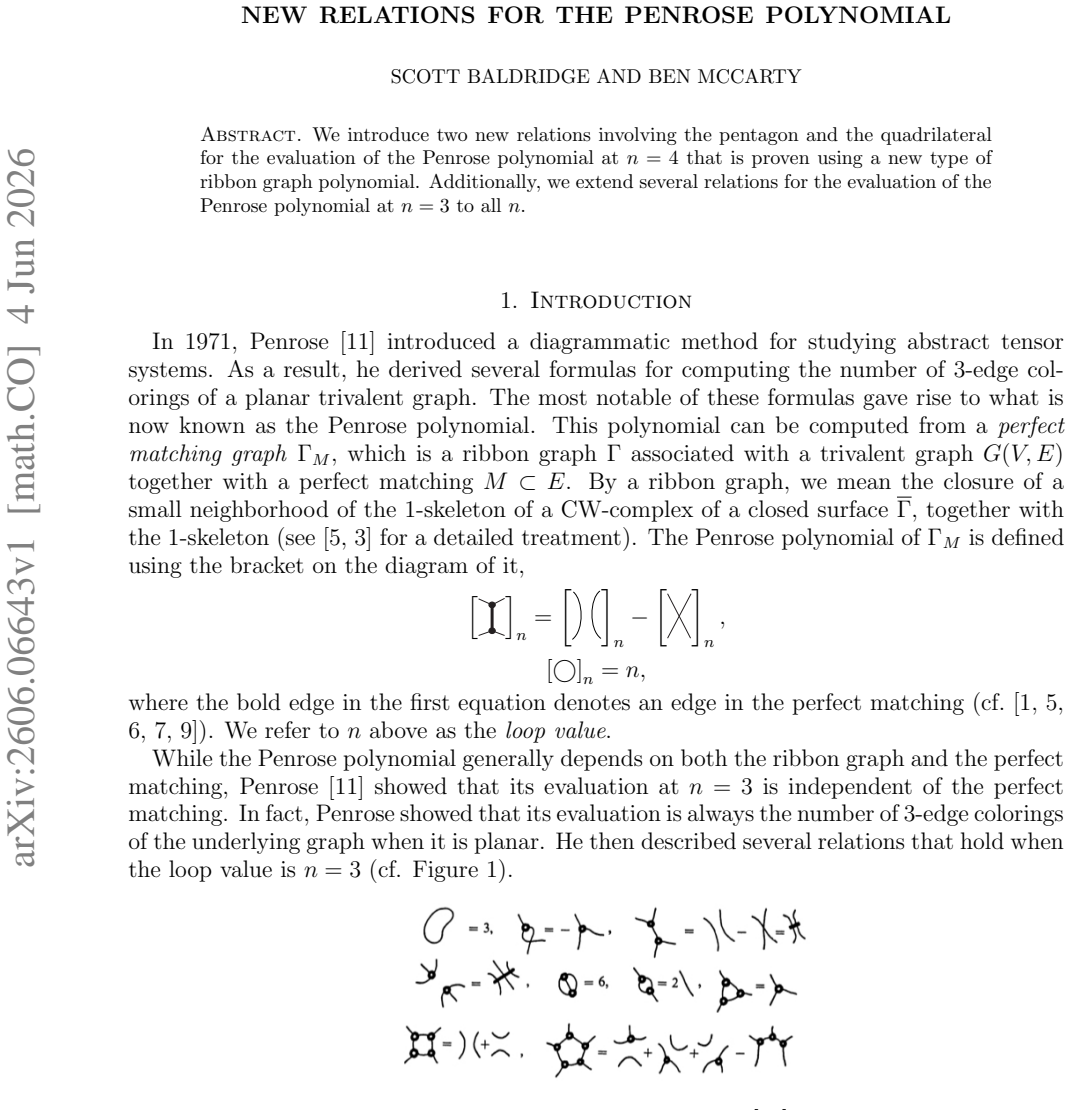
We introduce two new relations involving the pentagon and the quadrilateral for the evaluation of the Penrose polynomial at n=4 that is proven using a new type of ribbon graph polynomial. Additionally, we extend several relations for the evaluation of the Penrose polynomial at n=3 to all n.
What carries the argument
A new ribbon graph polynomial that proves the relations for the Penrose polynomial at n=4.
If this is right
- The Penrose polynomial at n=4 can be reduced using operations on pentagons and quadrilaterals.
- Relations for the Penrose polynomial at n=3 now hold for arbitrary n.
- The new ribbon graph polynomial provides a method to establish these evaluations.
Where Pith is reading between the lines
- The new relations could be used to develop algorithms for computing the Penrose polynomial more efficiently.
- Similar techniques might be applied to other values of n or related graph polynomials.
- This work may strengthen connections between Penrose polynomials and ribbon graphs in combinatorial topology.
Load-bearing premise
The new ribbon graph polynomial correctly encodes the evaluations of the Penrose polynomial at n=4 in the cases of the pentagon and the quadrilateral.
What would settle it
Direct computation of the Penrose polynomial at n=4 for a graph with a pentagon that contradicts the value predicted by the new relation.
Figures
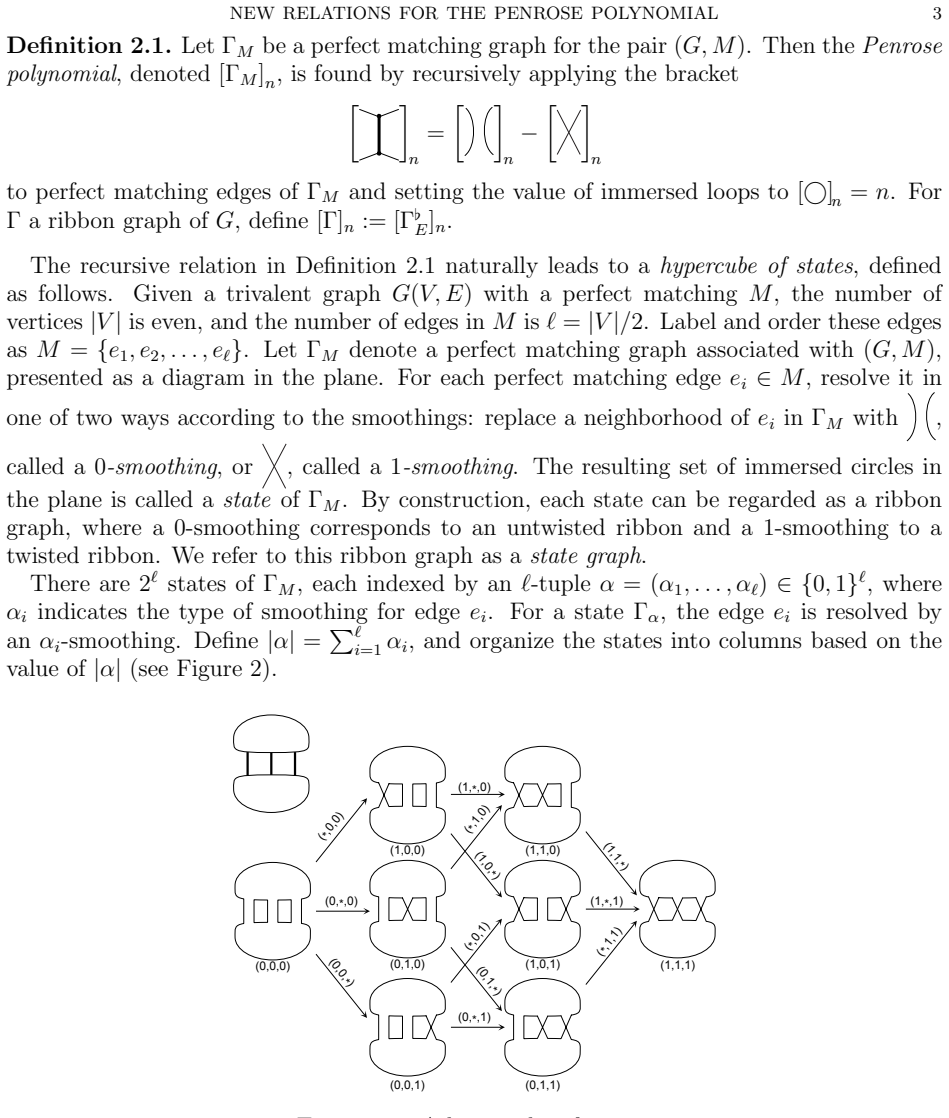
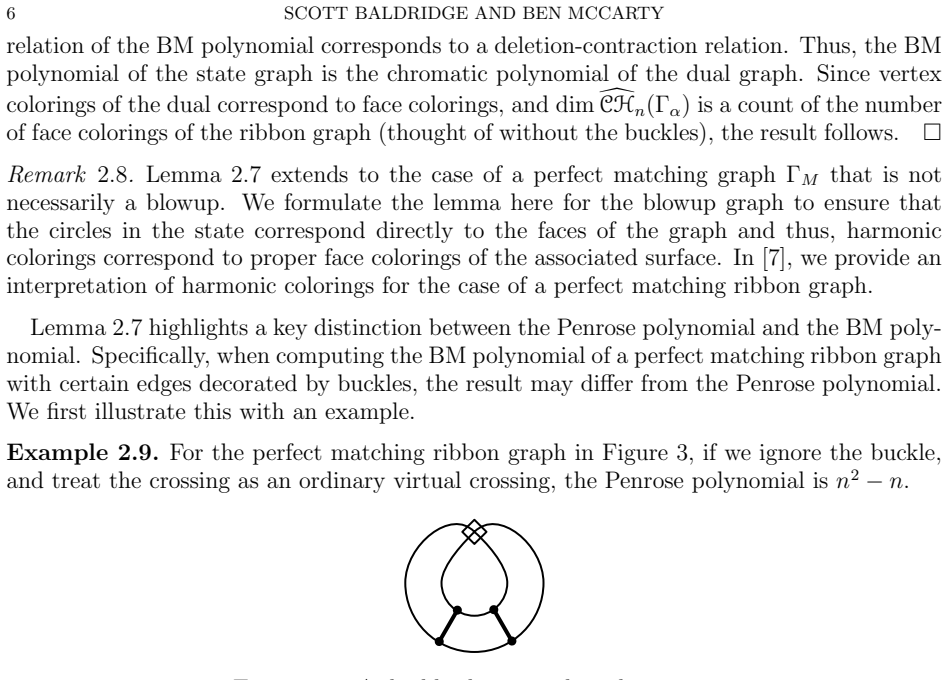
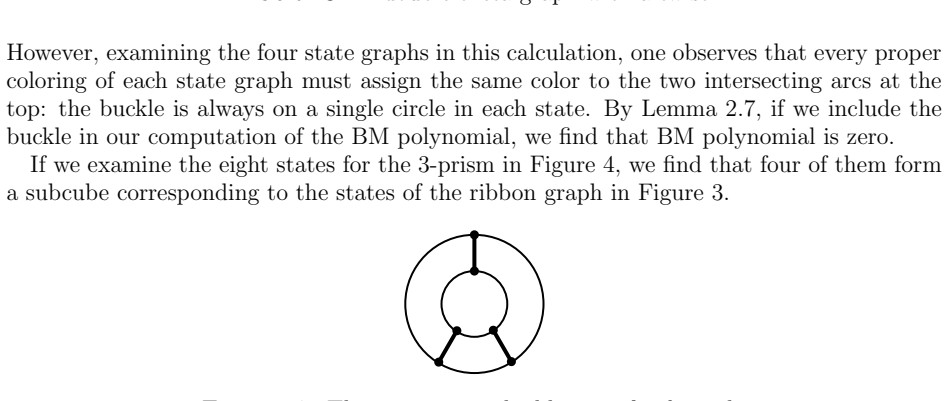
read the original abstract
We introduce two new relations involving the pentagon and the quadrilateral for the evaluation of the Penrose polynomial at $n=4$ that is proven using a new type of ribbon graph polynomial. Additionally, we extend several relations for the evaluation of the Penrose polynomial at $n=3$ to all $n$.
Editorial analysis
A structured set of objections, weighed in public.
Referee Report
Summary. The manuscript introduces two new relations for the Penrose polynomial evaluated at n=4, specifically involving the pentagon and quadrilateral, which are proven using a newly defined ribbon graph polynomial. It additionally extends several existing relations for the Penrose polynomial at n=3 to hold for arbitrary n.
Significance. If the central claims hold, the work supplies concrete new identities for Penrose polynomial evaluations at a fixed point together with a supporting ribbon-graph construction that encodes those evaluations. The generalization of the n=3 relations to all n increases the scope of previously known identities. These contributions are of moderate interest within combinatorial graph theory and knot invariants, provided the new polynomial is shown to be well-defined and faithful to the Penrose evaluations.
minor comments (2)
- [Abstract] The abstract states that the relations are proven via the new ribbon graph polynomial but does not indicate the precise form of either the relations or the polynomial; a one-sentence statement of each would improve readability without lengthening the abstract.
- Notation for the new ribbon graph polynomial is introduced without an explicit comparison table to the classical Penrose polynomial; adding such a table (even a small one) would clarify the encoding claim.
Simulated Author's Rebuttal
We thank the referee for their summary of the manuscript and for recommending minor revision. The report notes the introduction of new relations at n=4 via a ribbon graph polynomial and the extension of n=3 relations to arbitrary n. No specific major comments appear under the MAJOR COMMENTS heading.
Circularity Check
No significant circularity; derivation self-contained
full rationale
The paper defines a new ribbon graph polynomial to prove relations for the Penrose polynomial at n=4 and extends relations at n=3. No equations appear in the abstract, and the description indicates explicit constructions whose correctness can be verified directly without any reduction to inputs by definition, fitted parameters renamed as predictions, or load-bearing self-citations. The central argument does not invoke uniqueness theorems from the authors' prior work or smuggle ansatzes via citation. This is the normal case of an independent derivation.
Axiom & Free-Parameter Ledger
Reference graph
Works this paper leans on
-
[1]
Aigner, The Penrose polynomial of a plane graph , Mathematische Annalen, 307, 173-189, 1997
M. Aigner, The Penrose polynomial of a plane graph , Mathematische Annalen, 307, 173-189, 1997
1997
-
[2]
Baldridge, A new cohomology theory for planar trivalent graphs with perfect matchings
S. Baldridge, A new cohomology theory for planar trivalent graphs with perfect matchings . arXiv:1810.07302
-
[3]
S. Baldridge, L. Kauffman, and W. Rushworth, On ribbon graphs and virtual links , European Journal of Combinatorics 103 , June 2022, doi: 10.1016/j.ejc.2022.103520, arXiv: 2010.04238
-
[4]
S. Baldridge, A. Lowrance, and B. McCarty, The 2-factor polynomial detects even perfect matchings , The Electronic Journal of Combinatorics 27 (2020), no. 2, P2.27, 16 pp. doi: 10.37236/9214, arXiv:1812.10346
-
[5]
S. Baldridge and B. McCarty, A topological quantum field theory approach to graph coloring , arXiv:2303.12010
-
[6]
S. Baldridge and B. McCarty, A new way to prove configuration reducibility using gauge theory , arXiv:2412.18558
-
[7]
S. Baldridge, L. Kauffman, and B. McCarty, A State Sum for the Total Face Color Polynomial Journal of Graph Theory, 24 March 2025, https://doi.org/10.1002/jgt.23239
-
[8]
J. A. Ellis-Monaghan and I. Moffatt, Graphs on surfaces , Springer Briefs in Mathematics. Springer, New York, 2013
2013
-
[9]
J. A. Ellis-Monaghan and I. Moffatt, A Penrose polynomial for embedded graphs , European J. Combin., 34 (2013), 424-445
2013
-
[10]
Snarks, boojums, and other conjectures related to the four-color-map theorem
Gardner, Martin (1976), "Snarks, boojums, and other conjectures related to the four-color-map theorem", Mathematical Games, Scientific American, 4 (234): 126Ð130,
1976
-
[11]
American Mathematical Monthly , vol
Isaacs, Rufus (1975), Infinite Families of Nontrivial Trivalent Graphs Which Are Not Tait Colorable. American Mathematical Monthly , vol. 82, Pages 630Ð633
1975
-
[12]
Jaeger, F., On transition polynomials of 4-regular graphs , Cycles and Rays (Hahn et al, eds.) Kluwer, 123-150, 1990
1990
-
[13]
L. H. Kauffman, A state calculus for graph coloring , Illinois Journal of Mathematics 60 (2015), no. 1, 251-271
2015
-
[14]
L. H. Kauffman, Multi-Virtual Knot Theory, arXiv:2409.07499
-
[15]
Khovanov, A categorification of the Jones polynomial, Duke Math
M. Khovanov, A categorification of the Jones polynomial, Duke Math. J. 101 (2000), no. 3, 359--426
2000
-
[16]
Lee, An endomorphism of the Khovanov invariant, Adv
E.S. Lee, An endomorphism of the Khovanov invariant, Adv. Math. 197 (2005), no. 2, 554–586
2005
-
[17]
Thesis, Grenoble 1977
Martin, P., Enumeration eul\' e riennes dans les multigraphes et invariants de Tutte?Grothendieck. Thesis, Grenoble 1977
1977
-
[18]
Penrose, ``Applications of negative dimensional tensors,'' in Combinatorial Mathematics and Its Applications , Academic Press (1971)
R. Penrose, ``Applications of negative dimensional tensors,'' in Combinatorial Mathematics and Its Applications , Academic Press (1971)
1971
-
[19]
Sur le th\'eor\`me de Tait
Petersen, Julius (1898), "Sur le th\'eor\`me de Tait", L'Interm\'ediaire des Math\'ematiciens, 5: 225Ð227
-
[20]
Combin.TheorySer.B 70 (1997),no.1, 166-183
Robertson,Neil, Seymore, Paul and Thomas, Robin, Tutte's edge coloring conjecture, J. Combin.TheorySer.B 70 (1997),no.1, 166-183
1997
-
[21]
T., On the algebraic theory of graph colorings , J
Tutte, W. T., On the algebraic theory of graph colorings , J. Combinatorial Theory,1 (1966),15-50
1966
discussion (0)
Sign in with ORCID, Apple, or X to comment. Anyone can read and Pith papers without signing in.