Polarized and unpolarized synchrotron emission from dark matter in extragalactic targets
Pith reviewed 2026-06-27 21:14 UTC · model grok-4.3
The pith
Microwave polarimetry yields upper limits on dark matter annihilation and decay from synchrotron emission in five extragalactic targets.
A machine-rendered reading of the paper's core claim, the machinery that carries it, and where it could break.
Core claim
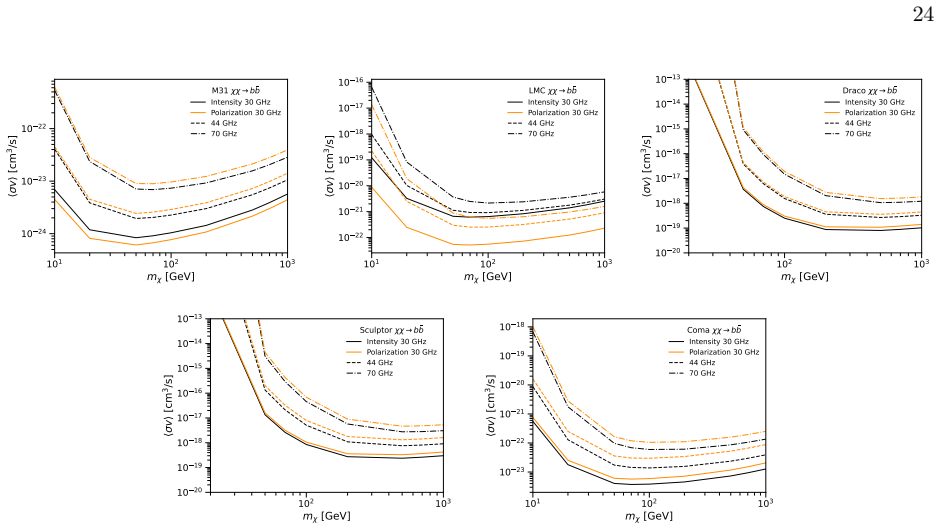
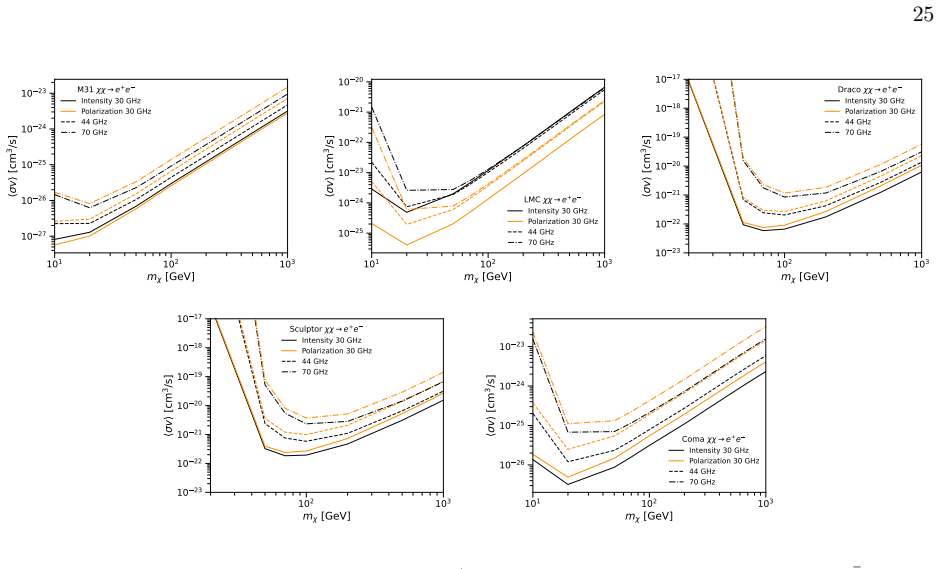
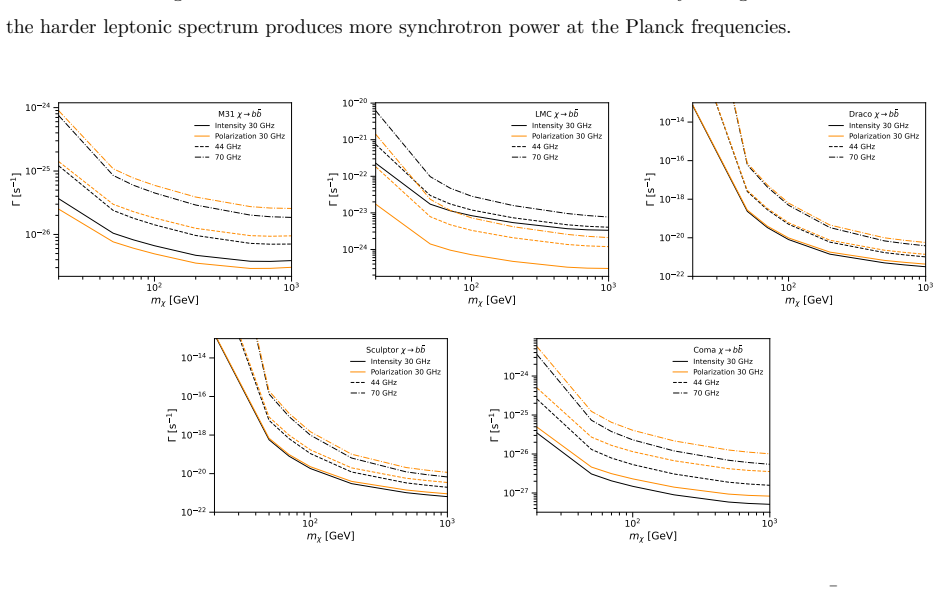
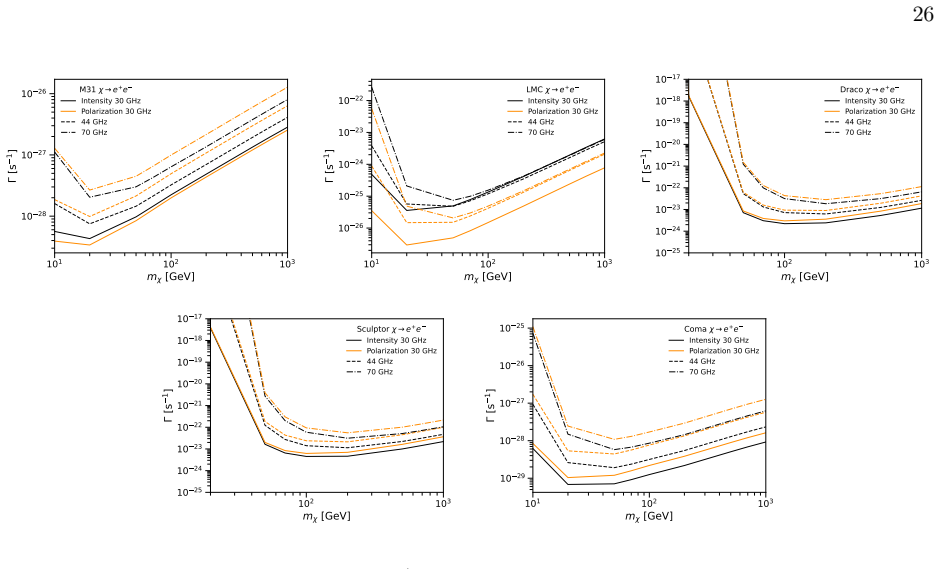
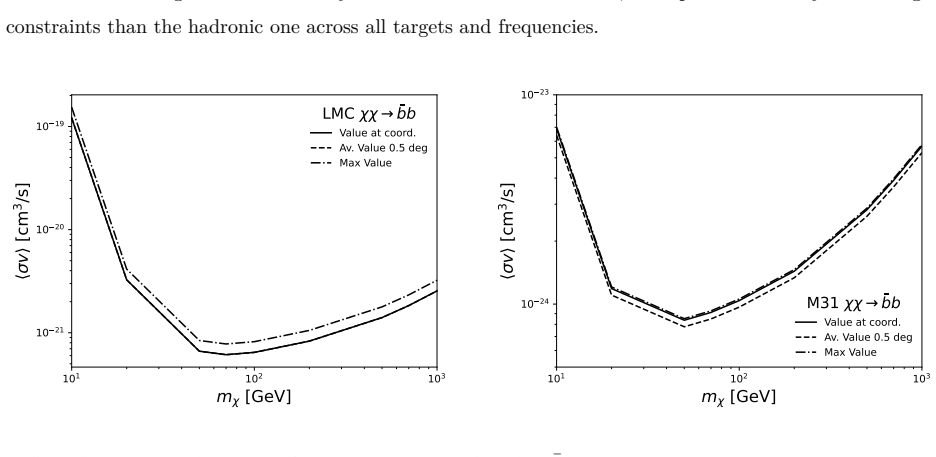
We compute 95% confidence-level upper limits on the dark matter annihilation cross section and decay rate from both total-intensity and polarized synchrotron emission in five extragalactic targets: M31, the Large Magellanic Cloud, the Draco and Sculptor dwarf spheroidal galaxies, and the Coma cluster. Using Planck maps at 30, 44, and 70 GHz, we solve the diffusion-loss equation for dark-matter-produced electrons and positrons numerically with DRAGON and integrate the resulting synchrotron emission along the line of sight with HERMES, computing both total-intensity and polarized-intensity maps for each target with target-specific magnetic-field, gas, and radiation-field environments. The 30 G
What carries the argument
Numerical solution of the diffusion-loss equation for dark-matter electrons and positrons followed by line-of-sight integration of both total and polarized synchrotron emissivity under target-specific magnetic, gas, and radiation fields.
If this is right
- The 30 GHz channel supplies the strongest constraints for every target examined.
- Annihilation or decay channels that inject a harder electron-positron spectrum produce tighter limits than softer channels.
- Polarized and total-intensity limits remain comparable except in the LMC, where depolarization makes total intensity the dominant observable.
- The derived bounds are insensitive to the precise choice of flux estimator and to small coordinate offsets.
Where Pith is reading between the lines
- Polarized maps could help separate a dark-matter signal from astrophysical synchrotron if the two components exhibit different polarization fractions or spatial patterns.
- Refining the magnetic-field models with additional radio data would directly tighten the same limits without changing the observational dataset.
- Applying the same polarized analysis to additional nearby galaxies or to future higher-resolution surveys could extend the reach to lower dark-matter masses.
- If the assumed diffusion parameters prove too optimistic, the actual constraints would weaken proportionally to the change in electron propagation length.
Load-bearing premise
The magnetic-field, gas-density, and radiation-field models chosen for each target accurately describe the actual conditions inside M31, the LMC, the dwarf galaxies, and the Coma cluster.
What would settle it
A future 30 GHz polarized-intensity measurement in M31 that lies significantly above the predicted dark-matter synchrotron contribution after subtraction of known astrophysical foregrounds would falsify the reported upper limits on the annihilation cross section.
Figures

read the original abstract
We compute 95% confidence-level upper limits on the dark matter annihilation cross section and decay rate from both total-intensity and polarized synchrotron emission in five extragalactic targets: M31, the Large Magellanic Cloud (LMC), the Draco and Sculptor dwarf spheroidal galaxies, and the Coma cluster. Using Planck maps at 30, 44, and 70 GHz, we solve the diffusion-loss equation for dark-matter-produced electrons and positrons numerically with DRAGON and integrate the resulting synchrotron emission along the line of sight with HERMES, computing both total-intensity and polarized-intensity maps for each target with target-specific magnetic-field, gas, and radiation-field environments. The 30 GHz channel yields the most stringent constraints in all cases, and limits on annihilation or decay into $e^+e^-$ are stronger than those for $b\bar{b}$ due to the harder injected spectrum. For most targets the total-intensity and polarized limits are broadly comparable; the LMC is an exception, where Faraday depolarization in the turbulent disk suppresses the polarized signal relative to total intensity, making total intensity the primary estimator. Our results are robust against the choice of flux estimator and coordinate uncertainty. This work demonstrates that microwave polarimetry provides a complementary and largely independent probe of dark matter synchrotron emission in extragalactic targets.
Editorial analysis
A structured set of objections, weighed in public.
Referee Report
Summary. The manuscript computes 95% CL upper limits on dark matter annihilation cross section and decay lifetime from both total-intensity and polarized synchrotron emission in five extragalactic targets (M31, LMC, Draco, Sculptor, Coma) using Planck 30/44/70 GHz maps. DRAGON solves the diffusion-loss equation for DM-produced e+/e- with target-specific B-field, gas, and radiation inputs; HERMES integrates the resulting synchrotron maps along the line of sight. The 30 GHz channel yields the tightest bounds in all cases, e+e- limits are stronger than bb due to the harder spectrum, and polarized and total-intensity limits are broadly comparable except in the LMC where Faraday depolarization suppresses the polarized signal. The work concludes that microwave polarimetry supplies a complementary and largely independent probe of DM synchrotron emission.
Significance. If the numerical results hold, the paper is significant for demonstrating that existing propagation codes can be used to extract polarized synchrotron limits from Planck data, thereby adding a new observable to indirect DM searches in resolved extragalactic targets. The explicit comparison of total vs. polarized channels and the identification of 30 GHz dominance constitute concrete, falsifiable outputs. The strength lies in the use of established, publicly documented codes (DRAGON, HERMES) rather than ad-hoc analytic approximations.
major comments (2)
- [Abstract] Abstract: the central claim that polarized synchrotron supplies a 'largely independent' probe is load-bearing for the paper's novelty but is not supported by any sensitivity study; the polarized intensity is computed from the identical e+/e- distributions as total intensity, and the polarization fraction is set directly by the ordered vs. turbulent B-field geometry and turbulence spectrum supplied as inputs to HERMES for each target. An error in these model choices scales the polarized limits without affecting the total-intensity limits, undermining the independence assertion.
- [Abstract] Abstract (results paragraph): the statement that 'limits on annihilation or decay into e+e- are stronger than those for bb due to the harder injected spectrum' is presented without quantifying how the diffusion and energy-loss parameters in DRAGON propagate the spectral difference into the final 95% CL bounds; because the same propagation parameters are used for both channels, a modest change in the diffusion coefficient or halo height could alter the relative strength of the two channels.
minor comments (1)
- [Abstract] The abstract states that results are 'robust against the choice of flux estimator and coordinate uncertainty' but does not define the estimators or the coordinate uncertainty range used in the robustness test.
Simulated Author's Rebuttal
We thank the referee for the careful reading and constructive comments on our manuscript. We address each major comment below, proposing revisions where the points identify areas that can be strengthened without altering the core results.
read point-by-point responses
-
Referee: [Abstract] Abstract: the central claim that polarized synchrotron supplies a 'largely independent' probe is load-bearing for the paper's novelty but is not supported by any sensitivity study; the polarized intensity is computed from the identical e+/e- distributions as total intensity, and the polarization fraction is set directly by the ordered vs. turbulent B-field geometry and turbulence spectrum supplied as inputs to HERMES for each target. An error in these model choices scales the polarized limits without affecting the total-intensity limits, undermining the independence assertion.
Authors: We agree that the polarized and total-intensity signals are derived from the same electron/positron distributions and that the polarization fraction is controlled by the assumed ordered versus turbulent magnetic-field geometry. The phrasing 'largely independent' was intended to reflect that polarized emission constitutes a distinct observable sensitive to the ordered field component and to line-of-sight depolarization effects (explicitly illustrated by the LMC results). Nevertheless, the referee correctly notes that a quantitative sensitivity study on B-field parameters would be needed to fully substantiate the degree of independence. We will therefore revise the abstract to replace 'largely independent' with 'complementary' and add a short paragraph in Section 4 discussing how variations in the turbulence spectrum affect the polarized limits differently from the total-intensity limits. revision: partial
-
Referee: [Abstract] Abstract (results paragraph): the statement that 'limits on annihilation or decay into e+e- are stronger than those for bb due to the harder injected spectrum' is presented without quantifying how the diffusion and energy-loss parameters in DRAGON propagate the spectral difference into the final 95% CL bounds; because the same propagation parameters are used for both channels, a modest change in the diffusion coefficient or halo height could alter the relative strength of the two channels.
Authors: The harder e+e- injection spectrum produces a larger population of electrons and positrons at energies that, after synchrotron and inverse-Compton losses, radiate efficiently in the 30–70 GHz band. Because the propagation parameters (diffusion coefficient, halo height, energy-loss rates) are held fixed for each target and applied identically to both channels, the relative ordering of the limits is a direct consequence of the injected spectra. We will expand the abstract sentence with a brief clause noting this and include a supplementary comparison of the propagated spectra for the two channels to make the propagation effect explicit. revision: yes
Circularity Check
No significant circularity detected
full rationale
The paper derives 95% CL limits on DM annihilation/decay by numerically solving the diffusion-loss equation via DRAGON for e+/e- distributions from DM, then integrating total and polarized synchrotron emission with HERMES using target-specific B-field/gas/radiation inputs, and comparing the resulting maps directly to Planck 30/44/70 GHz observations. No quoted step reduces a prediction to a fitted parameter by construction, renames a known result, or relies on a load-bearing self-citation chain; the central claim of a complementary polarimetry probe follows from the explicit modeling and data comparison, which remains externally falsifiable against the Planck maps. This is a standard self-contained modeling pipeline against external benchmarks.
Axiom & Free-Parameter Ledger
free parameters (2)
- target-specific magnetic field strength and geometry
- diffusion and energy-loss parameters in DRAGON
axioms (2)
- standard math Diffusion-loss equation governs cosmic-ray electron propagation
- standard math Synchrotron emissivity formulas apply to the computed electron spectra
Reference graph
Works this paper leans on
-
[1]
at 150 MHz (5σlimit∼17mJy beam−1), bracket the radio synchrotron flux from both dSphs across two decades in frequency and are consistent with the magnetic field and DM constraints presented in Sections VIII and XII. X. SYNCHROTRON POLARIZATION IN THE LMC: ASTROPHYSICAL CONTEXT The LMC requires separate treatment from the other four targets because the rel...
2020
-
[2]
S. Colafrancesco, S. Profumo, and P. Ullio, Astron. Astrophys.455, 21 (2006), arXiv:astro-ph/0507575
Pith/arXiv arXiv 2006
-
[3]
S. Colafrancesco, S. Profumo, and P. Ullio, Phys. Rev. D75, 023513 (2007), arXiv:astro-ph/0607073
Pith/arXiv arXiv 2007
-
[4]
M. Regis, L. Richter, S. Colafrancesco, M. Massardi, W. J. G. de Blok, S. Profumo, and N. Orford, Mon. Not. Roy. Astron. Soc.448, 3731 (2015), arXiv:1407.5479 [astro-ph.GA]
Pith/arXiv arXiv 2015
-
[5]
M. Regis, L. Richter, S. Colafrancesco, S. Profumo, W. J. G. de Blok, and M. Massardi, Mon. Not. Roy. Astron. Soc.448, 3747 (2015), arXiv:1407.5482 [astro-ph.GA]
Pith/arXiv arXiv 2015
-
[6]
M. Regis, S. Colafrancesco, S. Profumo, W. J. G. de Blok, M. Massardi, and L. Richter, JCAP10, 016, arXiv:1407.4948 [astro-ph.CO]
-
[7]
M. Regis, L. Richter, and S. Colafrancesco, JCAP2017(07), 025, arXiv:1703.09921
-
[8]
A. Basu, N. Roy, S. Choudhuri, K. K. Datta, and D. Sarkar, Mon. Not. Roy. Astron. Soc.502, 1605 (2021), arXiv:2101.04925
arXiv 2021
- [9]
-
[10]
Chenet al., arXiv e-prints (2024), arXiv:2412.03163 [astro-ph.HE]
Z. Chenet al., arXiv e-prints (2024), arXiv:2412.03163 [astro-ph.HE]
arXiv 2024
-
[11]
A. McDaniel, T. Jeltema, S. Profumo, and E. Storm, JCAP2017(09), 027, arXiv:1705.09384
-
[12]
E. Storm, T. E. Jeltema, M. Splettstoesser, and S. Profumo, Astrophys. J.839, 33 (2017), arXiv:1607.01049 [astro-ph.CO]
Pith/arXiv arXiv 2017
-
[13]
E. Storm, T. E. Jeltema, S. Profumo, and L. Rudnick, Astrophys. J.768, 106 (2013), arXiv:1210.0872 [astro-ph.CO]
Pith/arXiv arXiv 2013
-
[14]
S. Manconi, A. Cuoco, and J. Lesgourgues, Phys. Rev. Lett.129, 111103 (2022), arXiv:2204.04232
arXiv 2022
-
[15]
C. Evoli, D. Gaggero, A. Vittino, G. Di Bernardo, M. Di Mauro, A. Ligorini, P. Ullio, and D. Grasso, JCAP02, 015, arXiv:1607.07886 [astro-ph.HE]
-
[16]
A. Dundovic, C. Evoli, D. Gaggero, and D. Grasso, Astron. Astrophys.653, A18 (2021), arXiv:2105.13165 [astro-ph.HE]
arXiv 2021
-
[17]
A. W. Strong and I. V. Moskalenko, Astrophys. J.509, 212 (1998), arXiv:astro-ph/9807150
Pith/arXiv arXiv 1998
-
[18]
I. V. Moskalenko and A. W. Strong, Astrophys. J.493, 694 (1998), arXiv:astro-ph/9710124
Pith/arXiv arXiv 1998
-
[19]
T. A. Porter, I. V. Moskalenko, A. W. Strong, E. Orlando, and L. Bouchet, Astrophys. J.682, 400 (2008), arXiv:0804.1774 [astro-ph]
Pith/arXiv arXiv 2008
-
[20]
A. Waelkens, T. Jaffe, M. Reinecke, F. S. Kitaura, and T. A. Ensslin, Astron. Astrophys.495, 697 (2009), arXiv:0807.2262 [astro-ph]
Pith/arXiv arXiv 2009
-
[21]
J. Wang, T. R. Jaffe, T. A. Enßlin, P. Ullio, S. Ghosh, and L. Santos, The Astrophysical Journal Supplement Series247, 18 (2020). 30
2020
-
[22]
J. Reynoso-Cordova, D. Gaggero, M. Regis, and M. Taoso, arXiv:2512.14906 [astro-ph.GA] (2025)
arXiv 2025
- [23]
-
[24]
E. Todarello, M. Regis, J. Reynoso-Cordova, M. Taoso, D. Vaz, J. Brinchmann, M. Steinmetz, and S. L. Zoutendijke, JCAP05, 043, arXiv:2307.07403 [astro-ph.CO]
-
[25]
G. B. Rybicki and A. P. Lightman,Radiative Processes in Astrophysics(Wiley-Interscience, New York, 1979)
1979
-
[26]
M. S. Longair,High Energy Astrophysics, 3rd ed. (Cambridge University Press, Cambridge, 2011)
2011
-
[27]
R. Beck and R. Wielebinski, inPlanets, Stars and Stellar Systems, Vol. 5: Galactic Structure and Stellar Populations, edited by T. D. Oswalt and G. Gilmore (Springer, Dordrecht, 2013) pp. 641–723, arXiv:1302.5663
arXiv 2013
-
[28]
D. D. Sokoloff, A. A. Bykov, A. Shukurov, E. M. Berkhuijsen, R. Beck, and A. D. Poezd, Mon. Not. Roy. Astron. Soc.299, 189 (1998)
1998
-
[29]
Hassani, F
H. Hassani, F. Tabatabaei, A. Hughes, J. Chastenet, A. F. McLeod, E. Schinnerer, and S. Nasiri, Mon. Not. Roy. Astron. Soc.510, 11 (2022)
2022
-
[30]
B. J. Burn, Mon. Not. Roy. Astron. Soc.133, 67 (1966)
1966
-
[31]
M. Cirelli, G. Corcella, A. Hektor, G. Hütsi, M. Kadastik, P. Panci, M. Raidal, F. Sala, and A. Strumia, JCAP2011(03), 051, erratum: JCAP 2012, 010, arXiv:1012.4515
Pith/arXiv arXiv 2012
-
[32]
B. T. Draine, G. Aniano, O. Krause, B. Groves, K. Sandstrom, R. Braun, A. K. Leroy, U. Klaas, H. Linz, H.-W. Rix, E. Schinnerer, A. Schmiedeke, and F. Walter, Astrophys. J.780, 172 (2014), arXiv:1306.2304
Pith/arXiv arXiv 2014
-
[33]
Viaene, M
S. Viaene, M. Baes, A. Tamm, E. Tempel, G. J. Bendo, S. Bianchi, I. De Looze,et al., Astron. Astrophys. 599, A64 (2017)
2017
-
[34]
Courteau, L
S. Courteau, L. M. Widrow, M. McDonald, P. Guhathakurta, K. M. Gilbert, Y. Zhu, R. Beaton, and S. R. Majewski, Astrophys. J.739, 20 (2011)
2011
-
[35]
C. Nieten, N. Neininger, M. Guelin, H. Ungerechts, R. Lucas, E. M. Berkhuijsen, R. Beck, and R. Wielebinski, Astron. Astrophys.453, 459 (2006), arXiv:astro-ph/0512563
Pith/arXiv arXiv 2006
-
[36]
Braun, D
R. Braun, D. A. Thilker, R. A. M. Walterbos, and E. Corbelli, Astrophys. J.695, 937 (2009)
2009
-
[37]
Corbelli, S
E. Corbelli, S. Lorenzoni, R. A. M. Walterbos, R. Braun, and D. Thilker, Astron. Astrophys.511, A89 (2010)
2010
-
[38]
Acharyyaet al.(Cherenkov Telescope Array), Mon
A. Acharyyaet al.(Cherenkov Telescope Array), Mon. Not. Roy. Astron. Soc.523, 5353 (2023), arXiv:2305.16707 [astro-ph.HE]
arXiv 2023
-
[39]
Brunetti and T
G. Brunetti and T. W. Jones, Int. J. Mod. Phys. D23, 1430007 (2014)
2014
-
[40]
M. S. Mirakhor and S. A. Walker, Mon. Not. Roy. Astron. Soc.497, 3204 (2020), arXiv:2007.12194 [astro-ph.CO]
arXiv 2020
-
[41]
Y. Uchida, A. Simionescu, T. Takahashi, N. Werner, Y. Ichinohe, S. W. Allen, O. Urban, and K. Mat- sushita, Publ. Astron. Soc. Jap.68, Publications of the Astronomical Society of Japan, Volume 68, 31 Issue SP1, June 2016, S20, https://doi.org/10.1093/pasj/psv126 (2016), arXiv:1509.01901 [astro-ph.HE]
work page internal anchor Pith review Pith/arXiv arXiv doi:10.1093/pasj/psv126 2016
- [42]
-
[43]
Grcevich and M
J. Grcevich and M. E. Putman, Astrophys. J.696, 385 (2009)
2009
-
[44]
Spekkens, N
K. Spekkens, N. Urbancic, B. S. Mason, B. Willman, and J. E. Aguirre, Astrophys. J. Lett.795, L5 (2014)
2014
-
[45]
J. F. Navarro, C. S. Frenk, and S. D. M. White, Astrophys. J.490, 493 (1997), arXiv:astro-ph/9611107
Pith/arXiv arXiv 1997
-
[46]
A. A. Dutton and A. V. Macciò, Mon. Not. Roy. Astron. Soc.441, 3359 (2014), arXiv:1402.7073
Pith/arXiv arXiv 2014
-
[47]
A. Tamm, E. Tempel, P. Tenjes, O. Tihhonova, and T. Tuvikene, Astron. Astrophys.546, A4 (2012)
2012
-
[48]
J. J. Geehan, M. A. Fardal, A. Babul, and P. Guhathakurta, Mon. Not. Roy. Astron. Soc.366, 996 (2006)
2006
-
[49]
M. S. Seigar, A. J. Barth, and J. S. Bullock, Mon. Not. Roy. Astron. Soc.389, 1911 (2008)
1911
-
[50]
P. R. Kafle, S. Sharma, A. S. G. Robotham,et al., Mon. Not. Roy. Astron. Soc.475, 4043 (2018)
2018
- [51]
-
[52]
E. L. Łokas and G. A. Mamon, Mon. Not. Roy. Astron. Soc.343, 401 (2003), arXiv:astro-ph/0302461
Pith/arXiv arXiv 2003
-
[53]
R. Brilenkov, M. Eingorn, and A. Zhuk, Astron. Astrophys. Trans.30, 81 (2017), arXiv:1507.07234 [astro-ph.CO]
Pith/arXiv arXiv 2017
-
[54]
L. E. Strigari, C. S. Frenk, and S. D. M. White, Astrophys. J.838, 123 (2017), arXiv:1406.6079
arXiv 2017
-
[55]
A. Chiappo, J. Cohen-Tanugi, J. Conrad, and L. E. Strigari, Mon. Not. Roy. Astron. Soc.488, 2616 (2019), arXiv:1810.09917 [astro-ph.GA]
arXiv 2019
-
[56]
J. I. Read, M. G. Walker, and P. Steger, Mon. Not. Roy. Astron. Soc.481, 860 (2018), arXiv:1805.06934 [astro-ph.GA]
Pith/arXiv arXiv 2018
-
[57]
R. Beck and E. M. Berkhuijsen, Astron. Astrophys. 10.1051/0004-6361/202555048 (2025), arXiv:2507.07719 [astro-ph.GA]
-
[58]
Fletcher, E
A. Fletcher, E. M. Berkhuijsen, R. Beck, and A. Shukurov, Astron. Astrophys.414, 53 (2004)
2004
-
[59]
B. M. Gaensler, M. Haverkorn, L. Staveley-Smith, J. M. Dickey, N. M. McClure-Griffiths, J. R. Dickel, and M. Wolleben, Science307, 1610 (2005), arXiv:astro-ph/0503226
Pith/arXiv arXiv 2005
-
[60]
A. Bonafede, L. Feretti, M. Murgia, F. Govoni, G. Giovannini, D. Dallacasa, K. Dolag, and G. B. Taylor, Astron. Astrophys.513, A30 (2010), arXiv:1002.0594
Pith/arXiv arXiv 2010
-
[61]
U. G. Briel, J. P. Henry, and H. Böhringer, Astron. Astrophys.259, L31 (1992)
1992
-
[62]
J. J. Mohr, B. Mathiesen, and A. E. Evrard, Astrophys. J.517, 627 (1999), arXiv:astro-ph/9901281
Pith/arXiv arXiv 1999
-
[63]
Govoni and L
F. Govoni and L. Feretti, Int. J. Mod. Phys. D13, 1549 (2004)
2004
-
[64]
A. Natarajan, J. E. Aguirre, K. Spekkens, and B. S. Mason, (2015), arXiv:1507.03589 [astro-ph.CO]
Pith/arXiv arXiv 2015
-
[65]
Planck Collaboration, Y. Akrami,et al., Astron. Astrophys.641, A2 (2020), arXiv:1807.06206
arXiv 2020
-
[66]
R. Gießübel, G. Heald, R. Beck, and T. G. Arshakian, Astron. Astrophys.559, A27 (2013), arXiv:1309.2539. 32
Pith/arXiv arXiv 2013
-
[67]
M. Murgiaet al., Mon. Not. Roy. Astron. Soc.461, 3516 (2016), arXiv:1607.03636 [astro-ph.GA]
Pith/arXiv arXiv 2016
-
[68]
Beck, Astron
R. Beck, Astron. Astrophys. Rev.24, 4 (2015)
2015
-
[69]
R. P. van der Marel and M.-R. L. Cioni, Astron. J.122, 1807 (2001), arXiv:astro-ph/0105339
Pith/arXiv arXiv 2001
-
[70]
S. M. Kent, Publ. Astron. Soc. Pacific101, 489 (1989)
1989
-
[71]
R. A. M. Walterbos and J. Kennicutt, R. C., Astron. Astrophys. Suppl. Ser.69, 311 (1987)
1987
discussion (0)
Sign in with ORCID, Apple, or X to comment. Anyone can read and Pith papers without signing in.