Transition from Diffusion to Drift-Dominated Cosmic Ray Transport and the Origin of the Knee
Pith reviewed 2026-06-29 02:34 UTC · model grok-4.3
The pith
If parallel diffusion becomes energy-independent above 1 TeV, drift motions can produce the cosmic ray knee at PeV energies.
A machine-rendered reading of the paper's core claim, the machinery that carries it, and where it could break.
Core claim
The paper shows that the knee can arise from the transition to drift-dominated transport when the parallel diffusion coefficient becomes energy independent above approximately 1 TeV. This occurs because drifts due to magnetic field curvature then compete effectively with diffusion for particle escape, leading to an energy-dependent escape time that steepens the spectrum at PeV energies. The result holds only under specific conditions on the large-scale field topology and the turbulence properties.
What carries the argument
Drift motions induced by the curvature and gradients of the large-scale Galactic magnetic field competing with parallel and perpendicular diffusion, with the key transition when parallel diffusion turns energy-independent.
Load-bearing premise
The parallel diffusion coefficient becomes energy independent at energies above roughly 1 TeV.
What would settle it
Direct or indirect evidence that the parallel diffusion coefficient continues to scale with energy above 1 TeV would prevent drift dominance from producing the knee.
Figures


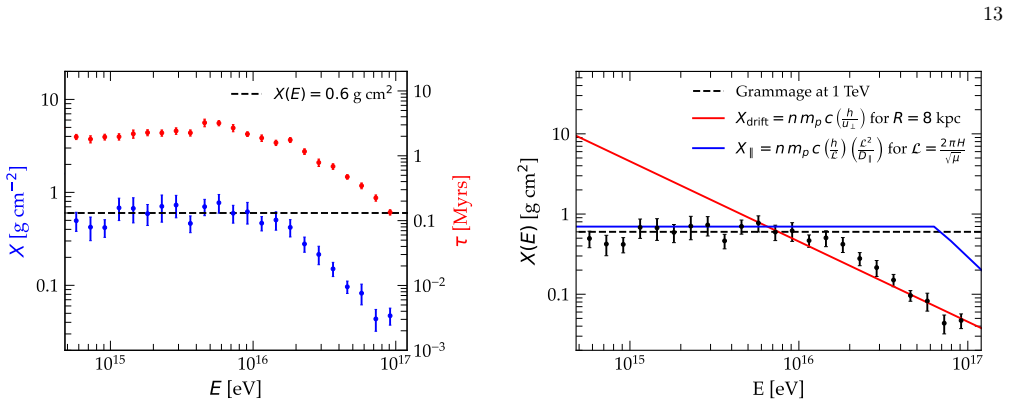
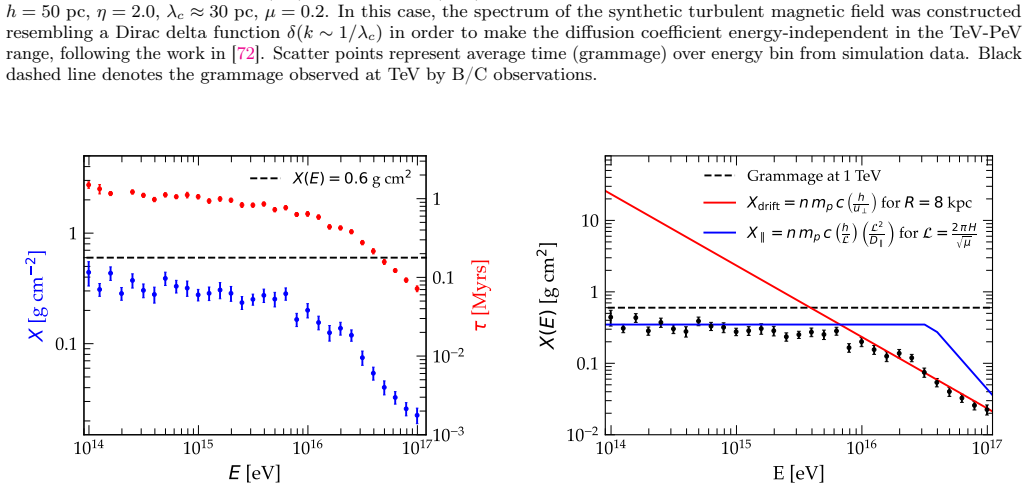
read the original abstract
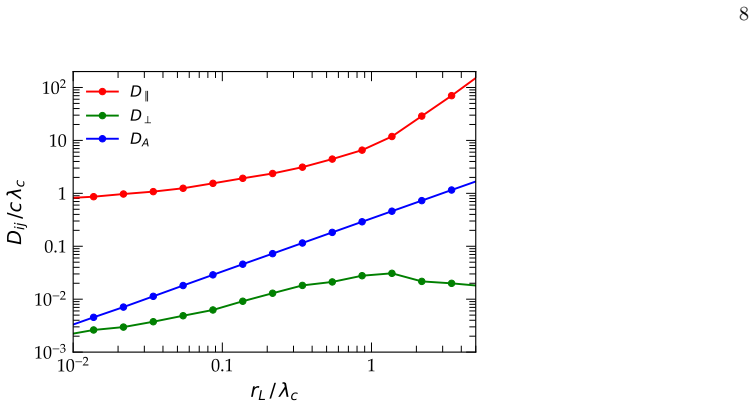
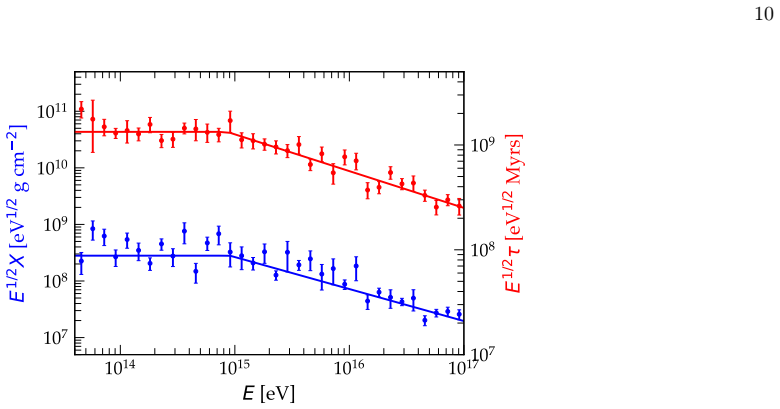
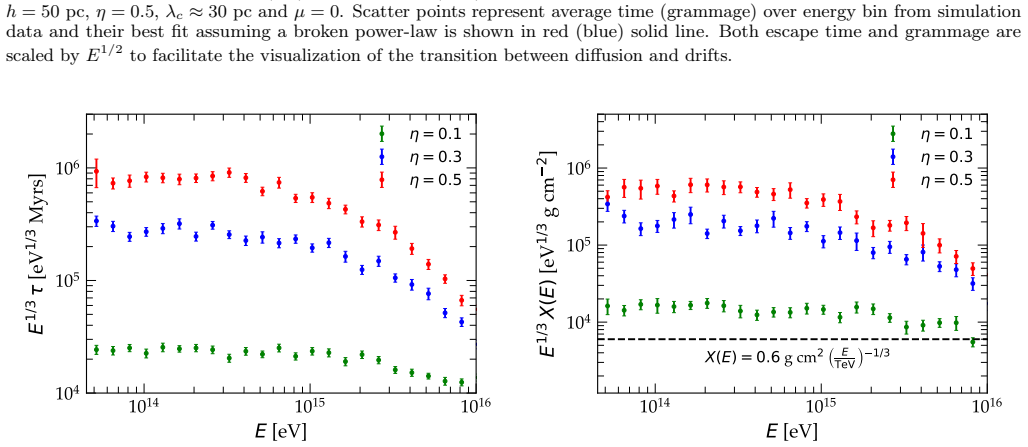
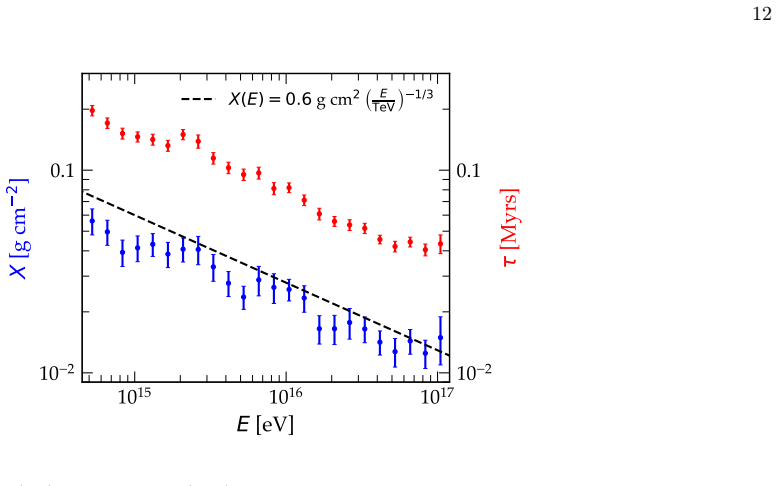
In a magnetic field with a complex topology, as can be the Galactic magnetic field, cosmic ray transport cannot simply be described by diffusion parallel and perpendicular to magnetic field lines, because the gradients and curvature of the large-scale magnetic field induce drift motions. These effects become especially important at high energies. Here we revisit the possibility that the competition between diffusion and drifts may lead to a knee in the cosmic ray spectrum. We carry out test-particle simulations of cosmic ray transport in a mock Galactic magnetic field made of a regular large scale component, with a non-trivial topology and a homogeneous and isotropic turbulent magnetic field, with a spectrum that is assumed to be Kolmogorov-like in the basic setup. These simulations are used to infer the escape time and the grammage accumulated by cosmic rays with energy in the TeV--10 PeV energy range. In the case of a large scale magnetic field with a purely azimuthal structure, the drift due to the curvature of magnetic field lines produces a knee in the PeV range, but the model fails to reproduce the grammage, due to the exceedingly low value of the perpendicular diffusion coefficient. If the large scale magnetic field acquires a component perpendicular to the Galactic disc, the parallel diffusion coefficient becomes quickly dominant in terms of particle escape, and drifts are unable to compete. A knee structure does not appear in such a scenario. However, if the parallel diffusion coefficient becomes energy independent at $E\gtrsim 1$ TeV, a knee may arise around PeV energies due to drift dominance. We discuss two cases in which this situation may occur.
Editorial analysis
A structured set of objections, weighed in public.
Referee Report
Summary. The paper performs test-particle simulations of cosmic ray propagation in a mock Galactic magnetic field consisting of a large-scale regular component (azimuthal or with a perpendicular tilt) plus a homogeneous isotropic Kolmogorov turbulent field. Escape times and grammage are computed in the TeV–10 PeV range to investigate whether the transition to drift-dominated transport, driven by curvature and gradient drifts, can produce the observed knee. A knee appears in the PeV range only for a purely azimuthal large-scale field when the parallel diffusion coefficient is assumed to become energy-independent above ~1 TeV; the tilted-field case suppresses drifts, and the azimuthal case fails to match observed grammage.
Significance. If the energy-independent parallel diffusion regime can be shown to arise self-consistently, the work would provide a transport-based mechanism for the knee that depends on realistic magnetic-field topology rather than source properties alone. The test-particle approach in a non-trivial field geometry is a concrete step toward quantifying drift versus diffusion competition, but the current results rest on an external modeling assumption whose compatibility with the simulated turbulence remains untested.
major comments (2)
- [Abstract] Abstract: The production of a knee at PeV energies is stated to require that the parallel diffusion coefficient becomes energy-independent for E ≳ 1 TeV so that drifts can dominate escape. This condition is introduced as an external requirement rather than shown to emerge from the Kolmogorov turbulence spectrum used in the simulations; standard quasi-linear theory for isotropic Kolmogorov turbulence predicts D∥ ∝ E^{1/3} (or steeper) continuing through the TeV–PeV range, so the knee appears only under an added assumption whose self-consistency is not demonstrated.
- [Abstract] Abstract: In the purely azimuthal large-scale field geometry the curvature drift produces a knee, yet the model yields an exceedingly low perpendicular diffusion coefficient that prevents reproduction of the observed grammage; this internal inconsistency undermines the viability of the drift-knee scenario even in the configuration where the spectral feature appears.
minor comments (1)
- [Abstract] The abstract supplies only qualitative outcomes and does not report quantitative values for escape times, grammage, knee position, or error estimates, which limits assessment of the numerical robustness of the claimed transition.
Simulated Author's Rebuttal
We thank the referee for the detailed review and for highlighting the key assumptions and limitations in our work. Below we respond point-by-point to the major comments. We agree that the energy-independent parallel diffusion regime is an external assumption and that the azimuthal-field case does not reproduce observed grammage; the manuscript already flags the latter as a limitation. We will revise the text to make these points more explicit while preserving the exploratory nature of the study.
read point-by-point responses
-
Referee: [Abstract] Abstract: The production of a knee at PeV energies is stated to require that the parallel diffusion coefficient becomes energy-independent for E ≳ 1 TeV so that drifts can dominate escape. This condition is introduced as an external requirement rather than shown to emerge from the Kolmogorov turbulence spectrum used in the simulations; standard quasi-linear theory for isotropic Kolmogorov turbulence predicts D∥ ∝ E^{1/3} (or steeper) continuing through the TeV–PeV range, so the knee appears only under an added assumption whose self-consistency is not demonstrated.
Authors: We agree that the transition to energy-independent parallel diffusion is introduced as an external modeling assumption rather than derived from the simulated Kolmogorov turbulence. The manuscript does not claim that this regime arises self-consistently within quasi-linear theory; instead, the abstract and discussion section explicitly condition the appearance of the knee on this assumption and outline two possible physical contexts (e.g., non-linear wave-particle interactions or deviations from standard QLT) where such a flattening might occur. We will revise the abstract and conclusions to state more clearly that the knee is obtained only under this added hypothesis and that demonstrating its emergence from the turbulence remains outside the scope of the present test-particle study. revision: partial
-
Referee: [Abstract] Abstract: In the purely azimuthal large-scale field geometry the curvature drift produces a knee, yet the model yields an exceedingly low perpendicular diffusion coefficient that prevents reproduction of the observed grammage; this internal inconsistency undermines the viability of the drift-knee scenario even in the configuration where the spectral feature appears.
Authors: The manuscript already states in the abstract and in the results section that the purely azimuthal geometry produces a knee via curvature drift but fails to match the observed grammage because of the very low perpendicular diffusion coefficient. We present this as an intrinsic limitation of that particular large-scale field topology. The referee correctly identifies this as an internal tension that weakens the scenario in the only geometry where the knee appears. We will expand the discussion in the conclusions to emphasize that this mismatch indicates the drift-knee mechanism, as implemented here, is not viable without additional ingredients (such as a stronger perpendicular diffusion or a different field geometry) and will add a quantitative comparison of the computed grammage to observational constraints. revision: yes
Circularity Check
No circularity: knee produced conditionally on external assumption about D_parallel(E), not by construction from inputs
full rationale
The paper performs forward test-particle simulations in a mock GMF (regular azimuthal or tilted component plus isotropic Kolmogorov turbulence) to compute escape times and grammage for TeV–PeV particles. The knee appears only under the explicit additional assumption that D_∥ becomes energy-independent above ~1 TeV, allowing drifts to dominate; this assumption is introduced as a condition whose possible origins are discussed separately rather than derived from the simulated turbulence spectrum or field geometry. No equation or result reduces to a fitted parameter, self-citation chain, or redefinition of the target feature. The derivation chain is therefore self-contained against the stated simulation inputs and assumptions.
Axiom & Free-Parameter Ledger
free parameters (1)
- energy threshold for energy-independent parallel diffusion
axioms (1)
- domain assumption Turbulent magnetic field follows a Kolmogorov-like spectrum
Reference graph
Works this paper leans on
-
[1]
PAMELA Measurements of Cosmic-ray Proton and Helium Spectra
O. Adriani, G. C. Barbarino, G. A. Bazilevskaya et al., Science332, 69 (2011), arXiv:1103.4055 [astro-ph.HE]
work page internal anchor Pith review Pith/arXiv arXiv 2011
-
[2]
Y. S. Yoon, H. S. Ahn, P. S. Allison et al., ApJ728, 122 (2011), arXiv:1102.2575 [astro-ph.HE]
work page internal anchor Pith review Pith/arXiv arXiv 2011
-
[3]
Aguilar, D
M. Aguilar, D. Aisa, B. Alpat et al., Phys. Rev. Lett.114, 171103 (2015)
2015
-
[4]
Y. S. Yoon, T. Anderson, A. Barrau et al., ApJ839, 5 (2017), arXiv:1704.02512 [astro-ph.HE]
work page internal anchor Pith review Pith/arXiv arXiv 2017
- [5]
-
[6]
Aguilar, L
M. Aguilar, L. Ali Cavasonza, G. Ambrosi et al., Phys. Rep.894, 1 (2021)
2021
-
[7]
F. Alemanno, Q. An, P. Azzarello et al., Phys. Rev. Lett.126, 201102 (2021), arXiv:2105.09073 [astro-ph.HE]
-
[8]
O. Adriani, Y. Akaike, K. Asano et al., Phys. Rev. Lett.129, 101102 (2022), arXiv:2209.01302 [astro-ph.HE]
-
[9]
O. Adriani, Y. Akaike, K. Asano et al., Phys. Rev. Lett.130, 171002 (2023), arXiv:2304.14699 [astro-ph.HE]
-
[10]
T. Antoni, W. D. Apel, A. F. Badea et al., Astroparticle Physics24, 1 (2005), arXiv:astro-ph/0505413 [astro-ph]
work page internal anchor Pith review Pith/arXiv arXiv 2005
-
[11]
W. D. Apel, J. C. Arteaga-Velázquez, K. Bekk et al., Phys. Rev. Lett.107, 171104 (2011), arXiv:1107.5885 [astro-ph.HE]
work page internal anchor Pith review Pith/arXiv arXiv 2011
-
[12]
W. D. Apel, J. C. Arteaga-Velázquez, K. Bekk et al., Astroparticle Physics47, 54 (2013), arXiv:1306.6283 [astro-ph.HE]
work page internal anchor Pith review Pith/arXiv arXiv 2013
-
[13]
M. Amenomori, X. J. Bi, D. Chen et al., ApJ678, 1165 (2008), arXiv:0801.1803 [hep-ex]
- [14]
- [15]
- [16]
- [17]
- [18]
- [19]
-
[20]
Peters, Il Nuovo Cimento22, 800 (1961)
B. Peters, Il Nuovo Cimento22, 800 (1961)
1961
-
[21]
J. R. Hörandel, Astroparticle Physics21, 241 (2004), arXiv:astro-ph/0402356 [astro-ph]
work page internal anchor Pith review Pith/arXiv arXiv 2004
-
[22]
P. Cristofari, P. Blasi and E. Amato, Astroparticle Physics123, 102492 (2020), arXiv:2007.04294 [astro-ph.HE]
-
[23]
Massive Stars as Major Factories of Galactic Cosmic Rays
F. Aharonian, R. Yang and E. de Oña Wilhelmi, Nature Astronomy3, 561 (2019), arXiv:1804.02331 [astro-ph.HE]
work page internal anchor Pith review Pith/arXiv arXiv 2019
- [24]
- [25]
-
[26]
Cocconi, Il Nuovo Cimento3, 1433 (1956)
G. Cocconi, Il Nuovo Cimento3, 1433 (1956)
1956
-
[27]
Numerical propagation of high energy cosmic rays in the Galaxy I: technical issues
D. De Marco, P. Blasi and T. Stanev, J. Cosmology Astropart. Phys.2007, 027 (2007), arXiv:0705.1972 [astro-ph]
work page internal anchor Pith review Pith/arXiv arXiv 2007
-
[28]
Escape model for Galactic cosmic rays and an early extragalactic transition
G. Giacinti, M. Kachelrieß and D. V. Semikoz, Phys. Rev. D91, 083009 (2015), arXiv:1502.01608 [astro-ph.HE]
work page internal anchor Pith review Pith/arXiv arXiv 2015
-
[29]
Charged particle diffusion in isotropic random magnetic fields
P. Subedi, W. Sonsrettee, P. Blasi et al., ApJ837, 140 (2017), arXiv:1612.09507 [physics.space-ph]
work page internal anchor Pith review Pith/arXiv arXiv 2017
-
[30]
A. Dundovic, O. Pezzi, P. Blasi et al., Phys. Rev. D102, 103016 (2020), arXiv:2007.09142 [astro-ph.HE]
-
[31]
V. S. Ptuskin, S. I. Rogovaya, V. N. Zirakashvili et al., A&A268, 726 (1993)
1993
-
[32]
P. A. Isenberg and J. R. Jokipii, ApJ234, 746 (1979)
1979
-
[33]
J. Candia, E. Roulet and L. N. Epele, Journal of High Energy Physics2002, 033 (2002), arXiv:astro-ph/0206336 [astro-ph]
work page internal anchor Pith review Pith/arXiv arXiv 2002
-
[34]
Diffusion and drift of cosmic rays in highly turbulent magnetic fields
J. Candia and E. Roulet, J. Cosmology Astropart. Phys.2004, 007 (2004), arXiv:astro-ph/0408054 [astro-ph]
work page internal anchor Pith review Pith/arXiv arXiv 2004
-
[35]
Diffuse Neutrino and Gamma-ray Emissions of the Galaxy above the TeV
C. Evoli, D. Grasso and L. Maccione, J. Cosmology Astropart. Phys.2007, 003 (2007), arXiv:astro-ph/0701856 [astro-ph]
work page internal anchor Pith review Pith/arXiv arXiv 2007
-
[36]
Giacalone and J
J. Giacalone and J. R. Jokipii, ApJ520, 204 (1999)
1999
-
[37]
J. R. Jokipii, ApJ146, 480 (1966)
1966
-
[38]
P. Blasi, Proc. Int. Sch. Phys. Fermi208, 41 (2024), arXiv:2307.11640 [astro-ph.HE]
-
[39]
R. C. Tautz and A. Shalchi, ApJ744, 125 (2012)
2012
-
[40]
Rossi and S
B. Rossi and S. Olbert,Introduction to the physics of space.(1970)
1970
-
[41]
Spectrum of Galactic Cosmic Rays Accelerated in Supernova Remnants
V. Ptuskin, V. Zirakashvili and E.-S. Seo, ApJ718, 31 (2010), arXiv:1006.0034 [astro-ph.CO]
work page internal anchor Pith review Pith/arXiv arXiv 2010
-
[42]
K. M. Schure and A. R. Bell, MNRAS435, 1174 (2013), arXiv:1307.6575 [astro-ph.HE]
work page internal anchor Pith review Pith/arXiv arXiv 2013
-
[43]
Particle Acceleration at Shocks:
D. Caprioli, Proc. Int. Sch. Phys. Fermi208, 143 (2024), arXiv:2307.00284 [astro-ph.HE]
-
[44]
R. Alves Batista, J. Becker Tjus, J. Dörner et al., J. Cosmology Astropart. Phys.2022, 035 (2022), arXiv:2208.00107 [astro-ph.HE]
-
[45]
The outer scale of turbulence in the magneto-ionized Galactic interstellar medium
M. Haverkorn, J. C. Brown, B. M. Gaensler et al., ApJ680, 362 (2008), arXiv:0802.2740 [astro-ph]
work page internal anchor Pith review Pith/arXiv arXiv 2008
-
[46]
M. Iacobelli, M. Haverkorn, E. Orrú et al., A&A558, A72 (2013), arXiv:1308.2804 [astro-ph.GA]
work page internal anchor Pith review Pith/arXiv arXiv 2013
-
[47]
Transport of Cosmic Rays in Chaotic Magnetic Fields
F. Casse, M. Lemoine and G. Pelletier, Phys. Rev. D65, 023002 (2001), arXiv:astro-ph/0109223 [astro-ph]
work page internal anchor Pith review Pith/arXiv arXiv 2001
- [48]
- [49]
-
[50]
J. W. Bieber and W. H. Matthaeus, ApJ485, 655 (1997)
1997
-
[51]
C. Evoli and U. Dupletsa, Proc. Int. Sch. Phys. Fermi208, 257 (2024), arXiv:2309.00298 [astro-ph.HE]
-
[52]
L. Tibaldo, S. W. Digel, J. M. Casandjian et al., ApJ807, 161 (2015), arXiv:1505.04223 [astro-ph.HE]
work page internal anchor Pith review Pith/arXiv arXiv 2015
- [53]
-
[54]
N. Weinrich, M. Boudaud, L. Derome et al., A&A639, A74 (2020), arXiv:2004.00441 [astro-ph.HE]
-
[55]
Ferrière, Mem
K. Ferrière, Mem. Soc. Astron. Italiana82, 824 (2011)
2011
-
[56]
M. Unger and G. R. Farrar, ApJ970, 95 (2024), arXiv:2311.12120 [astro-ph.GA]
-
[57]
The magnetic field of the Milky Way: an observational perspective
M. Haverkorn, arXiv e-prints , arXiv:2606.02149 (2026), arXiv:2606.02149 [astro-ph.GA]
work page internal anchor Pith review Pith/arXiv arXiv 2026
-
[58]
J. L. Han, Ap&SS278, 181 (2001), arXiv:astro-ph/0110319 [astro-ph]
work page internal anchor Pith review Pith/arXiv arXiv 2001
-
[59]
M. S. Pshirkov, P. G. Tinyakov, P. P. Kronberg et al., ApJ738, 192 (2011), arXiv:1103.0814 [astro-ph.GA]
work page internal anchor Pith review Pith/arXiv arXiv 2011
- [60]
-
[61]
Shalchi, ApJ881, L27 (2019), arXiv:1908.00694 [astro-ph.SR]
A. Shalchi, ApJ881, L27 (2019), arXiv:1908.00694 [astro-ph.SR]
-
[62]
B. Schroer, C. Evoli and P. Blasi, Phys. Rev. D103, 123010 (2021), arXiv:2102.12576 [astro-ph.HE]
-
[63]
Reconciling cosmic ray diffusion with Galactic magnetic field models
G. Giacinti, M. KachelrieSS and D. V. Semikoz, J. Cosmology Astropart. Phys.2018, 051 (2018), arXiv:1710.08205 [astro-ph.HE]
work page internal anchor Pith review Pith/arXiv arXiv 2018
-
[64]
Lemoine, Journal of Plasma Physics89, 175890501 (2023), arXiv:2304.03023 [physics.plasm-ph]
M. Lemoine, Journal of Plasma Physics89, 175890501 (2023), arXiv:2304.03023 [physics.plasm-ph]
-
[65]
P. Kempski, D. B. Fielding, E. Quataert et al., MNRAS525, 4985 (2023), arXiv:2304.12335 [astro-ph.HE]
-
[66]
P. Kempski, D. Li, D. B. Fielding et al., ApJ990, L18 (2025), arXiv:2412.03649 [astro-ph.HE]
- [67]
-
[68]
V. Grebenyuk, D. Karmanov, I. Kovalev et al., Advances in Space Research64, 2559 (2019), arXiv:1809.09665 [astro-ph.HE]
-
[69]
S. Recchia and S. Gabici, A&A692, A20 (2024), arXiv:2312.11397 [astro-ph.HE]
-
[70]
A. Ambrosone, C. Evoli, B. Schroer et al., A&A698, L18 (2025), arXiv:2503.14651 [astro-ph.HE]
-
[71]
R. Yang and F. Aharonian, Phys. Rev. D111, 083040 (2025), arXiv:2410.22199 [astro-ph.HE]
-
[72]
O. Pezzi and P. Blasi, MNRAS529, L13 (2024), arXiv:2305.02890 [astro-ph.HE]
-
[73]
A. J. Farmer and P. Goldreich, ApJ604, 671 (2004), arXiv:astro-ph/0311400 [astro-ph]
work page internal anchor Pith review Pith/arXiv arXiv 2004
-
[74]
Spectral breaks as a signature of cosmic ray induced turbulence in the Galaxy
P. Blasi, E. Amato and P. D. Serpico, Phys. Rev. Lett.109, 061101 (2012), arXiv:1207.3706 [astro-ph.HE]
work page internal anchor Pith review Pith/arXiv arXiv 2012
discussion (0)
Sign in with ORCID, Apple, or X to comment. Anyone can read and Pith papers without signing in.