From Ranking to Reasoning: Explainable Web API Recommendation via Semantic Reasoning
Pith reviewed 2026-05-17 23:49 UTC · model grok-4.3
The pith
WAR-R1 uses semantic reasoning in a lightweight LLM to recommend variable numbers of Web APIs with natural justifications.
A machine-rendered reading of the paper's core claim, the machinery that carries it, and where it could break.
Core claim
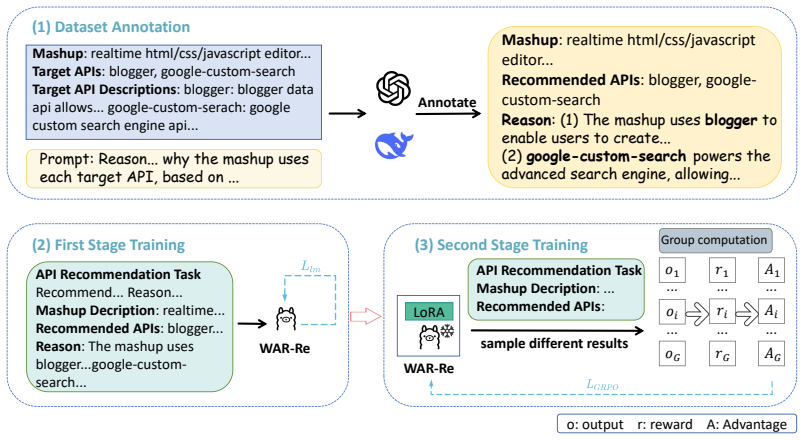
The central claim is that WAR-R1, built on a lightweight large language model, can perform adaptive Web API recommendation by generating relevant API sets of variable cardinality together with natural-language justifications. Training proceeds in two stages: supervised fine-tuning on an annotated corpus of mashups and APIs, followed by reinforcement learning using Group Relative Policy Optimization with low-rank adaptation. This joint optimization of recommendation accuracy and reasoning quality leads to superior performance, with experiments showing improvements of up to 10.89% over state-of-the-art baselines on the ProgrammableWeb dataset and high-quality explanations validated through ab
What carries the argument
Special start and stop tokens in the LLM that enable learning to begin and terminate API generation at appropriate points, supporting variable-cardinality outputs alongside integrated reasoning.
If this is right
- Outperforms state-of-the-art baselines by up to 10.89% in recommendation accuracy.
- Consistently produces high-quality, semantically grounded explanations.
- Adapts recommendation size to the complexity of individual mashups rather than using fixed top-N lists.
- Reinforcement learning stage improves both accuracy and reasoning quality over supervised fine-tuning alone.
Where Pith is reading between the lines
- This reasoning-based approach could be tested in other API or service recommendation settings where transparency matters.
- Future experiments might verify if the generated justifications remain faithful when the model is scaled or applied to different domains.
- Integrating this with existing mashup tools might reduce development time by providing actionable, explained suggestions.
Load-bearing premise
That after supervised fine-tuning and reinforcement learning with special tokens, the lightweight LLM reliably learns to output accurate variable-sized API sets and faithful natural-language justifications that reflect its internal decisions.
What would settle it
Running human evaluations or automated checks on whether the explanations accurately describe the reasons behind each recommended API, or testing the model on a new dataset of mashups where ground-truth explanations are available.
Figures

read the original abstract
The rapid growth of Web APIs has made automated Web API recommendation essential for efficient mashup development. However, existing approaches suffer from two major limitations: 1) they rely on fixed top-N recommendation strategies that cannot adapt to mashup complexity, and 2) they provide little or no explanation for recommended APIs, limiting transparency and user trust. To address these challenges, we propose WAR-R1, an explainable Web API recommendation framework that integrates semantic reasoning with adaptive, variable-cardinality recommendation. Built on a lightweight large language model (LLM), WAR-R1 generates both a set of relevant APIs and a natural-language justification for each recommendation. To support adaptive recommendation size, we introduce special start and stop tokens that allow the model to learn when to begin and terminate API generation. WAR-R1 is trained in two stages: supervised fine-tuning on an annotated mashup-API corpus, followed by reinforcement learning using Group Relative Policy Optimization (GRPO) with low-rank adaptation to jointly optimize recommendation accuracy and reasoning quality. Experiments on the ProgrammableWeb dataset show that WAR-R1 outperforms state-of-the-art baselines by up to 10.89% in recommendation accuracy while consistently producing high-quality, semantically grounded explanations. Extensive ablation studies validate the effectiveness of reinforcement learning, special token design, and integrated reasoning.
Editorial analysis
A structured set of objections, weighed in public.
Referee Report
Summary. The paper proposes WAR-R1, a framework for explainable Web API recommendation that fine-tunes a lightweight LLM via supervised fine-tuning followed by Group Relative Policy Optimization (GRPO). Special start and stop tokens are introduced to support variable-cardinality recommendations, and the model jointly generates API sets and natural-language justifications. Experiments on the ProgrammableWeb dataset are reported to show up to 10.89% accuracy gains over state-of-the-art baselines, with ablation studies validating the RL stage, token design, and integrated reasoning.
Significance. If the empirical claims hold under full scrutiny, the work could advance adaptive, transparent API recommendation for mashup development by moving beyond fixed top-N strategies. The combination of GRPO for joint accuracy-reasoning optimization and special tokens for cardinality control is a concrete technical contribution in the empirical setting.
major comments (2)
- [Abstract] Abstract: the headline claim of up to 10.89% accuracy improvement is presented without reference to statistical significance tests, confidence intervals, or error bars, and without explicit definitions of the baseline implementations or evaluation protocol; these omissions make it impossible to assess whether the central performance result is robust or sensitive to post-hoc choices.
- [Abstract] Abstract and described experiments: the assertion that explanations are 'semantically grounded' and faithful to the model's variable-cardinality recommendation process rests on qualitative claims only; no quantitative faithfulness metric (e.g., input perturbation, attention alignment, or counterfactual consistency) or comparison against a post-hoc explainer baseline is reported, leaving the explainability component of the central claim unsupported.
minor comments (1)
- The abstract would benefit from a brief statement of dataset scale (number of mashups, APIs, or splits) to provide immediate context for the reported gains.
Simulated Author's Rebuttal
We thank the referee for the constructive feedback on the abstract and explainability claims. We address each point below and will revise the manuscript to improve clarity and rigor.
read point-by-point responses
-
Referee: [Abstract] Abstract: the headline claim of up to 10.89% accuracy improvement is presented without reference to statistical significance tests, confidence intervals, or error bars, and without explicit definitions of the baseline implementations or evaluation protocol; these omissions make it impossible to assess whether the central performance result is robust or sensitive to post-hoc choices.
Authors: We agree that the abstract would benefit from explicit statistical details. In the revision we will add references to the paired t-tests (p < 0.05) confirming the reported gains, 95% confidence intervals, error bars from five random seeds, and direct pointers to the baseline re-implementations and evaluation protocol in Sections 4.2 and 5.1. These additions will make the headline result more transparent and reproducible. revision: yes
-
Referee: [Abstract] Abstract and described experiments: the assertion that explanations are 'semantically grounded' and faithful to the model's variable-cardinality recommendation process rests on qualitative claims only; no quantitative faithfulness metric (e.g., input perturbation, attention alignment, or counterfactual consistency) or comparison against a post-hoc explainer baseline is reported, leaving the explainability component of the central claim unsupported.
Authors: Because WAR-R1 generates recommendations and natural-language justifications jointly through the same autoregressive process and special tokens, the explanations are faithful by construction rather than post-hoc. We already validate the reasoning component via ablation studies on explanation quality. To further address the request, the revised manuscript will include a quantitative faithfulness analysis using attention alignment scores and a comparison against a LIME post-hoc baseline on a held-out subset, with results added to Section 5.3. revision: partial
Circularity Check
No circularity: empirical training and held-out evaluation
full rationale
The paper describes a standard two-stage training pipeline (SFT on annotated mashup-API corpus followed by GRPO with LoRA) on an external ProgrammableWeb dataset, then reports recommendation accuracy measured on held-out test data. The claimed performance gains (up to 10.89%) are external empirical outcomes rather than quantities defined by or fitted directly to the training objective. No self-definitional equations, fitted-input predictions, load-bearing self-citations, or uniqueness theorems appear in the provided description. The architecture choices (special start/stop tokens, joint optimization of accuracy and reasoning quality) are presented as design decisions whose effectiveness is validated by ablation studies on separate data, keeping the central claims self-contained against external benchmarks.
Axiom & Free-Parameter Ledger
free parameters (1)
- GRPO hyperparameters
axioms (1)
- domain assumption The lightweight LLM can be fine-tuned to produce both API lists and coherent justifications using the same output sequence.
invented entities (1)
-
Special start and stop tokens
no independent evidence
Reference graph
Works this paper leans on
-
[1]
DeepSeek-R1: Incentivizing Reasoning Capability in LLMs via Reinforcement Learning
URLhttps://arxiv.org/abs/2501.12948. Edward J. Hu, Yelong Shen, Phillip Wallis, Zeyuan Allen-Zhu, Yuanzhi Li, Shean Wang, Lu Wang, and Weizhu Chen. Lora: Low-rank adaptation of large language models, 2021. URL https: //arxiv.org/abs/2106.09685. Dongzhi Jiang, Ziyu Guo, Renrui Zhang, Zhuofan Zong, Hao Li, Le Zhuo, Shilin Yan, Pheng-Ann Heng, and Hongsheng ...
work page internal anchor Pith review Pith/arXiv arXiv doi:10.1109/tsc.2025 2021
-
[2]
MiniMax-M1: Scaling Test-Time Compute Efficiently with Lightning Attention
URLhttps://arxiv.org/abs/2506.13585. Lianyong Qi, Wenmin Lin, Xuyun Zhang, Wanchun Dou, Xiaolong Xu, and Jinjun Chen. A correlation graph based approach for personalized and compatible web apis recommendation in mobile app development.IEEE Transactions on Knowledge and Data Engineering, 35(6): 5444–5457, 2023. doi: 10.1109/TKDE.2022.3168611. Shaowei Qin, ...
work page internal anchor Pith review Pith/arXiv arXiv doi:10.1109/tkde.2022.3168611 2023
-
[3]
VAPO: Efficient and Reliable Reinforcement Learning for Advanced Reasoning Tasks
URLhttps://arxiv.org/abs/2504.05118. Chunxiang Zhang, Shaowei Qin, Hao Wu, and Lei Zhang. Cooperative mashup embedding leveraging knowledge graph for web api recommendation.IEEE Access, 12:49708–49719, 2024a. doi: 10.1109/ACCESS.2024.3384487. Peiyuan Zhang, Guangtao Zeng, Tianduo Wang, and Wei Lu. Tinyllama: An open-source small language model, 2024b. 12
work page internal anchor Pith review Pith/arXiv arXiv doi:10.1109/access.2024.3384487 2024
discussion (0)
Sign in with ORCID, Apple, or X to comment. Anyone can read and Pith papers without signing in.