Projected logical ensembles in surface codes via the random-matrix theory of quantum dots
Pith reviewed 2026-06-27 03:39 UTC · model grok-4.3
The pith
Surface code post-measurement logical states form ensembles isomorphic to quantum dot scattering matrices.
A machine-rendered reading of the paper's core claim, the machinery that carries it, and where it could break.
Core claim
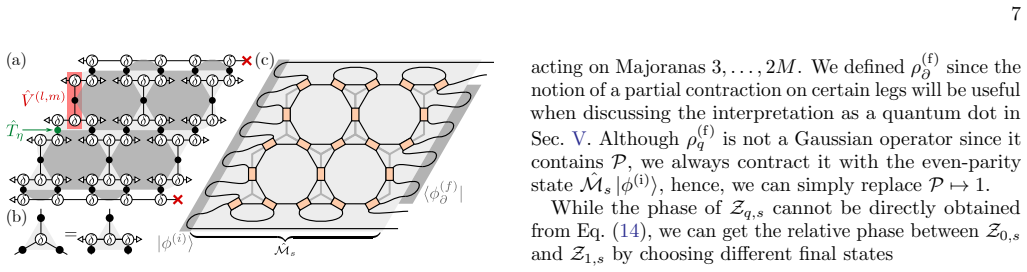
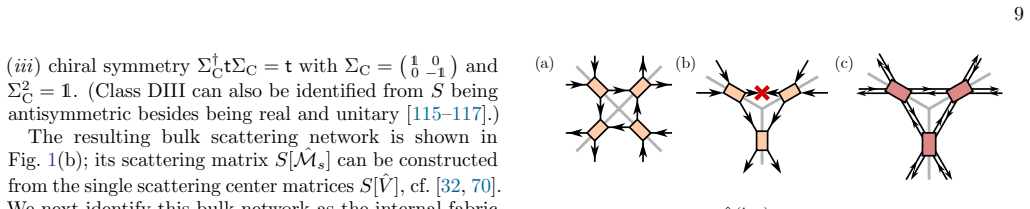
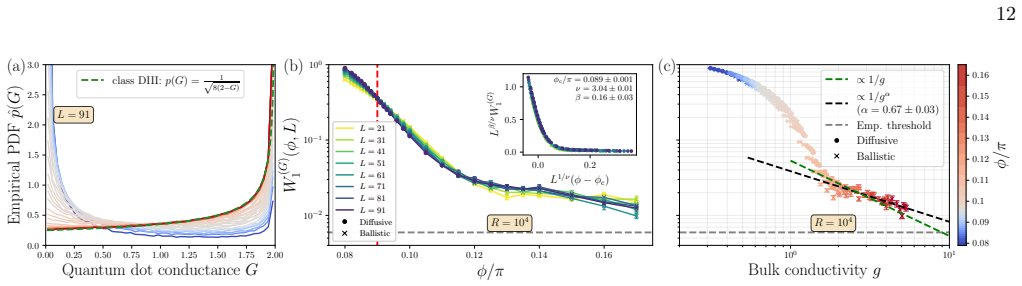
For a surface code with a single logical qubit, the projected logical ensemble is isomorphic to an ensemble of scattering matrices describing mesoscopic quantum dots from a 2D Majorana network model with suitable boundary conditions. In chaotic regimes, the PLE approaches a universal ensemble that is maximally random up to symmetry and decoder-induced constraints, realizing Altland-Zirnbauer classes D or DIII.
What carries the argument
The isomorphism between the Born-weighted post-measurement ensemble after maximum-likelihood decoding and the scattering-matrix ensemble of the 2D Majorana network model.
If this is right
- The PLE becomes maximally random in chaotic regimes, limited only by the code's symmetries.
- Symmetry classes D or DIII emerge based on the weights of stabilizers and logical operators.
- This connection applies specifically to uniform single-qubit Pauli-X rotations on the surface code.
Where Pith is reading between the lines
- Experiments on quantum dots could be used to probe properties of logical ensembles in QEC.
- The mapping suggests that universality in one domain implies similar behavior in the other, potentially allowing cross-domain predictions.
- Similar isomorphisms might exist for other codes or gate sets, extending the connection beyond surface codes.
Load-bearing premise
The Born-weighted post-measurement ensemble after maximum-likelihood decoding on the surface code is exactly isomorphic to the scattering-matrix ensemble of the 2D Majorana network model with the chosen boundary conditions.
What would settle it
Measuring the statistical distribution of logical Pauli operators or state fidelities in a surface code experiment and finding it inconsistent with the predicted random matrix ensemble in the chaotic limit would falsify the claimed isomorphism.
Figures





read the original abstract
Measurements underpin active quantum error correction (QEC) and have been recognized as a source of novel measurement-induced many-body phenomena. Here, we study the statistical properties of post-measurement logical states arising in QEC on topological codes subject to deterministic transversal unitary gates. Upon syndrome extraction followed by maximum-likelihood decoding, a Born-weighted ensemble arises which we dub the "projected logical ensemble" (PLE). Focusing on surface codes subject to uniform single-qubit Pauli-$X$ rotations, we characterize the measurement-induced randomness of the PLE. To this end, we show that for a code with a single logical qubit, the PLE is isomorphic to an ensemble of scattering matrices describing mesoscopic quantum dots obtained from a 2D Majorana network model with suitable boundary conditions. We uncover regimes where these quantum dots are chaotic such that their scattering matrices are well-described by random matrix theory. In these regimes, the PLE approaches a universal ensemble that is maximally random up to symmetry and decoder-induced constraints. The symmetry constraints, set by stabilizer and logical operator weights, realize Altland-Zirnbauer classes D or DIII, which we both illustrate. Our results establish a fundamental connection between emergent universality concepts in mesoscopic physics, quantum many-body systems, and QEC.
Editorial analysis
A structured set of objections, weighed in public.
Referee Report
Summary. The manuscript defines the projected logical ensemble (PLE) as the Born-weighted post-measurement ensemble of logical states after syndrome extraction and maximum-likelihood decoding in surface codes under uniform single-qubit Pauli-X rotations. It claims that for a single-logical-qubit surface code the PLE is isomorphic to the scattering-matrix ensemble of a 2D Majorana network model with suitable boundary conditions, and that in chaotic regimes this ensemble approaches a universal random-matrix-theory form respecting Altland-Zirnbauer classes D or DIII set by the stabilizer and logical-operator weights.
Significance. If the claimed isomorphism holds exactly, the work supplies a concrete bridge between measurement-induced ensembles in topological quantum error correction and the established random-matrix theory of mesoscopic quantum dots. The explicit realization of symmetry classes D and DIII through decoder constraints is a concrete strength that could allow transfer of RMT universality results to logical-state statistics.
major comments (2)
- [The isomorphism claim (abstract and the section introducing the Majorana network model)] The exact isomorphism between the Born-weighted PLE (after maximum-likelihood decoding) and the scattering-matrix ensemble of the 2D Majorana network is the load-bearing step for the RMT connection. The section presenting the mapping must demonstrate that the chosen boundary conditions preserve the precise stabilizer and logical-operator weights that enforce the Altland-Zirnbauer class D or DIII constraints; any mismatch would invalidate the subsequent claim that the PLE approaches the universal ensemble in chaotic regimes.
- [The section on chaotic regimes and universal ensembles] The assertion that the PLE 'approaches a universal ensemble' in chaotic regimes requires explicit verification that the surface-code measurement outcomes map onto the network scattering matrices without additional fitting parameters or regime restrictions. The relevant section should include either an analytic derivation or numerical checks confirming that the symmetry constraints are identical.
minor comments (2)
- [Introduction or methods] The definition of the PLE would benefit from an explicit mathematical expression for the Born-weighted probability distribution over logical states.
- [Figures] Figure captions should clarify which panels correspond to class D versus class DIII and which decoder is used.
Simulated Author's Rebuttal
We thank the referee for their careful reading of the manuscript and for highlighting the importance of explicit demonstrations in the mapping and chaotic-regime sections. We address each major comment below.
read point-by-point responses
-
Referee: [The isomorphism claim (abstract and the section introducing the Majorana network model)] The exact isomorphism between the Born-weighted PLE (after maximum-likelihood decoding) and the scattering-matrix ensemble of the 2D Majorana network is the load-bearing step for the RMT connection. The section presenting the mapping must demonstrate that the chosen boundary conditions preserve the precise stabilizer and logical-operator weights that enforce the Altland-Zirnbauer class D or DIII constraints; any mismatch would invalidate the subsequent claim that the PLE approaches the universal ensemble in chaotic regimes.
Authors: We agree that the boundary conditions must be shown to preserve the exact stabilizer and logical-operator weights. In the revised manuscript we have expanded the Majorana-network section with explicit derivations that map the surface-code stabilizers and logical operators onto the network boundaries, confirming that the parity and weight constraints required for classes D and DIII are identically reproduced. These additions remove any ambiguity in the isomorphism. revision: yes
-
Referee: [The section on chaotic regimes and universal ensembles] The assertion that the PLE 'approaches a universal ensemble' in chaotic regimes requires explicit verification that the surface-code measurement outcomes map onto the network scattering matrices without additional fitting parameters or regime restrictions. The relevant section should include either an analytic derivation or numerical checks confirming that the symmetry constraints are identical.
Authors: We accept the request for explicit verification. The revised manuscript now includes both an analytic argument establishing the parameter-free correspondence between measurement outcomes and scattering matrices, and numerical checks on small lattices that confirm the symmetry classes remain identical in the chaotic regime. These results are presented in the updated chaotic-regimes section. revision: yes
Circularity Check
No circularity: PLE-RMT isomorphism presented as derived mapping
full rationale
The paper states it shows an isomorphism between the projected logical ensemble (after syndrome extraction and maximum-likelihood decoding) and the scattering-matrix ensemble of a 2D Majorana network model. This is framed as a connection to an independently studied RMT ensemble (Altland-Zirnbauer classes), not as a definition, fit, or self-citation reduction. No equations or steps in the provided abstract reduce the result to its inputs by construction, and the reader's assessment notes absence of fitted-parameter or loop issues. The derivation is treated as self-contained against external RMT benchmarks.
Axiom & Free-Parameter Ledger
axioms (2)
- domain assumption Random matrix theory describes the scattering matrices of chaotic quantum dots in the appropriate Altland-Zirnbauer classes.
- domain assumption The surface-code syndrome extraction plus maximum-likelihood decoding produces a Born-weighted ensemble that admits an exact isomorphism to the chosen Majorana network model.
invented entities (1)
-
Projected logical ensemble (PLE)
no independent evidence
Reference graph
Works this paper leans on
-
[1]
maximally entropic
Wasserstein-1 distance Here, we compare the logical ensemble E [Eq. (7)] with the Haar ensemble over the upper Bloch hemisphere E ∗ H, which is the appropriate “maximally entropic” ensemble within the constraints given by symmetry class DIII, max- imum likelihood decoder, and initial state |0⟩ [Sec. V D]. For convenience, we compare, using the Wasserstein...
-
[2]
max- imally entropic
Logical state designs Here, we consider a closely related logical ensemble E ′. To construct E ′, after applying the correction operation Cs according to the maximum likelihood decoder [cf. Sec. III A], we apply with probability 1 /2 a logical X. Hence, the states in E ′ can be anywhere on the Bloch sphere for symmetry class DIII, unlike those in E, which...
-
[3]
V B [see Eq
Construction from the effective Gaussian tensor Here, we derive in more detail the scattering matrix of the quantum dot discussed in Sec. V B [see Eq. (29)]. By considering the single-particle action of ˜Ms [Eq. (23)], which we reproduce here for convenience ˜Ms = cos θs 2 (1 +iγ 1γ2) + sin θs 2 eiφs(1−iγ 1γ2)√ 2 ,(E1) we first construct the transfer matr...
-
[4]
partial Pauli twirling
Isomorphism with the final state correlation matrix Since |ϕs⟩ [Eq. (20)] is an unnormalized Gaussian state, it is instructive to consider its correlation matrix. Again switching to Majoranas via χ2j−1 = (Q k<j τ x k )τ z j , χ2j = (Q k<j τ x k )τ y j for j = 1, . . . ,4, the corresponding cor- relation matrix Γ (χ) s,jk = i 2 ⟨ϕs|[χj, χk]|ϕs⟩/⟨ϕ s|ϕs⟩rea...
-
[5]
P. W. Shor, Phys. Rev. A52, R2493 (1995)
1995
-
[6]
A. R. Calderbank and P. W. Shor, Phys. Rev. A54, 1098 (1996)
1996
-
[7]
A. M. Steane, Phys. Rev. Lett.77, 793 (1996)
1996
-
[8]
Gottesman, arXiv:quant-ph/9705052 (1997)
D. Gottesman, arXiv:quant-ph/9705052 (1997)
Pith/arXiv arXiv 1997
-
[9]
Aharonov and M
D. Aharonov and M. Ben-Or, SIAM J. Comp.38, 1207 (2008)
2008
-
[10]
Knill, R
E. Knill, R. Laflamme, and W. H. Zurek, Proc. R. Soc. A454, 365–384 (1998)
1998
-
[11]
S. B. Bravyi and A. Y. Kitaev, arXiv:quant-ph/9811052 (1998)
Pith/arXiv arXiv 1998
-
[12]
Dennis, A
E. Dennis, A. Kitaev, A. Landahl, and J. Preskill, J. Math. Phys.43, 4452 (2002)
2002
-
[13]
Kitaev, Ann
A. Kitaev, Ann. Phys.303, 2 (2003). 22
2003
-
[14]
Gottesman, A
D. Gottesman, A. Kitaev, and J. Preskill, Phys. Rev. A 64, 012310 (2001)
2001
-
[15]
N. P. Breuckmann and J. N. Eberhardt, PRX Quantum 2, 040101 (2021)
2021
-
[16]
B. M. Terhal, Rev. Mod. Phys.87, 307 (2015)
2015
-
[17]
M. A. Nielsen and I. L. Chuang,Quantum Computa- tion and Quantum Information(CUP, Cambridge, U.K., 2010)
2010
-
[18]
Ryan-Andersonet al., Phys
C. Ryan-Andersonet al., Phys. Rev. X11, 041058 (2021)
2021
-
[19]
Krinneret al., Nature605, 669–674 (2022)
S. Krinneret al., Nature605, 669–674 (2022)
2022
-
[20]
G. Q. AI, Nature614, 676 (2023)
2023
-
[21]
Bluvsteinet al., Nature626, 58–65 (2023)
D. Bluvsteinet al., Nature626, 58–65 (2023)
2023
-
[22]
Acharyaet al., Nature638, 920–926 (2024)
R. Acharyaet al., Nature638, 920–926 (2024)
2024
-
[23]
Bluvsteinet al., Nature649, 39 (2026), [Erratum: Nature 650, E3 (2026)]
D. Bluvsteinet al., Nature649, 39 (2026), [Erratum: Nature 650, E3 (2026)]
2026
- [24]
-
[25]
Gottesman and I
D. Gottesman and I. L. Chuang, Nature402, 390–393 (1999)
1999
-
[26]
Raussendorf and H
R. Raussendorf and H. J. Briegel, Phys. Rev. Lett.86, 5188 (2001)
2001
-
[27]
Bravyi and A
S. Bravyi and A. Kitaev, Phys. Rev. A71, 022316 (2005)
2005
-
[28]
Horsman, A
D. Horsman, A. G. Fowler, S. Devitt, and R. V. Meter, New J. Phys.14, 123011 (2012)
2012
-
[29]
Skinner, J
B. Skinner, J. Ruhman, and A. Nahum, Phys. Rev. X9, 031009 (2019)
2019
-
[30]
Y. Li, X. Chen, and M. P. A. Fisher, Phys. Rev. B98, 205136 (2018)
2018
-
[31]
Y. Li, X. Chen, and M. P. A. Fisher, Phys. Rev. B100, 134306 (2019)
2019
-
[32]
S. Choi, Y. Bao, X.-L. Qi, and E. Altman, Phys. Rev. Lett.125, 030505 (2020)
2020
-
[33]
M. J. Gullans and D. A. Huse, Phys. Rev. X10, 041020 (2020)
2020
-
[34]
Ippoliti, M
M. Ippoliti, M. J. Gullans, S. Gopalakrishnan, D. A. Huse, and V. Khemani, Phys. Rev. X11, 011030 (2021)
2021
-
[35]
M. P. A. Fisher, V. Khemani, A. Nahum, and S. Vijay, Ann. Rev. Condens. Matter Phys.14, 1 (2023)
2023
-
[36]
C.-M. Jian, B. Bauer, A. Keselman, and A. W. W. Lud- wig, Phys. Rev. B106, 134206 (2022)
2022
-
[37]
J. S. Cotler, D. K. Mark, H.-Y. Huang, F. Hern´ andez, J. Choi, A. L. Shaw, M. Endres, and S. Choi, PRX Quantum4, 010311 (2023)
2023
-
[38]
Choiet al., Nature613, 468–473 (2023)
J. Choiet al., Nature613, 468–473 (2023)
2023
-
[39]
W. W. Ho and S. Choi, Phys. Rev. Lett.128, 060601 (2022)
2022
-
[40]
Ippoliti and W
M. Ippoliti and W. W. Ho, Quantum6, 886 (2022)
2022
-
[41]
P. W. Claeys and A. Lamacraft, Quantum6, 738 (2022)
2022
-
[42]
McGinley and M
M. McGinley and M. Fava, Phys. Rev. Lett.131, 160601 (2023)
2023
-
[43]
Bhore, J.-Y
T. Bhore, J.-Y. Desaules, and Z. Papi´ c, Phys. Rev. B 108, 104317 (2023)
2023
-
[44]
Ippoliti and W
M. Ippoliti and W. W. Ho, PRX Quantum4, 030322 (2023)
2023
-
[45]
Lucas, L
M. Lucas, L. Piroli, J. De Nardis, and A. De Luca, Phys. Rev. A107, 032215 (2023)
2023
-
[46]
D. K. Mark, F. Surace, A. Elben, A. L. Shaw, J. Choi, G. Refael, M. Endres, and S. Choi, Phys. Rev. X14, 041051 (2024)
2024
-
[47]
C. Liu, Q. C. Huang, and W. W. Ho, Phys. Rev. Lett. 133, 260401 (2024)
2024
-
[48]
Chang, H
R.-A. Chang, H. Shrotriya, W. W. Ho, and M. Ippoliti, PRX Quantum6, 020343 (2025)
2025
-
[49]
Bejan, B
M. Bejan, B. B´ eri, and M. McGinley, Phys. Rev. Lett. 135, 1 (2025)
2025
-
[50]
X.-H. Yu, W. W. Ho, and P. Kos, Phys. Rev. Lett.135, 260402 (2025)
2025
- [51]
-
[52]
W.-K. Mok, T. Haug, W. W. Ho, and J. Preskill, arXiv:2601.00266 (2026)
arXiv 2026
-
[53]
C. Liu, M. Ippoliti, and W. W. Ho, Phys. Rev. Lett. 136, 100404 (2026)
2026
-
[54]
T.-C. Lu, L. A. Lessa, I. H. Kim, and T. H. Hsieh, PRX Quantum3, 040337 (2022)
2022
-
[55]
G.-Y. Zhu, N. Tantivasadakarn, A. Vishwanath, S. Trebst, and R. Verresen, Phys. Rev. Lett.131, 200201 (2023)
2023
-
[56]
J. C. Hokeet al., Nature622, 481–486 (2023)
2023
-
[57]
Negari, S
A.-R. Negari, S. Sahu, and T. H. Hsieh, Phys. Rev. B 109, 125148 (2024)
2024
-
[58]
Iqbalet al., Nature626, 505–511 (2024)
M. Iqbalet al., Nature626, 505–511 (2024)
2024
-
[59]
Tantivasadakarn, R
N. Tantivasadakarn, R. Thorngren, A. Vishwanath, and R. Verresen, Phys. Rev. X14, 021040 (2024)
2024
-
[60]
McGinley, W
M. McGinley, W. W. Ho, and D. Malz, Phys. Rev. X 15, 021059 (2025)
2025
-
[61]
S. J. Garratt, Z. Weinstein, and E. Altman, Phys. Rev. X13, 021026 (2023)
2023
-
[62]
Murciano, P
S. Murciano, P. Sala, Y. Liu, R. S. K. Mong, and J. Al- icea, Phys. Rev. X13, 041042 (2023)
2023
-
[63]
J. Y. Lee, C.-M. Jian, and C. Xu, PRX Quantum4, 030317 (2023)
2023
-
[64]
Z. Yang, D. Mao, and C.-M. Jian, Phys. Rev. B108, 165120 (2023)
2023
-
[65]
Khanna and R
K. Khanna and R. Vasseur, Phys. Rev. Lett.136, 160402 (2026)
2026
-
[66]
Jian, Y.-Z
C.-M. Jian, Y.-Z. You, R. Vasseur, and A. W. W. Ludwig, Phys. Rev. B101, 104302 (2020)
2020
-
[67]
Fuji and Y
Y. Fuji and Y. Ashida, Phys. Rev. B102, 054302 (2020)
2020
-
[68]
Turkeshi, R
X. Turkeshi, R. Fazio, and M. Dalmonte, Phys. Rev. B 102, 014315 (2020)
2020
-
[69]
M. J. Gullans and D. A. Huse, Phys. Rev. Lett.125, 070606 (2020)
2020
-
[71]
Altland and M
A. Altland and M. R. Zirnbauer, Phys. Rev. B55, 1142 (1997)
1997
-
[72]
Cheng, E
Z. Cheng, E. Huang, V. Khemani, M. J. Gullans, and M. Ippoliti, PRX Quantum6, 030333 (2025)
2025
- [73]
-
[74]
F. Venn, J. Behrends, and B. B´ eri, Phys. Rev. Lett.131, 060603 (2023)
2023
-
[75]
Bravyi, M
S. Bravyi, M. Englbrecht, R. K¨ onig, and N. Peard, npj Quantum Inf.4, 55 (2018)
2018
-
[76]
Venn and B
F. Venn and B. B´ eri, Phys. Rev. Res.2, 043412 (2020)
2020
-
[77]
Behrends, F
J. Behrends, F. Venn, and B. B´ eri, Phys. Rev. Res.6, 013137 (2024)
2024
-
[78]
Behrends and B
J. Behrends and B. B´ eri, PRX Quantum6, 040305 (2025)
2025
-
[79]
Behrends and B
J. Behrends and B. B´ eri, PRX Quantum6, 040350 (2025)
2025
- [80]
-
[81]
S. W. Yan, Y. Bao, and S. Vijay, arXiv:2603.25665 (2026)
Pith/arXiv arXiv 2026
discussion (0)
Sign in with ORCID, Apple, or X to comment. Anyone can read and Pith papers without signing in.