Surveying GenAI-based Automation in Printed Circuit Board Design and Test
Pith reviewed 2026-06-27 08:11 UTC · model grok-4.3
The pith
Generative AI is applied across the full printed circuit board design lifecycle, from specification to assembly, but faces data and integration limits.
A machine-rendered reading of the paper's core claim, the machinery that carries it, and where it could break.
Core claim
Generative AI has been applied to supply chains, system specification, circuit design, layout optimisation, validation, test, assembly and distribution of PCBs; these efforts can be grouped by intent and contribution into a taxonomy, yet progress is constrained by domain data scarcity and limited compatibility with existing PCB tools.
What carries the argument
A taxonomy that organises discovered GenAI-PCB works according to their intent and contributions.
If this is right
- Automation can extend from schematic entry through physical layout and into manufacturing test.
- Generative models may reduce manual effort in PCB validation and assembly steps.
- Integration barriers must be addressed before GenAI tools can be used inside current design flows.
- Future work can target the identified data-scarcity problem to unlock additional applications.
Where Pith is reading between the lines
- PCB-specific generative models could eventually shorten the time from specification to working prototype in consumer electronics.
- Supply-chain tasks such as component selection or alternate-part generation may become early practical wins.
- Standardised interfaces between GenAI generators and existing EDA suites would be needed for widespread adoption.
Load-bearing premise
The authors' literature search captured a representative sample of all relevant GenAI work on PCBs.
What would settle it
Publication or discovery of a substantial set of GenAI-PCB papers whose goals or methods fall outside the reported taxonomy categories.
Figures

read the original abstract
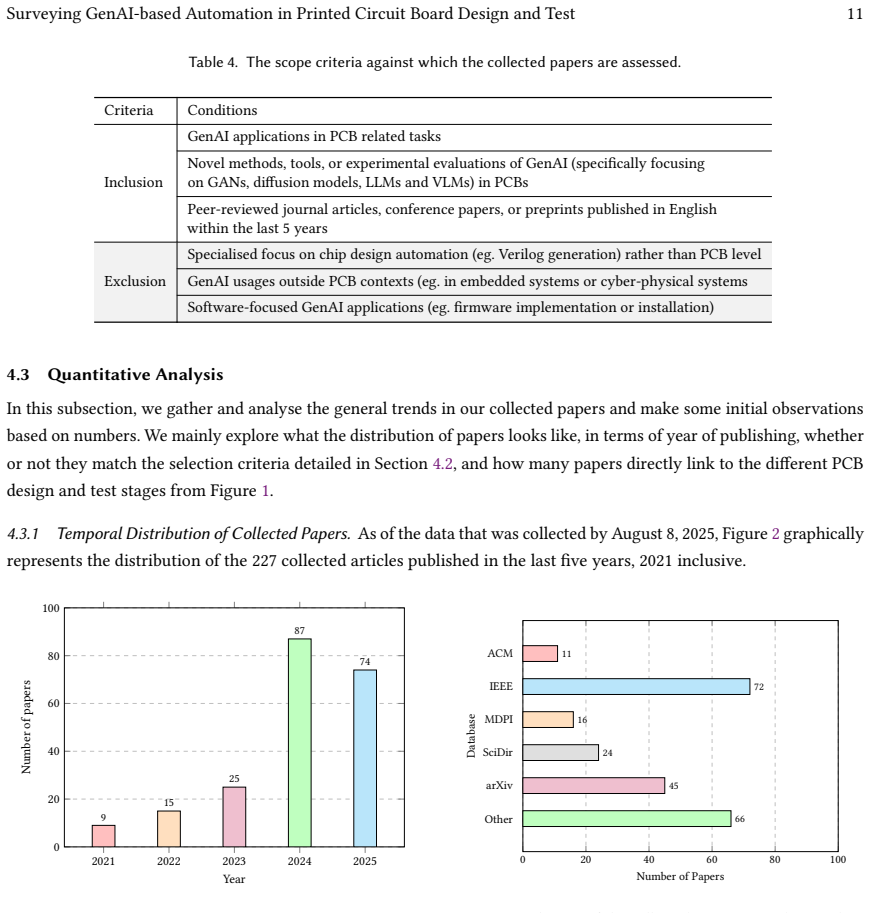
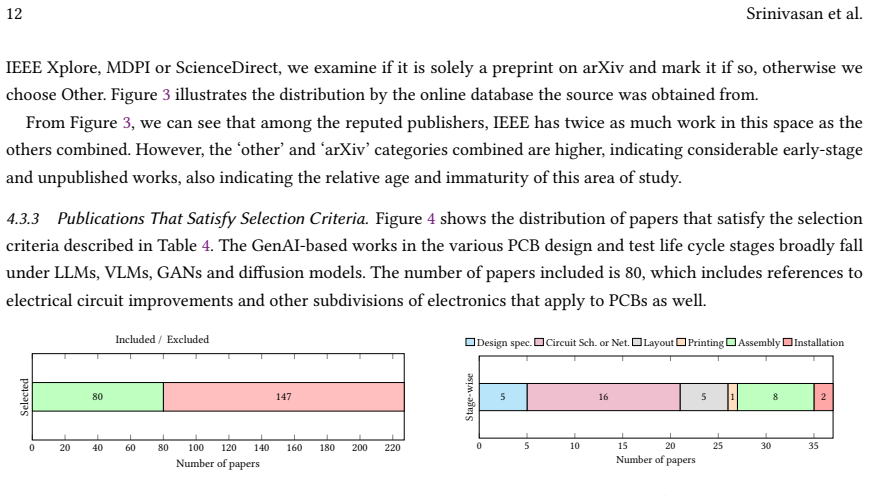
Generative artificial intelligence (GenAI) is increasingly used for applications in the hardware and software domains. It purports to reduce the manual effort involved in the development and testing of complex systems before release. Within the hardware space, most tasks have focused on design automation of integrated circuits, particularly with hardware description languages. However, other types of hardware also exist! In this survey, we instead examine how GenAI has been and is being across the printed circuit board (PCB) design life cycle. This includes everything from supply chains, system specification, circuit design, layout and optimisation, validation and test, and PCB assembly and distribution. Through this lens we present a taxonomy of discovered works, categorising them according to their intent and contributions. This survey also identifies key technical challenges that GenAI faces in this space, such as domain-specific data scarcity and limited support for integration with existing PCB tools. Finally, future research directions are discussed: our survey shows that there are many opportunities remaining when considering how GenAI may be integrated into various tasks in PCB design and test.
Editorial analysis
A structured set of objections, weighed in public.
Referee Report
Summary. The paper surveys the application of generative AI (GenAI) across the printed circuit board (PCB) design life cycle, covering supply chains, system specification, circuit design, layout and optimisation, validation and test, and PCB assembly and distribution. It presents a taxonomy of discovered works categorized by intent and contributions, identifies key technical challenges such as domain-specific data scarcity and limited support for integration with existing PCB tools, and discusses future research directions.
Significance. If the literature search underlying the taxonomy is representative and systematic, this survey would provide a useful overview of an emerging application area for GenAI that has received less attention than integrated circuit design. The categorization and challenge identification could help direct future research efforts in PCB automation.
major comments (1)
- [Abstract] Abstract: The abstract states that the survey examines GenAI across the PCB design life cycle and presents a taxonomy of discovered works, but provides no details on the search methodology, databases used, keywords, time period covered, or inclusion/exclusion criteria. This is load-bearing for the central claims, as the taxonomy categories and the identified challenges (such as data scarcity) depend directly on the completeness and representativeness of the collected sample.
Simulated Author's Rebuttal
We thank the referee for their constructive feedback on our survey. We address the major comment below.
read point-by-point responses
-
Referee: [Abstract] Abstract: The abstract states that the survey examines GenAI across the PCB design life cycle and presents a taxonomy of discovered works, but provides no details on the search methodology, databases used, keywords, time period covered, or inclusion/exclusion criteria. This is load-bearing for the central claims, as the taxonomy categories and the identified challenges (such as data scarcity) depend directly on the completeness and representativeness of the collected sample.
Authors: We agree that the abstract should briefly summarize the literature search methodology to support the taxonomy's representativeness. The full manuscript contains a dedicated methods section describing the search process, but we will revise the abstract to include key details on databases, keywords, time period, and inclusion/exclusion criteria. revision: yes
Circularity Check
No circularity: survey of external literature with no derivations or self-referential reductions
full rationale
This is a survey paper reviewing external GenAI-PCB literature. It constructs a taxonomy from discovered works and lists challenges such as data scarcity. No mathematical derivations, fitted parameters, predictions, or ansatzes appear. No self-citation chains are load-bearing for the taxonomy or gaps; all cited works are external. The representativeness of the search is an assumption about coverage, not a circular reduction of any result to the paper's own inputs by construction. The derivation chain is empty; the paper is self-contained against external benchmarks.
Axiom & Free-Parameter Ledger
Reference graph
Works this paper leans on
-
[1]
Altium Designer
2025. Altium Designer. https://www.altium.com/altium-designer
2025
-
[2]
A Better Way to Build PCBs | Flux
2025. A Better Way to Build PCBs | Flux. https://www.flux.ai/p/
2025
-
[3]
CWE - Common Weakness Enumeration
2025. CWE - Common Weakness Enumeration. https://cwe.mitre.org/
2025
-
[4]
FreePCB: freeware PCB layout software
2025. FreePCB: freeware PCB layout software. https://www.freepcb.com/
2025
-
[5]
KiCad EDA
2025. KiCad EDA. https://www.kicad.org/
2025
-
[6]
Meisam Abdollahi, Seyedeh Faegheh Yeganli, Mohammad (Amir) Baharloo, and Amirali Baniasadi. 2024. Hardware Design and Verification with Large Language Models: A Scoping Review, Challenges, and Open Issues.Electronics14, 1 (Dec. 2024), 120. doi:10.3390/electronics14010120
-
[7]
Sally Adee. 2008. The Hunt For The Kill Switch.IEEE Spectrum45, 5 (May 2008), 34–39. doi:10.1109/MSPEC.2008.4505310
-
[8]
Shreevatsa Alawandi, Kaushik Mallibhat, Umer Kudachi, and Aishwarya Beedanal. 2025. PCB Defects: A Unified Survey of Trends, Detection Techniques, and Limitations through Systematic Literature Review.Journal of Electronic Testing(Oct. 2025). doi:10.1007/s10836-025-06198-y
-
[9]
B Aravind Balaji, S Sasikumar, and K Ramesh. 2021. Development of Test Automation Framework for Printed Circuit Board Assembly.Journal of Physics: Conference Series2070, 1 (Nov. 2021), 012142. doi:10.1088/1742-6596/2070/1/012142
-
[10]
Navid Asadizanjani, Mir Tanjidur Rahman, and Mark Tehranipoor. 2021. Physical Inspection of Printed Circuit Boards. InPhysical Assurance. Springer International Publishing, Cham, 67–99. doi:10.1007/978-3-030-62609-9_4
-
[11]
Navid Asadizanjani, Mark Tehranipoor, and Domenic Forte. 2017. PCB Reverse Engineering Using Nondestructive X-ray Tomography and Advanced Image Processing.IEEE Transactions on Components, Packaging and Manufacturing Technology(2017), 1–8. doi:10.1109/TCPMT.2016.2642824
-
[12]
Jitendra Bhandari, Vineet Bhat, Yuheng He, Hamed Rahmani, Siddharth Garg, and Ramesh Karri. 2025. Masala-CHAI: A Large-Scale SPICE Netlist Dataset for Analog Circuits by Harnessing AI. doi:10.48550/arXiv.2411.14299
-
[13]
Robert Brayton, Luca P. Carloni, Alberto L. Sangiovanni-Vincentelli, and Tiziano Villa. 2015. Design Automation of Electronic Systems: Past Accomplishments and Challenges Ahead [Scanning the Issue].Proc. IEEE103, 11 (Nov. 2015), 1952–1957. doi:10.1109/JPROC.2015.2487798
-
[14]
Cadence Home. 2025. PCB Design Software. https://www.cadence.com/en_US/home/tools/pcb-design-and-analysis/orcad.html
2025
-
[15]
Chen-Chia Chang, Yikang Shen, Shaoze Fan, Jing Li, Shun Zhang, Ningyuan Cao, Yiran Chen, and Xin Zhang. 2024. LaMAGIC: Language- Model-based Topology Generation for Analog Integrated Circuits. (2024). doi:10.48550/ARXIV.2407.18269 Publisher: arXiv Version Number: 2
-
[16]
Jayeeta Chaudhuri, Dhruv Thapar, Arjun Chaudhuri, Farshad Firouzi, and Krishnendu Chakrabarty. 2024. SPICED: Syntactical Bug and Trojan Pattern Identification in A/MS Circuits using LLM-Enhanced Detection. In2024 IEEE Physical Assurance and Inspection of Electronics (PAINE). 1–7. doi:10.1109/PAINE62042.2024.10792717
-
[17]
Guojin Chen, Keren Zhu, Seunggeun Kim, Hanqing Zhu, Yao Lai, Bei Yu, and David Z. Pan. 2024. LLM-Enhanced Bayesian Optimization for Efficient Analog Layout Constraint Generation. doi:10.48550/arXiv.2406.05250 arXiv:2406.05250 [cs]
-
[18]
Lin Chen, Ran Chen, Shoubo Hu, Xufeng Yao, Zhentao Tang, Shixiong Kai, Siyuan Xu, Mingxuan Yuan, Jianye Hao, Bei Yu, and Jiang Xu. 2025. PCBAgent: An Agent-based Framework for High-Density Printed Circuit Board Placement. InProceedings of the 30th Asia and South Pacific Design Automation Conference. Association for Computing Machinery, New York, NY, USA, ...
-
[19]
Mark Chen, Jerry Tworek, Heewoo Jun, Qiming Yuan, Henrique Ponde de Oliveira Pinto, Jared Kaplan, Harri Edwards, Yuri Burda, Nicholas Joseph, Greg Brockman, Alex Ray, Raul Puri, Gretchen Krueger, Michael Petrov, Heidy Khlaaf, Girish Sastry, Pamela Mishkin, Brooke Chan, Scott Gray, Nick Ryder, Mikhail Pavlov, Alethea Power, Lukasz Kaiser, Mohammad Bavarian...
work page internal anchor Pith review Pith/arXiv arXiv doi:10.48550/arxiv.2107.03374 2021
-
[20]
Chenggang Cui, Jiaming Liu, Junkang Feng, Peifeng Hui, Amer M. Y. M. Ghias, and Chuanlin Zhang. 2024. Large Language Models based Multi-Agent Framework for Objective Oriented Control Design in Power Electronics. doi:10.48550/arXiv.2406.12628 arXiv:2406.12628 [eess]
-
[21]
2025.Part 573 Safety Recall Report 25V628
DOT. 2025.Part 573 Safety Recall Report 25V628. Technical Report 25V628. US Department of Transportation. https://static.nhtsa.gov/odi/rcl/2025/ RCLRPT-25V628-3952.pdf
2025
-
[22]
Emre Ecik, Werner John, Julian Withöft, and Jürgen Götze. 2023. Anomaly Detection with Decision Trees for AI Assisted Evaluation of Signal Integrity on PCB Transmission Lines. InAdvances in Radio Science, Vol. 21. Copernicus GmbH, 37–48. doi:10.5194/ars-21-37-2023 ISSN: 1684-9965 Issue: C
-
[23]
Casey Elder, George Pozek, Samuel Horine, Alessia Tripaldelli, and Brian Butka. 2023. Can Artificial Intelligence Pass a Sophomore Level Digital Design Laboratory?. InSoutheastCon 2023. 861–868. doi:10.1109/SoutheastCon51012.2023.10115116 ISSN: 1558-058X
work page internal anchor Pith review Pith/arXiv arXiv doi:10.1109/southeastcon51012.2023.10115116 2023
-
[24]
Zachary Englhardt, Richard Li, Dilini Nissanka, Zhihan Zhang, Girish Narayanswamy, Joseph Breda, Xin Liu, Shwetak Patel, and Vikram Iyer
-
[25]
InExtended Abstracts of the CHI Conference on Human Factors in Computing Systems (CHI EA ’24)
Exploring and Characterizing Large Language Models for Embedded System Development and Debugging. InExtended Abstracts of the CHI Conference on Human Factors in Computing Systems (CHI EA ’24). Association for Computing Machinery, New York, NY, USA, 1–9. doi:10.1145/3613905.3650764 Manuscript submitted to ACM Surveying GenAI-based Automation in Printed Cir...
-
[26]
Nusrat Farzana, Fahim Rahman, Mark Tehranipoor, and Farimah Farahmandi. 2019. SoC Security Verification using Property Checking. In2019 IEEE International Test Conference (ITC). IEEE, Washington, DC, USA, 1–10. doi:10.1109/ITC44170.2019.9000170
-
[27]
2025.Medtronic Announces Voluntary Recall of Select Newport™HT70 and Newport™HT70 Plus Ventilators and Certain Related Newport™Service Parts
FDA. 2025.Medtronic Announces Voluntary Recall of Select Newport™HT70 and Newport™HT70 Plus Ventilators and Certain Related Newport™Service Parts. Technical Report. US Food and Drug Administration. https://www.fda.gov/safety/recalls-market-withdrawals-safety-alerts/medtronic- announces-voluntary-recall-select-newporttm-ht70-and-newporttm-ht70-plus-ventilators-and
2025
-
[28]
Fabiano Fruett, Fernanda Pereira Barbosa, Samuel Cardoso Zampolli Fraga, and Pedro Ivo Aragão Guimarães. 2024. Empowering STEAM Activities With Artificial Intelligence and Open Hardware: The BitDogLab.IEEE Transactions on Education67, 3 (June 2024), 462–471. doi:10.1109/TE.2024. 3377555
-
[29]
Sumyung Gang, Ndayishimiye Fabrice, Daewon Chung, and Joonjae Lee. 2021. Character Recognition of Components Mounted on Printed Circuit Board Using Deep Learning.Sensors21, 9 (Jan. 2021), 2921. doi:10.3390/s21092921 Publisher: Multidisciplinary Digital Publishing Institute
-
[30]
Sujan Ghimire, Muhtasim Alam Chowdhury, Banafsheh Saber Latibari, Muntasir Mamun, Jaeden Wolf Carpenter, Benjamin Tan, Hammond Pearce, Krishnendu Chakrabarty, Pratik Satam, and Soheil Salehi. 2025. Hardware Design and Security Needs Attention: From Survey to Path Forward. doi:10.48550/ARXIV.2504.08854 Version Number: 2
-
[31]
Shajib Ghosh, Antika Roy, Nitin Varshney, Patrick Craig, Md Mahfuz Al Hasan, and Navid Asadizanjani. 2025. Advanced metrics for high-precision PCB inspection using 3D x-ray reconstruction. InMetrology, Inspection, and Process Control XXXIX, Vol. 13426. SPIE, 835–844. doi:10.1117/12.3058653
-
[32]
Vasudev Gohil, Matthew DeLorenzo, Veera Vishwa Achuta Sai Venkat Nallam, Joey See, and Jeyavijayan Rajendran. 2024. LLMPirate: LLMs for Black-box Hardware IP Piracy. doi:10.48550/arXiv.2411.16111 arXiv:2411.16111 [cs]
-
[33]
Liang Gonog and Yimin Zhou. 2019. A Review: Generative Adversarial Networks. In2019 14th IEEE Conference on Industrial Electronics and Applications (ICIEA). 505–510. doi:10.1109/ICIEA.2019.8833686 ISSN: 2158-2297
-
[34]
Tengyue Gui, Haobin Xu, Weimin Xu, and Lifeng Chen. 2025. A Fault Diagnosis Strategy for Analog Circuits Based on Composite Neural Networks. In2025 3rd International Conference on Integrated Circuits and Communication Systems (ICICACS). IEEE, Raichur, India, 1–5. doi:10.1109/ ICICACS65178.2025.10967749
arXiv 2025
-
[35]
Tinghao Guo, Daniel Herber, and James T. Allison. 2019. Circuit Synthesis Using Generative Adversarial Networks (GANs). InAIAA Scitech 2019 Forum. American Institute of Aeronautics and Astronautics, San Diego, California. doi:10.2514/6.2019-2350
-
[36]
Jacob Harrison, Navid Asadizanjani, and Mark Tehranipoor. 2021. On malicious implants in PCBs throughout the supply chain.Integration79 (July 2021), 12–22. doi:10.1016/j.vlsi.2021.03.002
-
[37]
Wei He, Yigang He, and Bing Li. 2020. Generative Adversarial Networks With Comprehensive Wavelet Feature for Fault Diagnosis of Analog Circuits.IEEE Transactions on Instrumentation and Measurement69, 9 (Sept. 2020), 6640–6650. doi:10.1109/TIM.2020.2969008
-
[38]
Zhuolun He and Bei Yu. 2024. Large Language Models for EDA: Future or Mirage?. InProceedings of the 2024 International Symposium on Physical Design (ISPD ’24). Association for Computing Machinery, New York, NY, USA, 65–66. doi:10.1145/3626184.3639700
-
[39]
Jonathan Ho, Ajay Jain, and Pieter Abbeel. 2020. Denoising Diffusion Probabilistic Models. doi:10.48550/arXiv.2006.11239 arXiv:2006.11239 [cs]
work page internal anchor Pith review Pith/arXiv arXiv doi:10.48550/arxiv.2006.11239 2020
-
[40]
2006.The Security Development Lifecycle
Michael Howard and Steve Lipner. 2006.The Security Development Lifecycle. Vol. 34. doi:10.1007/s11623-010-0021-7 Journal Abbreviation: Datenschutz Und Datensicherheit - Dud Publication Title: Datenschutz Und Datensicherheit - Dud
-
[41]
Jiayi Huang, Feiyun Zhao, and Lieyang Chen. 2025. Defect Detection Network In PCB Circuit Devices Based on GAN Enhanced YOLOv11. doi:10.48550/arXiv.2501.06879 arXiv:2501.06879 [cs]
-
[43]
Hangjiang Jin, Junchao Wang, Junjie Sheng, Yifan Wu, Jiayu Chen, Yaqi Wang, and Jun Liu. 2025. WiseEDA: LLMs in RF Circuit Design. Microelectronics Journal158 (April 2025), 106607. doi:10.1016/j.mejo.2025.106607
-
[44]
Kacmarcik, Prateek Juyal, Milos Prvulovic, and Alenka Zajic
Andrew S. Kacmarcik, Prateek Juyal, Milos Prvulovic, and Alenka Zajic. 2022. Circuit Activity Fingerprinting Using Electromagnetic Side-Channel Sensing and Digital Circuit Simulations.IEEE Access10 (2022), 123316–123327. doi:10.1109/ACCESS.2022.3223998
-
[45]
Rahul Kande, Vasudev Gohil, Matthew DeLorenzo, Chen Chen, and Jeyavijayan Rajendran. 2024. LLMs for Hardware Security: Boon or Bane?. In 2024 IEEE 42nd VLSI Test Symposium (VTS). 1–4. doi:10.1109/VTS60656.2024.10538871 ISSN: 2375-1053
-
[46]
Ramesh Karri, Jeyavijayan Rajendran, Kurt Rosenfeld, and Mohammad Tehranipoor. 2010. Trustworthy Hardware: Identifying and Classifying Hardware Trojans.Computer43, 10 (Oct. 2010), 39–46. doi:10.1109/MC.2010.299
-
[47]
Priyank Kashyap, Chris Cheng, Yongjin Choi, and Paul Franzon. 2023. Generative Multi-Physics Models for System Power and Thermal Analysis Using Conditional Generative Adversarial Networks. In2023 IEEE 32nd Conference on Electrical Performance of Electronic Packaging and Systems (EPEPS). 1–3. doi:10.1109/EPEPS58208.2023.10314864 ISSN: 2165-4115
-
[48]
Shahriar Khan. 2025. ChatGPT for Design of Transformers and Machines: Implications for Open-Ended Problems. InProceedings of IEMTRONICS 2024, Phillip G. Bradford, S. Andrew Gadsden, Shiban K. Koul, and Kamakhya Prasad Ghatak (Eds.). Springer Nature, Singapore, 425–436. doi:10.1007/978-981-97-4780-1_32
-
[49]
Georgios Kokolakis, Athanasios Moschos, and Angelos D. Keromytis. 2024. Harnessing the Power of General-Purpose LLMs in Hardware Trojan Design. InApplied Cryptography and Network Security Workshops, Martin Andreoni (Ed.). Springer Nature Switzerland, Cham, 176–194. doi:10.1007/978-3-031-61486-6_11
-
[50]
Prashanth Krishnamurthy, Hammond Pearce, Virinchi Roy Surabhi, Joshua Trujillo, Ramesh Karri, and Farshad Khorrami. 2024. MUDDLE: Multi- Modal Dynamic Detector Loopback Evaluator to Expose Trojans in Zero-Trust PCB Systems.IEEE Micro(2024), 1–9. doi:10.1109/MM.2024.3520996 Manuscript submitted to ACM 30 Srinivasan et al
-
[51]
Sumanth L, Srujan B N, Shravan Acharya, and Shravankumar Kudari. 2025. Artificial Intelligence for Circuit Design and Optimization: Enhancing Efficiency and Performance. In2025 Global Conference in Emerging Technology (GINOTECH). 1–6. doi:10.1109/GINOTECH63460.2025.11076866
-
[52]
2025.CVE-2025-26408
SEC Consult Vulnerability Lab. 2025.CVE-2025-26408. Technical Report. National Vulnerability Database. https://nvd.nist.gov/vuln/detail/CVE- 2025-26408
2025
-
[53]
Yao Lai, Sungyoung Lee, Guojin Chen, Souradip Poddar, Mengkang Hu, David Z. Pan, and Ping Luo. 2025. AnalogCoder: Analog Circuit Design via Training-Free Code Generation.Proceedings of the AAAI Conference on Artificial Intelligence39, 1 (April 2025), 379–387. doi:10.1609/aaai.v39i1.32016 Number: 1
-
[54]
Haiyun Li, Jixin Zhang, Ning Xu, and Mingyu Liu. 2023. FanoutNet: a neuralized PCB fanout automation method using deep reinforcement learning. InProceedings of the Thirty-Seventh AAAI Conference on Artificial Intelligence and Thirty-Fifth Conference on Innovative Applications of Artificial Intelligence and Thirteenth Symposium on Educational Advances in A...
-
[55]
Junyan Li, Sam-Zaak Wong, Gwok-Waa Wan, Xi Wang, and Jun Yang. 2025. EDA-Debugger: An LLM-Based Framework for Automated EDA Runtime Issue Resolution. In2025 26th International Symposium on Quality Electronic Design (ISQED). 1–7. doi:10.1109/ISQED65160.2025.11014463 ISSN: 1948-3295
-
[56]
Jiayu Li, Yunbo Zhao, and Binkun Liu. 2024. Functional Evaluation for Printed Circuit Board Based on Surface Mount Technology Process Data. In 2024 11th International Forum on Electrical Engineering and Automation (IFEEA). 18–21. doi:10.1109/IFEEA64237.2024.10878693
-
[57]
Ming Li, Jike Zhong, Tianle Chen, Yuxiang Lai, and Konstantinos Psounis. 2025. EEE-Bench: A Comprehensive Multimodal Electrical And Electronics Engineering Benchmark. 13337–13349. https://openaccess.thecvf.com/content/CVPR2025/html/Li_EEE-Bench_A_Comprehensive_ Multimodal_Electrical_And_Electronics_Engineering_Benchmark_CVPR_2025_paper.html
2025
-
[58]
Albin Lidbäck. 2024. Evaluation of LLMs for Hardware Test Generation. (2024)
2024
-
[59]
Fanfan Lin, Xinze Li, Weihao Lei, Juan J. Rodriguez-Andina, Josep M. Guerrero, Changyun Wen, Xin Zhang, and Hao Ma. 2025. PE-GPT: A New Paradigm for Power Electronics Design.IEEE Transactions on Industrial Electronics72, 4 (April 2025), 3778–3791. doi:10.1109/TIE.2024.3454408
-
[60]
Qiang Lin, Min Yang, Juntao Wang, Linfeng He, Zhiguo Gui, Zeming Ma, Wenjian Wang, Haohao Ding, and Xiangchun Zhang. 2022. Design of detachable computed laminography scanning mechanism and neutron tomography detection method for plate-like component.NDT & E International132 (Dec. 2022), 102712. doi:10.1016/j.ndteint.2022.102712
-
[61]
Bingyang Liu, Haoyi Zhang, Xiaohan Gao, Zichen Kong, Xiyuan Tang, Yibo Lin, Runsheng Wang, and Ru Huang. 2025. LayoutCopilot: An LLM-Powered Multi-Agent Collaborative Framework for Interactive Analog Layout Design.IEEE Transactions on Computer-Aided Design of Integrated Circuits and Systems(2025), 1–1. doi:10.1109/TCAD.2025.3529805
-
[62]
Chengjie Liu, Weiyu Chen, Anlan Peng, Yuan Du, Li Du, and Jun Yang. 2024. AmpAgent: An LLM-based Multi-Agent System for Multi-stage Amplifier Schematic Design from Literature for Process and Performance Porting. doi:10.48550/arXiv.2409.14739 arXiv:2409.14739 [cs]
-
[63]
Chengjie Liu, Yijiang Liu, Yuan Du, and Li Du. 2024. LADAC: Large Language Model-driven Auto-Designer for Analog Circuits. (Jan. 2024). https://doi.org/10.36227/techrxiv.170473941.10097233/v1
-
[65]
Junhua Liu, Fanfan Lin, Xinze Li, Kwan Hui Lim, and Shuai Zhao. 2024. Physics-Informed LLM-Agent for Automated Modulation Design in Power Electronics Systems. doi:10.48550/arXiv.2411.14214 arXiv:2411.14214 [cs]
-
[66]
Wensheng Liu. 2025. Printed Circuit Board Assembly Welding Process Based on Computer-Aided Design. InAdvances in Communication, Devices and Networking, Sourav Dhar, Subhas Mukhopadhyay, Dinh-Thuan Do, Samarendra Nath Sur, and Agbotiname Lucky Imoize (Eds.). Springer Nature, Singapore, 45–53. doi:10.1007/978-981-97-6465-5_5
-
[67]
Yulong Liu, Hao Wu, Youzhi Xu, Xiaoming Liu, and Xiujuan Yu. 2024. Automatic PCB Sample Generation and Defect Detection Based on ControlNet and Swin Transformer.Sensors (Basel, Switzerland)24, 11 (May 2024), 3473. doi:10.3390/s24113473
-
[68]
Qiuyu Lu, Jiawei Fang, Zhihao Yao, Yue Yang, Shiqing Lyu, Haipeng Mi, and Lining Yao. 2024. Enabling Generative Design Tools with LLM Agents for Mechanical Computation Devices: A Case Study. doi:10.48550/arXiv.2405.17837 arXiv:2405.17837 [cs]
-
[69]
Weihang Luo, Zhijie Zhang, Jianxiongwen Huang, Ling Li, Xingen Gao, and Huali Jiang. 2025. DEFectDiffuser: A Text-Free Framework for Semantically Consistent PCB Defect Image Generation via Dual Diffusion Alignment. In2025 IEEE 2nd International Conference on Electronics, Communications and Intelligent Science (ECIS). 1–6. doi:10.1109/ECIS65594.2025.11086965
-
[70]
Ilchuk M, Stadnyk A, and Prokhorenko S. 2023. A NOVEL APPROACH TO AUTOMATED PCB QUALITY CONTROL: INTEGRATING IMAGE PROCESSING AND LARGE LANGUAGE MODELS. (Dec. 2023). doi:10.5281/ZENODO.10451414 Publisher: Norwegian Journal of development of the International Science
-
[71]
Ryoga Matsuo, Stefan Uhlich, Arun Venkitaraman, Andrea Bonetti, Chia-Yu Hsieh, Ali Momeni, Lukas Mauch, Augusto Capone, Eisaku Ohbuchi, and Lorenzo Servadei. 2024. Schemato – An LLM for Netlist-to-Schematic Conversion. doi:10.48550/arXiv.2411.13899 arXiv:2411.13899 [cs]
-
[72]
Matthew McGuire, Umit Ogras, and Sule Ozev. 2019. PCB Hardware Trojans: Attack Modes and Detection Strategies. In2019 IEEE 37th VLSI Test Symposium (VTS). 1–6. doi:10.1109/VTS.2019.8758643 ISSN: 2375-1053
-
[73]
Dhwani Mehta, Hangwei Lu, Olivia P. Paradis, Mukhil Azhagan M. S., M. Tanjidur Rahman, Yousef Iskander, Praveen Chawla, Damon L. Woodard, Mark Tehranipoor, and Navid Asadizanjani. 2020. The Big Hack Explained: Detection and Prevention of PCB Supply Chain Implants.ACM Journal on Emerging Technologies in Computing Systems16, 4 (Oct. 2020), 1–25. doi:10.1145...
-
[74]
Pragati Shuddhodhan Meshram, Swetha Karthikeyan, Bhavya, and Suma Bhat. 2024. ElectroVizQA: How well do Multi-modal LLMs perform in Electronics Visual Question Answering? doi:10.48550/arXiv.2412.00102 arXiv:2412.00102 [cs]
-
[75]
Maxime Mirka, Maxime France France Pillois, Gilles Sassatelli, and Abdoulaye Gamatié. 2021. GANNoC: A Framework for Automatic Generation of NoC Topologies using Generative Adversarial Networks. InProceedings of the 2021 Drone Systems Engineering and Rapid Simulation and Performance Evaluation: Methods and Tools Proceedings (DroneSE and RAPIDO ’21). Associ...
-
[76]
Simon Nau, Jan Krummenauer, and André Zimmermann. 2025. SPICEAssistant: LLM using SPICE Simulation Tools for Schematic Design of Switched-Mode Power Supplies. doi:10.48550/arXiv.2507.10639 arXiv:2507.10639 [cs]
-
[77]
Martin Otieno, David Odera, and Jairus Ekume Ounza. 2023. Theory and practice in secure software development lifecycle: A comprehensive survey. World Journal of Advanced Research and Reviews18, 3 (2023), 053–078. doi:10.30574/wjarr.2023.18.3.0944 Last Modified: 2023-06-03T17:24+05:30 Publisher: World Journal of Advanced Research and Reviews
-
[78]
Steven Paley, Tamzidul Hoque, and Swarup Bhunia. 2016. Active protection against PCB physical tampering. In2016 17th International Symposium on Quality Electronic Design (ISQED). 356–361. doi:10.1109/ISQED.2016.7479227 ISSN: 1948-3295
-
[79]
Jingyu Pan, Guanglei Zhou, Chen-Chia Chang, Isaac Jacobson, Jiang Hu, and Yiran Chen. 2025. A Survey of Research in Large Language Models for Electronic Design Automation.ACM Trans. Des. Autom. Electron. Syst.30, 3 (Feb. 2025), 34:1–34:21. doi:10.1145/3715324
-
[80]
Hammond Pearce, Virinchi Roy Surabhi, Prashanth Krishnamurthy, Joshua Trujillo, Ramesh Karri, and Farshad Khorrami. 2022. Detecting Hardware Trojans in PCBs Using Side Channel Loopbacks.IEEE Transactions on Very Large Scale Integration (VLSI) Systems30, 7 (July 2022), 926–937. doi:10.1109/TVLSI.2022.3171174
-
[81]
Gor Piliposyan, Saqib Khursheed, and Daniele Rossi. 2020. Hardware Trojan Detection on a PCB Through Differential Power Monitoring.IEEE Transactions on Emerging Topics in Computing(2020), 1–1. doi:10.1109/TETC.2020.3035521
-
[82]
Khushboo Qayyum, Sallar Ahmadi-Pour, Chandan Kumar Jha, Muhammad Hassan, and Rolf Drechsler. 2024. LLMs for Hardware Verification: Frameworks, Techniques, and Future Directions. In2024 IEEE 33rd Asian Test Symposium (ATS). 1–6. doi:10.1109/ATS64447.2024.10915476 ISSN: 2377-5386
discussion (0)
Sign in with ORCID, Apple, or X to comment. Anyone can read and Pith papers without signing in.