CANNs: A Toolkit for Research on Continuous Attractor Neural Networks
Pith reviewed 2026-06-29 02:33 UTC · model grok-4.3
The pith
The CANNs toolkit unifies simulation, acceleration, and analysis for continuous attractor neural network research.
A machine-rendered reading of the paper's core claim, the machinery that carries it, and where it could break.
Core claim
The authors state that their toolkit, built from the canns Python library on BrainPy/JAX, the canns-lib Rust acceleration layer, and the ASA analyzer that applies persistent homology and cohomology, supplies the complete workflow for CANN research and recovers recent findings on SFA-driven tracking, theta sweeps, and hierarchical path integration.
What carries the argument
The CANNs toolkit, whose three integrated parts are the canns library of standardized models and tasks, the canns-lib Rust backend, and the ASA persistent-homology pipeline that identifies attractor geometry in spike data.
If this is right
- Users obtain ready-made 1D/2D CANNs, SFA variants, grid-cell networks, and hierarchical path-integration models for spatial-navigation experiments.
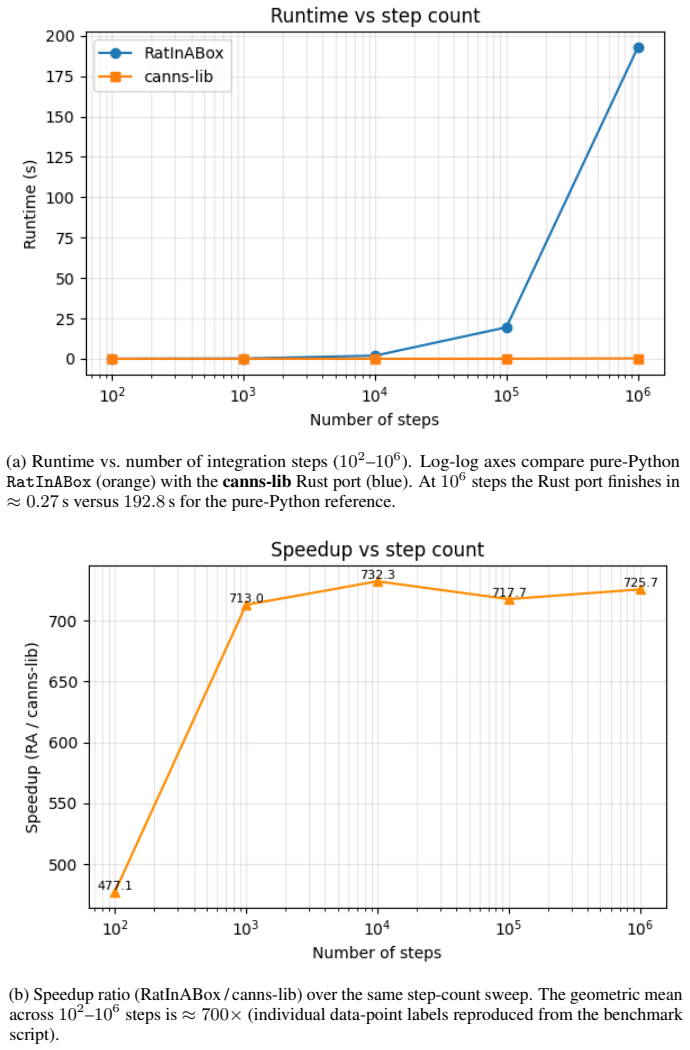
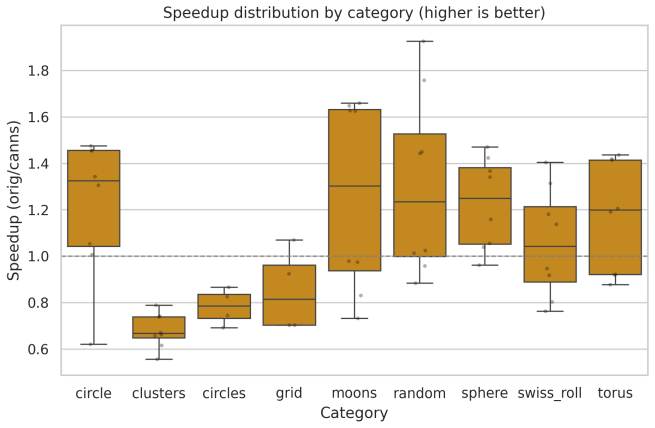
- The Rust backend delivers large speedups on spatial workloads and modest gains on persistent-homology calculations.
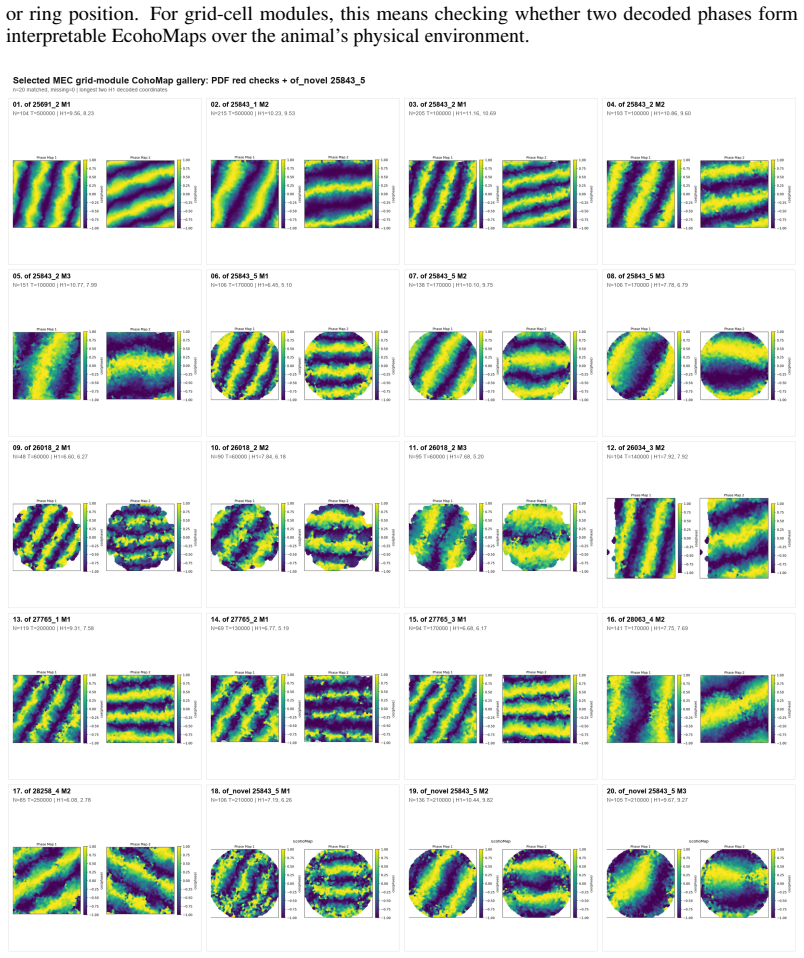
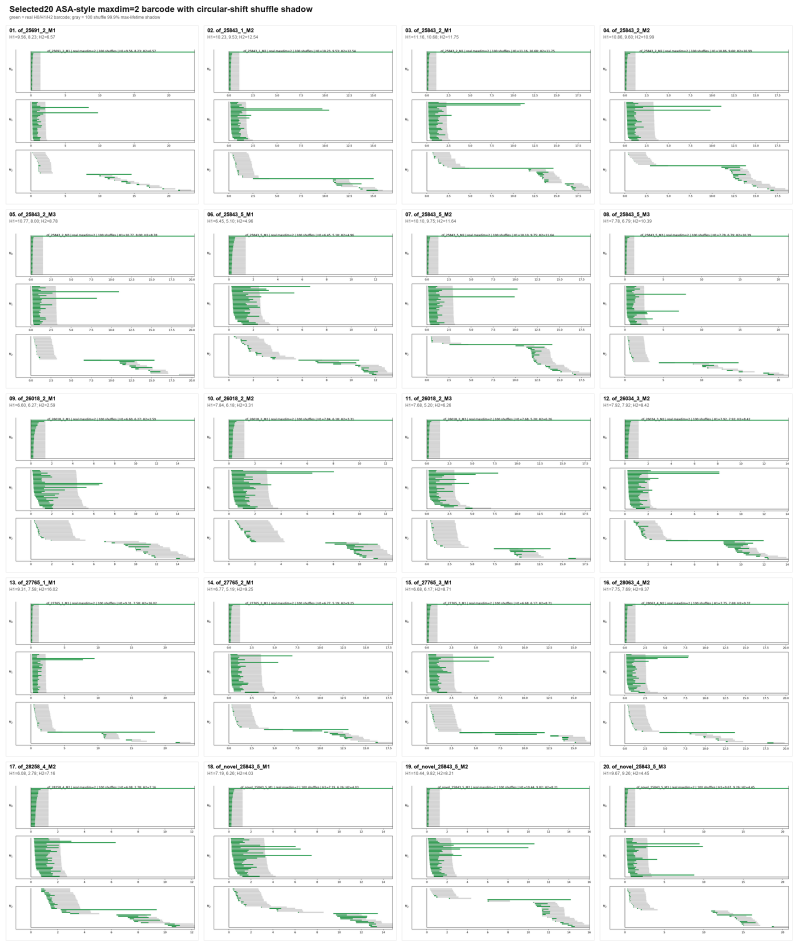
- The ASA pipeline supplies a standardized route from experimental spike trains to detected ring-like or toroidal attractor signatures.
- Reproducible pipelines allow verification of published results on anticipative tracking and theta sweeps without re-coding.
Where Pith is reading between the lines
- Wider use of the shared codebase could reduce duplication and enable direct side-by-side comparisons of different CANN architectures.
- The persistent-homology detection step may be applied to other classes of neural population activity beyond classical CANNs.
- Integration of the toolkit with existing large-scale recording datasets could test whether additional brain areas exhibit toroidal or ring attractors.
Load-bearing premise
The supplied model code and homology routines correctly reproduce the dynamics and structures reported in the original CANN literature.
What would settle it
Direct numerical comparison of the toolkit's 1D or 2D CANN trajectories against the matching models from prior papers, or application of the ASA pipeline to benchmark recordings that contain documented ring or toroidal attractors.
Figures






read the original abstract
Continuous attractor neural networks (CANNs) are the canonical computational framework for how the brain encodes continuous variables such as spatial position, head direction, and movement direction, and explain the activity of hippocampal place cells, entorhinal grid cells, and head-direction cells. CANN research, however, is fragmented: most results rest on lab-specific implementations, general-purpose simulators lack CANN-specific abstractions, and the path from spike trains to attractor geometry in real recordings lacks a standardized toolkit. Here, we present a comprehensive open-source toolkit that unifies the full CANN research workflow. It combines three tightly integrated components: 1) canns, a Python library on BrainPy/JAX that provides standardized 1D/2D CANNs, spike-frequency-adaptation variants, grid cell networks, hierarchical path-integration models, and brain-inspired attractor architectures, together with curated datasets, task generators, an analyzer module and trainer modules for biologically plausible plasticity; 2) canns-lib, a Rust acceleration backend delivering hundreds-of-times speedups for spatial-navigation workloads and modest gains for Ripser-based persistent homology; 3) ASA (Attractor Structure Analyzer), a PySide6 pipeline applying persistent homology and cohomology to experimental neural recordings to detect ring-like and toroidal attractor signatures in real data. The toolkit ships with full-detail reproducible pipelines that recover recent CANN results including SFA-driven anticipative tracking, theta sweeps in head-direction/place/grid systems, and hierarchical path integration.
Editorial analysis
A structured set of objections, weighed in public.
Referee Report
Summary. The manuscript presents CANNs, a comprehensive open-source toolkit for Continuous Attractor Neural Networks research. It integrates three components: (1) the canns Python library on BrainPy/JAX providing standardized 1D/2D CANNs, SFA variants, grid cell networks, hierarchical path-integration models, datasets, task generators, analyzers, and plasticity trainers; (2) canns-lib, a Rust backend for performance speedups; and (3) the ASA pipeline using persistent homology and cohomology to detect ring-like and toroidal attractor signatures in experimental recordings. The toolkit includes reproducible pipelines claimed to recover recent results on SFA-driven anticipative tracking, theta sweeps, and hierarchical path integration.
Significance. If the delivered implementations correctly reproduce the intended CANN dynamics and the ASA pipeline reliably identifies attractor geometries without implementation mismatches to the literature, the toolkit would address fragmentation in the field by providing standardized, accelerated, and analysis-ready tools. This could facilitate reproducible modeling and data analysis for place cells, grid cells, and head-direction cells, with particular value in the open-source delivery of the full workflow including biologically plausible plasticity and topological analysis.
major comments (2)
- [Abstract, §4] Abstract and §4 (pipelines): The claim that the provided pipelines recover recent results (SFA-driven anticipative tracking, theta sweeps, hierarchical path integration) is central to the toolkit's utility, yet the manuscript provides no quantitative validation metrics, error tables, or side-by-side comparisons against the original literature implementations or ground-truth synthetic data. This leaves the reproducibility claim unverified within the text.
- [§3.3] §3.3 (ASA pipeline): The application of persistent homology and cohomology to detect toroidal signatures in neural recordings is load-bearing for the analysis component, but the description lacks explicit validation steps (e.g., tests on synthetic ring/torus attractors with known topology or comparison to Ripser baselines) to confirm that detected features correspond to CANN dynamics rather than noise or preprocessing artifacts.
minor comments (2)
- The manuscript should include a table listing all provided model classes, their key parameters, and default values for reproducibility.
- Installation and dependency instructions for the Rust backend integration with the Python library could be expanded with explicit version pins and benchmark hardware details.
Simulated Author's Rebuttal
We thank the referee for the constructive comments on our manuscript. We address each major point below and indicate the revisions we will make.
read point-by-point responses
-
Referee: [Abstract, §4] Abstract and §4 (pipelines): The claim that the provided pipelines recover recent results (SFA-driven anticipative tracking, theta sweeps, hierarchical path integration) is central to the toolkit's utility, yet the manuscript provides no quantitative validation metrics, error tables, or side-by-side comparisons against the original literature implementations or ground-truth synthetic data. This leaves the reproducibility claim unverified within the text.
Authors: The manuscript states that the toolkit ships with full-detail reproducible pipelines in the code repository. We acknowledge that the text itself does not include quantitative metrics, error tables, or direct comparisons. In the revised manuscript we will add a validation subsection to §4 that reports quantitative error metrics, side-by-side comparisons with original literature implementations, and results on ground-truth synthetic data. revision: yes
-
Referee: [§3.3] §3.3 (ASA pipeline): The application of persistent homology and cohomology to detect toroidal signatures in neural recordings is load-bearing for the analysis component, but the description lacks explicit validation steps (e.g., tests on synthetic ring/torus attractors with known topology or comparison to Ripser baselines) to confirm that detected features correspond to CANN dynamics rather than noise or preprocessing artifacts.
Authors: We agree that explicit validation steps would strengthen the ASA pipeline section. In the revision we will expand §3.3 to include tests on synthetic ring and toroidal attractors with known topology together with direct comparisons against Ripser baselines, confirming that detected features align with CANN dynamics rather than artifacts. revision: yes
Circularity Check
No circularity: software toolkit release with no derivations
full rationale
The manuscript is a software release describing a Python library, Rust backend, and ASA pipeline for CANN modeling and analysis. No equations, parameter fits, predictions, or derivation chains are present in the abstract or described content. Claims concern delivered code reproducing published behaviors via persistent homology, which are empirical statements about implementation rather than reductions to self-defined inputs or self-citations. No load-bearing steps qualify under any enumerated circularity pattern.
Axiom & Free-Parameter Ledger
Reference graph
Works this paper leans on
-
[1]
Biological cybernetics , volume=
Dynamics of pattern formation in lateral-inhibition type neural fields , author=. Biological cybernetics , volume=. 1977 , publisher=
1977
-
[2]
Neural computation , volume=
Dynamics and computation of continuous attractors , author=. Neural computation , volume=. 2008 , publisher=
2008
-
[3]
Neural Computation , volume=
A moving bump in a continuous manifold: a comprehensive study of the tracking dynamics of continuous attractor neural networks , author=. Neural Computation , volume=. 2010 , publisher=
2010
-
[4]
F1000Research , volume=
Continuous attractor neural networks: candidate of a canonical model for neural information representation , author=. F1000Research , volume=. 2016 , doi=
2016
-
[5]
, author=
The hippocampus as a spatial map: preliminary evidence from unit activity in the freely-moving rat. , author=. Brain research , year=
-
[6]
Head-direction cells recorded from the postsubiculum in freely moving rats. I. Description and quantitative analysis , author=. Journal of Neuroscience , volume=. 1990 , publisher=
1990
-
[7]
Nature , volume=
Microstructure of a spatial map in the entorhinal cortex , author=. Nature , volume=. 2005 , publisher=
2005
-
[8]
Nature neuroscience , volume=
Theta sequences are essential for internally generated hippocampal firing fields , author=. Nature neuroscience , volume=. 2015 , publisher=
2015
-
[9]
Hippocampus , volume=
Phase Precession Relative to Turning Angle in Theta-Modulated Head Direction Cells , author=. Hippocampus , volume=. 2025 , publisher=
2025
-
[10]
Current Biology , volume=
A systems model of alternating theta sweeps via firing rate adaptation , author=. Current Biology , volume=. 2025 , publisher=
2025
-
[11]
Elife , volume=
Firing rate adaptation affords place cell theta sweeps, phase precession, and procession , author=. Elife , volume=. 2024 , publisher=
2024
-
[12]
2005 , publisher=
The organization of behavior: A neuropsychological theory , author=. 2005 , publisher=
2005
-
[13]
Biological cybernetics , volume=
Neural theory of association and concept-formation , author=. Biological cybernetics , volume=. 1977 , publisher=
1977
-
[14]
, author=
Neural networks and physical systems with emergent collective computational abilities. , author=. Proceedings of the national academy of sciences , volume=. 1982 , doi=
1982
-
[15]
Journal of neuroscience , volume=
Synaptic modifications in cultured hippocampal neurons: dependence on spike timing, synaptic strength, and postsynaptic cell type , author=. Journal of neuroscience , volume=. 1998 , publisher=
1998
-
[16]
Journal of Neuroscience , volume=
Theory for the development of neuron selectivity: orientation specificity and binocular interaction in visual cortex , author=. Journal of Neuroscience , volume=. 1982 , publisher=
1982
-
[17]
Advances in neural information processing systems , volume=
Spike frequency adaptation implements anticipative tracking in continuous attractor neural networks , author=. Advances in neural information processing systems , volume=
-
[18]
Neural Computation , volume=
Dynamics of Continuous Attractor Neural Networks With Spike Frequency Adaptation , author=. Neural Computation , volume=. 2025 , publisher=
2025
-
[19]
Journal of mathematical biology , volume=
Simplified neuron model as a principal component analyzer , author=. Journal of mathematical biology , volume=. 1982 , publisher=
1982
-
[20]
Neural networks , volume=
Optimal unsupervised learning in a single-layer linear feedforward neural network , author=. Neural networks , volume=. 1989 , publisher=
1989
-
[21]
Nature Reviews Neuroscience , volume=
Path integration and the neural basis of the'cognitive map' , author=. Nature Reviews Neuroscience , volume=. 2006 , publisher=
2006
-
[22]
Journal of Neuroscience , volume=
Path integration and cognitive mapping in a continuous attractor neural network model , author=. Journal of Neuroscience , volume=. 1997 , publisher=
1997
-
[23]
Hippocampus , volume=
Path integration in mammals , author=. Hippocampus , volume=. 2004 , publisher=
2004
-
[24]
BrainPy, a flexible, integrative, efficient, and extensible framework for general-purpose brain dynamics programming , author =. eLife , issn =. doi:10.7554/eLife.86365 , url =
-
[25]
Nature Communications , volume=
Integrating physical units into high-performance AI-driven scientific computing , author=. Nature Communications , volume=. 2025 , publisher=
2025
-
[26]
James Bradbury and Roy Frostig and Peter Hawkins and Matthew James Johnson and Chris Leary and Dougal Maclaurin and George Necula and Adam Paszke and Jake Vander
-
[27]
Bulletin of the American Mathematical Society , volume=
Topology and data , author=. Bulletin of the American Mathematical Society , volume=. 2009 , doi=
2009
-
[28]
2010 , publisher=
Computational topology: an introduction , author=. 2010 , publisher=
2010
-
[29]
Neural computation , volume=
Opening the black box: low-dimensional dynamics in high-dimensional recurrent neural networks , author=. Neural computation , volume=. 2013 , publisher=
2013
-
[30]
Journal of open source software , volume=
FixedPointFinder: A Tensorflow toolbox for identifying and characterizing fixed points in recurrent neural networks , author=. Journal of open source software , volume=. 2018 , doi=
2018
-
[31]
2026 , howpublished =
He, Sichao and Tuerhong, Aiersi and She, Shangjun and Chu, Tianhao and Wu, Yuling and Zuo, Junfeng and Wu, Si , title =. 2026 , howpublished =
2026
-
[32]
Hippocampus , volume=
Phase relationship between hippocampal place units and the EEG theta rhythm , author=. Hippocampus , volume=. 1993 , publisher=
1993
-
[33]
bioRxiv , pages=
Localized Space Coding and Phase Coding Complement Each Other to Achieve Robust and Efficient Spatial Representation , author=. bioRxiv , pages=. 2025 , publisher=
2025
-
[34]
Nature , volume=
Geometric determinants of the place fields of hippocampal neurons , author=. Nature , volume=. 1996 , publisher=
1996
-
[35]
PLoS computational biology , volume=
Accurate path integration in continuous attractor network models of grid cells , author=. PLoS computational biology , volume=. 2009 , publisher=
2009
-
[36]
Scholarpedia , year =
Marc-Oliver Gewaltig and Markus Diesmann , title =. Scholarpedia , year =
-
[37]
elife , volume=
Brian 2, an intuitive and efficient neural simulator , author=. elife , volume=. 2019 , publisher=
2019
-
[38]
Neural computation , volume=
The NEURON simulation environment , author=. Neural computation , volume=. 1997 , publisher=
1997
-
[39]
Nature , volume =
Toroidal topology of population activity in grid cells , author =. Nature , volume =. 2022 , publisher =
2022
-
[40]
Ring attractor dynamics in the
Kim, Sung Soo and Rouault, Herv. Ring attractor dynamics in the. Science , volume =. 2017 , doi =
2017
-
[41]
bioRxiv , year =
A topological perspective on the dual nature of the neural state space and the correlation structure , author =. bioRxiv , year =
-
[42]
Discrete & Computational Geometry , volume =
Persistent cohomology and circular coordinates , author =. Discrete & Computational Geometry , volume =. 2011 , publisher =
2011
-
[43]
2021 , publisher =
Bauer, Ulrich , journal =. 2021 , publisher =
2021
discussion (0)
Sign in with ORCID, Apple, or X to comment. Anyone can read and Pith papers without signing in.