Search for single production of a vector-like B' quark decaying to a top quark and a W boson in the single-lepton final state in proton-proton collisions at sqrt{s} = 13 TeV
Pith reviewed 2026-06-28 15:45 UTC · model grok-4.3
The pith
CMS excludes narrow vector-like B' quarks with masses from 0.8 to 1.23 TeV
A machine-rendered reading of the paper's core claim, the machinery that carries it, and where it could break.
Core claim
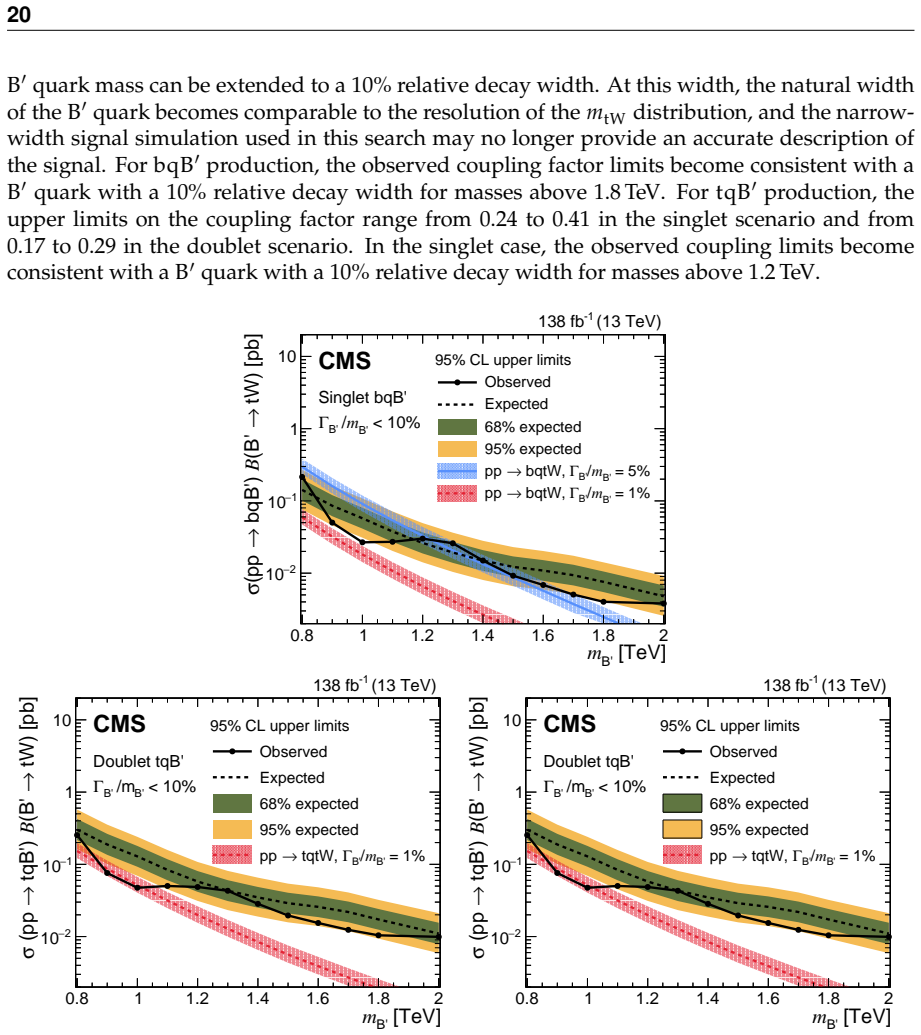
This search excludes singlet B' quarks with relative width 5 percent for masses between 0.8 and 1.23 TeV at 95 percent confidence level. Limits are also set on the production cross section for B' quarks produced in association with top quarks and on the B' coupling strength to electroweak bosons.
What carries the argument
Reconstruction of the B' candidate from a lepton, missing transverse momentum, one large-radius jet, and one small-radius jet, with neural-network jet tagging and neural autoregressive flow network for background modeling.
If this is right
- No evidence for single B' production is found in the analyzed dataset.
- Upper limits are placed on the production cross section of single B' quarks produced with top quarks.
- Constraints are derived on the coupling factor of the B' quark to electroweak bosons.
- The result improves the sensitivity reach for narrow-width vector-like B' quarks relative to earlier searches.
Where Pith is reading between the lines
- The data-driven neural flow background technique could be adapted to improve precision in other rare-process searches at the LHC.
- Models predicting vector-like quarks with different widths or mixing patterns would face tighter constraints if future data extend the mass reach.
- These limits restrict the parameter space of Standard Model extensions that introduce heavy quarks coupling preferentially to third-generation fermions.
Load-bearing premise
The dominant background contributions are modeled from data using a neural autoregressive flow network; systematic misestimation of this background in the signal region would shift the exclusion limits.
What would settle it
An observed excess of events above the modeled background whose mass and kinematic distributions match the expected B' signal at a mass between 0.8 and 1.23 TeV would indicate the presence of the quark.
Figures

read the original abstract
A search is presented for the single production of a narrow-width vector-like B' quark that decays to a t quark and a W boson, with one of the decay products yielding an electron or muon. The data were collected from 2016 to 2018 by the CMS experiment at the LHC in proton-proton collisions at $\sqrt{s}$ = 13 TeV, corresponding to an integrated luminosity of 138 fb$^{-2}$. The search is performed in a single-lepton final state, where the B' quark candidate is reconstructed from an electron or muon, missing transverse momentum, one large-radius jet, and one small-radius jet if the t quark decays leptonically. The originating particles of large-radius jets are identified using a neural-network-based tagger, and the dominant background contributions are modeled from data using a neural autoregressive flow network. This search is the most sensitive to date to the single production of narrow-width B' quarks, excluding singlet B' quarks with $\Gamma/m_\mathrm{B'}$ = 5% for masses between 0.8 and 1.23 TeV. Limits are also placed on the production cross section of single B' quarks produced in association with t quarks, and on the coupling factor of the B' quark to electroweak bosons.
Editorial analysis
A structured set of objections, weighed in public.
Referee Report
Summary. The manuscript presents a search by the CMS experiment for single production of narrow-width vector-like B' quarks decaying to tW in the single-lepton final state, using 138 fb^{-1} of 13 TeV pp collision data. The analysis reconstructs B' candidates from a lepton, MET, one large-R jet (tagged via neural network), and optionally a small-R jet; dominant backgrounds are estimated via a neural autoregressive flow network trained on data. The central result is an exclusion of singlet B' quarks with Γ/m_B' = 5% for masses 0.8–1.23 TeV, stated to be the most sensitive limit to date, together with cross-section and coupling limits.
Significance. If the background modeling holds, the result provides the strongest constraints to date on narrow-width single B' production and improves the reach of vector-like quark searches at the LHC. The data-driven flow-network approach and neural tagger are positive technical elements when accompanied by robust validation.
major comments (2)
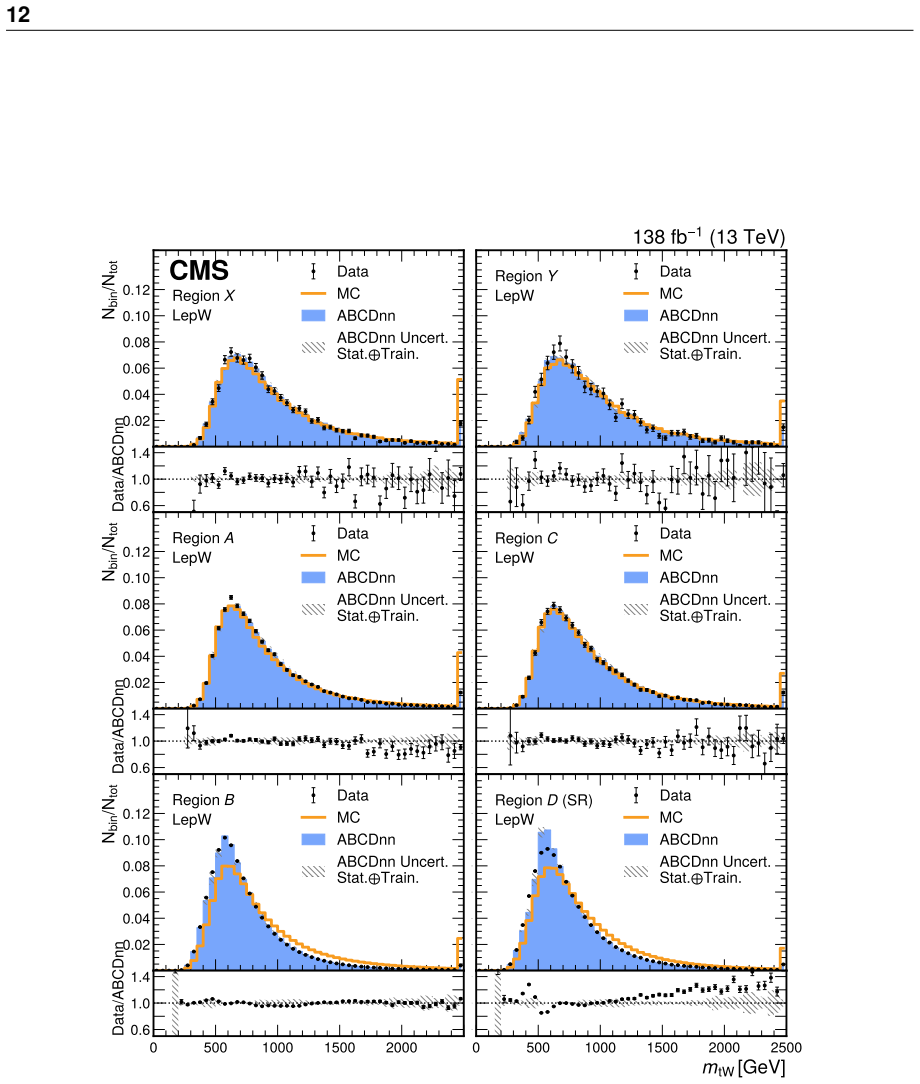
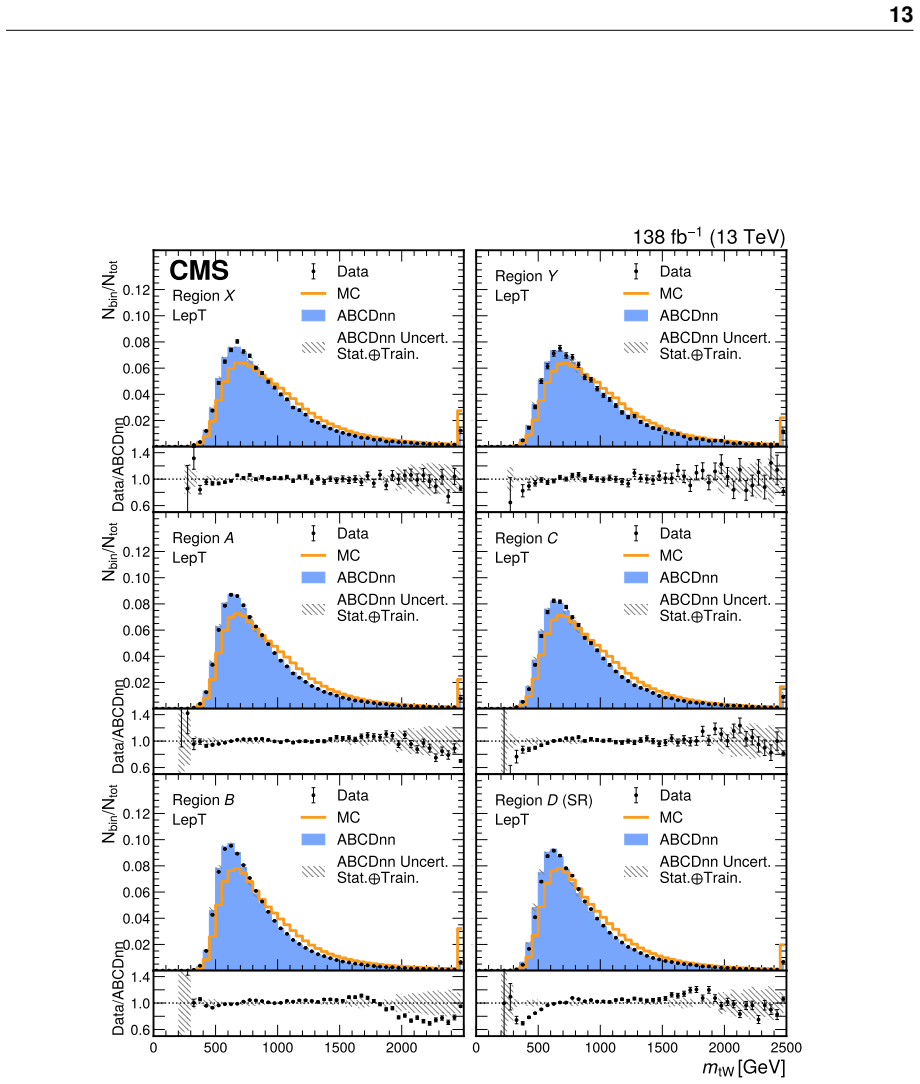
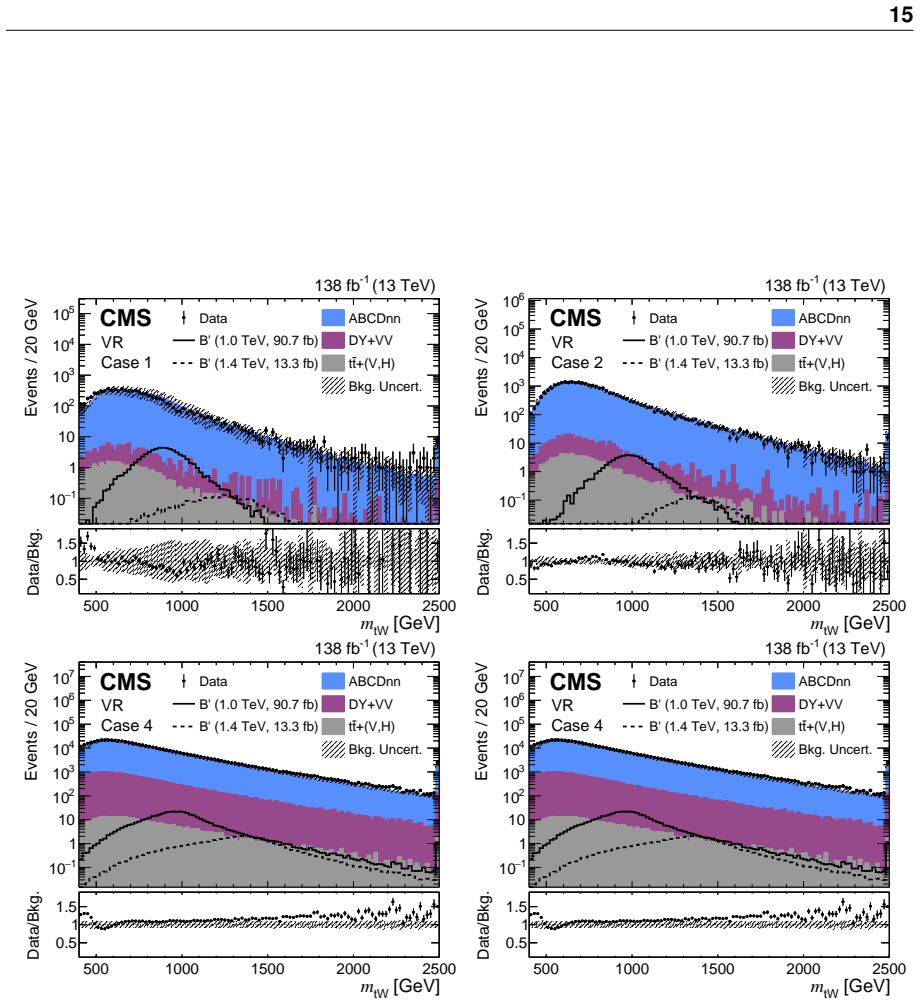
- [Background estimation] Background estimation section: the neural autoregressive flow network is used to model the dominant backgrounds in the high-p_T signal region. The manuscript must provide quantitative closure tests (e.g., predicted vs. observed yields and shapes) in sidebands and control regions that match the signal-region jet multiplicity, large-R jet mass, and MET kinematics; without these, any unmodeled correlation between substructure variables and MET directly affects the extracted upper limits.
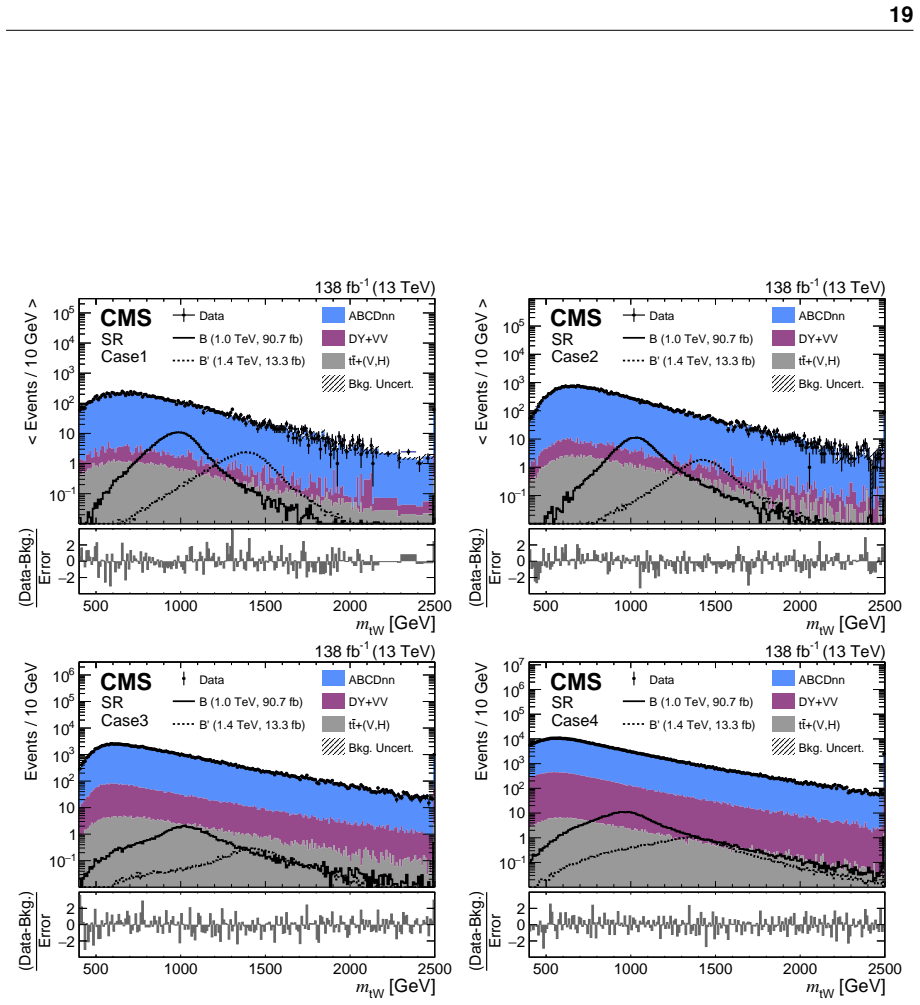
- [Results] Results section (limit extraction): the quoted exclusion 0.8–1.23 TeV for Γ/m_B' = 5% relies on the background prediction in the highest-mass bins. The paper should report the systematic uncertainty assigned to the flow-network extrapolation (including training-sample statistics and kinematic extrapolation) and show how it propagates into the limit; the current abstract claim of “most sensitive to date” cannot be assessed without this breakdown.
minor comments (2)
- [Introduction] The notation Γ/m_B' is used without an explicit definition of the width parameterization in the signal model; a short clarification in the introduction or theory section would help readers.
- [Object identification] Figure captions for the neural-network tagger performance plots should state the working point efficiency and mis-tag rate used in the analysis.
Simulated Author's Rebuttal
We thank the referee for the constructive comments on our manuscript. We address each major point below and agree to incorporate additional validation material and uncertainty details in a revised version.
read point-by-point responses
-
Referee: [Background estimation] Background estimation section: the neural autoregressive flow network is used to model the dominant backgrounds in the high-p_T signal region. The manuscript must provide quantitative closure tests (e.g., predicted vs. observed yields and shapes) in sidebands and control regions that match the signal-region jet multiplicity, large-R jet mass, and MET kinematics; without these, any unmodeled correlation between substructure variables and MET directly affects the extracted upper limits.
Authors: We agree that explicit quantitative closure tests are required to demonstrate the robustness of the neural autoregressive flow network. The revised manuscript will include additional tables and figures presenting predicted versus observed yields and kinematic shapes in multiple sidebands and control regions selected to match the signal-region jet multiplicity, large-R jet mass, and MET distributions. These tests confirm agreement within the assigned uncertainties and will be accompanied by a discussion of any residual correlations. revision: yes
-
Referee: [Results] Results section (limit extraction): the quoted exclusion 0.8–1.23 TeV for Γ/m_B' = 5% relies on the background prediction in the highest-mass bins. The paper should report the systematic uncertainty assigned to the flow-network extrapolation (including training-sample statistics and kinematic extrapolation) and show how it propagates into the limit; the current abstract claim of “most sensitive to date” cannot be assessed without this breakdown.
Authors: We will expand the results section to report the systematic uncertainty on the flow-network extrapolation, explicitly separating contributions from training-sample statistics and kinematic extrapolation. This uncertainty will be propagated through the limit-setting procedure, with its effect on the final exclusion limits shown in a dedicated table or plot. A brief comparison with prior results will also be added to support the statement that the search is the most sensitive to date for narrow-width single B' production in this channel. revision: yes
Circularity Check
No circularity: experimental limit from collision data
full rationale
The paper reports an LHC search for B' production with limits extracted from 138 fb^{-1} of collision data. The background is modeled via a neural autoregressive flow trained on data, but this is a standard data-driven technique whose validity is tested in control regions and sidebands (standard in CMS analyses). No derivation reduces by construction to a fitted input, no self-citation chain carries the central claim, and no ansatz or uniqueness theorem is invoked. The result is an observed upper limit on a cross section, externally falsifiable by future data or independent analyses, satisfying the self-contained criterion.
Axiom & Free-Parameter Ledger
axioms (1)
- domain assumption Standard Model backgrounds and detector simulation are sufficiently accurate outside the signal region for the flow network to extrapolate correctly.
Reference graph
Works this paper leans on
-
[1]
Light custodians in natural composite Higgs models
R. Contino, L. Da Rold, and A. Pomarol, “Light custodians in natural composite Higgs models”,Phys. Rev. D75(Mar, 2007) 055014,doi:10.1103/PhysRevD.75.055014, arXiv:hep-ph/0612048. 24
work page internal anchor Pith review Pith/arXiv arXiv doi:10.1103/physrevd.75.055014 2007
-
[2]
Warped/Composite Phenomenology Simplified
R. Contino, T. Kramer, M. Son, and R. Sundrum, “Warped/composite phenomenology simplified”,JHEP05(2007) 074,doi:10.1088/1126-6708/2007/05/074, arXiv:hep-ph/0612180
work page internal anchor Pith review Pith/arXiv arXiv doi:10.1088/1126-6708/2007/05/074 2007
-
[3]
A handbook of vector-like quarks: mixing and single production
J. A. Aguilar-Saavedra, R. Benbrik, S. Heinemeyer, and M. P ´erez-Victoria, “Handbook of vectorlike quarks: Mixing and single production”,Phys. Rev. D88(2013) 094010, doi:10.1103/PhysRevD.88.094010,arXiv:1306.0572
work page internal anchor Pith review Pith/arXiv arXiv doi:10.1103/physrevd.88.094010 2013
-
[4]
A First Top Partner Hunter's Guide
A. De Simone, O. Matsedonskyi, R. Rattazzi, and A. Wulzer, “A first top partner hunter’s guide”,JHEP04(2013) 004,doi:10.1007/JHEP04(2013)004,arXiv:1211.5663 [hep-ph]
work page internal anchor Pith review Pith/arXiv arXiv doi:10.1007/jhep04(2013)004 2013
-
[5]
CMS Collaboration, “Search for single production of vector-like quarks decaying to a top quark and a W boson in proton-proton collisions at √s=13 TeV”,Eur. Phys. J. C79 (2019) 90,doi:10.1140/epjc/s10052-019-6556-3,arXiv:1809.08597
work page internal anchor Pith review Pith/arXiv arXiv doi:10.1140/epjc/s10052-019-6556-3 2019
-
[6]
Search for single production of vector-like quarks decaying to a b quark and a Higgs boson
CMS Collaboration, “Search for single production of vector-like quarks decaying to a b quark and a Higgs boson”,JHEP06(2018) 031,doi:10.1007/JHEP06(2018)031, arXiv:1802.01486
work page internal anchor Pith review Pith/arXiv arXiv doi:10.1007/jhep06(2018)031 2018
-
[7]
CMS Collaboration, “Search for a heavy resonance decaying into a top quark and a W boson in the lepton+jets final state at √s=13 TeV”,JHEP04(2022) 048, doi:10.1007/JHEP04(2022)048,arXiv:2111.10216
-
[8]
CMS Collaboration, “Review of searches for vector-like quarks, vector-like leptons, and heavy neutral leptons in proton–proton collisions at √s=13 TeVat the CMS experiment”,Phys. Rept.1115(2025) 570,doi:10.1016/j.physrep.2024.09.012, arXiv:2405.17605
-
[9]
ATLAS Collaboration, “Search for the production of single vector-like and excited quarks in theWtfinal state inppcollisions at √s=8 TeV with the ATLAS detector”,JHEP02 (2016) 110,doi:10.1007/JHEP02(2016)110,arXiv:1510.02664
work page internal anchor Pith review Pith/arXiv arXiv doi:10.1007/jhep02(2016)110 2016
-
[10]
ATLAS Collaboration, “Search for single vector-likeBquark production and decay via B→bH(b ¯b)inppcollisions at √s=13 TeV with the atlas detector”,JHEP11(2023) 168, doi:10.1007/JHEP11(2023)168,arXiv:2308.02595
-
[11]
HEPData record for this analysis, 2026.doi:10.17182/hepdata.168733
-
[12]
The CMS experiment at the CERN LHC
CMS Collaboration, “The CMS experiment at the CERN LHC”,JINST3(2008) S08004, doi:10.1088/1748-0221/3/08/S08004
-
[13]
Performance of the CMS Level-1 trigger in proton-proton collisions at √s=13 TeV
CMS Collaboration, “Performance of the CMS Level-1 trigger in proton-proton collisions at √s=13 TeV”,JINST15(2020) P10017,doi:10.1088/1748-0221/15/10/P10017, arXiv:2006.10165
-
[14]
CMS Collaboration, “The CMS trigger system”,JINST12(2017) P01020, doi:10.1088/1748-0221/12/01/P01020,arXiv:1609.02366
work page internal anchor Pith review Pith/arXiv arXiv doi:10.1088/1748-0221/12/01/p01020 2017
-
[15]
Performance of the CMS high-level trigger during LHC Run 2
CMS Collaboration, “Performance of the CMS high-level trigger during LHC run 2”, JINST19(2024) P11021,doi:10.1088/1748-0221/19/11/P11021, arXiv:2410.17038. References 25
-
[16]
Electron and photon reconstruction and identification with the CMS experiment at the CERN LHC
CMS Collaboration, “Electron and photon reconstruction and identification with the CMS experiment at the CERN LHC”,JINST16(2021) P05014, doi:10.1088/1748-0221/16/05/P05014,arXiv:2012.06888
-
[17]
CMS Collaboration, “Performance of the CMS muon detector and muon reconstruction with proton-proton collisions at √s=13 TeV”,JINST13(2018) P06015, doi:10.1088/1748-0221/13/06/P06015,arXiv:1804.04528
work page internal anchor Pith review Pith/arXiv arXiv doi:10.1088/1748-0221/13/06/p06015 2018
-
[18]
Description and performance of track and primary-vertex reconstruction with the CMS tracker
CMS Collaboration, “Description and performance of track and primary-vertex reconstruction with the CMS tracker”,JINST9(2014) P10009, doi:10.1088/1748-0221/9/10/P10009,arXiv:1405.6569
work page internal anchor Pith review Pith/arXiv arXiv doi:10.1088/1748-0221/9/10/p10009 2014
-
[19]
Development of the CMS detector for the CERN LHC Run 3
CMS Collaboration, “Development of the CMS detector for the CERN LHC Run 3”, JINST19(2024) P05064,doi:10.1088/1748-0221/19/05/P05064, arXiv:2309.05466
-
[20]
Technical proposal for the Phase-II upgrade of the Compact Muon Solenoid
CMS Collaboration, “Technical proposal for the Phase-II upgrade of the Compact Muon Solenoid”, CMS Technical Proposal CERN-LHCC-2015-010, CMS-TDR-15-02, 2015
2015
-
[21]
Particle-flow reconstruction and global event description with the CMS detector
CMS Collaboration, “Particle-flow reconstruction and global event description with the CMS detector”,JINST12(2017) P10003,doi:10.1088/1748-0221/12/10/P10003, arXiv:1706.04965
work page internal anchor Pith review Pith/arXiv arXiv doi:10.1088/1748-0221/12/10/p10003 2017
-
[22]
The anti-k_t jet clustering algorithm
M. Cacciari, G. P . Salam, and G. Soyez, “The anti-kT jet clustering algorithm”,JHEP04 (2008) 063,doi:10.1088/1126-6708/2008/04/063,arXiv:0802.1189
work page internal anchor Pith review Pith/arXiv arXiv doi:10.1088/1126-6708/2008/04/063 2008
-
[23]
M. Cacciari, G. P . Salam, and G. Soyez, “FastJet user manual”,Eur. Phys. J. C72(2012) 1896,doi:10.1140/epjc/s10052-012-1896-2,arXiv:1111.6097
work page internal anchor Pith review Pith/arXiv arXiv doi:10.1140/epjc/s10052-012-1896-2 2012
-
[24]
Pileup mitigation at CMS in 13 TeV data
CMS Collaboration, “Pileup mitigation at CMS in 13 TeV data”,JINST15(2020) P09018, doi:10.1088/1748-0221/15/09/p09018,arXiv:2003.00503
-
[25]
Pileup Per Particle Identification
D. Bertolini, P . Harris, M. Low, and N. Tran, “Pileup per particle identification”,JHEP10 (2014) 059,doi:10.1007/JHEP10(2014)059,arXiv:1407.6013
work page internal anchor Pith review Pith/arXiv arXiv doi:10.1007/jhep10(2014)059 2014
-
[26]
Jet energy scale and resolution in the CMS experiment in pp collisions at 8 TeV
CMS Collaboration, “Jet energy scale and resolution in the CMS experiment in pp collisions at 8 TeV”,JINST12(2017) P02014, doi:10.1088/1748-0221/12/02/P02014,arXiv:1607.03663
work page internal anchor Pith review Pith/arXiv arXiv doi:10.1088/1748-0221/12/02/p02014 2017
-
[27]
Precision luminosity measurement in proton-proton collisions at√s=13 TeV in 2015 and 2016 at CMS
CMS Collaboration, “Precision luminosity measurement in proton-proton collisions at√s=13 TeV in 2015 and 2016 at CMS”,Eur. Phys. J. C81(2021) 800, doi:10.1140/epjc/s10052-021-09538-2,arXiv:2104.01927
-
[28]
CMS luminosity measurement for the 2017 data-taking period at√s=13 TeV
CMS Collaboration, “CMS luminosity measurement for the 2017 data-taking period at√s=13 TeV”, CMS Physics Analysis Summary CMS-PAS-LUM-17-004, 2018
2017
-
[29]
CMS luminosity measurement for the 2018 data-taking period at√s=13 TeV
CMS Collaboration, “CMS luminosity measurement for the 2018 data-taking period at√s=13 TeV”, CMS Physics Analysis Summary CMS-PAS-LUM-18-002, 2019
2018
-
[30]
Precision luminosity measurement in proton-proton collisions at√s=13 TeV with the CMS detector
CMS Collaboration, “Precision luminosity measurement in proton-proton collisions at√s=13 TeV with the CMS detector”, CMS Physics Analysis Summary CMS-PAS-LUM-20-001, 2025
2025
-
[31]
J. Alwall et al., “The automated computation of tree-level and next-to-leading order differential cross sections, and their matching to parton shower simulations”,JHEP07 (2014) 079,doi:10.1007/JHEP07(2014)079,arXiv:1405.0301. 26
work page internal anchor Pith review Pith/arXiv arXiv doi:10.1007/jhep07(2014)079 2014
-
[32]
QCD next-to-leading-order predictions matched to parton showers for vector-like quark models
B. Fuks and H.-S. Shao, “QCD next-to-leading-order predictions matched to parton showers for vector-like quark models”,Eur. Phys. J. C77(2017) 135, doi:10.1140/epjc/s10052-017-4686-z,arXiv:1610.04622
work page internal anchor Pith review Pith/arXiv arXiv doi:10.1140/epjc/s10052-017-4686-z 2017
-
[33]
A. Deandrea et al., “Single production of vector-like quarks: the effects of large width, interference and NLO corrections”,JHEP08(2021) 107, doi:10.1007/JHEP08(2021)107,arXiv:2105.08745. [Erratum: doi:10.1007/JHEP11(2022)028]
-
[34]
Automatic spin-entangled decays of heavy resonances in Monte Carlo simulations
P . Artoisenet, R. Frederix, O. Mattelaer, and R. Rietkerk, “Automatic spin-entangled decays of heavy resonances in Monte Carlo simulations”,JHEP03(2013) 015, doi:10.1007/JHEP03(2013)015,arXiv:1212.3460
work page internal anchor Pith review Pith/arXiv arXiv doi:10.1007/jhep03(2013)015 2013
-
[35]
Single production of vector-like quarks with large width at the Large Hadron Collider
A. Carvalho et al., “Single production of vectorlike quarks with large width at the Large Hadron Collider”,Phys. Rev. D98(2018), no. 1, 015029, doi:10.1103/PhysRevD.98.015029,arXiv:1805.06402
work page internal anchor Pith review Pith/arXiv arXiv doi:10.1103/physrevd.98.015029 2018
-
[36]
Matching Parton Showers and Matrix Elements
S. Hoeche et al., “Matching parton showers and matrix elements”, inHERA and the LHC: A Workshop on the Implications of HERA for LHC Physics, p. 288. 2005. arXiv:hep-ph/0602031.doi:10.5170/CERN-2005-014.288
work page internal anchor Pith review Pith/arXiv arXiv doi:10.5170/cern-2005-014.288 2005
-
[37]
Merging meets matching in MC@NLO
R. Frederix and S. Frixione, “Merging meets matching inMC@NLO”,JHEP12(2012) 061, doi:10.1007/JHEP12(2012)061,arXiv:1209.6215
work page internal anchor Pith review Pith/arXiv arXiv doi:10.1007/jhep12(2012)061 2012
-
[38]
A Positive-Weight Next-to-Leading-Order Monte Carlo for Heavy Flavour Hadroproduction
S. Frixione, G. Ridolfi, and P . Nason, “A positive-weight next-to-leading-order Monte Carlo for heavy flavour hadroproduction”,JHEP09(2007) 126, doi:10.1088/1126-6708/2007/09/126,arXiv:0707.3088
work page internal anchor Pith review Pith/arXiv arXiv doi:10.1088/1126-6708/2007/09/126 2007
-
[39]
NLO single-top production matched with shower in POWHEG: s- and t-channel contributions
S. Alioli, P . Nason, C. Oleari, and E. Re, “NLO single-top production matched with shower inPOWHEG:s- andt-channel contributions”,JHEP09(2009) 111, doi:10.1088/1126-6708/2009/09/111,arXiv:0907.4076. [Erratum: doi:10.1007/JHEP02(2010)011]
work page internal anchor Pith review Pith/arXiv arXiv doi:10.1088/1126-6708/2009/09/111 2009
-
[40]
Single-top Wt-channel production matched with parton showers using the POWHEG method
E. Re, “Single-top Wt-channel production matched with parton showers using the POWHEGmethod”,Eur. Phys. J. C71(2011) 1547, doi:10.1140/epjc/s10052-011-1547-z,arXiv:1009.2450
work page internal anchor Pith review Pith/arXiv arXiv doi:10.1140/epjc/s10052-011-1547-z 2011
-
[41]
T. Sj ¨ostrand et al., “An introduction to PYTHIA 8.2”,Comput. Phys. Commun.191(2015) 159,doi:10.1016/j.cpc.2015.01.024,arXiv:1410.3012
work page internal anchor Pith review Pith/arXiv arXiv doi:10.1016/j.cpc.2015.01.024 2015
-
[42]
Parton distributions from high-precision collider data
NNPDF Collaboration, “Parton distributions from high-precision collider data”,Eur. Phys. J. C77(2017) 663,doi:10.1140/epjc/s10052-017-5199-5, arXiv:1706.00428
work page internal anchor Pith review Pith/arXiv arXiv doi:10.1140/epjc/s10052-017-5199-5 2017
-
[43]
Extraction and validation of a new set of CMS PYTHIA8 tunes from underlying-event measurements
CMS Collaboration, “Extraction and validation of a new set of CMSPYTHIA8 tunes from underlying-event measurements”,Eur. Phys. J. C80(2020) 4, doi:10.1140/epjc/s10052-019-7499-4,arXiv:1903.12179
-
[44]
GEANT4 Collaboration, “GEANT4—a simulation toolkit”,Nucl. Instrum. Meth. A506 (2003) 250,doi:10.1016/S0168-9002(03)01368-8
-
[45]
CMS Collaboration, “Search for supersymmetry in pp collisions at √s=13 TeV in the single-lepton final state using the sum of masses of large-radius jets”,JHEP08(2016) 122,doi:10.1007/JHEP08(2016)122,arXiv:1605.04608. References 27
work page internal anchor Pith review Pith/arXiv arXiv doi:10.1007/jhep08(2016)122 2016
-
[46]
M. Cacciari, G. P . Salam, and G. Soyez, “The catchment area of jets”,JHEP04(2008) 005, doi:10.1088/1126-6708/2008/04/005,arXiv:0802.1188
work page internal anchor Pith review Pith/arXiv arXiv doi:10.1088/1126-6708/2008/04/005 2008
-
[47]
Jet flavour classification using DeepJet
E. Bols et al., “Jet flavour classification using DeepJet”,JINST15(2020) P12012, doi:10.1088/1748-0221/15/12/P12012,arXiv:2008.10519
-
[48]
Performance of the DeepJet b tagging algorithm using 41.9/fb of data from proton-proton collisions at 13 TeV with Phase 1 CMS detector
CMS Collaboration, “Performance of the DeepJet b tagging algorithm using 41.9/fb of data from proton-proton collisions at 13 TeV with Phase 1 CMS detector”, CMS Detector Performance Summary CMS-DP-2018-058, 2018
2018
-
[49]
Jet tagging via particle clouds , volume=
H. Qu and L. Gouskos, “ParticleNet: Jet tagging via particle clouds”,Phys. Rev. D101 (2020) 056019,doi:10.1103/PhysRevD.101.056019,arXiv:1902.08570
-
[50]
CMS Collaboration, “Performance of missing transverse momentum reconstruction in proton-proton collisions at √s=13 TeV using the CMS detector”,JINST14(2019) P07004,doi:10.1088/1748-0221/14/07/P07004,arXiv:1903.06078
work page internal anchor Pith review Pith/arXiv arXiv doi:10.1088/1748-0221/14/07/p07004 2019
-
[51]
Data-driven estimation of background distribution through neural autoregressive flows
S. Choi, J. Lim, and H. Oh, “Data-driven estimation of background distribution through neural autoregressive flows”, 8, 2020.arXiv:2008.03636
arXiv 2020
-
[52]
Evidence for four-top quark production in proton-proton collisions at √s=13 TeV
CMS Collaboration, “Evidence for four-top quark production in proton-proton collisions at √s=13 TeV”,Phys. Lett. B844(2023) 138076, doi:10.1016/j.physletb.2023.138076,arXiv:2303.03864
-
[53]
Improved extrapolation methods of data-driven background estimations in high energy physics
S. Choi and H. Oh, “Improved extrapolation methods of data-driven background estimations in high energy physics”,Eur. Phys. J. C81(2021) 643, doi:10.1140/epjc/s10052-021-09404-1,arXiv:1906.10831
-
[54]
Neural autoregressive flows
C.-W. Huang, D. Krueger, A. Lacoste, and A. C. Courville, “Neural autoregressive flows”, inInternational Conference on Machine Learning. 2018
2018
-
[55]
Rectified linear units improve restricted boltzmann machines
V . Nair and G. E. Hinton, “Rectified linear units improve restricted boltzmann machines”, inProceedings of the 27th International Conference on Machine Learning. 2010
2010
-
[56]
Deep Learning
I. Goodfellow, Y. Bengio, and A. Courville, “Deep Learning”. MIT Press, 2016
2016
-
[57]
A kernel two-sample test
A. Gretton et al., “A kernel two-sample test”,J. Mach. Learn. Res.13(2012) 723
2012
-
[58]
Robust locally weighted regression and smoothing scatterplots
W. S. Cleveland, “Robust locally weighted regression and smoothing scatterplots”,J. Am. Stat. Assoc.74(1979) 829,doi:10.1080/01621459.1979.10481038
-
[59]
W. S. Cleveland and S. J. Devlin, “Locally weighted regression: An approach to regression analysis by local fitting”,J. Am. Stat. Assoc.83(1988) 596, doi:10.1080/01621459.1988.10478639
-
[60]
Measurement of the inelastic proton-proton cross section at $\sqrt{s}=$ 13 TeV
CMS Collaboration, “Measurement of the inelastic proton-proton cross section at√s=13 TeV”,JHEP07(2018) 161,doi:10.1007/JHEP07(2018)161, arXiv:1802.02613
work page internal anchor Pith review Pith/arXiv arXiv doi:10.1007/jhep07(2018)161 2018
-
[61]
Charmonium Spectroscopy from Radiative Decays of theJ/ψandψ′
J. E. Gaiser, “Charmonium Spectroscopy from Radiative Decays of theJ/ψandψ′”. PhD thesis, 1982
1982
-
[62]
The CMS statistical analysis and combination tool: Combine
CMS Collaboration, “The CMS statistical analysis and combination tool: COMBINE”, Comput. Softw. Big Sci.8(2024) 19,doi:10.1007/s41781-024-00121-4, arXiv:2404.06614. 28
-
[63]
The ROOFITtoolkit for data modeling
W. Verkerke and D. Kirkby, “The ROOFITtoolkit for data modeling”, inProc. 13th International Conference on Computing in High Energy and Nuclear Physics (CHEP 2003): La Jolla CA, United States, March 24–28. 2003.arXiv:physics/0306116
Pith/arXiv arXiv 2003
-
[64]
L. Moneta et al., “The ROOSTATSproject”, inProc. 13th International Workshop on Advanced Computing and Analysis T echniques in Physics Research (ACAT 2010): Jaipur, India, February 22–27. 2010.arXiv:1009.1003.doi:10.22323/1.093.0057
work page internal anchor Pith review Pith/arXiv arXiv doi:10.22323/1.093.0057 2010
-
[65]
Fitting using finite Monte Carlo samples
R. Barlow and C. Beeston, “Fitting using finite Monte Carlo samples”,Comput. Phys. Commun.77(1993) 219,doi:10.1016/0010-4655(93)90005-W
-
[66]
Incorporating Nuisance Parameters in Likelihoods for Multisource Spectra
J. S. Conway, “Incorporating nuisance parameters in likelihoods for multisource spectra”, inPHYSTAT 2011, p. 115. 2011.arXiv:1103.0354. doi:10.5170/CERN-2011-006.115
work page internal anchor Pith review Pith/arXiv arXiv doi:10.5170/cern-2011-006.115 2011
-
[67]
Asymptotic formulae for likelihood-based tests of new physics
G. Cowan, K. Cranmer, E. Gross, and O. Vitells, “Asymptotic formulae for likelihood-based tests of new physics”,Eur. Phys. J. C71(2011) 1554, doi:10.1140/epjc/s10052-011-1554-0,arXiv:1007.1727. [Erratum: doi:10.1140/epjc/s10052-013-2501-z]
work page internal anchor Pith review Pith/arXiv arXiv doi:10.1140/epjc/s10052-011-1554-0 2011
-
[68]
Confidence Level Computation for Combining Searches with Small Statistics
T. Junk, “Confidence level computation for combining searches with small statistics”, Nucl. Instrum. Meth. A434(1999) 435,doi:10.1016/S0168-9002(99)00498-2, arXiv:hep-ex/9902006
work page internal anchor Pith review Pith/arXiv arXiv doi:10.1016/s0168-9002(99)00498-2 1999
-
[69]
Presentation of search results: The CL s technique
A. L. Read, “Presentation of search results: The CL s technique”,J. Phys. G28(2002) 2693, doi:10.1088/0954-3899/28/10/313. 29 A The CMS Collaboration University of Tirana and Polytechnic University of Tirana, TIRANA, Albania K. Tauqeer Yerevan Physics Institute, Yerevan, Armenia A. Gevorgyan , A. Hayrapetyan, V . Makarenko , A. Tumasyan1 Marietta Blau Ins...
discussion (0)
Sign in with ORCID, Apple, or X to comment. Anyone can read and Pith papers without signing in.