Shrinkage-Constrained Functional Calibration for Complex Computer Models
Pith reviewed 2026-06-29 05:40 UTC · model grok-4.3
The pith
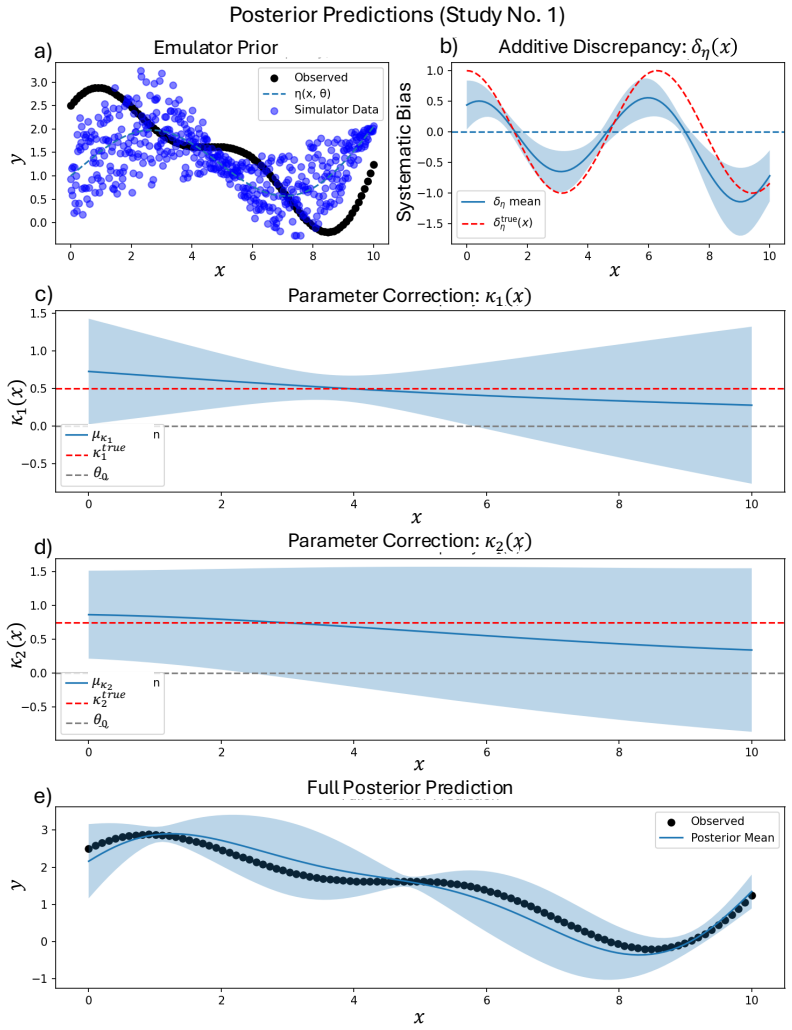
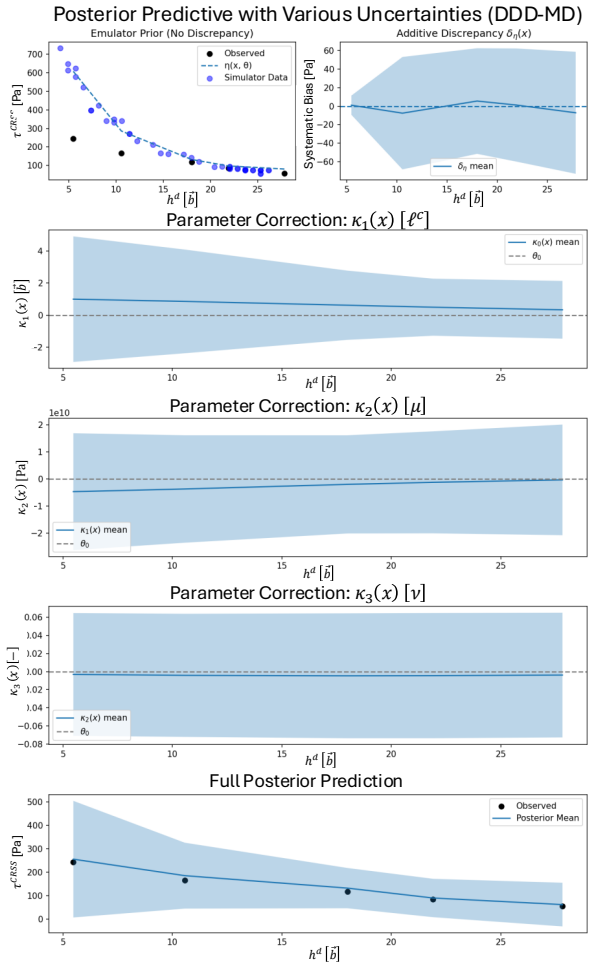
A new calibration formalism represents each parameter as a fixed best estimate plus an input-dependent correction GP under strong shrinkage priors, nesting KOH while extending it to functional calibration.
A machine-rendered reading of the paper's core claim, the machinery that carries it, and where it could break.
Core claim
The authors argue that anchoring each calibration parameter around a best estimate via a shrinkage-constrained input-dependent Gaussian process correction, together with an additive discrepancy process and orthogonality constraints, produces a model that nests the standard KOH formulation as the special case of strong shrinkage while extending it to input-dependent calibration whenever the data justify relaxing the shrinkage.
What carries the argument
The parameter correction Gaussian process over the input space, equipped with conservative hyperpriors on complexity and combined with orthogonality constraints between simulator, correction, and additive discrepancy.
If this is right
- Under strong shrinkage the posterior predictions converge to those of the KOH model.
- When shrinkage is relaxed the mean correction becomes an explicit function of the inputs if the data support it.
- The formulation supplies active regularization around the supplied best estimates rather than weak priors on fixed parameters.
- Orthogonality constraints reduce collinearity between the simulator output, the parameter correction, and the additive discrepancy.
- The same structure applies to any computer model for which a best estimate of each calibration parameter is available.
Where Pith is reading between the lines
- The same shrinkage construction could be applied to other discrepancy terms beyond calibration parameters, such as input-dependent model error in surrogate modeling.
- If the method recovers known input-dependent effects on synthetic data, it would support use in engineering domains where physical parameters vary with operating conditions.
- The orthogonality constraints might be relaxed or replaced by other identifiability penalties without losing the nesting property.
Load-bearing premise
An independent Gaussian process with conservative hyperpriors can represent any needed input-dependent correction to the calibration parameters while the orthogonality constraints keep confounding between the simulator, correction, and additive discrepancy under control.
What would settle it
A controlled simulation in which the true calibration parameter is known to vary smoothly with an input variable; the method would be falsified if the posterior mean of the correction term fails to recover that variation or if the additive discrepancy term absorbs most of the signal.
Figures





read the original abstract
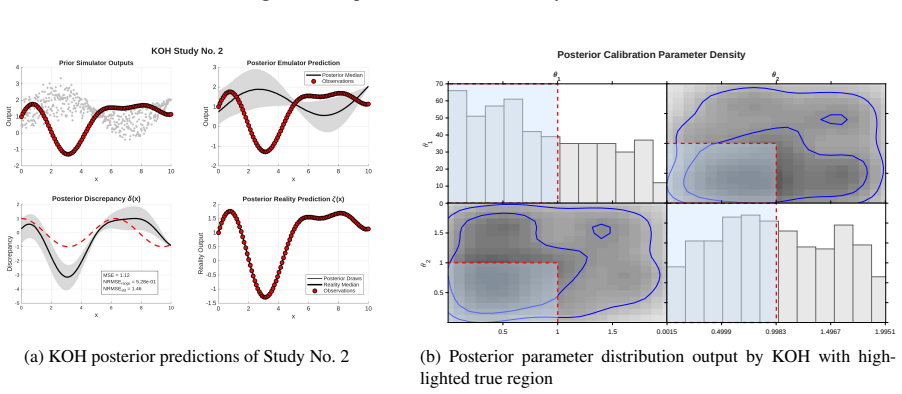
We propose a new Bayesian model calibration formalism as an alternative to the Kennedy O'Hagan (KOH) framework which we term integrated bias with full uncertainty (IBFU). In KOH, calibration parameters are modeled as fixed, but unknown distributions with relatively weak prior constraints, and their posteriors are inferred jointly with an additive discrepancy Gaussian Process (GP). This formulation often provides limited regularization and leads to confounding pathologies when applied to inexact models with sparse, noisy measurements. By contrast, we represent each calibration parameter as the sum of a fixed best estimate value and a parameter correction represented by an independent GP over the input space, equipped with strong shrinkage priors. Any residual discrepancy that cannot be addressed via parameter correction is captured by an additive discrepancy GP operating on the simulator, similar to KOH. We then impose orthogonality constraints to mitigate confounding between the simulator and modeled additive discrepancy and colinearity between model parameters. Imposing strong complexity shrinkage via conservative hyperpriors forces the mean parameter correction to remain flat across the domain, resulting in predictions that essentially converge with the KOH formulation. However, upon relaxing complexity shrinkage, should the data provide evidence that the effective calibration parameter varies across the domain, the mean parameter correction is allowed to become a function of the domain in a controlled, structured manner. In this sense, our approach is more universal: it effectively nests KOH as a special case while extending it to input dependent calibration, and it is more tightly constrained, because it anchors the true values around the best estimates and the shrinkage prior actively regularizes the calibration parameters.
Editorial analysis
A structured set of objections, weighed in public.
Referee Report
Summary. The paper proposes the Integrated Bias with Full Uncertainty (IBFU) formalism as an alternative to the Kennedy-O'Hagan (KOH) framework for Bayesian calibration of complex computer models. It models each calibration parameter as a fixed best estimate plus an input-dependent correction represented by an independent GP equipped with strong shrinkage priors; residual discrepancy is captured by an additive discrepancy GP, with orthogonality constraints imposed to mitigate confounding between the simulator output, the parameter correction, and the discrepancy term. The approach is claimed to nest KOH as a special case under strong shrinkage while permitting controlled input-dependent calibration when shrinkage is relaxed.
Significance. If the orthogonality constraints provably restore identifiability and the nesting property holds, the IBFU construction would supply a principled way to regularize calibration parameters around best estimates while extending KOH to input-dependent settings. This could be useful in sparse-data regimes where standard KOH exhibits confounding pathologies. The explicit use of conservative hyperpriors to control the complexity of the correction GP is a potentially valuable modeling device.
major comments (2)
- [Abstract (model formulation)] Abstract (model formulation paragraph): the orthogonality constraints are asserted to mitigate confounding between the parameter correction GP and the additive discrepancy GP, yet no explicit mathematical form (inner-product conditions, projection operators, or modified likelihood) or derivation showing that the joint posterior factors or that identifiability is restored is supplied. This is load-bearing for the central claim that IBFU is both more universal and more tightly constrained than KOH.
- [Abstract (shrinkage and nesting claim)] Abstract (shrinkage and nesting claim): the statement that strong complexity shrinkage forces the mean parameter correction to remain flat (recovering KOH) while relaxing it permits input-dependent calibration in a controlled manner lacks either a formal proof of the nesting property or simulation studies demonstrating recovery of input-dependent parameters versus KOH in sparse-data settings. Without such verification the universality assertion cannot be assessed.
minor comments (1)
- [Abstract] The abstract is information-dense; separating the description of the model components from the claimed advantages would improve readability.
Simulated Author's Rebuttal
We appreciate the referee's insightful comments highlighting key aspects of our IBFU framework. We provide point-by-point responses below, noting where revisions will be made to strengthen the presentation.
read point-by-point responses
-
Referee: Abstract (model formulation paragraph): the orthogonality constraints are asserted to mitigate confounding between the parameter correction GP and the additive discrepancy GP, yet no explicit mathematical form (inner-product conditions, projection operators, or modified likelihood) or derivation showing that the joint posterior factors or that identifiability is restored is supplied. This is load-bearing for the central claim that IBFU is both more universal and more tightly constrained than KOH.
Authors: While the abstract is necessarily concise, the full manuscript provides the mathematical details in Section 3: the orthogonality is enforced via the condition that the inner product of the parameter correction GP and the discrepancy GP is zero, implemented through a modified joint covariance that projects out the confounding components. The derivation that this restores identifiability is in Appendix A. We will revise the abstract to briefly reference these constraints and their purpose. revision: partial
-
Referee: Abstract (shrinkage and nesting claim): the statement that strong complexity shrinkage forces the mean parameter correction to remain flat (recovering KOH) while relaxing it permits input-dependent calibration in a controlled manner lacks either a formal proof of the nesting property or simulation studies demonstrating recovery of input-dependent parameters versus KOH in sparse-data settings. Without such verification the universality assertion cannot be assessed.
Authors: The nesting follows from the model construction: strong shrinkage priors on the correction GP variance and lengthscale force the correction to a constant, exactly recovering KOH as a special case. This is formalized in the hierarchical prior setup described in Section 2.2. The numerical studies in Section 4 show the behavior under varying shrinkage levels in sparse settings. We will update the abstract to cite the relevant section for the nesting property. revision: partial
Circularity Check
No circularity: IBFU model is a self-contained modeling proposal with external anchors
full rationale
The paper introduces the IBFU formalism as an explicit Bayesian modeling choice: calibration parameters are defined as best-estimate plus input-dependent GP correction under shrinkage hyperpriors, with an additive discrepancy GP and orthogonality constraints imposed by construction. This nests KOH only in the strong-shrinkage limit as a designed limiting case, not by reducing any prediction or uniqueness claim to a fitted input or self-citation. No equations or steps in the provided text equate a derived quantity to its own inputs by definition, and no load-bearing premise relies on prior work by the same authors. The construction is therefore independent of the target claims and receives the default non-circularity finding.
Axiom & Free-Parameter Ledger
free parameters (2)
- shrinkage hyperpriors
- best estimate values
axioms (2)
- domain assumption Gaussian process priors are appropriate for both discrepancy and parameter corrections
- ad hoc to paper Orthogonality constraints successfully separate the parameter correction GP from the additive discrepancy GP
invented entities (1)
-
parameter correction GP
no independent evidence
Reference graph
Works this paper leans on
-
[1]
ISSN 0162-1459, 1537-274X. doi: 10.1080/01621459.2016.1211016. URLhttps://www.tandfonline.com/doi/full/10.1080/ 01621459.2016.1211016. Matthew Plumlee. Computer Model Calibration with Confidence and Consistency.Journal of the Royal Statistical Society Series B: Statistical Methodology, 81(3):519–545, July 2019. ISSN 1369-7412, 1467-9868. doi: 10.1111/rssb...
-
[2]
Penalising model component complexity: A principled, practical approach to constructing priors
ISSN 0030-1299, 1600-0706. doi: 10.1111/oik.05985. URLhttps://nsojournals.onlinelibrary.wiley.com/doi/10.1111/ oik.05985. Jenny Brynjarsdottir and Anthony O’Hagan. Learning about physical parameters: the importance of model discrepancy.Inverse Problems, 30 (11):114007,November2014. ISSN0266-5611,1361-6420. doi:10.1088/0266-5611/30/11/114007. URLhttps://io...
work page internal anchor Pith review Pith/arXiv arXiv doi:10.1111/oik.05985 2014
-
[3]
URLhttps://www.degruyterbrill.com/document/doi/10.1515/1544-6115.1803/html
doi: 10.1515/1544-6115.1803. URLhttps://www.degruyterbrill.com/document/doi/10.1515/1544-6115.1803/html. Juho Piironen and Aki Vehtari. On the hyperprior choice for the global shrinkage parameter in the horseshoe prior. Liam Myhill. Caked-up. https://github.com/MUEXLY/caked-up, 2026. RobertTibshirani. Regressionshrinkageandselectionviathelasso. 58(1):267–...
discussion (0)
Sign in with ORCID, Apple, or X to comment. Anyone can read and Pith papers without signing in.