REVIEW 4 major objections 5 minor 8 cited by
A modular planning system with zero robot training data matches or beats a model fine-tuned on 350 hours of demonstrations.
Reviewed by Pith at T0; open to challenge. T0 means a machine referee read the full paper against a public rubric. the ladder, T0–T4 →
T0 review · deepseek-v4-flash
2026-08-02 18:26 UTC pith:G2WY72TJ
load-bearing objection A credible zero-training modular baseline that beats a fine-tuned VLA on a self-selected benchmark; the evaluation protocol needs tightening before the headline is taken at face value, but the core result is probably right. the 4 major comments →
TiPToP: A Modular Open-Vocabulary Robot Manipulation System That Plans
The pith
A machine-rendered reading of the paper's core claim, the machinery that carries it, and where it could break.
Core claim
The authors claim that composing pretrained depth, segmentation, grasp, and language models with a GPU-parallelized task-and-motion planner (cuTAMP) yields a manipulation system that, with zero robot training data, matches or outperforms π0.5-DROID, a VLA fine-tuned on 350 hours of demonstrations. Across 28 scenes and 165 trials, TiPToP attains 74.6% success versus 52.4%, higher task progress in distractor, semantic, and multi-step categories, and faster time-to-success on five of six scenes. They also show that the modular architecture enables component-level failure tracing, with grasping as the dominant bottleneck, and that new embodiments and skills can be added within hours.
What carries the argument
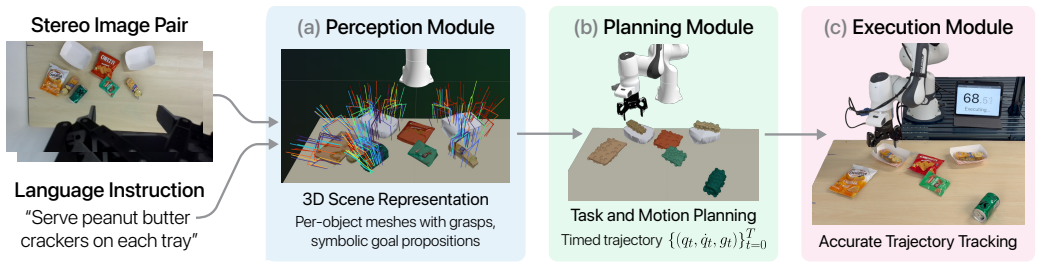
The central mechanism is a two-branch pipeline that fuses semantic and geometric understanding into an object-centric scene representation, then hands it to cuTAMP, a GPU-parallelized task-and-motion planner. A vision-language model turns the instruction into symbolic predicates (currently on(a,b)), grounding open-vocabulary references like 'peanut butter crackers' or 'largest toy' onto detected objects; stereo depth, segmentation, and grasp-prediction models supply per-object meshes and candidate grasps. cuTAMP enumerates plan skeletons, initializes thousands of sampled solutions, and jointly optimizes grasp and placement poses against collision, stability, and kinematic constraints, genera
Load-bearing premise
The central premise that carries the headline number is that the chosen evaluation scenes, task menus, and termination limits treat the trained baseline fairly; if those choices instead favor a system that reasons about semantics and geometry, the 74.6% vs 52.4% gap is not a general statement.
What would settle it
Run both systems on 100 third-party-designed tasks with identical success criteria and per-task time budgets matched to each controller's rates, and check whether the aggregate gap persists; a targeted version is to put a single concave object (a banana) in front of TiPToP and observe whether the convex-hull mesh repeatedly causes grasp or placement failures.
If this is right
- A manipulation system that requires no robot training data and can be installed on a standard DROID setup in under an hour is a viable alternative to end-to-end VLAs for pick-and-place and multi-step tasks.
- Component-level failure tracing becomes practical, steering improvement effort to the weakest modules—grasping first, then scene completion, VLM detection, and planning.
- Time-to-success is roughly half that of the reactive VLA on single-step real-world tasks, because the planner commits to a single time-optimal trajectory instead of iterating a closed-loop policy.
- The complementary failure modes suggest a hybrid design: using a VLA as a closed-loop skill primitive inside the TAMP framework to recover from grasp slips and unexpected object motion.
- Because components are swappable, the system should improve automatically as better depth estimators, grasp predictors, and VLMs become available.
Where Pith is reading between the lines
- The headline comparison is sensitive to the evaluation protocol: tasks were chosen to suit both systems, categories reward VLM grounding and multi-step geometric reasoning, and baseline termination limits differ; an independently curated task set could shrink or reverse the gap.
- The open-loop architecture means robustness depends on static scenes and precise tracking; adding closed-loop replanning after each pick-and-place, as the paper itself suggests, would likely address the dominant grasp-failure mode.
- The modular decomposition yields a direct testable extension: swapping in a stronger vision-language model should improve semantic and distractor tasks without touching the planner, while swapping in a better grasp predictor should directly reduce the largest failure class.
- Single-viewpoint convex-hull meshes are the root of failures on concave objects like bananas; multi-view perception or learned shape completion is a natural next experiment that would test whether the perception module, not the planner, is the binding constraint.
Editorial analysis
A structured set of objections, weighed in public.
Referee Report
Summary. This paper presents TiPToP, a modular open-vocabulary manipulation system that combines pretrained perception models (FoundationStereo, M2T2, SAM-2, Gemini Robotics-ER) with the GPU-parallelized task-and-motion planner cuTAMP. From a single stereo image pair and a natural-language instruction, TiPToP builds an object-centric scene representation, produces a symbolic goal, plans a full pick-and-place trajectory, and executes it open-loop with a joint impedance controller. The main empirical claim is that TiPToP, which requires no robot training data, 'matches or outperforms' π0.5-DROID, a VLA fine-tuned on 350 hours of DROID data, across 28 evaluation scenes: aggregate success 98/165 (74.6%) vs. 55/165 (52.4%), with faster average completion time on five of six measured scenes. The evaluation includes simulation, an in-house DROID setup, and an external DROID setup operated by a separate team, plus deployment on UR5e and WidowX and a wiping extension. A failure analysis over 173 additional trials attributes most failures to grasping, mesh approximation, VLM detection, and planner timeouts. The abstract also claims first place on the MolmoSpaces benchmark, though this is not described in the body.
Significance. If the claimed result holds, it is significant: a zero-robot-data modular system composed of off-the-shelf foundation models and geometric planning would be a competitive alternative to a VLA fine-tuned on embodiment-specific demonstrations, and the modular architecture provides a practical route for component-level debugging. The paper has real strengths: it releases open-source code, uses an external evaluation team for part of the study, reports both success rate and task progress, and honestly discusses open-loop execution as a key limitation. However, the headline comparison is not yet convincing as stated. The termination budget for π0.5-DROID differs between the external and designer-run scenes, real-world scenes use only five trials with no significance testing, and the task menu is author-selected. The conclusion 'matches or outperforms' therefore needs a matched-protocol rerun or equivalent evidence before it can be accepted.
major comments (4)
- [Appendix C; Table I] The unmarked scenes in Table I were run by the external team, where π0.5-DROID trials were terminated after 800 control steps; at 15 Hz this is ≈53 s. The dagger-marked designer scenes used a 120 s timeout. The Semantic category, in which TiPToP's margin is largest (26/40 vs. 10/40), consists entirely of unmarked scenes; AirPods→cup is also unmarked. Since π0.5 is a closed-loop policy that may need multiple grasp attempts and recovery cycles, an 800-step cutoff can convert a late success into a failure precisely on these semantic and multi-step tasks. Appendix C asserts the limits are 'generous' but gives no π0.5 completion-time distribution, and Table II reports only mean time-to-success on successful trials, which cannot establish that the cutoff was non-binding. Please rerun the external scenes with a matched wall-clock budget (120 s), or provide time-to-success and time-to-failure di
- [Section VII-A; Table I] Real-world scenes use 5 trials per scene and no error bars, confidence intervals, or significance tests. Many per-scene differences, such as 1/5 vs. 4/5 or 2/5 vs. 5/5, are within binomial noise. Task selection was explicitly based on 'tasks that both TiPToP and π0.5-DROID seemed capable of,' and the tasks were then grouped into categories that reward TiPToP's symbolic grounding and long-horizon planning strengths. This is not necessarily invalid, but the paper should justify the menu and provide per-category confidence intervals or a permutation test over scenes. Without this, the aggregate 74.6% vs. 52.4% cannot be cleanly separated from task-selection effects.
- [Abstract] The abstract claims that TiPToP 'ranks first overall on pick and pick-and-place tasks among methods not trained on in-distribution data' on the MolmoSpaces benchmark. No section of the paper describes MolmoSpaces, the comparison set, the task suite, or the numeric results. A benchmark-ranking claim cannot be evaluated from the abstract alone. Either add the full MolmoSpaces evaluation to the experiments or remove the claim from the abstract.
- [Table II; Appendix C] The completion-time comparison (Q2) uses average time-to-success over successful trials only, with a manually stopped timer for π0.5 and an automatically stopped timer for TiPToP, and no per-trial distributions or sample sizes are reported. Because failed π0.5 trials can be long and are excluded, the five-of-six speed advantage may overstate the difference. Please report all trials or medians/ranges, and use the same termination and measurement procedure for both systems.
minor comments (5)
- [Title; Section IV-B] There are typographical errors: 'Open-V ocabulary' in the title and 'logical relations betweeen' in Section IV-B. Please proofread the manuscript.
- [Appendix B] The impedance controller equation includes gains Kp and Kd, and the text says they were tuned, but no numerical values or tuning procedure are given. Provide the values in the appendix or point to the open-source controller for reproducibility.
- [Appendix C; Table I] Task-progress metrics are defined per-task with different scoring rules and penalties, and Appendix C notes that progress metrics 'may vary by the evaluator and the task.' Aggregating these heterogeneous scores in the TP column of Table I is not meaningful across scenes. Report TP only within matched scenes or provide a consistent metric.
- [Table II] The table reports mean time-to-success without indicating the number of successful trials used for each mean. Some entries are likely based on a single success. Include per-trial values or at least counts and confidence intervals.
- [Section VII-C] The abstract says TiPToP can be deployed on a standard DROID setup in under an hour, while the UR5e adaptation is described as taking 'a few hours.' Clarify that the sub-hour figure applies only to the already-supported DROID configuration, not to new embodiments.
Circularity Check
No circular derivation: the central claim is an externally anchored empirical benchmark; minor self-citation of cuTAMP is not load-bearing.
full rationale
The paper's headline result is an empirical benchmark (98/165 vs. 55/165 success over 28 scenes) against an independent external VLA baseline, π0.5-DROID, with unmarked scenes run by an external evaluation team. There is no fitted quantity that is renamed as a prediction: TiPToP uses pretrained foundation models and existing TAMP/motion-planning code (cuTAMP, cuRobo) with no robot-training data and no parameters fit to the evaluation outcomes. The author-overlap citations (cuTAMP [48], SceneComplete [1], PRoC3S [13], OWL-TAMP [33]) describe components or related work rather than serving as load-bearing proof of the central comparison. The main caveats are experimental-design fairness issues, not circularity: the authors state they "chose natural language goal expressions and objects that corresponded to tasks that both TiPToP and pi0.5-DROID seemed capable of" (Section VII-A), and Appendix C discloses different termination limits (800 external steps for pi0.5 vs. 120 s for designer-run trials), which could affect the success-rate gap but does not make the result equivalent to its inputs by construction. The abstract's MolmoSpaces "ranks first" claim is not reproduced in the body, so it cannot be independently verified, but that is a missing-support concern, not a circularity. Score 2 reflects only the minor, non-load-bearing self-citation of cuTAMP as an implementation component.
Axiom & Free-Parameter Ledger
free parameters (4)
- controller gains Kp, Kd =
not reported
- cuRobo time_dilation_factor =
0.6
- TiPToP planning timeout =
30-60 s
- baseline termination limits =
60 s sim / 800 steps external / 120 s designer
axioms (7)
- domain assumption Scene is static during open-loop execution; no object moves or slips after planning.
- domain assumption A single calibrated wrist-camera viewpoint at t=0 shows all task-relevant objects well enough.
- domain assumption Convex hulls of single-view object point clouds approximate object geometry for collision checking.
- domain assumption RANSAC's dominant fitted plane is the table.
- domain assumption Gemini's object detection and On(a,b) goal grounding are correct for the task.
- standard math cuTAMP/cuRobo correctly find feasible collision-free plans when one exists within the time budget.
- ad hoc to paper The evaluation protocol does not systematically favor TiPToP: task selection, trial counts, and termination limits are fair to both systems.
read the original abstract
We present TiPToP, a modular manipulation system that integrates pretrained foundation models with a GPU-accelerated Task and Motion Planner to solve tasks directly from RGB images and natural language. TiPToP composes perception, planning, and execution modules and requires no robot training data. It can be deployed on a standard DROID setup in under an hour and adapted to new embodiments with minimal effort. We evaluate TiPToP against $\pi_{0.5}\text{-DROID}$, a state-of-the-art VLA fine-tuned on 350 hours of demonstrations, across two real-world DROID setups (one operated by an external team) and simulation, where TiPToP attains a higher average success rate and faster average completion time. We also evaluate on the MolmoSpaces benchmark, where TiPToP ranks first overall on pick and pick-and-place tasks among methods not trained on in-distribution data. We further show that TiPToP's modularity enables us to trace failures to specific components, revealing where to target improvements. We release TiPToP open-source to serve as a reproducible baseline and to enable further research on modular manipulation systems. Project website and code: https://tiptop-robot.github.io
Figures



Forward citations
Cited by 8 Pith papers
-
Improving Robotic Generalist Policies via Flow Reversal Steering
Flow Reversal Steering steers flow matching generalist policies by reversing suboptimal actions to nearby better modes, enabling improved zero-shot control, quick distillation, and RL bootstrapping in robotic manipulation.
-
VoLo: A Physical Orchestrator for Open-Vocabulary Long-Horizon Manipulation
VoLoAgent uses a VLM to steer heterogeneous robot capabilities as interruptible tools for long-horizon manipulation and introduces the RoboVoLo benchmark, claiming substantial outperformance over single VLA/VLM or too...
-
Hypothesis-driven Model Expansion under Uncertainty for Open-World Robot Planning
HUME lets robots generate, plan over, and actively verify object-centric hypotheses from foundation models so incomplete symbolic models become usable for open-world household tasks.
-
Decompose and Reorganize: Planning with Primitives and Visuomotor Policies Learned from Demonstrations
DR-LfD decomposes demonstrations into contact-level skills, learns them as equivariant primitives and visuomotor policies, and uses TAMP to recombine them for long-horizon tasks.
-
Addressing the Orchestration Gap in Generalist Robots via Physical Agency
A closed-loop inference-time orchestrator using a frontier VLM lifts frozen robot policies from 12.8% to 53.3% on LIBERO-PRO and from near-zero to over 90% on reasoning-limited real-robot tasks, without retraining the...
-
GraspGen-X: Cross-Embodiment 6-DOF Diffusion-based Grasping
GraspGen-X extends diffusion 6-DOF grasping to cross-embodiment via swept-volume gripper encoding, trained on procedural grippers and 2B grasps, claiming best zero-shot generalization to novel grippers in sim and real tests.
-
Learning Bilevel Policies over Symbolic World Models for Long-Horizon Planning
BISON learns bilevel policies over symbolic world models to generalize long-horizon robotic planning beyond VLA and end-to-end baselines while remaining efficient even at 10,000-object scale.
-
A Conversational Framework for Human-Robot Collaborative Manipulation with Distributed Generative AI models
Presents a distributed ROS 2 framework integrating local LLMs and VLMs for conversational human-robot manipulation tasks with operator confirmation and experimental evaluation on a Franka FR3 arm.
Reference graph
Works this paper leans on
-
[1]
Aditya Agarwal, Gaurav Singh, Bipasha Sen, Tom ´as Lozano-P´erez, and Leslie Pack Kaelbling. Scenecom- plete: Open-world 3d scene completion in cluttered real world environments for robot manipulation.IEEE Robotics and Automation Letters (RA-L), 2025. URL https://arxiv.org/abs/2410.23643
arXiv 2025
-
[2]
Do as i can, not as i say: Grounding language in robotic affordances
Michael Ahn, Anthony Brohan, Noah Brown, Yevgen Chebotar, Omar Cortes, Byron David, Chelsea Finn, Chuyuan Fu, Keerthana Gopalakrishnan, Karol Haus- man, et al. Do as i can, not as i say: Grounding language in robotic affordances. InConference on Robot Learning (CoRL), 2022. URL https://arxiv.org/abs/2204.01691
Pith/arXiv arXiv 2022
-
[3]
Ashay Athalye, Nishanth Kumar, Tom Silver, Yichao Liang, Jiuguang Wang, Tom ´as Lozano-P ´erez, and Leslie Pack Kaelbling. From pixels to predicates: Learning symbolic world models via pretrained vision- language models.Robotics and Automation Letters (RA- L), 2026. URL https://arxiv.org/abs/2501.00296
arXiv 2026
-
[4]
Qwen3-vl technical report.arXiv preprint arXiv:2511.21631, 2025
Shuai Bai, Yuxuan Cai, Ruizhe Chen, Keqin Chen, Xionghui Chen, Zesen Cheng, Lianghao Deng, Wei Ding, Chang Gao, Chunjiang Ge, et al. Qwen3-vl technical report.arXiv preprint arXiv:2511.21631, 2025. URL https://arxiv.org/abs/2511.21631
Pith/arXiv arXiv 2025
-
[5]
Jon Louis Bentley. Multidimensional binary search trees used for associative searching.Communications of the ACM (CACM), 1975. URL https://dl.acm.org/doi/10. 1145/361002.361007
arXiv 1975
-
[6]
Johan Bjorck, Fernando Casta ˜neda, Nikita Cherniadev, Xingye Da, Runyu Ding, Linxi Fan, Yu Fang, Dieter Fox, Fengyuan Hu, Spencer Huang, Joel Jang, Zhenyu Jiang, Jan Kautz, Kaushil Kundalia, Lawrence Lao, Zhiqi Li, Zongyu Lin, Kevin Lin, Guilin Liu, Edith Llontop, Loic Magne, Ajay Mandlekar, Avnish Narayan, Soroush Nasiriany, Scott Reed, You Liang Tan, G...
Pith/arXiv arXiv 2025
-
[7]
InRobotics: Science and Systems (RSS), 2025
Kevin Black, Noah Brown, Danny Driess, Adnan Es- mail, Michael Equi, Chelsea Finn, Niccolo Fusai, Lachy Groom, Karol Hausman, Brian Ichter, et al.π 0: A vision- language-action flow model for general robot control. InRobotics: Science and Systems (RSS), 2025. URL https://arxiv.org/abs/2410.24164
Pith/arXiv arXiv 2025
-
[8]
Monitoring the execution of robot plans using semantic knowledge.Robotics and Autonomous Sys- tems (RAS), 2008
Abdelbaki Bouguerra, Lars Karlsson, and Alessandro Saffiotti. Monitoring the execution of robot plans using semantic knowledge.Robotics and Autonomous Sys- tems (RAS), 2008. URL https://www.sciencedirect.com/ science/article/abs/pii/S0921889008001152
2008
-
[9]
Rt-2: Vision-language-action models transfer web knowledge to robotic control
Anthony Brohan, Noah Brown, Justice Carbajal, Yevgen Chebotar, Xi Chen, Krzysztof Choromanski, Tianli Ding, Danny Driess, Avinava Dubey, Chelsea Finn, et al. Rt-2: Vision-language-action models transfer web knowledge to robotic control. InConference on Robot Learning (CoRL), 2023. URL https://proceedings.mlr.press/v229/ zitkovich23a.html
2023
-
[10]
Sahit Chintalapudi, Leslie Pack Kaelbling, and Tom ´as Lozano-P´erez. Bi-level belief space search for com- pliant part mating under uncertainty.arXiv preprint arXiv:2409.15774, 2024. URL https://arxiv.org/abs/2409. 15774
Pith/arXiv arXiv 2024
-
[11]
Tenenbaum, Tom´as Lozano-P´erez, and Leslie Pack Kaelbling
Rohan Chitnis, Tom Silver, Joshua B. Tenenbaum, Tom´as Lozano-P´erez, and Leslie Pack Kaelbling. Learning neuro-symbolic relational transition models for bilevel planning. InIEEE/RSJ International Conference on Intelligent Robots and Systems (IROS), 2022. URL https://arxiv.org/abs/2105.14074
Pith/arXiv arXiv 2022
-
[12]
Aidan Curtis, Xiaolin Fang, Leslie Pack Kaelbling, Tom´as Lozano-P ´erez, and Caelan Reed Garrett. Long- horizon manipulation of unknown objects via task and motion planning with estimated affordances. InIEEE International Conference on Robotics and Automation (ICRA), 2022. URL https://arxiv.org/abs/2108.04145
Pith/arXiv arXiv 2022
-
[13]
Trust the proc3s: Solving long-horizon robotics problems with llms and constraint satisfaction
Aidan Curtis, Nishanth Kumar, Jing Cao, Tom ´as Lozano- P´erez, and Leslie Pack Kaelbling. Trust the proc3s: Solving long-horizon robotics problems with llms and constraint satisfaction. InConference on Robot Learning (CoRL), 2024. URL https://arxiv.org/abs/2406.05572
Pith/arXiv arXiv 2024
-
[14]
Partially observable task and motion planning with uncertainty and risk awareness
Aidan Curtis, George Matheos, Nishad Gothoskar, Vikash Mansinghka, Joshua Tenenbaum, Tom´as Lozano- P´erez, and Leslie Pack Kaelbling. Partially observable task and motion planning with uncertainty and risk awareness. InRobotics: Science and Systems (RSS),
-
[15]
Molmo and pixmo: Open weights and open data for state-of-the-art vision-language models
Matt Deitke, Christopher Clark, Sangho Lee, Rohun Tripathi, Yue Yang, Jae Sung Park, Mohammadreza Salehi, Niklas Muennighoff, Kyle Lo, Luca Soldaini, et al. Molmo and pixmo: Open weights and open data for state-of-the-art vision-language models. InIEEE/CVF Conference on Computer Vision and Pattern Recognition (CVPR), 2025. URL https://arxiv.org/abs/2409.17146
Pith/arXiv arXiv 2025
-
[16]
Hao-Shu Fang, Chenxi Wang, Hongjie Fang, Minghao Gou, Jirong Liu, Hengxu Yan, Wenhai Liu, Yichen Xie, and Cewu Lu. Anygrasp: Robust and efficient grasp perception in spatial and temporal domains.IEEE Transactions on Robotics (T-RO), 2023. URL https: //ieeexplore.ieee.org/document/10167687
arXiv 2023
-
[17]
Richard E. Fikes and Nils J. Nilsson. Strips: A new approach to the application of theorem prov- ing to problem solving.Artificial Intelligence, 1971. URL https://www.sciencedirect.com/science/article/abs/ pii/0004370271900105
arXiv 1971
-
[18]
Martin A Fischler and Robert C Bolles. Random sample consensus: A paradigm for model fitting with appli- cations to image analysis and automated cartography. Communications of the ACM (CACM), 1981. URL https://dl.acm.org/doi/10.1145/358669.358692
arXiv 1981
-
[19]
FFRob: Leveraging symbolic planning for efficient task and motion planning
Caelan Reed Garrett, Tom ´as Lozano-P ´erez, and Leslie Pack Kaelbling. FFRob: Leveraging symbolic planning for efficient task and motion planning. International Journal of Robotics Research (IJRR),
-
[20]
PDDLStream: Integrating symbolic planners and blackbox samplers via optimistic adaptive planning
Caelan Reed Garrett, Tom ´as Lozano-P ´erez, and Leslie Pack Kaelbling. PDDLStream: Integrating symbolic planners and blackbox samplers via optimistic adaptive planning. InInternational Conference on Au- tomated Planning and Scheduling (ICAPS), 2020. URL https://ojs.aaai.org/index.php/ICAPS/article/view/6739
2020
-
[21]
Integrated task and motion planning.Annual Review of Control, Robotics, and Autonomous Systems, 2021
Caelan Reed Garrett, Rohan Chitnis, Rachel Holladay, Beomjoon Kim, Tom Silver, Leslie Pack Kaelbling, and Tom ´as Lozano-P ´erez. Integrated task and motion planning.Annual Review of Control, Robotics, and Autonomous Systems, 2021. URL https://www.annualreviews.org/doi/full/10.1146/annurev- control-091420-084139
doi:10.1146/annurev- 2021
-
[22]
Gemini robotics: Bringing ai into the physical world.arXiv preprint arXiv:2503.20020, 2025
Gemini Robotics Team, Saminda Abeyruwan, Joshua Ainslie, Jean-Baptiste Alayrac, Montserrat Gonzalez Arenas, Travis Armstrong, Ashwin Balakrishna, Robert Baruch, Maria Bauza, Michiel Blokzijl, et al. Gemini robotics: Bringing ai into the physical world.arXiv preprint arXiv:2503.20020, 2025. URL https://arxiv.org/ abs/2503.20020
Pith/arXiv arXiv 2025
-
[23]
Gemini: A family of highly capable multimodal models
Gemini Team, Rohan Anil, Sebastian Borgeaud, Jean- Baptiste Alayrac, Jiahui Yu, Radu Soricut, Johan Schalk- wyk, Andrew M Dai, Anja Hauth, Katie Millican, et al. Gemini: A family of highly capable multimodal models. arXiv preprint arXiv:2312.11805, 2023. URL https: //arxiv.org/abs/2312.11805
Pith/arXiv arXiv 2023
-
[25]
Inner monologue: Embodied reasoning through planning with language models
Wenlong Huang, Fei Xia, Ted Xiao, Harris Chan, Jacky Liang, Pete Florence, Andy Zeng, Jonathan Tompson, Igor Mordatch, Yevgen Chebotar, Pierre Sermanet, Noah Brown, Tomas Jackson, Linda Luu, Sergey Levine, Karol Hausman, and Brian Ichter. Inner monologue: Embodied reasoning through planning with language models. In Conference on Robot Learning (CoRL), 202...
Pith/arXiv arXiv 2022
-
[26]
V oxposer: Composable 3d value maps for robotic manipulation with language models
Wenlong Huang, Chen Wang, Ruohan Zhang, Yunzhu Li, Jiajun Wu, and Li Fei-Fei. V oxposer: Composable 3d value maps for robotic manipulation with language models. InConference on Robot Learning (CoRL), 2023. URL https://proceedings.mlr.press/v229/huang23b.html
2023
-
[27]
URL https://arxiv.org/abs/2411.14053
-
[28]
In- tegrated task and motion planning in belief space
Leslie Pack Kaelbling and Tom ´as Lozano-P ´erez. In- tegrated task and motion planning in belief space. International Journal of Robotics Research (IJRR),
-
[29]
Droid: A large-scale in-the-wild robot manipulation dataset
Alexander Khazatsky, Karl Pertsch, Suraj Nair, Ash- win Balakrishna, Sudeep Dasari, Siddharth Karamcheti, Soroush Nasiriany, Mohan Kumar Srirama, Lauryn Luo, Kathy Vuong, et al. Droid: A large-scale in-the-wild robot manipulation dataset. InRobotics: Science and Sys- tems (RSS), 2024. URL https://arxiv.org/abs/2403.12945
Pith/arXiv arXiv 2024
-
[30]
Hierar- chical task and motion planning in the now
Leslie Pack Kaelbling and Tom ´as Lozano-P´erez. Hierar- chical task and motion planning in the now. InIEEE International Conference on Robotics and Automation (ICRA), 2011. URL https://ieeexplore.ieee.org/document/ 5980391
2011
-
[31]
Berg, Wan-Yen Lo, Piotr Doll ´ar, and Ross Girshick
Alexander Kirillov, Eric Mintun, Nikhila Ravi, Hanzi Mao, Chloe Rolland, Laura Gustafson, Tete Xiao, Spencer Whitehead, Alexander C. Berg, Wan-Yen Lo, Piotr Doll ´ar, and Ross Girshick. Segment anything. In IEEE/CVF International Conference on Computer Vision (ICCV), 2023. URL https://arxiv.org/abs/2304.02643
Pith/arXiv arXiv 2023
-
[32]
Learning efficient abstract planning models that choose what to predict
Nishanth Kumar, Willie McClinton, Rohan Chitnis, Tom Silver, Tom´as Lozano-P ´erez, and Leslie Pack Kaelbling. Learning efficient abstract planning models that choose what to predict. InConference on Robot Learning (CoRL), 2023. URL https://proceedings.mlr.press/v229/ kumar23a.html
2023
-
[33]
Open-world task and motion planning via vision-language model inferred constraints
Nishanth Kumar, William Shen, Fabio Ramos, Dieter Fox, Tom ´as Lozano-P ´erez, Leslie Pack Kaelbling, and Caelan Reed Garrett. Open-world task and motion planning via vision-language model inferred constraints. arXiv preprint arXiv:2411.08253, 2024. URL https: //arxiv.org/abs/2411.08253
arXiv 2024
-
[34]
Openvla: An open-source vision-language-action model.arXiv preprint arXiv:2406.09246, 2024
Moo Jin Kim, Karl Pertsch, Siddharth Karamcheti, Ted Xiao, Ashwin Balakrishna, Suraj Nair, Rafael Rafailov, Ethan Foster, Grace Lam, Pannag Sanketi, et al. Openvla: An open-source vision-language-action model.arXiv preprint arXiv:2406.09246, 2024. URL https://arxiv.org/ abs/2406.09246
Pith/arXiv arXiv 2024
-
[35]
Code as policies: Language model programs for em- bodied control
Jacky Liang, Wenlong Huang, Fei Xia, Peng Xu, Karol Hausman, Brian Ichter, Pete Florence, and Andy Zeng. Code as policies: Language model programs for em- bodied control. InIEEE International Conference on Robotics and Automation (ICRA), 2023. URL https: //arxiv.org/abs/2209.07753
Pith/arXiv arXiv 2023
-
[36]
Tenenbaum, Tom Silver, Jo ˜ao F
Yichao Liang, Nishanth Kumar, Hao Tang, Adrian Weller, Joshua B. Tenenbaum, Tom Silver, Jo ˜ao F. Henriques, and Kevin Ellis. Visualpredicator: Learning abstract world models with neuro-symbolic predicates for robot planning. InInternational Conference on Learning Representations (ICLR), 2025. URL https://arxiv.org/abs/ 2410.23156
Pith/arXiv arXiv 2025
-
[37]
Demon- strating ok-robot: What really matters in integrating open-knowledge models for robotics
Peiqi Liu, Yaswanth Orru, Jay Vakil, Chris Paxton, Nur Muhammad Mahi Shafiullah, and Lerrel Pinto. Demon- strating ok-robot: What really matters in integrating open-knowledge models for robotics. InRobotics: Sci- ence and Systems (RSS), 2024. URL https://arxiv.org/ abs/2401.12202
Pith/arXiv arXiv 2024
-
[38]
Foresight and reconsideration in hierarchical planning and execution
Martin Levihn, Leslie Pack Kaelbling, Tom ´as Lozano- P´erez, and Mike Stilman. Foresight and reconsideration in hierarchical planning and execution. InIEEE/RSJ In- ternational Conference on Intelligent Robots and Systems (IROS), 2013. URL https://dspace.mit.edu/handle/1721. 1/90271
2013
-
[39]
Adithyavairavan Murali, Balakumar Sundaralingam, Yu- Wei Chao, Wentao Yuan, Jun Yamada, Mark Carlson, Fabio Ramos, Stan Birchfield, Dieter Fox, and Clemens Eppner. Graspgen: A diffusion-based framework for 6- dof grasping with on-generator training.arXiv preprint arXiv:2507.13097, 2025. URL https://arxiv.org/abs/2507. 13097
Pith/arXiv arXiv 2025
-
[40]
Nils J. Nilsson. Shakey the robot. Technical re- port, SRI International, Artificial Intelligence Center,
-
[41]
Isaac Sim, 2024
NVIDIA. Isaac Sim, 2024. URL https://developer.nvidia. com/isaac/sim
2024
-
[42]
Howe, Craig A
Drew McDermott, Malik Ghallab, Adele E. Howe, Craig A. Knoblock, Ashwin Ram, Manuela M. Veloso, Daniel S. Weld, and David E. Wilkins. PDDL: The planning domain definition language, 1998. URL https://www.semanticscholar.org/paper/PDDL- the-planning-domain-definition-language-McDermott- Ghallab/d82c6b8081343b2eae63d45feefe630233ad60e1
1998
-
[43]
Gpt-4o system card.arXiv preprint arXiv:2410.21276, 2024
OpenAI. Gpt-4o system card.arXiv preprint arXiv:2410.21276, 2024. URL https://arxiv.org/abs/2410. 21276
Pith/arXiv arXiv 2024
-
[44]
Execution monitoring in robotics: A survey.Robotics and Autonomous Systems (RAS), 2005
Ola Pettersson. Execution monitoring in robotics: A survey.Robotics and Autonomous Systems (RAS), 2005. URL https://www.sciencedirect.com/science/article/abs/ pii/S092188900500134X
2005
-
[45]
Physical Intelligence, Kevin Black, Noah Brown, James Darpinian, Karan Dhabalia, Danny Driess, Adnan Es- mail, Michael Equi, Chelsea Finn, Niccolo Fusai, Manuel Y . Galliker, Dibya Ghosh, Lachy Groom, Karol Hausman, Brian Ichter, Szymon Jakubczak, Tim Jones, Liyiming Ke, Devin LeBlanc, Sergey Levine, Adrian Li-Bell, Mohith Mothukuri, Suraj Nair, Karl Pert...
Pith/arXiv arXiv 2025
-
[47]
Open x- embodiment: Robotic learning datasets and rt-x models
Open X-Embodiment Collaboration. Open x- embodiment: Robotic learning datasets and rt-x models. InIEEE International Conference on Robotics and Automation (ICRA), 2024. URL https://arxiv.org/abs/2310.08864
Pith/arXiv arXiv 2024
-
[48]
Differentiable gpu- parallelized task and motion planning
William Shen, Caelan Garrett, Nishanth Kumar, Ankit Goyal, Tucker Hermans, Leslie Pack Kaelbling, Tom ´as Lozano-P´erez, and Fabio Ramos. Differentiable gpu- parallelized task and motion planning. InRobotics: Science and Systems (RSS), 2025. URL https://arxiv.org/ abs/2411.11833
Pith/arXiv arXiv 2025
-
[49]
Tenenbaum
Tom Silver, Rohan Chitnis, Nishanth Kumar, Willie McClinton, Tom´as Lozano-P´erez, Leslie Pack Kaelbling, and Joshua B. Tenenbaum. Predicate invention for bilevel planning. InAAAI Conference on Artificial Intelligence (AAAI), 2023. URL https://ojs.aaai.org/index.php/AAAI/ article/view/26429
2023
-
[50]
Progprompt: Generating situated robot task plans using large language models
Ishika Singh, Valts Blukis, Arsalan Mousavian, Ankit Goyal, Danfei Xu, Jonathan Tremblay, Dieter Fox, Jesse Thomason, and Animesh Garg. Progprompt: Generating situated robot task plans using large language models. InIEEE International Conference on Robotics and Au- tomation (ICRA), 2023. URL https://arxiv.org/abs/2209. 11302
2023
-
[51]
Com- bined task and motion planning through an extensible planner-independent interface layer
Siddharth Srivastava, Eugene Fang, Lorenzo Riano, Ro- han Chitnis, Stuart Russell, and Pieter Abbeel. Com- bined task and motion planning through an extensible planner-independent interface layer. InIEEE Interna- tional Conference on Robotics and Automation (ICRA),
-
[52]
URL https://arxiv.org/abs/2408.00714
-
[53]
SAM 3D: 3dfy anything in images.arXiv preprint arXiv:2511.16624, 2025
SAM 3D Team, Xingyu Chen, Fu-Jen Chu, Pierre Gleize, Kevin J Liang, Alexander Sax, Hao Tang, Weiyao Wang, Michelle Guo, Thibaut Hardin, Xiang Li, Aohan Lin, Jiawei Liu, Ziqi Ma, Anushka Sagar, Bowen Song, Xiaodong Wang, Jianing Yang, Bowen Zhang, Piotr Doll´ar, Georgia Gkioxari, Matt Feiszli, and Jitendra Malik. SAM 3D: 3dfy anything in images.arXiv prepr...
Pith/arXiv arXiv 2025
-
[55]
A survey on deep stereo matching in the twen- ties.International Journal of Computer Vision (IJCV),
Fabio Tosi, Luca Bartolomei, and Matteo Poggi. A survey on deep stereo matching in the twen- ties.International Journal of Computer Vision (IJCV),
-
[56]
Logic-geometric programming: An optimization-based approach to combined task and mo- tion planning
Marc Toussaint. Logic-geometric programming: An optimization-based approach to combined task and mo- tion planning. InInternational Joint Conference on Artificial Intelligence (IJCAI), 2015. URL https://www. ijcai.org/Proceedings/15/Papers/274.pdf
2015
-
[57]
Differentiable physics and stable modes for tool-use and manipulation planning
Marc Toussaint, Kelsey Allen, Kevin Smith, and Joshua Tenenbaum. Differentiable physics and stable modes for tool-use and manipulation planning. InRobotics: Science and Systems (RSS), 2018. URL https://www. roboticsproceedings.org/rss14/p44.html
2018
-
[58]
Jie Wang, Matthew Leonard, Kostas Daniilidis, Dinesh Jayaraman, and Edward S. Hu. Evaluatingπ 0 in the wild: Strengths, problems, and the future of generalist robot policies, 2025. URL https://penn-pal-lab.github.io/Pi0- Experiment-in-the-Wild/
2025
-
[59]
Balakumar Sundaralingam, Siva Kumar Sastry Hari, Adam Fishman, Caelan Reed Garrett, Karl Van Wyk, Valts Blukis, Alexander Millane, Helen Oleynikova, Ankur Handa, Fabio Ramos, Nathan D. Ratliff, and Dieter Fox. curobo: Parallelized collision-free robot motion generation. InIEEE International Conference on Robotics and Automation (ICRA), 2023. URL https: //...
arXiv 2023
-
[60]
Contact-graspnet: Efficient 6-dof grasp generation in cluttered scenes
Martin Sundermeyer, Arsalan Mousavian, Rudolph Triebel, and Dieter Fox. Contact-graspnet: Efficient 6-dof grasp generation in cluttered scenes. InIEEE International Conference on Robotics and Automation (ICRA), 2021. URL https://arxiv.org/abs/2103.14127
Pith/arXiv arXiv 2021
-
[61]
Foundationstereo: Zero-shot stereo matching
Bowen Wen, Matthew Trepte, Joseph Aribido, Jan Kautz, Orazio Gallo, and Stan Birchfield. Foundationstereo: Zero-shot stereo matching. InIEEE/CVF Conference on Computer Vision and Pattern Recognition (CVPR), 2025. URL https://arxiv.org/abs/2501.09898
Pith/arXiv arXiv 2025
-
[62]
Guiding long- horizon task and motion planning with vision language models
Zhutian Yang, Caelan Reed Garrett, Dieter Fox, Tom ´as Lozano-P´erez, and Leslie Pack Kaelbling. Guiding long- horizon task and motion planning with vision language models. InIEEE International Conference on Robotics and Automation (ICRA), 2025. URL https://arxiv.org/abs/ 2410.02193
Pith/arXiv arXiv 2025
-
[63]
put the ob- ject into the container
Wentao Yuan, Adithyavairavan Murali, Arsalan Mousa- vian, and Dieter Fox. M2t2: Multi-task masked trans- former for object-centric pick and place. InConfer- ence on Robot Learning (CoRL), 2023. URL https: //proceedings.mlr.press/v229/yuan23a.html. APPENDIX A. cuTAMP Extensions We made several extensions to cuTAMP [48] to improve real-world deployability: ...
2023
-
[68]
Llm3: Large language model-based task and motion planning with motion failure reasoning
Shu Wang, Muzhi Han, Ziyuan Jiao, Zeyu Zhang, Ying Nian Wu, Song-Chun Zhu, and Hangxin Liu. Llm3: Large language model-based task and motion planning with motion failure reasoning. InIEEE/RSJ International Conference on Intelligent Robots and Systems (IROS),
-
[69]
URL https://arxiv.org/abs/2403.11552
-
[70]
Fast- foundationstereo: Real-time zero-shot stereo matching
Bowen Wen, Shaurya Dewan, and Stan Birchfield. Fast- foundationstereo: Real-time zero-shot stereo matching. arXiv preprint arXiv:2512.11130, 2025. URL https: //arxiv.org/abs/2512.11130
arXiv 2025
-
[1984]
URL https://ai.stanford.edu/ ∼nilsson/OnlinePubs- Nils/shakey-the-robot.pdf
-
[2013]
URL https://journals.sagepub.com/doi/10.1177/ 0278364913484072
-
[2014]
URL https://people.eecs.berkeley.edu/ ∼russell/ papers/icra14-planrob.pdf
-
[2018]
1177/0278364917739114
URL https://journals.sagepub.com/doi/abs/10. 1177/0278364917739114
-
[2024]
URL https://www.roboticsproceedings.org/rss20/ p118.pdf
-
[2025]
URL https://link.springer.com/article/10.1007/ s11263-024-02331-0
-
[2026]
URL https://arxiv.org/abs/2601.17895
discussion (0)
Sign in with ORCID, Apple, or X to comment. Anyone can read and Pith papers without signing in.