Like Uber or Like Buses? Economic Feasibility Analysis of UAM for Airport Access
Pith reviewed 2026-06-28 18:39 UTC · model grok-4.3
The pith
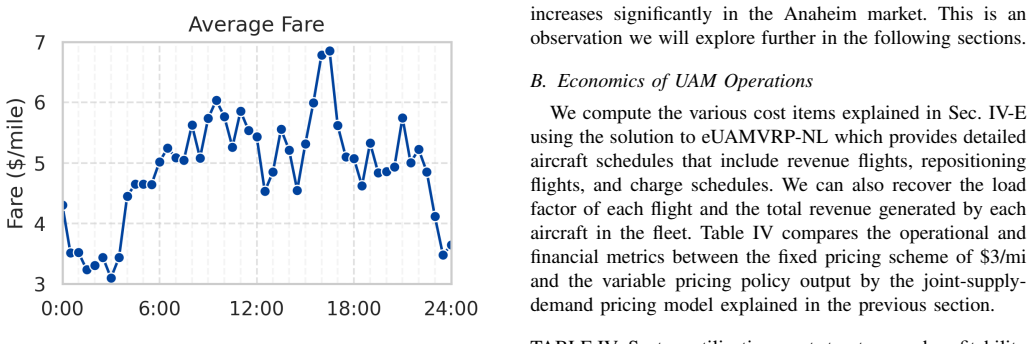
UAM airport access earns more than double the profit when run with variable pricing like ride-hailing rather than fixed prices like scheduled buses.
A machine-rendered reading of the paper's core claim, the machinery that carries it, and where it could break.
Core claim
In the Los Angeles International Airport access market with an eight-spoke vertiport network, UAM operations using a variable pricing policy that matches supply and demand produce more than 100 percent higher operating profits than fixed-pricing schemes, while longer flights also exhibit economies of stage length.
What carries the argument
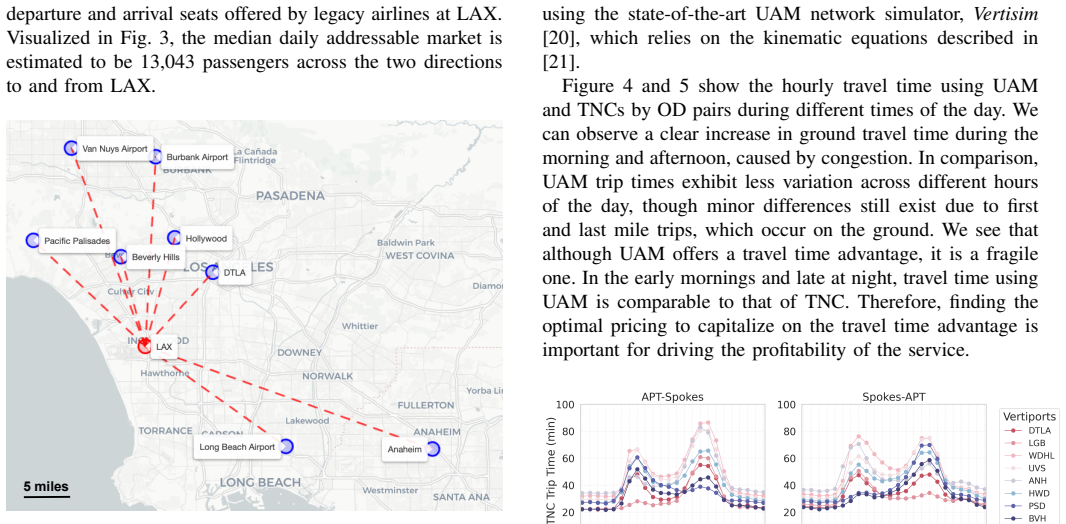
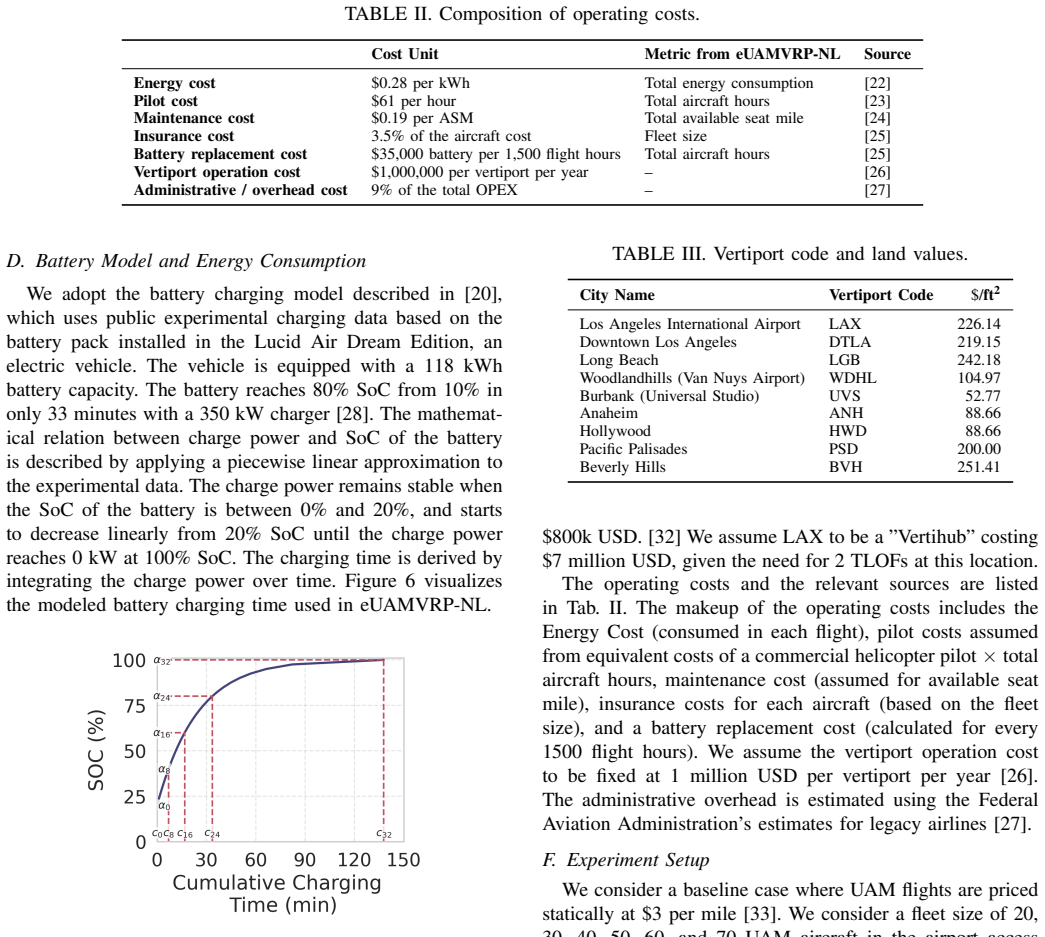
Two-stage framework that first solves a joint-supply-demand variable pricing problem with a binary logit demand model and then feeds the resulting demand into the Electric Urban Air Mobility Vehicle Routing Problem with Non-linear Charging Time (eUAMVRP-NL) to optimize fleet scheduling and charging.
If this is right
- UAM operators should adopt dynamic pricing policies to achieve substantially higher profits than fixed-price operations.
- Fixed pricing leads to lower utilization and lower revenue relative to variable pricing in the same network.
- Longer UAM flight segments reduce average cost per passenger and improve overall profitability.
Where Pith is reading between the lines
- Regulators may need to permit or encourage dynamic pricing for UAM services to reach commercial viability.
- The same two-stage pricing-plus-routing structure could be tested on other early UAM corridors such as city-center to suburban routes.
- Collecting real passenger choice data for UAM fares would provide a direct check on whether the binary logit predictions hold.
Load-bearing premise
Passenger choices between travel time and fare follow the binary logit model exactly, and the demand numbers produced by that model can be used directly as input to the routing optimization.
What would settle it
A field trial at LAX in which measured passenger responses produce a profit gain from variable pricing that is less than 50 percent would falsify the central claim.
Figures




read the original abstract
The airport access use case is a promising early-stage application for Urban Air Mobility (UAM). Understanding the operational paradigm of UAM at airports is crucial for making equitable and effective regulatory and management decisions. A central open question is whether UAM will be integrated into the airport transportation network as a conventional scheduled transit service, such as subways and rail, or as a Transportation Network Company (TNC) characterized by dynamic supply-demand matching. In this paper, we propose a two-stage framework for conducting an economic feasibility analysis of UAM networks. In the first stage, we introduce a joint-supply-demand variable pricing problem to evaluate the impact of dynamic pricing on UAM operations. This model uses a binary logit formulation to capture the trade-off between travel time advantages and fare levels. In the second stage, the determined demand is used as input for the Electric Urban Air Mobility Vehicle Routing Problem with Non-linear Charging Time (eUAMVRP-NL), which optimizes fleet scheduling and charging decisions to derive operating revenue and cost estimates. We apply this framework to a case study of the Los Angeles International Airport (LAX) access market with an eight-spoke vertiport network. Our results indicate that UAM operations benefit significantly from TNC-like management; a variable pricing policy can increase operating profits by more than 100\% compared to fixed-pricing schemes. Furthermore, we identify economies of stage length in longer UAM flights.
Editorial analysis
A structured set of objections, weighed in public.
Referee Report
Summary. The paper proposes a two-stage framework for economic feasibility analysis of UAM airport access: stage 1 solves a joint-supply-demand variable pricing problem via binary logit to set fares and derive demand from travel time vs. fare trade-offs; stage 2 feeds the resulting demand vector into the eUAMVRP-NL to optimize fleet routing, scheduling, and non-linear charging for revenue/cost estimates. Applied to an 8-spoke LAX network, the central claim is that TNC-style variable pricing increases operating profits by more than 100% relative to fixed pricing, with additional identification of economies of stage length in longer flights.
Significance. If the >100% profit differential holds under internally consistent supply parameters, the work supplies actionable quantitative evidence on management paradigms for early UAM deployments, favoring dynamic matching over scheduled service for airport access and highlighting policy implications for vertiport networks. The integration of logit demand with vehicle routing optimization is a methodological strength that could be extended to other UAM use cases.
major comments (2)
- [Abstract (framework overview)] Abstract (stage-1 and stage-2 descriptions): the binary logit in stage 1 determines demand using travel-time and fare inputs, yet the manuscript does not demonstrate that these supply parameters are taken from the endogenous routing/charging schedule produced by eUAMVRP-NL in stage 2. If stage 1 instead relies on exogenous averages, the fixed demand vector passed to stage 2 may be infeasible once actual fleet constraints and non-linear charging times are enforced, directly threatening the validity of the reported >100% profit gain from variable pricing.
- [Abstract (results paragraph)] Abstract (results paragraph): the claim that variable pricing increases operating profits by more than 100% is presented without accompanying sensitivity checks, demand elasticity ranges, or validation against the optimized supply costs/times from stage 2. Because this quantitative result is the primary evidence for the TNC-like management recommendation, the absence of such checks makes the magnitude load-bearing and unverifiable from the given description.
minor comments (1)
- [Abstract] The abstract refers to an 'eight-spoke vertiport network' but does not indicate whether a corresponding network diagram or parameter table appears in the main text; adding an explicit reference would improve traceability of the case-study inputs.
Simulated Author's Rebuttal
We thank the referee for the constructive comments on the two-stage framework and the central profit claim. We address each point below with clarifications and proposed revisions.
read point-by-point responses
-
Referee: [Abstract (framework overview)] Abstract (stage-1 and stage-2 descriptions): the binary logit in stage 1 determines demand using travel-time and fare inputs, yet the manuscript does not demonstrate that these supply parameters are taken from the endogenous routing/charging schedule produced by eUAMVRP-NL in stage 2. If stage 1 instead relies on exogenous averages, the fixed demand vector passed to stage 2 may be infeasible once actual fleet constraints and non-linear charging times are enforced, directly threatening the validity of the reported >100% profit gain from variable pricing.
Authors: Stage 1 uses fixed average travel times derived from network distances and standard UAM cruise speeds as exogenous inputs to the binary logit; these are not updated from the optimized schedules and non-linear charging times produced by eUAMVRP-NL in stage 2. The framework is therefore sequential rather than closed-loop. We will revise the manuscript to state these assumptions explicitly, note the risk of demand infeasibility under tight fleet constraints, and add discussion of a possible iterative extension in which stage-2 outputs feed back into stage 1. revision: partial
-
Referee: [Abstract (results paragraph)] Abstract (results paragraph): the claim that variable pricing increases operating profits by more than 100% is presented without accompanying sensitivity checks, demand elasticity ranges, or validation against the optimized supply costs/times from stage 2. Because this quantitative result is the primary evidence for the TNC-like management recommendation, the absence of such checks makes the magnitude load-bearing and unverifiable from the given description.
Authors: We agree that the >100% profit differential is presented without accompanying sensitivity or validation against stage-2 outputs. We will add sensitivity analyses on logit scale parameters (demand elasticity), charging-time coefficients, and a comparison that substitutes the optimized travel times and costs from eUAMVRP-NL back into the profit calculation. These checks will be included in a new subsection and referenced in the abstract. revision: yes
Circularity Check
No significant circularity; two-stage framework uses independent demand model and optimization
full rationale
The provided abstract and description outline a sequential two-stage process: binary logit demand estimation based on travel time vs. fare trade-offs, followed by feeding the resulting demand vector into an eUAMVRP-NL routing optimization. No equations or steps are shown that reduce a claimed prediction or result back to its own fitted inputs by construction, nor any load-bearing self-citations, uniqueness theorems imported from the authors, or ansatzes smuggled via prior work. The modeling chain is externally grounded in standard logit and VRP formulations without self-referential closure, making the >100% profit comparison a derived output rather than a definitional tautology.
Axiom & Free-Parameter Ledger
Reference graph
Works this paper leans on
-
[1]
Urban Air Mobility (UAM): Airport shuttles or city-taxis?
P. Coppola, F. De Fabiis, and F. Silvestri, “Urban Air Mobility (UAM): Airport shuttles or city-taxis?”Transport Policy, vol. 150, pp. 24–34, May 2024
2024
-
[2]
Exploring economic feasibility for airport shuttle service of urban air mobility (UAM),
J. Hae Choi and Y . Park, “Exploring economic feasibility for airport shuttle service of urban air mobility (UAM),”Transportation Research Part A: Policy and Practice, vol. 162, pp. 267–281, Aug. 2022. [Online]. Available: https://www.sciencedirect.com/science/article/pii/ S0965856422001574
2022
-
[3]
Urban Aerial Mobility for airport shuttle service,
D. Lv, W. Zhang, K. Wang, H. Hao, and Y . Yang, “Urban Aerial Mobility for airport shuttle service,”Transportation Research Part A: Policy and Practice, vol. 188, p. 104202, Oct. 2024. [Online]. Available: https://www.sciencedirect.com/science/article/pii/S0965856424002507
2024
-
[4]
Fast-Forwarding to a Future of On-Demand Urban Air Transportation,
J. Holden and N. Goel, “Fast-Forwarding to a Future of On-Demand Urban Air Transportation,” Uber Elevate, Tech. Rep., 2016
2016
-
[5]
Value of demand information in autonomous mobility-on-demand systems,
J. Wen, N. Nassir, and J. Zhao, “Value of demand information in autonomous mobility-on-demand systems,”Transportation Research Part A: Policy and Practice, vol. 121, pp. 346–359, Mar. 2019. [Online]. Available: https://www.sciencedirect.com/science/article/pii/ S0965856418306785
2019
-
[6]
Learning Joint Rebalancing and Dynamic Pricing Policies for Autonomous Mobility- on-Demand,
X. Li, C. Schmidt, D. Gammelli, and F. Rodrigues, “Learning Joint Rebalancing and Dynamic Pricing Policies for Autonomous Mobility- on-Demand,”IEEE Transactions on Intelligent Transportation Systems, vol. 26, no. 10, pp. 16 619–16 634, Oct. 2025. [Online]. Available: https://ieeexplore.ieee.org/document/11063454
-
[7]
Vertiport location planning for urban air mobility airport shuttle services under Demand uncertainty,
G. Gottschalg, A. K. Strauss, N. Ivanov, B. Mirkovi ´c, and J. Blasco Puyuelo, “Vertiport location planning for urban air mobility airport shuttle services under Demand uncertainty,”Transportation Research Part A: Policy and Practice, vol. 207, p. 104957, May 2026. [Online]. Available: https://www.sciencedirect.com/science/article/pii/ S0965856426000984
2026
-
[8]
Analysis of cost- efficient urban air mobility systems: Optimization of operational and configurational fleet decisions,
M. Husemann, A. Kirste, and E. Stumpf, “Analysis of cost- efficient urban air mobility systems: Optimization of operational and configurational fleet decisions,”European Journal of Operational Research, vol. 317, no. 3, pp. 678–695, Sep. 2024. [Online]. Available: https://linkinghub.elsevier.com/retrieve/pii/S0377221723003387
2024
-
[9]
Fleet and Vertiport Sizing for an Urban Air Mobility Commuting Service,
M. T. Kotwicz Herniczek, B. J. German, and L. Preis, “Fleet and Vertiport Sizing for an Urban Air Mobility Commuting Service,”Trans- portation Research Record: Journal of the Transportation Research Board, vol. 2678, no. 8, pp. 443–469, Aug. 2024. [Online]. Available: https://journals.sagepub.com/doi/10.1177/03611981231216977
-
[10]
Flight Scheduling and Fleet Sizing for an Airport Shuttle Air Taxi Service,
S. Roy, M. T. Kotwicz Herniczek, C. Leonard, B. J. German, and L. A. Garrow, “Flight Scheduling and Fleet Sizing for an Airport Shuttle Air Taxi Service,”Journal of Air Transportation, vol. 30, no. 2, pp. 49–58, Apr. 2022. [Online]. Available: https://arc.aiaa.org/doi/10.2514/1.D0265
-
[11]
S. Cao, X. Jiang, E. B. Onat, B. Zou, M. Hansen, R. Sengupta, and A. Chakrabarty, “Fleet Size and Spill for UAM Operation under Uncertain Demand,” Jul. 2024, arXiv:2407.00947 [cs, eess]. [Online]. Available: http://arxiv.org/abs/2407.00947
-
[12]
Y . Kim, N. Duan, G. Zardini, S. Samaranayake, and D. Wischik, “Strategic Pricing and Routing to Maximize Profit in Congested Roads Considering Interactions With Travelers,”IEEE Transactions on Control of Network Systems, vol. 12, no. 2, pp. 1638–1650, Jun. 2025. [Online]. Available: https://ieeexplore.ieee.org/document/10830554/
-
[13]
Joint Supply-Demand Control of Urban Air Mobility Operations with Variable Pricing: A Case Study of Airport Access Market at JFK,
S. Cao, J. H. Park, J. Duarte, R. K. Srinivasan, R. Sengupta, and M. Hansen, “Joint Supply-Demand Control of Urban Air Mobility Operations with Variable Pricing: A Case Study of Airport Access Market at JFK,” Rochester, NY , Apr. 2026. [Online]. Available: https://papers.ssrn.com/abstract=6521194
2026
-
[14]
The Urban Air Mobility Fleet Scheduling Problem with Nonlinear Charging Time,
S. Cao, E. B. Onat, X. Jiang, R. Sengupta, and M. Hansen, “The Urban Air Mobility Fleet Scheduling Problem with Nonlinear Charging Time,” 2026
2026
-
[15]
An optimization framework for urban air mobility (UAM) planning and operations,
H. Shon and J. Lee, “An optimization framework for urban air mobility (UAM) planning and operations,”Journal of Air Transport Management, vol. 124, p. 102720, Apr. 2025. [Online]. Available: https://linkinghub.elsevier.com/retrieve/pii/S0969699724001856
2025
-
[16]
The electric vehicle routing problem with nonlinear charging function,
A. Montoya, C. Gu ´eret, J. E. Mendoza, and J. G. Villegas, “The electric vehicle routing problem with nonlinear charging function,” Transportation Research Part B: Methodological, vol. 103, pp. 87–110, Sep. 2017. [Online]. Available: https://linkinghub.elsevier.com/retrieve/ pii/S0191261516304556
2017
-
[17]
2019 Passenger Survey Los Angeles International Airport,
Unison Consulting, “2019 Passenger Survey Los Angeles International Airport,” Tech. Rep., 2019. [Online]. Available: https://www.lawa.org/ sites/lawa/files/documents/
2019
-
[18]
T-100 Market,
B. of Transportation Statistics, “T-100 Market,” 2019. [Online]. Available: https://www.transtats.bts.gov
2019
-
[19]
Los Angeles world Airports Ground Transportation Monthly Report,
LAW A, “Los Angeles world Airports Ground Transportation Monthly Report,” Tech. Rep., Dec. 2019. [Online]. Available: https://www.lawa. org/media/27496
2019
-
[20]
Evaluating eVTOL Network Performance and Fleet Dynamics through Simulation-Based Analysis,
E. B. Onat, V . Bulusu, A. Chakrabarty, M. Hansen, R. Sengupta, and B. Sridar, “Evaluating eVTOL Network Performance and Fleet Dynamics through Simulation-Based Analysis,” inAIAA SCITECH 2024 F orum, Jan. 2024, arXiv:2312.02505 [cs, eess]. [Online]. Available: http://arxiv.org/abs/2312.02505
-
[21]
The promise of energy-efficient battery-powered urban aircraft,
S. Sripad and V . Viswanathan, “The promise of energy-efficient battery-powered urban aircraft,”Proceedings of the National Academy of Sciences, vol. 118, no. 45, p. e2111164118, Nov. 2021. [Online]. Available: https://pnas.org/doi/full/10.1073/pnas.2111164118
-
[22]
Average Energy Prices, Los Angeles-Long Beach-Anaheim – December 2024,
B. of Labor Statistics, “Average Energy Prices, Los Angeles-Long Beach-Anaheim – December 2024,” May 2025. [Online]. Available: https://www.bls.gov/regions/west/news-release
2024
-
[23]
Helicopter Pilot Salary in Los Angeles, California, United States (2026),
E. R. Institute, “Helicopter Pilot Salary in Los Angeles, California, United States (2026),” 2026. [Online]. Available: https://www.erieri. com/salary/job/helicopter-pilot/united-states/california/los-angeles
2026
-
[24]
Joby, “Joby SEC Filing,” 2021. [Online]. Available: https://www.sec. gov/Archives/edgar/data/1819848/000095017021005151
-
[25]
Vibration-based health characterization of multiple IMUs in UA V applications,
M. Rimjha, M. Li, N. Hinze, S. Tarafdar, S. Hotle, H. Swingle, A. Trani, and J. C. Smith, “Demand Forecast Model Development and Scenarios Generation For Urban Air Mobility Concepts,” Tech. Rep., Apr. 2020, nTRS Author Affiliations: Virginia Tech, Langley Research Center NTRS Document ID: 20205005881 NTRS Research Center: Langley Research Center (LaRC). [...
-
[26]
The Positive Economic Impact of a New Industry: A Long Beach Case Study,
W. Aero and L. B. E. Patrnership, “The Positive Economic Impact of a New Industry: A Long Beach Case Study,” 2023. [Online]. Available: https://wisk.aero/newsroom/aam-economic-impact
2023
-
[27]
Benefit-Cost Analysis|Federal Aviation Administration,
F. A. Authority, “Benefit-Cost Analysis|Federal Aviation Administration,” 2018. [Online]. Available: https://www.faa.gov
2018
-
[28]
Electric Vehicle database,
Electric Vehicle Database, “Electric Vehicle database,”
-
[29]
Available: https://ev-database.org/car/1696/ Lucid-Air-Dream-Edition-R
[Online]. Available: https://ev-database.org/car/1696/ Lucid-Air-Dream-Edition-R
-
[30]
Urban Air Mobility: Infrastructure and Operations,
E. B. Onat, “Urban Air Mobility: Infrastructure and Operations,” Ph.D. dissertation, University of California, Berkeley, Berkeley, CA, 2024. [Online]. Available: https: //www.proquest.com/openview/8144e59fae730d1e6961fc5138115aa7/ 1?pq-origsite=gscholar&cbl=18750&diss=y
2024
-
[31]
Computing value per square foot of vacant parcels and aggregating to model zone level,
H. Zhang and R. Arnott, “Computing value per square foot of vacant parcels and aggregating to model zone level,” University of California, Riverside, Tech. Rep., 2011. [Online]. Available: https://la-plan.caset.buffalo.edu
2011
-
[32]
Producer Price Index by Commodity: All Commodities,
S. L. F. Reserve, “Producer Price Index by Commodity: All Commodities,” 2026. [Online]. Available: https://fred.stlouisfed.org/ series/PPIACO
2026
-
[33]
Perspectives on advanced air mobility,
R. Riedel, “Perspectives on advanced air mobility,” McK- insey & Company, Tech. Rep., 2022. [Online]. Avail- able: https://www.mckinsey.com/industries/aerospace-and-defense/ our-insights/perspectives-on-advanced-air-mobility
2022
-
[34]
Commercializing Aerial Ridesharing,
Joby, “Commercializing Aerial Ridesharing,” 2021. [Online]. Available: https://ir.jobyaviation.com/sec-filings/all-sec-filings/conten/ 0001193125-21-071690/0001193125-21-071690.pdf
2021
discussion (0)
Sign in with ORCID, Apple, or X to comment. Anyone can read and Pith papers without signing in.