End-to-End Abstraction-Based Control with LLM-Enhanced NL-to-LTL Translation
Pith reviewed 2026-06-30 05:18 UTC · model grok-4.3
The pith
Large language models translate natural language requirements to Linear Temporal Logic with accuracy that decreases as the target specifications grow more complex.
A machine-rendered reading of the paper's core claim, the machinery that carries it, and where it could break.
Core claim
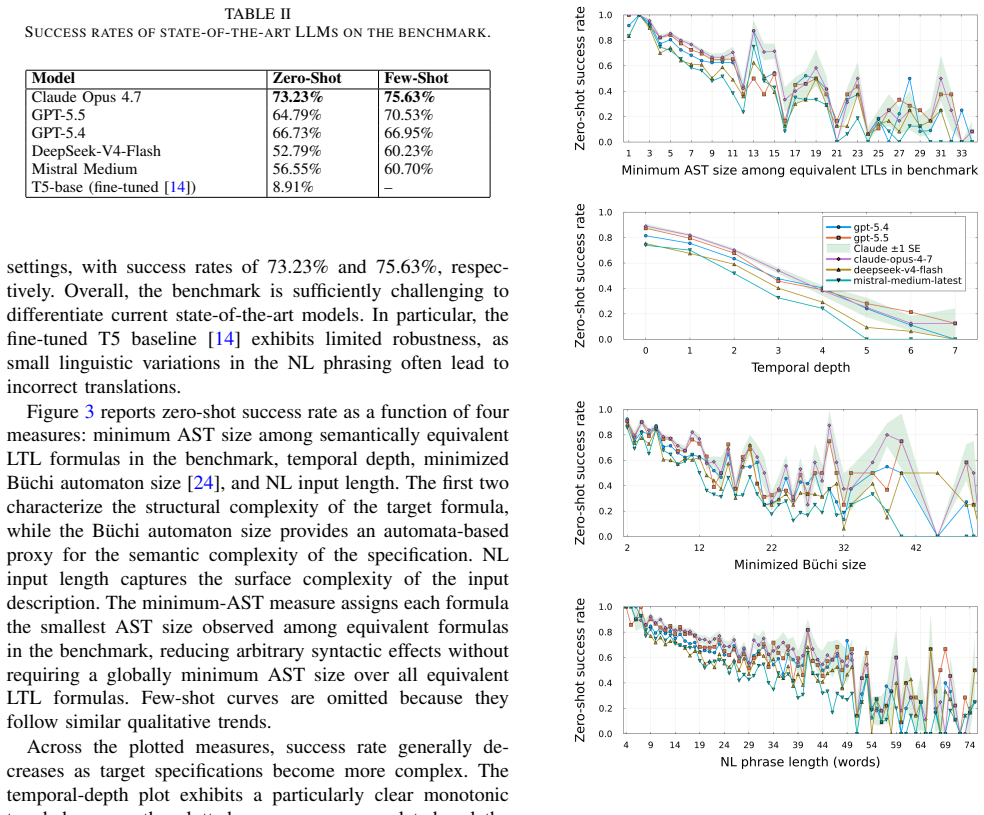
LLM-enhanced translation of natural language requirements into Linear Temporal Logic degrades systematically with increasing complexity of the target LTL formulas, as quantified by abstract syntax tree size, temporal depth, and Büchi automaton size, thereby revealing a scaling law between translation success rate and the intrinsic complexity of the underlying LTL specification.
What carries the argument
The benchmark that evaluates NL-to-LTL translation accuracy across controlled variation in logical complexity (AST size, temporal depth, Büchi automaton size) and linguistic phrasing, used inside an implemented ABCD pipeline.
If this is right
- The pipeline can be directly embedded in existing formal synthesis tools to accept natural language inputs while retaining formal correctness guarantees.
- Translation error rates must be budgeted into any safety argument when LLMs are used to generate specifications for controller synthesis.
- As target specifications increase in complexity, either stronger models or post-processing verification steps become necessary to maintain acceptable reliability.
- The same complexity measures (AST size, temporal depth, automaton size) can serve as predictors for the difficulty of other LLM-driven formal specification tasks.
Where Pith is reading between the lines
- Developers of future LLMs intended for control applications could use the benchmark's complexity metrics as training objectives or evaluation targets.
- If the scaling law holds, hybrid systems that route simple specifications to LLMs and complex ones to human experts or dedicated parsers would improve overall reliability.
- The benchmark could be extended to measure how translation errors propagate through the subsequent abstraction and synthesis steps, quantifying end-to-end impact on controller performance.
Load-bearing premise
The collected set of natural language requirements and matching LTL formulas is representative of the logical structures and linguistic variation that arise in real-world abstraction-based controller design tasks.
What would settle it
Collecting a fresh benchmark of NL-to-LTL pairs whose LTL formulas have higher values on the complexity measures and finding that LLM translation accuracy does not decline would falsify the reported scaling law.
Figures

read the original abstract
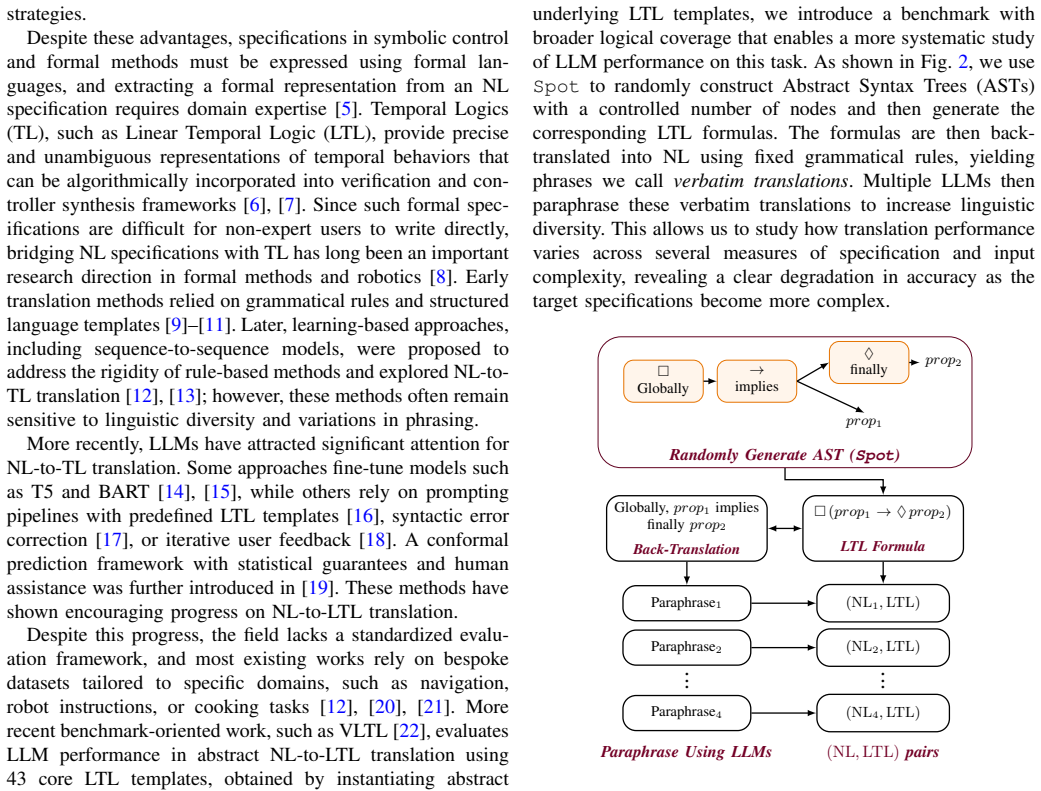
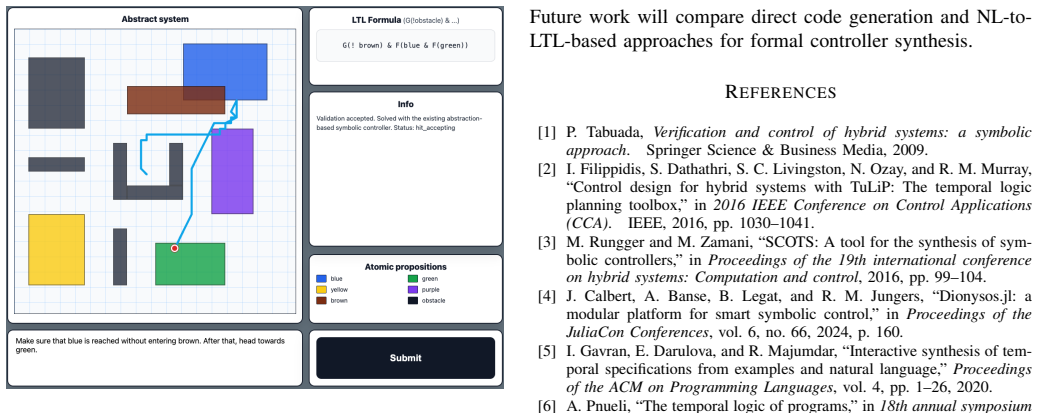
Abstraction-Based Controller Design (ABCD) offers a principled framework for the safe control of complex Cyber-Physical Systems (CPSs), but interfacing real-world requirements with its formal synthesis machinery remains a major bottleneck: such requirements are most naturally expressed in Natural Language (NL), whereas ABCD requires formal specifications such as Linear Temporal Logic (LTL). Large Language Models (LLMs) offer a promising way to bridge this gap by translating NL requirements into formal specifications. This paper makes three contributions. First, we formalize an LLM-enhanced pipeline for ABCD, in which NL requirements are translated into LTL and used within a formal synthesis workflow. Second, we implement this pipeline in the Dionysos toolbox and introduce a benchmark for evaluating NL-to-LTL translation under both logical diversity and linguistic variation. Third, through experiments with state-of-the-art LLMs, we show that translation accuracy degrades systematically as the target specifications become more complex, across several measures including Abstract Syntax Tree (AST) size, temporal depth, and B\"uchi automaton size, while also accounting for the length of the NL input. These results reveal a scaling law that links LLM success rate to the intrinsic complexity of the underlying LTL formula. Together, these contributions provide both an evaluation framework and a practical integration pathway for making ABCD more accessible while preserving the rigor of formal methods.
Editorial analysis
A structured set of objections, weighed in public.
Referee Report
Summary. The paper claims to formalize an LLM-enhanced pipeline for Abstraction-Based Controller Design (ABCD) that translates natural language (NL) requirements into Linear Temporal Logic (LTL) specifications, implements the pipeline in the Dionysos toolbox, introduces a benchmark for NL-to-LTL translation that incorporates logical diversity and linguistic variation, and reports experimental results showing that LLM translation accuracy degrades systematically with LTL complexity (measured by AST size, temporal depth, and Büchi automaton size) after controlling for NL input length, thereby revealing a scaling law between LLM success rate and intrinsic LTL complexity.
Significance. If the benchmark is representative, the work is significant for providing both a concrete integration pathway that preserves formal rigor in ABCD and an empirical evaluation framework that quantifies LLM limitations on complex specifications. The results are grounded in direct measurements on an externally defined benchmark with no circularity or fitted parameters, which strengthens the reliability of the observed degradation trends and scaling law.
major comments (1)
- [Abstract, paragraph 3] Abstract, paragraph 3: The assertion that the benchmark covers 'logical diversity and linguistic variation' provides no information on pair construction (expert-authored, template-based, or paraphrased from LTL), which is load-bearing for the claim that the observed scaling law reflects intrinsic LLM limitations rather than benchmark-specific artifacts when generalizing to real-world ABCD applications.
minor comments (1)
- [Experiments section] The complexity metrics (AST size, temporal depth, Büchi automaton size) are referenced in the abstract but their precise definitions and independence from LLM outputs should be stated explicitly in the benchmark or experiments section to allow full reproducibility.
Simulated Author's Rebuttal
We thank the referee for the constructive comment on the abstract. We address the point below and will make the requested clarification.
read point-by-point responses
-
Referee: [Abstract, paragraph 3] Abstract, paragraph 3: The assertion that the benchmark covers 'logical diversity and linguistic variation' provides no information on pair construction (expert-authored, template-based, or paraphrased from LTL), which is load-bearing for the claim that the observed scaling law reflects intrinsic LLM limitations rather than benchmark-specific artifacts when generalizing to real-world ABCD applications.
Authors: We agree that the abstract does not specify the construction method for the NL-LTL pairs. The full manuscript (Section 4) details that the benchmark was built from expert-authored LTL formulas, with logical diversity ensured via systematic variation of AST size, temporal depth, and automaton size, and linguistic variation introduced through controlled paraphrasing of the corresponding NL sentences. To make this explicit in the abstract and strengthen the generalization argument, we will revise the relevant sentence to briefly state the construction approach (expert-authored LTL with paraphrased NL). revision: yes
Circularity Check
No circularity: empirical observations on introduced benchmark
full rationale
The paper's central contribution is an empirical evaluation of LLM NL-to-LTL translation accuracy on a newly constructed benchmark, documenting systematic degradation with complexity metrics (AST size, temporal depth, Büchi size) after controlling for NL length. No derivation, equation, or first-principles claim is presented that reduces to a fitted parameter, self-definition, or self-citation chain. The observed scaling law is a post-hoc description of measured data rather than a constructed equivalence. The benchmark representativeness assumption affects generalizability but does not create circularity in the reported results.
Axiom & Free-Parameter Ledger
Reference graph
Works this paper leans on
-
[1]
Tabuada,Verification and control of hybrid systems: a symbolic approach
P. Tabuada,Verification and control of hybrid systems: a symbolic approach. Springer Science & Business Media, 2009
2009
-
[2]
Control design for hybrid systems with TuLiP: The temporal logic planning toolbox,
I. Filippidis, S. Dathathri, S. C. Livingston, N. Ozay, and R. M. Murray, “Control design for hybrid systems with TuLiP: The temporal logic planning toolbox,” in2016 IEEE Conference on Control Applications (CCA). IEEE, 2016, pp. 1030–1041
2016
-
[3]
SCOTS: A tool for the synthesis of sym- bolic controllers,
M. Rungger and M. Zamani, “SCOTS: A tool for the synthesis of sym- bolic controllers,” inProceedings of the 19th international conference on hybrid systems: Computation and control, 2016, pp. 99–104
2016
-
[4]
Dionysos.jl: a modular platform for smart symbolic control,
J. Calbert, A. Banse, B. Legat, and R. M. Jungers, “Dionysos.jl: a modular platform for smart symbolic control,” inProceedings of the JuliaCon Conferences, vol. 6, no. 66, 2024, p. 160
2024
-
[5]
Interactive synthesis of tem- poral specifications from examples and natural language,
I. Gavran, E. Darulova, and R. Majumdar, “Interactive synthesis of tem- poral specifications from examples and natural language,”Proceedings of the ACM on Programming Languages, vol. 4, pp. 1–26, 2020
2020
-
[6]
The temporal logic of programs,
A. Pnueli, “The temporal logic of programs,” in18th annual symposium on foundations of computer science (sfcs 1977). ieee, 1977, pp. 46–57
1977
-
[7]
Baier and J.-P
C. Baier and J.-P. Katoen,Principles of model checking. MIT press, 2008
2008
-
[8]
Synthesis of LTL formulas from natural language texts: State of the art and research directions,
A. Brunello, A. Montanari, and M. Reynolds, “Synthesis of LTL formulas from natural language texts: State of the art and research directions,” in26th International symposium on temporal representation and reasoning (TIME 2019). Schloss Dagstuhl–Leibniz-Zentrum f ¨ur Informatik, 2019, pp. 17–1
2019
-
[9]
Translating structured english to robot controllers,
H. Kress-Gazit, G. E. Fainekos, and G. J. Pappas, “Translating structured english to robot controllers,”Advanced Robotics, vol. 22, no. 12, pp. 1343–1359, 2008
2008
-
[10]
Ltlmop: Experimenting with language, temporal logic and robot control,
C. Finucane, G. Jing, and H. Kress-Gazit, “Ltlmop: Experimenting with language, temporal logic and robot control,” in2010 IEEE/RSJ International Conference on Intelligent Robots and Systems. IEEE, 2010, pp. 1988–1993
2010
-
[11]
Provably correct reactive control from natural language,
C. Lignos, V . Raman, C. Finucane, M. Marcus, and H. Kress-Gazit, “Provably correct reactive control from natural language,”Autonomous Robots, vol. 38, no. 1, pp. 89–105, 2015
2015
-
[12]
Sequence-to- sequence language grounding of non-markovian task specifications
N. Gopalan, D. Arumugam, L. L. Wong, and S. Tellex, “Sequence-to- sequence language grounding of non-markovian task specifications.” in Robotics: Science and Systems, vol. 2018, 2018
2018
-
[13]
DeepSTL: from english requirements to Signal Temporal Logic,
J. He, E. Bartocci, D. Ni ˇckovi´c, H. Isakovic, and R. Grosu, “DeepSTL: from english requirements to Signal Temporal Logic,” inProceedings of the 44th International Conference on Software Engineering, 2022, pp. 610–622
2022
-
[14]
NL2TL: Transforming natural languages to temporal logics using large language models,
Y . Chen, R. Gandhi, Y . Zhang, and C. Fan, “NL2TL: Transforming natural languages to temporal logics using large language models,” in Proceedings of the 2023 Conference on Empirical Methods in Natural Language Processing, 2023, pp. 15 880–15 903
2023
-
[15]
Data-efficient learning of natural language to linear temporal logic translators for robot task specification,
J. Pan, G. Chou, and D. Berenson, “Data-efficient learning of natural language to linear temporal logic translators for robot task specification,” in2023 IEEE International Conference on Robotics and Automation (ICRA). IEEE, 2023, pp. 11 554–11 561
2023
-
[16]
NL2LTL–a python package for con- verting natural language (NL) instructions to linear temporal logic (LTL) formulas,
F. Fuggitti and T. Chakraborti, “NL2LTL–a python package for con- verting natural language (NL) instructions to linear temporal logic (LTL) formulas,” inProceedings of the AAAI Conference on Artificial Intelligence, vol. 37, 2023, pp. 16 428–16 430
2023
-
[17]
Auto- TAMP: Autoregressive task and motion planning with llms as translators and checkers,
Y . Chen, J. Arkin, C. Dawson, Y . Zhang, N. Roy, and C. Fan, “Auto- TAMP: Autoregressive task and motion planning with llms as translators and checkers,” in2024 IEEE International conference on robotics and automation (ICRA). IEEE, 2024, pp. 6695–6702
2024
-
[18]
nl2spec: Interactively translating unstructured natural language to temporal logics with large language models,
M. Cosler, C. Hahn, D. Mendoza, F. Schmitt, and C. Trippel, “nl2spec: Interactively translating unstructured natural language to temporal logics with large language models,” inInternational Conference on Computer Aided Verification. Springer, 2023, pp. 383–396
2023
-
[19]
Yanwei Wang, Nadia Figueroa, Shen Li, Ankit Shah, and Julie Shah
D. S. Sundarsingh, J. Wang, J. V . Deshmukh, and Y . Kantaros, “Con- formalNL2LTL: Translating natural language instructions into temporal logic formulas with conformal correctness guarantees,”arXiv preprint arXiv:2504.21022, 2025
-
[20]
Grounding english commands to reward functions,
S. Squire, S. Tellex, D. Arumugam, and L. Yang, “Grounding english commands to reward functions,” inRobotics: Science and systems, 2015
2015
-
[21]
Cook2LTL: Translating cooking recipes to LTL formulae using large language models,
A. Mavrogiannis, C. Mavrogiannis, and Y . Aloimonos, “Cook2LTL: Translating cooking recipes to LTL formulae using large language models,” in2024 IEEE International Conference on Robotics and Automation (ICRA). IEEE, 2024, pp. 17 679–17 686
2024
-
[22]
W. H. English, C. Walker, D. Simon, S. K. Jha, and R. Ewetz, “Verifiable natural language to linear temporal logic translation: A benchmark dataset and evaluation suite,”arXiv preprint arXiv:2507.00877, 2025
-
[23]
LLM-enhanced symbolic control for safety-critical applications,
A. Bayat, A. Abate, N. Ozay, and R. M. Jungers, “LLM-enhanced symbolic control for safety-critical applications,”IFAC-PapersOnLine, vol. 59, no. 26, pp. 43–48, 2025
2025
-
[24]
From Spot 2.0 to Spot 2.10: What’s new?
A. Duret-Lutz, E. Renault, M. Colange, F. Renkin, A. Gbaguidi Aisse, P. Schlehuber-Caissier, T. Medioni, A. Martin, J. Dubois, C. Gillard et al., “From Spot 2.0 to Spot 2.10: What’s new?” inInternational Conference on Computer Aided Verification. Springer, 2022, pp. 174– 187
2022
-
[25]
Feedback refinement relations for the synthesis of symbolic controllers,
G. Reissig, A. Weber, and M. Rungger, “Feedback refinement relations for the synthesis of symbolic controllers,”IEEE Transactions on Auto- matic Control, vol. 62, no. 4, pp. 1781–1796, 2016
2016
discussion (0)
Sign in with ORCID, Apple, or X to comment. Anyone can read and Pith papers without signing in.