Adesua: Development and Feasibility Study of an AI WhatsApp Bot for Science Learning in West Africa
Pith reviewed 2026-05-19 15:18 UTC · model grok-4.3
pith:GCMG72XV Add to your LaTeX paper
What is a Pith Number?\usepackage{pith}
\pithnumber{GCMG72XV}
Prints a linked pith:GCMG72XV badge after your title and writes the identifier into PDF metadata. Compiles on arXiv with no extra files. Learn more
The pith
An AI-powered WhatsApp bot provides accessible science learning support and assessments for West African secondary students.
A machine-rendered reading of the paper's core claim, the machinery that carries it, and where it could break.
Core claim
Adesua combines generative AI with WhatsApp, curated textbooks, and 33 years of exam questions to enable students to ask questions conversationally and complete timed or untimed multiple-choice tests that receive automatic grading plus detailed feedback on right and wrong answers.
What carries the argument
The WhatsApp bot interface that merges local curriculum materials with generative AI for question answering and automated assessment.
If this is right
- Students receive instant grading and explanations for correct and incorrect responses on science tests.
- Support becomes available through a platform already used widely in Africa, lowering access barriers.
- The system aligns with national curricula for JHS and SHS levels across West Africa.
- Deployment data indicates potential for personalized learning without additional hardware or apps.
Where Pith is reading between the lines
- Similar bots could extend to other subjects like math or languages if content is prepared.
- Long-term use might allow tracking common student difficulties to guide teacher training.
- Partnerships with ministries of education could integrate the bot into official digital learning programs.
- Testing in other African countries would check if cultural and curriculum differences affect helpfulness.
Load-bearing premise
The small number of user ratings collected and the absence of checks on the accuracy of AI responses are enough to conclude that the bot is educationally effective and ready to scale.
What would settle it
A controlled trial that measures actual science test score improvements in students who use the bot compared to those who do not over one academic term.
Figures

read the original abstract
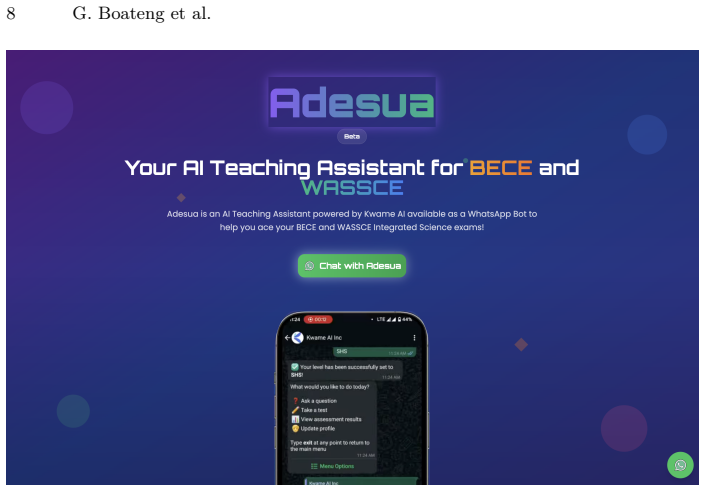
Sub-Saharan Africa faces persistently high student-teacher ratios and shortages of qualified teachers, limiting students' access to personalized learning support and formative assessment. To address this challenge, we present Adesua, a WhatsApp-based AI Teaching Assistant for science education that extends the Kwame for Science platform. Adesua leverages WhatsApp's widespread adoption in Africa to provide accessible, curriculum-aligned learning support for Junior High School (JHS) and Senior High School (SHS) students across West Africa. The system integrates curated textbooks and 33 years of national examination questions with generative AI to enable conversational question answering and automated assessment with feedback via a WhatsApp bot. Students can ask science questions, take timed or untimed multiple-choice tests by topic or exam year, and receive instant grading and detailed explanations of correct and incorrect responses. A 6-month feasibility deployment in 2025 had 56 active users in Ghana, including students and parents. Quantitative evaluation showed a high perceived usefulness, with a helpfulness score of 93.75\% for AI-generated answers, albeit with a small number of ratings (n=16). These preliminary results provide a basis for more extensive future evaluation of a WhatsApp-based AI assistant to assess its potential to offer scalable, low-cost personalized learning support and formative assessment in resource-constrained educational contexts.
Editorial analysis
A structured set of objections, weighed in public.
Referee Report
Summary. The manuscript presents Adesua, a WhatsApp-based AI teaching assistant extending the Kwame for Science platform, designed to provide curriculum-aligned science learning support and automated assessment for JHS and SHS students in West Africa. It integrates curated textbooks and 33 years of national exam questions with generative AI for conversational question answering and feedback. The core contribution is a 6-month feasibility deployment in Ghana with 56 active users (students and parents), reporting a 93.75% helpfulness score for AI-generated answers based on 16 user ratings, as preliminary evidence for scalable, low-cost personalized learning in resource-constrained contexts.
Significance. If the evaluation were strengthened, this work would offer a practical demonstration of using a ubiquitous platform (WhatsApp) to address teacher shortages and high student-teacher ratios in Sub-Saharan Africa through accessible, locally relevant AI support. The integration of national exam questions and textbooks is a clear strength for alignment and relevance. As a descriptive feasibility study rather than a technical model, it provides a foundation for future larger-scale trials but currently lacks the validation needed to substantiate scalability claims.
major comments (1)
- The central feasibility claim—that the deployment demonstrates potential for scalable personalized learning support—depends on the reported 93.75% helpfulness score. This metric is based on only 16 self-ratings from 56 active users, with no methodology described for how helpfulness was measured (e.g., exact survey items, response scale, or collection process), no independent accuracy validation of AI answers against ground-truth textbook or exam content, and no baseline comparisons to non-AI methods or human tutors. This directly matches the stress-test concern and makes the score difficult to interpret as evidence of effectiveness or readiness for scale.
minor comments (2)
- Abstract: The claim of 'high perceived usefulness' should be qualified with the small rating sample size (n=16) to maintain balance and avoid potential overinterpretation by readers.
- Deployment description: Clarify the exact number of questions or interactions per user and any filtering applied to the 56 active users to better contextualize engagement levels.
Simulated Author's Rebuttal
We thank the referee for the constructive feedback and for acknowledging the practical relevance of a WhatsApp-based AI assistant for science education in West Africa. We agree that the current presentation of the feasibility results would benefit from greater methodological transparency and a clearer framing of limitations to support the preliminary claims about scalability.
read point-by-point responses
-
Referee: The central feasibility claim—that the deployment demonstrates potential for scalable personalized learning support—depends on the reported 93.75% helpfulness score. This metric is based on only 16 self-ratings from 56 active users, with no methodology described for how helpfulness was measured (e.g., exact survey items, response scale, or collection process), no independent accuracy validation of AI answers against ground-truth textbook or exam content, and no baseline comparisons to non-AI methods or human tutors. This directly matches the stress-test concern and makes the score difficult to interpret as evidence of effectiveness or readiness for scale.
Authors: We agree that the small number of ratings and absence of detailed methodology limit the interpretability of the 93.75% figure. In the revised manuscript we will expand the Evaluation section to describe the feedback mechanism: an optional post-response prompt in the WhatsApp chat asking 'Was this answer helpful?' with a binary Yes/No scale, collected automatically from users who chose to respond. We will explicitly state that the 16 ratings represent voluntary responses from the 56 active users and note the low response rate as a limitation. We did not perform independent expert validation of AI answer accuracy against the source textbooks or exam questions in this deployment phase, as the study prioritized system integration, user engagement, and technical feasibility over controlled content auditing; the system architecture relies on curated materials to promote alignment, but we will add this as an explicit limitation and recommend such validation for follow-on work. We will likewise add a short discussion of the lack of baseline comparisons, framing the current results as preliminary evidence that motivates larger trials with comparative arms. These changes will better position the work as a feasibility study rather than a definitive effectiveness demonstration. revision: partial
Circularity Check
No circularity: descriptive feasibility study with no derivations or self-referential reductions
full rationale
The paper is a development and feasibility report on an AI WhatsApp bot for science education. It describes system integration with curated textbooks and exam questions, reports deployment metrics (56 users, n=16 ratings yielding 93.75% helpfulness), and discusses potential for scalable support. No equations, model predictions, fitted parameters, or load-bearing self-citations appear. The helpfulness score is a direct aggregate of user self-ratings, not derived from or equivalent to any internal inputs by construction. This matches the default non-circular outcome for purely descriptive studies without mathematical chains.
Axiom & Free-Parameter Ledger
axioms (2)
- domain assumption Generative AI can produce reliable curriculum-aligned explanations without systematic errors in science content for JHS/SHS level.
- domain assumption WhatsApp is sufficiently accessible and familiar to serve as the primary interface for educational interaction in the target population.
Lean theorems connected to this paper
-
IndisputableMonolith/Foundation/RealityFromDistinction.leanreality_from_one_distinction unclear?
unclearRelation between the paper passage and the cited Recognition theorem.
Adesua leverages WhatsApp's widespread adoption in Africa to provide accessible, curriculum-aligned learning support... RAG pipeline... GPT-4 via Azure OpenAI
What do these tags mean?
- matches
- The paper's claim is directly supported by a theorem in the formal canon.
- supports
- The theorem supports part of the paper's argument, but the paper may add assumptions or extra steps.
- extends
- The paper goes beyond the formal theorem; the theorem is a base layer rather than the whole result.
- uses
- The paper appears to rely on the theorem as machinery.
- contradicts
- The paper's claim conflicts with a theorem or certificate in the canon.
- unclear
- Pith found a possible connection, but the passage is too broad, indirect, or ambiguous to say the theorem truly supports the claim.
Reference graph
Works this paper leans on
-
[1]
https://foondamate.com/ (2026), https://foondamate.com/, ac- cessed: 2026-02-03
Foondamate. https://foondamate.com/ (2026), https://foondamate.com/, ac- cessed: 2026-02-03
work page 2026
-
[2]
Rori: Ai-powered virtual math tutor.https://rori.ai/(2026), https://rori.ai/, accessed: 2026-02-03. Rori is an AI-powered virtual math tutor developed by Rising Academies for improving mathematics learning outcomes
work page 2026
-
[3]
In: International Conference on Artificial Intelligence in Education
Boateng, G., John, S., Boateng, S., Badu, P., Agyeman-Budu, P., Kumbol, V.: Real-world deployment and evaluation of kwame for science, an ai teaching assistant for science education in west africa. In: International Conference on Artificial Intelligence in Education. Springer (2024)
work page 2024
-
[4]
Asia-Pacific Science Education9(1), 44–74 (2023)
Chang, J., Park, J., Park, J.: Using an artificial intelligence chatbot in scientific inquiry: Focusing on a guided-inquiry activity using inquirybot. Asia-Pacific Science Education9(1), 44–74 (2023)
work page 2023
-
[5]
Education and Information Technologies29(14), 18621–18642 (2024)
Chen, C.H., Chang, C.L.: Effectiveness of ai-assisted game-based learning on science learning outcomes, intrinsic motivation, cognitive load, and learning behavior. Education and Information Technologies29(14), 18621–18642 (2024)
work page 2024
-
[6]
Education and Information Technologies26(5), 6241–6265 (2021)
Deveci Topal, A., Dilek Eren, C., Kolburan Geçer, A.: Chatbot application in a 5th grade science course. Education and Information Technologies26(5), 6241–6265 (2021)
work page 2021
-
[7]
Why mobile internet is so expensive in africa (2020). https://www.dw.com/en/why- mobile-internet-is-so-expensive-in-some-african-nations/a-55483976 (Nov 2020)
work page 2020
-
[8]
Contemporary Educational Technology 17(4), ep613 (2025)
Fayzullina, A.R., Filippova, A.A., Garnova, N.Y., Astakhov, D.V., Kalmazova, N., Zaripova, Z.F.: Artificial intelligence in science education: A systematic review of applications, impacts, and challenges. Contemporary Educational Technology 17(4), ep613 (2025)
work page 2025
-
[9]
In: International conference on artificial intelligence in education
Henkel, O., Horne-Robinson, H., Kozhakhmetova, N., Lee, A.: Effective and scalable math support: Experimental evidence on the impact of an ai-math tutor in ghana. In: International conference on artificial intelligence in education. pp. 373–381. Springer (2024)
work page 2024
-
[10]
International Journal of Information and Education Technology 14(6), 876–882 (2024)
Kurniawan, W., Riantoni, C., Lestari, N., Ropawandi, D.: A hybrid automatic scoring system: Artificial intelligence-based evaluation of physics concept compre- hension essay test. International Journal of Information and Education Technology 14(6), 876–882 (2024)
work page 2024
-
[11]
Asia-Pacific Science Education9(2), 365–412 (2023)
Lee, J., An, T., Chu, H.E., Hong, H.G., Martin, S.N.: Improving science conceptual understanding and attitudes in elementary science classes through the development and application of a rule-based ai chatbot. Asia-Pacific Science Education9(2), 365–412 (2023)
work page 2023
-
[12]
Journal of Internet Technology24(2), 275–281 (2023),https://jit.ndhu.edu.tw/article/view/2867
Lin, Y.T., Ye, J.H.: Development of an educational chatbot system for enhancing students’ biology learning performance. Journal of Internet Technology24(2), 275–281 (2023),https://jit.ndhu.edu.tw/article/view/2867
work page 2023
-
[13]
Reimers, N., Gurevych, I.: Sentence-bert: Sentence embeddings using siamese bert- networks. In: Proceedings of the 2019 conference on empirical methods in natural language processing and the 9th international joint conference on natural language processing (EMNLP-IJCNLP). pp. 3982–3992 (2019)
work page 2019
-
[14]
International Journal of Mathematical Education in Science and Technology56(9), 1748–1777 (2025)
Taani, O., Alabidi, S.: Chatgpt in education: Benefits and challenges of chatgpt for mathematics and science teaching practices. International Journal of Mathematical Education in Science and Technology56(9), 1748–1777 (2025)
work page 2025
-
[15]
UNESCO: The persistent teacher gap in sub-saharan africa is jeopardizing education recovery. https://www.unesco.org/en/articles/persistent-teacher-gap-sub-saharan- africa-jeopardizing-education-recovery (July 2021), accessed: 2026-02-02 Adesua 11
work page 2021
-
[16]
UNESCO, International Task Force on Teachers for Education 2030: Global report on teachers: Addressing teacher shortages and transforming the profession (2024), https://www.teachertaskforce.org/sites/default/files/ 2024-02/2024_TTF-UNESCO-Global-Report-on-Teachers_EN.pdf, see p. 50
work page 2030
discussion (0)
Sign in with ORCID, Apple, or X to comment. Anyone can read and Pith papers without signing in.