Automating Cause-Effect Specification with Knowledge Graphs and Large Language Models
Pith reviewed 2026-07-01 03:59 UTC · model grok-4.3
The pith
Combining a knowledge graph with a constrained large language model automates the generation of cause-and-effect specifications.
A machine-rendered reading of the paper's core claim, the machinery that carries it, and where it could break.
Core claim
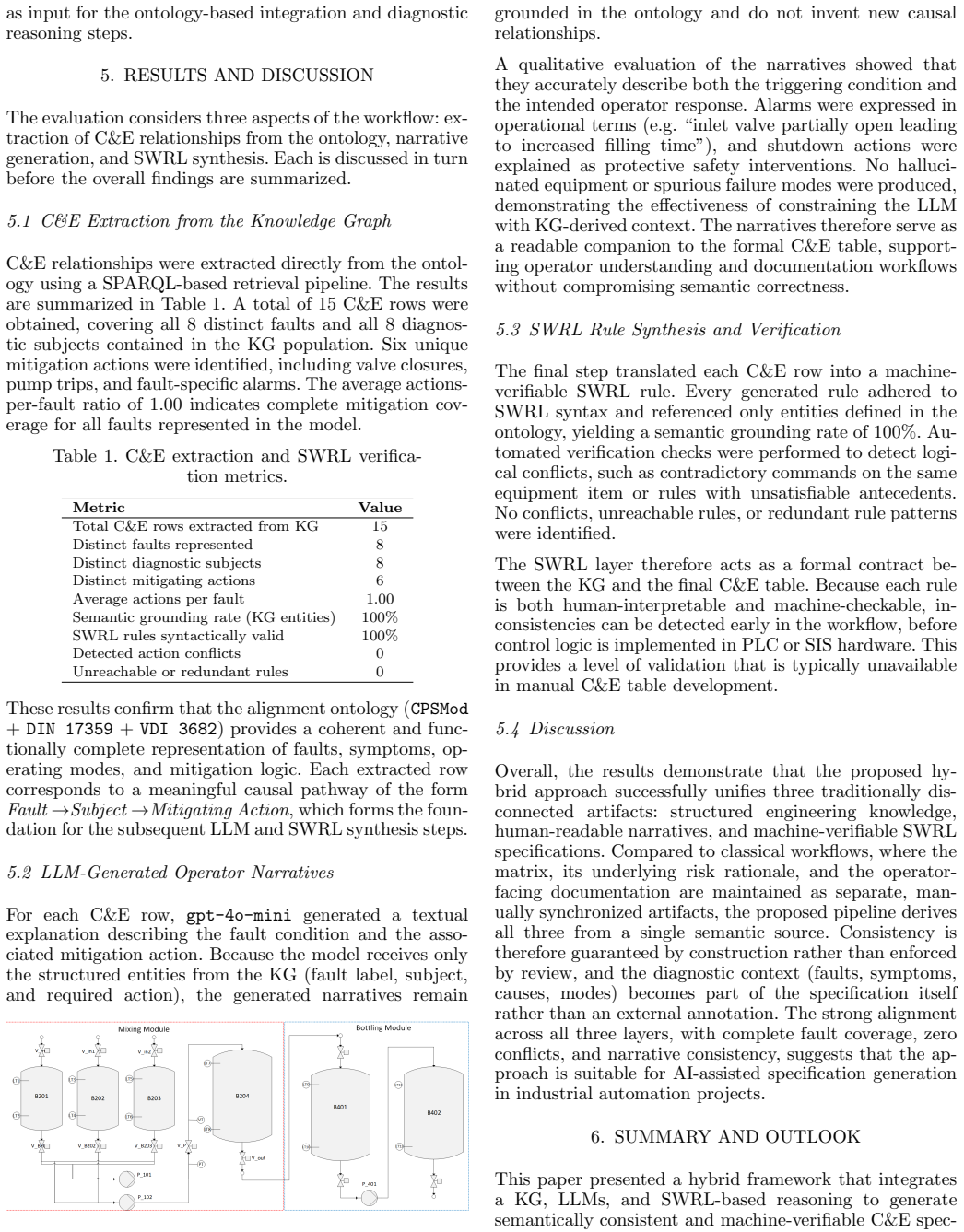
The paper claims that a knowledge graph built on an established modular alignment ontology, when paired with a constrained large language model, can transform represented process information into machine-verifiable SWRL rules and safety narratives, as shown in the generation of C&E logic for a modular process plant with less manual intervention than conventional document-driven approaches.
What carries the argument
The semantic-AI framework that combines a knowledge graph representing process structure, faults, symptoms, causes, and mitigation actions with a constrained LLM layer for transforming information into SWRL rules and narratives under strict ontology and vocabulary constraints.
If this is right
- Interlocks, alarm rationalization tables, and cause-and-effect matrices can be produced directly from the unified knowledge representation.
- Diagnostic relations and mitigation actions become expressible as machine-verifiable SWRL rules.
- Generated specifications remain grounded in the semantic model, supporting consistency across artifacts.
- The demonstrated workflow on a modular process plant indicates the method can reduce manual effort for similar structured systems.
Where Pith is reading between the lines
- If the same ontology can be populated from plant design files, the framework could generate initial safety documentation at the start of a project rather than after design completion.
- Adding sensor or historian data to the knowledge graph might let the same constrained LLM produce updated cause-effect logic when process conditions change.
- The approach could be tested on non-modular plants by relaxing the ontology constraints and measuring the increase in required corrections.
Load-bearing premise
The established modular alignment ontology is assumed to be complete enough to represent all relevant process structure, faults, symptoms, causes, and mitigation actions so that the constrained LLM can reliably produce correct SWRL rules and narratives without additional human correction.
What would settle it
Apply the workflow to a new modular process plant, then compare the generated SWRL rules and narratives against independently created expert versions and count how many require human correction before they are correct.
Figures


read the original abstract
Engineering specifications such as interlocks, alarm rationalization tables, and cause-and-effect (C&E) matrices remain central to process control and safety, yet their creation is still predominantly manual, document-driven, and prone to inconsistency. This paper presents a semantic-AI framework that automates the generation of C&E logic by combining a knowledge graph (KG) with a constrained large language model (LLM) layer. The KG builds on an established modular alignment ontology to represent process structure, operating modes, faults, symptoms, causes, and mitigation actions in a machine-interpretable form. The LLM then transforms this information into operator-ready safety narratives and Semantic Web Rule Language (SWRL) rules under strict ontology and vocabulary constraints, grounding the generated artifacts in the underlying semantic model. The workflow is demonstrated on a modular process plant, showing how engineering semantics, diagnostic relations, and machine-verifiable specifications can be generated from a unified knowledge representation with reduced manual effort.
Editorial analysis
A structured set of objections, weighed in public.
Referee Report
Summary. The manuscript presents a semantic-AI framework for automating cause-and-effect (C&E) specification in process control and safety. It combines a knowledge graph built on an established modular alignment ontology (representing process structure, operating modes, faults, symptoms, causes, and mitigation actions) with a constrained large language model to generate operator-ready safety narratives and SWRL rules. The workflow is demonstrated on a modular process plant, with the central claim being generation of engineering semantics, diagnostic relations, and machine-verifiable specifications from a unified representation with reduced manual effort.
Significance. If the claims hold with validation, the framework could meaningfully reduce manual effort and inconsistency in creating safety-critical documents such as interlocks and alarm rationalization tables. The grounding in an existing ontology and use of constrained LLM generation are positive elements that support reproducibility and verifiability. However, the current presentation supplies no quantitative evidence, limiting assessment of real-world significance.
major comments (2)
- [Demonstration] Demonstration section: the workflow is described as producing SWRL rules and narratives on a modular process plant, but no details are supplied on constraint enforcement during LLM generation, validation of the generated rules against actual plant behavior, error rates, or any comparison to manual baselines. This directly undermines the central claim of reliable automation with reduced manual effort.
- [Framework description] Ontology and LLM layer: the framework assumes the modular alignment ontology is complete enough to represent all relevant process elements so that the constrained LLM produces correct outputs without human correction, yet no test of this assumption, coverage analysis, or failure cases is reported.
minor comments (1)
- [Abstract] Abstract: adding one or two concrete outcomes (e.g., number of rules generated or qualitative observations from the plant demonstration) would strengthen the summary of results.
Simulated Author's Rebuttal
We thank the referee for the constructive feedback on our manuscript. We address each major comment below, clarifying the scope of the demonstration and proposing targeted revisions where the presentation can be strengthened without misrepresenting the work.
read point-by-point responses
-
Referee: [Demonstration] Demonstration section: the workflow is described as producing SWRL rules and narratives on a modular process plant, but no details are supplied on constraint enforcement during LLM generation, validation of the generated rules against actual plant behavior, error rates, or any comparison to manual baselines. This directly undermines the central claim of reliable automation with reduced manual effort.
Authors: The demonstration illustrates the workflow on a modular process plant example, showing generation of narratives and SWRL rules from the knowledge graph under ontology constraints. We agree that the manuscript would benefit from expanded description of the constraint mechanisms (e.g., vocabulary-restricted prompting and ontology grounding). We will revise the demonstration section to provide these details and to qualify the claim of reduced manual effort as illustrative of the approach rather than a quantified result. Quantitative validation against plant behavior, error rates, and baseline comparisons were not part of the reported study. revision: partial
-
Referee: [Framework description] Ontology and LLM layer: the framework assumes the modular alignment ontology is complete enough to represent all relevant process elements so that the constrained LLM produces correct outputs without human correction, yet no test of this assumption, coverage analysis, or failure cases is reported.
Authors: The framework employs an established modular alignment ontology and demonstrates its use for the selected process elements without requiring post-generation correction in the example. We acknowledge that an explicit discussion of coverage and potential failure modes is absent. We will add a limitations subsection addressing the ontology assumptions and scenarios where additional human oversight may be needed. revision: yes
- Quantitative metrics including error rates, validation against actual plant behavior, and comparisons to manual baselines, as these were not collected or reported in the original work.
Circularity Check
No significant circularity identified
full rationale
The paper describes a semantic-AI framework that composes an existing modular alignment ontology into a knowledge graph, then applies a constrained LLM to generate SWRL rules and narratives. No equations, fitted parameters, derivations, or self-citation chains appear in the abstract or described workflow. The demonstration on a modular process plant is presented as an application rather than a self-referential prediction or definition. The central claim therefore remains a composition of independent components with no load-bearing step that reduces to its own inputs by construction.
Axiom & Free-Parameter Ledger
axioms (1)
- domain assumption An established modular alignment ontology exists and is sufficient to represent process structure, operating modes, faults, symptoms, causes, and mitigation actions in machine-interpretable form.
Reference graph
Works this paper leans on
-
[1]
Zenith, Federico and Weinzierl, Christine and Krewer, Ulrike , year =. Model-based analysis of the feasibility envelope for autonomous operation of a portable direct methanol fuel-cell system , keywords =. Chemical Engineering Science , shorthand =. doi:10.1016/j.ces.2010.03.055 , number =
-
[2]
Annual Reviews in Control , shorthand =. 2016 , title =. doi:10.1016/j.arcontrol.2016.09.015 , abstract =
-
[3]
Alhazmi, Khalid and Albalawi, Fahad and Sarathy, S. Mani , year =. A reinforcement learning-based economic model predictive control framework for autonomous operation of chemical reactors , keywords =. Chemical Engineering Journal , shorthand =. doi:10.1016/j.cej.2021.130993 , abstract =
-
[4]
CEAS Aeronautical Journal , doi =
Gill, Milapji Singh and Fay, Alexander , year =. CEAS Aeronautical Journal , doi =
-
[5]
Meng, Lexuan and Dragicevic, Tomislav and Guerrero, Josep M. , year =. Adaptive Control Design for Autonomous Operation of Multiple Energy Storage Systems in Power Smoothing Applications , pages =. IEEE Transactions on Industrial Electronics , shortjournal =. doi:10.1109/TIE.2017.2756584 , number =
-
[6]
2025 , doi =
Gill, Milapji Singh and Jeleniewski, Tom and Gehlhoff, Felix and Fay, Alexander , title =. 2025 , doi =
2025
-
[7]
Distributed Control Strategy for Autonomous Operation of Hybrid AC/DC Microgrid , keywords =
Baek, Jongbok and Choi, Wooin and Chae, Suyong , year =. Distributed Control Strategy for Autonomous Operation of Hybrid AC/DC Microgrid , keywords =. Energies , shorthand =. doi:10.3390/en10030373 , number =
-
[8]
2021 5th International Conference on System Reliability and Safety (ICSRS) , year =
Lee, Daeil and Kim, Hyojin and Choi, Younhee and Kim, Jonghyun , title =. 2021 5th International Conference on System Reliability and Safety (ICSRS) , year =. doi:10.1109/ICSRS53853.2021.9660722 , shorthand =
-
[9]
Olivier, Laurentz E. and Craig, Ian K. , year =. Model-based fault-tolerant control with robustness to unanticipated faults , pages =. IFAC-PapersOnLine , shorthand =. doi:10.1016/j.ifacol.2017.08.401 , number =
-
[10]
Manee and R
V. Manee and R. Baratti and J. Romagnoli , title =. Chemical Engineering Research and Design , volume =. 2022 , url =
2022
-
[11]
TechRxiv Preprint , year =
Georgi Tancev , title =. TechRxiv Preprint , year =
-
[12]
Xun Tang and Yuhe Tian and V. S. D. , title =. Processes , publisher =. 2024 , url =
2024
-
[13]
Control-Informed Reinforcement Learning for Chemical Processes , journal =
Maximilian Bloor and Akhil Ahmed and Niki Kotecha and Mehmet Mercang. Control-Informed Reinforcement Learning for Chemical Processes , journal =. 2024 , url =
2024
-
[14]
Kwon , title =
Niranjan Sitapure and Joseph S. Kwon , title =. arXiv preprint , year =
-
[15]
Westermann, Tom and Gill, Milapji Singh and Fay, Alexander , title =. 2023 IEEE 49th IECON , year =. doi:10.1109/IECON51785.2023.10312156 , file =
-
[16]
Gill, Milapji Singh and Westermann, Tom and Schieseck, Marvin and Fay, Alexander , title =. 2023 IEEE 28th ETFA , year =. doi:10.1109/ETFA54631.2023.10275612 , file =
-
[17]
Gill, Milapji Singh and Westermann, Tom and Steindl, Gernot and Gehlhoff, Felix and Fay, Alexander , title =. 2024 IEEE 29th ETFA , year =. doi:10.1109/ETFA61755.2024.10710898 , file =
-
[18]
Proceedings of the 46th International Conference on Software Engineering: Software Engineering in Practice , publisher =
Fakih, Mohamad and Dharmaji, Rahul and Moghaddas, Yasamin and Quiros, Gustavo and Ogundare, Oluwatosin and Al Faruque, Mohammad Abdullah , year =. Proceedings of the 46th International Conference on Software Engineering: Software Engineering in Practice , publisher =
-
[19]
Pre-Trained Large Language Models for Industrial Control , publisher =. 2023 , copyright =. doi:10.48550/ARXIV.2308.03028 , author =
-
[20]
Fakih, Mohamad and Dharmaji, Rahul and Moghaddas, Yasamin and Quiros, Gustavo and Ogundare, Oluwatosin and Al Faruque, Mohammad Abdullah , year =. LLM4PLC: Harnessing Large Language Models for Verifiable Programming of PLCs in Industrial Control Systems , url =. doi:10.1145/3639477.3639743 , booktitle =
-
[21]
2026 , volume=
Liu, Zihan and Zeng, Ruinan and Wang, Dongxia and Peng, Gengyun and Liu, Xiaoxia and Liu, Qiang and Liu, Peiyu and Wang, Wenhai and Wang, Jingyi , journal=. 2026 , volume=
2026
-
[22]
Control Industrial Automation System with Large Language Models , publisher =. 2024 , copyright =. doi:10.48550/ARXIV.2409.18009 , author =
-
[23]
Towards autonomous system: flexible modular production system enhanced with large language model agents , year=
Xia, Yuchen and Shenoy, Manthan and Jazdi, Nasser and Weyrich, Michael , booktitle=. Towards autonomous system: flexible modular production system enhanced with large language model agents , year=
-
[24]
2024 , eprint=
ControlAgent: Automating Control System Design via Novel Integration of LLM Agents and Domain Expertise , author=. 2024 , eprint=
2024
-
[25]
Proceedings of the 1st International Workshop on Designing and Building Hybrid Human--AI Systems (SYNERGY 2024) , volume=
Towards an llm-based intelligent assistant for industry 5.0 , author=. Proceedings of the 1st International Workshop on Designing and Building Hybrid Human--AI Systems (SYNERGY 2024) , volume=
2024
-
[26]
Resiliency Analysis of LLM generated models for Industrial Automation , year=
Ogundare, Oluwatosin and Araya, Gustavo Quiros and Akrotirianakis, Ioannis and Shukla, Ankit , booktitle=. Resiliency Analysis of LLM generated models for Industrial Automation , year=
-
[27]
2022 IEEE 27th International Conference on Emerging Technologies and Factory Automation (ETFA) , year =
An. 2022 IEEE 27th International Conference on Emerging Technologies and Factory Automation (ETFA) , year =
2022
-
[28]
Tao, Laifa and Huang, Qixuan and Wu, Xianjun and Zhang, Weiwei and Wu, Yunlong and Li, Bin and Lu, Chen and Hai, Xingshuo , date =
-
[29]
, title =
Balhorn, Lukas Schulze and Caballero, Marc and Schweidtmann, Artur M. , title =. 2024 , doi =
2024
-
[30]
Multi-agent systems for chemical engineering: a review and perspective , journal =. 2026 , issn =. doi:https://doi.org/10.1016/j.coche.2025.101209 , author =
-
[31]
Xia, Yuchen and Jazdi, Nasser and Weyrich, Michael , title =. 2024 IEEE 29th International Conference on Emerging Technologies and Factory Automation (ETFA), 2024 , year =. doi:10.1109/ETFA61755.2024.10710996 , file =
-
[32]
and Wagner, Lukas P
Reinpold, Lasse M. and Wagner, Lukas P. and Gehlhoff, Felix and Ramonat, Malte and Kilthau, Maximilian and Gill, Milapji S. and Reif, Jonathan T. and Henkel, Vincent and Scholz, Lena and Fay, Alexander , year =. Journal of Intelligent Manufacturing , doi =
-
[33]
Digital Twin in manufacturing: A categorical literature review and classification , pages =
Kritzinger, Werner and Karner, Matthias and Traar, Georg and Henjes, Jan and Sihn, Wilfried , year =. Digital Twin in manufacturing: A categorical literature review and classification , pages =
-
[34]
Tao, Fei and Zhang, He and Liu, Ang and Nee, A. Y. C. , year =. IEEE Transactions on Industrial Informatics , doi =
-
[35]
, year =
Thambirajah, Jegatheeswaran and Benabbas, Lamia and Bauer, Margret and Thornhill, Nina F. , year =
-
[36]
2024 , title =
Markaj, Artan and Mercang. 2024 , title =
2024
-
[37]
2025 , volume=
Gill, Milapji Singh and Vyas, Javal and Markaj, Artan and Gehlhoff, Felix and Mercangöz, Mehmet , booktitle=. 2025 , volume=
2025
-
[38]
Gill, Milapji Singh and Jeleniewski, Tom and Gehlhoff, Felix and Fay, Alexander , year =
-
[39]
, year =
Rupprecht, Sophia and Gao, Qinghe and Karia, Tanuj and Schweidtmann, Artur M. , year =
-
[40]
Lee, Donghyeon and Lee, Jaewook and Shin, Dongil , year =
-
[41]
Gowaikar, Shreeyash and Iyengar, Srinivasan and Segal, Sameer and Kalyanaraman, Shivkumar , year =
-
[42]
Sakhinana, Sagar Srinivas and. 2024 , title =. doi:10.1609/aaaiss.v4i1.31796 , file =
-
[43]
2025 , title =
Vyas, Javal and Mercang. 2025 , title =
2025
-
[44]
2025 , doi =
Pajak, Emma and Bahamdan, Abdullah and Hellgardt, Klaus and Ro-Chanona, Antoniodel , title =. 2025 , doi =
2025
-
[45]
Driess, Danny and Xia, Fei and Sajjadi, Mehdi S. M. and Lynch, Corey and Chowdhery, Aakanksha and Ichter, Brian and Wahid, Ayzaan and Tompson, Jonathan and Vuong, Quan and Yu, Tianhe and Huang, Wenlong and Chebotar, Yevgen and Sermanet, Pierre and Duckworth, Daniel and Levine, Sergey and Vanhoucke, Vincent and Hausman, Karol and Toussaint, Marc and Greff,...
-
[46]
Webert, Heiko and D. 2022 , title =. doi:10.3390/s22062205 , file =
-
[47]
Manca, Gianluca and Fay, Alexander , year =
-
[48]
2022 IEEE 27th International Conference on Emerging Technologies and Factory Automation (ETFA) , year =
Gill, Milapji Singh and Reiche, Leif-Thore and Fay, Alexander , title =. 2022 IEEE 27th International Conference on Emerging Technologies and Factory Automation (ETFA) , year =
2022
-
[49]
and Caesar, Birte and Gundlach, Claas Steffen and Fay, Alexander , year =
Hildebrandt, Constantin and Köcher, Aljosha and Kustner, Christof and Lopez-Enriquez, Carlos-Manuel and Muller, Andreas W. and Caesar, Birte and Gundlach, Claas Steffen and Fay, Alexander , year =. IEEE T-ASE , doi =
-
[50]
and Schmidt,J
Single,J. and Schmidt,J. and Denecke,J. , year =
-
[51]
Laurenzi, Emanuele and Mathys, Adrian and Martin, Andreas , year =
-
[52]
2024 , volume=
Soularidis, Andreas and Kotis, Konstantinos and Lamolle, Myriam and Mejdoul, Zakaria and Lortal, Gaëlle and Vouros, George , booktitle=. 2024 , volume=
2024
-
[53]
2020 , title =
17th International Conference on Accelerator and Large Experimental Physics Control Systems. 2020 , title =
2020
-
[54]
I. de Zarz. Sensors , volume =. 2023 , doi =
2023
-
[55]
2025 , volume=
Xia, Yuchen and Jazdi, Nasser and Zhang, Jize and Shah, Chaitanya and Weyrich, Michael , booktitle=. 2025 , volume=
2025
-
[56]
and Maleh, Y
Lamaakal, I. and Maleh, Y. and. 2025 , title =
2025
-
[57]
2023 , title =
de Zarz. 2023 , title =
2023
-
[58]
Control Industrial Automation System with Large Language Model Agents , year=
Xia, Yuchen and Jazdi, Nasser and Zhang, Jize and Shah, Chaitanya and Weyrich, Michael , booktitle=. Control Industrial Automation System with Large Language Model Agents , year=
discussion (0)
Sign in with ORCID, Apple, or X to comment. Anyone can read and Pith papers without signing in.