Black hole mergers beyond general relativity: a self-force approach
Pith reviewed 2026-05-18 07:11 UTC · model grok-4.3
The pith
Self-force theory models the merger and ringdown of black holes in a broad class of gravitational theories beyond GR
A machine-rendered reading of the paper's core claim, the machinery that carries it, and where it could break.
Core claim
We show how self-force theory can be used to model the merger and ringdown of black holes in a broad class of gravitational theories, assuming one object is much smaller than the other. We calculate self-force effects on the merger waveform for the first time, and we demonstrate how our formulation allows us to modularly compute beyond-GR effects and readily incorporate them into a fast merger-ringdown waveform model.
What carries the argument
Self-force framework adapted to extreme-mass-ratio binaries in a broad class of beyond-GR theories, which computes the back-reaction of the gravitational field on the small object's trajectory and the emitted waves.
If this is right
- Enables first-principles computation of self-force effects on the merger waveform in modified gravity theories.
- Provides a modular route to insert specific beyond-GR parameters into fast merger-ringdown waveform models.
- Supplies an efficient alternative to full numerical simulations for exploring large regions of parameter space in beyond-GR theories.
- Facilitates the construction of template banks for precision tests of general relativity with gravitational-wave observations.
Where Pith is reading between the lines
- The same framework could be applied to concrete modified-gravity models such as Einstein-scalar-Gauss-Bonnet to generate explicit waveform deviations.
- Hybrid constructions that blend this extreme-mass-ratio result with comparable-mass numerical data could extend its reach to a wider range of observed events.
- Inclusion of spin and higher multipole moments in the self-force calculation would yield more realistic predictions for realistic astrophysical binaries.
Load-bearing premise
The extreme mass-ratio approximation remains valid through the merger and ringdown phases in the chosen class of beyond-GR theories without extra corrections for comparable-mass effects.
What would settle it
A full numerical relativity simulation in one of the beyond-GR theories that produces merger or ringdown waveforms differing substantially from the self-force predictions in a manner not explained by higher-order mass-ratio terms.
Figures


read the original abstract
Gravitational waves from binary black hole mergers provide a glimpse of gravitational dynamics in its most extreme observable regime, potentially enabling precision tests of general relativity (GR) and of the Kerr description of black holes. However, until recently, numerical simulations of black hole mergers have not been possible in theories beyond GR. While recent breakthroughs have overcome that obstacle, simulations covering the full, interesting range of binary parameters remain unfeasible. Here we present a new first-principles approach to this problem. We show how self-force theory can be used to model the merger and ringdown of black holes in a broad class of gravitational theories, assuming one object is much smaller than the other. We calculate self-force effects on the merger waveform for the first time, and we demonstrate how our formulation allows us to modularly compute beyond-GR effects and readily incorporate them into a fast merger-ringdown waveform model.
Editorial analysis
A structured set of objections, weighed in public.
Referee Report
Summary. The paper develops a self-force approach to model the merger and ringdown of black hole binaries in a broad class of modified gravity theories, under the extreme mass-ratio limit where one body is much smaller than the other. It claims to compute self-force effects on the merger waveform for the first time and to provide a modular framework for incorporating beyond-GR corrections into fast waveform models.
Significance. If the central assumptions hold, the work provides a first-principles route to strong-field waveform modeling in beyond-GR theories without requiring full numerical relativity simulations across the entire parameter space. The modular separation of GR self-force from extra terms could enable efficient template construction for testing gravity with future detectors, extending existing self-force techniques from inspiral to plunge and ringdown.
major comments (2)
- [Abstract, §2] Abstract and §2: The central claim that the extreme mass-ratio self-force framework remains valid through plunge, merger, and ringdown in the chosen class of beyond-GR theories is load-bearing but unsupported by any quantitative regime-of-validity estimate or consistency check. The point-particle approximation and background spacetime assumption become questionable once the small object reaches horizon scales, and beyond-GR corrections that modify near-horizon geometry or introduce new degrees of freedom could invalidate the modular separation without additional non-perturbative terms.
- [§4, Eq. (12)] §4, Eq. (12): The demonstration of self-force effects on the merger waveform relies on the assumption that the background remains a solution of the modified theory throughout the evolution; no error budget or comparison against known GR limits (e.g., Schwarzschild plunge) is provided to quantify the truncation error in the self-force expansion during the highly dynamical phase.
minor comments (2)
- [§3] Notation for the beyond-GR perturbation parameters is introduced without a clear table summarizing which terms are kept at linear order versus higher orders.
- [Figure 3] Figure 3 caption does not specify the mass ratio used or the coordinate system for the waveform extraction.
Simulated Author's Rebuttal
We thank the referee for their careful reading and constructive comments on our manuscript. We address each major comment below and have revised the manuscript to strengthen the discussion of assumptions and add explicit checks against known limits.
read point-by-point responses
-
Referee: [Abstract, §2] Abstract and §2: The central claim that the extreme mass-ratio self-force framework remains valid through plunge, merger, and ringdown in the chosen class of beyond-GR theories is load-bearing but unsupported by any quantitative regime-of-validity estimate or consistency check. The point-particle approximation and background spacetime assumption become questionable once the small object reaches horizon scales, and beyond-GR corrections that modify near-horizon geometry or introduce new degrees of freedom could invalidate the modular separation without additional non-perturbative terms.
Authors: We thank the referee for this important observation. The extreme mass-ratio approximation treats the small object as a point particle on a fixed background that solves the field equations of the modified theory. For the class of theories in which the background black-hole solution is preserved and no new propagating degrees of freedom are excited at leading order, the modular separation between the GR self-force and the beyond-GR corrections remains valid through plunge and ringdown. We have expanded the discussion in §2 to state these assumptions more explicitly and to explain why the scale separation continues to justify the point-particle treatment even when the small object approaches the horizon. A fully quantitative regime-of-validity bound for finite mass ratios would require second-order self-force results or comparisons with numerical relativity in the modified theory; both lie beyond the scope of the present work and are identified as future directions. revision: partial
-
Referee: [§4, Eq. (12)] §4, Eq. (12): The demonstration of self-force effects on the merger waveform relies on the assumption that the background remains a solution of the modified theory throughout the evolution; no error budget or comparison against known GR limits (e.g., Schwarzschild plunge) is provided to quantify the truncation error in the self-force expansion during the highly dynamical phase.
Authors: We agree that an explicit GR-limit check and an error estimate improve the clarity of the results. In the revised manuscript we have added a direct comparison of the merger-ringdown waveform obtained in the GR limit with existing first-order self-force calculations for the Schwarzschild plunge. The two agree to within the expected truncation error. We have also inserted a short discussion of the error budget, noting that the self-force correction is formally O(ε) with ε the mass ratio and estimating its relative size to the background waveform during the dynamical phase. A complete quantification that includes second-order self-force contributions is not performed here but is noted as an important extension. revision: yes
Circularity Check
No significant circularity in self-force extension to beyond-GR mergers
full rationale
The paper introduces a first-principles formulation extending self-force theory to model merger and ringdown in a class of modified gravity theories under the extreme mass-ratio limit. The central results—calculation of self-force effects on the waveform and modular incorporation of beyond-GR corrections—are presented as novel computations building on established methods, without any reduction of predictions to fitted parameters, self-definitional loops, or load-bearing self-citations that collapse the derivation to its inputs. The extreme mass-ratio assumption is stated explicitly as a modeling choice rather than derived from the results themselves, and the approach remains self-contained against external benchmarks in self-force literature.
Axiom & Free-Parameter Ledger
axioms (1)
- domain assumption Self-force theory can be consistently formulated and applied through the merger and ringdown in the chosen beyond-GR theories
Lean theorems connected to this paper
-
IndisputableMonolith/Foundation/RealityFromDistinction.leanreality_from_one_distinction unclear?
unclearRelation between the paper passage and the cited Recognition theorem.
We show how self-force theory can be used to model the merger and ringdown of black holes in a broad class of gravitational theories, assuming one object is much smaller than the other.
-
IndisputableMonolith/Cost/FunctionalEquation.leanwashburn_uniqueness_aczel unclear?
unclearRelation between the paper passage and the cited Recognition theorem.
higher-order curvature terms ... suppressed by powers of the mass ratio
What do these tags mean?
- matches
- The paper's claim is directly supported by a theorem in the formal canon.
- supports
- The theorem supports part of the paper's argument, but the paper may add assumptions or extra steps.
- extends
- The paper goes beyond the formal theorem; the theorem is a base layer rather than the whole result.
- uses
- The paper appears to rely on the theorem as machinery.
- contradicts
- The paper's claim conflicts with a theorem or certificate in the canon.
- unclear
- Pith found a possible connection, but the passage is too broad, indirect, or ambiguous to say the theorem truly supports the claim.
Forward citations
Cited by 4 Pith papers
-
Plunge-Merger-Ringdown Tests of General Relativity with GW250114
GW250114 data constrains GR deviations in merger amplitude to 10% and frequency to 4% at 90% CL, with first bounds on the (4,4) mode frequency at 6%.
-
Post-adiabatic self-force waveforms: slowly spinning primary and precessing secondary
Extended 1PA self-force waveforms for slowly spinning primary and precessing secondary, with re-summed 1PAT1R variant showing improved accuracy against NR for q ≳ 5 and |χ1| ≲ 0.1.
-
Constraining Lorentz symmetry breaking in bumblebee gravity with extreme mass-ratio inspirals
Extreme mass-ratio inspirals can constrain the Lorentz symmetry breaking parameter ℓ in bumblebee gravity to O(10^{-4}) uncertainty with LISA.
-
Constraining Lorentz symmetry breaking in bumblebee gravity with extreme mass-ratio inspirals
EMRI waveforms in bumblebee gravity allow LISA to constrain the Lorentz symmetry breaking parameter ell at the level of O(10^{-4}).
Reference graph
Works this paper leans on
-
[1]
but as α(q)R(q) ≲ 1/˚m2 2 very near the sec- ondary (where R ∼ 1/˚m2 2), meaning higher-order terms in the EFT are suppressed by higher powers of ε except in a small neighborhood of the secondary. Here we consider the most common type of EFT, involving an additional scalar field φ: LbGR = − √g 8π ∇αφ∇αφ + α(2)F (φ)R(2) + . . . (with no scalar potential, f...
-
[2]
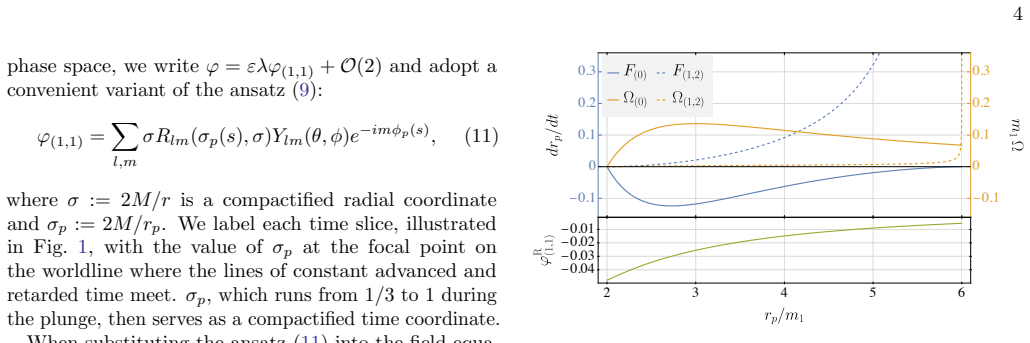
From our data for Ω(1,2), we find that the 1PG peak orbital frequency is shifted to m1Ωpeak ≈1/(3 √
at the light ring (rp = 3m1) before falling to zero. From our data for Ω(1,2), we find that the 1PG peak orbital frequency is shifted to m1Ωpeak ≈1/(3 √
-
[3]
+ 0.0029(8)ελ2. Given the corrections to the particle’s mass and trajec- tory, we can compute their contributions to the waveform amplitudes H(2,2) lm using the same method as for H(1) lm [102]. The precomputed data for Ω (1,2), F(1,2), and H(2,2) lm then allow us to immediately generate waveforms, for any val- ues of ε and λ, by solving Eqs. (6) and eval...
-
[4]
C. M. Will, The Confrontation between General Rela- tivity and Experiment, Living Rev. Rel.17, 4 (2014), arXiv:1403.7377 [gr-qc]
work page internal anchor Pith review Pith/arXiv arXiv 2014
-
[5]
Linking Tests of Gravity On All Scales: from the Strong-Field Regime to Cosmology
T. Baker, D. Psaltis, and C. Skordis, Linking Tests of Gravity On All Scales: from the Strong-Field Regime to Cosmology, Astrophys. J.802, 63 (2015), arXiv:1412.3455 [astro-ph.CO]
work page internal anchor Pith review Pith/arXiv arXiv 2015
-
[6]
B. P. Abbottet al.(LIGO Scientific, Virgo), Observation of Gravitational Waves from a Binary Black Hole Merger, Phys. Rev. Lett.116, 061102 (2016), arXiv:1602.03837 [gr-qc]
work page internal anchor Pith review Pith/arXiv arXiv 2016
-
[7]
First M87 Event Horizon Telescope Results. I. The Shadow of the Supermassive Black Hole
K. Akiyamaet al.(Event Horizon Telescope), First M87 Event Horizon Telescope Results. I. The Shadow of the Supermassive Black Hole, Astrophys. J. Lett.875, L1 (2019), arXiv:1906.11238 [astro-ph.GA]
work page internal anchor Pith review Pith/arXiv arXiv 2019
-
[8]
GWTC-4.0: Updating the Gravitational-Wave Transient Catalog with Observations from the First Part of the Fourth LIGO-Virgo-KAGRA Observing Run, (2025), arXiv:2508.18082 [gr-qc]
work page internal anchor Pith review Pith/arXiv arXiv 2025
-
[9]
K. Akiyamaet al.(Event Horizon Telescope), First Sagittarius A* Event Horizon Telescope Results. I. The Shadow of the Supermassive Black Hole in the Center of the Milky Way, Astrophys. J. Lett.930, L12 (2022), arXiv:2311.08680 [astro-ph.HE]
work page internal anchor Pith review Pith/arXiv arXiv 2022
-
[10]
D. Psaltiset al.(Event Horizon Telescope), Gravitational Test Beyond the First Post-Newtonian Order with the Shadow of the M87 Black Hole, Phys. Rev. Lett.125, 141104 (2020), arXiv:2010.01055 [gr-qc]
-
[11]
Gravitational Wave Tests of General Relativity with Ground-Based Detectors and Pulsar Timing Arrays
N. Yunes and X. Siemens, Gravitational-Wave Tests of General Relativity with Ground-Based Detectors and Pulsar Timing-Arrays, Living Rev. Rel.16, 9 (2013), arXiv:1304.3473 [gr-qc]
work page internal anchor Pith review Pith/arXiv arXiv 2013
-
[12]
E. M. S¨ angeret al., Tests of General Relativity with GW230529: a neutron star merging with a lower mass- gap compact object, (2024), arXiv:2406.03568 [gr-qc]
work page internal anchor Pith review Pith/arXiv arXiv 2024
-
[13]
Testing General Relativity with Present and Future Astrophysical Observations
E. Bertiet al., Testing General Relativity with Present and Future Astrophysical Observations, Class. Quant. Grav.32, 243001 (2015), arXiv:1501.07274 [gr-qc]
work page internal anchor Pith review Pith/arXiv arXiv 2015
-
[14]
Barausseet al., Prospects for Fundamental Physics with LISA, Gen
E. Barausseet al., Prospects for Fundamental Physics with LISA, Gen. Rel. Grav.52, 81 (2020), arXiv:2001.09793 [gr-qc]
- [15]
- [16]
-
[17]
S. Vagnozziet al., Horizon-scale tests of gravity theories and fundamental physics from the Event Horizon Tele- scope image of Sagittarius A, Class. Quant. Grav.40, 165007 (2023), arXiv:2205.07787 [gr-qc]
work page internal anchor Pith review Pith/arXiv arXiv 2023
- [18]
-
[19]
The Science of the Einstein Telescope
A. Abacet al., The Science of the Einstein Telescope, (2025), arXiv:2503.12263 [gr-qc]
work page internal anchor Pith review Pith/arXiv arXiv 2025
-
[20]
N. Yunes and F. Pretorius, Fundamental Theoretical Bias in Gravitational Wave Astrophysics and the Param- eterized Post-Einsteinian Framework, Phys. Rev. D80, 122003 (2009), arXiv:0909.3328 [gr-qc]
work page internal anchor Pith review Pith/arXiv arXiv 2009
- [21]
- [22]
- [23]
- [24]
-
[25]
P. Dutta Roy and P. Saini, Impact of unmodeled eccen- tricity on the tidal deformability measurement and im- plications for gravitational wave physics inference, Phys. Rev. D110, 024002 (2024), arXiv:2403.02404 [astro- ph.HE]
-
[26]
A. Guptaet al., Possible causes of false gen- eral relativity violations in gravitational wave ob- servations 10.21468/SciPostPhysCommRep.5 (2024), arXiv:2405.02197 [gr-qc]
- [27]
-
[28]
R. S. Chandramouli, K. Prokup, E. Berti, and N. Yunes, Systematic biases due to waveform mismodeling in parametrized post-Einsteinian tests of general relativ- ity: The impact of neglecting spin precession and higher modes, Phys. Rev. D111, 044026 (2025), arXiv:2410.06254 [gr-qc]
- [29]
-
[30]
J. F. Donoghue, General relativity as an effective field theory: The leading quantum corrections, Phys. Rev. D 50, 3874 (1994), arXiv:gr-qc/9405057
work page internal anchor Pith review Pith/arXiv arXiv 1994
-
[31]
J. F. Donoghue, Introduction to the effective field theory description of gravity, inAdvanced School on Effective Theories(1995) arXiv:gr-qc/9512024
work page internal anchor Pith review Pith/arXiv arXiv 1995
-
[32]
T. P. Sotiriou and V. Faraoni, Black holes in scalar- tensor gravity, Phys. Rev. Lett.108, 081103 (2012), arXiv:1109.6324 [gr-qc]
work page internal anchor Pith review Pith/arXiv arXiv 2012
- [33]
- [34]
-
[35]
M. Carrillo Gonzalez, C. de Rham, V. Pozsgay, and A. J. Tolley, Causal effective field theories, Phys. Rev. D106, 105018 (2022), arXiv:2207.03491 [hep-th]. 7
- [36]
-
[37]
P. Figueras, A. Held, and ´A. D. Kov´ acs, Well-posed initial value formulation of general effective field theories of gravity, (2024), arXiv:2407.08775 [gr-qc]
-
[38]
L. Bernard, S. Giri, L. Lehner, and R. Sturani, Generic EFT-motivated beyond General Relativity gravitational wave tests and their curvature dependence: from ob- servation to interpretation, (2025), arXiv:2507.17143 [gr-qc]
-
[39]
Post-Newtonian Theory for Gravitational Waves
L. Blanchet, Post-Newtonian Theory for Gravitational Waves, Living Rev. Rel.17, 2 (2014), arXiv:1310.1528 [gr-qc]
work page internal anchor Pith review Pith/arXiv arXiv 2014
-
[40]
K. Yagi, L. C. Stein, N. Yunes, and T. Tanaka, Post- Newtonian, Quasi-Circular Binary Inspirals in Quadratic Modified Gravity, Phys. Rev. D85, 064022 (2012), [Er- ratum: Phys.Rev.D 93, 029902 (2016)], arXiv:1110.5950 [gr-qc]
work page internal anchor Pith review Pith/arXiv arXiv 2012
-
[41]
Gravitational waveforms in scalar-tensor gravity at 2PN relative order
N. Sennett, S. Marsat, and A. Buonanno, Gravitational waveforms in scalar-tensor gravity at 2PN relative order, Phys. Rev. D94, 084003 (2016), arXiv:1607.01420 [gr- qc]
work page internal anchor Pith review Pith/arXiv arXiv 2016
-
[42]
L. Bernard, Dynamics of compact binary systems in scalar-tensor theories: Equations of motion to the third post-Newtonian order, Phys. Rev. D98, 044004 (2018), arXiv:1802.10201 [gr-qc]
-
[43]
R. N. Lang, Compact binary systems in scalar-tensor gravity. II. Tensor gravitational waves to second post- Newtonian order, Phys. Rev. D89, 084014 (2014), arXiv:1310.3320 [gr-qc]
work page internal anchor Pith review Pith/arXiv arXiv 2014
-
[44]
F.-L. Juli´ e and E. Berti, Post-Newtonian dynamics and black hole thermodynamics in Einstein-scalar-Gauss- Bonnet gravity, Phys. Rev. D100, 104061 (2019), arXiv:1909.05258 [gr-qc]
-
[45]
B. Shiralilou, T. Hinderer, S. M. Nissanke, N. Ortiz, and H. Witek, Post-Newtonian gravitational and scalar waves in scalar-Gauss–Bonnet gravity, Class. Quant. Grav.39, 035002 (2022), arXiv:2105.13972 [gr-qc]
-
[46]
L. Bernard, L. Blanchet, and D. Trestini, Gravitational waves in scalar-tensor theory to one-and-a-half post- Newtonian order, JCAP08(08), 008, arXiv:2201.10924 [gr-qc]
- [47]
- [48]
-
[49]
D. Trestini, Gravitational waves from quasielliptic com- pact binaries in scalar-tensor theory to one-and-a-half post-Newtonian order, Class. Quant. Grav.42, 155016 (2025), arXiv:2410.12898 [gr-qc]
-
[50]
The motion of point particles in curved spacetime
E. Poisson, A. Pound, and I. Vega, The Motion of point particles in curved spacetime, Living Rev. Rel.14, 7 (2011), arXiv:1102.0529 [gr-qc]
work page internal anchor Pith review Pith/arXiv arXiv 2011
-
[51]
Self-force and radiation reaction in general relativity
L. Barack and A. Pound, Self-force and radiation reaction in general relativity, Rept. Prog. Phys.82, 016904 (2019), arXiv:1805.10385 [gr-qc]
work page internal anchor Pith review Pith/arXiv arXiv 2019
-
[52]
A. Pound and B. Wardell, Black hole perturbation the- ory and gravitational self-force 10.1007/978-981-15-4702- 7 38-1 (2021), arXiv:2101.04592 [gr-qc]
-
[53]
C. F. Sopuerta and N. Yunes, Extreme and Intermediate- Mass Ratio Inspirals in Dynamical Chern-Simons Modified Gravity, Phys. Rev. D80, 064006 (2009), arXiv:0904.4501 [gr-qc]
work page internal anchor Pith review Pith/arXiv arXiv 2009
-
[54]
A. Maselli, N. Franchini, L. Gualtieri, and T. P. Sotiriou, Detecting scalar fields with Extreme Mass Ratio Inspirals, Phys. Rev. Lett.125, 141101 (2020), arXiv:2004.11895 [gr-qc]
-
[55]
A. Maselli, N. Franchini, L. Gualtieri, T. P. Sotiriou, S. Barsanti, and P. Pani, Detecting fundamental fields with LISA observations of gravitational waves from ex- treme mass-ratio inspirals, Nature Astron.6, 464 (2022), arXiv:2106.11325 [gr-qc]
-
[56]
S. Barsanti, N. Franchini, L. Gualtieri, A. Maselli, and T. P. Sotiriou, Extreme mass-ratio inspirals as probes of scalar fields: Eccentric equatorial orbits around Kerr black holes, Phys. Rev. D106, 044029 (2022), arXiv:2203.05003 [gr-qc]
-
[57]
S. Barsanti, A. Maselli, T. P. Sotiriou, and L. Gualtieri, Detecting Massive Scalar Fields with Extreme Mass- Ratio Inspirals, Phys. Rev. Lett.131, 051401 (2023), arXiv:2212.03888 [gr-qc]
- [58]
- [59]
- [60]
-
[61]
A. Hussain and A. Zimmerman, Approach to computing spectral shifts for black holes beyond Kerr, Phys. Rev. D106, 104018 (2022), arXiv:2206.10653 [gr-qc]
- [62]
-
[63]
G. D’Addario, A. Padilla, P. M. Saffin, T. P. Sotiriou, and A. Spiers, Ringdowns for black holes with scalar hair: The large mass case, Phys. Rev. D109, 084046 (2024), arXiv:2311.17666 [gr-qc]
-
[64]
S. Maenaut, G. Carullo, P. A. Cano, A. Liu, V. Cardoso, T. Hertog, and T. G. F. Li, Ringdown Analysis of Ro- tating Black Holes in Effective Field Theory Extensions of General Relativity, (2024), arXiv:2411.17893 [gr-qc]
- [65]
- [66]
- [67]
- [68]
- [69]
-
[70]
Numerical binary black hole mergers in dynamical Chern-Simons: I. Scalar field
M. Okounkova, L. C. Stein, M. A. Scheel, and D. A. Hemberger, Numerical binary black hole mergers in dy- namical Chern-Simons gravity: Scalar field, Phys. Rev. D96, 044020 (2017), arXiv:1705.07924 [gr-qc]
work page internal anchor Pith review Pith/arXiv arXiv 2017
- [71]
-
[72]
Black holes and binary mergers in scalar Gauss-Bonnet gravity: scalar field dynamics
H. Witek, L. Gualtieri, P. Pani, and T. P. Sotiriou, Black holes and binary mergers in scalar Gauss-Bonnet gravity: scalar field dynamics, Phys. Rev. D99, 064035 (2019), arXiv:1810.05177 [gr-qc]
work page internal anchor Pith review Pith/arXiv arXiv 2019
- [73]
- [74]
-
[75]
P. Figueras and T. Fran¸ ca, Black hole binaries in cubic Horndeski theories, Phys. Rev. D105, 124004 (2022), arXiv:2112.15529 [gr-qc]
- [76]
- [77]
- [78]
- [79]
-
[80]
M. Corman and W. E. East, Black hole-neutron star mergers in Einstein-scalar-Gauss-Bonnet gravity, Phys. Rev. D110, 084065 (2024), arXiv:2405.18496 [gr-qc]
discussion (0)
Sign in with ORCID, Apple, or X to comment. Anyone can read and Pith papers without signing in.