Non-Orthogonal Multiple Access with Spatial Modulation in Downlink Coordinated Multipoint Transmission
Pith reviewed 2026-05-24 19:09 UTC · model grok-4.3
The pith
JT-COMP NOMA-SM matches cell center capacity and exceeds cell edge capacity of VP-NOMA
A machine-rendered reading of the paper's core claim, the machinery that carries it, and where it could break.
Core claim
The JT-COMP NOMA-SM system has the same cell center user capacity compared to JT-COMP VP-NOMA and a higher cell edge user capacity than the other schemes. Its ergodic sum capacity outperforms the other schemes due to the enhancement in cell edge user capacity. The proposed system can maintain cell edge user capacity better than the other schemes if the number of cells is increased because spatial modulation works beyond Shannon upper bounds to mitigate inter-cell interference.
What carries the argument
The JT-COMP NOMA-SM scheme that uses spatial modulation in joint transmission coordinated multipoint NOMA to mitigate inter-cell interference at cell edge users.
If this is right
- The ergodic sum capacity is higher primarily due to cell edge user improvements.
- Cell edge user capacity is preserved better when increasing the number of cells.
- Imperfect successive interference cancellation and imperfect channel state information degrade the capacities of all schemes.
- The scheme provides equal cell center user capacity to JT-COMP VP-NOMA while improving cell edge performance.
Where Pith is reading between the lines
- This approach could be extended to other coordinated transmission scenarios where inter-cell interference limits performance.
- Further analysis might consider the impact of different numbers of antennas used for spatial modulation.
- The results suggest potential benefits for deploying such systems in dense urban cellular networks.
Load-bearing premise
Spatial modulation operates beyond Shannon upper bounds to mitigate inter-cell interference.
What would settle it
If increasing the number of cells causes the cell edge user capacity of JT-COMP NOMA-SM to drop at the same rate as in JT-COMP VP-NOMA, that would show the claimed maintenance advantage does not hold.
Figures
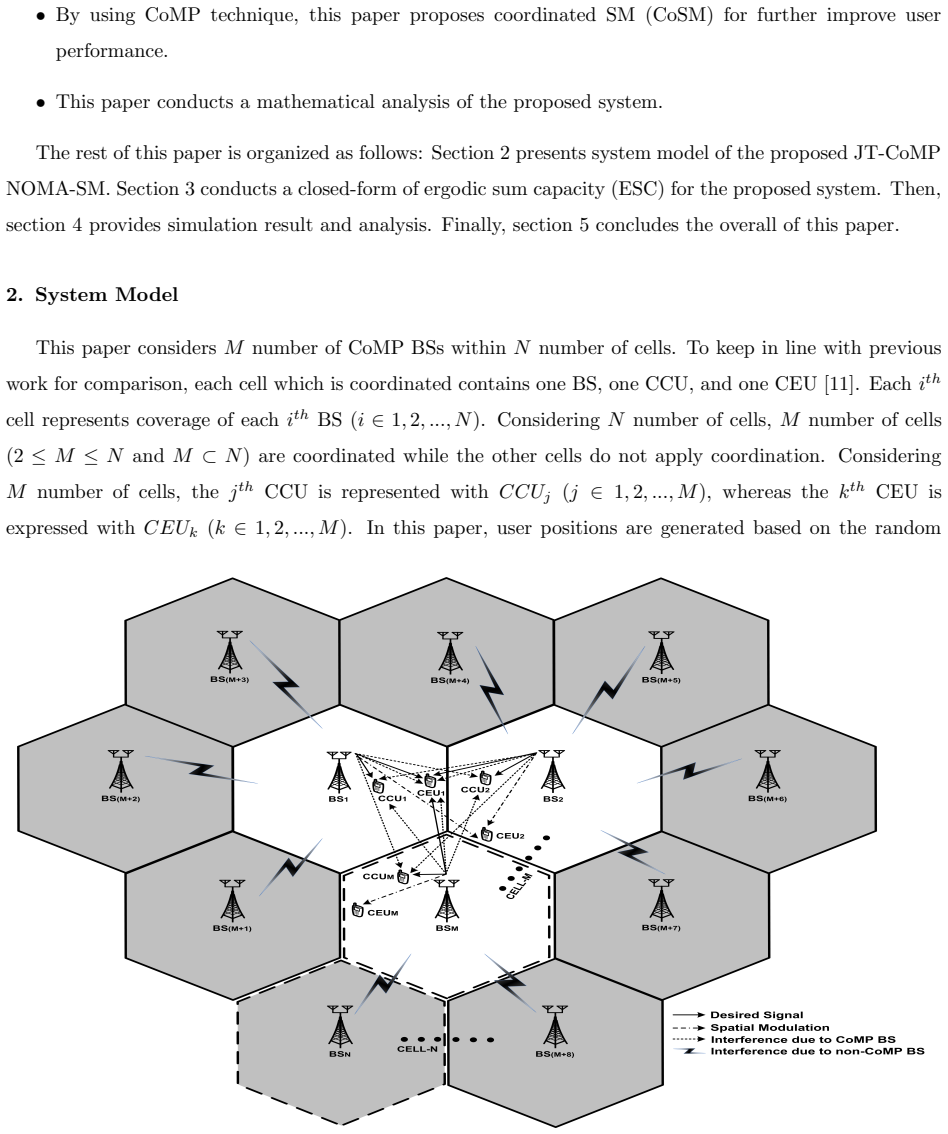


read the original abstract
In this paper, a joint transmission coordinated multi-point based non-orthogonal multiple access (JT-COMP NOMA) combined with spatial modulation (SM), termed as JT-COMP NOMA-SM, is proposed to enhance capacity. User capacity and ergodic sum capacity (ESC) of M number coordinated multi-point base stations (COMP BSs) within N number of cells are analyzed by considering imperfect successive interference cancellation (SIC) and imperfect channel state information (CSI). The performances of the proposed syatem are compared with non-orthogonal multiple access (NOMA), and joint transmission coordinated multi-point combined with virtual user pairing based non-orthogonal multiple access (JT-COMP VP-NOMA) by both simulation and analysis. The results show that the proposed system has the same cell center user (CCU) capacity compared to JT-COMP VP-NOMA and a higher cell edge user (CEU) capacity than the other schemes. ESC of the proposed system outperforms the other schemes due to enhancing CEU capacity. Imperfect SIC and imperfect CSI may degrade capacity. The proposed system can maintain CEU capacity better than the other schemes if the number of cells is increased. It happens because SM works beyond Shannon upper bounds which can mitigate inter-cell interference (ICI).
Editorial analysis
A structured set of objections, weighed in public.
Referee Report
Summary. The paper proposes a joint transmission coordinated multi-point NOMA scheme combined with spatial modulation (JT-COMP NOMA-SM) for downlink transmission. It analyzes cell-center user (CCU) and cell-edge user (CEU) capacities as well as ergodic sum capacity (ESC) under imperfect SIC and CSI for M coordinated BSs across N cells. Through analysis and simulations, it claims the scheme achieves the same CCU capacity as JT-COMP VP-NOMA, higher CEU capacity than NOMA and JT-COMP VP-NOMA, and superior ESC, with the advantage growing as the number of cells increases because SM operates beyond Shannon bounds to mitigate ICI.
Significance. If the reported capacity comparisons are reproducible and the modeling assumptions hold, the work would provide a concrete scheme-level comparison of NOMA variants in CoMP settings with imperfect CSI/SIC. The explicit inclusion of imperfect SIC/CSI and multi-cell scaling is a positive feature, but the central interpretive claim about SM exceeding Shannon limits is a load-bearing flaw that prevents the performance results from being interpreted as claimed.
major comments (2)
- [Abstract] Abstract: The statement that the proposed system 'can maintain CEU capacity better than the other schemes if the number of cells is increased. It happens because SM works beyond Shannon upper bounds which can mitigate inter-cell interference (ICI)' is factually incorrect. Shannon capacity (or mutual information of the effective channel including ICI) is an upper bound on any scheme; spatial modulation remains strictly inside this bound. This misstatement is offered as the explicit causal explanation for the central performance result (higher CEU capacity and superior ESC scaling), rendering the interpretation of both the analysis and simulations internally inconsistent.
- [Abstract] Abstract and § (results/discussion): The performance claims rest on simulations and analysis whose modeling details (exact channel model for ICI, antenna activation probabilities in SM, power allocation, and how 'beyond Shannon' is operationalized) are not shown to be free of the circularity that the explanatory text introduces. Without a corrected derivation or simulation protocol that removes the false premise, the reported CEU/ESC advantage cannot be attributed to the stated mechanism.
minor comments (2)
- [Abstract] Abstract contains the typo 'syatem' for 'system'.
- Notation for M (number of CoMP BSs) and N (number of cells) should be defined at first use and used consistently in any equations or figures.
Simulated Author's Rebuttal
We thank the referee for the thorough review and for highlighting the misstatement in the abstract. We agree that the claim regarding SM operating beyond Shannon bounds is factually incorrect and will be removed in revision. The observed performance advantages in simulations arise from the structural properties of SM within the JT-CoMP NOMA framework under imperfect SIC/CSI, not from any violation of information-theoretic limits. We address the comments point by point below.
read point-by-point responses
-
Referee: [Abstract] Abstract: The statement that the proposed system 'can maintain CEU capacity better than the other schemes if the number of cells is increased. It happens because SM works beyond Shannon upper bounds which can mitigate inter-cell interference (ICI)' is factually incorrect. Shannon capacity (or mutual information of the effective channel including ICI) is an upper bound on any scheme; spatial modulation remains strictly inside this bound. This misstatement is offered as the explicit causal explanation for the central performance result (higher CEU capacity and superior ESC scaling), rendering the interpretation of both the analysis and simulations internally inconsistent.
Authors: We agree that this statement is erroneous and must be corrected. Spatial modulation cannot exceed the mutual information of the effective channel. The simulations show higher CEU capacity and ESC for JT-COMP NOMA-SM as the number of cells increases, but this occurs because the spatial-domain symbol in SM provides an additional degree of freedom that interacts differently with residual interference under imperfect SIC and CSI, rather than any bound violation. We will revise the abstract to remove the incorrect causal claim and replace it with a description grounded in the derived capacity expressions (Section III) and the simulation setup. This change does not alter the numerical results but corrects their interpretation. revision: yes
-
Referee: [Abstract] Abstract and § (results/discussion): The performance claims rest on simulations and analysis whose modeling details (exact channel model for ICI, antenna activation probabilities in SM, power allocation, and how 'beyond Shannon' is operationalized) are not shown to be free of the circularity that the explanatory text introduces. Without a corrected derivation or simulation protocol that removes the false premise, the reported CEU/ESC advantage cannot be attributed to the stated mechanism.
Authors: The modeling details follow standard assumptions: ICI uses the multi-cell path-loss plus Rayleigh fading model with the effective channel including all inter-cell terms; SM activates exactly one antenna per symbol with uniform probability over the antenna set; power allocation follows the optimization in Section III-B. The 'beyond Shannon' phrasing was a misstatement and is not used in the derivations or simulation code. The capacity formulas are the standard ergodic rates with imperfect SIC/CSI terms subtracted. We will add an explicit paragraph in the revised results section clarifying that all results lie within the Shannon limit of the effective channel and that the advantage is due to SM's interference resilience in the multi-cell scaling regime. If additional simulation parameters are required, they can be included in an appendix. revision: yes
Circularity Check
No circularity; analysis and comparisons are self-contained without reductions to self-defined inputs or self-citations.
full rationale
The paper derives user capacity and ESC expressions under imperfect SIC/CSI, then compares JT-COMP NOMA-SM to NOMA and JT-COMP VP-NOMA via both closed-form analysis and Monte Carlo simulation. No equations reduce a 'prediction' to a fitted parameter by construction, no self-citation chain bears the central claim, and the SM performance explanation (while factually incorrect) is an interpretive statement rather than a definitional or fitted step. The derivation chain remains independent of the authors' prior outputs.
Axiom & Free-Parameter Ledger
axioms (1)
- standard math Standard ergodic capacity formulas for NOMA and SM under imperfect SIC and CSI hold for the JT-COMP setting
Lean theorems connected to this paper
-
IndisputableMonolith/Cost/FunctionalEquation.leanwashburn_uniqueness_aczel contradicts?
contradictsCONTRADICTS: the theorem conflicts with this paper passage, or marks a claim that would need revision before publication.
The proposed system can maintain CEU capacity better than the other schemes if the number of cells is increased. It happens because SM works beyond Shannon upper bounds which can mitigate inter-cell interference (ICI).
What do these tags mean?
- matches
- The paper's claim is directly supported by a theorem in the formal canon.
- supports
- The theorem supports part of the paper's argument, but the paper may add assumptions or extra steps.
- extends
- The paper goes beyond the formal theorem; the theorem is a base layer rather than the whole result.
- uses
- The paper appears to rely on the theorem as machinery.
- contradicts
- The paper's claim conflicts with a theorem or certificate in the canon.
- unclear
- Pith found a possible connection, but the passage is too broad, indirect, or ambiguous to say the theorem truly supports the claim.
Reference graph
Works this paper leans on
-
[1]
Z. Ding, X. Lei, G. K. Karagiannidis, R. Schober, J. Yuan, V. K. Bhargava, A survey on non-orthogonal multiple access for 5G networks: Research challenges and future trends, IEEE Journal on Selected Areas in Communications 35 (10) (2017) 2181-2195. doi:10.1109/JSAC.2017.2725519. URL http://geokarag.webpages.auth.gr/wp-content/papercite-data/pdf/j230.pdf
-
[2]
A. Benjebbour, A. L. K. Saito, Y. Kishiyama, T. Nakamura, Signal Processing for 5G: Algorithms and Implementations, First Edition, John Wiley and Sons, Ltd, 2016. doi:10.1002/9781119116493. URL http://solutionsproj.net/software/Signal Processing for 5G Algorithms and Implementations.pdf 17
-
[3]
M. B. Shahab, M. F. Kader, S. Y. Shin, On the power allocation of non-orthogonal multiple access for 5G wireless networks, in: 2016 International Conference on Open Source Systems Technologies (ICOSST), 2016, pp. 89-94. doi:10.1109/ICOSST.2016.7838583. URL https://ieeexplore.ieee.org/stamp/stamp.jsp?tp=&arnumber=7838583
-
[4]
Y. Saito, Y. Kishiyama, A. Benjebbour, T. Nakamura, A. Li, K. Higuchi, Non-orthogonal multiple ac- cess (NOMA) for cellular future radio access, in: 2013 IEEE 77th Vehicular Technology Conference (VTC Spring), 2013, pp. 1-5. doi:10.1109/VTCSpring.2013.6692652. URL https://ieeexplore.ieee.org/stamp/stamp.jsp?tp=&arnumber=6692652
-
[5]
J. Choi, Non-orthogonal multiple access in downlink coordinated two-point systems, IEEE Communica- tions Letters 18 (2) (2014) 313-316. doi:10.1109/LCOMM.2013.123113.132450. URL https://ieeexplore.ieee.org/stamp/stamp.jsp?arnumber=6708131
-
[6]
Y. Sun, Z. Ding, X. Dai, G. K. Karagiannidis, A novel network NOMA scheme for downlink coordinated three-point systems, arXiv:1708.06498 [cs.IT], [Online]. https://arxiv.org/pdf/1708.06498.pdf
work page internal anchor Pith review Pith/arXiv arXiv
- [7]
-
[8]
M. S. Ali, E. Hossain, A. Al-Dweik, D. I. Kim, Downlink power allocation for CoMP-NOMA in multi- cell networks, IEEE Transactions on Communications 66 (9) (2018) 3982-3998. doi:10.1109/TCOMM.2018. 2831206. URL https://ieeexplore.ieee.org/stamp/stamp.jsp?arnumber=8352643
-
[9]
M. S. Ali, E. Hossain, D. I. Kim, Coordinated multipoint transmission in downlink multi-cell NOMA systems: Models and spectral efficiency performance, IEEE Wireless Communications 25 (2) (2018) 24-31. doi:10.1109/MWC.2018.1700094. URL https://ieeexplore.ieee.org/stamp/stamp.jsp?tp=&arnumber=8352618
-
[10]
Generalized Coordinated Multipoint (GCoMP)-Enabled NOMA: Outage, Capacity, and Power Allocation
Y. Al-Eryani, E. Hossain, D. I. Kim, Generalized coordinated multipoint (GCoMP)-enabled NOMA: Out- age, capacity, and power allocation, arXiv:1901.10535 [cs.IT], [Online]. https://arxiv.org/pdf/1901.10535.pdf. 18
work page internal anchor Pith review Pith/arXiv arXiv 1901
-
[11]
D. K. Hendraningrat, M. B. Shahab, S. Y. Shin, Virtual user pairing non-orthogonal multiple access in downlink coordinated multipoint transmission, arXiv:1903.10674 [cs.NI], [Online]. https://arxiv.org/abs/ 1903.10674
work page internal anchor Pith review Pith/arXiv arXiv 1903
-
[12]
M. B. Shahab, S. Y. Shin, On the performance of a virtual user pairing scheme to efficiently utilize the spectrum of unpaired users in NOMA, Physical Communications 25 (2017) 492-501. URL https://www.sciencedirect.com/science/article/pii/S1874490717302082
work page 2017
-
[13]
E. Soujeri, Advanced Index Modulation Techniques for Future Wireless Networks, Ecole De Technologie Superieure, Universite Du Quebec, 2018. URL http://espace.etsmtl.ca/2091/1/SOUJERI Ebrahim.pdf
work page 2018
-
[14]
R. Y. Mesleh, H. Haas, S. Sinanovic, C. W. Ahn, S. Yun, Spatial modulation, IEEE Transactions on Vehicular Technology 57 (4) (2008) 2228-2241. doi:10.1109/TVT.2007.912136. URL https://ieeexplore.ieee.org/stamp/stamp.jsp?arnumber=4382913
-
[15]
J. W. Kim, M. Irfan, S. M. AL, S. Y. Shin, Selective non-orthogonal multiple access (NOMA) and spa- tial modulation (SM) for improved spectral efficiency, 2015 International Symposium on Intelligent Signal Processing and Communication Systems (ISPACS) (2015) 552-555. doi:10.1109/ISPACS.2015.7432833. URL https://ieeexplore.ieee.org/stamp/stamp.jsp?tp=&arnumb...
- [16]
-
[17]
M. Irfan, B. S. Kim, S. Y. Shin, A spectral efficient spatially modulated non-orthogonal multiple access for 5G, in: 2015 International Symposium on Intelligent Signal Processing and Communication Systems (ISPACS), 2015, pp. 625-628. doi:10.1109/ISPACS.2015. 7432847. URL https://ieeexplore.ieee.org/stamp/stamp.jsp?tp=&arnumber=7432847
-
[18]
J. W. Kim, S. Y. Shin, V. C. M. Leung, Performance enhancement of downlink NOMA by combination with GSSK, IEEE Wireless Communications Letters 7 (5) (2018) 860-863. doi:10.1109/LWC.2018.2833469. URL https://ieeexplore.ieee.org/stamp/stamp.jsp?tp=&arnumber=8355593 19
-
[19]
K. Ntontin, M. D. Renzo, A. Perez-Neira, C. Verikoukis, Adaptive generalized space shift keying, EURASIP Journal on Wireless Communications and Networking 2013 (1) (2013) 43. doi:10.13067/JKIECS. 2015.10.11.1257. URL https://jwcn-eurasipjournals.springeropen.com/track/pdf/10.1186/1687-1499-2013-43
-
[20]
R. F. Siregar, F. W. Murti, S. Y. Shin, Bit allocation approach of spatial modulation for multi-user scenario, Journal of Network and Computer Applications 127 (2019) 1-8. doi:https://doi.org/10.1016/j.jnca. 2018.11.014. URL http://www.sciencedirect.com/science/article/pii/S1084804518303801
-
[21]
M. R. Usman, A. Khan, M. A. Usman, Y. S. Jang, S. Y. Shin, On the performance of perfect and imperfect SIC in downlink non-orthogonal multiple access (NOMA), in: 2016 International Confer- ence on Smart Green Technology in Electrical and Information Systems (ICSGTEIS), 2016, pp. 102-106. doi:10.1109/ICSGTEIS.2016.7885774. URL https://ieeexplore.ieee.org/d...
-
[22]
J. W. Craig, A new, simple and exact result for calculating the probability of error for two-dimensional signal constellations, in: MILCOM 91 - Conference record, 1991, pp. 571-575 vol.2. doi:10.1109/MILCOM. 1991.258319. URL https://ieeexplore.ieee.org/stamp/stamp.jsp?tp=&arnumber=258319
-
[23]
F. Kara, H. Kaya, BER performances of downlink and uplink NOMA in the presence of SIC errors over fading channels, IET Communications 12 (15) (2018) 1834-1844. doi:10.1049/iet-com.2018.5278. URL https://ieeexplore.ieee.org/stamp/stamp.jsp?tp=&arnumber=8457925 20
discussion (0)
Sign in with ORCID, Apple, or X to comment. Anyone can read and Pith papers without signing in.