REVIEW 4 major objections 6 minor 49 references
Predicting Artificial Neural Network Representations to Learn Recognition Model for Music Identification from Brain Recordings
T0 review · 4 major / 6 minor · reviewed 2026-08-11 · deepseek-v4-flash
Pith's one-line read Training an EEG recognition model to predict ANN representations of music substantially improves music identification accuracy from noisy brain recordings.
desk verdict A genuinely interesting training trick for EEG music identification, but the paper oversells the 'ANN representation' mechanism: the target is a co-trained audio encoder, not a fixed pretrained one. read the letter →
The pith
A machine-rendered reading of the paper's core claim, the machinery that carries it, and where it could break.
The reading
What carries the argument
The load-bearing mechanism is the PredANN loss: an InfoNCE-style contrastive loss (Eq. 2) that pulls the EEG encoder's feature embedding toward the music encoder's feature embedding for the same song while repelling embeddings from different songs, with a stop-gradient operation that prevents the music encoder from being updated by this loss. The model also jointly trains both branches on the 10-way song classification task (Eq. 1), and the total loss is the sum of the two classification losses plus the weighted PredANN loss (Eq. 3). The stop-gradient is the key design choice: it keeps the ANN representations discriminative for the target task rather than letting EEG noise corrupt them, and the paper shows that removing it degrades accuracy. The same architecture is used for both encoders, a 2D CNN based on prior work, with the contrastive head branching off after the main classification head.
What would settle it
Train the same model but replace the jointly-trained music encoder with a fixed, pretrained music model that is not updated by the PredANN loss, then compare accuracy; if accuracy does not exceed the classification-only baseline, the reported benefit is not due to predicting ANN representations.
Extended reading notes
Core claim
The central discovery is that a recognition model for brain recordings can be trained to predict the representations of an artificial neural network processing the same auditory stimulus, and this reverses the usual direction of ANN-brain alignment studies: instead of regressing from ANN to cortical activity, the authors regress from EEG to ANN features as a supervisory signal. Concretely, the model optimizes the sum of an EEG classification loss, a music classification loss, and a weighted InfoNCE-style contrastive loss between the two modalities, with a stop-gradient applied to the music branch so that the ANN encoder is not distorted by EEG noise. On the NMED-T dataset, the best configuration (2D CNN, PredANN weight 0.05, 200 ms delay) attains 0.624 average accuracy over three seeds on 3-second clips versus 0.547 for the classification-only baseline, and 0.783 at 7-second evaluation with the mean scoring rule. The authors further report that the improvement is statistically significant for most seeds, that the optimal 200 ms delay matches known auditory response latencies, and that longer evaluation windows monotonically improve accuracy without retraining.
Load-bearing premise
The supervisory 'ANN representation' comes from a music encoder that is randomly initialized and trained jointly with the EEG model on the same ten songs, so it is not an independently pre-trained ANN representation.
Editorial extensions
If this is right
- Increasing the EEG evaluation length from 3 to 7 seconds via overlapping windows improves accuracy (from 0.716 to 0.783 with mean scoring) without any additional training, supporting real-time sliding-window decoding.
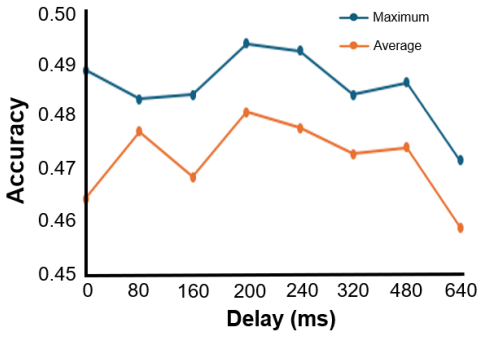
- The 200 ms delay between music onset and EEG input consistently improves accuracy, aligning with known auditory response latencies and suggesting that temporal alignment matters for EEG decoding.
- The stop-gradient operation on the music branch is essential: removing it drops average accuracy from 0.624 to 0.497, supporting the claim that preserving ANN discriminative power is key.
- The proposed point-to-point contrastive alignment substantially outperforms the set-to-set gradient-reversal domain adaptation of a prior study (0.624 vs about 0.159 average) on the same 10-class task.
- Song and subject analyses show that accuracy depends on both stimulus distinctiveness (songs with electronic or unusual features are easier) and individual differences, which the authors interpret as reflecting neural response salience.
Reading between the lines
- Because the music encoder is randomly initialized and co-trained rather than a fixed pretrained ANN, the paper's claim that 'ANN knowledge' complements EEG is not fully established; a direct test would be to fix a pretrained music-encoding network and see whether the same gain persists.
- If the benefit is mainly a regularizing or optimization effect rather than genuine ANN-brain alignment, the method may transfer to any paired stimulus-recording domain, such as speech, video, or imagined music, where a co-trained 'teacher' representation is available.
- The 200 ms peak could serve as a calibration sanity check for other EEG decoding pipelines: a pipeline that shows no such latency dependence may be learning spurious features.
- A testable extension is to vary the strength of the stop-gradient, for example by applying it only every other batch, to map how much ANN-branch plasticity hurts EEG accuracy.
Editorial analysis
A structured set of objections, weighed in public.
Referee Report
Summary. The manuscript proposes an auxiliary 'PredANN' loss that trains an EEG encoder to predict embeddings produced by a music CNN, while both branches also solve a 10-song classification task. On the NMED-T dataset, the method reports average accuracy of 0.624 over three seeds for 3-second clips with a 2D CNN, versus 0.547 for the classification-only baseline, and 0.783 at 7 seconds with the mean scoring method. The paper interprets these gains as evidence that ANN representations can complement noisy EEG signals for music identification.
Significance. If the improvement were shown to derive from a fixed, independently trained ANN representation, this would be a novel way to exploit brain-ANN similarity for neural decoding. The empirical recipe may still be useful as a cross-modal distillation technique, and the authors use a public dataset, describe preprocessing in detail, and report McNemar tests. However, the current design does not separate the hypothesized mechanism from generic regularization or co-training drift, so the significance claim is conditional on a stronger experimental control.
major comments (4)
- [Methods, Eqs. (1)-(3)] The load-bearing claim is that training an EEG model to predict ANN representations improves recognition. But the 'ANN representation' is not a fixed pretrained model: the music encoder is randomly initialized and trained jointly on the same 10 song labels through LclsM, with only stop-gradient applied to the PredANN term. Therefore the comparison between lambda=0 and lambda=0.05 cannot separate knowledge transferred from an independent pretrained ANN from (i) cross-modal distillation toward an audio representation learned on the same training split, (ii) optimization stabilization from a second view, or (iii) label-driven drift of the target during training. To support the central claim, the authors should either use a frozen, pretrained music-identification ANN as the target, or re-scope the claim to co-trained cross-modal distillation and include a control with a randomly initialized, untrained target.
- [Results: Robustness Testing, Table 1] The 1D CNN baseline collapses to chance-level accuracy of 0.100 on seeds 0 and 1, while reaching 0.486 and 0.474 on seeds 2 and 42. This bimodal behavior indicates optimization failure in the baseline, not a typical performance level, so the reported average of 0.324 is dominated by two failed runs. The claim that PredANN makes learning robust may be true, but the comparison is misleading as presented. The authors should report results conditioned on successful baseline training, fix the baseline's training procedure, or use multiple restarts and report the full distribution of outcomes.
- [Results: 2D CNN vs 1D CNN, Table 3] The headline improvement of the 2D CNN over its own classification-only baseline is not statistically significant for seed 1 (p=0.367), one of the three seeds. The average gain (0.624 vs 0.547) therefore rests on inconsistent seed-level differences. The authors should report per-seed confidence intervals, increase the number of seeds, or otherwise demonstrate that the effect is not driven by a subset of initializations.
- [Results: Incorporating Time-delay, Table 2 and Figure 2] The 200 ms delay was selected after scanning 80, 160, 320, and 640 ms, then adding 240 and 480 ms, and finally testing 200 ms, all on the same evaluation data. No correction for multiple comparisons is applied, and no separate validation set is used for delay selection. The reported p-values for 200 ms versus 0 ms (seed 0 p<0.001, seed 1 p=0.0043) are post-selection and therefore overstate significance. The delay should be treated as a selected hyperparameter with a held-out validation split, or the full search and a multiple-testing correction should be reported.
minor comments (6)
- [Abstract and Introduction] The phrase 'ANN representations' is used throughout to describe the target, but the music encoder is randomly initialized and co-trained on the same labels. Please clarify this in the abstract and introduction so that readers are not misled about the nature of the supervisory signal.
- [Methods, Eq. (2)] The indices in Eq. (2) run from 0 to B, but a mini-batch of size B typically has indices 0 to B-1; please fix the indexing and clarify the batch-size convention.
- [Results, Table 1 and Table 3] The captions of Tables 1 and 3 should identify which rows are baseline models and which are proposed models; currently the reader must infer this from the text.
- [Methods: Model Training and Evaluation] Please report the optimizer, learning rate, weight decay, batch size, and the meaning of 'stride of 200' in terms of samples or time steps; these details are needed for reproducibility.
- [Results: Previous Study Comparison] The comparison with Avramidis et al. (Table 4) is not a controlled comparison because the architecture, delay, loss weights, and evaluation protocol differ. Presenting this as an indicative benchmark rather than a head-to-head comparison would be more accurate.
- [Discussion] Reference 42 is cited as a PsyPost article, which is not a peer-reviewed source; please replace it with the underlying primary literature if available.
Circularity Check
The 'ANN representation' supervision is supplied by a randomly initialized music encoder trained jointly on the same 10 labels (Eqs. 1-3), so the claimed brain-ANN mechanism reduces to cross-modal distillation from a co-trained audio classifier.
-
fitted input called prediction
[Methods, Model Architecture and Losses, Eqs. (1)-(3)]
"The proposed model consists of two distinct but structurally identical CNN-based encoders: one for processing raw EEG data and another for processing audio data. ... The final loss function is a weighted combination of three components: the EEG classification loss, the music classification loss, and the PredANN loss. This cumulative loss function drives joint optimization, allowing the model to simultaneously learn discriminative features for classification and representations for contrastive learning."
The supervision target zMII in Eq. (2) is the output of the music encoder, which is initialized randomly and trained with LclsM in Eq. (1) on the same 10 song labels used for LclsE; Eq. (3) optimizes both branches jointly, and the stop-gradient only prevents EEG gradients from updating the music branch. The paper nowhere uses a frozen or pretrained ANN of the kind whose brain-alignment motivated the method. Consequently, 'predicting ANN representations' does not test whether an external, brain-aligned ANN supplies complementary information: the target is a co-trained, label-conditioned audio embedding, and the lambda>0 gain can be explained by cross-modal distillation or optimization regularization on the same training labels.
full rationale
The empirical comparison between PredANN loss weight 0.05 and weight 0 is genuine: the authors report higher accuracy for the proposed model over multiple seeds, and the improvement is not definitionally identical to the classification loss because the audio modality and stop-gradient give the PredANN term independent content. However, the load-bearing conceptual claim—that ANN representations, shown in prior brain-encoding work to resemble cortical responses, are being used as an external supervisory signal—is not supported by the implemented loss. The music encoder is a randomly initialized CNN trained jointly on the same 10 song labels, so its representations are generated by the same task and data that define the EEG classification objective. This makes the 'prediction' of ANN representations a cross-modal alignment to a co-trained audio classifier rather than a test of knowledge transferred from an independent pretrained ANN. A control using a frozen, pretrained music encoder would have broken the circularity; as written, the paper's mechanism reduces to self-distillation or regularization, and the brain-ANN interpretation is not established. No self-citation chains or imported uniqueness arguments appear, so the circularity is partial and confined to the operationalization of the supervisory target.
Assumptions & free parameters
free parameters (3)
- PredANN loss weight lambda =
0.05
- EEG-to-music delay =
200 ms
- InfoNCE temperature tau =
not reported
assumptions (4)
- ad hoc to paper A randomly initialized CNN trained on the same 10-song labels can serve as the 'ANN representation' that resembles cortical representations.
- domain assumption EEG signals in NMED-T contain stable song-discriminative information within 3-second windows at 125 Hz.
- domain assumption Samples used in McNemar's test are independent.
- standard math Standard properties of cross-entropy, InfoNCE, and stochastic gradient optimization hold.
Cite this review
Pith. "Pith review of Predicting Artificial Neural Network Representations to Learn Recognition Model for Music Identification from Brain Recordings." pith.science (2026). https://pith.science/paper/GV534RVY
@misc{pith2026241215560,
  author       = {Pith},
  title        = {Pith review of: Predicting Artificial Neural Network Representations to Learn Recognition Model for Music Identification from Brain Recordings},
  year         = {2026},
  howpublished = {\url{https://pith.science/paper/GV534RVY}},
  note         = {Machine review of arXiv:2412.15560}
}
read the original abstract
Recent studies have demonstrated that the representations of artificial neural networks (ANNs) can exhibit notable similarities to cortical representations when subjected to identical auditory sensory inputs. In these studies, the ability to predict cortical representations is probed by regressing from ANN representations to cortical representations. Building upon this concept, our approach reverses the direction of prediction: we utilize ANN representations as a supervisory signal to train recognition models using noisy brain recordings obtained through non-invasive measurements. Specifically, we focus on constructing a recognition model for music identification, where electroencephalography (EEG) brain recordings collected during music listening serve as input. By training an EEG recognition model to predict ANN representations-representations associated with music identification-we observed a substantial improvement in classification accuracy. This study introduces a novel approach to developing recognition models for brain recordings in response to external auditory stimuli. It holds promise for advancing brain-computer interfaces (BCI), neural decoding techniques, and our understanding of music cognition. Furthermore, it provides new insights into the relationship between auditory brain activity and ANN representations.
Figures


Figures from the paper (5 more)


Reference graph
Works this paper leans on
-
[1]
Neural decoding of music from the eeg
Daly, I. Neural decoding of music from the eeg. Sci. Reports 13, 624, DOI: 10.1038/s41598-022-27361-x (2023). 15/18
-
[2]
Pasley, B. N. et al. Reconstructing speech from human auditory cortex. PLOS Biol. 10, e1001251, DOI: 10.1371/journal. pbio.1001251 (2012)
doi:10.1371/journal 2012
-
[3]
Akbari, H., Khalighinejad, B., Herrero, J. L. & Mesgarani, N. Towards reconstructing intelligible speech from the human auditory cortex. Sci. Reports 9, 874, DOI: 10.1038/s41598-018-37359-z (2019)
-
[4]
Anumanchipalli, G. K., Chartier, J. & Chang, E. F. Speech synthesis from neural decoding of spoken sentences. Nature 568, 493–498, DOI: 10.1038/s41586-019-1119-1 (2019)
-
[5]
Bellier, L. et al. Music can be reconstructed from human auditory cortex activity using nonlinear decoding models. PLOS Biol. 21, e3002176, DOI: 10.1371/journal.pbio.3002176 (2023)
-
[6]
Hoefle, S., Engel, A., Basilio, R. et al. Identifying musical pieces from fmri data using encoding and decoding models. Sci. Reports 8, 2266, DOI: 10.1038/s41598-018-20732-3 (2018)
-
[7]
Correia, J. et al. Brain-based translation: fmri decoding of spoken words in bilinguals reveals language-independent semantic representations in anterior temporal lobe. J. Neurosci. 34, 332–338, DOI: 10.1523/JNEUROSCI.1302-13.2014 (2014)
-
[8]
Di Liberto, G. M. et al. Cortical encoding of melodic expectations in human temporal cortex. eLife 9, e51784 (2022)
work page 2022
Show all 49 references
-
[9]
Millet, J. et al. Toward a realistic model of speech processing in the brain with self-supervised learning. In Proceedings of the 36th Conference on Neural Information Processing Systems (NeurIPS) (2022). *Equal contribution
2022
-
[10]
Défossez, A., Caucheteux, C., Rapin, J. et al. Decoding speech perception from non-invasive brain recordings. Nat. Mach. Intell. 5, 1097–1107, DOI: 10.1038/s42256-023-00714-5 (2023)
2023 doi
-
[11]
Marion, G., Di Liberto, G. M. & Shamma, S. A. The music of silence: Part i: Responses to musical imagery encode melodic expectations and acoustics. J. Neurosci. 41, 7435–7448, DOI: 10.1523/JNEUROSCI.0183-21.2021 (2021)
2021 doi
-
[12]
& Tzanetakis, G
Foster, C., Dharmaretnam, D., Xu, H., Fyshe, A. & Tzanetakis, G. Decoding music in the human brain using eeg data. In 2018 IEEE 20th International Workshop on Multimedia Signal Processing (MMSP) , 1–6, DOI: 10.1109/MMSP.2018. 8547051 (IEEE, 2018)
2018 doi
-
[13]
S., Farquhar, J., Blokland, Y ., Sadakata, M
Schaefer, R. S., Farquhar, J., Blokland, Y ., Sadakata, M. & Desain, P. Name that tune: Decoding music from the listening brain. NeuroImage 56, 843–849, DOI: 10.1016/j.neuroimage.2010.05.084 (2011)
2011 doi
-
[14]
Classifying Music Perception and Imagination Using EEG
Sternin, A. Classifying Music Perception and Imagination Using EEG . Ph.d. thesis, The University of Western Ontario (2016)
2016
-
[15]
R., Sharma, E., Miyapuram, K
Lawhatre, P., Shiraguppi, B. R., Sharma, E., Miyapuram, K. P. & Lomas, D. Classifying songs with eeg. arXiv preprint arXiv:2010.04087 (2020)
2020 arXiv
-
[16]
Stober, S., Sternin, A., Owen, A. M. & Grahn, J. A. Deep feature learning for eeg recordings. arXiv preprint arXiv:1511.04306v4 (2015)
2015 arXiv
- [17]
-
[18]
Ramirez-Aristizabal, A. G. & Kello, C. Eeg2mel: Reconstructing sound from brain responses to music. arXiv preprint arXiv:2207.13845 (2022)
2022 arXiv
- [19]
-
[20]
P., Subramanian, R
Pandey, P., Sharma, G., Miyapuram, K. P., Subramanian, R. & Lomas, D. Music identification using brain responses to initial snippets. In ICASSP 2022 - 2022 IEEE International Conference on Acoustics, Speech and Signal Processing (ICASSP), 1246–1250, DOI: 10.1109/ICASSP43922.20...
2022
-
[21]
M., Marion, G
Di Liberto, G. M., Marion, G. & Shamma, S. A. Accurate decoding of imagined and heard melodies. Front. Neurosci. 15, 673401, DOI: 10.3389/fnins.2021.673401 (2021)
2021
-
[22]
V ogel, J. et al. An assistive decision-and-control architecture for force-sensitive hand–arm systems driven by hu- man–machine interfaces. The Int. J. Robotics Res. 34, 763–780, DOI: 10.1177/0278364914561535 (2015). 16/18
2015 doi
-
[23]
Electroencephalography reflects the activity of sub-cortical brain regions during approach-withdrawal behaviour while listening to music
Daly, I., Williams, D., Hwang, F.et al. Electroencephalography reflects the activity of sub-cortical brain regions during approach-withdrawal behaviour while listening to music. Sci. Reports 9, 9415, DOI: 10.1038/s41598-019-45105-2 (2019)
2019 doi
-
[24]
Schirrmeister, R. T. et al. Deep learning with convolutional neural networks for eeg decoding and visualization. Hum. Brain Mapp. 38, 5391–5420, DOI: 10.1002/hbm.23730 (2017)
2017 doi
-
[25]
R., Jain, S
Vaidya, A. R., Jain, S. & Huth, A. G. Self-supervised models of audio effectively explain human cortical responses to speech. arXiv preprint arXiv:2205.14252 (2022)
2022 arXiv
-
[26]
& McDermott, J
Tuckute, G., Feather, J., Boebinger, D. & McDermott, J. H. Many but not all deep neural network audio models capture brain responses and exhibit correspondence between model stages and brain regions. PLOS Biol. 21, e3002366, DOI: 10.1371/journal.pbio.3002366 (2023)
2023 doi
-
[27]
R., Pahwa, K., Marreddy, M., Gupta, M
Oota, S. R., Pahwa, K., Marreddy, M., Gupta, M. & Raju, B. S. Neural architecture of speech. In ICASSP 2023 - 2023 IEEE International Conference on Acoustics, Speech and Signal Processing (ICASSP) , 1–5, DOI: 10.1109/ICASSP49357. 2023.10096248 (IEEE, 2023)
2023
-
[28]
& Vinyals, O
van den Oord, A., Li, Y . & Vinyals, O. Representation learning with contrastive predictive coding.ArXiv abs/1807.03748 (2018)
2018 arXiv
-
[29]
Zhang, Y ., Jiang, H., Miura, Y ., Manning, C. D. & Langlotz, C. P. Contrastive learning of medical visual representations from paired images and text. In Lipton, Z., Ranganath, R., Sendak, M., Sjoding, M. & Yeung, S. (eds.) Proceedings of the 7th Machine Learning for Healthca...
2022
-
[30]
Radford, A. et al. Learning transferable visual models from natural language supervision. In Meila, M. & Zhang, T. (eds.) Proceedings of the 38th International Conference on Machine Learning , vol. 139 of Proceedings of Machine Learning Research, 8748–8763 (PMLR, 2021)
2021
-
[31]
T., Dmochowski, J
Losorelli, S., Nguyen, D. T., Dmochowski, J. P. & Kaneshiro, B. Nmed-t: A tempo-focused dataset of cortical and behavioral responses to naturalistic music. In ISMIR, 3, 5 (2017)
2017
-
[32]
Lee, J., Park, J., Kim, K. L. & Nam, J. Samplecnn: End-to-end deep convolutional neural networks using very small filters for music classification. Appl. Sci. 8, 150, DOI: 10.3390/app8010150 (2018)
2018 doi
-
[33]
& Chait, M
Jagiello, R., Pomper, U., Yoneya, M., Zhao, S. & Chait, M. Rapid brain responses to familiar vs. unfamiliar music - an eeg and pupillometry study. Sci. Rep. 9, 15570 (2019)
2019
-
[34]
& Kello, C
Ramirez-Aristizabal, A., Ebrahimpour, M. & Kello, C. Image-based eeg classification of brain responses to song recordings. arXiv preprint arXiv:2202.03265 (2022)
2022 arXiv
-
[35]
& Maragos, P
Avramidis, K., Garoufis, C., Zlatintsi, A. & Maragos, P. Enhancing affective representations of music-induced eeg through multimodal supervision and latent domain adaptation. arXiv preprint arXiv:2202.09750 (2022)
2022 arXiv
-
[36]
J., Di Liberto, G
Crosse, M. J., Di Liberto, G. M., Bednar, A. & Lalor, E. C. The multivariate temporal response function (mtrf) toolbox: a matlab toolbox for relating neural signals to continuous stimuli. Front. Hum. Neurosci. 10, 604, DOI: 10.3389/fnhum.2016. 00604 (2016)
2016 doi
-
[37]
Postolache, E. et al. Naturalistic music decoding from eeg data via latent diffusion models.arXiv preprint arXiv:2405.09062 (2024)
2024 arXiv
-
[38]
Denk, T. I. et al. Brain2music: Reconstructing music from human brain activity. arXiv preprint arXiv:2307.11078 (2023)
2023
- [39]
-
[40]
& Maragos, P
Avramidis, K., Garoufis, C., Zlatintsi, A. & Maragos, P. Enhancing affective representations of music-induced eeg through multimodal supervision and latent domain adaptation. In Proceedings of IEEE International Conference on Acoustics, Speech, and Signal Processing (ICASSP) ,...
-
[41]
Koelstra, S. et al. DEAP: A Database for Emotion Analysis Using Physiological Signals. IEEE Transactions on Affective Computing 3 (2011)
2011
-
[42]
& Huang, R
Li, Q., Liu, G., Zhang, Y ., Wu, J. & Huang, R. Neural correlates of musical familiarity: A functional magnetic resonance study. PsyPost - Psychol. News (2024). 17/18
2024
-
[43]
Ding, K., Li, J., Li, X. & Li, H. Understanding the effect of listening to music, playing music, and singing on brain function: A scoping review of fnirs studies. Brain Sci. 14, 751, DOI: 10.3390/brainsci14080751 (2024)
2024 doi
-
[44]
Martínez-Molina, N., Mas-Herrero, E., Rodríguez-Fornells, A., Zatorre, R. J. & Marco-Pallares, J. White matter microstructure reflects individual differences in music reward sensitivity. J. Neurosci. 36, 5301–5310, DOI: 10.1523/ JNEUROSCI.2506-15.2016 (2016)
2016
-
[45]
& Müller, M
Stober, S., Prätzlich, T. & Müller, M. Brain beats: Tempo extraction from eeg data. In ISMIR, 276–282 (2016)
2016
-
[46]
Rivera-Tello, S., Romo-Vázquez, R., González-Garrido, A. A. & Ramos-Loyo, J. Musical tempo affects eeg spectral dynamics during subsequent time estimation. Biol.Psychol. 178, 108517 (2023)
2023
-
[47]
& Richard, G
Cantisani, G., Essid, S. & Richard, G. Eeg-based decoding of auditory attention to a target instrument in polyphonic music. 2019 IEEE WASPAA 80–84 (2019)
2019
-
[48]
Pedregosa, F. et al. Scikit-learn: Machine learning in python. J. Mach. Learn. Res. 12, 2825–2830 (2011)
2011
-
[49]
& King, J
Défossez, A., Caucheteux, C., Rapin, J., Kabeli, O. & King, J. R. Decoding speech from non-invasive brain recordings. arXiv preprint arXiv:2208.12266 (2022). Author contributions statement T.A. conceptualized and designed the framework, method, and experiment. K.H., P.L., and ...
2022 arXiv
Reviewed August 11, 2026 · model on record in the stance chip above.
Discussion (0). Continue with ORCID to comment.