Rethinking Object-Centric Representations for Video Dynamics Modeling
Pith reviewed 2026-06-26 09:02 UTC · model grok-4.3
The pith
Disentangling appearance from geometric pose in each video slot allows temporal consistency to be enforced only on appearance, preventing identity swaps under motion.
A machine-rendered reading of the paper's core claim, the machinery that carries it, and where it could break.
Core claim
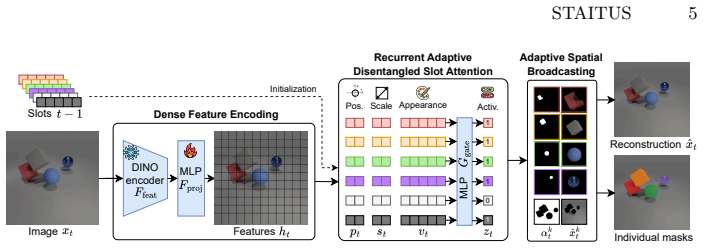
STAITUS explicitly factors each slot into an appearance latent and a separate geometric pose (position and scale) latent. Temporal alignment is applied exclusively to the appearance latents while within-frame spatial separation is enforced on the full slots; an adaptive gating mechanism dynamically selects the number of active slots according to scene complexity. The paper states that these changes remove the conflict between consistency and motion, yielding sharper masks and more persistent object identities under motion, occlusion, and object entry or exit.
What carries the argument
Per-slot disentanglement into separate appearance and geometric pose (position/scale) latents, with temporal alignment restricted to appearance space and within-frame spatial separation applied to the full slots.
If this is right
- Slots stop locking onto static background regions to satisfy temporal consistency.
- Foreground objects maintain single persistent identities across frames with motion and occlusion.
- The number of active slots automatically matches scene complexity, reducing over-segmentation.
- Segmentation quality and tracking stability improve on both synthetic and real-world video benchmarks.
Where Pith is reading between the lines
- The same separation could be tested on tasks that require predicting future frames rather than only segmenting observed ones.
- If the disentanglement holds, the method might extend to multi-camera or 3-D scene videos without retraining the alignment logic.
- A natural next measurement would be whether the learned appearance latents transfer to downstream tasks such as object classification from tracked masks.
Load-bearing premise
Explicit separation of appearance and geometric pose into independent latent components is possible inside the slot architecture and sufficient to eliminate the consistency-motion conflict without losing information or creating new failure modes.
What would settle it
A controlled video sequence in which object appearance changes independently of pose but the model still produces identity swaps or fragmented masks despite the disentanglement.
Figures



read the original abstract
Unsupervised video object tracking aims to decompose dynamic scenes into persistent, object-centric entities without manual annotations. Many recent approaches rely on slot-based representations, where a fixed set of latent variables ("slots") represent individual objects across frames. To preserve object identity, these models enforce temporal consistency on slot embeddings. However, when appearance and pose are entangled, this consistency objective conflicts with object motion and viewpoint changes. As a result, slots tend to lock onto static regions (e.g., background) to satisfy the consistency objective, while foreground objects become fragmented across multiple slots or frequently swap identities. To address these limitations, we propose STAITUS, a unified framework that explicitly disentangles each slot into appearance and geometric pose (position/scale). Leveraging this disentanglement, STAITUS enforces within-frame spatial separation and applies temporal alignment only in appearance space, yielding sharper masks and more persistent identities under motion, occlusion, and object entry/exit. Furthermore, to mitigate over-segmentation, we introduce an adaptive gating mechanism that dynamically adjusts the number of active slots to match scene complexity. Extensive experiments on synthetic and real-world benchmarks demonstrate that STAITUS substantially outperforms state-of-the-art baselines in segmentation quality and tracking stability.
Editorial analysis
A structured set of objections, weighed in public.
Referee Report
Summary. The manuscript introduces STAITUS, a slot-based framework for unsupervised video object tracking that explicitly disentangles each slot into separate appearance and geometric pose (position/scale) components. It enforces within-frame spatial separation on the full slots while restricting temporal alignment to appearance space only, and adds an adaptive gating mechanism to dynamically adjust the number of active slots according to scene complexity. The authors claim this resolves conflicts between consistency objectives and object motion, producing sharper masks and more stable identities under motion, occlusion, and object entry/exit, with substantial gains over baselines on synthetic and real-world benchmarks.
Significance. If the disentanglement is realized without information loss, the work would meaningfully advance object-centric video representations by decoupling temporal consistency from geometric variation, addressing a recurring failure mode in slot models. The adaptive gating mechanism is a practical contribution for handling variable object counts. The approach is internally consistent as described and offers falsifiable predictions via the reported improvements in segmentation quality and tracking stability.
minor comments (3)
- The abstract states that experiments demonstrate 'substantial' outperformance but does not name the specific benchmarks or metrics; these should be listed explicitly in §1 or the experiments section for immediate context.
- [Method] Notation for the disentangled components (appearance vs. pose latents) and the adaptive gate should be introduced with a clear diagram or equations in the method section to aid reproducibility.
- Minor typographical inconsistency: 'STAITUS' is used throughout but the expansion or acronym origin is not stated in the provided text.
Simulated Author's Rebuttal
We thank the referee for the positive evaluation of our manuscript and the recommendation for minor revision. The provided summary correctly reflects the core contributions of STAITUS, including the disentanglement of appearance and pose, appearance-only temporal alignment, spatial separation, and adaptive gating. We will incorporate any minor suggestions in the revised version.
Circularity Check
No significant circularity; derivation is architectural proposal without self-referential reductions
full rationale
The provided abstract and description present STAITUS as an architectural framework that introduces explicit disentanglement of appearance and geometric pose into separate slot components, followed by within-frame spatial separation and appearance-only temporal alignment plus adaptive gating. No equations, loss functions, or derivation steps are shown that define a quantity in terms of itself, rename a fitted parameter as a prediction, or rely on self-citation chains for load-bearing uniqueness claims. The central improvements are stated as direct consequences of the proposed disentanglement and gating choices, which remain independent of the target metrics and do not reduce to the inputs by construction. This is the expected outcome for a method paper whose claims rest on new architectural decisions rather than closed-form derivations.
Axiom & Free-Parameter Ledger
Reference graph
Works this paper leans on
-
[1]
In: ICLR (2025) 4
Akan, K., Yemez, Y.: Slot-guided adaptation of pre-trained diffusion models for object-centric learning and compositional generation. In: ICLR (2025) 4
2025
-
[2]
In: ICCV
Antol, S., Agrawal, A., Lu, J., Mitchell, M., Batra, D., Zitnick, C.L., Parikh, D.: VQA: Visual question answering. In: ICCV. pp. 2425–2433 (2015) 2
2015
-
[3]
In: ICML
Biza, O., van Steenkiste, S., Sajjadi, M.S., Mahendran, A., Kipf, T.: Invariant slot attention: Object discovery with slot-centric reference frames. In: ICML. pp. 2507–2527 (2023) 2, 3, 6, 7, 9, 10
2023
-
[4]
Burgess, C.P., Matthey, L., Watters, N., Kabra, R., Higgins, I., Botvinick, M., Lerchner,A.:MONet:Unsupervisedscenedecompositionandrepresentation.arXiv preprint arXiv:1901.11390 (2019) 2, 3
work page internal anchor Pith review Pith/arXiv arXiv 1901
-
[5]
In: ICCV
Caron, M., Touvron, H., Misra, I., Jégou, H., Mairal, J., Bojanowski, P., Joulin, A.: Emerging properties in self-supervised vision transformers. In: ICCV. pp. 9650– 9660 (October 2021) 2, 4, 5, 13
2021
-
[6]
In: ICML
Chen, M., Radford, A., Child, R., Wu, J., Jun, H., Luan, D., Sutskever, I.: Gener- ative pretraining from pixels. In: ICML. pp. 1691–1703 (2020) 4
2020
-
[7]
IEEE TPAMI47(9), 7689–7703 (2025) 2
Chen, Z., Dong, S., Yi, K., Li, Y., Ding, M., Torralba, A., Tenenbaum, J.B., Gan, C.: Compositional physical reasoning of objects and events from videos. IEEE TPAMI47(9), 7689–7703 (2025) 2
2025
-
[8]
In: ICLR (2024) 13
Darcet, T., Oquab, M., Mairal, J., Bojanowski, P.: Vision transformers need reg- isters. In: ICLR (2024) 13
2024
-
[9]
In: NeurIPS (2022) 2, 4
Elsayed, G.F., Mahendran, A., van Steenkiste, S., Greff, K., Mozer, M.C., Kipf, T.: SAVi++: Towards end-to-end object-centric learning from real-world videos. In: NeurIPS (2022) 2, 4
2022
-
[10]
In: ICLR (2020) 3
Engelcke, M., Kosiorek, A.R., Jones, O.P., Posner, I.: GENESIS: Generative scene inference and sampling with object-centric latent representations. In: ICLR (2020) 3
2020
-
[11]
In: CVPR
Fan, K., Bai, Z., Xiao, T., He, T., Horn, M., Fu, Y., Locatello, F., Zhang, Z.: Adaptive slot attention: Object discovery with dynamic slot number. In: CVPR. pp. 23062–23071 (2024) 6, 9, 10, 11
2024
-
[12]
In: CVPR
Greff, K., Belletti, F., Beyer, L., Doersch, C., Du, Y., Duckworth, D., Fleet, D.J., Gnanapragasam, D., Golemo, F., Herrmann, C., Kipf, T., Kundu, A., Lagun, D., Laradji, I., Liu, H.T.D., Meyer, H., Miao, Y., Nowrouzezahrai, D., Oztireli, C., Pot, E., Radwan, N., Rebain, D., Sabour, S., Sajjadi, M.S.M., Sela, M., Sitzmann, V., Stone, A., Sun, D., Vora, S....
2022
-
[13]
In: ICML (2019) 3
Greff, K., Kaufman, R.L., Kabra, R., Watters, N., Burgess, C., Zoran, D., Matthey, L., Botvinick, M., Lerchner, A.: Multi-object representation learning with iterative variational inference. In: ICML (2019) 3
2019
-
[14]
In: ECCV
Hamdan, S., Güney, F.: CarFormer: Self-driving with learned object-centric repre- sentations. In: ECCV. pp. 177–193. Springer (2024) 2
2024
-
[15]
Journal of classification2(1), 193– 218 (1985) 9
Hubert, L., Arabie, P.: Comparing partitions. Journal of classification2(1), 193– 218 (1985) 9
1985
-
[16]
In: ICLR (2017) 7
Jang, E., Gu, S., Poole, B.: Categorical reparameterization with Gumbel-Softmax. In: ICLR (2017) 7
2017
-
[17]
In: NeurIPS
Jiang, J., Deng, F., Singh, G., Ahn, S.: Object-centric slot diffusion. In: NeurIPS. vol. 37 (2023) 2, 3
2023
-
[18]
In: ICLR (2024) 4 16 A
Jung, W., Yoo, J., Ahn, S., Hong, S.: Learning to compose: Improving object centric learning by injecting compositionality. In: ICLR (2024) 4 16 A. Wei et al
2024
-
[19]
In: CVPR
Kakogeorgiou, I., Gidaris, S., Karantzalos, K., Komodakis, N.: SPOT: Self-training with patch-order permutation for object-centric learning with autoregressive trans- formers. In: CVPR. pp. 22776–22786 (2024) 4
2024
-
[20]
In: ICLR (2014) 6
Kingma, D.P., Welling, M.: Auto-encoding variational Bayes. In: ICLR (2014) 6
2014
-
[21]
In: ICLR (2022) 2, 4, 6, 9, 10, 11
Kipf, T., Elsayed, G.F., Mahendran, A., Stone, A., Sabour, S., Heigold, G., Jon- schkowski, R., Dosovitskiy, A., Greff, K.: Conditional object-centric learning from video. In: ICLR (2022) 2, 4, 6, 9, 10, 11
2022
-
[22]
In: ICLR (2024) 2, 3
Kirilenko, D., Vorobyov, V., Kovalev, A., Panov, A.: Object-Centric Learning with Slot Mixture Module. In: ICLR (2024) 2, 3
2024
-
[23]
In: CVPR
Lee, M., Cho, S., Lee, D., Park, C., Lee, J., Lee, S.: Guided slot attention for unsupervised video object segmentation. In: CVPR. pp. 3807–3816 (2024) 4
2024
-
[24]
Neurocomputing409, 1–11 (2020) 2
Liu, D., Cui, Y., Chen, Y., Zhang, J., Fan, B.: Video object detection for au- tonomous driving: Motion-aid feature calibration. Neurocomputing409, 1–11 (2020) 2
2020
-
[25]
In: ECCV
Liu, Y., Jia, B., Chen, Y., Huang, S.: SlotLifter: Slot-guided feature lifting for learning object-centric radiance fields. In: ECCV. pp. 270–288 (2024) 4
2024
-
[26]
In: Larochelle, H., Ranzato, M., Hadsell, R., Balcan, M., Lin, H
Locatello, F., Weissenborn, D., Unterthiner, T., Mahendran, A., Heigold, G., Uszkoreit, J., Dosovitskiy, A., Kipf, T.: Object-centric learning with slot attention. In: Larochelle, H., Ranzato, M., Hadsell, R., Balcan, M., Lin, H. (eds.) NeurIPS. vol. 33, pp. 11525–11538 (2020) 2, 3, 4
2020
-
[27]
The International Journal of Robotics Research36(1), 3–15 (2017) 2
Maddern, W., Pascoe, G., Linegar, C., Newman, P.: 1 year, 1000 km: The Oxford RobotCar dataset. The International Journal of Robotics Research36(1), 3–15 (2017) 2
2017
-
[28]
TMLR (2025) 2, 3
Majellaro, R., Collu, J., Plaat, A., Moerland, T.M.: Explicitly disentangled repre- sentations in object-centric learning. TMLR (2025) 2, 3
2025
-
[29]
In: CVPR
Manasyan, A., Seitzer, M., Radovic, F., Martius, G., Zadaianchuk, A.: Temporally consistent object-centric learning by contrasting slots. In: CVPR. pp. 5401–5411 (2025) 2, 4, 5, 8, 9, 10, 11
2025
-
[30]
IEEE transactions on pattern analysis and machine intelligence39(1), 128–140 (2016) 9
Pont-Tuset, J., Arbelaez, P., Barron, J.T., Marques, F., Malik, J.: Multiscale com- binatorial grouping for image segmentation and object proposal generation. IEEE transactions on pattern analysis and machine intelligence39(1), 128–140 (2016) 9
2016
-
[31]
Journal of the American Statistical association66(336), 846–850 (1971) 9
Rand, W.M.: Objective criteria for the evaluation of clustering methods. Journal of the American Statistical association66(336), 846–850 (1971) 9
1971
-
[32]
In: ICRA
Rezazadeh, A., Badithela, A., Desingh, K., Choi, C.: SlotGNN: Unsupervised dis- covery of multi-object representations and visual dynamics. In: ICRA. pp. 17508– 17514 (2024) 2
2024
-
[33]
In: CVPR (2022) 4
Sajjadi,M.S.M.,Meyer,H.,Pot,E.,Bergmann, U.,Greff,K., Radwan,N., Vora,S., Lucic,M.,Duckworth,D.,Dosovitskiy,A.,Uszkoreit,J.,Funkhouser,T.,Tagliasac- chi, A.: Scene Representation Transformer: Geometry-Free Novel View Synthesis Through Set-Latent Scene Representations. In: CVPR (2022) 4
2022
-
[34]
In: NeurIPS
Sajjadi, M.S., Duckworth, D., Mahendran, A., Van Steenkiste, S., Pavetic, F., Lu- cic, M., Guibas, L.J., Greff, K., Kipf, T.: Object scene representation transformer. In: NeurIPS. vol. 35, pp. 9512–9524 (2022) 4
2022
-
[35]
In: ICLR (2023) 2, 4, 9, 10
Seitzer, M., Horn, M., Zadaianchuk, A., Zietlow, D., Xiao, T., Simon-Gabriel, C.J., He, T., Zhang, Z., Schölkopf, B., Brox, T., Locatello, F.: Bridging the Gap to Real- World Object-Centric Learning. In: ICLR (2023) 2, 4, 9, 10
2023
-
[36]
Siméoni, O., Vo, H.V., Seitzer, M., Baldassarre, F., Oquab, M., Jose, C., Khalidov, V., Szafraniec, M., Yi, S., Ramamonjisoa, M., Massa, F., Haziza, D., Wehrstedt, L., Wang, J., Darcet, T., Moutakanni, T., Sentana, L., Roberts, C., Vedaldi, A., Tolan, J., Brandt, J., Couprie, C., Mairal, J., Jégou, H., Labatut, P., Bojanowski, P.: DINOv3. arXiv preprint a...
work page internal anchor Pith review Pith/arXiv arXiv 2025
-
[37]
In: ICLR (2022) 3, 4
Singh, G., Deng, F., Ahn, S.: Illiterate DALL-E learns to compose. In: ICLR (2022) 3, 4
2022
-
[38]
In: CVPR
Tang, Q., Zhu, X., Lei, Z., Zhang, Z.: Intrinsic physical concepts discovery with object-centric predictive models. In: CVPR. pp. 23252–23261 (2023) 2
2023
-
[39]
In: CVPR
Tian,P.,Yang,S.,Yu,H.,Kot,A.:Payattentiontotheforegroundinobject-centric learning. In: CVPR. pp. 30281–30290 (2025) 4
2025
-
[40]
IJCV88(2), 284–302 (2010) 2
Tuytelaars, T., Lampert, C.H., Blaschko, M.B., Buntine, W.: Unsupervised object discovery: A comparison. IJCV88(2), 284–302 (2010) 2
2010
-
[41]
In: ICML (2025) 2
Villar-Corrales, A., Behnke, S.: PlaySlot: Learning inverse latent dynamics for controllable object-centric video prediction and planning. In: ICML (2025) 2
2025
-
[42]
pp.570–574
Villar-Corrales, A., Wahdan, I., Behnke, S.: Object-centric video prediction via decoupling of object dynamicsand interactions.In:ICIP. pp.570–574. IEEE (2023) 2
2023
-
[43]
In: CVPR
Wang, B., Ma, L., Zhang, W., Liu, W.: Reconstruction network for video caption- ing. In: CVPR. pp. 7622–7631 (2018) 2
2018
-
[44]
arXiv preprint arXiv:1901.07017 (2019) 4, 7
Watters, N., Matthey, L., Burgess, C.P., Lerchner, A.: Spatial broadcast decoder: A simple architecture for learning disentangled representations in VAEs. arXiv preprint arXiv:1901.07017 (2019) 4, 7
-
[45]
In: ICLR (2023) 2, 6
Wu, Z., Dvornik, N., Greff, K., Kipf, T., Garg, A.: SlotFormer: Unsupervised visual dynamics simulation with object-centric models. In: ICLR (2023) 2, 6
2023
-
[46]
In: CVPR
Xiao, J., Yao, A., Li, Y., Chua, T.S.: Can i trust your answer? visually grounded video question answering. In: CVPR. pp. 13204–13214 (June 2024) 2
2024
-
[47]
In: ICCV
Yang, L., Fan, Y., Xu, N.: Video instance segmentation. In: ICCV. pp. 5188–5197 (2019) 2, 9
2019
-
[48]
In: ICLR (2020) 2
Yi, K., Gan, C., Li, Y., Kohli, P., Wu, J., Torralba, A., Tenenbaum, J.B.: CLEVRER: Collision events for video representation and reasoning. In: ICLR (2020) 2
2020
-
[49]
In: NeurIPS
Zadaianchuk, A., Seitzer, M., Martius, G.: Object-Centric Learning for Real-World Videos by Predicting Temporal Feature Similarities. In: NeurIPS. vol. 37 (2023) 2, 4, 5, 6, 9
2023
-
[50]
In: IJCAI (2025) 2
Zou, J., Zhu, X., Zhang, Z., Lei, Z.: Top-down guidance for learning object-centric representations. In: IJCAI (2025) 2
2025
discussion (0)
Sign in with ORCID, Apple, or X to comment. Anyone can read and Pith papers without signing in.