Antisymmetric spontaneous resistivity anisotropy due to hard-axis collapse in polycrystalline Co thin films
Pith reviewed 2026-06-29 14:23 UTC · model grok-4.3
The pith
Hard-axis field removal in polycrystalline Co films leaves at least three distinct stable remanent states in the planar Hall resistance at room temperature.
A machine-rendered reading of the paper's core claim, the machinery that carries it, and where it could break.
Core claim
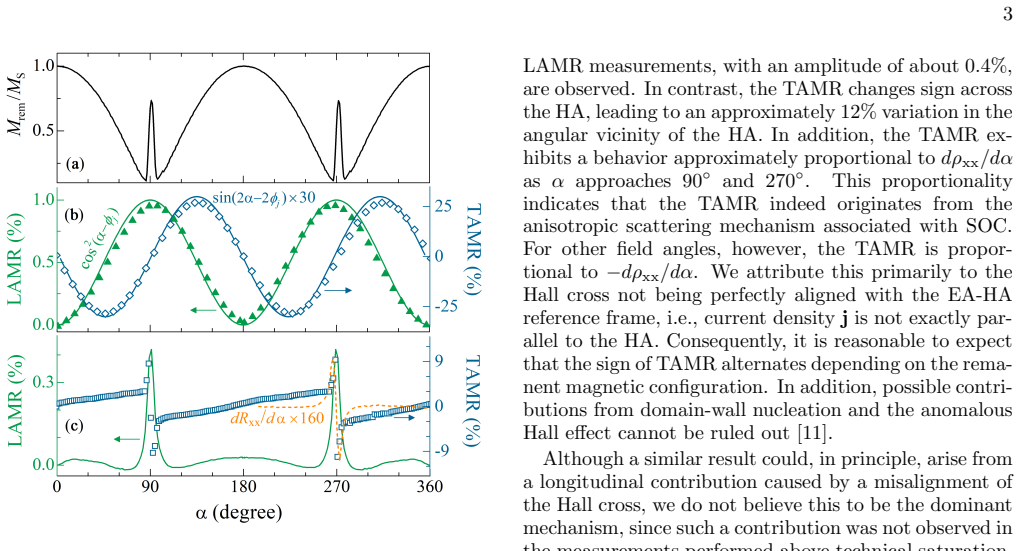
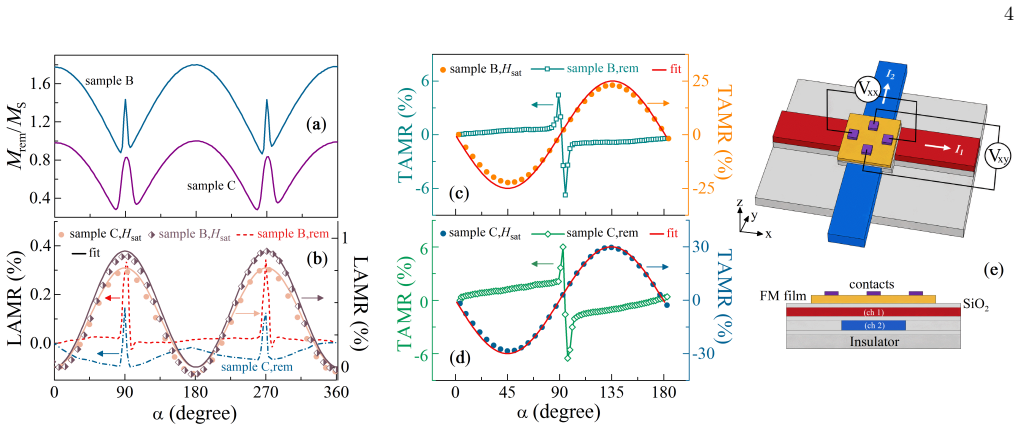
For specific orientations of the applied magnetic field, the system exhibits distinct remanent resistance levels in both the in-plane longitudinal and transverse voltage responses. In particular, the planar Hall resistance shows multiple stable and reproducible levels at room temperature, enabling the identification of at least three remanent states that can be distinguished and used for information storage. These resistance levels originate from non-uniform magnetic configurations stabilized after the application and removal of the external magnetic field in the hard-axis region.
What carries the argument
Hard-axis collapse, which stabilizes non-uniform magnetic configurations that produce antisymmetric spontaneous resistivity anisotropy and multiple distinct remanent resistance levels.
If this is right
- At least three distinguishable remanent states become available for information storage.
- The multiple levels appear at room temperature in films grown on silicon.
- Both longitudinal magnetoresistance and planar Hall resistance exhibit the effect for appropriate field orientations.
- The films provide a simple low-cost platform for spintronic memory and sensing devices.
Where Pith is reading between the lines
- The number of accessible states could be increased by varying the precise angle or sweep rate of the hard-axis field, which would raise storage density without added material complexity.
- Comparable multi-state remanent behavior may occur in other polycrystalline ferromagnets, offering a way to test material generality.
- Direct compatibility with silicon processing could reduce fabrication steps compared with epitaxial structures that require lattice-matched substrates.
- Magnetic imaging of the remanent configurations would provide an independent check on whether their spatial non-uniformity directly accounts for the observed resistance steps.
Load-bearing premise
The distinct remanent resistance levels are produced by non-uniform magnetic configurations that remain stable after the hard-axis field is removed.
What would settle it
A set of measurements in which repeated hard-axis field cycles produce only a single resistance level or fail to reproduce the same set of levels would show that the claimed multiple stable states do not exist.
Figures

read the original abstract
We investigate magnetoresistance phenomena associated with the magnetization hard-axis collapse in polycrystalline Co thin films. Transport measurements reveal that, for specific orientations of the applied magnetic field, the system exhibits distinct remanent resistance levels in both the in-plane longitudinal and transverse voltage responses. In particular, the planar Hall resistance shows multiple stable and reproducible levels at room temperature, enabling the identification of at least three remanent states that can be distinguished and used for information storage. These resistance levels originate from non-uniform magnetic configurations stabilized after the application and removal of the external magnetic field in the hard-axis region. Since this phenomenon remains largely unexplored, we present an incipient study addressing its potential implications from an applied-physics perspective. The observation of such behavior in polycrystalline Co thin films grown on Si substrates suggests a simple and low-cost platform for spintronic memory and sensing devices based on the remanent planar Hall effect.
Editorial analysis
A structured set of objections, weighed in public.
Referee Report
Summary. The manuscript investigates magnetoresistance in polycrystalline Co thin films, reporting that specific hard-axis field orientations produce multiple stable, reproducible remanent levels in both longitudinal and planar Hall resistance at room temperature. It attributes these levels to non-uniform magnetic configurations that persist after field removal and suggests their use for multi-state information storage in a low-cost spintronic platform on Si substrates.
Significance. If the claimed origin and stability of the remanent states are confirmed, the result would identify a simple materials platform for remanent planar Hall effect devices. The absence of any presented data, figures, protocols, or supporting analysis in the current text prevents evaluation of whether the observation is robust or reproducible.
major comments (1)
- [Abstract] Abstract: The central claim that the observed resistance levels 'originate from non-uniform magnetic configurations stabilized after the application and removal of the external magnetic field in the hard-axis region' is presented as a demonstrated result and is load-bearing for both the proposed mechanism and the information-storage application. Transport data alone cannot establish non-uniformity; the manuscript supplies no magnetic imaging, micromagnetic modeling, or quantitative comparison that would distinguish this interpretation from uniform magnetization rotation, current inhomogeneities, or contact artifacts.
Simulated Author's Rebuttal
We thank the referee for the report and the opportunity to clarify our manuscript. The central issue raised concerns the strength of evidence supporting our interpretation of the remanent states. We respond point by point below.
read point-by-point responses
-
Referee: The central claim that the observed resistance levels 'originate from non-uniform magnetic configurations stabilized after the application and removal of the external magnetic field in the hard-axis region' is presented as a demonstrated result and is load-bearing for both the proposed mechanism and the information-storage application. Transport data alone cannot establish non-uniformity; the manuscript supplies no magnetic imaging, micromagnetic modeling, or quantitative comparison that would distinguish this interpretation from uniform magnetization rotation, current inhomogeneities, or contact artifacts.
Authors: We agree that transport data alone cannot definitively prove non-uniform magnetic configurations and that the manuscript presents the attribution as a result rather than an interpretation. The observation of at least three distinct, reproducible remanent levels is the basis for our proposed origin, as uniform magnetization would be expected to produce at most a single remanent state for a given field orientation. We will revise the abstract to state that the levels 'are consistent with non-uniform magnetic configurations' rather than asserting that they 'originate from' them. We will also add a paragraph in the discussion section addressing alternative explanations, including uniform rotation and possible contact or current inhomogeneity effects. No magnetic imaging or micromagnetic simulations were performed, as the work is an incipient transport-focused study. revision: yes
Circularity Check
No circularity: purely observational transport study with no derivations or models
full rationale
The manuscript reports experimental magnetoresistance and planar Hall effect measurements on polycrystalline Co films. No equations, fitting procedures, theoretical derivations, or model predictions appear in the provided text or abstract. The central claim attributes observed remanent resistance levels to non-uniform magnetic configurations, but this is presented as an interpretive conclusion from the data rather than a result derived from any self-referential equations or self-citations. No load-bearing steps reduce to inputs by construction, and the study contains no ansatzes, uniqueness theorems, or renamed empirical patterns.
Axiom & Free-Parameter Ledger
Reference graph
Works this paper leans on
-
[1]
McGuire and R
T. McGuire and R. Potter, Anisotropic Magnetoresis- tance in Ferromagnetic 3d Alloys, IEEE Trans. Magn. 11, 1018 (1975)
1975
-
[2]
Idigoras, A
O. Idigoras, A. K. Suszka, P. Vavassori, P. Landeros, J. M. Porro, and A. Berger, Collapse of hard-axis behavior in uniaxial Co films, Phys. Rev. B84, 132403 (2011)
2011
-
[3]
Idigoras, A
O. Idigoras, A. K. Suszka, P. Vavassori, B. Obry, B. Hille- brands, P. Landeros, and A. Berger, Magnetization rever- sal of in-plane uniaxial Co films and its dependence on epitaxial alignment, J. Appl. Phys.115, 083912 (2014)
2014
-
[4]
Becker, Zur Theorie der Magnetisierungskurve, Z
R. Becker, Zur Theorie der Magnetisierungskurve, Z. Phys.62, 253 (1930)
1930
-
[5]
E. C. Stoner, F. R. S. and E. P. Wohlfarth, A mechanism of magnetic hysteresis in heterogeneous alloys, Philos. Trans. R. Soc. London, Ser. A240, 559 (1948)
1948
-
[6]
Fernandes, A
Y. Fernandes, A. D. C. Viegas, M. G. Brito Neto, L. G. Pereira, A. M. H. de Andrade, and J. Geshev, Rem- nant magnetoresistance and hard-axis collapse in Co thin films, Phys. Rev. B113, 064428 (2026)
2026
-
[7]
Fernandes, A
Y. Fernandes, A. D. C. Viegas, A. M. H. de Andrade, and J. Geshev, Hard-axis collapse in Co thin films: In- sights from remnant magnetoresistance and micromag- netic simulations, J. Magn. Magn. Mater.648, 174039 (2026)
2026
-
[8]
C. M. Hurd, Galvanomagnetic effects in anisotropic met- als, Adv. Phys.23(2), 315 (1974)
1974
-
[9]
R. L. Coren and H. J. Juretschke, Magnetoresistance and Domain Structure in Thin Nickel Films, Phys. Rev.126, 1378 (1962)
1962
-
[10]
Jaoul, I
O. Jaoul, I. A. Campbell, and A. Fert, Spontaneous re- sistivity anisotropy in Ni alloys, J. Magn. Magn. Mater. 5, 23 (1977)
1977
-
[11]
Nagaosa, J
N. Nagaosa, J. Sinova, S. Onoda, A. H. MacDonald, and N. P. Ong, Anomalous Hall effect, Rev. Mod. Phys.82, 1539 (2010)
2010
-
[12]
Geshev, W
J. Geshev, W. J. S. Garcia, V. Z. C. Paes, L. F. S. Az- eredo, L. S. Dorneles, and A. M. H. de Andrade, Obser- vation of recoil magnetization curves outside the major loop in Co, Fe and Ni films, Phys. Rev. B104, 054436 (2021)
2021
-
[13]
Geshev and A
J. Geshev and A. M. H. de Andrade, Magnetization recoil-curve overshoot and interaction plots in Co thin films J. Magn. Magn. Mater.560, 169573 (2022)
2022
-
[14]
L. F. S. Azeredo, J. Geshev, P. L. Grande, and A. M. H. de Andrade, Ion-irradiation-induced direction of col- lapsed hard-magnetization axis in thin Co films, Phys. Rev. B107, 134428 (2023)
2023
-
[15]
H. S. Acosta, A. M. H. de Andrade, L. F. S. Az- eredo, and J. Geshev, Assessment of magnetization re- versal and anisotropy of thin films with collapsed hard- magnetization axes through vector magnetometry, Phys. Rev. B109, 144425 (2024)
2024
discussion (0)
Sign in with ORCID, Apple, or X to comment. Anyone can read and Pith papers without signing in.