Dust colour, phase behaviour, and Monte Carlo modelling of interstellar comet 3I/ATLAS from 4 au pre- to 4 au post-perihelion
Pith reviewed 2026-06-26 19:27 UTC · model grok-4.3
The pith
Interstellar comet 3I/ATLAS exhibits a backscattering phase curve with opposition surge unlike Solar System comets
A machine-rendered reading of the paper's core claim, the machinery that carries it, and where it could break.
Core claim
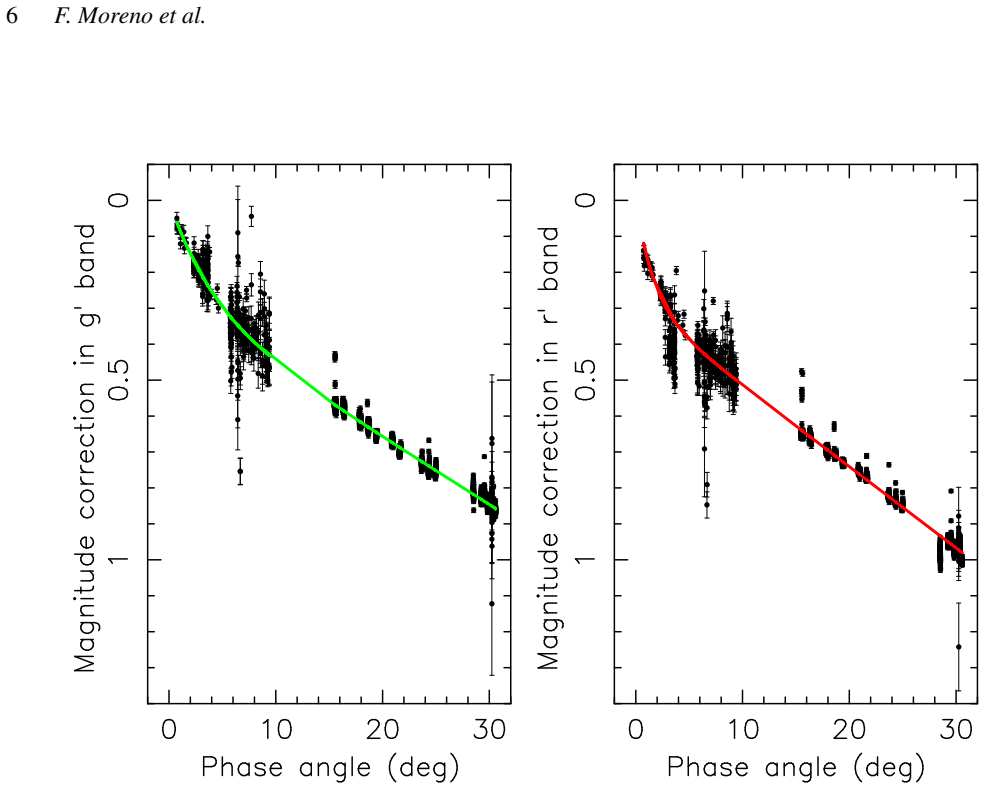
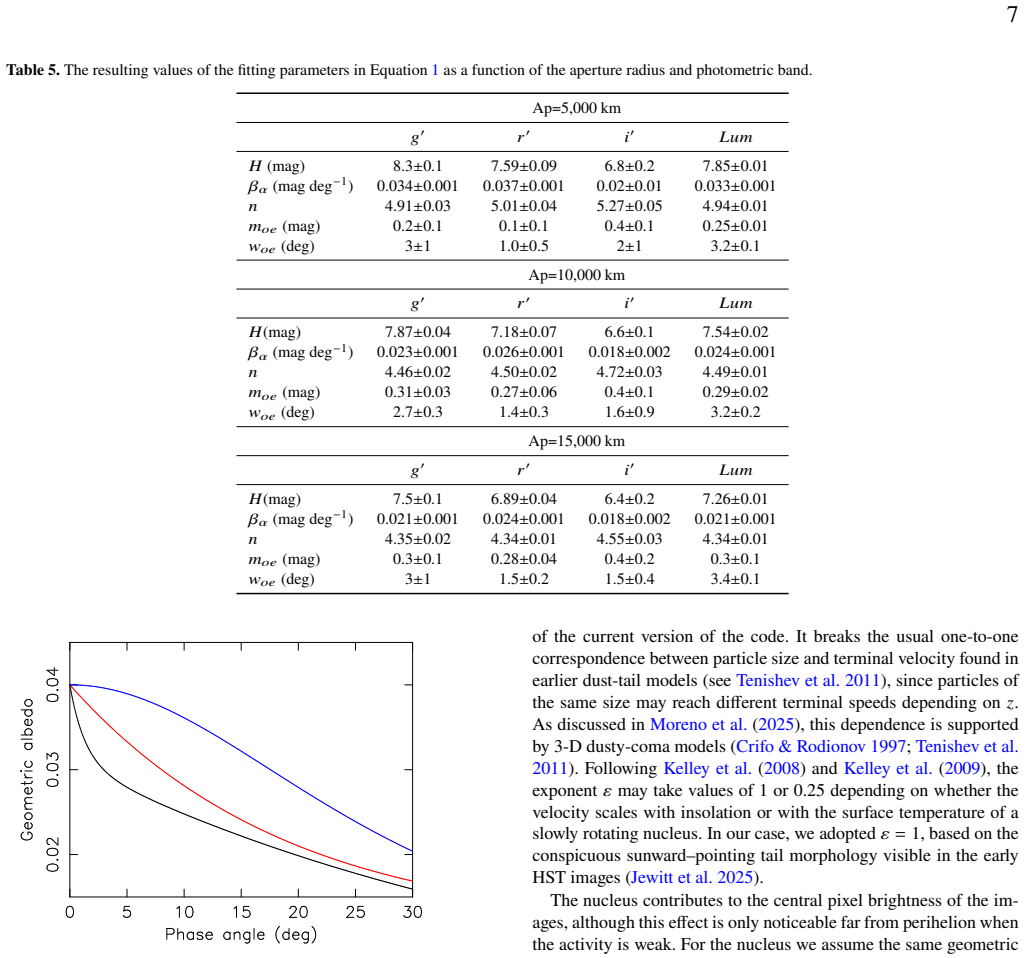
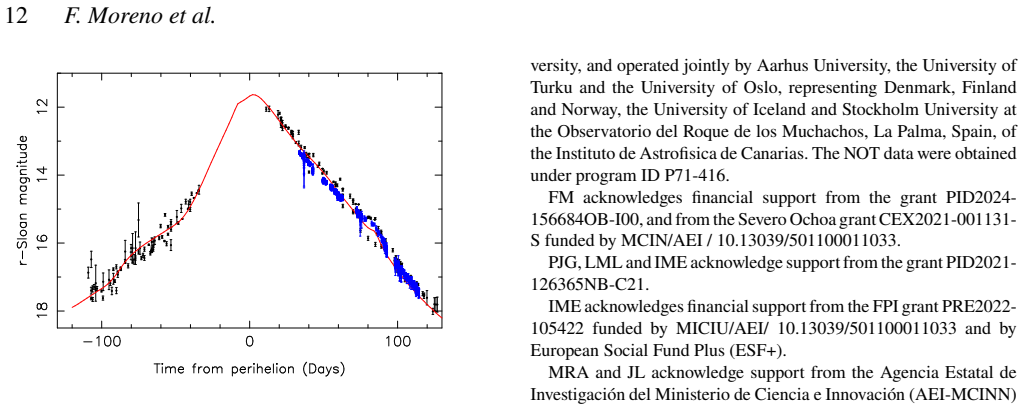
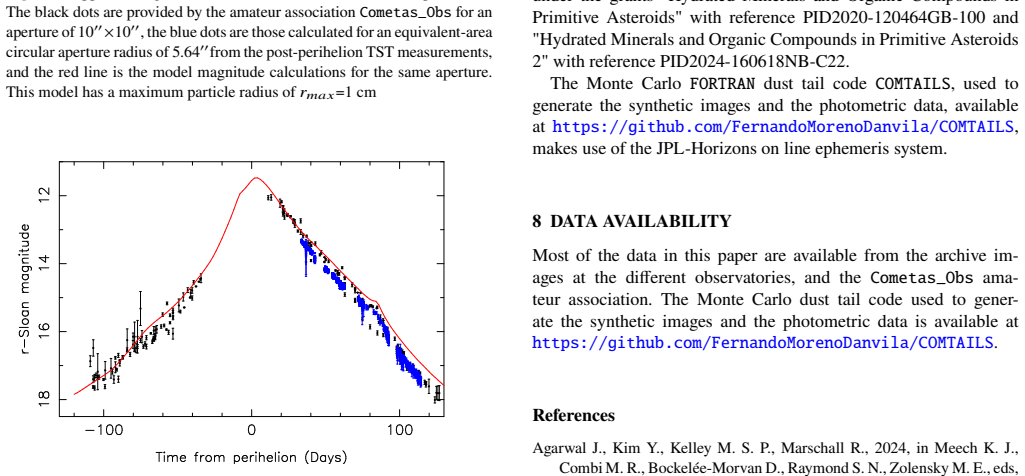
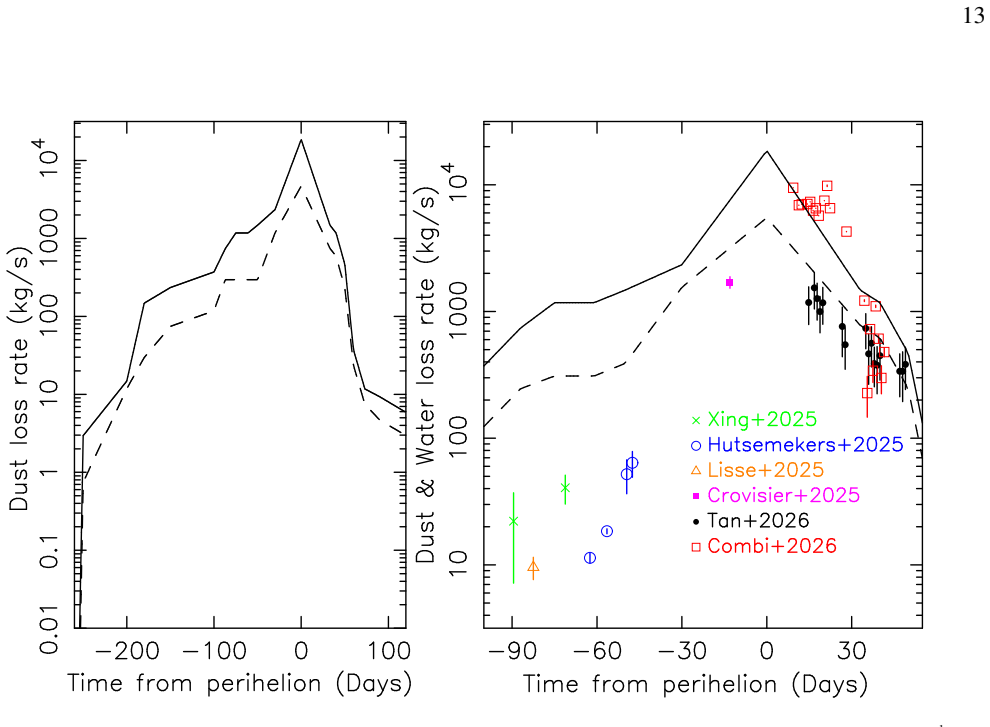
The dust phase curve of 3I/ATLAS exhibits a prominent backscattering enhancement distinct from Solar System comets, with an opposition surge of 0.1--0.4 mag, a width of 1--3 deg, and a linear phase coefficient of 0.02-0.04 mag/deg. Monte Carlo modeling of the imaging data supports a dust size distribution with power-law index -3.5, minimum particle radius 10 micrometer, and maximum radius 1-10 cm. The maximum dust-loss rate at perihelion is (0.5-1.8) x 10^4 kg/s, and water production correlates with dust production post-perihelion but not pre-perihelion, an effect possibly linked to the high CO2/H2O ratio measured before perihelion.
What carries the argument
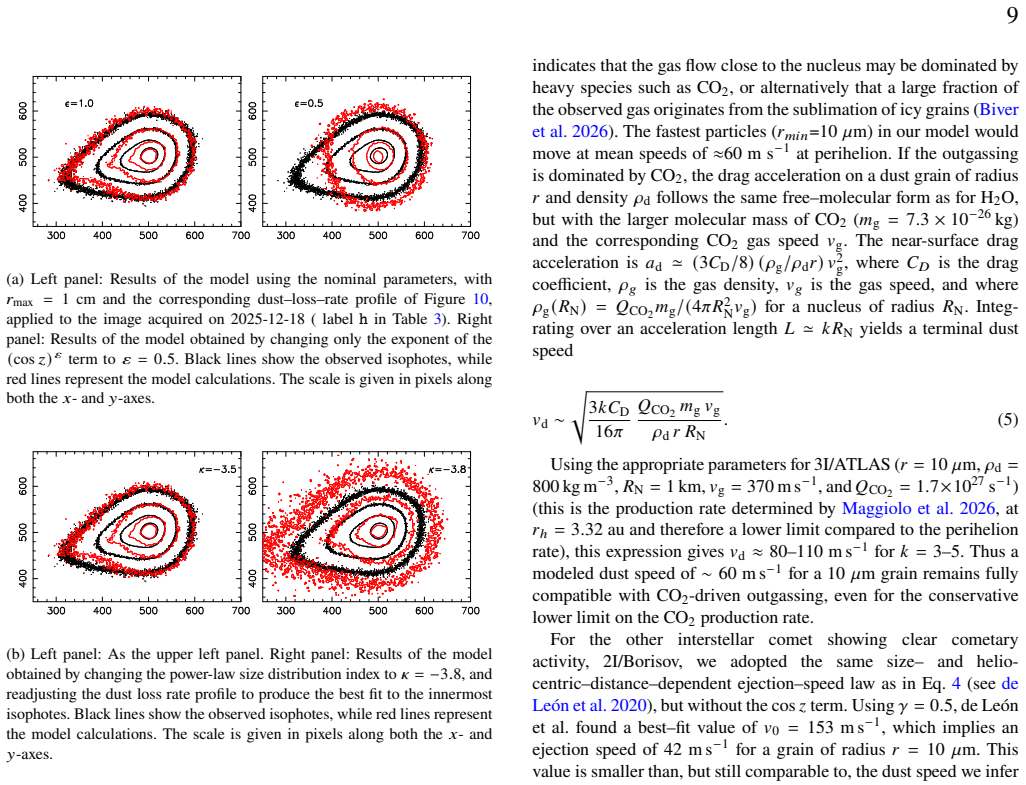
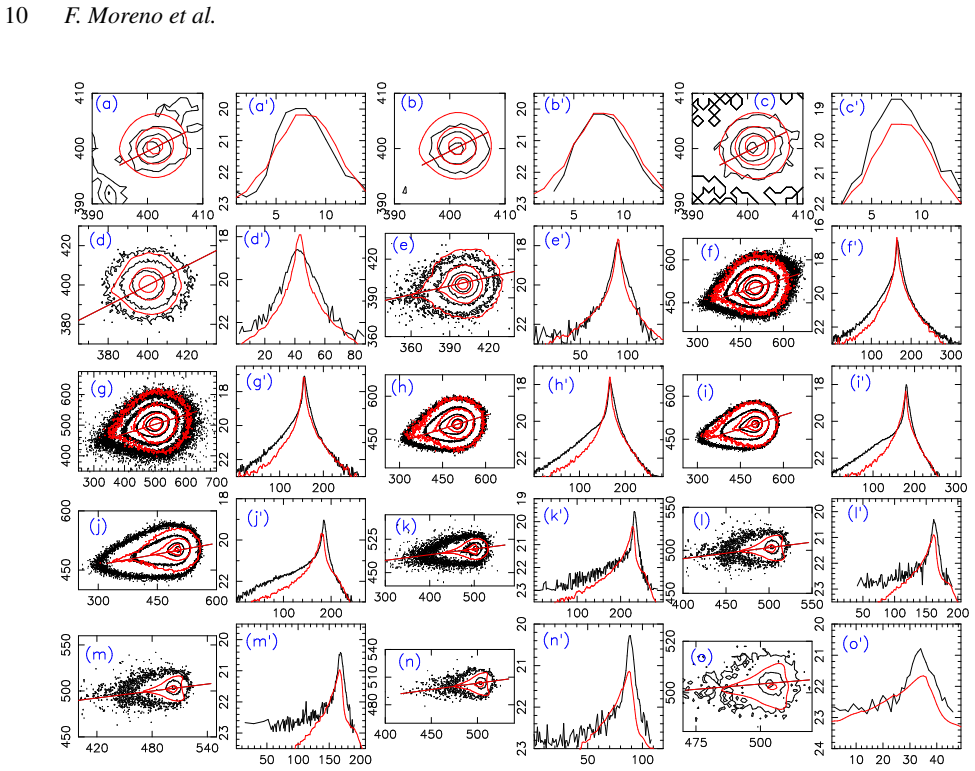
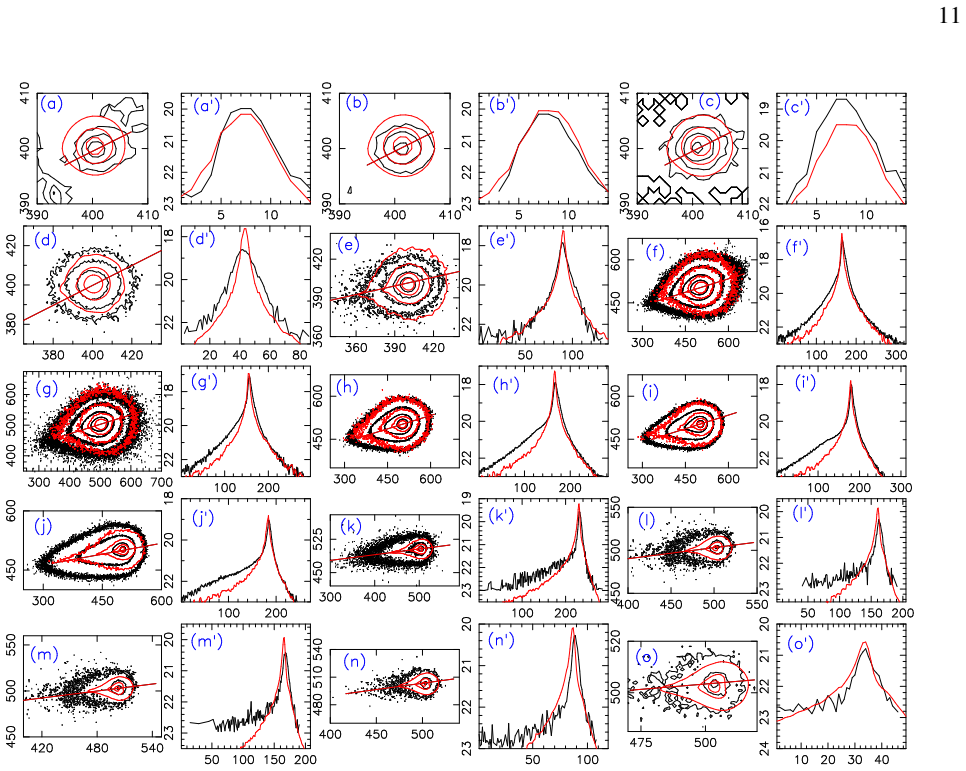
Monte Carlo dust tail model that fits observed tail morphology across multiple bands and phase angles to constrain particle size distribution, ejection speeds, and production rates versus heliocentric distance.
If this is right
- The derived phase function parameters supply a reference for interpreting photometry of future interstellar objects at small phase angles.
- The power-law dust size distribution and radius limits can be applied to predict scattering behavior in other active interstellar bodies.
- Dust production rates as a function of heliocentric distance follow patterns consistent with the full pre- to post-perihelion dataset.
- The pre-perihelion mismatch between water and dust production indicates composition-driven outgassing that changes across perihelion.
- The peak dust-loss rate of 0.5-1.8 x 10^4 kg/s at perihelion sets a quantitative benchmark for the activity level of this object.
Where Pith is reading between the lines
- The distinct backscattering properties may reflect particle shapes or surface textures uncommon among solar-system comets, suggesting targeted laboratory experiments on scattering from irregular grains.
- Multi-wavelength spectroscopy timed to pre- and post-perihelion passages could directly test whether the CO2/H2O ratio controls the observed production-rate correlations.
- Application of the same Monte Carlo approach to additional interstellar visitors would indicate whether the reported phase-curve parameters are typical or unique to 3I/ATLAS.
- The inferred dominance of larger particles in mass loss implies that radar or in-situ detection of centimeter-scale grains could provide an independent check on the size distribution.
Load-bearing premise
The Monte Carlo dust tail model correctly captures the dominant scattering and ejection physics without major biases from assumptions about particle shape, composition, or the CO2/H2O ratio.
What would settle it
A spacecraft flyby or radar observation that directly measures a dust size distribution power-law index outside -3.5 or particle radii outside the 10 micrometer to 10 cm range would falsify the modeled distribution.
Figures
read the original abstract
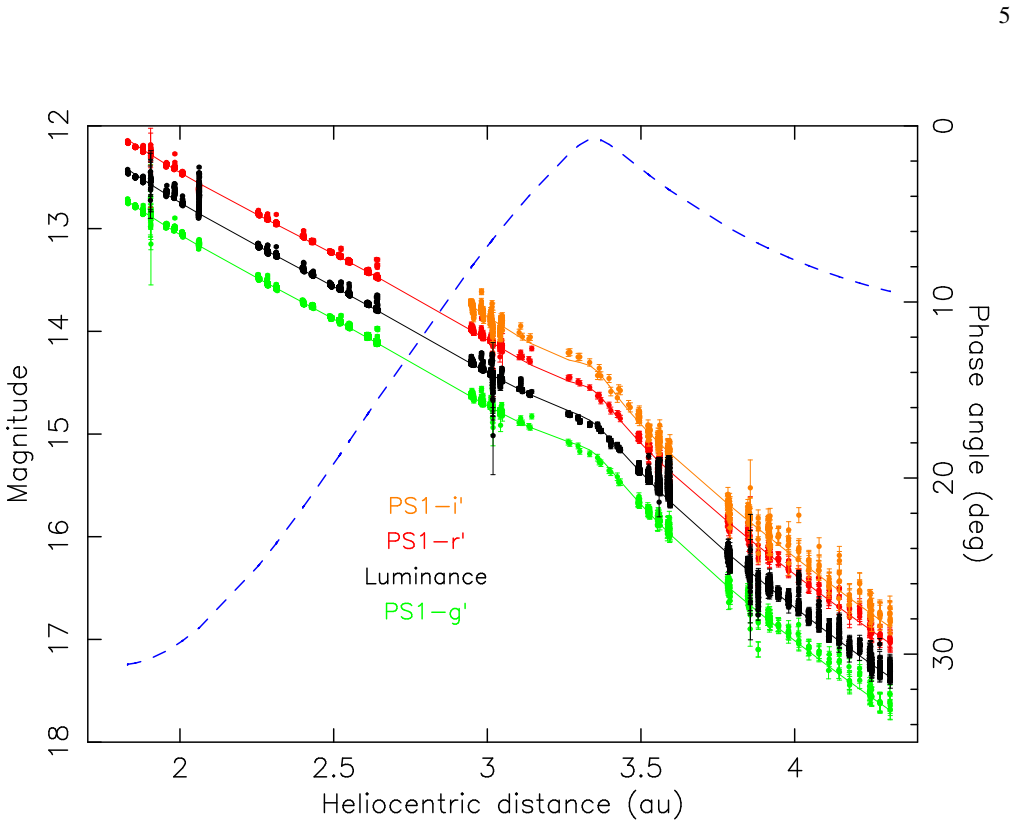
We report multi-band photometric imaging observations and Monte Carlo dust tail modelling of the interstellar comet 3I/ATLAS covering a wide range of heliocentric distances, from about 4 au pre-perihelion to 4 au post-perihelion. The extensive imaging data set allowed us to constrain the dust physical properties, ejection speeds, and production rates as a function of heliocentric distance. The post-perihelion observations, obtained at high cadence in multiple photometric bands (SDSS g, r, i, and luminance filters) and spanning phase angles between approximately 0.7 deg and 30 deg, enabled us to determine the dust color and phase function. The resulting phase curve exhibits a prominent backscattering enhancement, distinct from those derived for Solar System comets, with an opposition surge of 0.1--0.4 mag, a width of 1--3 deg, and a linear phase coefficient of 0.02-0.04 mag/deg, consistent with independent pre-perihelion estimates. A possible interpretation of the imaging data, together with independent photometric measurements, indicates a dust size distribution characterized by a power-law index of -3.5, with minimum and maximum particle radii of rmin = 10 micrometer and rmax in the interval 1-10 cm. The reported water production rate correlates well with the dust production rate post-perihelion, but fails to do so pre-perihelion, an effect possibly linked to the high CO2/H2O ratio measured before perihelion. The derived maximum dust-loss rate at perihelion is (0.5-1.8)E4 kg/s.
Editorial analysis
A structured set of objections, weighed in public.
Referee Report
Summary. The manuscript reports multi-band photometric imaging of interstellar comet 3I/ATLAS from ~4 au pre- to post-perihelion, combined with Monte Carlo dust tail modeling to constrain dust properties, ejection speeds, and production rates as functions of heliocentric distance. From post-perihelion data spanning phase angles 0.7–30 deg, it derives a phase curve with opposition surge 0.1–0.4 mag, width 1–3 deg, and linear coefficient 0.02–0.04 mag/deg (distinct from Solar System comets), a dust size distribution with power-law index –3.5 (rmin=10 µm, rmax=1–10 cm), and notes a pre-perihelion mismatch between water and dust production possibly linked to high CO2/H2O ratio, with peak dust-loss rate (0.5–1.8)×10^4 kg/s.
Significance. If the Monte Carlo modeling assumptions hold after sensitivity testing, the results would provide the first detailed post-perihelion phase curve and dust constraints for an interstellar comet, offering a benchmark for comparing interstellar vs. Solar System objects and highlighting activity drivers such as CO2/H2O ratios.
major comments (2)
- [Monte Carlo dust tail modeling] Monte Carlo dust tail modeling section: the central claim of a backscattering enhancement distinct from Solar System comets is extracted from a model that fits dust size distribution, production rates, and scattering parameters directly to the same multi-band imaging data used to construct the phase curve; no sensitivity tests to particle shape (spheres vs. aggregates), refractive indices, or CO2/H2O-driven ejection physics are described, leaving the reported opposition surge, width, and slope vulnerable to systematic bias.
- [Abstract and results] Abstract and results: fitted ranges (opposition surge 0.1–0.4 mag, width 1–3 deg, slope 0.02–0.04 mag/deg, rmax 1–10 cm) and production rates are reported without error bars, full model equations, or validation against independent datasets, undermining quantitative comparison to pre-perihelion estimates and the claimed consistency.
Simulated Author's Rebuttal
We thank the referee for their constructive and detailed comments, which have helped us identify areas for improvement in the manuscript. We address each major comment point by point below and will revise the paper to strengthen the presentation of the modeling assumptions and quantitative results.
read point-by-point responses
-
Referee: [Monte Carlo dust tail modeling] Monte Carlo dust tail modeling section: the central claim of a backscattering enhancement distinct from Solar System comets is extracted from a model that fits dust size distribution, production rates, and scattering parameters directly to the same multi-band imaging data used to construct the phase curve; no sensitivity tests to particle shape (spheres vs. aggregates), refractive indices, or CO2/H2O-driven ejection physics are described, leaving the reported opposition surge, width, and slope vulnerable to systematic bias.
Authors: We note that the phase curve itself, including the opposition surge parameters, is constructed directly from the multi-band photometric measurements of total brightness as a function of phase angle (0.7–30 deg), without requiring the Monte Carlo model. The modeling is applied separately to interpret the tail morphology and constrain dust size distribution and production rates. That said, we agree that the manuscript would benefit from explicit sensitivity tests on the modeling assumptions. In the revised version we will add a dedicated subsection presenting tests varying particle shape (including aggregates), refractive indices, and CO2/H2O-driven ejection velocity prescriptions to quantify any impact on the derived dust parameters and to support the robustness of the phase-curve interpretation. revision: partial
-
Referee: [Abstract and results] Abstract and results: fitted ranges (opposition surge 0.1–0.4 mag, width 1–3 deg, slope 0.02–0.04 mag/deg, rmax 1–10 cm) and production rates are reported without error bars, full model equations, or validation against independent datasets, undermining quantitative comparison to pre-perihelion estimates and the claimed consistency.
Authors: The reported ranges reflect the span of acceptable fits obtained by varying key parameters within the Monte Carlo framework. We acknowledge that formal uncertainties, the complete set of model equations, and direct comparisons to independent datasets are not provided in the current text. In the revision we will (i) include the full model equations and fitting procedure in an appendix, (ii) report estimated uncertainties derived from the ensemble of acceptable solutions, and (iii) add a comparison of the post-perihelion dust production rates and phase-curve parameters against the available pre-perihelion photometric measurements to substantiate the claimed consistency. revision: yes
Circularity Check
Phase curve derived directly from photometric observations; no circularity in derivation chain.
full rationale
The paper derives the phase curve parameters (opposition surge of 0.1-0.4 mag, width 1-3 deg, linear coefficient 0.02-0.04 mag/deg) from post-perihelion multi-band photometric imaging at phase angles ~0.7-30 deg. The Monte Carlo dust tail model is used separately to constrain dust physical properties, ejection speeds, and production rates, with the size distribution (power-law index -3.5) presented only as a possible interpretation of the imaging data together with independent photometry. No equations, self-citations, or steps are indicated where the reported phase function reduces to a fitted model input or is defined in terms of the model's outputs by construction. The distinction from Solar System comets and consistency with pre-perihelion estimates rest on the observational photometry itself.
Axiom & Free-Parameter Ledger
free parameters (3)
- dust size distribution power-law index =
-3.5
- minimum particle radius =
10 micrometer
- maximum particle radius =
1-10 cm
axioms (1)
- domain assumption Dust ejection and scattering can be accurately simulated with Monte Carlo methods using standard optical properties.
Reference graph
Works this paper leans on
-
[1]
Experimental phase function and degree of linear polarization of cometary dust analogs
Experimental phase function and degree of linear polarization of cometary dust analogues. , keywords =. doi:10.1093/mnras/stz129 , archivePrefix =. 1901.05975 , primaryClass =
work page internal anchor Pith review Pith/arXiv arXiv doi:10.1093/mnras/stz129 1901
-
[2]
The backscattering ratio of comet 67P/Churyumov-Gerasimenko dust coma as seen by OSIRIS onboard Rosetta. , keywords =. doi:10.1093/mnras/sty2843 , adsurl =
-
[3]
The Pan-STARRS1 Database and Data Products. , keywords =. doi:10.3847/1538-4365/abb82d , archivePrefix =. 1612.05243 , primaryClass =
-
[4]
Initial Characterization of Interstellar Comet 2I/2019 Q4 (Borisov). , keywords =. doi:10.3847/2041-8213/ab530b , archivePrefix =. 1910.02547 , primaryClass =
-
[5]
Empirical Color Transformations Between SDSS Photometry and Other Photometric Systems
Empirical color transformations between SDSS photometry and other photometric systems. , keywords =. doi:10.1051/0004-6361:20066082 , archivePrefix =. astro-ph/0609121 , primaryClass =
work page internal anchor Pith review Pith/arXiv arXiv doi:10.1051/0004-6361:20066082
-
[6]
Hypercalibration: A Pan-STARRS1-based recalibration of the Sloan Digital Sky Survey
Hypercalibration: A Pan-STARRS1-based Recalibration of the Sloan Digital Sky Survey Photometry. , keywords =. doi:10.3847/0004-637X/822/2/66 , archivePrefix =. 1512.01214 , primaryClass =
work page internal anchor Pith review Pith/arXiv arXiv doi:10.3847/0004-637x/822/2/66
-
[7]
The Pan-STARRS1 Photometric System
The Pan-STARRS1 Photometric System. , keywords =. doi:10.1088/0004-637X/750/2/99 , archivePrefix =. 1203.0297 , primaryClass =
work page internal anchor Pith review Pith/arXiv arXiv doi:10.1088/0004-637x/750/2/99
-
[8]
Meisenheimer, Klaus , title =
-
[9]
The Nordic Optical Telescope. Highlights of Spanish Astrophysics V , year = 2010, editor =. doi:10.1007/978-3-642-11250-8_21 , archivePrefix =. 0901.4015 , primaryClass =
work page internal anchor Pith review Pith/arXiv arXiv doi:10.1007/978-3-642-11250-8_21 2010
-
[10]
and others , title = "
Tubiana, C. and others , title = ". A&A, in preparation , keywords =
-
[11]
The Astronomer's Telegram , keywords =
Deep g'-band Imaging of Interstellar Comet 3I/ATLAS from the Two-meter Twin Telescope (TTT). The Astronomer's Telegram , keywords =
-
[12]
X-SHOOTER spectrum of comet 3I/ATLAS: Insights into a distant interstellar visitor. , keywords =. doi:10.1051/0004-6361/202556338 , archivePrefix =. 2507.07312 , primaryClass =
-
[13]
, year = 2006, month = jul, volume =
Porous irregular aggregates of sub-micron sized grains to reproduce cometary dust light scattering observations. , year = 2006, month = jul, volume =. doi:10.1016/j.jqsrt.2005.11.040 , adsurl =
-
[14]
, year = 2006, month = jul, volume =
Light-scattering properties of random-oriented aggregates: Do they represent the properties of an ensemble of aggregates?. , year = 2006, month = jul, volume =. doi:10.1016/j.jqsrt.2005.11.038 , adsurl =
-
[15]
, year = 2011, month = sep, volume =
Polarization of light backscattered by small particles. , year = 2011, month = sep, volume =. doi:10.1016/j.jqsrt.2011.06.009 , adsurl =
-
[16]
Comets II , year = 2004, editor =
Physical properties of cometary dust from light scattering and thermal emission. Comets II , year = 2004, editor =
2004
-
[17]
On the dectectability of icy grains in the comae of comets. , keywords =. doi:10.1016/0019-1035(81)90182-2 , adsurl =
-
[18]
Comets III , year = 2024, editor =
Dust Emission and Dynamics. Comets III , year = 2024, editor =. doi:10.2458/azu_uapress_9780816553631-ch020 , adsurl =
-
[19]
JWST Detection of a Carbon-dioxide-dominated Gas Coma Surrounding Interstellar Object 3I/ATLAS. , keywords =. doi:10.3847/2041-8213/ae0647 , archivePrefix =. 2508.18209 , primaryClass =
-
[20]
SPHEREx Pre-perihelion Mapping of H _ 2 O, CO _ 2 , and CO in Interstellar Object 3I/ATLAS. , keywords =. doi:10.3847/2041-8213/ae4974 , archivePrefix =. 2512.07318 , primaryClass =
-
[21]
Central Bureau Electronic Telegrams , year = 2025, month = Oct, volume =
Comet 3I/ATLAS. Central Bureau Electronic Telegrams , year = 2025, month = Oct, volume =
2025
-
[22]
Pre-perihelion evolution of the NiI/FeI abundance ratio in the coma of the interstellar comet 3I/ATLAS: From extreme to normal. , keywords =. doi:10.1051/0004-6361/202557484 , archivePrefix =. 2509.26053 , primaryClass =
-
[23]
Research Notes of the American Astronomical Society , keywords =
SPHEREx Discovery of Strong Water Ice Absorption and an Extended Carbon Dioxide Coma in 3I/ATLAS. Research Notes of the American Astronomical Society , keywords =. doi:10.3847/2515-5172/ae0293 , archivePrefix =. 2508.15469 , primaryClass =
-
[24]
Water Production Rates of the Interstellar Object 3I/ATLAS. , keywords =. doi:10.3847/2041-8213/ae08ab , archivePrefix =. 2508.04675 , primaryClass =
-
[25]
Perihelion Asymmetry in the Water Production Rate of the Interstellar Object 3I/ATLAS. , keywords =. doi:10.3847/2041-8213/ae3c97 , adsurl =
-
[26]
Water Production of Interstellar Comet 3I/ATLAS from SOHO/SWAN Observations after Perihelion. , keywords =. doi:10.3847/2041-8213/ae3bd8 , adsurl =
-
[27]
Interstellar Comet 3I/ATLAS: Evidence for Galactic Cosmic-Ray Processing. , keywords =. doi:10.3847/2041-8213/ae2fff , archivePrefix =. 2510.26308 , primaryClass =
-
[28]
Visible and near-infrared observations of interstellar comet 2I/Borisov with the 10.4-m GTC and the 3.6-m TNG telescopes. , keywords =. doi:10.1093/mnras/staa1190 , archivePrefix =. 2005.00786 , primaryClass =
-
[29]
Discovery and Preliminary Characterization of a Third Interstellar Object: 3I/ATLAS. , keywords =. doi:10.3847/2041-8213/adf49a , archivePrefix =. 2507.02757 , primaryClass =
-
[30]
Perihelion observations of interstellar comet 3I/ATLAS with the IRAM 30-m telescope
Perihelion observations of interstellar comet 3I/ATLAS with the IRAM 30-m telescope. arXiv e-prints , keywords =. doi:10.48550/arXiv.2603.23240 , archivePrefix =. 2603.23240 , primaryClass =
work page internal anchor Pith review Pith/arXiv arXiv doi:10.48550/arxiv.2603.23240
-
[31]
A composite phase function for cometary dust comae. , keywords =. doi:10.1016/j.pss.2025.106164 , adsurl =
-
[32]
Time-Domain Photometry and Activity Evolution of Interstellar Comet 3I/ATLAS with BHTOM. arXiv e-prints , keywords =. doi:10.48550/arXiv.2603.01383 , archivePrefix =. 2603.01383 , primaryClass =
-
[33]
Isotopic Evidence for a Cold and Distant Origin of the Interstellar Object 3I/ATLAS. arXiv e-prints , keywords =. doi:10.48550/arXiv.2603.06911 , archivePrefix =. 2603.06911 , primaryClass =
-
[34]
Water D/H in 3I/ATLAS as a Probe of Formation Conditions in Another Planetary System
A Direct View of the Chemical Properties of Water from Another Planetary System: Water D/H in 3I/ATLAS. arXiv e-prints , keywords =. doi:10.48550/arXiv.2603.07026 , archivePrefix =. 2603.07026 , primaryClass =
work page internal anchor Pith review Pith/arXiv arXiv doi:10.48550/arxiv.2603.07026
-
[35]
Dust Properties of the Interstellar Object 3I/ATLAS Revealed by Optical and Near-Infrared Polarimetry. arXiv e-prints , keywords =. doi:10.48550/arXiv.2601.08591 , archivePrefix =. 2601.08591 , primaryClass =
-
[36]
Extreme Negative Polarization of New Interstellar Comet 3I/ATLAS. , keywords =. doi:10.3847/2041-8213/ae0c08 , archivePrefix =. 2509.05181 , primaryClass =
-
[37]
arXiv e-prints , keywords =
Inferring the mass and size of 3I/ATLAS from its non-gravitational acceleration. arXiv e-prints , keywords =
-
[38]
Interstellar Object 3I/ATLAS Observed from Mars by China's Tianwen-1 Spacecraft
Interstellar Object 3I/ATLAS Observed from Mars by China's Tianwen-1 Spacecraft. arXiv e-prints , keywords =. doi:10.48550/arXiv.2603.10350 , archivePrefix =. 2603.10350 , primaryClass =
work page internal anchor Pith review Pith/arXiv arXiv doi:10.48550/arxiv.2603.10350
-
[39]
Hubble Space Telescope Observations of the Interstellar Interloper 3I/ATLAS. , keywords =. doi:10.3847/2041-8213/adf8d8 , archivePrefix =. 2508.02934 , primaryClass =
-
[40]
Density and Charge of Pristine Fluffy Particles from Comet 67P/Churyumov-Gerasimenko. , keywords =. doi:10.1088/2041-8205/802/1/L12 , adsurl =
-
[41]
Comets II , year = 2004, editor =
Using cometary activity to trace the physical and chemical evolution of cometary nuclei. Comets II , year = 2004, editor =
2004
-
[42]
Precovery Observations of 3I/ATLAS from TESS Suggest Possible Distant Activity. , keywords =. doi:10.3847/2041-8213/adfd4d , archivePrefix =. 2507.21967 , primaryClass =
-
[43]
Dust environment of long-period comet C/2023 A3 (Tsuchinshan-ATLAS). , keywords =. doi:10.1093/mnras/staf552 , archivePrefix =. 2504.01845 , primaryClass =
-
[44]
Ensemble Properties of Comets in the Sloan Digital Sky Survey
Ensemble properties of comets in the Sloan Digital Sky Survey. , keywords =. doi:10.1016/j.icarus.2011.10.008 , archivePrefix =. 1202.3999 , primaryClass =
work page internal anchor Pith review Pith/arXiv arXiv doi:10.1016/j.icarus.2011.10.008 2011
-
[45]
The art of scientific computing
Numerical recipes. The art of scientific computing
-
[46]
The Computer Journal , year=1965, volume=
A simplex method for function minimization. The Computer Journal , year=1965, volume=
1965
-
[47]
ATLAS: A High-cadence All-sky Survey System. , keywords =. doi:10.1088/1538-3873/aabadf , archivePrefix =. 1802.00879 , primaryClass =
work page internal anchor Pith review Pith/arXiv arXiv doi:10.1088/1538-3873/aabadf
-
[48]
Interstellar comet 3I/ATLAS: discovery and physical description. , keywords =. doi:10.1093/mnrasl/slaf078 , archivePrefix =. 2507.05252 , primaryClass =
-
[49]
Nucleus and Postperihelion Activity of Interstellar Object 3I/ATLAS Observed by Hubble Space Telescope. arXiv e-prints , keywords =. doi:10.48550/arXiv.2601.21569 , archivePrefix =. 2601.21569 , primaryClass =
-
[50]
Minor Planet Electronic Circulars , keywords =
3I/ATLAS = C/2025 n1 (atlas). Minor Planet Electronic Circulars , keywords =. doi:10.48377/MPEC/2025-N12 , adsurl =
-
[51]
The Absolute Magnitude of the Sun in Several Filters
The Absolute Magnitude of the Sun in Several Filters. , keywords =. doi:10.3847/1538-4365/aabfdf , archivePrefix =. 1804.07788 , primaryClass =
work page internal anchor Pith review Pith/arXiv arXiv doi:10.3847/1538-4365/aabfdf
-
[52]
On the use of Gaia magnitudes and new tables of bolometric corrections
On the use of Gaia magnitudes and new tables of bolometric corrections. , keywords =. doi:10.1093/mnrasl/sly104 , archivePrefix =. 1806.01953 , primaryClass =
work page internal anchor Pith review Pith/arXiv arXiv doi:10.1093/mnrasl/sly104
-
[53]
Infrared Observations of Comet West (1975n). I. Observational Results. , keywords =
-
[54]
arXiv e-prints , keywords =
Optical and Near-Infrared Contemporaneous Polarimetry of C/2023 A3 (Tsuchinshan-ATLAS). arXiv e-prints , keywords =
2023
-
[55]
The activity of comet C/2007 D1 (LINEAR) at 9.7 AU from the Sun. , keywords =. doi:10.1051/0004-6361/200913535 , adsurl =
-
[56]
A Look at Outbursts of Comet C/2014 UN _ 271 (Bernardinelli-Bernstein) near 20 au. , keywords =. doi:10.3847/2041-8213/ac7bec , archivePrefix =. 2206.14888 , primaryClass =
-
[57]
Comet Bowell 1980b. , keywords =. doi:10.1086/113552 , adsurl =
-
[58]
AAS/Division for Planetary Sciences Meeting Abstracts , year = 2024, series =
CN imaging of recent bright comets 12P/Pons-Brooks, 13P/Olbers, C/2021 S3 PanSTARRS, and C/2023 A3 Tsuchinshan-ATLAS. AAS/Division for Planetary Sciences Meeting Abstracts , year = 2024, series =
2021
-
[59]
AAS/Division for Planetary Sciences Meeting Abstracts , year = 2024, series =
Investigating Dust Composition of Comet C/2023 A3 from Mid-Infrared Observations with VISIR/VLT. AAS/Division for Planetary Sciences Meeting Abstracts , year = 2024, series =
2023
-
[60]
Research Notes of the American Astronomical Society , keywords =
The Spectrum of C/2023 A3 Indicates a Depleted Composition. Research Notes of the American Astronomical Society , keywords =. doi:10.3847/2515-5172/ad891a , archivePrefix =. 2501.07340 , primaryClass =
-
[61]
Numerical Simulation of Dust in a Cometary Coma: Application to Comet 67P/Churyumov-Gerasimenko. , keywords =. doi:10.1088/0004-637X/732/2/104 , adsurl =
-
[62]
, year = 1997, month = jun, volume =
The Dependence of the Circumnuclear Coma Structure on the Properties of the Nucleus. , year = 1997, month = jun, volume =. doi:10.1006/icar.1997.5690 , adsurl =
-
[63]
The Dust Trail of Comet 67P/Churyumov-Gerasimenko
The dust trail of Comet 67P/Churyumov Gerasimenko. , keywords =. doi:10.1016/j.icarus.2007.08.018 , archivePrefix =. 0709.0877 , primaryClass =
work page internal anchor Pith review Pith/arXiv arXiv doi:10.1016/j.icarus.2007.08.018 2007
-
[64]
The Formation of Encke Meteoroids and Dust Trail. , keywords =. doi:10.1006/icar.2000.6478 , archivePrefix =. astro-ph/0007146 , primaryClass =
-
[65]
The Comet Interceptor Mission. , keywords =. doi:10.1007/s11214-023-01035-0 , adsurl =
-
[66]
, year = 2009, month = jan, volume =
Cometary dust properties retrieved from polarization observations: Application to C/1995 O1 Hale Bopp and 1P/Halley. , year = 2009, month = jan, volume =. doi:10.1016/j.icarus.2008.09.008 , adsurl =
-
[67]
Rotation period of comet Donati. , keywords =. doi:10.1038/273134a0 , adsurl =
-
[68]
Nature Communications , year = 2021, month = jan, volume =
Unusual polarimetric properties for interstellar comet 2I/Borisov. Nature Communications , year = 2021, month = jan, volume =. doi:10.1038/s41467-021-22000-x , adsurl =
-
[69]
, year = 2000, month = may, volume =
Polarimetric Observations of Comets C/1995 O1 Hale-Bopp and C/1996 B2 Hyakutake. , year = 2000, month = may, volume =. doi:10.1006/icar.1999.6315 , adsurl =
-
[70]
COMetary dust TAIL Simulator (COMTAILS): A computer code to generate comet dust tail brightness images. , keywords =. doi:10.1051/0004-6361/202453458 , archivePrefix =. 2503.05291 , primaryClass =
-
[71]
Dust shells and dark linear structures on dust tails of historical and recent long-period comets
-
[72]
Inevitable Endgame of Comet Tsuchinshan-ATLAS (C/2023 A3). arXiv e-prints , keywords =. doi:10.48550/arXiv.2407.06166 , archivePrefix =. 2407.06166 , primaryClass =
-
[73]
Minor Planet Electronic Circulars , keywords =
COMET C/2023 A3 (Tsuchinshan-ATLAS). Minor Planet Electronic Circulars , keywords =. doi:10.48377/MPEC/2023-D77 , adsurl =
-
[74]
Radiation forces on small particles in the solar system. , keywords =. doi:10.1016/0019-1035(79)90050-2 , adsurl =
-
[75]
Monte Carlo Models of Comet Dust Tails Observed from the Ground. Universe , keywords =. doi:10.3390/universe8070366 , adsurl =
-
[76]
A Comet Model. II. Physical Relations for Comets and Meteors. , year = 1951, month = may, volume =. doi:10.1086/145416 , adsurl =
-
[77]
Dust measurements in the coma of comet 67P/Churyumov-Gerasimenko inbound to the Sun. Science , keywords =. doi:10.1126/science.aaa3905 , adsurl =
-
[78]
A theory of dust comets. I. Model and equations. , year = 1968, month = oct, volume =. doi:10.1086/149761 , adsurl =
-
[79]
Observational results for eight long-period comets observed far from the Sun. , keywords =. doi:10.1051/0004-6361/201321290 , adsurl =
-
[80]
The Preperihelion Dust Environment of C/1995 O1 Hale-Bopp from 13 to 4 AU. , keywords =. doi:10.1086/300505 , adsurl =
discussion (0)
Sign in with ORCID, Apple, or X to comment. Anyone can read and Pith papers without signing in.