Recognition: 2 theorem links
· Lean TheoremInterstellar Object 3I/ATLAS Observed from Mars by China's Tianwen-1 Spacecraft
Pith reviewed 2026-05-15 13:42 UTC · model grok-4.3
The pith
Observations from Mars show the interstellar object 3I/ATLAS ejects large dust grains at low velocities.
A machine-rendered reading of the paper's core claim, the machinery that carries it, and where it could break.
Core claim
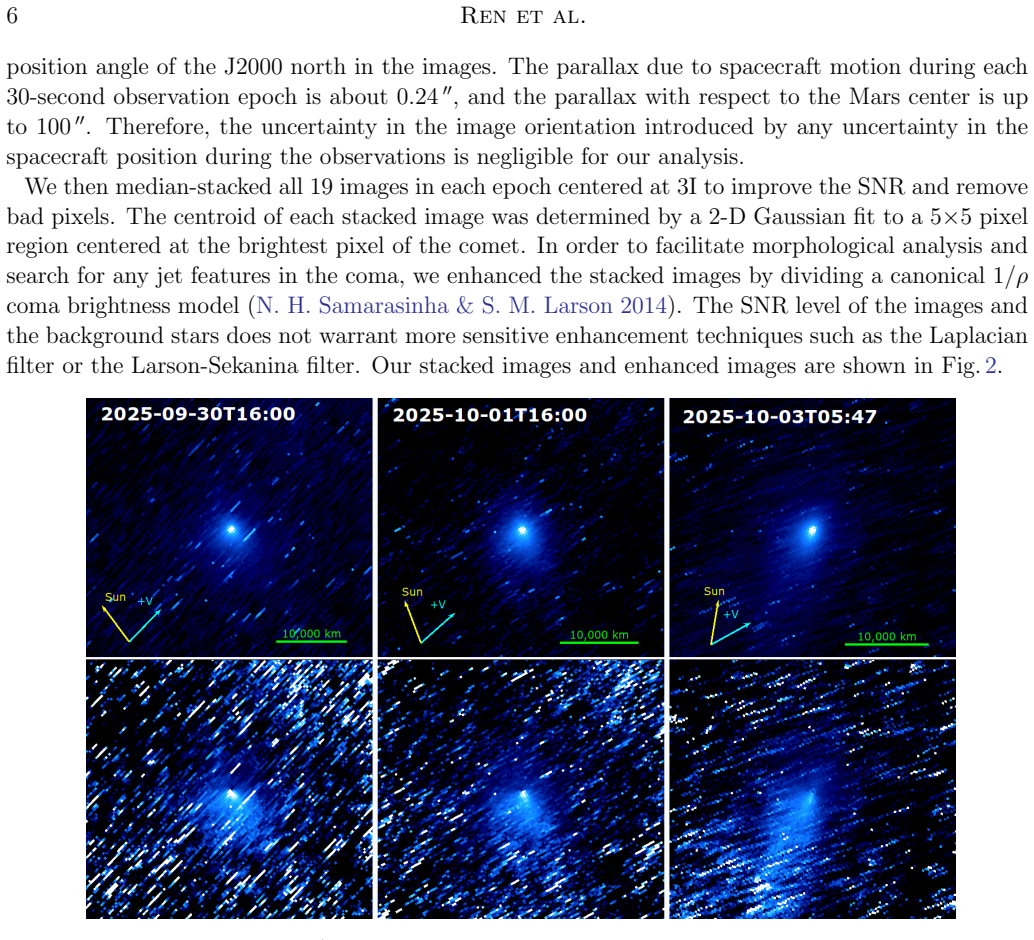
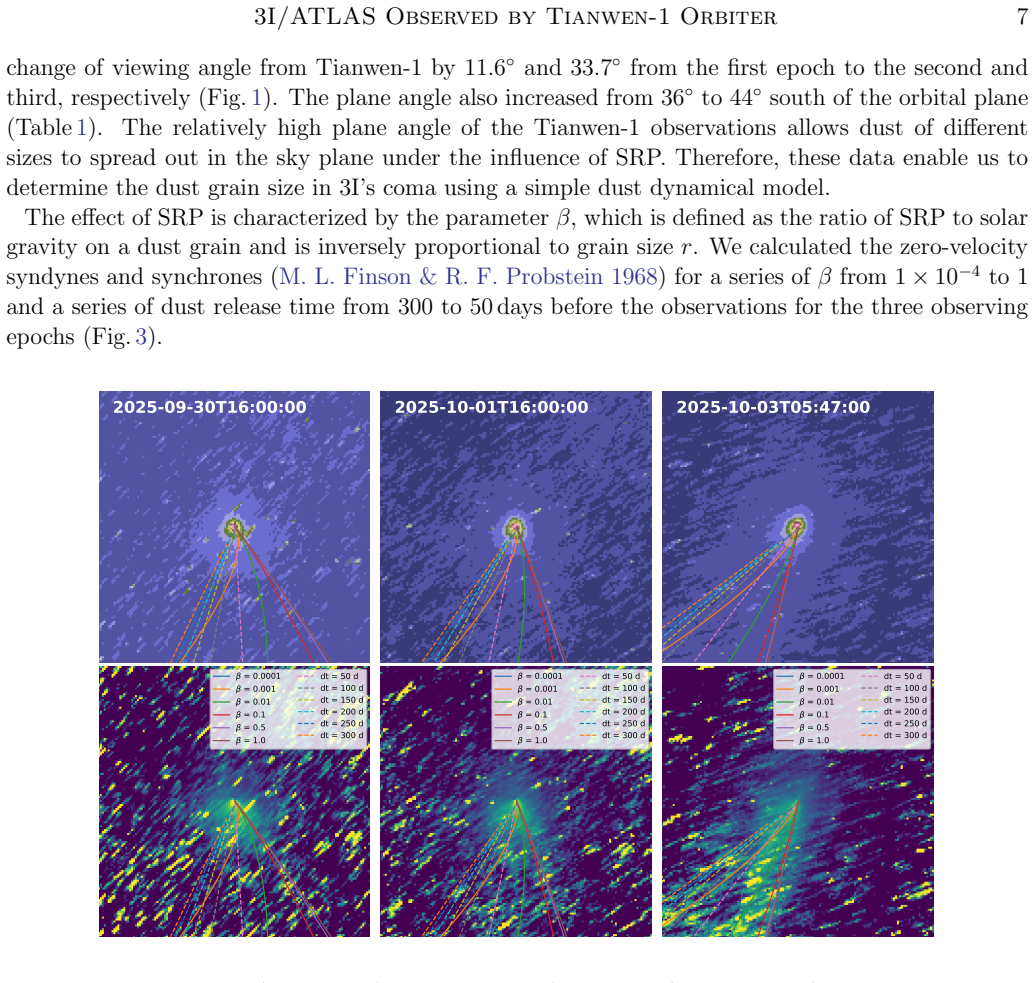
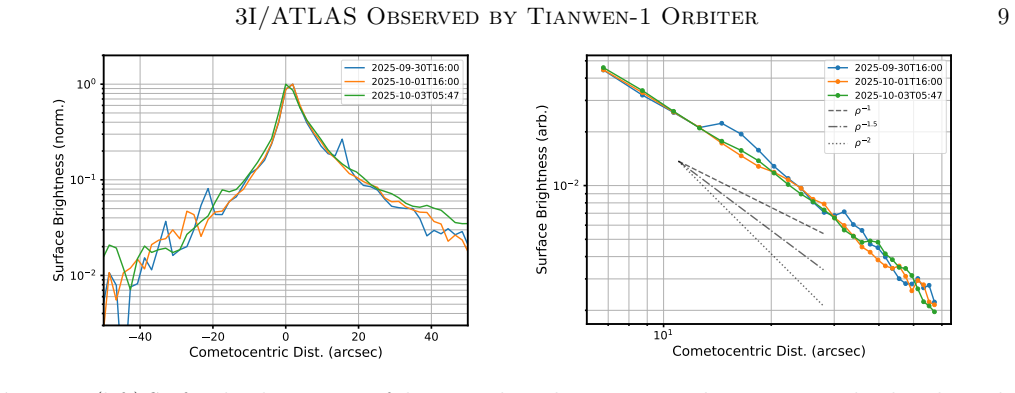
The Tianwen-1 HiRIC camera imaged interstellar object 3I/ATLAS from Mars, providing the first out-of-plane observations. Morphological evolution of the coma and tail across three epochs is explained by changing viewing geometry. Comparison with Finson-Probstein models shows dominance of large grains with β ≈ 10^{-3} to 10^{-2} (sizes of a few hundred μm) and ejection velocities of 3-10 m s^{-1}. The azimuthally averaged surface brightness profile is consistent with steady-state dust outflow under solar radiation pressure, with Afρ ~ 2×10^4 cm and dust mass loss rate ~10^3 kg s^{-1}.
What carries the argument
The Finson-Probstein dust dynamical models, which simulate particle trajectories under gravity and radiation pressure to interpret the observed coma shape and extent.
Load-bearing premise
That the observed changes in coma morphology result only from the spacecraft's changing viewing angle and not from any intrinsic variations in the comet's dust ejection over the short observing period.
What would settle it
If observations from a different vantage point during the same period showed a different dust grain size distribution or if the surface brightness profile changed in a way not predicted by steady-state outflow.
Figures


read the original abstract
China's Tianwen-1 Mars orbiter successfully imaged the third interstellar object, 3I/ATLAS, during its close encounter with Mars using the onboard HiRIC CMOS camera. This is China's first deep-space observation of an astronomical object. These observations constitute the first imaging of this object from a vantage point significantly out of its orbital plane, providing a unique constraint on dust dynamics. Three observing epochs between 2025 September 30 and October 3 reveal clear changes in coma and tail morphology driven by the rapidly evolving viewing geometry. Comparison with Finson-Probstein dust dynamical models indicates that the coma is dominated by large grains with solar radiation pressure parameter $\beta \approx 10^{-3} $ - $10^{-2}$, corresponding to grain sizes of a few 100s $\mu$m. The extent of the sunward coma implies dust ejection velocities of $3$ - $10$ m s$^{-1}$. Despite the morphological evolution, the azimuthally averaged surface brightness profile remains nearly unchanged through the three epochs, transitioning from a radial slope near -1 close to the nucleus to slightly steeper than -1.5 at larger cometocentric distances, consistent with steady-state dust outflow accelerated by solar radiation pressure. Photometry yields an average $Af\rho \sim (2.0\pm0.2)\times10^4$ cm and a corresponding dust mass loss rate of $\dot{M} \sim 10^3$ kg s$^{-1}$.
Editorial analysis
A structured set of objections, weighed in public.
Referee Report
Summary. The manuscript reports the first observations of interstellar object 3I/ATLAS from the Tianwen-1 Mars orbiter using the HiRIC CMOS camera, providing the first out-of-plane vantage point. Three epochs between 2025 Sep 30 and Oct 3 show evolving coma and tail morphology attributed to changing viewing geometry. Comparison to Finson-Probstein dust dynamical models yields β ≈ 10^{-3}–10^{-2} (grain sizes of a few 100s μm) and dust ejection velocities of 3–10 m s^{-1}. Azimuthally averaged surface brightness profiles remain stable (slope near -1 near the nucleus, steeper than -1.5 at larger distances), consistent with steady-state outflow under radiation pressure. Photometry gives Afρ ≈ (2.0 ± 0.2) × 10^4 cm and a dust mass-loss rate of ~10^3 kg s^{-1}.
Significance. If the modeling conclusions hold, the work supplies a unique geometric constraint on dust dynamics for an interstellar object, reinforcing the picture of large-grain-dominated comae with modest ejection speeds. The reported stability of the radial profiles across epochs provides supporting evidence for steady dust production rather than strong temporal variability. These results add to the small sample of characterized interstellar objects and could inform future mission planning for close encounters.
major comments (2)
- [Dust dynamical modeling (comparison with Finson-Probstein models)] The central inference of β ≈ 10^{-3}–10^{-2} and grain sizes of a few 100s μm rests on matching the observed sunward coma extent and morphology to Finson-Probstein trajectories. No quantitative assessment is provided of how gas drag near the nucleus or post-ejection fragmentation would alter the required β or velocity values to reproduce the same three-epoch evolution; if either effect contributes appreciably, the specific numerical ranges would not be unique.
- [Photometry and mass-loss rate derivation] The dust mass-loss rate of ~10^3 kg s^{-1} is obtained from the measured Afρ without an explicit statement of the assumed grain density, size distribution power-law index, or terminal velocity used in the conversion. Because these parameters directly scale the mass-loss estimate, the reported value and its uncertainty cannot be independently verified from the given information.
minor comments (2)
- [Surface brightness profiles] The abstract states the surface-brightness profile transitions 'from a radial slope near -1 close to the nucleus to slightly steeper than -1.5'; a figure or table showing the fitted slopes with uncertainties for each epoch would make this claim more precise.
- [Observations] The three observing epochs are given only as date ranges; listing the exact UTC times and the corresponding heliocentric and observer distances would allow readers to reproduce the viewing-geometry calculations.
Simulated Author's Rebuttal
We thank the referee for their constructive and insightful comments, which have helped clarify several aspects of our analysis. We address each major comment below and have revised the manuscript accordingly where appropriate.
read point-by-point responses
-
Referee: The central inference of β ≈ 10^{-3}–10^{-2} and grain sizes of a few 100s μm rests on matching the observed sunward coma extent and morphology to Finson-Probstein trajectories. No quantitative assessment is provided of how gas drag near the nucleus or post-ejection fragmentation would alter the required β or velocity values to reproduce the same three-epoch evolution; if either effect contributes appreciably, the specific numerical ranges would not be unique.
Authors: We acknowledge that the Finson-Probstein model does not explicitly incorporate near-nucleus gas drag or post-ejection fragmentation, and a full quantitative sensitivity analysis of these effects is not present in the original manuscript. For the large grain sizes (hundreds of μm) and modest ejection velocities (3–10 m s^{-1}) inferred here, gas drag is expected to be negligible beyond the acceleration zone, and fragmentation of such grains is unlikely under the observed conditions; these points are standard assumptions in similar studies of cometary dust. In the revised manuscript we will add a dedicated paragraph in the discussion section explaining these assumptions, their justification for 3I/ATLAS, and the expected magnitude of any corrections, together with references to hydrodynamic modeling of other comets. A complete numerical re-derivation incorporating gas drag would require new simulations beyond the scope of this observational work. revision: partial
-
Referee: The dust mass-loss rate of ~10^3 kg s^{-1} is obtained from the measured Afρ without an explicit statement of the assumed grain density, size distribution power-law index, or terminal velocity used in the conversion. Because these parameters directly scale the mass-loss estimate, the reported value and its uncertainty cannot be independently verified from the given information.
Authors: We agree that the conversion from Afρ to mass-loss rate requires explicit parameter values for independent verification. In the revised manuscript we will state the adopted values (grain density 500 kg m^{-3}, differential size-distribution index q = −3.5, terminal velocity 5 m s^{-1} consistent with the modeled ejection speeds), include the conversion equation, and discuss the sensitivity of the derived rate to these choices. The uncertainty on the mass-loss rate will be updated to reflect the range of plausible parameters. revision: yes
Circularity Check
No circularity: parameters inferred from external standard model
full rationale
The paper's central inferences for β ≈ 10^{-3}–10^{-2} and ejection velocities 3–10 m s^{-1} are obtained by direct morphological matching of observed coma/tail evolution across three epochs to the established Finson-Probstein dust trajectory framework (a 1968 external model, not derived or cited from the present authors). Observational surface brightness profiles, Afρ photometry, and viewing-geometry changes are independent inputs; the model supplies the dynamical mapping without the paper redefining or fitting the model parameters to its own outputs. No self-citation chain, self-definitional loop, or renaming of fitted quantities as predictions occurs. The derivation remains self-contained against the external benchmark.
Axiom & Free-Parameter Ledger
free parameters (2)
- beta =
10^{-3} to 10^{-2}
- ejection_velocity =
3 to 10 m s^{-1}
axioms (2)
- domain assumption Finson-Probstein model assumptions hold for this interstellar object's dust
- domain assumption Surface brightness profile reflects steady-state dust outflow
Reference graph
Works this paper leans on
-
[1]
Feldman, P. D., & Thompson, D. T. 1984, AJ, 89, 579, doi: 10.1086/113552 Astropy Collaboration, Robitaille, T. P., Tollerud, E. J., et al. 2013, A&A, 558, A33, doi: 10.1051/0004-6361/201322068 Astropy Collaboration, Price-Whelan, A. M., Sip˝ ocz, B. M., et al. 2018, AJ, 156, 123, doi: 10.3847/1538-3881/aabc4f Astropy Collaboration, Price-Whelan, A. M., Li...
-
[2]
H., Podolak, M., & Prialnik, D
Beer, E. H., Podolak, M., & Prialnik, D. 2006, Icarus, 180, 473, doi: 10.1016/j.icarus.2005.10.018
-
[3]
The Volatile Inventory of 3I/ATLAS as seen with JWST/MIRI
Belyakov, M., Wong, I., Bolin, B. T., et al. 2026, arXiv e-prints, arXiv:2601.22034, doi: 10.48550/arXiv.2601.22034
work page internal anchor Pith review Pith/arXiv arXiv doi:10.48550/arxiv.2601.22034 2026
-
[4]
Bodewits, D., Noonan, J. W., Feldman, P. D., et al. 2020, Nature Astronomy, 4, 867, doi: 10.1038/s41550-020-1095-2
-
[5]
T., Belyakov, M., Fremling, C., et al
Bolin, B. T., Belyakov, M., Fremling, C., et al. 2025, MNRAS, 542, L139, doi: 10.1093/mnrasl/slaf078
-
[6]
Burns, J. A., Lamy, P. L., & Soter, S. 1979, Icarus, 40, 1, doi: 10.1016/0019-1035(79)90050-2
-
[7]
Casagrande, L., & VandenBerg, D. A. 2018, MNRAS, 479, L102, doi: 10.1093/mnrasl/sly104
-
[8]
Cordiner, M., Roth, N. X., Micheli, M., et al. 2026, arXiv e-prints, arXiv:2603.06911, doi: 10.48550/arXiv.2603.06911
-
[9]
Cordiner, M. A., Roth, N. X., Kelley, M. S. P., et al. 2025, ApJL, 991, L43, doi: 10.3847/2041-8213/ae0647
-
[10]
2025, Central Bureau Electronic Telegrams, 5625, 1 16Ren et al
Crovisier, J., Biver, N., & Bockelee-Morvan, D. 2025, Central Bureau Electronic Telegrams, 5625, 1 16Ren et al. de la Fuente Marcos, R., Alarcon, M. R.,
work page 2025
-
[11]
Licandro, J., et al. 2025, A&A, 700, L9, doi: 10.1051/0004-6361/202556439 de Le´ on, J., Licandro, J., de la Fuente Marcos, C., et al. 2020, MNRAS, 495, 2053, doi: 10.1093/mnras/staa1190
-
[12]
2025, Minor Planet Electronic Circulars, 2025-N12, doi: 10.48377/MPEC/2025-N12
Denneau, L., Siverd, R., Tonry, J., et al. 2025, Minor Planet Electronic Circulars, 2025-N12, doi: 10.48377/MPEC/2025-N12
-
[13]
Eubanks, T. M., Bills, B. G., Hibberd, A., et al. 2025, arXiv e-prints, arXiv:2508.15768, doi: 10.48550/arXiv.2508.15768
-
[14]
Sunshine, J. M. 2025, Research Notes of the American Astronomical Society, 9, 266, doi: 10.3847/2515-5172/ae109f
-
[15]
Farnham, T. L., Samarasinha, N. H., Mueller, B. E. A., & Knight, M. M. 2007, AJ, 133, 2001, doi: 10.1086/513186
-
[16]
Farnham, T. L., & Schleicher, D. G. 2005, Icarus, 173, 533, doi: 10.1016/j.icarus.2004.08.021
-
[17]
Feinstein, A. D., Noonan, J. W., & Seligman, D. Z. 2025, ApJL, 991, L2, doi: 10.3847/2041-8213/adfd4d
-
[18]
2012, Icarus, 221, 721, doi: 10.1016/j.icarus.2012.09.001
Fink, U., & Rubin, M. 2012, Icarus, 221, 721, doi: 10.1016/j.icarus.2012.09.001
-
[19]
Finson, M. L., & Probstein, R. F. 1968, ApJ, 154, 327, doi: 10.1086/149761 Gaia Collaboration, Prusti, T., de Bruijne, J. H. J., et al. 2016, A&A, 595, A1, doi: 10.1051/0004-6361/201629272 Gaia Collaboration, Vallenari, A., Brown, A. G. A., et al. 2023, A&A, 674, A1, doi: 10.1051/0004-6361/202243940
-
[20]
Hadamcik, E., & Levasseur-Regourd, A. C. 2003, A&A, 403, 757, doi: 10.1051/0004-6361:20030378
-
[21]
Hui, M.-T., Jewitt, D., Mutchler, M. J., Agarwal, J., & Kim, Y. 2026, arXiv e-prints, arXiv:2601.21569, doi: 10.48550/arXiv.2601.21569
-
[22]
Tholen, D. J. 2020, AJ, 160, 92, doi: 10.3847/1538-3881/ab9df8 Hutsem´ ekers, D., Manfroid, J., Jehin, E., et al. 2026, A&A, 706, A43, doi: 10.1051/0004-6361/202557484
-
[23]
2024, A&A, 691, A148, doi: 10.1051/0004-6361/202451589
Jang, H., Waters, R., Kaeufer, T., et al. 2024, A&A, 691, A148, doi: 10.1051/0004-6361/202451589
-
[24]
2025, The Astronomer’s Telegram, 17515, 1
Jehin, E., Hmiddouch, S., Aravind, K., et al. 2025, The Astronomer’s Telegram, 17515, 1
work page 2025
-
[25]
1991, in Astrophysics and Space Science Library, Vol
Jewitt, D. 1991, in Astrophysics and Space Science Library, Vol. 167, IAU Colloquium 116: Comets in the post-Halley era, ed. R. L
work page 1991
-
[26]
Newburn, Jr., M. Neugebauer, & J. Rahe, 19, doi: 10.1007/978-94-011-3378-4 2
-
[27]
2020, ApJL, 888, L23, doi: 10.3847/2041-8213/ab621b
Jewitt, D., Hui, M.-T., Kim, Y., et al. 2020, ApJL, 888, L23, doi: 10.3847/2041-8213/ab621b
-
[28]
2025, ApJL, 990, L2, doi: 10.3847/2041-8213/adf8d8
Agarwal, J. 2025, ApJL, 990, L2, doi: 10.3847/2041-8213/adf8d8
-
[29]
2025, ApJL, 994, L3, doi: 10.3847/2041-8213/ae1832
Jewitt, D., & Luu, J. 2025, ApJL, 994, L3, doi: 10.3847/2041-8213/ae1832
-
[30]
2010, AJ, 139, 1782, doi: 10.1088/0004-6256/139/5/1782
Roweis, S. 2010, AJ, 139, 1782, doi: 10.1088/0004-6256/139/5/1782
-
[31]
2021, SSRv, 217, 26, doi: 10.1007/s11214-021-00803-0
Li, C., Tang, S., Hu, X., et al. 2021, SSRv, 217, 26, doi: 10.1007/s11214-021-00803-0
-
[32]
Lisse, C. M., Bach, Y. P., Bryan, S., et al. 2025, Research Notes of the American Astronomical Society, 9, 242, doi: 10.3847/2515-5172/ae0293
-
[33]
Lisse, C. M., Bach, Y. P., Bryan, S. A., et al. 2026, Research Notes of the American Astronomical Society, 10, 26, doi: 10.3847/2515-5172/ae3f95
-
[34]
DiSanti, M. A. 2020, ApJL, 889, L10, doi: 10.3847/2041-8213/ab64ed
-
[35]
J., Weryk, R., Micheli, M., et al
Meech, K. J., Weryk, R., Micheli, M., et al. 2017, Nature, 552, 378, doi: 10.1038/nature25020
-
[36]
2021, SSRv, 217, 42, doi: 10.1007/s11214-021-00823-w
Meng, Q., Wang, D., Wang, X., et al. 2021, SSRv, 217, 42, doi: 10.1007/s11214-021-00823-w
-
[37]
Micheli, M., Farnocchia, D., Meech, K. J., et al. 2018, Nature, 559, 223, doi: 10.1038/s41586-018-0254-4
-
[38]
2019, The Journal of Open Source Software, 4, 1426, doi: 10.21105/joss.01426
Mommert, M., Kelley, M., de Val-Borro, M., et al. 2019, The Journal of Open Source Software, 4, 1426, doi: 10.21105/joss.01426
-
[39]
Mueller, B. E. A., Samarasinha, N. H., Farnham, T. L., & A’Hearn, M. F. 2013, Icarus, 222, 799, doi: 10.1016/j.icarus.2012.08.014
-
[40]
2026, arXiv e-prints, arXiv:2603.07187, doi: 10.48550/arXiv.2603.07187
Opitom, C., Manfroid, J., Hutsem´ ekers, D., et al. 2026, arXiv e-prints, arXiv:2603.07187, doi: 10.48550/arXiv.2603.07187 Ram´ ırez, I., Michel, R., Sefako, R., et al. 2012, ApJ, 752, 5, doi: 10.1088/0004-637X/752/1/5
-
[41]
M., Ward-Thompson, D., & Andr´ e, P
Lodato, G. 2006, MNRAS, 373, 1619, doi: 10.1111/j.1365-2966.2006.11113.x 3I/ATLAS Observed by Tianwen-1 Orbiter17 Salazar Manzano, L. E., Paneque-Carre˜ no, T.,
-
[42]
Water D/H in 3I/ATLAS as a Probe of Formation Conditions in Another Planetary System
Cordiner, M. A., et al. 2026, arXiv e-prints, arXiv:2603.07026, doi: 10.48550/arXiv.2603.07026
work page internal anchor Pith review Pith/arXiv arXiv doi:10.48550/arxiv.2603.07026 2026
-
[43]
Samarasinha, N. H., & Larson, S. M. 2014, Icarus, 239, 168, doi: 10.1016/j.icarus.2014.05.028
-
[44]
2025, A&A, 702, L3, doi: 10.1051/0004-6361/202556717
Santana-Ros, T., Ivanova, O., Mykhailova, S., et al. 2025, A&A, 702, L3, doi: 10.1051/0004-6361/202556717
-
[45]
2026a, arXiv e-prints, arXiv:2601.10860, doi: 10.48550/arXiv.2601.10860
Scarmato, T., & Loeb, A. 2026a, arXiv e-prints, arXiv:2601.10860, doi: 10.48550/arXiv.2601.10860
-
[46]
2026b, arXiv e-prints, arXiv:2602.18512, doi: 10.48550/arXiv.2602.18512
Scarmato, T., & Loeb, A. 2026b, arXiv e-prints, arXiv:2602.18512, doi: 10.48550/arXiv.2602.18512
-
[47]
Schleicher, D. G., & Bair, A. N. 2011, AJ, 141, 177, doi: 10.1088/0004-6256/141/6/177
-
[48]
Serra-Ricart, M., Licandro, J., & Alarcon, M. R. 2026, A&A, 705, L3, doi: 10.1051/0004-6361/202558072
-
[49]
2026, ApJL, 998, L22, doi: 10.3847/2041-8213/ae3c97
Tan, H., Yan, X., & Li, J.-Y. 2026, ApJL, 998, L22, doi: 10.3847/2041-8213/ae3c97
-
[50]
Taylor, A. G., & Seligman, D. Z. 2025, ApJL, 990, L14, doi: 10.3847/2041-8213/adfa28
-
[51]
Wan, W. X., Wang, C., Li, C. L., & Wei, Y. 2020, Nature Astronomy, 4, 721, doi: 10.1038/s41550-020-1148-6
-
[52]
2025, ApJL, 991, L50, doi: 10.3847/2041-8213/ae08ab
Xing, Z., Oset, S., Noonan, J., & Bodewits, D. 2025, ApJL, 991, L50, doi: 10.3847/2041-8213/ae08ab
-
[53]
J., Connelley, M., Zhao, R., & Keane, J
Yang, B., Meech, K. J., Connelley, M., Zhao, R., & Keane, J. V. 2025, ApJL, 992, L9, doi: 10.3847/2041-8213/ae08a7
-
[54]
Ye, Q., Kelley, M. S. P., Hsieh, H. H., et al. 2025, ApJL, 993, L31, doi: 10.3847/2041-8213/ae147b
-
[55]
2026, PASP, 138, 014403, doi: 10.1088/1538-3873/ae2e88
Zhang, Q., & Battams, K. 2026, PASP, 138, 014403, doi: 10.1088/1538-3873/ae2e88
-
[56]
Post-perihelion Coma Composition of the Interstellar Comet 3I/ATLAS from Optical Spectroscopy
Zhao, R., Zhang, X., Yang, B., et al. 2026, arXiv e-prints, arXiv:2603.07718, doi: 10.48550/arXiv.2603.07718
work page internal anchor Pith review Pith/arXiv arXiv doi:10.48550/arxiv.2603.07718 2026
-
[57]
2021, Advances in Space Research, 67, 812, doi: 10.1016/j.asr.2020.11.005
Zou, Y., Zhu, Y., Bai, Y., et al. 2021, Advances in Space Research, 67, 812, doi: 10.1016/j.asr.2020.11.005
discussion (0)
Sign in with ORCID, Apple, or X to comment. Anyone can read and Pith papers without signing in.