Design Considerations for Phase Modulation in Testable Photonic Systems and Co-packaged Optics
Pith reviewed 2026-06-26 15:27 UTC · model grok-4.3
The pith
Thermal and electrical phase modulation in silicon photonic modulators trade speed, energy use, and tuning precision for test and calibration tasks.
A machine-rendered reading of the paper's core claim, the machinery that carries it, and where it could break.
Core claim
Thermal modulation provides stronger tuning controllability at the cost of slower response and higher steady-state power in some regimes, while carrier-based electrical modulation enables faster modulation bandwidth but with different efficiency limits; these differences determine which method is better suited to generating test signals and performing calibration inside scalable silicon photonic systems.
What carries the argument
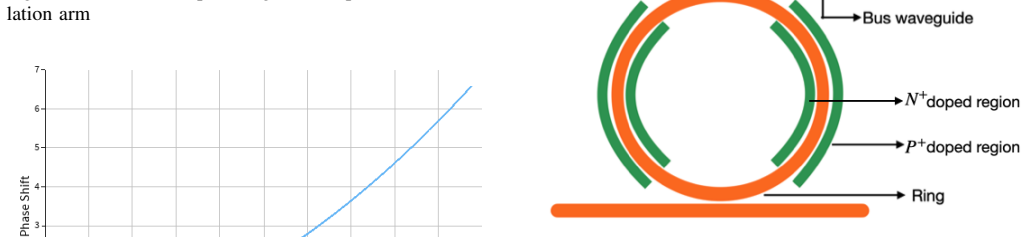
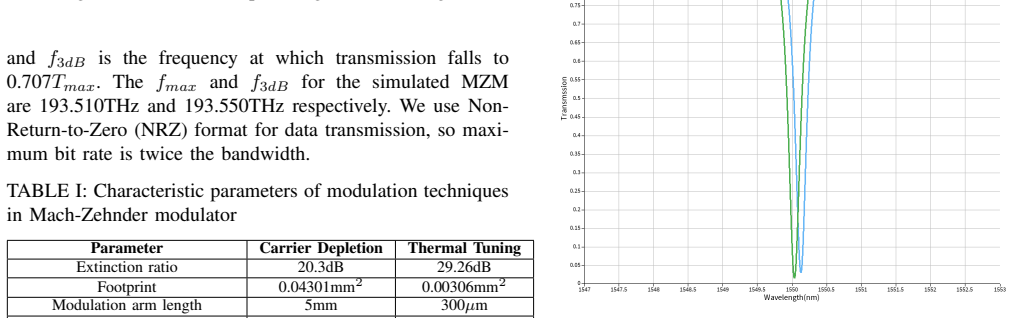
Side-by-side evaluation of thermally induced phase modulation and carrier-based electrical modulation implemented in Mach-Zehnder and microring modulators, quantified by extinction ratio, tuning efficiency, power consumption, and modulation bandwidth.
If this is right
- Thermal approaches become preferable when precise, low-speed tuning is needed for calibration steps.
- Electrical approaches become preferable when high-bandwidth test signals are required.
- Device choice for integrated test functions must be made according to the dominant operating regime of the larger circuit.
- Designers gain concrete criteria for selecting modulation type when adding on-chip test and calibration capability.
Where Pith is reading between the lines
- Hybrid thermal-electrical modulators could be explored to combine the controllability of one with the speed of the other.
- The same trade-off data may help size power budgets for co-packaged optics that include built-in calibration loops.
- If thermal crosstalk proves larger than modeled, entire calibration architectures that rely on dense thermal tuning would need redesign.
Load-bearing premise
The chosen performance metrics and the fabricated or simulated devices are sufficient to judge real-world suitability for test and calibration without needing to account for fabrication variability, thermal crosstalk, or long-term stability.
What would settle it
Fabricated devices showing that thermal crosstalk or fabrication spread changes the measured tuning efficiency or extinction ratio by more than the difference reported between thermal and electrical methods.
Figures


read the original abstract
As silicon photonic integrated circuits (PICs) scale in complexity, testing and calibration increasingly depend on effective phase modulation mechanisms. This work compares thermally induced phase modulation and carrier-based electrical modulation in Mach-Zehnder and microring modulators. The devices are designed and evaluated for extinction ratio, tuning efficiency, power consumption, and modulation bandwidth. The study identifies key trade-offs among modulation speed, energy consumption, and tuning controllability that directly influence the suitability of these methods for test signal generation and calibration tasks. The results highlight the relative advantages and limitations of thermal and electrical approaches across different operating regimes. These findings provide practical design guidance for selecting phase modulation strategies in scalable silicon photonic systems with integrated test and calibration requirements.
Editorial analysis
A structured set of objections, weighed in public.
Referee Report
Summary. The manuscript compares thermally induced phase modulation and carrier-based electrical modulation implemented in Mach-Zehnder interferometers and microring modulators for silicon photonic integrated circuits. Devices are evaluated on extinction ratio, tuning efficiency, power consumption, and modulation bandwidth; the central claim is that the resulting trade-offs among modulation speed, energy consumption, and tuning controllability directly determine suitability for test-signal generation and calibration in scalable, co-packaged photonic systems.
Significance. If the device comparisons rest on validated models, the work would supply concrete design guidance for an increasingly important engineering problem in photonic testing and calibration. The emphasis on co-packaged optics and testability is timely for the field.
major comments (2)
- [Abstract] Abstract: the claim that the identified trade-offs 'directly influence the suitability of these methods for test signal generation and calibration tasks' cannot be assessed because the manuscript supplies no simulation methods, device parameters, data sets, error analysis, or validation approach.
- [Device evaluation sections] Device evaluation sections: the reported advantages of thermal versus carrier-based modulation rest on idealized models that omit fabrication variability (waveguide width/thickness) and thermal crosstalk; these effects routinely shift phase efficiency and bandwidth by tens of percent in silicon photonics and therefore directly undermine the claim that the evaluated metrics are representative of real-world suitability for testable systems.
Simulated Author's Rebuttal
We thank the referee for the constructive feedback on our manuscript comparing thermal and electrical phase modulation approaches. The comments correctly identify areas where clarity and limitations can be better addressed. We respond to each major comment below.
read point-by-point responses
-
Referee: [Abstract] Abstract: the claim that the identified trade-offs 'directly influence the suitability of these methods for test signal generation and calibration tasks' cannot be assessed because the manuscript supplies no simulation methods, device parameters, data sets, error analysis, or validation approach.
Authors: The device parameters (e.g., waveguide dimensions, doping levels, heater resistances) and evaluation methods (analytical models for thermo-optic and plasma-dispersion effects, combined with standard rate equations for bandwidth) are detailed in the device evaluation sections of the main text. No experimental data sets or error analysis are included because the work is a comparative modeling study rather than a validation paper. We will revise the abstract to explicitly reference the modeled metrics and note that the suitability claims are based on these nominal comparisons, allowing readers to evaluate the basis of the trade-offs. revision: yes
-
Referee: [Device evaluation sections] Device evaluation sections: the reported advantages of thermal versus carrier-based modulation rest on idealized models that omit fabrication variability (waveguide width/thickness) and thermal crosstalk; these effects routinely shift phase efficiency and bandwidth by tens of percent in silicon photonics and therefore directly undermine the claim that the evaluated metrics are representative of real-world suitability for testable systems.
Authors: We agree that the models are idealized and exclude fabrication variability and thermal crosstalk, which are known to affect real devices. The study intentionally uses standard analytical expressions to isolate fundamental trade-offs in extinction ratio, tuning efficiency, power, and bandwidth for initial design guidance. We will add a dedicated limitations paragraph in the discussion section acknowledging these omissions and clarifying that the reported metrics represent nominal benchmarks rather than process-specific predictions. This will strengthen the manuscript without requiring new simulations. revision: yes
Circularity Check
No significant circularity; device comparison grounded in standard models
full rationale
The paper is a comparative evaluation of thermal vs. carrier-based phase modulation in Mach-Zehnder and microring devices, reporting standard metrics (extinction ratio, tuning efficiency, power consumption, modulation bandwidth) and trade-offs for test/calibration suitability. No equations, derivations, parameter fittings, or predictions are present that reduce to self-definition or fitted inputs by construction. No self-citation chains or uniqueness theorems are invoked as load-bearing. The analysis rests on established silicon photonics device physics and is self-contained against external benchmarks.
Axiom & Free-Parameter Ledger
Reference graph
Works this paper leans on
-
[1]
Electronic chip package and co-packaged optics (CPO) technology for modern AI era: A review,
G. Chen, G. Wang, Z. Wang, and L. Wang, “Electronic chip package and co-packaged optics (CPO) technology for modern AI era: A review,”Micromachines, vol. 16, no. 4, 2025. [Online]. Available: https://www.mdpi.com/2072-666X/16/4/431
2025
-
[2]
D. Gostimirovic, D.-X. Xu, O. Liboiron-Ladouceur, and Y . Grinberg, “Deep learning-based prediction of fabrication-process-induced structural variations in nanophotonic devices,”ACS Photonics, vol. 9, no. 8, pp. 2623–2633, 2022. [Online]. Available: https://doi.org/10.1021/acsphotonics.1c01973
-
[3]
A. Fyrillas, O. Faure, N. Maring, J. Senellart, and N. Belabas, “Scalable machine learning-assisted clear-box characterization for optimally controlled photonic circuits,” 2024. [Online]. Available: https://arxiv.org/abs/2310.15349
arXiv 2024
-
[4]
Transfer-matrix abstractions to ana- lyze the effect of manufacturing variations in silicon photonic circuits,
P. Agnihotri, P. Kalla, and S. Blair, “Transfer-matrix abstractions to ana- lyze the effect of manufacturing variations in silicon photonic circuits,” in2022 IEEE International Test Conference India (ITC India), 2022, pp. 1–8
2022
-
[5]
Abstractions for modeling the effects of wall surface roughness in silicon photonic microring resonators,
P. Agnihotri, L. Schlitt, P. Kalla, and S. Blair, “Abstractions for modeling the effects of wall surface roughness in silicon photonic microring resonators,” inIEEE 24th Latin American Test Symposium (LATS), 2023, pp. 1–6
2023
-
[6]
Grating-assisted fiber to chip coupling for soi photonic circuits,
S. Nambiar, P. Sethi, and S. K. Selvaraja, “Grating-assisted fiber to chip coupling for soi photonic circuits,”Applied Sciences, vol. 8, no. 7,
-
[7]
Available: https://www.mdpi.com/2076-3417/8/7/1142
[Online]. Available: https://www.mdpi.com/2076-3417/8/7/1142
2076
-
[8]
Towards fully automated testing and characterization for photonic compact modeling on 300-mm wafer platform,
A. Aboketaf, C. Hedges, V . Dhurgude, B. Harris, F. Guan, F. Pavlik, T. Anderson, A. Stricker, Y . Bian, M. Rakowski, A. Dasgupta, and A. Paganini, “Towards fully automated testing and characterization for photonic compact modeling on 300-mm wafer platform,” inOptical Fiber Communication Conference (OFC)
-
[9]
Optica Publishing Group, 2021, p. W6A.1. [Online]. Available: https://opg.optica.org/abstract.cfm?URI=OFC-2021-W6A.1
2021
-
[10]
Design-for-Test for Silicon Photonic Circuits,
P. Agnihotri, P. Kalla, and S. Blair, “Design-for-Test for Silicon Photonic Circuits,” inProc. Intl. Test Conf. (ITC), 2024, pp. 86–90
2024
-
[11]
A 240 Gb/s pam4 silicon micro-ring optical modulator,
M. Sakib, R. Kumar, C. Ma, D. Huang, X. Wu, G. Su, and H. Rong, “A 240 Gb/s pam4 silicon micro-ring optical modulator,” in2022 Optical Fiber Communications Conference and Exhibition (OFC), 2022, pp. 01– 03
2022
-
[12]
Fast thermo-optical modulators with doped-silicon heaters operating at 2µm waveband,
C. Zhong, H. Ma, C. Sun, M. Wei, Y . Ye, B. Tang, P. Zhang, R. Liu, J. Li, L. Li, and H. Lin, “Fast thermo-optical modulators with doped-silicon heaters operating at 2µm waveband,”Opt. Express, vol. 29, no. 15, pp. 23 508–23 516, Jul 2021. [Online]. Available: https://opg.optica.org/oe/abstract.cfm?URI=oe-29-15-23508
2021
-
[13]
A comprehensive design approach for a mzm based pam-4 silicon photonic transmitter,
K. Zhu, V . Saxena, and X. Wu, “A comprehensive design approach for a mzm based pam-4 silicon photonic transmitter,” in2015 IEEE 58th International Midwest Symposium on Circuits and Systems (MWSCAS), 2015, pp. 1–4
2015
-
[14]
Silicon intensity mach-zehnder modulator for single lane 100Gb/s applications,
M. Li, L. Wang, X. Li, X. Xiao, and S. Yu, “Silicon intensity mach-zehnder modulator for single lane 100Gb/s applications,”Photon. Res., vol. 6, no. 2, pp. 109–116, Feb 2018. [Online]. Available: https://opg.optica.org/prj/abstract.cfm?URI=prj-6-2-109
2018
-
[15]
Ultra-compact efficient thermally actuated mach-zehnder modulator based on VO2,
S. Mohammadi-Pouyan, M. Afrouzmehr, and D. Abbott, “Ultra-compact efficient thermally actuated mach-zehnder modulator based on VO2,” IEEE Access, vol. 10, pp. 85 952–85 959, 2022
2022
-
[16]
High-efficiency 25Gb/s cmos ring modulator with integrated thermal tuning,
G. Li, X. Zheng, J. Yao, H. Thacker, I. Shubin, Y . Luo, K. Raj, J. E. Cunningham, and A. V . Krishnamoorthy, “High-efficiency 25Gb/s cmos ring modulator with integrated thermal tuning,” in8th IEEE International Conference on Group IV Photonics, 2011, pp. 8–10
2011
-
[17]
Thermal modelling of silicon photonic ring modulator with substrate undercut,
D. Coenen, H. Oprins, Y . Ban, F. Ferraro, M. Pantouvaki, J. Van Camp- enhout, and I. De Wolf, “Thermal modelling of silicon photonic ring modulator with substrate undercut,”Journal of Lightwave Technology, vol. 40, no. 13, pp. 4357–4363, 2022. [16]Lumerical Photonic Design Software, Lumerical Computational Solu- tions, Inc., www.lumerical.com
2022
-
[18]
Experimental parameter study of thermally tunable Mach-Zehnder switches,
J. Samland, B. Chmielak, J. Bolten, S. Suckow, T. Wahlbrink, and M. C. Lemme, “Experimental parameter study of thermally tunable Mach-Zehnder switches,”Opt. Continuum, vol. 4, no. 3, pp. 561–570, Mar 2025. [Online]. Available: https://opg.optica.org/optcon/abstract. cfm?URI=optcon-4-3-561
2025
-
[19]
Design-for-test and calibration for silicon photonics using ring resonators and wavelength division multiplexing,
P. Agnihotri, L. Schlitt, P. Kalla, and S. Blair, “Design-for-test and calibration for silicon photonics using ring resonators and wavelength division multiplexing,” in2025 IEEE European Test Symposium (ETS), 2025, pp. 1–6
2025
-
[20]
40 gb/s thermally tunable cmos ring modulator,
G. Li, X. Zheng, H. Thacker, J. Yao, Y . Luo, I. Shubin, K. Raj, J. E. Cunningham, and A. V . Krishnamoorthy, “40 gb/s thermally tunable cmos ring modulator,” inThe 9th International Conference on Group IV Photonics (GFP), 2012, pp. 1–3
2012
discussion (0)
Sign in with ORCID, Apple, or X to comment. Anyone can read and Pith papers without signing in.