CineMesh4D: Personalized 4D Whole Heart Reconstruction from Sparse Cine MRI
Pith reviewed 2026-05-15 05:50 UTC · model grok-4.3
The pith
CineMesh4D reconstructs personalized 4D whole-heart meshes directly from sparse multi-view 2D cine MRI.
A machine-rendered reading of the paper's core claim, the machinery that carries it, and where it could break.
Core claim
CineMesh4D is an end-to-end 4D pipeline that directly reconstructs patient-specific whole-heart meshes from multi-view 2D cine MRI via cross-domain mapping, supervised by a differentiable rendering loss on sparse contours and driven by a dual-context temporal block that fuses global and local sequential cardiac patterns, yielding higher reconstruction quality and motion consistency than existing approaches.
What carries the argument
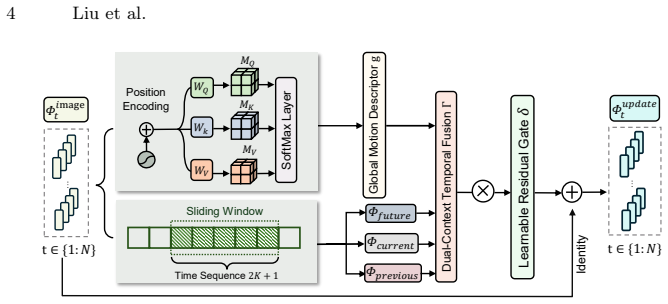
Differentiable rendering loss that supervises 3D+t whole-heart meshes from multi-view sparse 2D contours, paired with a dual-context temporal block that fuses global and local cardiac temporal information.
If this is right
- Reconstructs the full heart in 3D over the entire cardiac cycle rather than isolated chambers or single phases.
- Delivers measurable gains in both spatial accuracy and temporal motion consistency.
- Operates directly on standard multi-view cine MRI without requiring denser sampling or additional modalities.
- Enables patient-specific 4D models suitable for real-time cardiac assessment.
Where Pith is reading between the lines
- The rendering supervision could transfer to other sparse-view modalities such as ultrasound if the contour-to-mesh mapping proves robust.
- Dynamic whole-heart meshes might support simulation of interventions by providing time-varying boundary conditions.
- Routine clinical cine scans could feed automated pipelines that flag motion abnormalities earlier than current slice-by-slice review.
Load-bearing premise
The differentiable rendering loss can accurately supervise full 3D+t whole-heart meshes from only the sparse multi-view 2D contours without further constraints or extra data.
What would settle it
Reconstructed meshes that deviate substantially from independent 3D ground-truth volumes or display discontinuous motion between consecutive time frames on held-out patient cine MRI data.
Figures


read the original abstract
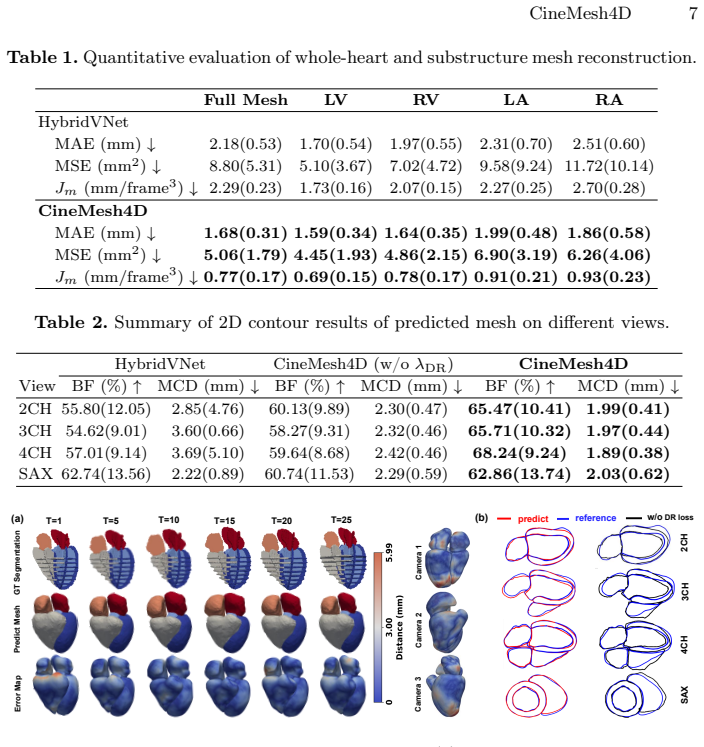
Accurate 3D+t whole-heart mesh reconstruction from cine MRI is a clinically crucial yet technically challenging task. The difficulty of this task arises from two coupled factors: inherently sparse sampling of 3D cardiac anatomy by 2D image slices and the tight coupling between cardiac shape and motion. Current cardiac image-to-mesh approaches typically reconstruct only a subset of cardiac chambers or a single phase of the cardiac cycle. In this work, we propose CineMesh4D, a novel end-to-end 4D (3D+t) pipeline that directly reconstructs patient-specific whole-heart mesh from multi-view 2D cine MRI via cross-domain mapping. Specifically, we introduce a differentiable rendering loss that enables supervision of 3D+t whole-heart mesh from multi-view sparse contours of cine MRI. Furthermore, we develop a dual-context temporal block that fuses global and local cardiac temporal information to capture high-dimensional sequential patterns. In quantitative and qualitative evaluations, CineMesh4D outperforms existing approaches in terms of reconstruction quality and motion consistency, providing a practical pathway for personalized real-time cardiac assessment. The code will be publicly released once the manuscript is accepted.
Editorial analysis
A structured set of objections, weighed in public.
Referee Report
Summary. The manuscript presents CineMesh4D, an end-to-end pipeline for patient-specific 4D whole-heart mesh reconstruction directly from multi-view sparse 2D cine MRI. It introduces a differentiable rendering loss to supervise 3D+t meshes from 2D contours and a dual-context temporal block to fuse global and local temporal cardiac information, claiming outperformance over prior methods in reconstruction quality and motion consistency for personalized cardiac assessment.
Significance. If the central claims are substantiated with rigorous quantitative validation, the approach could enable practical 4D whole-heart modeling from standard clinical cine MRI, extending beyond current methods limited to subsets of chambers or single phases.
major comments (3)
- [Abstract] Abstract: the claim of outperformance 'in quantitative and qualitative evaluations' is unsupported by any reported metrics, error bars, dataset details, ablation studies, or baseline comparisons, leaving the central claim of superior reconstruction quality and motion consistency without verifiable evidence in the provided text.
- [Method (differentiable rendering loss)] Method section on differentiable rendering loss: projection from 3D+t meshes to sparse multi-view 2D contours is many-to-one, yet the manuscript introduces no explicit volume, topology, or biomechanical regularizers beyond the temporal block and provides no analysis of solution uniqueness or sensitivity to initialization, raising the risk that multiple plausible meshes satisfy the loss.
- [Method (dual-context temporal block)] Method section on dual-context temporal block: the block is asserted to capture high-dimensional sequential patterns sufficiently for accurate 4D reconstruction, but without additional constraints or empirical tests of ambiguity resolution, it does not demonstrably address the underconstrained nature of sparse-contour supervision.
minor comments (1)
- [Abstract] Abstract: the final sentence on code release is conventional but could include a placeholder repository link or license for immediate clarity.
Simulated Author's Rebuttal
We thank the referee for the constructive and detailed comments, which highlight important aspects of clarity and rigor. We address each major comment point by point below and indicate the planned revisions to the manuscript.
read point-by-point responses
-
Referee: [Abstract] Abstract: the claim of outperformance 'in quantitative and qualitative evaluations' is unsupported by any reported metrics, error bars, dataset details, ablation studies, or baseline comparisons, leaving the central claim of superior reconstruction quality and motion consistency without verifiable evidence in the provided text.
Authors: The full manuscript includes a Results section with quantitative metrics (Chamfer distance, Hausdorff distance, motion consistency scores), error bars, dataset details (patient counts, view configurations), ablation studies, and baseline comparisons that support the outperformance claims. To ensure the abstract is self-contained, we will revise it to reference key quantitative improvements. revision: yes
-
Referee: [Method (differentiable rendering loss)] Method section on differentiable rendering loss: projection from 3D+t meshes to sparse multi-view 2D contours is many-to-one, yet the manuscript introduces no explicit volume, topology, or biomechanical regularizers beyond the temporal block and provides no analysis of solution uniqueness or sensitivity to initialization, raising the risk that multiple plausible meshes satisfy the loss.
Authors: We agree the projection is many-to-one and the problem underconstrained. The differentiable rendering loss provides direct 2D supervision while the dual-context temporal block supplies temporal coherence; together they produce consistent meshes in our experiments. We will add sensitivity analysis to initialization and a discussion of implicit regularization from the architecture in the revision. revision: partial
-
Referee: [Method (dual-context temporal block)] Method section on dual-context temporal block: the block is asserted to capture high-dimensional sequential patterns sufficiently for accurate 4D reconstruction, but without additional constraints or empirical tests of ambiguity resolution, it does not demonstrably address the underconstrained nature of sparse-contour supervision.
Authors: Ablation results in the manuscript show that the dual-context block improves motion consistency, indicating it helps resolve temporal ambiguities arising from sparse supervision. We will expand the revision with additional empirical tests (e.g., perturbed inputs) and visualizations to more explicitly demonstrate ambiguity resolution. revision: yes
Circularity Check
No circularity: supervision derives from external contours via rendering loss
full rationale
The paper's core pipeline maps multi-view 2D cine contours to 3D+t meshes using a differentiable rendering loss for supervision and a dual-context temporal block for sequential fusion. These components operate on external input data (sparse contours) rather than redefining outputs in terms of fitted parameters or prior self-citations. No equations, uniqueness theorems, or ansatzes are shown to collapse to the inputs by construction. Quantitative outperformance is evaluated against independent baselines, keeping the derivation self-contained.
Axiom & Free-Parameter Ledger
Lean theorems connected to this paper
-
IndisputableMonolith/Cost/FunctionalEquation.leanwashburn_uniqueness_aczel unclear?
unclearRelation between the paper passage and the cited Recognition theorem.
we introduce a differentiable rendering loss that enables supervision of 3D+t whole-heart mesh from multi-view sparse contours of cine MRI... Beer–Lambert law... q_i,w_t = 1−exp(−μ ℓ_sigmoid(R_i,w_t))
-
IndisputableMonolith/Foundation/ArrowOfTime.leanforward_accumulates unclear?
unclearRelation between the paper passage and the cited Recognition theorem.
dual-context temporal block that fuses global and local cardiac temporal information... temporal self-attention... sliding window of size (2K+1)
What do these tags mean?
- matches
- The paper's claim is directly supported by a theorem in the formal canon.
- supports
- The theorem supports part of the paper's argument, but the paper may add assumptions or extra steps.
- extends
- The paper goes beyond the formal theorem; the theorem is a base layer rather than the whole result.
- uses
- The paper appears to rely on the theorem as machinery.
- contradicts
- The paper's claim conflicts with a theorem or certificate in the canon.
- unclear
- Pith found a possible connection, but the passage is too broad, indirect, or ambiguous to say the theorem truly supports the claim.
Forward citations
Cited by 1 Pith paper
-
Personalized 4D Whole-Heart Mesh Reconstruction from Cine MRI via Multi-Scale Temporal Modeling and Differentiable Contour Rendering
End-to-end framework reconstructs 4D whole-heart meshes from cine MRI using differentiable contour rendering and multi-scale temporal modeling, reporting 1.68 mm MAE and improved motion smoothness over prior methods.
Reference graph
Works this paper leans on
-
[1]
Medical image analysis74, 102228 (2021)
Chen, X., Ravikumar, N., Xia, Y., Attar, R., Diaz-Pinto, A., Piechnik, S.K., Neubauer, S., Petersen, S.E., Frangi, A.F.: Shape registration with learned de- formations for 3d shape reconstruction from sparse and incomplete point clouds. Medical image analysis74, 102228 (2021)
work page 2021
-
[2]
In: Proceedings of the IEEE/CVF conference on computer vision and pattern recognition
Cheng, D., Liao, R., Fidler, S., Urtasun, R.: Darnet: Deep active ray network for building segmentation. In: Proceedings of the IEEE/CVF conference on computer vision and pattern recognition. pp. 7431–7439 (2019)
work page 2019
-
[3]
In: Interna- tional Conference on Functional Imaging and Modeling of the Heart
Dillon, J.R., Mauger, C., Zhao, D., Deng, Y., Petersen, S.E., McCulloch, A.D., Young, A.A., Nash, M.P.: An open-source end-to-end pipeline for generating 3d+ t biventricular meshes from cardiac magnetic resonance imaging. In: Interna- tional Conference on Functional Imaging and Modeling of the Heart. pp. 372–383. Springer (2025)
work page 2025
-
[4]
Medical Image Analysis104, 103630 (2025)
Gaggion, N., Matheson, B.A., Xia, Y., Bonazzola, R., Ravikumar, N., Taylor, Z.A., Milone, D.H., Frangi, A.F., Ferrante, E.: Multi-view hybrid graph convolutional network for volume-to-mesh reconstruction in cardiovascular mri. Medical Image Analysis104, 103630 (2025)
work page 2025
-
[5]
arXiv preprint arXiv:1912.00367 , year=
Gur, S., Shaharabany, T., Wolf, L.: End to end trainable active contours via dif- ferentiable rendering. arXiv preprint arXiv:1912.00367 (2019)
-
[6]
Hu, E.J., Shen, Y., Wallis, P., Allen-Zhu, Z., Li, Y., Wang, S., Wang, L., Chen, W., et al.: Lora: Low-rank adaptation of large language models. Iclr1(2), 3 (2022)
work page 2022
-
[7]
Cardiovascular Imaging Asia2(4), 187–193 (2018)
Kawakubo, M., Arai, H., Nagao, M., Yamasaki, Y., Sanui, K., Nishimura, H., Kadokami, T.: Global left ventricular area strain using standard two-dimensional cine magnetic resonance imaging with inter-slice interpolation. Cardiovascular Imaging Asia2(4), 187–193 (2018)
work page 2018
-
[8]
In: International conference on medical imaging with deep learning
Kervadec, H., Bouchtiba, J., Desrosiers, C., Granger, E., Dolz, J., Ayed, I.B.: Boundary loss for highly unbalanced segmentation. In: International conference on medical imaging with deep learning. pp. 285–296. PMLR (2019)
work page 2019
-
[9]
Medical image analysis74, 102222 (2021)
Kong, F., Wilson, N., Shadden, S.: A deep-learning approach for direct whole-heart mesh reconstruction. Medical image analysis74, 102222 (2021)
work page 2021
-
[10]
IEEE transactions on medical imaging43(7), 2466–2478 (2024)
Li, L., Camps, J., Wang, Z.J., Beetz, M., Banerjee, A., Rodriguez, B., Grau, V.: Toward enabling cardiac digital twins of myocardial infarction using deep compu- tational models for inverse inference. IEEE transactions on medical imaging43(7), 2466–2478 (2024)
work page 2024
-
[11]
Medical image analysis88, 102869 (2023) 10 Liu et al
Li, L., Ding, W., Huang, L., Zhuang, X., Grau, V.: Multi-modality cardiac image computing: A survey. Medical image analysis88, 102869 (2023) 10 Liu et al
work page 2023
-
[12]
ChemPhysChem21(18), 2029–2046 (2020)
Mayerhöfer, T.G., Pahlow, S., Popp, J.: The bouguer-beer-lambert law: Shining light on the obscure. ChemPhysChem21(18), 2029–2046 (2020)
work page 2029
-
[13]
IEEE transactions on medical imaging43(4), 1489–1500 (2023)
Meng, Q., Bai, W., O’Regan, D.P., Rueckert, D.: Deepmesh: Mesh-based cardiac motion tracking using deep learning. IEEE transactions on medical imaging43(4), 1489–1500 (2023)
work page 2023
-
[14]
IEEE trans- actions on pattern analysis and machine intelligence32(12), 2262–2275 (2010)
Myronenko, A., Song, X.: Point set registration: Coherent point drift. IEEE trans- actions on pattern analysis and machine intelligence32(12), 2262–2275 (2010)
work page 2010
-
[15]
Advances in neural information processing systems30(2017)
Qi, C.R., Yi, L., Su, H., Guibas, L.J.: Pointnet++: Deep hierarchical feature learn- ing on point sets in a metric space. Advances in neural information processing systems30(2017)
work page 2017
-
[16]
In: International Workshop on Statistical Atlases and Computational Models of the Heart
Qiao, M., Basaran, B.D., Qiu, H., Wang, S., Guo, Y., Wang, Y., Matthews, P.M., Rueckert,D.,Bai,W.:Generativemodellingoftheageingheartwithcross-sectional imaging and clinical data. In: International Workshop on Statistical Atlases and Computational Models of the Heart. pp. 3–12. Springer (2022)
work page 2022
-
[17]
In: Proceedings of the European conference on computer vision (ECCV)
Ranjan, A., Bolkart, T., Sanyal, S., Black, M.J.: Generating 3d faces using convolu- tional mesh autoencoders. In: Proceedings of the European conference on computer vision (ECCV). pp. 704–720 (2018)
work page 2018
-
[18]
Rivera,F.A.,Ahmad,R.,Trejo-Gutierrez,J.:Cardiovascularriskassessment:Prac- ticaltipsfortheinternalmedicinespecialist.EuropeanJournalofInternalMedicine p. 106600 (2025)
work page 2025
-
[19]
In: International Conference on Medical image computing and computer-assisted intervention
Ronneberger, O., Fischer, P., Brox, T.: U-net: Convolutional networks for biomedi- cal image segmentation. In: International Conference on Medical image computing and computer-assisted intervention. pp. 234–241. Springer (2015)
work page 2015
-
[20]
In: Proceedings of the IEEE/CVF Conference on Computer Vision and Pattern Recognition
Shin, S., Kim, J., Halilaj, E., Black, M.J.: Wham: Reconstructing world-grounded humans with accurate 3d motion. In: Proceedings of the IEEE/CVF Conference on Computer Vision and Pattern Recognition. pp. 2070–2080 (2024)
work page 2070
-
[21]
In: International Conference on Machine Learning
Shirzad, H., Velingker, A., Venkatachalam, B., Sutherland, D.J., Sinop, A.K.: Ex- phormer: Sparse transformers for graphs. In: International Conference on Machine Learning. pp. 31613–31632. PMLR (2023)
work page 2023
-
[22]
European Heart Journal45(45), 4808–4821 (2024)
Thangaraj, P.M., Benson, S.H., Oikonomou, E.K., Asselbergs, F.W., Khera, R.: Cardiovascular care with digital twin technology in the era of generative artificial intelligence. European Heart Journal45(45), 4808–4821 (2024)
work page 2024
-
[23]
Advances in neural information pro- cessing systems30(2017)
Vaswani,A.,Shazeer,N.,Parmar,N.,Uszkoreit,J.,Jones,L.,Gomez,A.N.,Kaiser, Ł., Polosukhin, I.: Attention is all you need. Advances in neural information pro- cessing systems30(2017)
work page 2017
-
[24]
In: Proceedings of the European conference on computer vision (ECCV)
Wang, N., Zhang, Y., Li, Z., Fu, Y., Liu, W., Jiang, Y.G.: Pixel2mesh: Generating 3d mesh models from single rgb images. In: Proceedings of the European conference on computer vision (ECCV). pp. 52–67 (2018)
work page 2018
-
[25]
In: International Workshop on Statistical Atlases and Computational Models of the Heart
Xu, Y., Xu, H., Sinclair, M., Puyol-Antón, E., Niederer, S.A., Chiribiri, A., Williams, S.E., Williams, M.C., Young, A.A.: Improved 3d whole heart geome- try from sparse cmr slices. In: International Workshop on Statistical Atlases and Computational Models of the Heart. pp. 43–52. Springer (2024)
work page 2024
-
[26]
In: Proceedings of the IEEE/CVF conference on computer vision and pattern recognition
Yi, X., Zhou, Y., Habermann, M., Shimada, S., Golyanik, V., Theobalt, C., Xu, F.: Physical inertial poser (pip): Physics-aware real-time human motion tracking from sparse inertial sensors. In: Proceedings of the IEEE/CVF conference on computer vision and pattern recognition. pp. 13167–13178 (2022)
work page 2022
-
[27]
In: Proceedings of the IEEE conference on computer vision and pattern recognition
Yu,L.,Li,X.,Fu,C.W.,Cohen-Or,D.,Heng,P.A.:Pu-net:Pointcloudupsampling network. In: Proceedings of the IEEE conference on computer vision and pattern recognition. pp. 2790–2799 (2018)
work page 2018
discussion (0)
Sign in with ORCID, Apple, or X to comment. Anyone can read and Pith papers without signing in.