REVIEW 4 minor 27 references
Disguised complex balance via positive algebraic geometry
T0 review · 0 major / 4 minor · reviewed 2026-07-11 · grok-4.5
Pith's one-line read Disguised complex balance reduces to binomial equations on a flux cone, eliminating concentrations from the parameter-locus problem.
desk verdict Clean elimination theorem that removes concentrations from the dCB locus computation; solid methods paper, not a conceptual breakthrough. read the letter →
The pith
A machine-rendered reading of the paper's core claim, the machinery that carries it, and where it could break.
The reading
What carries the argument
The disguised complex-balanced flux cone C_dCB together with the monomial dependency subspace D = ker(Y_s I_{E,s}; 1^T). Membership of a rate vector k in the locus is decided by existence of a normalized positive flux ν in C_dCB that satisfies the binomial equations ν^z = k^z for all z in D.
What would settle it
Exhibit a mass-action system whose disguised complex-balanced locus, computed by full quantifier elimination over concentrations and fluxes, properly contains the locus obtained from the binomial equations on the flux cone of the complete source digraph.
Extended reading notes
Core claim
The disguised complex-balanced parameter locus of a reaction network equals the set of positive rate vectors k for which there exists a positive flux vector ν lying in the normalized positive part of the disguised complex-balanced flux cone and satisfying the binomial equations ν^z = k^z for every vector z in the monomial dependency subspace of the source complexes. This identity removes the concentration variables from the original quantifier-elimination formulation.
Load-bearing premise
Every dynamically equal complex-balanced realization can be realized using only source complexes already present in the original network, so it is enough to work inside the complete digraph on those source vertices.
Signed reviews
Editorial analysis
A structured set of objections, weighed in public.
Referee Report
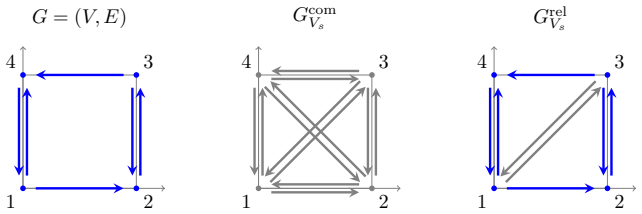
Summary. The paper studies mass-action systems that are not themselves complex-balanced but are dynamically equal to complex-balanced realizations (disguised complex-balanced systems). It first reformulates membership of a rate vector k in the disguised complex-balanced parameter locus K_dCB as the existence of positive concentrations x such that the reaction-rate vector v_k(x) lies in a polyhedral cone C_dCB (the disguised complex-balanced flux cone), yielding a parametrized system of polynomial inequalities (Theorem 16). Applying the authors’ earlier positive-algebraic-geometry framework, the concentrations are eliminated, producing an equivalent characterization solely in terms of binomial equations on the positive part of that cone intersected with the simplex (Theorem 20). A self-contained proof of the key reduction that only source complexes of the original network need be retained (Theorem 8) is supplied, and the method is illustrated on the partially reversible cycle of Boros et al., recovering their locus analytically after the elimination step.
Significance. If correct, the result supplies a systematic algebraic reduction that removes the state variables from the quantifier-elimination problem defining the disguised complex-balanced locus. This is a genuine computational and conceptual advance over the full (x, u)-elimination performed by Boros et al., and it places the problem cleanly inside the authors’ existing theory of generalized polynomial inequalities. The paper is largely self-contained: it re-proves the essential dynamical-equivalence reduction (Theorem 8) and verifies that the resulting locus coincides with an independently obtained description on a nontrivial example. The contribution is therefore both theoretical (a new geometric object, the disguised complex-balanced flux cone, together with an explicit binomial characterization) and practical (a reduced elimination problem).
minor comments (4)
- The ambient complete-graph construction (Proposition 11) and the subsequent relevant-edge subgraph (Remark 17) are correct but could be sign-posted more clearly for readers who have not internalized Theorem 9; a short sentence after Proposition 11 reminding that V'_s \subseteq V_s is already guaranteed by Theorem 9 would help.
- In the example, the four homogeneous linear equations that reduce the six-dimensional problem to a quadratic in u_41/ u_12 are stated without an intermediate matrix or Gröbner step; a one-line reference to the explicit basis of D would make the reduction fully reproducible by hand.
- Notation for the kinetic matrix Γ_k versus the stoichiometric matrix N is introduced carefully, yet the switch between u = v_k(x) and the auxiliary ū occasionally forces the reader to re-check which graph is intended; a consistent subscript (e.g., u^E versus ū^{E_com}) would reduce cognitive load.
- The phrase “s-cone” is used once without definition; either expand it or cite the earlier paper [23] more explicitly at that point.
Circularity Check
No significant circularity: Theorem 20 is a genuine application of an external positive-algebraic-geometry framework to a newly derived polyhedral characterization of the disguised locus.
full rationale
The paper's central claim (Theorem 20) is obtained by applying the authors' prior framework for generalized polynomial inequalities (Theorem 18 / Corollary 19 of [24]) to the polyhedral reformulation of the disguised complex-balanced locus already established in Theorem 16. That reformulation itself rests on a self-contained sequence of lemmas (12–13) and a streamlined proof of the key dynamical-equivalence reduction (Theorem 8), which the authors supply rather than merely cite. The ambient complete-graph construction (Proposition 11) inherits Theorem 9 from Craciun et al., but the paper makes the inheritance explicit and verifies that the resulting locus coincides with the independently computed locus of Boros et al. on the running example. No equation is forced by a normalization that already encodes the target, no parameter is fitted and then re-predicted, and the self-citations are not load-bearing for the elimination step itself. The derivation is therefore self-contained against external benchmarks; the single minor self-citation of the authors' own framework is ordinary and does not raise the score above 1.
Assumptions & free parameters
assumptions (4)
- domain assumption Existence of a positive complex-balanced equilibrium implies uniqueness, asymptotic stability (global Lyapunov function) and linear stability in every stoichiometric class (Horn–Jackson, Feinberg).
- domain assumption A mass-action system admits a dynamically equal complex-balanced realization if and only if it admits one whose source complexes are a subset of the original source complexes (Theorem 9, from Craciun et al. 2020).
- standard math For a parametrized system of generalized polynomial inequalities (c o x^B) o C, the solution set is nonempty if and only if the corresponding binomial system on the coefficient polytope is nonempty (Corollary 19 of Müller–Regensburger 2026).
- standard math Polyhedral cones defined by linear equalities and non-negativity can be projected by vertex-enumeration algorithms such as lrs.
invented entities (1)
-
disguised complex-balanced flux cone C_dCB
Cite this review
Pith. "Pith review of Disguised complex balance via positive algebraic geometry." pith.science (2026). https://pith.science/paper/HQDCVR4Q
@misc{pith2026260704810,
  author       = {Pith},
  title        = {Pith review of: Disguised complex balance via positive algebraic geometry},
  year         = {2026},
  howpublished = {\url{https://pith.science/paper/HQDCVR4Q}},
  note         = {Machine review of arXiv:2607.04810}
}
read the original abstract
We study dynamical systems arising from reaction networks under mass-action kinetics. For certain choices of the rate constants (parameters), such systems are complex-balanced (vertex-balanced), which guarantees the existence of a unique positive equilibrium. Moreover, this equilibrium is asymptotically stable (admitting a global Lyapunov function) and linearly stable. In a series of recent papers, Craciun and collaborators introduced and studied disguised complex-balanced systems, that is, mass-action systems that are dynamically equal to auxiliary complex-balanced systems and therefore inherit their strong stability properties. Determining the parameter values for which a given system is disguised complex-balanced is a nontrivial algebraic problem. In this work, we show that the defining conditions for disguised complex-balanced equilibria naturally give rise to parametrized systems of polynomial inequalities. Using the framework for positive algebraic geometry developed by M\"uller and Regensburger, we reformulate these systems as binomial equations (on the disguised complex-balanced flux cone). Computing the disguised complex-balanced parameter locus can be viewed as a quantifier-elimination problem, and our approach eliminates the concentrations (state variables) from the problem. We illustrate our results using the running example of a recent paper by Boros et al.
Figures
Reference graph
Works this paper leans on
-
[1]
Adleman, M
L. Adleman, M. Gopalkrishnan, M. Huang, P. Moisset, and D. Reishus. On the mathematics of the law of mass action. InA Systems Theoretic Approach to Systems and Synthetic Biology I: Models and System Characterizations, pages 3–46. Springer, 2014
2014
-
[2]
D. Avis. A revised implementation of the reverse search vertex enumeration algorithm. In G. Kalai and G. M. Ziegler, editors,Polytopes — Combinatorics and Computation, volume 29 ofDMV Seminar Band, pages 177–198. Birkh¨ auser-Verlag, 2000
2000
-
[3]
Avis.lrslib: A self-contained C implementation of the reverse search algorithm, Version 7.3
D. Avis.lrslib: A self-contained C implementation of the reverse search algorithm, Version 7.3. School of Computer Science, McGill University, Montreal, Canada, 2023. Available at http://cgm.cs.mcgill.ca/~avis/C/lrs.html
2023
-
[4]
Avis and K
D. Avis and K. Fukuda. A pivoting algorithm for convex hulls and vertex enumeration of arrangements and polyhedra.Discrete & Computational Geometry, 8(1):295–313, 1992
1992
-
[5]
B. Boros. Existence of positive steady states for weakly reversible mass-action systems. SIAM J. Math. Anal., 51(1):435–449, 2019
2019
- [6]
-
[7]
Brustenga i Moncus´ ı, G
L. Brustenga i Moncus´ ı, G. Craciun, and M.-c. Sorea. Disguised toric dynamical systems. J. Pure Appl. Algebra, 226(8):107035, 2022
2022
-
[8]
G. Craciun. Toric differential inclusions and a proof of the global attractor conjecture. arXiv, 2015. arXiv:1501.02860
arXiv 2015
Show all 27 references
-
[9]
G. Craciun. Polynomial dynamical systems, reaction networks, and toric differential inclu- sions.SIAM J. Appl. Algebra Geom., 3(1):87–106, 2019
2019
-
[10]
Craciun, A
G. Craciun, A. Deshpande, and J. Jin. On the connectivity of the disguised toric locus of a reaction network.J. Math. Chem., 62(2):386–405, 2024
2024
-
[11]
Craciun, A
G. Craciun, A. Deshpande, and J. Jin. The dimension of the disguised toric locus of a reaction network.Stud. Appl. Math., 154(6):e70071, 2025
2025
-
[12]
Craciun, J
G. Craciun, J. Jin, and P. Y. Yu. An efficient characterization of complex-balanced, detailed-balanced, and weakly reversible systems.SIAM Journal on Applied Mathemat- ics, 80(1):183–205, 2020
2020
-
[13]
Craciun, S
G. Craciun, S. M¨ uller, C. Pantea, and P. Yu. A generalization of Birch’s theorem and vertex- balanced steady states for generalized mass-action systems.Mathematical Biosciences and Engineering, 16(6):8243–8267, 2019
2019
-
[14]
Craciun and C
G. Craciun and C. Pantea. Identifiability of chemical reaction networks.J. Math. Chem., 44(1):244–259, 2008
2008
-
[15]
Feinberg.Foundations of Chemical Reaction Network Theory
M. Feinberg.Foundations of Chemical Reaction Network Theory. Springer International Publishing, 2019
2019
-
[16]
Feinberg and F
M. Feinberg and F. J. M. Horn. Chemical mechanism structure and the coincidence of the stoichiometric and kinetic subspaces.Arch. Rational Mech. Anal., 66(1):83–97, 1977. 17
1977
-
[17]
Hars and J
V. Hars and J. T´ oth. On the inverse problem of reaction kinetics.Colloq. Math. Soc. J´ anos Bolyai, 30:pp. 363–379, 1981
1981
-
[18]
F. Horn. Necessary and sufficient conditions for complex balancing in chemical kinetics. Arch. Rational Mech. Anal., 49:172–186, 1972
1972
-
[19]
Horn and R
F. Horn and R. Jackson. General mass action kinetics.Arch. Rational Mech. Anal., 47:81– 116, 1972
1972
-
[20]
M. D. Johnston.Topics in chemical reaction network theory. PhD thesis, University of Waterloo, 2011
2011
-
[21]
M. D. Johnston, D. Siegel, and G. Szederk´ enyi. A linear programming approach to weak reversibility and linear conjugacy of chemical reaction networks.J. Math. Chem., 50(1):pp. 274–288, 2012
2012
-
[22]
M¨ uller and G
S. M¨ uller and G. Regensburger. Generalized mass-action systems and positive solutions of polynomial equations with real and symbolic exponents. InComputer Algebra in Scientific Computing – CASC 2014, volume 8660 ofLecture Notes in Comput. Sci., pages 302–323, Berlin/Heidelbe...
2014
-
[23]
M¨ uller and G
S. M¨ uller and G. Regensburger. Elementary vectors and conformal sums in polyhedral geometry and their relevance for metabolic pathway analysis.Front. Genet., 7(90):1–11, 2016
2016
-
[24]
M¨ uller and G
S. M¨ uller and G. Regensburger. Parametrized systems of generalized polynomial inequalities via linear algebra and convex geometry.Positivity, 30:4, 2026
2026
-
[25]
Szederk´ enyi and K
G. Szederk´ enyi and K. M. Hangos. Finding complex balanced and detailed balanced real- izations of chemical reaction networks.J. Math. Chem., 49:pp. 1163–1179, 2011
2011
-
[26]
E. Voit, H. Martens, and S. Omholt. 150 years of the mass action law.PLOS Comput. Biol., 11(1):e1004012, 2015
2015
-
[27]
Yu and G
P. Yu and G. Craciun. Mathematical Analysis of Chemical Reaction Systems.Isr. J. Chem., 58(6-7):733–741, 2018. 18
2018
Reviewed July 11, 2026 · model on record in the stance chip above.
Discussion (0). Continue with ORCID to comment.