pith. sign in

arxiv: 2605.18062 · v2 · pith:HRGBTORPnew · submitted 2026-05-18 · 🌌 astro-ph.EP · astro-ph.GA· astro-ph.SR

Chemistry and IR emission of acetylene in planet-forming regions of T Tauri disks. Impact of elemental abundances and dust properties

Pith reviewed 2026-05-20 08:29 UTC · model grok-4.3

classification 🌌 astro-ph.EP astro-ph.GAastro-ph.SR
keywords acetylene emissionT Tauri disksC/O ratiomid-infrared linesplanet-forming regionswater emissionelemental abundancesJWST observations
0
0 comments X

The pith

The acetylene-to-water flux ratio traces the gas-phase C/O and O/H ratios in the inner regions of T Tauri disks.

A machine-rendered reading of the paper's core claim, the machinery that carries it, and where it could break.

This paper uses an updated 2D thermochemical model to predict mid-infrared emission from acetylene and water in the warm inner zones of planet-forming disks. It demonstrates that acetylene forms mainly through X-ray dissociation of CO and is destroyed by atomic oxygen released from water and CO, so the observed flux ratio depends directly on the elemental carbon-to-oxygen ratio and the overall oxygen abundance. The models match current observations when a solar C/O ratio is assumed, yet show that higher oxygen abundances suppress acetylene emission while the relative abundance of small grains boosts it relative to water. This implies the flux ratio can serve as a diagnostic of the gas composition available for planet formation rather than reflecting dust properties alone.

Core claim

Acetylene abundance results from the competition between X-ray-driven formation initiated by CO dissociation and destruction by atomic oxygen produced from H2O and CO; the resulting F_C2H2/F_H2O ratio is sensitive to both the C/O ratio and the total O/H abundance, with enhanced O/H lowering acetylene emission. Models using a solar C/O ratio reproduce observed acetylene fluxes, while increasing the fraction of small grains relative to large grains favors higher C2H2 flux over H2O flux. Grain depletion has little effect on the ratio.

What carries the argument

The DALI 2D thermochemical model with carbon chemistry adapted for warm gas, updated UV shielding, and mutual line overlap treatment in the ray-tracing step.

If this is right

  • Enhanced O/H reduces C2H2 emission through excess atomic oxygen.
  • The flux ratio acts as a tracer for both C/O and total oxygen abundance in inner-disk gas.
  • Higher fractions of small grains increase C2H2 flux relative to H2O flux.
  • Grain depletion leaves the line flux ratio largely unchanged.

Where Pith is reading between the lines

These are editorial extensions of the paper, not claims the author makes directly.

  • If enhanced O/H proves common, it would point to oxygen-rich gas reservoirs that could alter the chemistry available during planet assembly.
  • Systematic JWST mapping of this ratio across many disks could reveal spatial or evolutionary trends in elemental composition.
  • The same modeling framework could be applied to predict fluxes of other organics such as HCN or CH4 for additional composition diagnostics.

Load-bearing premise

The chemical network correctly describes acetylene formation from CO dissociation by X-rays and its destruction by atomic oxygen without omitting important reaction channels or rate errors in the warm inner-disk conditions.

What would settle it

A disk with independently determined high gas-phase O/H showing strong acetylene emission instead of the predicted suppression would falsify the claimed dependence of the flux ratio on oxygen abundance.

Figures

Figures reproduced from arXiv: 2605.18062 by Aditya M. Arabhavi, Beno\^it Tabone, Emilie Habart, Ewine F. van Dishoeck, Inga Kamp, Marissa Vlasblom, Pac\^ome Est\`eve, Simon Bruderer.

Figure 1
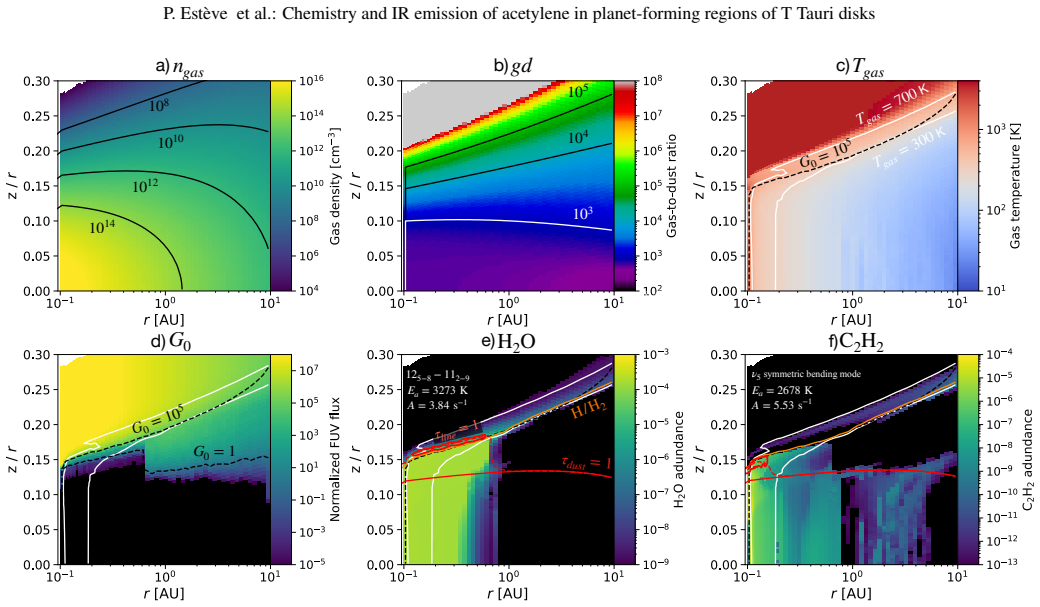
Figure 1. Figure 1: Disk structure of the fiducial model. The top panels show the gas density, the local gas-to-dust ratio and the gas temperature. The bottom panels present the normalized UV field G0 (Habing units), the abundance of H2O and C2H2. The white lines indicate the 300 K and 700 K gas temperature contours. The bottom red solid line shows the dust optically thick surface (τdust = 1 at 14 µm) while the dashed red lin… view at source ↗
Figure 2
Figure 2. Figure 2: DALI synthetic spectrum of C2H2 (red) and H2O (blue) for the fiducial model. The total spectrum is shown in black. The spectral resolution is λ/∆λ = 2000 to mimic a JWST/MIRI spectrum. Although the fiducial model is richer in oxygen, the C2H2 feature stands out clearly from the forest of water lines. the carbon released by CO dissociation, and destruction by the oxygen. This balance reveals that C2H2 is no… view at source ↗
Figure 3
Figure 3. Figure 3: Top panel: Vertical cut at r = 0.15 au showing the abundances of several key atoms and molecules. Middle panel: Irradiation conditions in this vertical cut, with G H2O shield 0 showing the UV field attenuated by water absorption (water shielding). The grey line G0 indicates what the UV field would be without the water UV shielding. Bottom panel: Gas and dust temperature, with the gas density nH in blue. Wa… view at source ↗
Figure 4
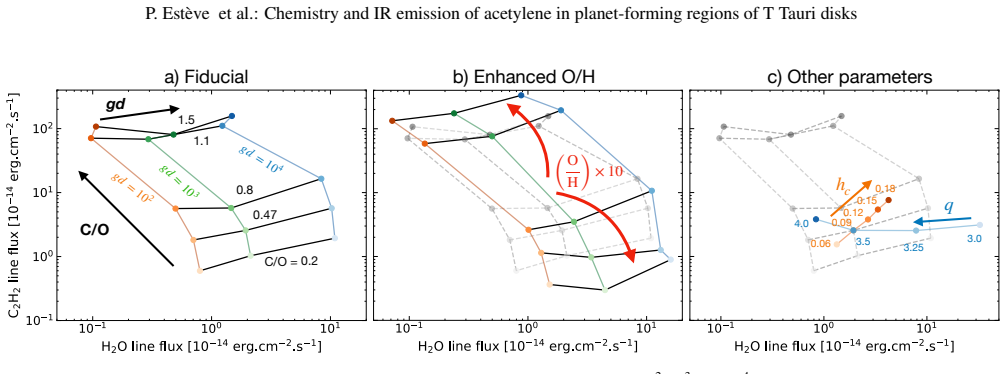
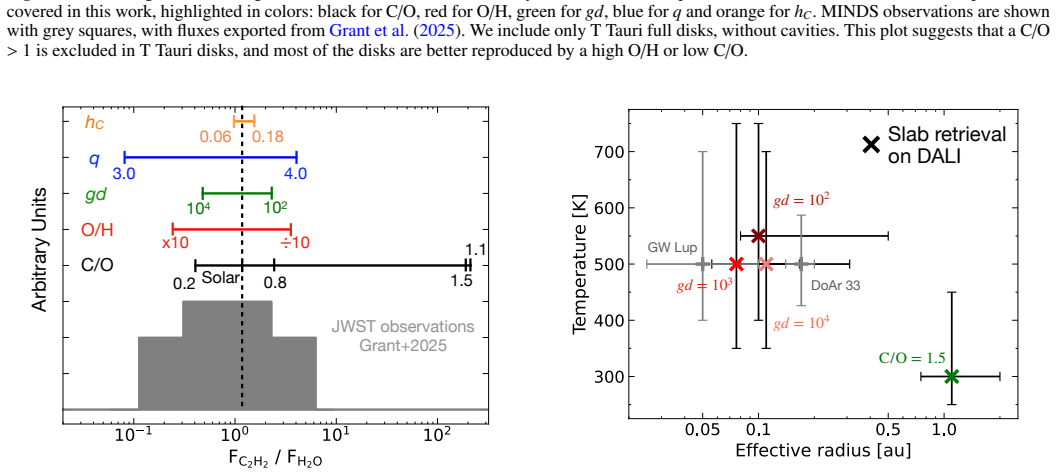
Figure 4. Figure 4: Left: Result from the fiducial grid. Orange, Green and blue points correspond to gd = 102 ,103 and 104 respectively. The black lines highlight a constant C/O ratio. Middle: Result obtained for the "enhanced O/H" grid: O/H×10 (C/H is scaled with the C/O ratio). The fiducial grid is overlaid in grey for reference. Right: Results for the disk aspect ratio hC (orange), power law index of the dust distribution … view at source ↗
Figure 5
Figure 5. Figure 5: Evolution of the line flux ratio C2H2/H2O with the elemental abundances (C/O and O/H), gas-to-dust mass ratio gd, power law index q and disk aspect ratio hC from left to right respectively. Fiducial model with C/O=0.47 adopted in c), d) and e) except for parameters that is varied. C2H2 H2O O/H x10 Fiducial Enhanced O/H Solar C/O Solar C/O [PITH_FULL_IMAGE:figures/full_fig_p009_5.png] view at source ↗
Figure 6
Figure 6. Figure 6: DALI synthetic spectra of the fiducial model (left panel) and a model with O/H x10 (right panel). The Q-branch of C2H2 (black) and the water lines (blue) used for the line flux around 17.25 µm are shown together for clarity. The carbon and oxygen budget itself acts similarly to a decrease in the C/O ratio: the flux of water increases while acetylene decreases. O/H grid in Appendix D). Our results confirm t… view at source ↗
Figure 7
Figure 7. Figure 7: Vertical cut at r = 0.15 au showing the abundance of C2H2 (top) and the corresponding spectrum (bottom) for 2 chemical networks: the fiducial (in red) and the one based on UMIST only (including also three￾body reactions and C + H2O −→ HCO + H). Our models are based on an extended chemical network, combining reactions from the latest version of UMIST (Mil￾lar et al. 2023, RATE22) and KIDA (Wakelam et al. 20… view at source ↗
Figure 9
Figure 9. Figure 9: Vertical column densities at r = 0.15 au for hydrocarbons. The total vertical column density is shown in blue. The red dots represent the emitting column density (above the surface τdust = 1 at 14 µm and Tgas > 500 K). While CH4 is the major hydrocarbon, C2H2 is dominant in the emitting layers. 4.2. Hydrocarbons beyond acetylene C2H2 is detected in nearly all disks around T Tauri, accord￾ing to Spitzer (Po… view at source ↗
Figure 10
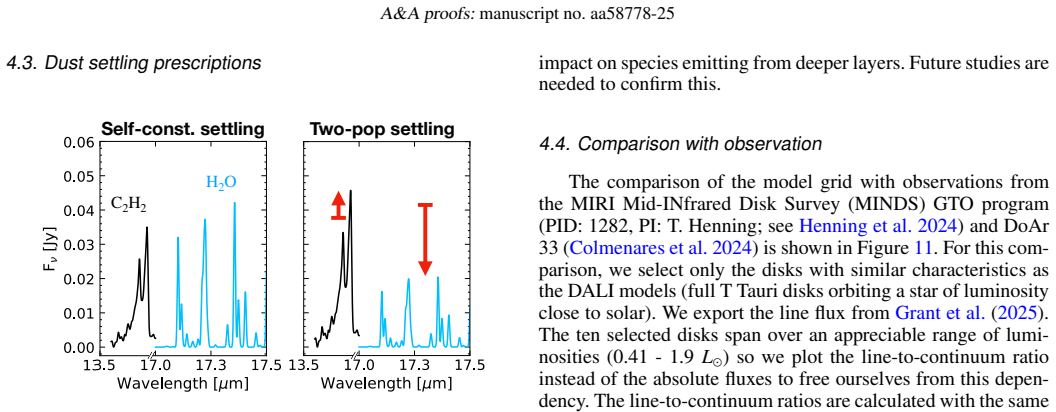
Figure 10. Figure 10: DALI synthetic spectra for two dust settling prescriptions. Left: fiducial spectrum with self-consistent dust settling (Riols settling, Riols & Lesur 2018). Right: spectrum obtained with the two-pop settling pre￾scription, based on two dust population (small - large). The two-pop settling reduces water emission by a factor 2. . Our results show that molecular emissions are sensitive to dust properties. Th… view at source ↗
Figure 11
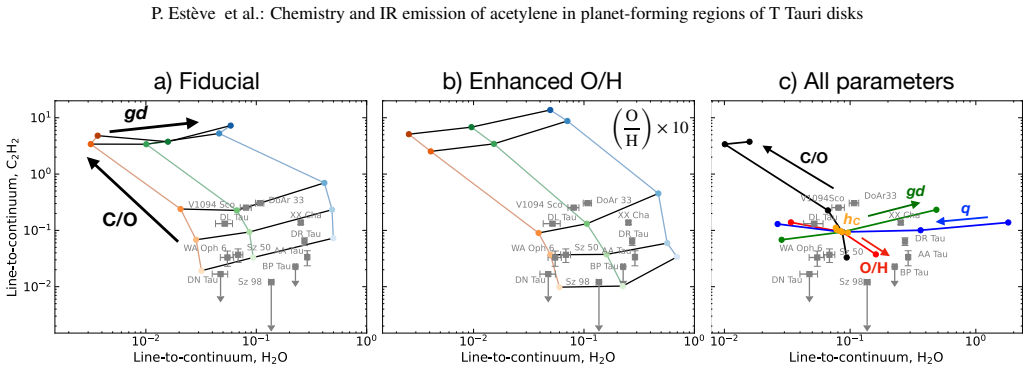
Figure 11. Figure 11: Same as [PITH_FULL_IMAGE:figures/full_fig_p013_11.png] view at source ↗
Figure 13
Figure 13. Figure 13: Temperature and effective radius (corresponding to an emitting area πR 2 ) of C2H2 emission retrieved from slab models on DALI pre￾dicted spectra. Red crosses indicate DALI models with solar C/O and gd = 102 , 103 , 104 , while the green cross corresponds to C/O = 1.5 and gd = 103 . JWST observations of 2 disks are shown in grey (Grant et al. 2023; Colmenares et al. 2024). thick in the inner disk. Detaile… view at source ↗
read the original abstract

(Abridged) We aim to explore the parameters that influence the mid-infrared emission of C$_2$H$_2$ and H$_2$O, and if the spread observed in $F\rm{_{C_2H_2}}$/$F\rm{_{H_2O}}$ is tracing a variation of the C/O ratio. Our work is based on the DALI 2D thermochemical model to predict spectra readily comparable to JWST/MIRI observations. To robustly model organics in inner disks, several improvements have been made: (1) carbon chemistry adapted for warm environments, (2) updated UV shielding treatment, and (3) mutual line overlap in the raytracing. We are able to reproduce the observed C$_2$H$_2$ fluxes of T Tauri disks with a solar C/O ratio. Acetylene abundance is primarily set by a balance between formation initiated by CO dissociation by X-rays and destruction of carbon chains by atomic oxygen, the latter being generated by X-ray-induced destruction of H$_2$O and CO. The water UV shielding and hot temperatures of the inner disk also favor acetylene formation, as they prevent the destruction of carbon chains and allow overcoming activation barriers of reactions with H$_2$. C$_2$H$_2$ and H$_2$O emissions are not only sensitive to the C/O ratio but also to the total O/H elemental abundance, supporting recent claims. In particular, we find that enhanced O/H reduces acetylene emission due to an excess of atomic oxygen. $F_{\rm{C_2H_2}}$/$F_{\rm{H_2O}}$ is thus a promising tracer of the elemental composition of inner disks. Still, the dust size distribution also plays a key role in this line flux ratio. We find that increasing the abundance of small grains relative to large grains favors C$_2$H$_2$ flux over H$_2$O flux. Grain depletion does not affect the line flux ratio as previously suggested by observational works. A preliminary comparison with published JWST observations indicates a gas-phase C/O ratio below unity and suggests that enhanced O/H ratios may be common in T Tauri disks.

Editorial analysis

A structured set of objections, weighed in public.

Desk editor's note, referee report, simulated authors' rebuttal, and a circularity audit. Tearing a paper down is the easy half of reading it; the pith above is the substance, this is the friction.

Referee Report

3 major / 2 minor

Summary. The manuscript uses an updated DALI 2D thermochemical model to predict mid-IR spectra of C2H2 and H2O in T Tauri inner disks. Key updates include adapting carbon chemistry for warm conditions, revising UV shielding, and incorporating mutual line overlap in raytracing. The central result is that the flux ratio F_C2H2 / F_H2O traces gas-phase C/O and O/H abundances, with solar C/O reproducing observed C2H2 fluxes; acetylene forms via X-ray CO dissociation and is destroyed by atomic O from H2O/CO. Dust size distribution also affects the ratio, while grain depletion does not. Preliminary JWST comparisons suggest sub-solar C/O and commonly enhanced O/H in T Tauri disks.

Significance. If the chemical network holds, the work supplies a practical observational diagnostic for inner-disk elemental composition, directly relevant to planet-formation chemistry. The reproduction of observed fluxes at solar C/O and the exploration of O/H and dust sensitivities add concrete value; the model improvements for warm organics enable more direct JWST comparisons than prior efforts.

major comments (3)
  1. [Model description and chemical network (Section 2, improvements 1-3)] The claim that acetylene abundance is controlled by the balance of X-ray-driven CO dissociation versus atomic-O destruction (from H2O and CO) is load-bearing for the tracer interpretation, yet the updated DALI network is not benchmarked against independent rate databases or other codes for the warm inner-disk regime (T ~ 100-500 K, high density, X-ray ionization). This validation gap directly affects the predicted sensitivity of F_C2H2/F_H2O to C/O and O/H.
  2. [Results (Section 4) and abstract] Table or figure showing flux reproduction at solar C/O reports no quantitative uncertainties or Monte-Carlo error bars on the modeled fluxes; without these, the inference that enhanced O/H is common (and reduces C2H2 emission) remains only moderately supported.
  3. [Discussion and conclusions (Section 5)] The preliminary JWST comparison concluding gas-phase C/O below unity depends on the specific choice of dust size distribution and O/H values; the manuscript does not present a systematic grid that isolates the ratio from dust effects, weakening the tracer claim.
minor comments (2)
  1. [Notation and figures] Clarify in the text whether 'enhanced O/H' refers to a specific factor above solar (e.g., 2x or 3x) and show this explicitly in the relevant figures.
  2. [Methods] Add a short paragraph or appendix entry summarizing the key rate coefficients and branching ratios that were updated for the warm carbon chemistry.

Simulated Author's Rebuttal

3 responses · 0 unresolved

We thank the referee for their thorough review and positive assessment of the significance of our work. We address each of the major comments point by point below, indicating where revisions will be made to the manuscript.

read point-by-point responses
  1. Referee: [Model description and chemical network (Section 2, improvements 1-3)] The claim that acetylene abundance is controlled by the balance of X-ray-driven CO dissociation versus atomic-O destruction (from H2O and CO) is load-bearing for the tracer interpretation, yet the updated DALI network is not benchmarked against independent rate databases or other codes for the warm inner-disk regime (T ~ 100-500 K, high density, X-ray ionization). This validation gap directly affects the predicted sensitivity of F_C2H2/F_H2O to C/O and O/H.

    Authors: We recognize the importance of validating the chemical network for the specific conditions of the warm inner disk. Our updates to the DALI network incorporate established reaction rates from the literature for warm carbon chemistry, including adaptations to account for high temperatures and densities. While a comprehensive benchmark against other codes like those used in recent JWST modeling papers is not included in the current manuscript, the network reproduces observed C2H2 fluxes at solar C/O, providing empirical support. In revision, we will add a dedicated paragraph in Section 2 discussing the key reactions, their rate sources (e.g., from the UMIST database and disk chemistry studies), and any known uncertainties in the warm regime. This will strengthen the foundation for the tracer interpretation without requiring a full new benchmark study at this stage. revision: partial

  2. Referee: [Results (Section 4) and abstract] Table or figure showing flux reproduction at solar C/O reports no quantitative uncertainties or Monte-Carlo error bars on the modeled fluxes; without these, the inference that enhanced O/H is common (and reduces C2H2 emission) remains only moderately supported.

    Authors: The referee is correct that the modeled fluxes lack explicit uncertainty estimates. Since our models are based on fixed input parameters and deterministic calculations, we did not include Monte-Carlo error bars in the original submission. To address this, we will revise Section 4 to include a discussion of uncertainties stemming from variations in elemental abundances, dust properties, and X-ray fluxes. We will add estimated uncertainties to the flux values in the relevant table or figure, derived from a limited parameter exploration, to better support the conclusions about enhanced O/H being common. revision: yes

  3. Referee: [Discussion and conclusions (Section 5)] The preliminary JWST comparison concluding gas-phase C/O below unity depends on the specific choice of dust size distribution and O/H values; the manuscript does not present a systematic grid that isolates the ratio from dust effects, weakening the tracer claim.

    Authors: We agree that the JWST comparison is preliminary and that dust properties influence the flux ratio, as already noted in the manuscript. We have tested multiple dust size distributions and shown that the ratio is sensitive to the abundance of small grains. However, a full systematic grid decoupling C/O from all dust effects would be extensive and is beyond the scope of this initial study. In the revised manuscript, we will expand Section 5 to present additional models that better isolate the C/O and O/H effects while holding dust fixed, and we will qualify the conclusions to emphasize the preliminary nature while highlighting the robustness across the explored parameter space. revision: partial

Circularity Check

0 steps flagged

No significant circularity; forward modeling with independent physical assumptions

full rationale

The paper runs the established DALI 2D thermochemical code with three stated improvements (warm carbon chemistry, updated UV shielding, mutual line overlap) to compute C2H2 and H2O line fluxes as functions of C/O, O/H, and dust properties. The reproduction of observed fluxes at solar C/O and the sensitivity analysis that leads to the tracer claim are direct outputs of these forward models rather than any self-definitional loop, fitted parameter renamed as prediction, or load-bearing self-citation. No equation or section reduces the central result to its own inputs by construction; the derivation remains a standard parameter exploration within an externally developed code framework.

Axiom & Free-Parameter Ledger

3 free parameters · 2 axioms · 0 invented entities

The central claim rests on standard thermochemical assumptions plus three adjustable elemental and dust parameters explored to match data. No new particles or forces are introduced.

free parameters (3)
  • C/O ratio = solar (approximately 0.5)
    Set to solar value to reproduce observed C2H2 fluxes; varied to test tracer behavior
  • O/H elemental abundance = enhanced relative to solar
    Explored as enhanced values increase atomic oxygen and suppress acetylene
  • Dust size distribution (small vs large grains) = increased small-grain fraction
    Varied to show effect on line flux ratio; more small grains favor C2H2
axioms (2)
  • domain assumption X-ray dissociation of CO and H2O generates atomic oxygen that destroys carbon chains
    Invoked in abstract as the dominant destruction route balancing acetylene formation
  • domain assumption Water UV shielding and high inner-disk temperatures protect carbon chains and overcome activation barriers
    Cited as conditions favoring acetylene survival in the model

pith-pipeline@v0.9.0 · 5995 in / 1710 out tokens · 83345 ms · 2026-05-20T08:29:34.695478+00:00 · methodology

discussion (0)

Sign in with ORCID, Apple, or X to comment. Anyone can read and Pith papers without signing in.

Reference graph

Works this paper leans on

220 extracted references · 220 canonical work pages · 32 internal anchors

  1. [1]

    , author =

    Cosmic. , author =. 2025 , pages =. doi:10.3847/2041-8213/adfbe3 , abstract =

  2. [2]

    MINDS: Intertwined evolution of dust and gas in large planet-forming disks. A diversity driven by halted pebble drift?

    MINDS: Intertwined evolution of dust and gas in large planet-forming disks. A diversity driven by halted pebble drift?. arXiv e-prints , keywords =. doi:10.48550/arXiv.2604.21803 , archivePrefix =. 2604.21803 , primaryClass =

  3. [3]

    , author =

    The. , author =. 2023 , file =. doi:10.1051/0004-6361/202346908 , abstract =

  4. [4]

    , author =

    The 2024. , author =. 2024 , pages =. doi:10.1051/0004-6361/202450606 , abstract =

  5. [5]

    , author =

    The. , author =. 2023 , pages =. doi:10.3847/1538-4365/accae9 , abstract =

  6. [6]

    , author =

    Water. , author =. 2022 , pages =. doi:10.3847/2041-8213/ac7d9f , abstract =

  7. [7]

    , author =

    Water. , author =. 2022 , pages =. doi:10.3847/2041-8213/ac66ce , abstract =

  8. [8]

    , author =

    Water. , author =. 2022 , pages =. doi:10.3847/2041-8213/ac822b , abstract =

  9. [9]

    , author =

    Hydrocarbon chemistry in the inner regions of planet-forming disks , volume =. , author =. 2024 , pages =. doi:10.1051/0004-6361/202346262 , abstract =

  10. [10]

    , author =

    Close-in ice lines and the super-stellar. , author =. 2023 , pages =. doi:10.1051/0004-6361/202347169 , abstract =

  11. [11]

    2007 , pages =

    , author =. 2007 , pages =. doi:10.1051/0004-6361:20066829 , abstract =

  12. [12]

    , author =

    X-ray chemistry in the envelopes around young stellar objects , volume =. , author =. 2005 , pages =. doi:10.1051/0004-6361:20052889 , language =

  13. [13]

    2009 , pages =

    , author =. 2009 , pages =. doi:10.1088/0067-0049/183/2/179 , abstract =

  14. [15]

    , keywords =

    Gas. , author =. 2008 , pages =. doi:10.1086/591548 , abstract =

  15. [16]

    , author =

    Ro-vibrational excitation of an organic molecule (. , author =. 2015 , pages =. doi:10.1051/0004-6361/201425009 , abstract =

  16. [17]

    , author =

    Models of gas-grain chemistry in dense interstellar clouds with complex organic molecules , volume =. , author =. 1992 , pages =. doi:10.1086/191713 , abstract =

  17. [18]

    , author =

    Efficiency of non-thermal desorptions in cold-core conditions:. , author =. 2021 , pages =. doi:10.1051/0004-6361/202039855 , abstract =

  18. [19]

    , author =

    The interstellar gas-phase chemistry of. , author =. 2014 , pages =. doi:10.1093/mnras/stu1089 , abstract =

  19. [20]

    , author =

    A. , author =. 2012 , pages =. doi:10.1088/0067-0049/199/1/21 , abstract =

  20. [21]

    , author =

    Consistent dust and gas models for protoplanetary disks:. , author =. 2017 , pages =. doi:10.1051/0004-6361/201730388 , abstract =

  21. [22]

    Annual Review of Astronomy and Astrophysics , author =

    Photodissociation and. Annual Review of Astronomy and Astrophysics , author =. 2022 , note =. doi:10.1146/annurev-astro-052920-010254 , abstract =

  22. [23]

    , keywords =

    Astrochemistry and compositions of planetary systems. , keywords =. doi:10.1016/j.physrep.2020.09.004 , archivePrefix =. 2010.03529 , primaryClass =

  23. [24]

    Chemical Physics , author =

    Photodissociation of small carbonaceous molecules of astrophysical interest , volume =. Chemical Physics , author =. 2008 , pages =. doi:10.1016/j.chemphys.2007.08.011 , abstract =

  24. [25]

    2018 , pages =

    , author =. 2018 , pages =. doi:10.1051/0004-6361/201833497 , abstract =

  25. [26]

    , author =

    The. , author =. 2013 , pages =. doi:10.1051/0004-6361/201220465 , abstract =

  26. [27]

    , author =

    Constraints on the. , author =. 2024 , pages =. doi:10.3847/1538-4357/ad6447 , abstract =

  27. [28]

    2024 , pages =

    , author =. 2024 , pages =. doi:10.3847/1538-4357/ad8b4f , abstract =

  28. [29]

    , author =

    Photodissociation and photoionization of molecules of astronomical interest:. , author =. 2023 , pages =. doi:10.1051/0004-6361/202346645 , abstract =

  29. [30]

    JWST-MIRI reveals a peculiar CO _ 2 -rich chemistry in the drift-dominated disk CX Tau

    MINDS. JWST-MIRI reveals a peculiar CO _ 2 -rich chemistry in the drift-dominated disk CX Tau. , keywords =. doi:10.1051/0004-6361/202450863 , archivePrefix =. 2412.12715 , primaryClass =

  30. [31]

    , month = feb, year =

    Raul, Eshan and Alarcón, Felipe and Bergin, Edwin A. , month = feb, year =. Tracking the. doi:10.3847/1538-4357/adaeae , abstract =

  31. [32]

    Frontiers in Astronomy and Space Sciences , author =

    Unusual. Frontiers in Astronomy and Space Sciences , author =. 2021 , pages =. doi:10.3389/fspas.2021.776942 , abstract =

  32. [33]

    , author =

    X‐. , author =. 1997 , pages =. doi:10.1086/303952 , abstract =

  33. [34]

    , author =

    Observing. , author =. 2021 , pages =. doi:10.3847/1538-4357/abd9c1 , abstract =

  34. [35]

    , author =

    The. , author =. 2025 , pages =. doi:10.3847/2041-8213/ad99d2 , abstract =

  35. [36]

    Chemical Physics , author =

    Temperature dependence of the. Chemical Physics , author =. 1982 , pages =. doi:10.1016/0301-0104(82)87050-X , language =

  36. [37]

    The Journal of Physical Chemistry A , author =

    Kinetics of. The Journal of Physical Chemistry A , author =. 1997 , pages =. doi:10.1021/jp963373o , abstract =

  37. [38]

    Chemical Physics , author =

    Temperature dependence of reactions and intersystem crossing of. Chemical Physics , author =. 1981 , pages =. doi:10.1016/0301-0104(81)80017-1 , language =

  38. [39]

    , author =

    Photodissociation and photoionisation of atoms and molecules of astrophysical interest , volume =. , author =. 2017 , pages =. doi:10.1051/0004-6361/201628742 , abstract =

  39. [40]

    Faraday Discussions , author =

    Photoprocesses in protoplanetary disks , volume =. Faraday Discussions , author =. 2006 , pages =. doi:10.1039/b517564j , language =

  40. [41]

    , author =

    Disentangling the dust and gas contributions of the. , author =. 2024 , note =. doi:10.1051/0004-6361/202450891 , abstract =

  41. [42]

    The Journal of Physical Chemistry A , author =

    How. The Journal of Physical Chemistry A , author =. 2009 , pages =. doi:10.1021/jp905524e , language =

  42. [43]

    , author =

    Water in. , author =. 2025 , pages =. doi:10.3847/1538-3881/ada962 , abstract =

  43. [44]

    , author =

    Emission from. , author =. 2025 , pages =. doi:10.3847/1538-3881/adb397 , abstract =

  44. [45]

    2024 , pages =

    , author =. 2024 , pages =. doi:10.1051/0004-6361/202348487 , abstract =

  45. [46]

    2011 , pages =

    , author =. 2011 , pages =. doi:10.1088/0004-637X/739/2/78 , abstract =

  46. [47]

    2024 , pages =

    , author =. 2024 , pages =. doi:10.1051/0004-6361/202347730 , abstract =

  47. [48]

    , author =

    Dust mineralogy and variability of the inner. , author =. 2024 , pages =. doi:10.1051/0004-6361/202451589 , abstract =

  48. [49]

    and Kamp, Inga and Dishoeck, Ewine F

    Arabhavi, Aditya M. and Kamp, Inga and Dishoeck, Ewine F. van and Henning, Thomas and Jang, Hyerin and Christiaens, Valentin and Gasman, Danny and Pascucci, Ilaria and Perotti, Giulia and Grant, Sierra L. and Barrado, David and Güdel, Manuel and Lagage, Pierre-Olivier and Garatti, Alessio Caratti o and Lahuis, Fred and Waters, L. B. F. M. and Kaeufer, Til...

  49. [50]

    Science , author =

    The ancient heritage of water ice in the solar system , volume =. Science , author =. 2014 , note =. doi:10.1126/science.1258055 , abstract =

  50. [51]

    The effects of transport processes on the bulk composition of the first generation of planetesimals interior to the water iceline , url =

    Oosterloo, Mark and Kamp, Inga and Westrenen, Wim van , month = apr, year =. The effects of transport processes on the bulk composition of the first generation of planetesimals interior to the water iceline , url =. doi:10.48550/arXiv.2504.15982 , abstract =

  51. [52]

    , author =

    The. , author =. 2019 , pages =. doi:10.3847/1538-4357/ab4ad9 , abstract =

  52. [53]

    , author =

    The photodissociation and chemistry of interstellar. , author =. 1988 , pages =. doi:10.1086/166877 , language =

  53. [54]

    , author =

    A. , author =. 2010 , pages =. doi:10.1088/0004-637X/721/2/1570 , abstract =

  54. [55]

    2025 , pages =

    , author =. 2025 , pages =. doi:10.1051/0004-6361/202452152 , abstract =

  55. [56]

    2025 , pages =

    , author =. 2025 , pages =. doi:10.1051/0004-6361/202451137 , abstract =

  56. [57]

    , keywords =

    The JDISC Survey: Linking the Physics and Chemistry of Inner and Outer Protoplanetary Disk Zones. , keywords =. doi:10.3847/1538-3881/addd01 , archivePrefix =. 2505.07562 , primaryClass =

  57. [58]

    , author =

    Molecules with. , author =. 2021 , pages =. doi:10.3847/1538-4365/ac2583 , abstract =

  58. [59]

    , author =

    If you like. , author =. 2021 , note =. doi:10.1051/0004-6361/202141786 , abstract =

  59. [60]

    and Bergin, Edwin A

    Keyte, Luke and Kama, Mihkel and Booth, Alice S. and Bergin, Edwin A. and Cleeves, L. Ilsedore and Dishoeck, Ewine F. van and Drozdovskaya, Maria N. and Furuya, Kenji and Rawlings, Jonathan and Shorttle, Oliver and Walsh, Catherine , month = mar, year =. Azimuthal. doi:10.48550/arXiv.2303.08927 , abstract =

  60. [61]

    , author =

    Mind the trap:. , author =. 2024 , pages =. doi:10.1051/0004-6361/202450405 , abstract =

  61. [62]

    , author =

    Connecting planet formation and astrochemistry:. , author =. 2019 , note =. doi:10.1051/0004-6361/201936105 , abstract =

  62. [65]

    , keywords =

    Dust evolution by chemisputtering during protostellar formation. , keywords =. doi:10.1051/0004-6361/202452228 , archivePrefix =. 2501.17937 , primaryClass =

  63. [66]

    , author =

    Carbon. , author =. 2024 , pages =. doi:10.3847/1538-4357/ad39e3 , abstract =

  64. [67]

    2016 , pages =

    , author =. 2016 , pages =. doi:10.3847/0004-637X/831/1/101 , abstract =

  65. [68]

    , author =

    Sulfur monoxide (. , author =. 2024 , pages =. doi:10.1051/0004-6361/202451299 , abstract =

  66. [69]

    , author =

    Constraining. , author =. 2018 , pages =. doi:10.3847/1538-4357/aade96 , abstract =

  67. [70]

    , author =

    Lupus disks with faint. , author =. 2017 , pages =. doi:10.1051/0004-6361/201629556 , abstract =

  68. [71]

    2017 , pages =

    , author =. 2017 , pages =. doi:10.1051/0004-6361/201629946 , abstract =

  69. [72]

    , keywords =

    MINDS: The very low-mass star and brown dwarf sample: Detections and trends in the inner disk gas. , keywords =. doi:10.1051/0004-6361/202554109 , archivePrefix =. 2506.02748 , primaryClass =

  70. [73]

    , author =

    Determining protoplanetary disk gas masses from. , author =. 2016 , pages =. doi:10.1051/0004-6361/201628159 , abstract =

  71. [74]

    , author =

    Consistent dust and gas models for protoplanetary disks:. , author =. 2016 , pages =. doi:10.1051/0004-6361/201526538 , abstract =

  72. [75]

    , author =

    How drifting and evaporating pebbles shape giant planets:. , author =. 2021 , pages =. doi:10.1051/0004-6361/202039640 , abstract =

  73. [76]

    , author =

    Molecular abundances and. , author =. 2018 , pages =. doi:10.1051/0004-6361/201731302 , abstract =

  74. [77]

    , author =

    C/. , author =. 2024 , pages =. doi:10.3847/2041-8213/ad5839 , abstract =

  75. [78]

    , author =

    Nitrogen isotope fractionation in protoplanetary disks , volume =. , author =. 2018 , pages =. doi:10.1051/0004-6361/201731898 , abstract =

  76. [79]

    and Jayawardhana, Ray and Damian, Belinda and Muzic, Koraljka and Natta, Antonella and Pinilla, Paola and Testi, Leonardo , month = may, year =

    Flagg, Laura and Scholz, Aleks and Almendros-Abad, V. and Jayawardhana, Ray and Damian, Belinda and Muzic, Koraljka and Natta, Antonella and Pinilla, Paola and Testi, Leonardo , month = may, year =. Detection of. doi:10.48550/arXiv.2505.13714 , abstract =

  77. [80]

    , author =

    Scanning. , author =. 2022 , pages =. doi:10.3847/1538-3881/ac52f0 , abstract =

  78. [81]

    , author =

    Molecules with. , author =. 2021 , pages =. doi:10.3847/1538-4365/ac1433 , abstract =

  79. [82]

    2012 , pages =

    , author =. 2012 , pages =. doi:10.1088/0004-637X/747/2/92 , abstract =

  80. [83]

    , author =

    Different dust and gas radial extents in protoplanetary disks: consistent models of grain growth and. , author =. 2017 , note =. doi:10.1051/0004-6361/201630329 , abstract =

Showing first 80 references.