REVIEW 4 major objections 6 minor 2 cited by
Vision-based autonomous structural damage detection using data-driven methods
T0 review · 4 major / 6 minor · reviewed 2026-08-10 · deepseek-v4-flash
Pith's one-line read The paper argues that YOLOv7 outperforms two rival detectors for wind-turbine surface damage, with 82.4% mAP@50 and 11 ms per image, making real-time automated inspection feasible.
desk verdict Routine YOLOv7 benchmark with a plausible ranking, but the paper never says which data split produced its headline numbers, and the 2.6-point margin over YOLOv7-tiny could easily be noise. read the letter →
The pith
A machine-rendered reading of the paper's core claim, the machinery that carries it, and where it could break.
The reading
What carries the argument
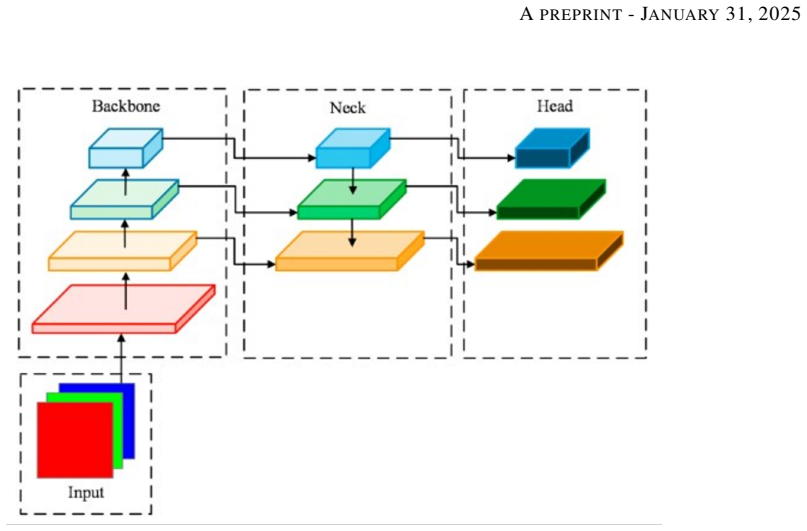
The mechanism that carries the argument is the one-stage detection pipeline of YOLOv7: a convolutional backbone extracts hierarchical image features, a neck layer fuses them across scales, and a head predicts bounding boxes and class labels in a single pass, aided by training techniques called 'trainable bag-of-freebies.' YOLOv7-tiny is the same design with a lighter backbone; Faster R-CNN is the two-stage alternative, running a region proposal network before classification. The comparison is made concrete by measuring mAP@50, precision, recall, and per-image execution time on the same dataset, with all three models initialized from pretrained weights.
What would settle it
Retrain each model from the same pretrained weights with several random seeds, tune hyperparameters only on the 299-image testing subset, and compute mAP@50 on the held-out 300-image evaluation subset; if YOLOv7's lead over YOLOv7-tiny and Faster R-CNN disappears or flips across seeds, the reported ranking is not reproducible.
Extended reading notes
Core claim
The paper's central claim, stated as its own result, is that YOLOv7 is the best of the three tested detectors for wind-turbine surface damage: 82.4% mAP@50, 83.3% precision, and 81.1% recall at 11 ms per image. YOLOv7-tiny trades a small amount of accuracy (79.8% mAP@50) for a faster 7 ms per image, and Faster R-CNN is the most accurate on small, low-contrast defects but takes 200 ms per image. The authors read these results as evidence that one-stage detectors, and YOLOv7 specifically, are suitable for real-time structural health monitoring, while the two-stage detector remains useful for offline reviews. The finding extends earlier vision-based structural damage detection work to a two-class dataset of turbine surfaces combining damage and pollution.
Load-bearing premise
The ranking in Table 3 is only trustworthy if the metrics came from a held-out test set that was never used for hyperparameter selection; the paper defines separate testing and evaluation subsets but never identifies which one produced the headline numbers.
Editorial extensions
If this is right
- At 11 ms per image, YOLOv7 can process roughly 90 frames per second, fast enough to inspect turbine surfaces while a drone flies past rather than hovering.
- YOLOv7-tiny at 7 ms per image is the paper's recommended trade-off for edge devices and embedded cameras, losing about 2.6 points of mAP@50 compared with full YOLOv7.
- Faster R-CNN at 200 ms per image is unsuitable for real-time scanning, so its role is offline analysis of small or low-contrast damage.
- The two-class damage/pollution output can act as a triage layer that flags regions for closer inspection, with segmentation models proposed as the next step for severity measurement.
Reading between the lines
- The paper does not test whether the 82.4% figure survives a change of turbine site, camera, or weather; running the trained YOLOv7 on images from a turbine outside the training distribution would show how much of the accuracy is dataset-specific.
- Because the three models are separated by only about 2.6 to 3.3 points of mAP@50, a different random seed or split could plausibly reorder second and third place; reporting variance across seeds would settle the stability of the ranking.
- The 11 ms inference time is a GPU measurement; re-measuring on drone-grade embedded hardware would give the practical frame rate for real deployment.
- A testable extension is to add instance segmentation and compare pixel-level crack area against manual measurements, turning the detector into a severity-estimation tool rather than a flagging tool.
Editorial analysis
A structured set of objections, weighed in public.
Referee Report
Summary. The paper presents a comparative study of YOLOv7, YOLOv7-tiny, and Faster R-CNN for detecting surface damage (damage vs. pollution) in wind turbine images. The authors built an augmented dataset of 2,995 images from public sources, split it 80/10/10 into training, testing, and evaluation subsets (Section 2.1.1), and trained the three detectors with transfer learning and hyperparameter tuning (Section 2.4). They report that YOLOv7 achieves the best mAP@50 (82.4%), precision (83.3%), and recall (81.1%) with an execution time of 11 ms per image, followed by YOLOv7-tiny (79.8%, 7 ms) and Faster R-CNN (79.11%, 200 ms) (Table 3). The paper concludes that YOLOv7 is the most effective model for real-time structural health monitoring, while noting dataset and environmental limitations and suggesting future segmentation-based work.
Significance. If the reported results are correct, the paper provides a useful empirical comparison of three object detectors on a wind-turbine damage dataset, with the practical implication that YOLOv7 offers a strong speed-accuracy trade-off for real-time inspection. The authors make their dataset publicly available through two Kaggle links and use standard detection metrics (mAP@50, precision, recall, execution time), which supports reproducibility in principle. The contribution is an application-oriented benchmark rather than a methodological advance; its value to the community depends on the reliability and clarity of the reported experimental evidence. The paper is most relevant to researchers in structural health monitoring and computer-vision practitioners seeking to deploy lightweight detectors on edge devices.
major comments (4)
- [§2.1.1 and §3, Table 3] The manuscript defines an 80/10/10 split into training, testing, and evaluation subsets, but it never states which subset produced the mAP values in Table 3. Since Section 2.4.1 reports that hyperparameters were fine-tuned, the 'evaluation' set may have been used for model selection; if the headline numbers come from that set, the 2.6-point margin between YOLOv7 (82.4%) and YOLOv7-tiny (79.8%) could be an artifact of selecting on validation data. Please state explicitly which split was used for the final comparison, report metrics on both held-out splits, and, if the eval set was used for tuning, describe the selection procedure (e.g., early stopping) and present the test-set results as the primary evidence.
- [§3, Table 3] The comparison lacks any measure of uncertainty. With a test set of only 299 images and a single training run per model, the 2.6 mAP difference between YOLOv7 and YOLOv7-tiny is not demonstrably outside noise; a bootstrap confidence interval on mAP@50 would likely overlap. Please report variance across multiple seeds (e.g., mean ± std over at least three runs) or a bootstrap interval, and provide per-class AP for 'damage' and 'pollution' so the reader can see whether the ranking is driven by one class.
- [§2.4.1] Faster R-CNN is trained for 10,000 epochs with batch size 64 on 2,396 training images. This is an unusual and computationally extreme schedule; if taken literally, it suggests either a typo or a training setup that is not comparable to the 250 epochs used for the YOLO models. The reported inference time of 200 ms and the lack of a stopping criterion leave the reader unsure whether Faster R-CNN was overtrained or undertrained relative to the other two models. Please clarify the exact epoch count, the early-stopping rule, and whether the same validation-based model selection was applied to all three models.
- [§2] The paper claims replicability (Section 2) but provides no code, random seeds, or exact split indices. The dataset links are given, but without the exact split assignments or seeds, the reported numbers cannot be independently reproduced. Please include the data-split definition (or the seed used for the split) and, ideally, release the training and evaluation code to allow the community to verify the reported metrics.
minor comments (6)
- [§2.1.1] The terms 'testing set' and 'evaluation set' are nonstandard; normally the tuning set is called a validation set. Please clarify the roles of these two held-out subsets and use the term 'validation set' if that is what the evaluation set is.
- [§1, Table 1] Reference [23] is a self-citation to a preprint; the text should clearly note that this is the authors' own prior work, and the comparison should confirm that it is used only as a baseline and not as an input to the present experiments.
- [§3.2.2] The claim that 'Faster R-CNN was more effective in identifying low-contrast and small damages' is unsupported by the reported metrics or figures; either provide evidence (e.g., per-class or size-based analysis) or soften the claim.
- [§3, Figure 8] The confusion matrix is shown only for YOLOv7; consider including confusion matrices for all models or at least a per-class performance table to support the qualitative comparisons.
- [References] References [22] and [25] are the same work (Faster R-CNN) with different bibliographic entries; consolidate them into a single citation to avoid duplication.
- [§1.3] The heading 'Controversial Hypotheses and Diverging Perspectives' is unusual for this type of paper; the content could be folded into the introduction to improve readability.
Circularity Check
No significant circularity: the central result is an empirical comparison against held-out data, with no fitted parameter or prior self-citation used as the source of the reported prediction.
full rationale
The paper's central claim (YOLOv7 outperforms YOLOv7-tiny and Faster R-CNN with 82.4% mAP@50 and 11 ms/image) is an empirical benchmark result, not a derivation. The models are trained on an 80/10/10 split of a public image dataset and evaluated with standard detection metrics; no metric is defined in terms of another result, and no equation or fitted parameter is renamed as a prediction. The only self-referential element is reference [23], an earlier paper by overlapping authors listed in Table 1 as one row of related work. That citation is not load-bearing: YOLOv7's reported 82.4% mAP is not computed from, nor justified by, the 96.1% mAP50 in reference [23], and no conclusion in Sections 3-5 depends on that prior result. The dataset is sourced from public Mendeley repositories and repackaged by the authors on Kaggle; repackaging is an engineering convenience, not a circular input to the model comparison. The manuscript's failure to state whether Table 3 comes from the testing set or the evaluation set is a reporting gap that affects the reliability of the model ranking, but it is not a circularity: the reported numbers are not equal by construction to any training objective, hyperparameter setting, or prior citation. The claim is therefore empirically grounded rather than derived from its own inputs.
Assumptions & free parameters
free parameters (3)
- Training hyperparameters (learning rate, batch size, epochs) =
YOLOv7/tiny: LR=0.01, batch=16, epochs=250; Faster R-CNN: LR=0.001, batch=64, epochs=10000
- Image size for inference/resizing =
Not stated; source images are 586x371
- Data split fractions (80/10/10) =
80% training, 10% testing, 10% evaluation
assumptions (3)
- domain assumption Pre-trained COCO weights (YOLOv7) and ImageNet weights (Faster R-CNN) transfer useful features to wind-turbine surface damage detection.
- domain assumption The labels in the public DTU and Nordtank datasets, as cleaned and re-released by the authors, correctly distinguish damage from pollution.
- standard math Stochastic gradient descent with the stated hyperparameters converges to a near-optimal solution for each architecture.
Cite this review
Pith. "Pith review of Vision-based autonomous structural damage detection using data-driven methods." pith.science (2026). https://pith.science/paper/HVBBG4MQ
@misc{pith2026250116662,
  author       = {Pith},
  title        = {Pith review of: Vision-based autonomous structural damage detection using data-driven methods},
  year         = {2026},
  howpublished = {\url{https://pith.science/paper/HVBBG4MQ}},
  note         = {Machine review of arXiv:2501.16662}
}
read the original abstract
This study addresses the urgent need for efficient and accurate damage detection in wind turbine structures, a crucial component of renewable energy infrastructure. Traditional inspection methods, such as manual assessments and non-destructive testing (NDT), are often costly, time-consuming, and prone to human error. To tackle these challenges, this research investigates advanced deep learning algorithms for vision-based structural health monitoring (SHM). A dataset of wind turbine surface images, featuring various damage types and pollution, was prepared and augmented for enhanced model training. Three algorithms-YOLOv7, its lightweight variant, and Faster R-CNN- were employed to detect and classify surface damage. The models were trained and evaluated on a dataset split into training, testing, and evaluation subsets (80%-10%-10%). Results indicate that YOLOv7 outperformed the others, achieving 82.4% mAP@50 and high processing speed, making it suitable for real-time inspections. By optimizing hyperparameters like learning rate and batch size, the models' accuracy and efficiency improved further. YOLOv7 demonstrated significant advancements in detection precision and execution speed, especially for real-time applications. However, challenges such as dataset limitations and environmental variability were noted, suggesting future work on segmentation methods and larger datasets. This research underscores the potential of vision-based deep learning techniques to transform SHM practices by reducing costs, enhancing safety, and improving reliability, thus contributing to the sustainable maintenance of critical infrastructure and supporting the longevity of wind energy systems.
Figures


Figures from the paper (5 more)


Forward citations
Cited by 2 Pith papers
-
Seeing the Unseen: Towards Training-Free Inspection for Wind Turbine Blades Using Knowledge-Augmented Vision Language Models
A retrieval-augmented vision-language framework scored 30/30 on a four-class wind-turbine blade damage test, vs 28/30 for the same model without retrieval — a two-sample difference the paper's own confidence intervals...
-
An Experimental Study of Trojan Vulnerabilities in UAV Autonomous Landing
A VGG16 landing-pad classifier trained with 30% 5x5-chessboard-triggered images drops from 96.4% to 73.3% accuracy on triggered input.
Reference graph
Works this paper leans on
-
[1]
C. Stock-Williams and S. K. Swamy. Automated daily maintenance planning for offshore wind farms.Renewable Energy 2018, doi:10.1016/j.renene.2018.08.112
-
[2]
M. Canizo, E. Onieva, A. Conde, S. Charramendieta, and S. Trujillo. Real-time predictive maintenance for wind turbines using Big Data frameworks. In Proceedings of the 2017 IEEE International Conference on Prognostics and Health Management (ICPHM) , Dallas, TX, USA, 19–21 June 2017; pp. 70-77
work page 2017
-
[3]
K. Zhou, C. Fu, and S. Yang. Big data driven smart energy management: From big data to big insights. Renewable and Sustainable Energy Reviews 2016, 56, 215–225, doi:10.1016/j.rser.2015.11.050
-
[4]
M. L. Wymore, J. E. V . Dam, H. Ceylan, and D. Qiao. A survey of health monitoring systems for wind turbines. Renewable and Sustainable Energy Reviews 2015, 52, 976–990, doi:10.1016/j.rser.2015.07.110
-
[5]
S. K. Jha, J. Bilalovic, A. Jha, N. Patel, and H. Zhang. Renewable energy: Present research and future scope of Arti- ficial Intelligence. Renewable and Sustainable Energy Reviews 2017, 77, 297–317, doi:10.1016/j.rser.2017.04.018
-
[6]
S. Dorafshan, M. Maguire, N. V . Hoffer, and C. Coopmans. Fatigue Crack Detection Using Unmanned Aerial Systems in Under-Bridge Inspection. Idaho Transportation Department 2017, 2, 1–120
work page 2017
-
[7]
S. Dorafshan, R. J. Thomas, and M. Maguire. Fatigue crack detection using unmanned aerial systems in fracture critical inspection of steel bridges. Journal of Bridge Engineering 2018, 23, 04018078
work page 2018
- [8]
Show all 25 references
-
[9]
Y . J. Cha, W. Choi, G. Suh, S. Mahmoudkhani, and O. Büyüköztürk. Autonomous Structural Visual Inspection Using Region-Based Deep Learning for Detecting Multiple Damage Types. Computer-Aided Civil and Infrastructure Engineering 2018, 33, 731–747
2018
-
[10]
Attard, C
L. Attard, C. J. Debono, G. Valentino, M. Di Castro, A. Masi, and L. Scibile. Automatic Crack Detection using Mask R-CNN. In Proceedings of the 2019 11th International Symposium on Image and Signal Processing and Analysis (ISPA), Dubrovnik, Croatia, 23–25 September 2019; pp. 152–157
2019
-
[11]
C. V . Dung and L. D. Anh. Autonomous concrete crack detection using deep fully convolutional neural network. Automation in Construction 2019, 99, 52–58
2019
-
[12]
Y . J. Cha, W. Choi, and O. Büyüköztürk. Deep learning-based crack damage detection using convolutional neural networks. Computer-Aided Civil and Infrastructure Engineering 2017, 32(5), 361-378
2017
-
[13]
J. Deng, Y . Lu, and V . Cheng-Siong Lee. Imaging-based crack detection on concrete surfaces using You Only Look Once network. Structural Health Monitoring 2021, 20(2), 484-499
2021
-
[14]
König, M
J. König, M. D. Jenkins, M. Mannion, P. Barrie, and G. Morison. Optimized deep encoder-decoder methods for crack segmentation. Digital Signal Processing 2021, 108, 102907
2021
-
[15]
X. Cui, Q. Wang, J. Dai, Y . Xue, and Y . Duan. Intelligent crack detection based on attention mechanism in convolution neural network. Advances in Structural Engineering 2021, 1369433220986638
2021
-
[16]
Dosovitskiy, L
A. Dosovitskiy, L. Beyer, A. Kolesnikov, D. Weissenborn, X. Zhai, T. Unterthiner, and N. Houlsby. An image is worth 16x16 words: Transformers for image recognition at scale. arXiv preprint arXiv:2010.11929
2010 arXiv
-
[17]
Z. Qiu, S. Wang, Z. Zeng, and D. Yu. Automatic visual defects inspection of wind turbine blades via YOLO-based small object detection approach. Journal of Electronic Imaging 2019, 28, 1–11. 12 A PREPRINT - JANUARY 31, 2025
2019
-
[18]
Shihavuddin, X
A. Shihavuddin, X. Chen, V . Fedorov, A. Nymark Christensen, N. Andre Brogaard Riis, K. Branner, A. Bjorholm Dahl, and R. Reinhold Paulsen. Wind Turbine Surface Damage Detection by Deep Learning Aided Drone Inspection Analysis. Energies 2019, 12, 676
2019
-
[19]
A. Foster. YOLO Annotated Wind Turbine Surface Damage. Mendeley Data , V1, 2021, doi:10.17632/t6fwpc735s.1
2021 doi
-
[20]
A. S. M. Shihavuddin and X. Chen. DTU - Drone inspection images of wind turbine. Mendeley Data, V2, 2018, doi:10.17632/hd96prn3nc.2
2018 doi
-
[21]
C. Y . Wang, A. Bochkovskiy, and H. Y . M. Liao. YOLOv7: Trainable bag-of-freebies sets new state-of-the-art for real-time object detectors. arXiv preprint arXiv:2207.02696
-
[22]
Ren, et al
S. Ren, et al. Faster R-CNN: Towards real-time object detection with region proposal networks. Advances in Neural Information Processing Systems 2015, 28
2015
-
[23]
Ataei, S
S. Ataei, S. Adibnazari, and S. T. Ataei. Data-driven Detection and Evaluation of Damages in Concrete Structures: Using Deep Learning and Computer Vision. arXiv preprint arXiv:2501.11836, 2025
2025 arXiv
-
[24]
P. Wang, J. Xiao, K. I. Kawaguchi, and L. Wang. Automatic ceiling damage detection in large-span structures based on computer vision and deep learning. Sustainability 2022, 14(6), 3275
2022
-
[25]
S. Ren, K. He, R. Girshick, and J. Sun. Faster R-CNN: Towards real-time object detection with region proposal networks. IEEE Transactions on Pattern Analysis and Machine Intelligence 2016, 39(6), 1137–1149. 13
2016
Reviewed August 10, 2026 · model on record in the stance chip above.
Discussion (0). Continue with ORCID to comment.