CO-dark molecular gas traced by HCO^+ in the diffuse interstellar medium
Pith reviewed 2026-06-28 05:57 UTC · model grok-4.3
The pith
Broad HCO+ absorption traces CO-dark H2 with lower cold HI fraction and molecular fraction than CO-traced gas in the same directions.
A machine-rendered reading of the paper's core claim, the machinery that carries it, and where it could break.
Core claim
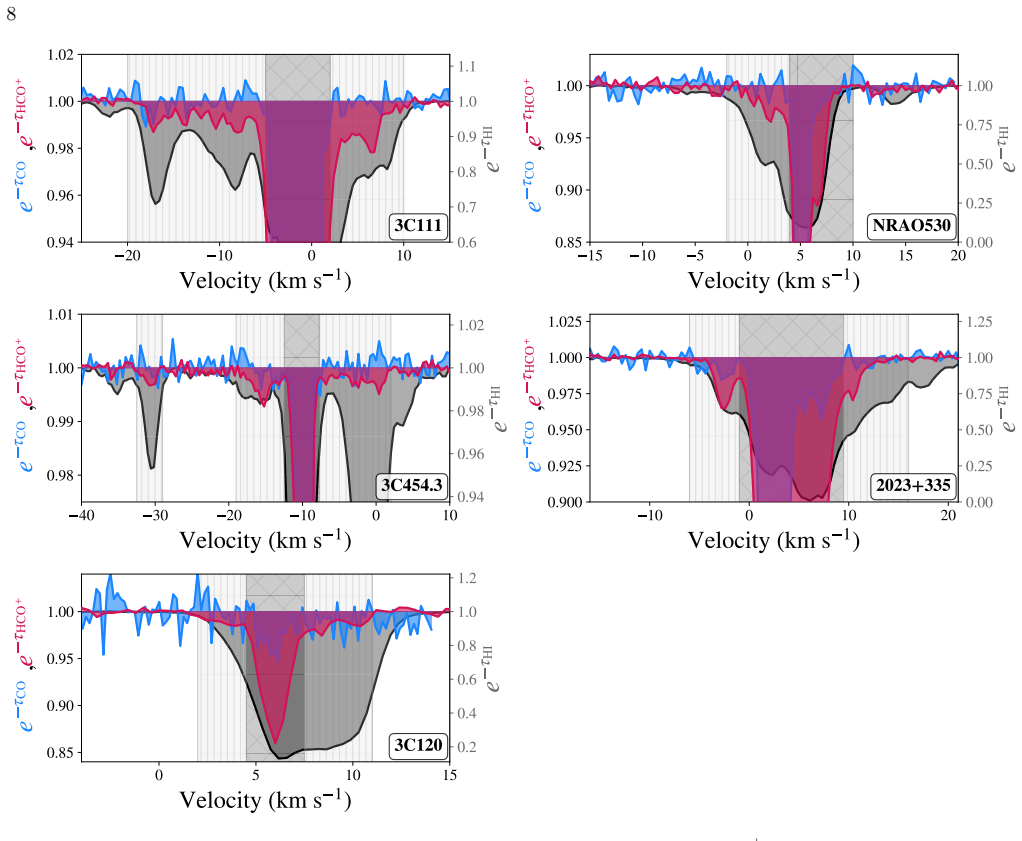
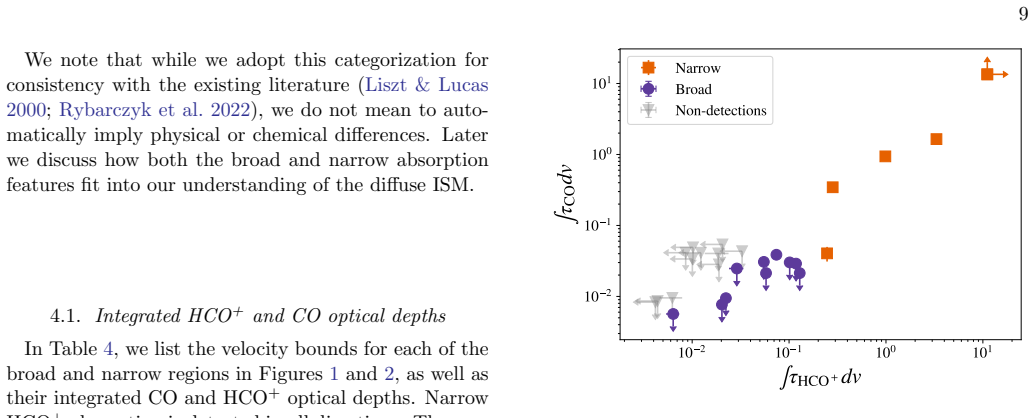
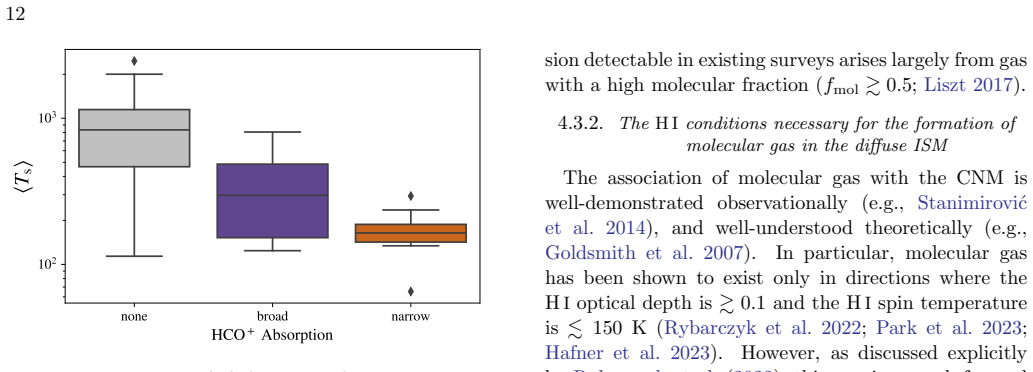
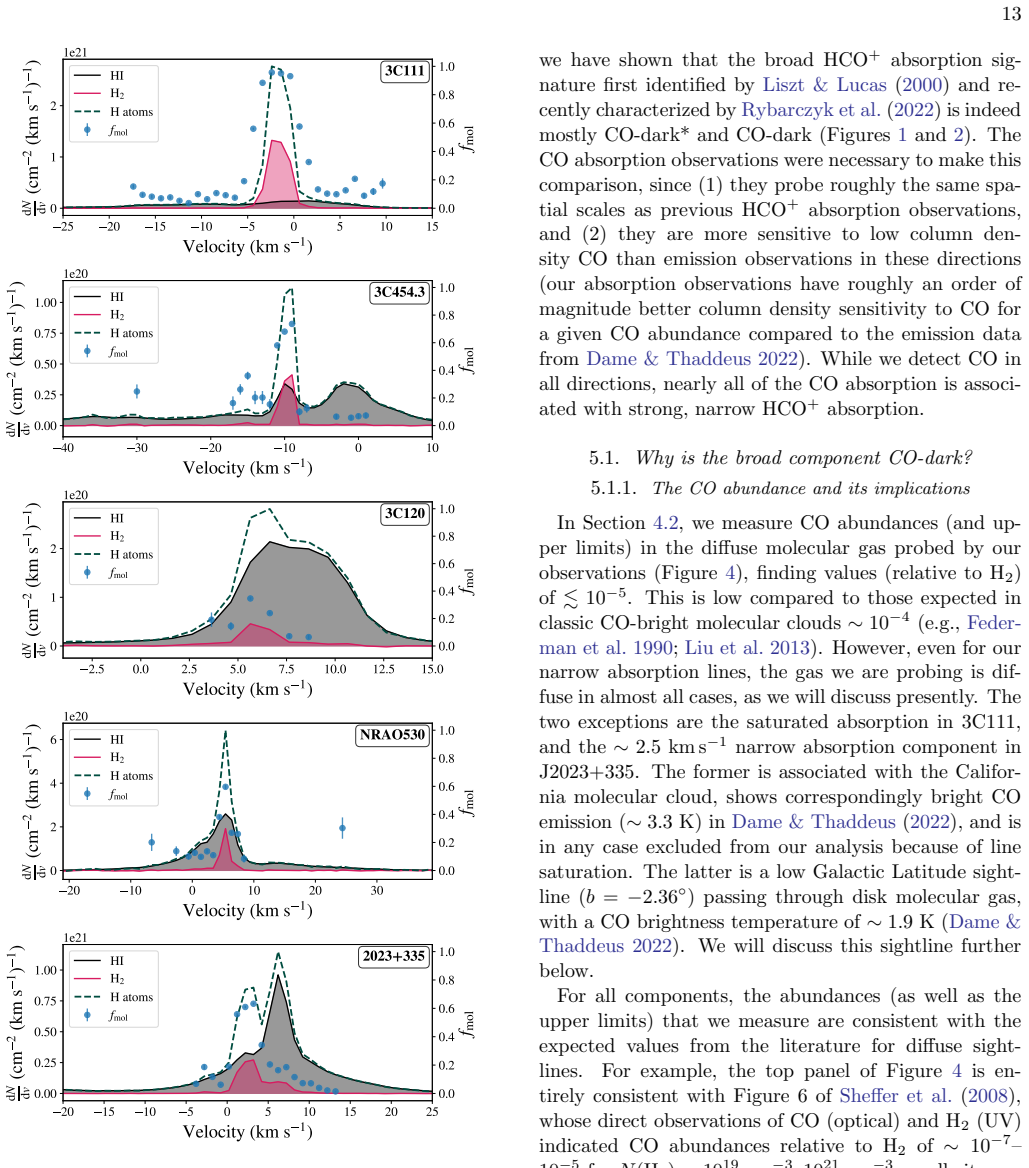
The diffuse molecular gas revealed by broad HCO+ absorption has a lower fraction of cold HI (f_CNM = 0.38^{+0.28}_{-0.27}) and a lower fraction of hydrogen in H2 (f_mol=0.09^{+0.06}_{-0.03}) than gas traced by CO in the same directions. We detect almost no CO absorption from the gas traced by broad HCO+ absorption. We constrain the CO abundance relative to H2 to be ≲10^{-6}-10^{-5} for gas traced by both broad and narrow HCO+ absorption, consistent with chemical model predictions for the diffuse ISM. We further show that neither CO emission nor absorption is likely to be detected where N(H2)≲few×10^{19} cm^{-2}, while HCO+ absorption is readily detected for N(H2)≳few×10^{18} cm^{-2}.
What carries the argument
The kinematically broad component of HCO+ absorption, which isolates extremely diffuse CO-dark H2.
If this is right
- CO remains undetectable in emission or absorption below H2 columns of a few times 10^{19} cm^{-2}.
- HCO+ absorption detects H2 columns down to a few times 10^{18} cm^{-2}.
- Modest amounts of cold HI can support the presence of H2.
- The HI-to-H2 transition occurs at lower molecular fractions in diffuse gas than in denser regions.
Where Pith is reading between the lines
- HCO+ absorption offers a practical way to map the total molecular gas reservoir beyond CO-based estimates.
- The low CO abundance supports existing chemical models of the diffuse ISM.
- Similar absorption surveys could refine the mass budget of CO-dark gas across the Milky Way.
Load-bearing premise
The broad kinematic component of HCO+ absorption can be cleanly separated from narrow components and directly attributed to CO-dark H2 without significant contributions from other chemical or excitation effects.
What would settle it
Detection of substantial CO absorption or emission at the velocities of the broad HCO+ component, or measurement of a significantly higher molecular fraction in that gas.
Figures




read the original abstract
A classic problem in the study of the interstellar medium (ISM) is the near-invisibility of molecular hydrogen (H$_2$) in cold environments. Observations of CO emission are typically used to indirectly trace H$_2$, but a significant fraction of H$_2$ in the diffuse ISM is not associated with any detectable CO emission (``CO-dark'' molecular gas). Meanwhile, observations of H$_2$ absorption trace nearly all of the H$_2$ in diffuse directions. In particular, a kinematically broad HCO$^+$ absorption signature traces extremely diffuse, CO-dark H$_2$. We have used sensitive observations of HCO$^+$, CO, and atomic hydrogen (HI) in absorption to constrain the properties of such diffuse molecular gas in five directions. The diffuse molecular gas revealed by broad HCO$^+$ absorption has a lower fraction of cold HI ($f_{\mathrm{CNM}} = 0.38^{+0.28}_{-0.27}$) and a lower fraction of hydrogen in H$_2$ ($f_{\mathrm{mol}}=0.09^{+0.06}_{-0.03}$) than gas traced by CO in the same directions. We detect almost no CO absorption from the gas traced by broad HCO$^+$ absorption. We constrain the CO abundance relative to H$_2$ to be $\lesssim10^{-6}$-$10^{-5}$ for gas traced by both broad and narrow HCO$^+$ absorption, consistent with chemical model predictions for the diffuse ISM. We further show that neither CO emission nor absorption is likely to be detected where $N(\mathrm{H_2})\lesssim\mathrm{few}\times10^{19}$ $\mathrm{cm^{-2}}$ - a result of both the low CO abundance and the low H$_2$ column - while HCO$^+$ absorption is readily detected for $N(\mathrm{H_2})\gtrsim\text{few}\times10^{18}$ $\mathrm{cm^{-2}}$. These results demonstrate that even modest amounts of cold HI can bear H$_2$, providing critical constraints on the HI-to-H$_2$ transition in the ISM.
Editorial analysis
A structured set of objections, weighed in public.
Referee Report
Summary. The paper reports absorption-line observations of HCO+, CO, and HI toward five sightlines, claiming that the kinematically broad HCO+ component traces a distinct CO-dark molecular phase with lower cold-neutral-medium fraction (f_CNM = 0.38^{+0.28}_{-0.27}) and lower molecular fraction (f_mol = 0.09^{+0.06}_{-0.03}) than CO-traced gas in the same directions. It further reports non-detection of CO absorption from this gas and derives CO/H2 abundance upper limits of ≲10^{-6}–10^{-5}, consistent with chemical models, while showing that HCO+ absorption is detectable at lower N(H2) than CO.
Significance. If the kinematic attribution holds, the results supply direct observational constraints on the HI-to-H2 transition and the prevalence of CO-dark gas at low columns, reinforcing the role of HCO+ absorption as a tracer where CO fails. The consistency with existing chemical models and the quantitative limits on CO abundance are strengths.
major comments (2)
- [Abstract and methods] Abstract and implied methods: the headline values of f_CNM and f_mol, as well as the CO/H2 limits, rest on the clean kinematic separation of broad versus narrow HCO+ absorption and the attribution of the broad component to a distinct diffuse molecular phase. The manuscript must supply explicit separation criteria, quantitative tests against velocity crowding or overlapping narrow components, and assessment of possible non-LTE excitation or chemical broadening effects; without these, the derived fractions do not follow from the observations.
- [Results] Results section: the reported uncertainties (e.g., f_mol = 0.09^{+0.06}_{-0.03}) and abundance limits require full column-density tables, error budgets, and exclusion criteria for the five sightlines to be verifiable; these details are not visible in the provided text and are load-bearing for the quantitative claims.
minor comments (1)
- [Abstract] Notation for f_mol and f_CNM should be defined at first use with explicit reference to the underlying column-density definitions.
Simulated Author's Rebuttal
We thank the referee for the positive evaluation of our work's significance and for the constructive major comments. We address each point below and will revise the manuscript to improve clarity and verifiability of the kinematic separation and supporting data.
read point-by-point responses
-
Referee: [Abstract and methods] Abstract and implied methods: the headline values of f_CNM and f_mol, as well as the CO/H2 limits, rest on the clean kinematic separation of broad versus narrow HCO+ absorption and the attribution of the broad component to a distinct diffuse molecular phase. The manuscript must supply explicit separation criteria, quantitative tests against velocity crowding or overlapping narrow components, and assessment of possible non-LTE excitation or chemical broadening effects; without these, the derived fractions do not follow from the observations.
Authors: We agree that the kinematic separation is central to the derived fractions and that the current text would benefit from greater explicitness. In the revised manuscript we will add a dedicated Methods subsection that states the separation criteria (Gaussian decomposition with velocity dispersion thresholds), includes Monte Carlo tests of velocity crowding using the observed line profiles and spectral resolution, and provides a brief assessment showing that non-LTE and chemical-broadening contributions are sub-dominant to the kinematic widths at the low densities involved. These additions will make the attribution of the broad component transparent. revision: yes
-
Referee: [Results] Results section: the reported uncertainties (e.g., f_mol = 0.09^{+0.06}_{-0.03}) and abundance limits require full column-density tables, error budgets, and exclusion criteria for the five sightlines to be verifiable; these details are not visible in the provided text and are load-bearing for the quantitative claims.
Authors: The column densities, uncertainties, and sightline selection are summarized in Table 1 and described in Sections 2 and 3, but we acknowledge that the error budget and exclusion criteria could be presented more accessibly. We will expand the Results section with a consolidated table listing all measured columns, the full statistical-plus-systematic error budget, and the explicit exclusion criteria applied to arrive at the final five sightlines. Machine-readable versions of the tables will also be provided as supplementary material to allow direct verification of the reported values and limits. revision: yes
Circularity Check
No circularity: results are direct observational measurements
full rationale
The paper derives f_CNM, f_mol, and CO/H2 limits from measured absorption profiles of HCO+, CO, and HI in five sightlines. These quantities are computed from observed column densities and velocity components without any self-referential equations, fitted inputs renamed as predictions, or load-bearing self-citations. The broad/narrow kinematic separation is an empirical profile decomposition step whose validity rests on the data rather than on prior results by the same authors. No derivation chain reduces to its own inputs by construction.
Axiom & Free-Parameter Ledger
axioms (2)
- domain assumption HCO+ absorption reliably traces H2 column density in diffuse gas
- domain assumption Velocity component decomposition cleanly separates broad and narrow features without blending
Reference graph
Works this paper leans on
-
[1]
Allen, R. J., Hogg, D. E., & Engelke, P. D. 2015, AJ, 149, 123, doi: 10.1088/0004-6256/149/4/123
-
[2]
2020, A&A, 643, A36, doi: 10.1051/0004-6361/202038593
Bellomi, E., Godard, B., Hennebelle, P., et al. 2020, A&A, 643, A36, doi: 10.1051/0004-6361/202038593
-
[3]
2008, AJ, 136, 2846, doi: 10.1088/0004-6256/136/6/2846
Bigiel, F., Leroy, A., Walter, F., et al. 2008, AJ, 136, 2846, doi: 10.1088/0004-6256/136/6/2846
-
[4]
Bolatto, A. D., Wolfire, M., & Leroy, A. K. 2013, ARA&A, 51, 207, doi: 10.1146/annurev-astro-082812-140944
work page internal anchor Pith review doi:10.1146/annurev-astro-082812-140944 2013
-
[5]
Busch, M. P. 2024, ApJ, 967, 148, doi: 10.3847/1538-4357/AD3AF6
-
[6]
Busch, M. P., Allen, R. J., Engelke, P. D., et al. 2019, ApJ, 883, 158, doi: 10.3847/1538-4357/ab3a4b
-
[7]
Busch, M. P., Engelke, P. D., Allen, R. J., & Hogg, D. E. 2021, ApJ, 914, 72, doi: 10.3847/1538-4357/abf832
-
[8]
Cazaux, S., & Tielens, A. G. G. M. 2002, ApJL, 575, L29, doi: 10.1086/342607
-
[9]
M., Hartmann, D., & Thaddeus, P
Dame, T. M., Hartmann, D., & Thaddeus, P. 2001, ApJ, 547, 792, doi: 10.1086/318388
work page internal anchor Pith review doi:10.1086/318388 2001
-
[10]
Dame, T. M., & Thaddeus, P. 2022, ApJS, 262, 5, doi: 10.3847/1538-4365/ac7e53 19
-
[11]
2017, MNRAS, 472, 3169, doi: 10.1093/mnras/stx2211
Donate, E., & Magnani, L. 2017, MNRAS, 472, 3169, doi: 10.1093/mnras/stx2211
-
[12]
Edenhofer, G., Zucker, C., Frank, P., et al. 2024, A&A, 685, A82, doi: 10.1051/0004-6361/202347628
-
[13]
2018, Monthly Notices of the Royal Astronomical Society, 478, 2315, doi: 10.1093/mnras/sty1168
Esteban, C., & Garc´ ıa-Rojas, J. 2018, Monthly Notices of the Royal Astronomical Society, 478, 2315, doi: 10.1093/mnras/sty1168
-
[14]
Federman, S. R., Huntress, Jr., W. T., & Prasad, S. S. 1990, ApJ, 354, 504, doi: 10.1086/168711 Gildas Team. 2013, GILDAS: Grenoble Image and Line Data Analysis Software, Astrophysics Source Code Library, record ascl:1305.010. http://ascl.net/1305.010
-
[15]
2010, A&A, 520, A20, doi: 10.1051/0004-6361/201014283
Luca, M. 2010, A&A, 520, A20, doi: 10.1051/0004-6361/201014283
-
[16]
Goldsmith, P. F. 2013, ApJ, 774, 134, doi: 10.1088/0004-637X/774/2/134
-
[17]
Goldsmith, P. F., Li, D., & Krˇ co, M. 2007, ApJ, 654, 273, doi: 10.1086/509067
-
[18]
2019, ApJ, 887, 93, doi: 10.3847/1538-4357/ab5362
Finkbeiner, D. 2019, ApJ, 887, 93, doi: 10.3847/1538-4357/ab5362 G¨ uver, T., &¨Ozel, F. 2009, MNRAS, 400, 2050, doi: 10.1111/j.1365-2966.2009.15598.x
work page internal anchor Pith review doi:10.3847/1538-4357/ab5362 2019
-
[19]
Hafner, A., Dawson, J. R., Nguyen, H., et al. 2023, PASA, 40, e015, doi: 10.1017/pasa.2023.8
-
[20]
2023, Monthly Notices of the Royal Astronomical Society, 525, 3318, doi: 10.1093/mnras/stad1244
Hawkins, K. 2023, Monthly Notices of the Royal Astronomical Society, 525, 3318, doi: 10.1093/mnras/stad1244
-
[21]
Heiles, C., & Troland, T. H. 2003, ApJS, 145, 329, doi: 10.1086/367785
-
[22]
Kaufman, M. J., Wolfire, M. G., & Hollenbach, D. J. 2006, ApJ, 644, 283, doi: 10.1086/503596
-
[23]
Kim, C.-G., Ostriker, E. C., & Kim, W.-T. 2014, ApJ, 786, 64, doi: 10.1088/0004-637X/786/1/64
-
[24]
2018, ApJS, 235, 1, doi: 10.3847/1538-4365/aaa762
Li, D., Tang, N., Nguyen, H., et al. 2018, ApJS, 235, 1, doi: 10.3847/1538-4365/aaa762
-
[25]
2023a, A&A, 675, A145, doi: 10.1051/0004-6361/202346259 —
Liszt, H., & Gerin, M. 2023a, A&A, 675, A145, doi: 10.1051/0004-6361/202346259 —. 2023b, ApJ, 943, 172, doi: 10.3847/1538-4357/acae83
-
[26]
2019, A&A, 627, A95, doi: 10.1051/0004-6361/201935436
Liszt, H., Gerin, M., & Grenier, I. 2019, A&A, 627, A95, doi: 10.1051/0004-6361/201935436
-
[27]
2000, A&A, 355, 333
Liszt, H., & Lucas, R. 2000, A&A, 355, 333
2000
-
[28]
2005, in Astrochemistry: Recent Successes and Current Challenges, ed
Liszt, H., Lucas, R., & Pety, J. 2005, in Astrochemistry: Recent Successes and Current Challenges, ed. D. C. Lis, G. A. Blake, & E. Herbst, Vol. 231, 187–196, doi: 10.1017/S1743921306007186
-
[29]
Liszt, H. S. 2017, ApJ, 835, 138, doi: 10.3847/1538-4357/835/2/138
-
[30]
S., & Lucas, R
Liszt, H. S., & Lucas, R. 1998, A&A, 339, 561
1998
-
[31]
Liszt, H. S., & Pety, J. 2012, A&A, 541, A58, doi: 10.1051/0004-6361/201218771
-
[32]
S., Pety, J., Gerin, M., & Lucas, R
Liszt, H. S., Pety, J., Gerin, M., & Lucas, R. 2014, A&A, 564, A64, doi: 10.1051/0004-6361/201323320
-
[33]
2013, ApJL, 775, L2, doi: 10.1088/2041-8205/775/1/L2
Liu, T., Wu, Y., & Zhang, H. 2013, ApJL, 775, L2, doi: 10.1088/2041-8205/775/1/L2
-
[34]
1996, A&A, 307, 237
Lucas, R., & Liszt, H. 1996, A&A, 307, 237
1996
-
[35]
2020, ApJL, 889, L4, doi: 10.3847/2041-8213/ab6337
Luo, G., Li, D., Tang, N., et al. 2020, ApJL, 889, L4, doi: 10.3847/2041-8213/ab6337
-
[36]
Luo, G., Zhang, Z.-Y., Bisbas, T. G., et al. 2023, ApJ, 946, 91, doi: 10.3847/1538-4357/acbf34
-
[37]
2024, A&A, 685, L12, doi: 10.1051/0004-6361/202450067
Luo, G., Li, D., Zhang, Z.-Y., et al. 2024, A&A, 685, L12, doi: 10.1051/0004-6361/202450067
-
[38]
M., Stanimirovi´ c, S., & Rybarczyk, D
McClure-Griffiths, N. M., Stanimirovi´ c, S., & Rybarczyk, D. R. 2023, ARA&A, 61, 19, doi: 10.1146/annurev-astro-052920-104851
-
[39]
McClure-Griffiths, N. M., Pisano, D. J., Calabretta, M. R., et al. 2009, ApJS, 181, 398, doi: 10.1088/0067-0049/181/2/398
-
[40]
E., Stanimirovi´ c, S., Goss, W
Murray, C. E., Stanimirovi´ c, S., Goss, W. M., et al. 2018, ApJS, 238, 14, doi: 10.3847/1538-4365/aad81a
-
[41]
E., Stanimirovi´ c, S., Heiles, C., et al
Murray, C. E., Stanimirovi´ c, S., Heiles, C., et al. 2021, ApJS, 256, 37, doi: 10.3847/1538-4365/ac0f0b
-
[42]
E., Stanimirovi´ c, S., Goss, W
Murray, C. E., Stanimirovi´ c, S., Goss, W. M., et al. 2015, ApJ, 804, 89, doi: 10.1088/0004-637X/804/2/89
-
[43]
Nguyen, H., Dawson, J. R., Lee, M.-Y., et al. 2019, ApJ, 880, 141, doi: 10.3847/1538-4357/ab2b9f
-
[44]
R., Miville-Deschˆ enes, M.-A., et al
Nguyen, H., Dawson, J. R., Miville-Deschˆ enes, M.-A., et al. 2018, ApJ, 862, 49, doi: 10.3847/1538-4357/aac82b
-
[45]
2023, ApJ, 955, 145, doi: 10.3847/1538-4357/ace164
Park, G., Lee, M.-Y., Bialy, S., et al. 2023, ApJ, 955, 145, doi: 10.3847/1538-4357/ace164
-
[46]
Peek, J. E. G., Heiles, C., Douglas, K. A., et al. 2011, ApJS, 194, 20, doi: 10.1088/0067-0049/194/2/20
-
[47]
Peek, J. E. G., Babler, B. L., Zheng, Y., et al. 2018, ApJS, 234, 2, doi: 10.3847/1538-4365/aa91d3
-
[48]
2005, in SF2A-2005: Semaine de l’Astrophysique Francaise, ed
Pety, J. 2005, in SF2A-2005: Semaine de l’Astrophysique Francaise, ed. F. Casoli, T. Contini, J. M. Hameury, & L. Pagani, 721
2005
-
[49]
R., Stanimirovi´ c, S., & Gusdorf, A
Rybarczyk, D. R., Stanimirovi´ c, S., & Gusdorf, A. 2023, ApJ, 950, 52, doi: 10.3847/1538-4357/accba1
-
[50]
R., Stanimirovi´ c, S., Gong, M., et al
Rybarczyk, D. R., Stanimirovi´ c, S., Gong, M., et al. 2022, ApJ, 928, 79, doi: 10.3847/1538-4357/ac5035
-
[51]
Measuring Reddening with SDSS Stellar Spectra and Recalibrating SFD
Schlafly, E. F., & Finkbeiner, D. P. 2011, ApJ, 737, 103, doi: 10.1088/0004-637X/737/2/103
work page internal anchor Pith review doi:10.1088/0004-637x/737/2/103 2011
-
[52]
Sheffer, Y., Rogers, M., Federman, S. R., et al. 2008, ApJ, 687, 1075, doi: 10.1086/591484 Stanimirovi´ c, S., Murray, C. E., Lee, M.-Y., Heiles, C., &
-
[53]
2014, ApJ, 793, 132, doi: 10.1088/0004-637X/793/2/132 20
Miller, J. 2014, ApJ, 793, 132, doi: 10.1088/0004-637X/793/2/132 20
-
[54]
2021, ApJ, 910, 131, doi: 10.3847/1538-4357/abe5ab
Su, Y., Yang, J., Yan, Q.-Z., et al. 2021, ApJ, 910, 131, doi: 10.3847/1538-4357/abe5ab
-
[55]
2024, The Journal of Open Source Software, 9, 7201, doi: 10.21105/joss.07201
Wenger, T. 2024, The Journal of Open Source Software, 9, 7201, doi: 10.21105/joss.07201
-
[56]
Wenger, T. V., Balser, D. S., Anderson, L. D., & Bania, T. M. 2018, ApJ, 856, 52, doi: 10.3847/1538-4357/aaaec8
-
[57]
G., Hollenbach, D., & McKee, C
Wolfire, M. G., Hollenbach, D., & McKee, C. F. 2010, ApJ, 716, 1191, doi: 10.1088/0004-637X/716/2/1191
-
[58]
Xu, D., Li, D., Yue, N., & Goldsmith, P. F. 2016, ApJ, 819, 22, doi: 10.3847/0004-637X/819/1/22
-
[59]
2017, MNRAS, 471, 3494, doi: 10.1093/mnras/stx1580
Zhu, H., Tian, W., Li, A., & Zhang, M. 2017, MNRAS, 471, 3494, doi: 10.1093/mnras/stx1580
discussion (0)
Sign in with ORCID, Apple, or X to comment. Anyone can read and Pith papers without signing in.