The CepA disk-outflow system at <=0.2'' or <=100au resolution
Pith reviewed 2026-07-01 02:45 UTC · model grok-4.3
The pith
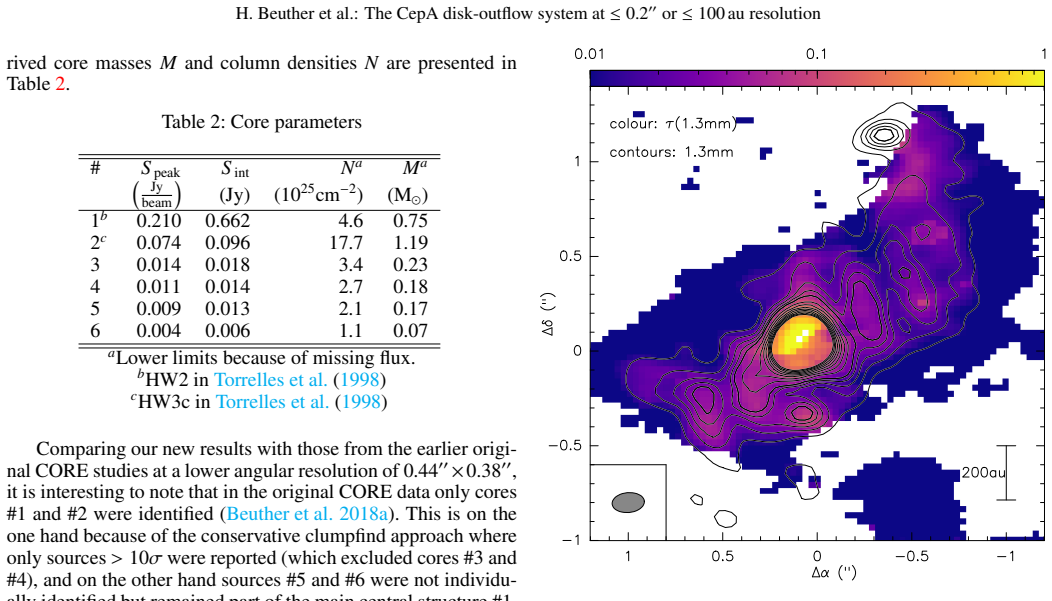
High-resolution millimeter data resolve the CepA disk into multiple sub-structures consistent with fragments in an almost edge-on geometry that drive several outflows.
A machine-rendered reading of the paper's core claim, the machinery that carries it, and where it could break.
Core claim
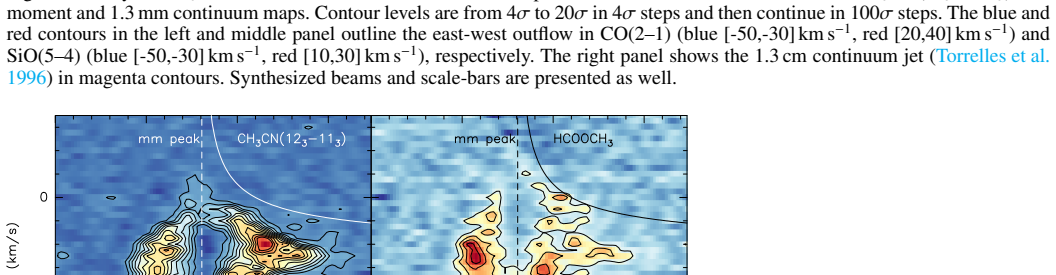
The mm continuum emission resolves the central disk candidate into several sub-structures. Conducting a Toomre Q stability analysis based on CH3CN and continuum data, and a comparison to 3D radiation hydrodynamic simulations shows that the data are consistent with an almost edge-on disk where the observed sub-structures may represent fragments within the disk. The CO and SiO spectral line data confirm a second bipolar outflow emanating from the central peak position, indicating that this central peak should host at least a binary if not even a higher order multiple system.
What carries the argument
NOEMA long-baseline 1.3 mm continuum and spectral-line imaging at <=100 au resolution combined with Toomre Q stability maps derived from CH3CN and dust data.
If this is right
- Fragmentation can occur inside the inner accretion disks of high-mass protostars on scales below 100 au.
- A single central peak can launch multiple distinct outflows when it contains a multiple stellar system.
- CH3CN emission receives significant contributions from outflow shocks, limiting its use as a pure disk tracer.
- High-mass star formation proceeds with multiplicity already established at the smallest disk scales.
Where Pith is reading between the lines
- Similar disk-fragmentation signatures may appear in other nearby high-mass candidates once observed at comparable linear resolution.
- The observed outflow multiplicity supplies an indirect but testable route to counting companions before they are spatially resolved.
- If the fragments continue to accrete, they could produce a small cluster rather than a single high-mass star.
Load-bearing premise
The continuum sub-structures are physical fragments inside a single edge-on disk rather than separate objects or imaging artifacts.
What would settle it
Higher-resolution kinematic maps showing the sub-structures do not rotate with the disk velocity field or Toomre Q values remaining above unity across the entire structure.
Figures






read the original abstract
Context: Although there has been significant progress, the physical properties and potential fragmentation of accretion disks around high-mass protostars remain poorly constrained. Aims: We characterize at high angular resolution one of the most nearby (~700pc) high-mass accretion disk candidates CepA HW2. Methods: Using the new long baseline array configuration (~1700m) of the Northern Extended Millimeter Array (NOEMA), we study CepA HW2 with a resolution of <=0.2'' or <=100au at 1.3mm in dust continuum and spectral line emission. Results: The mm continuum emission resolves the central disk candidate into several sub-structures. Conducting a Toomre Q stability analysis based on CH_3CN and continuum data, and a comparison to 3D radiation hydrodynamic simulations shows that the data are consistent with an almost edge-on disk where the observed sub-structures may represent fragments within the disk. The CO and SiO spectral line data confirm a second bipolar outflow (in addition to the well-known jet) emanating from the central peak position. This indicates that this central peak should host at least a binary if not even a higher order multiple system. The usually assumed dense gas tracer CH_3CN shows also contributions from the outflows which complicates further kinematic analysis of the disk. Conclusions: The high-resolution outflow-disk data of CepA reveal a multiply fragmented disk that drives several outflows. These observations enforce the picture of high-mass star formation where multiplicity and fragmentation can happen on the smallest spatial scales related to the inner accretion disks.
Editorial analysis
A structured set of objections, weighed in public.
Referee Report
Summary. The paper presents NOEMA long-baseline observations at 1.3 mm of the nearby high-mass protostar candidate CepA HW2, achieving ≤0.2'' (≤100 au) resolution. The continuum resolves the central source into several sub-structures. A Toomre Q analysis is performed using CH3CN line data for temperature and velocity dispersion together with continuum-derived surface densities; this is combined with a comparison to 3D radiation-hydrodynamic simulations. The authors conclude that the observations are consistent with an almost edge-on, multiply fragmented disk that drives at least two bipolar outflows (one previously known jet plus a new CO/SiO outflow), implying that the central peak hosts a binary or higher-order multiple system. The work argues that fragmentation and multiplicity can occur on the smallest scales associated with inner accretion disks around high-mass stars.
Significance. If the Toomre Q results and simulation comparison hold, the observations supply rare sub-100-au constraints on the structure and stability of a high-mass accretion disk, directly addressing the open question of whether and how fragmentation proceeds at the scales of the inner disk. The detection of a second outflow from the central peak is a clear observational advance that strengthens the case for early multiplicity.
major comments (1)
- [Results section] Results section (Toomre Q analysis): The central claim that the sub-structures represent gravitationally unstable fragments rests on Q < 1 values derived from CH3CN temperatures/velocity dispersions and continuum surface densities. The abstract itself states that CH3CN exhibits outflow contributions that complicate kinematic analysis of the disk. If the CH3CN emission used for the Q calculation includes outflow material rather than pure disk gas, both the local sound speed and the surface-density estimates become unreliable, undermining the inference of gravitational instability. No independent check (e.g., dust-only temperature map or optically thin isotopologue) is described that would isolate the disk contribution.
minor comments (2)
- [Observations section] The abstract and text repeatedly cite a resolution of “≤0.2'' or ≤100 au”; the exact synthesized beam size, position angle, and how the 700 pc distance converts to au should be stated explicitly in the observations section for reproducibility.
- [Results section] The comparison to 3D radiation-hydrodynamic simulations is mentioned but the specific simulation parameters, viewing angle, and quantitative metrics used for the match are not detailed; a brief table or figure panel showing the simulated vs. observed morphology would improve clarity.
Simulated Author's Rebuttal
We thank the referee for the positive assessment of the significance of our NOEMA observations and for the constructive comment on the Toomre Q analysis. We address the point below.
read point-by-point responses
-
Referee: [Results section] Results section (Toomre Q analysis): The central claim that the sub-structures represent gravitationally unstable fragments rests on Q < 1 values derived from CH3CN temperatures/velocity dispersions and continuum surface densities. The abstract itself states that CH3CN exhibits outflow contributions that complicate kinematic analysis of the disk. If the CH3CN emission used for the Q calculation includes outflow material rather than pure disk gas, both the local sound speed and the surface-density estimates become unreliable, undermining the inference of gravitational instability. No independent check (e.g., dust-only temperature map or optically thin isotopologue) is described that would isolate the disk contribution.
Authors: We acknowledge the validity of this concern. The abstract explicitly notes that CH3CN shows outflow contributions that complicate kinematic analysis, and the Toomre Q values were derived from the CH3CN (12-11) data for temperature and velocity dispersion together with continuum-derived surface densities. The analysis is presented as one line of evidence that is consistent with fragmentation when combined with the 3D radiation-hydrodynamic simulation comparison. We agree that an independent verification isolating pure disk emission would strengthen the result. The current data set does not contain an optically thin isotopologue or a separate dust-temperature map. We will revise the manuscript to expand the discussion of uncertainties arising from possible outflow contamination in the CH3CN-derived quantities and to qualify the strength of the gravitational-instability conclusion accordingly. revision: partial
- Independent check isolating disk-only CH3CN emission (e.g., via optically thin isotopologue or dust-only temperature map) is not available in the present observations.
Circularity Check
No significant circularity; analysis is data-driven and self-contained
full rationale
The paper reports new NOEMA observations at <=0.2'' resolution, resolves sub-structures in 1.3 mm continuum, applies standard Toomre Q calculation using measured CH3CN line widths/temperatures plus continuum surface densities, and compares the outcome to independent 3D radiation-hydrodynamic simulations. No equations reduce a claimed prediction to a fitted parameter by construction, no load-bearing self-citations are invoked to justify uniqueness or ansatzes, and the outflow contamination in CH3CN is explicitly flagged as a complication rather than hidden. The derivation chain therefore rests on external data and external simulations, not on re-labeling of its own inputs.
Axiom & Free-Parameter Ledger
axioms (2)
- standard math Standard assumptions in millimeter interferometry data reduction and imaging
- domain assumption CH3CN and continuum data can be used to compute Toomre Q for disk stability despite noted outflow contamination
Reference graph
Works this paper leans on
- [1]
- [2]
- [3]
-
[4]
Andrews , S. M., Huang , J., P \'e rez , L. M., et al. 2018, , 869, L41
work page 2018
- [5]
-
[6]
T., Cesaroni , R., Rivilla , V
Beltr \'a n , M. T., Cesaroni , R., Rivilla , V. M., et al. 2018, , 615, A141
work page 2018
-
[7]
Beltr \'a n , M. T. & de Wit , W. J. 2016, , 24, 6
work page 2016
-
[8]
Beuther , H., Churchwell , E. B., McKee , C. F., & Tan , J. C. 2007, in Protostars and Planets V, ed. B. Reipurth , D. Jewitt , & K. Keil , 165--180
work page 2007
- [9]
- [10]
-
[11]
Beuther , H., Mottram , J. C., Ahmadi , A., et al. 2018 a , , 617, A100
work page 2018
-
[12]
Beuther , H., Soler , J. D., Vlemmings , W., et al. 2018 b , , 614, A64
work page 2018
- [13]
-
[14]
Binney , J. & Tremaine , S. 2008, Galactic Dynamics: Second Edition (Princeton University Press)
work page 2008
- [15]
- [16]
-
[17]
Carrasco-Gonz \'a lez , C., Sanna , A., Rodr \' guez-Kamenetzky , A., et al. 2021, , 914, L1
work page 2021
- [18]
-
[19]
Cesaroni , R., Galli , D., Lodato , G., Walmsley , C. M., & Zhang , Q. 2007, in Protostars and Planets V, ed. B. Reipurth , D. Jewitt , & K. Keil , 197--212
work page 2007
-
[20]
Comito , C., Schilke , P., Endesfelder , U., Jim \'e nez-Serra , I., & Mart \' n-Pintado , J. 2007, , 469, 207
work page 2007
-
[21]
Cunningham , N. J., Moeckel , N., & Bally , J. 2009, , 692, 943
work page 2009
-
[22]
Curiel , S., Trinidad , M. A., Cant \'o , J., et al. 2002, , 564, L35
work page 2002
-
[23]
De Buizer , J. M., Liu , M., Tan , J. C., et al. 2017, , 843, 33
work page 2017
-
[24]
Draine , B. T. 2011, Physics of the Interstellar and Intergalactic Medium (Princeton Series in Astrophysics)
work page 2011
-
[25]
Durjasz , M., Szymczak , M., Olech , M., & Bartkiewicz , A. 2022, , 663, A123
work page 2022
-
[26]
Frau , P., Girart , J. M., Beltr \'a n , M. T., et al. 2010, , 723, 1665
work page 2010
-
[27]
Gammie , C. F. 2001, , 553, 174
work page 2001
- [28]
- [29]
- [30]
- [31]
-
[32]
Ginsburg , A., Bally , J., Goddi , C., Plambeck , R., & Wright , M. 2018, , 860, 119
work page 2018
-
[33]
Ginsburg , A., McGuire , B. A., Sanhueza , P., et al. 2023, , 942, 66
work page 2023
-
[34]
G \'o mez , J. F., Sargent , A. I., Torrelles , J. M., et al. 1999, , 514, 287
work page 1999
-
[35]
G \'o mez , J. F., Torrelles , J. M., Girart , J. M., et al. 2023, , 956, L45
work page 2023
-
[36]
Hildebrand , R. H. 1983, , 24, 267
work page 1983
-
[37]
Hughes , V. A. & Wouterloot , J. G. A. 1984, , 276, 204
work page 1984
-
[38]
Ilee , J. D., Cyganowski , C. J., Brogan , C. L., et al. 2018, , 869, L24
work page 2018
-
[39]
Ilee , J. D., Cyganowski , C. J., Nazari , P., et al. 2016, , 462, 4386
work page 2016
-
[40]
Jim \'e nez-Serra , I., Mart \' n-Pintado , J., Rodr \' guez-Franco , A., et al. 2007, , 661, L187
work page 2007
- [41]
-
[42]
Johnston , K. G., Robitaille , T. P., Beuther , H., et al. 2015, , 813, L19
work page 2015
-
[43]
Kenyon , S. J. & Hartmann , L. 1987, , 323, 714
work page 1987
- [44]
-
[45]
E., Kuiper , R., Peters , T., & Banerjee , R
Klassen , M., Pudritz , R. E., Kuiper , R., Peters , T., & Banerjee , R. 2016, , 823, 28
work page 2016
-
[46]
Kratter , K. M., Matzner , C. D., Krumholz , M. R., & Klein , R. I. 2010, , 708, 1585
work page 2010
-
[47]
Kumar , M. S. N., Palmeirim , P., Arzoumanian , D., & Inutsuka , S. I. 2020, , 642, A87
work page 2020
-
[48]
Lang , K. R. 1992, Astrophysical Data I (Planets and Stars, X, 937 pp. 33 figs.. Springer-Verlag Berlin Heidelberg New York)
work page 1992
- [49]
-
[50]
B., Trapman , L., Monsch , K., et al
Lovell , J. B., Trapman , L., Monsch , K., et al. 2025, , 989, 69
work page 2025
-
[51]
M \" u ller , H. S. P., Thorwirth , S., Roth , D. A., & Winnewisser , G. 2001, , 370, L49
work page 2001
-
[52]
Manara , C. F., Ansdell , M., Rosotti , G. P., et al. 2023, in Astronomical Society of the Pacific Conference Series, Vol. 534, Protostars and Planets VII, ed. S. Inutsuka , Y. Aikawa , T. Muto , K. Tomida , & M. Tamura , 539
work page 2023
-
[53]
Mart \' n-Pintado , J., Jim \'e nez-Serra , I., Rodr \' guez-Franco , A., Mart \' n , S., & Thum , C. 2005, , 628, L61
work page 2005
-
[54]
Maud , L. T., Cesaroni , R., Kumar , M. S. N., et al. 2019, , 627, L6
work page 2019
-
[55]
Mignon-Risse , R., Oliva , A., Gonz \'a lez , M., Kuiper , R., & Commer c on , B. 2023, , 672, A88
work page 2023
- [56]
-
[57]
Monsch , K., Lovell , J. B., Stapelfeldt , K. R., et al. 2026, , 996, 45
work page 2026
-
[58]
Moscadelli , L., Beuther , H., Ahmadi , A., et al. 2021, , 647, A114
work page 2021
-
[59]
Moscadelli , L., Beuther , H., Sanna , A., et al. 2026, arXiv e-prints, arXiv:2606.11908
work page internal anchor Pith review Pith/arXiv arXiv 2026
-
[60]
Moscadelli , L., Li , J. J., Cesaroni , R., et al. 2013, , 549, A122
work page 2013
-
[61]
Moscadelli , L., Reid , M. J., Menten , K. M., et al. 2009, , 693, 406
work page 2009
- [62]
- [63]
-
[64]
C., Beuther , H., Ahmadi , A., et al
Mottram , J. C., Beuther , H., Ahmadi , A., et al. 2020, , 636, A118
work page 2020
-
[65]
Complex organic molecules and cosmic ray ionisation rate towards the massive protostar Cepheus A HW2
Nielsen , E. W., Punanova , A., Wirstr \"o m , E., et al. 2026, arXiv e-prints, arXiv:2605.06767
work page internal anchor Pith review Pith/arXiv arXiv 2026
-
[66]
Offner , S. S. R., Moe , M., Kratter , K. M., et al. 2023, in Astronomical Society of the Pacific Conference Series, Vol. 534, Astronomical Society of the Pacific Conference Series, ed. S. Inutsuka , Y. Aikawa , T. Muto , K. Tomida , & M. Tamura , 275
work page 2023
-
[67]
Ohashi , N., Hayashi , M., Ho , P. T. P., Momose , M., & Hirano , N. 1996, , 466, 957
work page 1996
-
[68]
A., Sanhueza , P., Oya , Y., et al
Olguin , F. A., Sanhueza , P., Oya , Y., et al. 2026, , 999, 106
work page 2026
-
[69]
Oliva , G. A. & Kuiper , R. 2020, , 644, A41
work page 2020
- [70]
- [71]
-
[72]
A., Curiel , S., Sridharan , T
Patel , N. A., Curiel , S., Sridharan , T. K., et al. 2005, , 437, 109
work page 2005
-
[73]
R., Hily-Blant , P., Gerin , M., & Teyssier , D
Pety , J., Goicoechea , J. R., Hily-Blant , P., Gerin , M., & Teyssier , D. 2007, , 464, L41
work page 2007
- [74]
-
[75]
S \'a nchez-Monge , \'A ., G \'o mez , J. F., Torrelles , J. M., et al. 2025, , 543, 662
work page 2025
- [76]
- [77]
- [78]
-
[79]
Schuller , F., Menten , K. M., Contreras , Y., et al. 2009, , 504, 415
work page 2009
- [80]
discussion (0)
Sign in with ORCID, Apple, or X to comment. Anyone can read and Pith papers without signing in.