Protostellar Outflows at the EarliesT Stages (POETS). IX. Magnetohydrodynamic disk winds traced by SO and SO₂ in luminous protostars
Pith reviewed 2026-06-27 08:28 UTC · model grok-4.3
The pith
SO emission patterns in two massive protostars indicate a rotating wind launched magneto-centrifugally from the disk surface.
A machine-rendered reading of the paper's core claim, the machinery that carries it, and where it could break.
Core claim
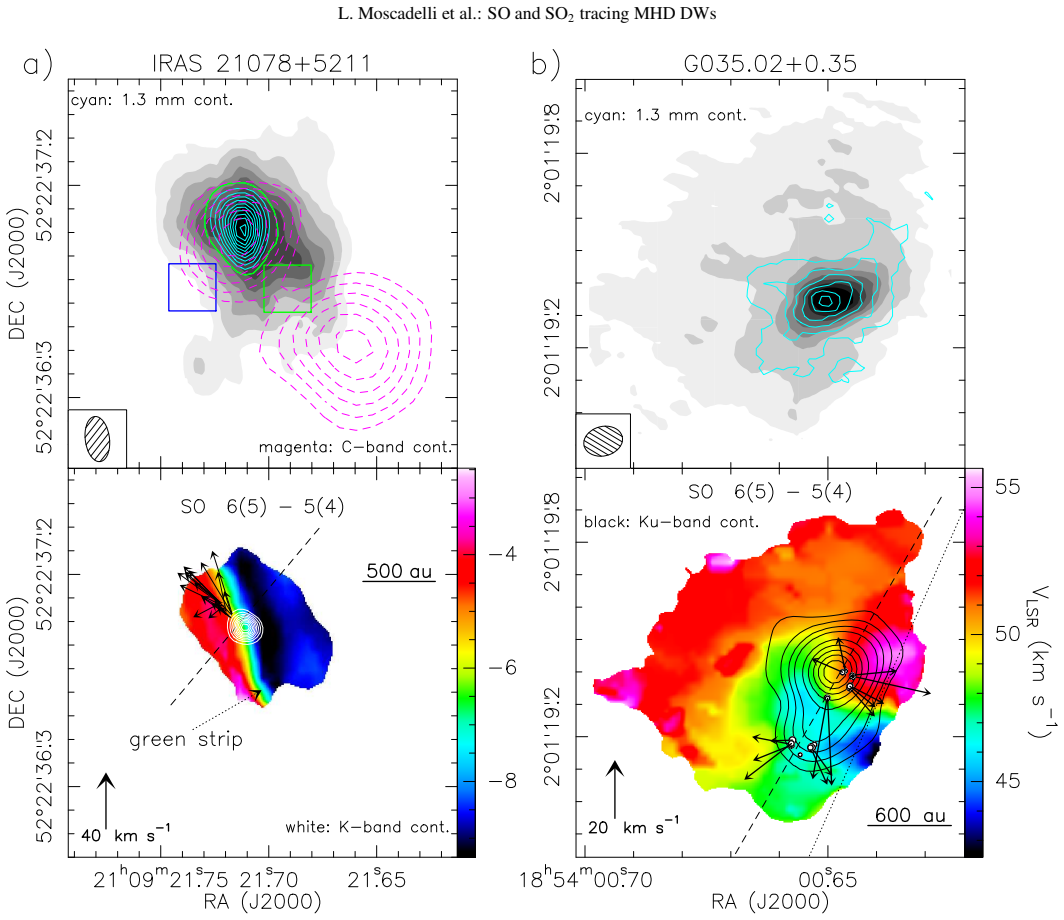
In IRAS21078+5211 the molecular emissions lie along the radio jet axis with transverse Vlsr gradients and SO PV plots consistent with Keplerian rotation, while SO2 traces high-velocity gas near the axis and other species extend farther out. In G035.02+0.35 the molecules follow the disk major axis with Keplerian PV profiles and only SO extends outside the disk. In both cases the SO kinematics match a magneto-centrifugally launched rotating wind from the YSO disk, and shock models explain the radial extents via a radially extended MHD DW rather than a compact X-wind.
What carries the argument
Magneto-centrifugally launched rotating disk wind, traced by SO spatial and velocity distributions and tested against shock chemistry models for molecule formation and excitation.
If this is right
- The different radial extensions of SO, SO2, CH3CN and CH3OH arise from their formation in shocks at varying distances within an extended disk wind.
- The lack of most molecules except SO in one source's wind is consistent with the same extended MHD DW structure.
- The transverse velocity gradients directly reflect the rotation of the launched wind material.
- Similar wind signatures appear in both studied YSOs despite differences in their disk versus jet alignments.
Where Pith is reading between the lines
- Disk winds may remove angular momentum over larger radial ranges than compact launch models allow in massive star formation.
- Multi-molecule mapping could distinguish wind structures across a wider sample of protostars.
- Refined shock models incorporating wind density profiles might predict additional observable tracers.
Load-bearing premise
The transverse velocity gradients and Keplerian position-velocity plots arise directly from a magneto-centrifugally launched wind originating at the disk surface.
What would settle it
If observations at higher angular resolution reveal velocity patterns inconsistent with Keplerian rotation in the SO-emitting gas, or if X-wind models can reproduce the observed molecular radial extents without an extended wind component.
Figures


read the original abstract
We investigate two massive young stellar objects (YSOs), IRAS21078+5211 and G035.02+0.35, where evidence for magnetohydrodynamic (MHD) disk winds (DWs) has been obtained at scales of 10-100 au through measurements of the 22GHz water maser velocity distribution within the Protostellar Outflows at the EarliesT Stages (POETS) survey. We employ IRAM Northern Extended Millimeter Array and archival Atacama Large Millimeter Array observations of IRAS21078+5211 and G035.02+0.35, respectively, to study kinematics and physical conditions of the corresponding protostellar winds on scales of 100-1000 au using the same molecular tracers. In IRAS21078+5211, the emissions of several molecules, particularly SO, SO2, CH3CN and CH3OH, are distributed along the axis of the radio jet, and present a LSR velocity (Vlsr) gradient transversal to the jet axis. Position-velocity (PV) plots of the SO lines show patterns consistent with Keplerian rotation. The SO2 emission comes from high velocity gas flowing close to the jet axis, while CH3CN and CH3OH present larger radial extension than the S-bearing species. In G035.02+0.35, the same molecules are instead distributed along the major axis of the rotating disk, and their Vlsr gradients consistently trace the disk rotation. The corresponding PV plots present Keplerian profiles. SO is the only molecular species whose emission extends well outside the disk. In both YSOs, the spatial and velocity distributions of SO are consistent with a rotating wind magneto-centrifugally launched from the YSO disk. The comparison with models of molecule formation and excitation in shocks indicates that the different radial extension of the molecular species observed in the protostellar wind of IRAS21078+5211, as well as the lack of molecules, except SO, in the G035.02+0.35's wind, can be explained in terms of a radially extended MHD DW, rather than a compact X-wind.
Editorial analysis
A structured set of objections, weighed in public.
Referee Report
Summary. The manuscript presents IRAM NOEMA and archival ALMA observations of SO, SO2, CH3CN, and CH3OH toward two luminous YSOs (IRAS21078+5211 and G035.02+0.35). It reports transverse V_LSR gradients and Keplerian-like PV diagrams for SO, argues that these trace a magneto-centrifugally launched rotating disk wind on 100-1000 au scales, and concludes that the differing radial extents of the species (and the absence of most molecules in the G035.02+0.35 wind) are explained by shock-chemistry models for a radially extended MHD disk wind rather than a compact X-wind.
Significance. If the kinematic interpretation and model comparison hold, the work would extend the POETS water-maser evidence for MHD disk winds to larger scales using thermal molecular lines and provide a potential observational discriminator between extended disk-wind and X-wind scenarios via chemistry. The multi-tracer approach and direct comparison to shock models are strengths that could be impactful for massive-star formation studies.
major comments (2)
- [kinematics section for IRAS21078+5211] Abstract and the section on IRAS21078+5211 kinematics: the claim that SO PV plots are 'consistent with Keplerian rotation' and trace a magneto-centrifugally launched wind is load-bearing, yet the text presents only qualitative patterns without reported best-fit rotation-curve parameters, residuals, or formal comparison to the expected MHD wind velocity field (e.g., no χ^{2} values or parameter uncertainties).
- [model comparison section] The section comparing to shock-chemistry models: the manuscript states that the models explain the radial extents of SO/SO2 versus CH3CN/CH3OH without additional wind-structure parameters, but does not demonstrate that the models were run with parameters fixed solely from the observed MHD DW geometry or that alternative (X-wind) geometries were quantitatively ruled out; this is the weakest step in distinguishing the two scenarios.
minor comments (2)
- [abstract] Abstract: no mention of observed transitions, beam sizes, or rms noise levels; these details should be added for completeness.
- [figures] Figure captions and text: ensure consistent use of V_LSR versus Vlsr and explicit labeling of velocity gradient directions and units on all PV diagrams.
Simulated Author's Rebuttal
We thank the referee for the constructive and detailed report. The comments highlight areas where the kinematic and model-comparison sections can be strengthened with additional quantitative detail. We address each point below and will incorporate revisions accordingly.
read point-by-point responses
-
Referee: [kinematics section for IRAS21078+5211] Abstract and the section on IRAS21078+5211 kinematics: the claim that SO PV plots are 'consistent with Keplerian rotation' and trace a magneto-centrifugally launched wind is load-bearing, yet the text presents only qualitative patterns without reported best-fit rotation-curve parameters, residuals, or formal comparison to the expected MHD wind velocity field (e.g., no χ² values or parameter uncertainties).
Authors: We agree that the kinematic interpretation is central and that the current presentation relies on qualitative assessment of the PV diagrams. In the revised manuscript we will add least-squares fits to the SO position-velocity data, reporting the best-fit rotation-curve parameters, residuals, and formal uncertainties. These will be compared directly to the expected velocity field of a magneto-centrifugal disk wind, including χ² statistics where appropriate. This addition will make the supporting evidence for the claimed rotation explicit. revision: yes
-
Referee: [model comparison section] The section comparing to shock-chemistry models: the manuscript states that the models explain the radial extents of SO/SO2 versus CH3CN/CH3OH without additional wind-structure parameters, but does not demonstrate that the models were run with parameters fixed solely from the observed MHD DW geometry or that alternative (X-wind) geometries were quantitatively ruled out; this is the weakest step in distinguishing the two scenarios.
Authors: We acknowledge that the model-comparison section would benefit from greater transparency on parameter choices and on the quantitative distinction from an X-wind geometry. In the revision we will (i) tabulate the exact shock-chemistry model inputs and show they are taken directly from the observed disk-wind geometry (radius, velocity, density) without additional free parameters, and (ii) present a side-by-side comparison of predicted radial extents for both the extended MHD disk-wind and compact X-wind cases, including a brief discussion of why the latter is disfavored by the data. We note that a fully exhaustive statistical exclusion of every X-wind variant lies beyond the scope of the present observations, but the revised text will make the existing model constraints explicit. revision: yes
Circularity Check
Derivation chain is self-contained with no circular reductions
full rationale
The paper's claims rest on direct observational data (Vlsr gradients, PV plots of SO/SO2/CH3CN/CH3OH) and qualitative comparison to independent shock-chemistry models for radial extents. The POETS water-maser reference supplies prior context at smaller scales but is not load-bearing for the new 100-1000 au conclusions or the distinction from X-winds. No self-definitional loops, fitted inputs renamed as predictions, or ansatzes smuggled via self-citation appear in the provided text. The derivation remains externally falsifiable against the cited models and does not reduce to its own inputs by construction.
Axiom & Free-Parameter Ledger
axioms (2)
- domain assumption Position-velocity diagrams showing linear or Keplerian patterns trace rotation in a disk or wind launched from a disk.
- domain assumption Shock-chemistry and excitation models from the literature accurately predict the observed radial extents of SO, SO2, CH3CN and CH3OH in protostellar winds.
Forward citations
Cited by 1 Pith paper
-
The CepA disk-outflow system at <=0.2'' or <=100au resolution
NOEMA observations at <=100 au resolution show CepA HW2 has a fragmented accretion disk driving multiple outflows, indicating an early multiple stellar system.
Reference graph
Works this paper leans on
-
[1]
2023, A&A, 677, A17 1
Ahmadi, A., Beuther, H., Bosco, F., et al. 2023, A&A, 677, A17 1
2023
-
[2]
2014, in Pro- tostars and Planets VI, ed
Alexander, R., Pascucci, I., Andrews, S., Armitage, P ., & Cieza, L. 2014, in Pro- tostars and Planets VI, ed. H. Beuther, R. S. Klessen, C. P . Du llemond, & T. Henning, 475
2014
-
[3]
2026, A&A, 705, A185
Baijot, C., Groyne, M., & De Becker, M. 2026, A&A, 705, A185
2026
-
[4]
S., Moscadelli, L., Cesaroni, R., et al
Bayandina, O. S., Moscadelli, L., Cesaroni, R., et al. 2025, A&A, 694, A92 Beltrán, M. T., Cesaroni, R., Neri, R., et al. 2004, ApJ, 601, L187 Beltrán, M. T., Sánchez-Monge, Á., Cesaroni, R., et al. 2014 , A&A, 571, A52
2025
-
[5]
C., Ahmadi, A., et al
Beuther, H., Mottram, J. C., Ahmadi, A., et al. 2018, A&A, 617 , A100
2018
-
[6]
Blandford, R. D. & Payne, D. G. 1982, MNRAS, 199, 883
1982
-
[7]
Briggs, D. S. 1995, in Bulletin of the American Astronomical Society, V ol. 27, American Astronomical Society Meeting Abstracts, 1444
1995
-
[8]
M., Shingledecker, C
Burkhardt, A. M., Shingledecker, C. N., Le Gal, R., et al. 201 9, ApJ, 881, 32 CASA Team, Bean, B., Bhatnagar, S., et al. 2022, PASP , 134, 114501
2022
-
[9]
1999, A&A, 345, 9 49 De Simone, M., Podio, L., Chahine, L., et al
Cesaroni, R., Felli, M., Jenness, T., et al. 1999, A&A, 345, 9 49 De Simone, M., Podio, L., Chahine, L., et al. 2024, A&A, 686, L 13 de V alon, A., Dougados, C., Cabrit, S., et al. 2022, A&A, 668, A78
1999
-
[10]
P ., Schlemmer, S., Schilke, P ., Stutzki, J., & Mül ler, H
Endres, C. P ., Schlemmer, S., Schilke, P ., Stutzki, J., & Mül ler, H. S. P . 2016, Journal of Molecular Spectroscopy, 327, 95
2016
-
[11]
2021, A&A, 648, A 66
Gieser, C., Beuther, H., Semenov, D., et al. 2021, A&A, 648, A 66
2021
-
[12]
Gorti, U., Hollenbach, D., & Dullemond, C. P . 2015, ApJ, 804, 29 Högbom, J. A. 1974, A&AS, 15, 417
2015
-
[13]
Hollenbach, D., Elitzur, M., & McKee, C. F. 2013, ApJ, 773, 70
2013
-
[14]
1994, Ap J, 428, 654
Hollenbach, D., Johnstone, D., Lizano, S., & Shu, F. 1994, Ap J, 428, 654
1994
-
[15]
2016, ApJ, 824, 1 19
Hosokawa, T., Hirano, S., Kuiper, R., et al. 2016, ApJ, 824, 1 19
2016
-
[16]
& Omukai, K
Hosokawa, T. & Omukai, K. 2009, ApJ, 691, 823
2009
-
[17]
2025, A&A, 695, A167 Königl, A
Kadam, K., V orobyov, E., Woitke, P ., Basu, S., & van Terwisga, S. 2025, A&A, 695, A167 Königl, A. & Pudritz, R. E. 2000, Protostars and Planets IV , 7 59
2025
-
[18]
R., McKee, C
Krumholz, M. R., McKee, C. F., & Klein, R. I. 2005, ApJ, 618, L3 3
2005
-
[19]
& Hosokawa, T
Kuiper, R. & Hosokawa, T. 2018, A&A, 616, A101
2018
-
[20]
2010, ApJ, 7 22, 1556
Kuiper, R., Klahr, H., Beuther, H., & Henning, T. 2010, ApJ, 7 22, 1556
2010
-
[21]
& Y orke, H
Kuiper, R. & Y orke, H. W. 2013, ApJ, 763, 104
2013
-
[22]
1944, Quarterly of Applied Mathematics, 2, 64 López-Vázquez, J
Levenberg, K. 1944, Quarterly of Applied Mathematics, 2, 64 López-Vázquez, J. A., Cantó, J., & Lizano, S. 2019, ApJ, 879, 42
1944
-
[23]
& Pringle, J
Lynden-Bell, D. & Pringle, J. E. 1974, MNRAS, 168, 603
1974
-
[24]
1963, Journal of the Society for Industrial an d Applied Mathe- matics, 11, 431 Martín, S., Martín-Pintado, J., Blanco-Sánchez, C., et al
Marquardt, D. 1963, Journal of the Society for Industrial an d Applied Mathe- matics, 11, 431 Martín, S., Martín-Pintado, J., Blanco-Sánchez, C., et al. 2019, A&A, 631, A159
1963
-
[25]
2021, A&A, 64 7, A114
Moscadelli, L., Beuther, H., Ahmadi, A., et al. 2021, A&A, 64 7, A114
2021
-
[26]
J., Dodson, R., & Reid, M
Moscadelli, L., Cesaroni, R., Rioja, M. J., Dodson, R., & Reid, M. J. 2011, A&A, 526, A66+
2011
-
[27]
T., & Fu ruya, R
Moscadelli, L., Goddi, C., Cesaroni, R., Beltrán, M. T., & Fu ruya, R. S. 2007, A&A, 472, 867
2007
-
[28]
2024, A&A, 690, A81
Moscadelli, L., Oliva, A., Sanna, A., Surcis, G., & Bayandin a, O. 2024, A&A, 690, A81
2024
-
[29]
2016, A &A, 585, A71
Moscadelli, L., Sánchez-Monge, Á., Goddi, C., et al. 2016, A &A, 585, A71
2016
-
[30]
2022, Nature Astronomy, 6, 1068
Moscadelli, L., Sanna, A., Beuther, H., Oliva, A., & Kuiper, R. 2022, Nature Astronomy, 6, 1068
2022
-
[31]
2019b, A&A, 631, A74 Müller, H
Moscadelli, L., Sanna, A., Goddi, C., et al. 2019b, A&A, 631, A74 Müller, H. S. P ., Thorwirth, S., Roth, D. A., & Winnewisser, G. 2001, A&A, 370, L49
2001
-
[32]
2026, ApJ, 1000, 184
Narang, M., Tyagi, H., Ohashi, N., et al. 2026, ApJ, 1000, 184
2026
-
[33]
A., Sanhueza, P ., Oya, Y ., et al
Olguin, F. A., Sanhueza, P ., Oya, Y ., et al. 2026, arXiv e-pri nts, arXiv:2601.15371
-
[34]
2025, MNRAS, 541, 377 2
Pandey, R., Palau, A., Serna, J., et al. 2025, MNRAS, 541, 377 2
2025
-
[35]
L., Cabrit, S., et al
Pascucci, I., Beck, T. L., Cabrit, S., et al. 2025, Nature Ast ronomy, 9, 81
2025
-
[36]
2023, in Astron omical Society of the Pacific Conference Series, V ol
Pascucci, I., Cabrit, S., Edwards, S., et al. 2023, in Astron omical Society of the Pacific Conference Series, V ol. 534, Protostars and Planets VII, ed. S. Inut- suka, Y . Aikawa, T. Muto, K. Tomida, & M. Tamura, 567
2023
-
[37]
& Pudritz, R
Pelletier, G. & Pudritz, R. E. 1992, ApJ, 394, 117 Pineau des Forets, G., Roue ff, E., Schilke, P ., & Flower, D. R. 1993, MNRAS, 262, 915
1992
-
[38]
Pudritz, R. E., Cridland, A. J., Inglis, J., & Alessi, M. 2025 , arXiv e-prints, arXiv:2505.22724
-
[39]
E., Ouyed, R., Fendt, C., & Brandenburg, A
Pudritz, R. E., Ouyed, R., Fendt, C., & Brandenburg, A. 2007, in Protostars and Planets V , ed. B. Reipurth, D. Jewitt, & K. Keil, 277 Sánchez-Monge, Á., Schilke, P ., Ginsburg, A., Cesaroni, R. , & Schmiedeke, A. 2018, A&A, 609, A101
2007
-
[40]
2010, A&A, 51 7, A78+
Sanna, A., Moscadelli, L., Cesaroni, R., et al. 2010, A&A, 51 7, A78+
2010
-
[41]
2018, A&A, 619, A107
Sanna, A., Moscadelli, L., Goddi, C., Krishnan, V ., & Massi,F. 2018, A&A, 619, A107
2018
-
[42]
Shakura, N. I. & Sunyaev, R. A. 1973, A&A, 24, 337
1973
-
[43]
1994, ApJ, 429, 781
Shu, F., Najita, J., Ostriker, E., et al. 1994, ApJ, 429, 781
1994
-
[44]
Dishoeck, E. F. 2014, MNRAS, 440, 1844
2014
-
[45]
2017, A&A, 607, L6
Tabone, B., Cabrit, S., Bianchi, E., et al. 2017, A&A, 607, L6
2017
-
[46]
2020, A& A, 640, A82 Tychoniec, Ł., van Gelder, M
Tabone, B., Cabrit, S., Pineau des Forêts, G., et al. 2020, A& A, 640, A82 Tychoniec, Ł., van Gelder, M. L., van Dishoeck, E. F., et al. 2 024, A&A, 687, A36 van Gelder, M. L., Tabone, B., van Dishoeck, E. F., & Godard, B . 2021, A&A, 653, A159
2020
-
[47]
W., Sato, M., Reid, M
Wu, Y . W., Sato, M., Reid, M. J., et al. 2014, A&A, 566, A17
2014
-
[48]
J., Reid, M
Xu, Y ., Li, J. J., Reid, M. J., et al. 2013, ApJ, 769, 15 Y orke, H. W. & Welz, A. 1996, A&A, 315, 555 Article number, page 12 L. Moscadelli et al.: SO and SO 2 tracing MHD DWs Appendix A: Fit of the molecular emission For each source, position and molecule reported in Table 3, w e have identified and fit with MADCUBA all the unblended transi tions within ...
2013
discussion (0)
Sign in with ORCID, Apple, or X to comment. Anyone can read and Pith papers without signing in.