GPUAlert: A Zero-Instrumentation Process-Boundary Monitor for Diagnosing GPU Training-Job Failures
Pith reviewed 2026-07-03 19:14 UTC · model grok-4.3
The pith
A command-line wrapper diagnoses GPU training failures by classifying logs at the process boundary without any script changes.
A machine-rendered reading of the paper's core claim, the machinery that carries it, and where it could break.
Core claim
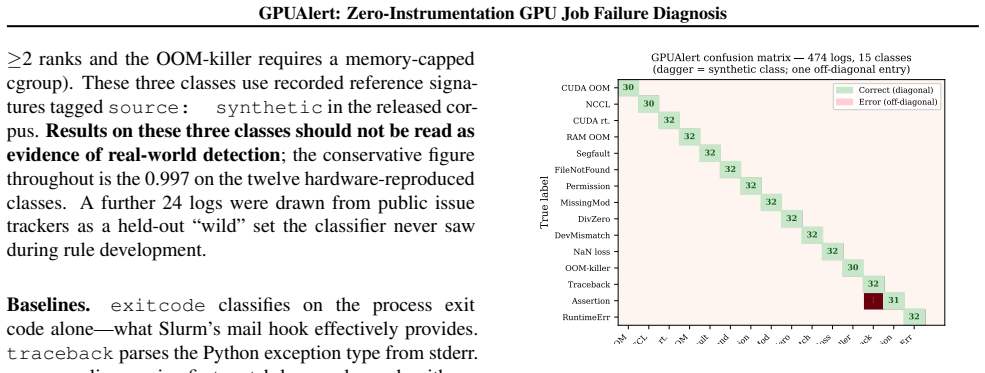
GPUAlert is a command-line wrapper that monitors any training command at the process boundary and, with no change to that command, emails a structured notification on completion carrying a classified failure cause, durable logs, and output artifacts. The tool is organized around three reliability primitives: a pre-launch log guarantee that establishes the durable destination before the child process can crash, notifier isolation that makes the wrapper's exit code a pure function of the child's status regardless of whether the email succeeds, and a non-silent artifact budget that bounds attachment size without ever dropping output silently. A labelled corpus of 474 GPU training logs across 15
What carries the argument
The ordered-rule classifier that processes log content in a fixed sequence to assign one of 15 failure classes, backed by the pre-launch log guarantee that creates the output file before the child process begins execution.
If this is right
- Operators receive a classified failure cause and logs immediately rather than hours later.
- No changes to training scripts or additional cloud connections are needed for monitoring.
- Logs are preserved even when the job crashes before any shell redirect can occur.
- The wrapper adds only a constant 3 ms overhead per job regardless of duration.
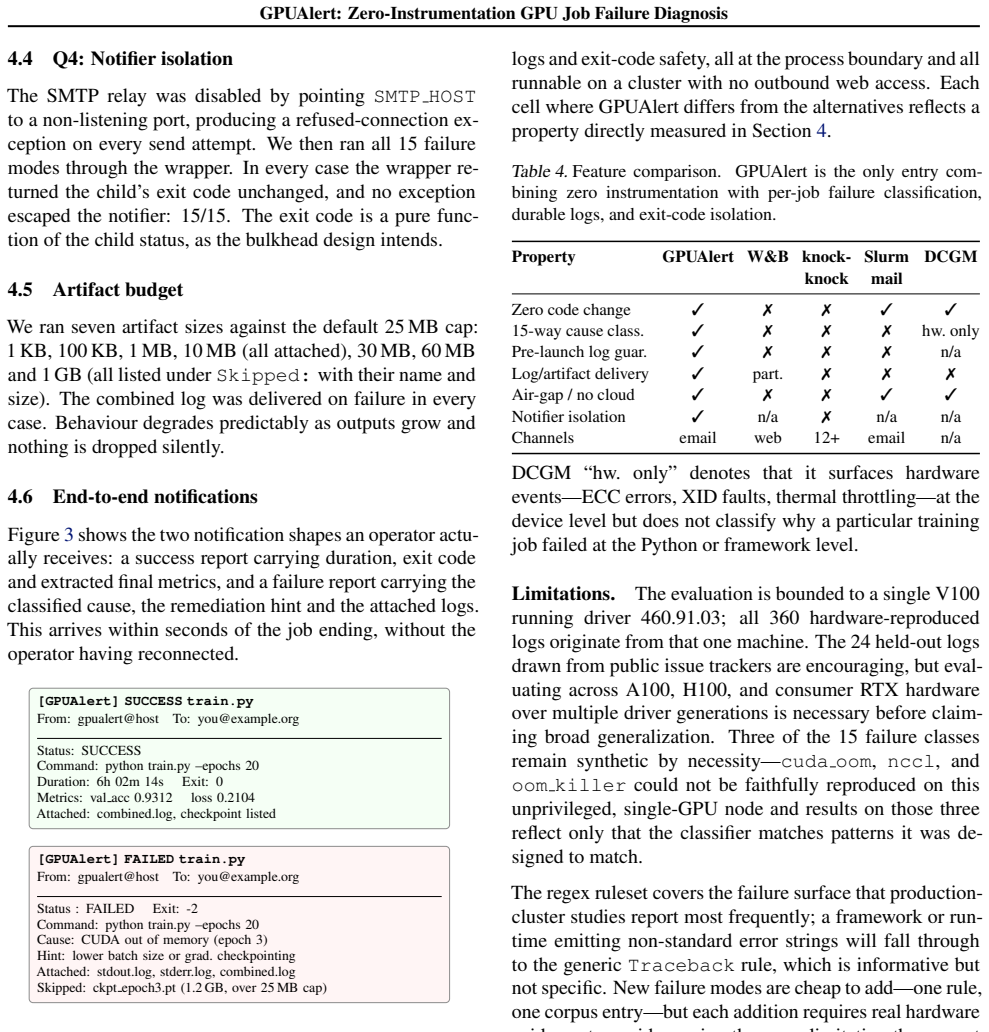
- The child's original exit code is returned unchanged across all 15 failure modes even if the SMTP relay is unreachable.
Where Pith is reading between the lines
- The same wrapper pattern could be applied to non-GPU compute jobs such as large-scale CPU or TPU training.
- The released corpus of 474 labelled logs could serve as a public benchmark for testing machine-learning-based failure classifiers.
- Classified failure types could trigger automated recovery scripts that restart jobs with adjusted parameters.
- Deployment across multi-user schedulers would let operators measure cluster-wide failure patterns without per-job instrumentation.
Load-bearing premise
The 15 failure classes and the labelled corpus of 474 logs are representative of the distribution of real GPU training failures encountered in production clusters.
What would settle it
Running the wrapper and classifier on GPU training jobs drawn from a different production cluster and measuring whether macro-F1 stays near 0.997 on the new logs.
Figures

read the original abstract
GPU training jobs fail often, roughly two in five on large production clusters, yet the operator typically learns of a failure only by reconnecting hours later. Experiment trackers require editing the training script and maintaining a cloud connection; the scheduler's mail hook delivers a single status line with no cause and no logs. GPUAlert is a command-line wrapper that monitors any training command at the process boundary, and with no change to that command, emails a structured notification on completion carrying a classified failure cause, durable logs, and output artifacts. The tool is organized around three reliability primitives: a pre-launch log guarantee that establishes the durable destination before the child process can crash, notifier isolation that makes the wrapper's exit code a pure function of the child's status regardless of whether the email succeeds, and a non-silent artifact budget that bounds attachment size without ever dropping output silently. We release a labelled corpus of 474 GPU training logs across 15 failure classes and a reproducible evaluation harness. On the twelve hardware-reproduced classes, the ordered-rule classifier reaches 0.997 macro-F1, against 0.830 for unordered keyword matching and 0.133 for exit-code inspection. Wrapper overhead is a constant approximately 3ms per job; the pre-launch guarantee preserves a log where a shell redirect yields nothing; and across all 15 failure modes the wrapper returns the child's exit code unchanged even when the SMTP relay is unreachable.
Editorial analysis
A structured set of objections, weighed in public.
Referee Report
Summary. The paper presents GPUAlert, a command-line wrapper that monitors any GPU training command at the process boundary with zero instrumentation to the script. It provides structured email notifications on job completion containing a classified failure cause (via an ordered-rule classifier), durable logs, and output artifacts. The work introduces three reliability primitives (pre-launch log guarantee, notifier isolation, non-silent artifact budget), releases a labelled corpus of 474 logs across 15 failure classes plus a reproducible evaluation harness, and reports that the classifier achieves 0.997 macro-F1 on the twelve hardware-reproduced classes (vs. 0.830 for unordered keyword matching and 0.133 for exit-code inspection), with ~3 ms constant overhead and unchanged child exit codes even on SMTP failure.
Significance. If the reported performance holds under scrutiny, the tool addresses a practical pain point in large-scale GPU training by delivering actionable failure diagnosis without script changes or cloud dependencies. The explicit release of the labelled corpus and evaluation harness is a clear strength, supporting reproducibility and enabling external validation or extension by the community. The low-overhead and exit-code preservation claims are presented against concrete baselines.
major comments (2)
- [Methods] Methods section: the construction of the ordered-rule classifier (feature ordering, rule derivation, and decision thresholds), the criteria used to select the twelve hardware-reproduced classes, and any procedure for assessing label noise or inter-annotator agreement are not described. These details are required to verify the 0.997 macro-F1 result and to assess whether the performance is an artifact of the labelling process.
- [Evaluation] Evaluation: the headline performance is measured exclusively on the authors' own 474-log corpus; no external validation set, cross-cluster comparison, or coverage argument is supplied to test whether the 15-class taxonomy and learned rules generalize to the distribution of failures encountered on production clusters.
Simulated Author's Rebuttal
We thank the referee for the constructive feedback and for highlighting both the practical utility of GPUAlert and the value of the released corpus. We respond point-by-point to the major comments below.
read point-by-point responses
-
Referee: [Methods] Methods section: the construction of the ordered-rule classifier (feature ordering, rule derivation, and decision thresholds), the criteria used to select the twelve hardware-reproduced classes, and any procedure for assessing label noise or inter-annotator agreement are not described. These details are required to verify the 0.997 macro-F1 result and to assess whether the performance is an artifact of the labelling process.
Authors: We agree that the methods section omits these implementation details. In the revised manuscript we will add a dedicated subsection that specifies: (i) feature ordering by descending empirical frequency across the 474-log corpus, (ii) rule derivation by iterative manual refinement to eliminate false positives on the labelled set, (iii) decision thresholds chosen to maximize precision on hardware-specific patterns, (iv) selection criteria for the twelve classes as those reproducible on our test hardware without external dependencies, and (v) that labels were produced by a single annotator with no inter-annotator agreement or label-noise audit performed. These additions will allow independent verification of the reported macro-F1. revision: yes
-
Referee: [Evaluation] Evaluation: the headline performance is measured exclusively on the authors' own 474-log corpus; no external validation set, cross-cluster comparison, or coverage argument is supplied to test whether the 15-class taxonomy and learned rules generalize to the distribution of failures encountered on production clusters.
Authors: The evaluation is performed solely on our internal corpus. We will insert a limitations paragraph that explicitly states this scope and the lack of external or cross-cluster validation. At the same time, the public release of the full labelled corpus together with the evaluation harness is intended to enable precisely the external validation and coverage studies the referee requests; we will note that the 15-class taxonomy reflects failures observed in our environment and invite community extension. revision: partial
Circularity Check
No circularity: evaluation uses released corpus and external baselines
full rationale
The paper describes a command-line wrapper and an ordered-rule classifier evaluated on a released corpus of 474 logs across 15 classes. No equations, fitted parameters, or predictions are present. Performance (0.997 macro-F1) is reported against independent baselines (unordered keyword matching at 0.830, exit-code inspection at 0.133). The corpus is released with a reproducible harness, and no self-citations, uniqueness theorems, or ansatzes are invoked to support the central claims. The derivation chain is self-contained against external benchmarks.
Axiom & Free-Parameter Ledger
Reference graph
Works this paper leans on
-
[1]
21st USENIX Symposium on Networked Systems Design and Implementation (NSDI 24) , pages =
Characterization of Large Language Model Development in the Datacenter , author =. 21st USENIX Symposium on Networked Systems Design and Implementation (NSDI 24) , pages =
-
[2]
2025 IEEE International Symposium on High Performance Computer Architecture (HPCA) , year=
Revisiting Reliability in Large-Scale Machine Learning Research Clusters , author=. 2025 IEEE International Symposium on High Performance Computer Architecture (HPCA) , year=
2025
-
[3]
Analysis of Large-Scale Multi-Tenant
Jeon, Myeongjae and Venkataraman, Shivaram and Phanishayee, Amar and Qian, Junjie and Xiao, Wencong and Yang, Fan , booktitle =. Analysis of Large-Scale Multi-Tenant
-
[4]
Weng, Qizhen and Xiao, Wencong and Yu, Yinghao and Wang, Wei and Wang, Cheng and He, Jian and Li, Yong and Zhang, Liping and Lin, Wei and Ding, Yu , booktitle =
-
[5]
2020 , note =
Experiment tracking with Weights and Biases , author =. 2020 , note =
2020
-
[6]
, author =
Accelerating the machine learning lifecycle with MLflow. , author =. IEEE Data Engineering Bulletin , volume =
-
[7]
and Jette, Morris A
Yoo, Andy B. and Jette, Morris A. and Grondona, Mark , booktitle =. 2003 , publisher =
2003
-
[8]
2019 , note =
knockknock: Get Notified When Your Training Ends , author =. 2019 , note =
2019
-
[9]
Mohan, Jayashree and Phanishayee, Amar and Chidambaram, Vijay , booktitle =
-
[10]
19th USENIX Symposium on Networked Systems Design and Implementation (NSDI 22) , pages =
Eisenman, Assaf and Matam, Kiran Kumar and Ingram, Steven and others , year =. 19th USENIX Symposium on Networked Systems Design and Implementation (NSDI 22) , pages =
-
[11]
2022 , journal=
Operationalizing Machine Learning: An Interview Study , author =. 2022 , journal=
2022
-
[12]
Paszke, Adam and Gross, Sam and Massa, Francisco and Lerer, Adam and Bradbury, James and Chanan, Gregory and Killeen, Trevor and Lin, Zeming and Gimelshein, Natalia and Antiga, Luca and others , booktitle =
-
[13]
Agarwal Parv , year =
-
[14]
Experiment tracking with weights and biases, 2020
Biewald, L. Experiment tracking with weights and biases, 2020. URL https://wandb.ai/site. Software
2020
-
[15]
Comet ML : A meta machine learning platform, 2021
Comet ML Inc. Comet ML : A meta machine learning platform, 2021. URL https://www.comet.com/site/. Software
2021
-
[16]
K., Ingram, S., et al
Eisenman, A., Matam, K. K., Ingram, S., et al. Check-N-Run : A checkpointing system for training deep learning recommendation models. In 19th USENIX Symposium on Networked Systems Design and Implementation (NSDI 22), pp.\ 929--943, 2022
2022
-
[17]
Characterization of large language model development in the datacenter
Hu, Q., Ye, Z., Wang, Z., Wang, G., Zhang, M., Chen, Q., Sun, P., Lin, D., Wang, X., Luo, Y., et al. Characterization of large language model development in the datacenter. In 21st USENIX Symposium on Networked Systems Design and Implementation (NSDI 24), pp.\ 709--729, 2024
2024
-
[18]
knockknock: Get notified when your training ends, 2019
Hugging Face . knockknock: Get notified when your training ends, 2019. URL https://github.com/huggingface/knockknock. Software
2019
-
[19]
Analysis of large-scale multi-tenant GPU clusters for DNN training workloads
Jeon, M., Venkataraman, S., Phanishayee, A., Qian, J., Xiao, W., and Yang, F. Analysis of large-scale multi-tenant GPU clusters for DNN training workloads. In 2019 USENIX Annual Technical Conference (USENIX ATC 19), pp.\ 947--960, 2019
2019
-
[20]
Revisiting reliability in large-scale machine learning research clusters
Kokolis, A., Kuchnik, M., Hoffman, J., et al. Revisiting reliability in large-scale machine learning research clusters. In 2025 IEEE International Symposium on High Performance Computer Architecture (HPCA), pp.\ 1259--1274, 2025. doi:10.1109/HPCA61900.2025.00096
-
[21]
CheckFreq : Frequent, fine-grained DNN checkpointing
Mohan, J., Phanishayee, A., and Chidambaram, V. CheckFreq : Frequent, fine-grained DNN checkpointing. In 19th USENIX Conference on File and Storage Technologies (FAST 21), pp.\ 203--216, 2021
2021
-
[22]
NVIDIA data center GPU manager ( DCGM ), 2024
NVIDIA Corporation . NVIDIA data center GPU manager ( DCGM ), 2024. URL https://developer.nvidia.com/dcgm. Software
2024
-
[23]
gpualert-eval : Evaluation corpus and harness, 2026
Parv, A. gpualert-eval : Evaluation corpus and harness, 2026. URL https://github.com/Parv-01/gpualert-eval/. Double-blind artifact(474 labelled GPU training logs, 15 failure classes, five experiments)
2026
-
[24]
PyTorch : An imperative style, high-performance deep learning library
Paszke, A., Gross, S., Massa, F., Lerer, A., Bradbury, J., Chanan, G., Killeen, T., Lin, Z., Gimelshein, N., Antiga, L., et al. PyTorch : An imperative style, high-performance deep learning library. In Advances in Neural Information Processing Systems (NeurIPS), volume 32, pp.\ 8024--8035, 2019
2019
-
[25]
Shankar, S., Garcia, R., Hellerstein, J. M., and Parameswaran, A. G. Operationalizing machine learning: An interview study. arXiv preprint arXiv:2209.09125, 2022
-
[26]
MLaaS in the wild: Workload analysis and scheduling in large-scale heterogeneous GPU clusters
Weng, Q., Xiao, W., Yu, Y., Wang, W., Wang, C., He, J., Li, Y., Zhang, L., Lin, W., and Ding, Y. MLaaS in the wild: Workload analysis and scheduling in large-scale heterogeneous GPU clusters. In 19th USENIX Symposium on Networked Systems Design and Implementation (NSDI 22), pp.\ 945--960, 2022
2022
-
[27]
B., Jette, M
Yoo, A. B., Jette, M. A., and Grondona, M. SLURM : Simple linux utility for resource management. In Job Scheduling Strategies for Parallel Processing (JSSPP), Lecture Notes in Computer Science, pp.\ 44--60. Springer, 2003
2003
-
[28]
Accelerating the machine learning lifecycle with mlflow
Zaharia, M., Chen, A., Davidson, A., et al. Accelerating the machine learning lifecycle with mlflow. IEEE Data Engineering Bulletin, 41 0 (4): 0 39--45, 2018
2018
discussion (0)
Sign in with ORCID, Apple, or X to comment. Anyone can read and Pith papers without signing in.