Can dwarf novae produce type Ia supernovae?
Pith reviewed 2026-06-25 20:31 UTC · model grok-4.3
The pith
Dwarf novae cannot grow white dwarfs to the Chandrasekhar mass needed for type Ia supernovae.
A machine-rendered reading of the paper's core claim, the machinery that carries it, and where it could break.
Core claim
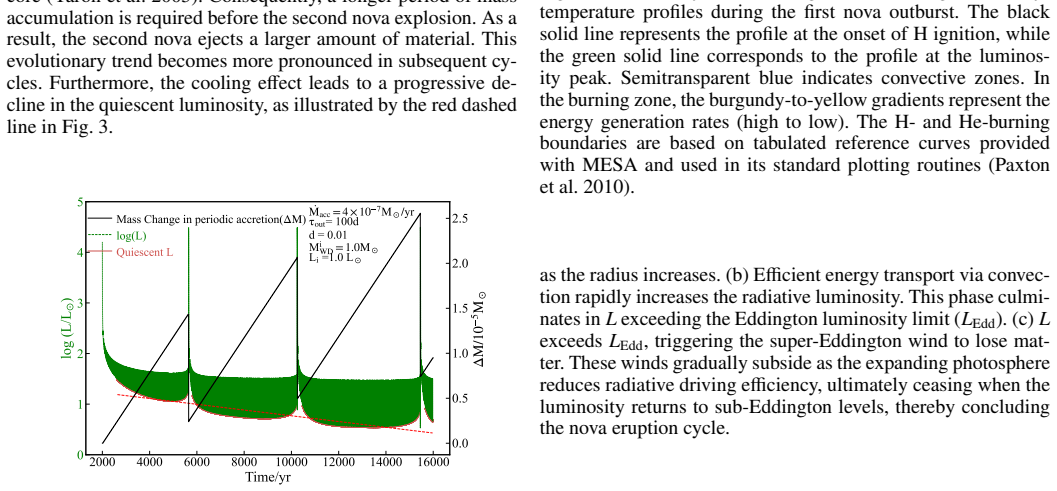
Periodic accretion fails to maintain stable hydrogen burning. During quiescent phases the white dwarf cools and becomes increasingly degenerate, leading to nova outbursts with progressively decreasing mass-retention efficiency and ultimately preventing further white dwarf mass growth toward the Chandrasekhar mass.
What carries the argument
Mass-retention efficiency under intermittent DN-like accretion, computed in MESA as a function of duty cycle, accretion rate, and initial white dwarf properties.
If this is right
- White dwarfs in dwarf novae experience net mass loss rather than growth across repeated cycles.
- Dwarf novae are unlikely progenitors of type Ia supernovae.
- Stable hydrogen burning on the white dwarf requires continuous rather than episodic accretion.
- Mass-retention efficiency declines with increasing degeneracy during quiescence.
Where Pith is reading between the lines
- Other cataclysmic variables with similar periodic accretion may also fail to grow white dwarfs to supernova masses.
- Averaged accretion-rate models likely overestimate retention compared with time-resolved simulations.
- Direct mass measurements of white dwarfs in long-period dwarf novae could test for any net growth.
Load-bearing premise
MESA modeling accurately captures how white dwarfs cool, increase in degeneracy, and eject mass during quiescent intervals for the adopted duty cycles and accretion rates.
What would settle it
A measured increase in white dwarf mass over multiple outburst cycles in a long-period dwarf nova despite the observed episodic accretion pattern.
Figures




read the original abstract
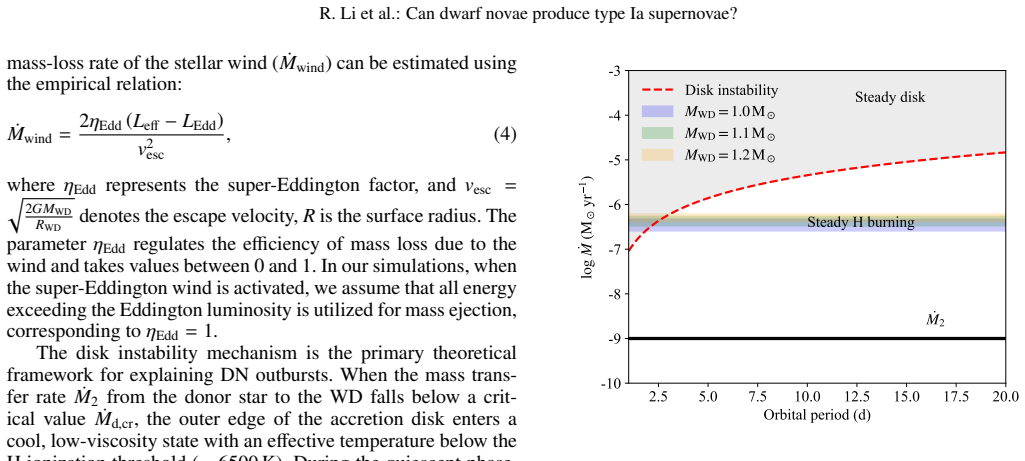
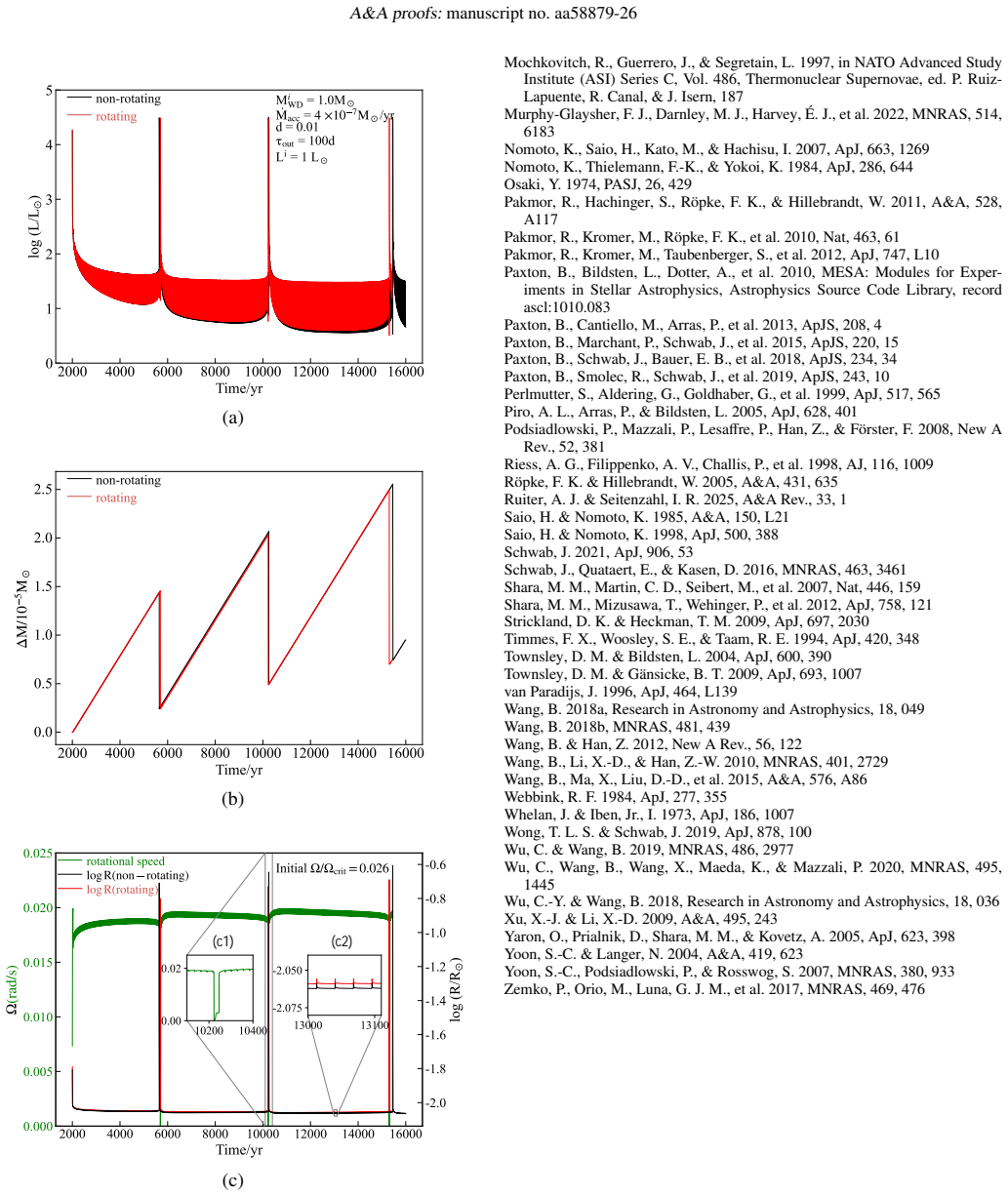
Accreting white dwarfs (WDs) are considered one of the most promising progenitor candidates for Type Ia supernovae (SNe Ia). Dwarf novae (DNe), a subclass of cataclysmic variables (CVs), consist of a carbon--oxygen (CO) WD accretor and a low-mass donor star, which may be either a main-sequence (MS) star or a slightly evolved subgiant. Previous studies have suggested that, under the thermal--viscous disk instability mechanism, the time-averaged accretion rate in long-period DNe may approach the regime of stable hydrogen burning, potentially allowing the WD to grow toward the Chandrasekhar mass, (M_{\rm Ch}). However, whether such periodic accretion can sustain stable hydrogen burning and lead to WD mass growth remains uncertain. In this work, we explore whether high accretion rates on short periodic timescales can maintain stable hydrogen burning on the WD surface and drive the WD toward (M_{\rm Ch}). Using Modules for Experiments in Stellar Astrophysics (MESA), we investigate the mass-retention efficiency of WDs undergoing intermittent DN-like accretion and examine its dependence on duty cycle, accretion rate, and initial WD properties. We find that periodic accretion fails to maintain stable hydrogen burning. During quiescent phases, the WD cools and becomes increasingly degenerate, leading to nova outbursts with progressively decreasing mass-retention efficiency and ultimately preventing further WD mass growth. We therefore suggest that DNe are unlikely to be progenitors of SNe Ia.
Editorial analysis
A structured set of objections, weighed in public.
Referee Report
Summary. The paper uses MESA simulations to model white dwarfs accreting intermittently at high rates for a fraction of time (set by duty cycle) and zero otherwise, mimicking dwarf novae. It claims that this periodic accretion cannot sustain stable hydrogen burning: during quiescent intervals the WD cools and grows more degenerate, triggering nova outbursts whose mass-retention efficiency decreases over successive cycles, ultimately preventing net growth toward the Chandrasekhar mass. The authors therefore conclude that dwarf novae are unlikely Type Ia supernova progenitors.
Significance. If the numerical result is robust, the work would remove a plausible channel from the single-degenerate progenitor pool, tightening constraints on the SN Ia rate and on the required time-averaged accretion rates. The explicit exploration of duty-cycle and outburst-rate dependence via forward stellar-structure integration is a concrete strength; the manuscript supplies reproducible MESA input physics for this specific setup.
major comments (2)
- [Methods] Methods (MESA setup for quiescent evolution): the central claim that retention efficiency decreases progressively rests on the thermal relaxation and degeneracy evolution during zero-accretion intervals. No convergence tests with respect to spatial resolution, time-step criteria, or number of simulated cycles are reported, nor is a comparison presented to analytic WD cooling timescales or to retention efficiencies measured in observed recurrent novae. This directly affects whether the simulated drop in retention is physical or numerical.
- [Results] Results (dependence on duty cycle): the conclusion that stable burning cannot be maintained is shown for the explored grid of duty cycles and outburst accretion rates, but the manuscript provides neither error bars on the retained mass per cycle nor a sensitivity study around the critical duty-cycle boundary. Small systematic offsets in the ignition-mass prescription would alter whether net growth is blocked.
minor comments (2)
- [Abstract] Notation: the abstract writes (M_{\rm Ch}) while the text uses M_Ch; adopt a single consistent symbol.
- [Figures] Figure captions should state the exact number of accretion cycles shown and the initial WD mass/temperature for each panel.
Simulated Author's Rebuttal
We thank the referee for the constructive and detailed report. We address each major comment below. We agree that the manuscript would benefit from additional numerical validation and sensitivity tests, which we will incorporate in the revision.
read point-by-point responses
-
Referee: [Methods] Methods (MESA setup for quiescent evolution): the central claim that retention efficiency decreases progressively rests on the thermal relaxation and degeneracy evolution during zero-accretion intervals. No convergence tests with respect to spatial resolution, time-step criteria, or number of simulated cycles are reported, nor is a comparison presented to analytic WD cooling timescales or to retention efficiencies measured in observed recurrent novae. This directly affects whether the simulated drop in retention is physical or numerical.
Authors: We agree that convergence tests and comparisons to analytic expectations strengthen the claim. In the revised manuscript we will add explicit tests varying spatial resolution (mesh_delta_coeff = 0.5 to 0.1) and time-step controls, showing that the progressive drop in retention efficiency persists across at least 20 cycles. We will also compare the simulated cooling timescales during quiescence to analytic Mestel-type cooling, confirming consistency. A brief discussion of retention efficiencies in observed recurrent novae will be included for context, although a full system-specific comparison lies outside the scope of this parameter study. revision: yes
-
Referee: [Results] Results (dependence on duty cycle): the conclusion that stable burning cannot be maintained is shown for the explored grid of duty cycles and outburst accretion rates, but the manuscript provides neither error bars on the retained mass per cycle nor a sensitivity study around the critical duty-cycle boundary. Small systematic offsets in the ignition-mass prescription would alter whether net growth is blocked.
Authors: We acknowledge the lack of quantitative uncertainty measures. The retained mass per cycle is an output of MESA's self-consistent ignition criterion. The revised version will report error bars as the standard deviation of retained mass across cycles for each model. We will also add a sensitivity study perturbing the ignition mass by ±5% and ±10%, demonstrating that net mass loss remains for duty cycles below ~0.1 while the outcome near the boundary can shift; this will be shown explicitly in a new figure or table. revision: yes
Circularity Check
No significant circularity; results from forward MESA integration
full rationale
The paper's central result—that periodic DN-like accretion leads to WD cooling, increased degeneracy, and declining nova mass-retention efficiency—is obtained by direct numerical integration of the stellar structure equations in MESA under imposed intermittent accretion histories (high rate for a fraction of time set by duty cycle, zero otherwise). No parameter is fitted to a target outcome and then relabeled as a prediction; no self-citation supplies a uniqueness theorem or ansatz that the present work then treats as external; and the mass-retention behavior is not defined in terms of itself. The simulation is therefore self-contained against external benchmarks (MESA's implementation of thermal relaxation and ignition physics), consistent with the reader's assessment of score 1.0. No load-bearing circular steps are present.
Axiom & Free-Parameter Ledger
free parameters (2)
- duty cycle
- accretion rate during outburst
axioms (1)
- domain assumption The thermal-viscous disk instability mechanism produces the periodic accretion pattern observed in dwarf novae
Reference graph
Works this paper leans on
-
[1]
J., Townsley, D
Boos, S. J., Townsley, D. M., Shen, K. J., Caldwell, S., & Miles, B. J. 2021, ApJ, 919, 126
2021
-
[2]
B., Nomoto, K., & Thielemann, F.-K
Branch, D., Doggett, J. B., Nomoto, K., & Thielemann, F.-K. 1985, ApJ, 294, 619
1985
-
[3]
2016, ApJ, 821, 28
Brooks, J., Bildsten, L., Schwab, J., & Paxton, B. 2016, ApJ, 821, 28
2016
-
[4]
Fink, M., Hillebrandt, W., & Röpke, F. K. 2007, A&A, 476, 1133
2007
-
[5]
K., Hillebrandt, W., et al
Fink, M., Röpke, F. K., Hillebrandt, W., et al. 2010, A&A, 514, A53
2010
-
[6]
M., Cheng, F., et al
Godon, P., Sion, E. M., Cheng, F., et al. 2006, ApJ, 642, 1018
2006
-
[7]
& Renzini, A
Greggio, L. & Renzini, A. 1983, A&A, 118, 217
1983
-
[8]
& Podsiadlowski, P
Han, Z. & Podsiadlowski, P. 2004, MNRAS, 350, 1301
2004
-
[9]
& Niemeyer, J
Hillebrandt, W. & Niemeyer, J. C. 2000, ARA&A, 38, 191
2000
-
[10]
& Fowler, W
Hoyle, F. & Fowler, W. A. 1960, ApJ, 132, 565
1960
-
[11]
& Tutukov, A
Iben, Jr., I. & Tutukov, A. V . 1984, ApJS, 54, 335
1984
-
[12]
Iglesias, C. A. & Rogers, F. J. 1996, ApJ, 464, 943
1996
-
[13]
R., Mac Low, M.-M., & Bryan, G
Joung, M. R., Mac Low, M.-M., & Bryan, G. L. 2009, ApJ, 704, 137
2009
- [14]
-
[15]
King, A. R. 1997, in Accretion Disks - New Aspects, ed. E. Meyer-Hofmeister & H. Spruit, V ol. 487, 89
1997
-
[16]
R., Rolfe, D
King, A. R., Rolfe, D. J., & Schenker, K. 2003, MNRAS, 341, L35
2003
-
[17]
2000, A&A, 362, 1046
Langer, N., Deutschmann, A., Wellstein, S., & Höflich, P. 2000, A&A, 362, 1046
2000
-
[18]
& Nomoto, K
Leung, S.-C. & Nomoto, K. 2018, ApJ, 861, 143
2018
-
[19]
& Wang, B
Liu, D. & Wang, B. 2020, MNRAS, 494, 3422
2020
-
[20]
K., & Han, Z
Liu, Z.-W., Röpke, F. K., & Han, Z. 2023, Research in Astronomy and Astro- physics, 23, 082001
2023
-
[21]
& Graur, O
Maoz, D. & Graur, O. 2017, ApJ, 848, 25
2017
-
[22]
& Mannucci, F
Maoz, D. & Mannucci, F. 2012, PASA, 29, 447
2012
-
[23]
2014, ARA&A, 52, 107
Maoz, D., Mannucci, F., & Nelemans, G. 2014, ARA&A, 52, 107
2014
-
[24]
& Greggio, L
Matteucci, F. & Greggio, L. 1986, A&A, 154, 279
1986
-
[25]
& Yang, W
Meng, X. & Yang, W. 2010, ApJ, 710, 1310
2010
-
[26]
& Meyer-Hofmeister, E
Meyer, F. & Meyer-Hofmeister, E. 1981, A&A, 104, L10 Article number, page 7 of 8 A&A proofs:manuscript no. aa58879-26 2000 4000 6000 8000 10000 12000 14000 16000 Time/yr 0 1 2 3 4 5log (L/L ) Mi WD = 1.0M Macc = 4 ×10 7M /yr d = 0.01 out = 100d Li = 1 L non-rotating rotating (a) 2000 4000 6000 8000 10000 12000 14000 16000 Time/yr 0.0 0.5 1.0 1.5 2.0 2.5 M...
1981
-
[27]
1997, in NATO Advanced Study Institute (ASI) Series C, V ol
Mochkovitch, R., Guerrero, J., & Segretain, L. 1997, in NATO Advanced Study Institute (ASI) Series C, V ol. 486, Thermonuclear Supernovae, ed. P. Ruiz-
1997
-
[28]
J., Darnley, M
Murphy-Glaysher, F. J., Darnley, M. J., Harvey, É. J., et al. 2022, MNRAS, 514, 6183
2022
-
[29]
2007, ApJ, 663, 1269
Nomoto, K., Saio, H., Kato, M., & Hachisu, I. 2007, ApJ, 663, 1269
2007
-
[30]
1984, ApJ, 286, 644
Nomoto, K., Thielemann, F.-K., & Yokoi, K. 1984, ApJ, 286, 644
1984
-
[31]
1974, PASJ, 26, 429
Osaki, Y . 1974, PASJ, 26, 429
1974
-
[32]
K., & Hillebrandt, W
Pakmor, R., Hachinger, S., Röpke, F. K., & Hillebrandt, W. 2011, A&A, 528, A117
2011
-
[33]
K., et al
Pakmor, R., Kromer, M., Röpke, F. K., et al. 2010, Nat, 463, 61
2010
-
[34]
2012, ApJ, 747, L10
Pakmor, R., Kromer, M., Taubenberger, S., et al. 2012, ApJ, 747, L10
2012
-
[35]
2010, MESA: Modules for Exper- iments in Stellar Astrophysics, Astrophysics Source Code Library, record ascl:1010.083
Paxton, B., Bildsten, L., Dotter, A., et al. 2010, MESA: Modules for Exper- iments in Stellar Astrophysics, Astrophysics Source Code Library, record ascl:1010.083
2010
-
[36]
2013, ApJS, 208, 4
Paxton, B., Cantiello, M., Arras, P., et al. 2013, ApJS, 208, 4
2013
-
[37]
2015, ApJS, 220, 15
Paxton, B., Marchant, P., Schwab, J., et al. 2015, ApJS, 220, 15
2015
-
[38]
B., et al
Paxton, B., Schwab, J., Bauer, E. B., et al. 2018, ApJS, 234, 34
2018
-
[39]
2019, ApJS, 243, 10
Paxton, B., Smolec, R., Schwab, J., et al. 2019, ApJS, 243, 10
2019
-
[40]
1999, ApJ, 517, 565
Perlmutter, S., Aldering, G., Goldhaber, G., et al. 1999, ApJ, 517, 565
1999
-
[41]
L., Arras, P., & Bildsten, L
Piro, A. L., Arras, P., & Bildsten, L. 2005, ApJ, 628, 401
2005
-
[42]
2008, New A Rev., 52, 381
Podsiadlowski, P., Mazzali, P., Lesaffre, P., Han, Z., & Förster, F. 2008, New A Rev., 52, 381
2008
-
[43]
G., Filippenko, A
Riess, A. G., Filippenko, A. V ., Challis, P., et al. 1998, AJ, 116, 1009 Röpke, F. K. & Hillebrandt, W. 2005, A&A, 431, 635
1998
-
[44]
Ruiter, A. J. & Seitenzahl, I. R. 2025, A&A Rev., 33, 1
2025
-
[45]
& Nomoto, K
Saio, H. & Nomoto, K. 1985, A&A, 150, L21
1985
-
[46]
& Nomoto, K
Saio, H. & Nomoto, K. 1998, ApJ, 500, 388
1998
-
[47]
2016, MNRAS, 463, 3461
Schwab, J., Quataert, E., & Kasen, D. 2016, MNRAS, 463, 3461
2016
-
[48]
M., Martin, C
Shara, M. M., Martin, C. D., Seibert, M., et al. 2007, Nat, 446, 159
2007
-
[49]
M., Mizusawa, T., Wehinger, P., et al
Shara, M. M., Mizusawa, T., Wehinger, P., et al. 2012, ApJ, 758, 121
2012
-
[50]
Strickland, D. K. & Heckman, T. M. 2009, ApJ, 697, 2030
2009
-
[51]
X., Woosley, S
Timmes, F. X., Woosley, S. E., & Taam, R. E. 1994, ApJ, 420, 348
1994
-
[52]
Townsley, D. M. & Bildsten, L. 2004, ApJ, 600, 390
2004
-
[53]
Townsley, D. M. & Gänsicke, B. T. 2009, ApJ, 693, 1007 van Paradijs, J. 1996, ApJ, 464, L139
2009
-
[54]
& Han, Z
Wang, B. & Han, Z. 2012, New A Rev., 56, 122
2012
-
[55]
2010, MNRAS, 401, 2729
Wang, B., Li, X.-D., & Han, Z.-W. 2010, MNRAS, 401, 2729
2010
-
[56]
2015, A&A, 576, A86
Wang, B., Ma, X., Liu, D.-D., et al. 2015, A&A, 576, A86
2015
-
[57]
Webbink, R. F. 1984, ApJ, 277, 355
1984
-
[58]
& Iben, Jr., I
Whelan, J. & Iben, Jr., I. 1973, ApJ, 186, 1007
1973
-
[59]
Wong, T. L. S. & Schwab, J. 2019, ApJ, 878, 100
2019
-
[60]
& Wang, B
Wu, C. & Wang, B. 2019, MNRAS, 486, 2977
2019
-
[61]
2020, MNRAS, 495, 1445
Wu, C., Wang, B., Wang, X., Maeda, K., & Mazzali, P. 2020, MNRAS, 495, 1445
2020
-
[62]
& Wang, B
Wu, C.-Y . & Wang, B. 2018, Research in Astronomy and Astrophysics, 18, 036
2018
-
[63]
& Li, X.-D
Xu, X.-J. & Li, X.-D. 2009, A&A, 495, 243
2009
-
[64]
M., & Kovetz, A
Yaron, O., Prialnik, D., Shara, M. M., & Kovetz, A. 2005, ApJ, 623, 398
2005
-
[65]
& Langer, N
Yoon, S.-C. & Langer, N. 2004, A&A, 419, 623
2004
-
[66]
2007, MNRAS, 380, 933
Yoon, S.-C., Podsiadlowski, P., & Rosswog, S. 2007, MNRAS, 380, 933
2007
-
[67]
Zemko, P., Orio, M., Luna, G. J. M., et al. 2017, MNRAS, 469, 476 Article number, page 8 of 8
2017
discussion (0)
Sign in with ORCID, Apple, or X to comment. Anyone can read and Pith papers without signing in.