Optical constants of Ih, Ic, and amorphous H₂O ices in the THz and IR ranges
Pith reviewed 2026-06-25 20:29 UTC · model grok-4.3
The pith
THz measurements of water ices reveal a shared weak peak near 1.8 THz formed by infrared band wings, with opacity calculations for ice mantles differing from extrapolations.
A machine-rendered reading of the paper's core claim, the machinery that carries it, and where it could break.
Core claim
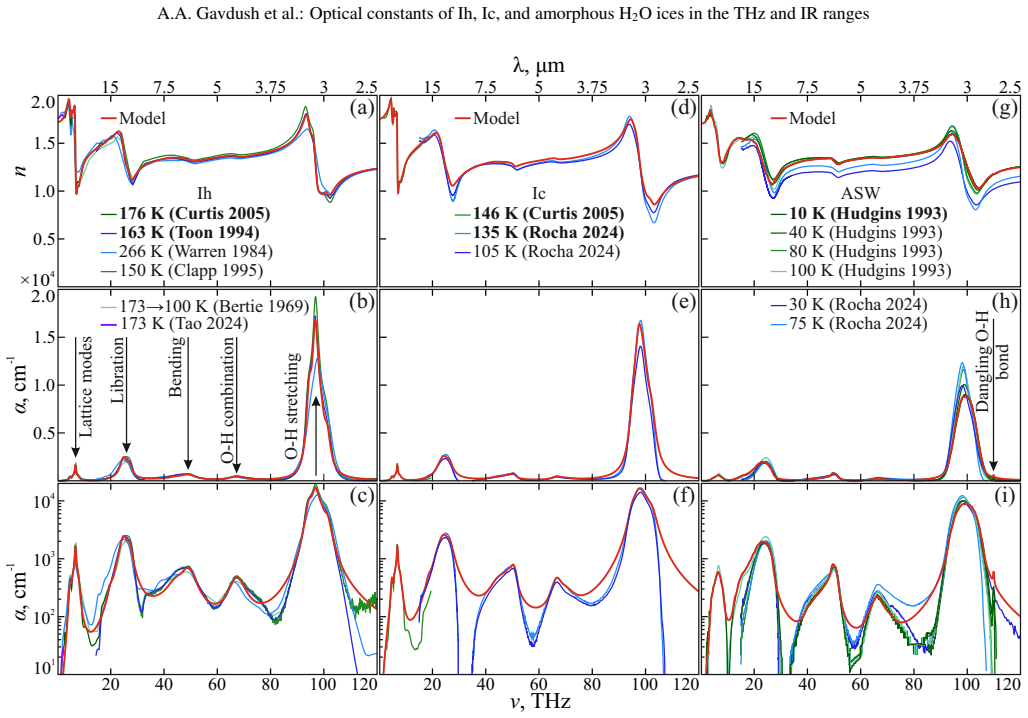
Direct THz measurements combined with selected compact ice literature data yield broadband optical constants for Ih, Ic, and ASW ices. The THz response arises from low-frequency wings of IR vibrational bands and a single broad low-intensity peak near 1.8 THz that remains similar across all three phases. Opacity computations for H2O ice-coated dust grains based on these experimental constants show clear discrepancies with values derived from extrapolation of higher-frequency data.
What carries the argument
multiple-Lorentz model fitted to merged experimental THz spectra and selected high-constant literature IR data, isolating the common 1.8 THz peak
If this is right
- THz absorption across all water ice phases can be described uniformly by infrared band wings plus one shared weak peak
- Dust grain opacity with ice mantles calculated from merged data differs from extrapolated models, especially in low-absorption regions
- The inferred constants apply directly to radiative transfer in cold clouds and protoplanetary disks
Where Pith is reading between the lines
- Phase-independent THz behavior may simplify ice-mantle models rather than requiring separate treatments for each ice form
- The observed discrepancies imply that current extrapolation methods systematically misestimate absorption in the THz gap for astrophysical grain calculations
Load-bearing premise
Literature samples classified as compact with the highest optical constants can be merged with the new experimental THz data without introducing systematic offsets, particularly in low-absorption regions or at band overlaps.
What would settle it
A new set of THz transmission measurements on compact ice samples that yields either a markedly different continuum level or no peak near 1.8 THz would falsify the merged constants and the claimed phase similarity.
Figures



read the original abstract
Direct measurements of optical constants in the THz spectral region for astrophysically relevant H$_2$O ice samples are scarce. Extrapolation of optical properties in the THz spectral region from IR data can introduce uncertainties into astrophysical models. We measured the optical properties of water ice samples in the Ih and Ic forms as well as amorphous solid water (ASW) in the THz region in order to derive broad optical constants using literature and experimental data in the THz-IR range. In our experiments, the Ih, Ic, and ASW ices were grown by vapour deposition onto a cold substrate and measured by THz pulsed spectroscopy. Their THz optical properties were retrieved, compared with the THz-IR literature data, and approximated using the multiple-Lorentz model. From the existing literature data on the Ih, Ic, and ASW ices, we selected samples with the highest optical constants and classified them as compact. Their optical properties were merged in the frequency range of $\nu = 0.3$-$120$~THz (the wavelength range of $\lambda = 1$~mm-2.5$~\mu$m). The underlying absorption bands were attributed to vibrational modes and approximated using the multiple-Lorentz model while accounting for anharmonicity. Discrepancies primarily arising in low-absorption regions between the experimental data and broadband models were attributed to factors such as the model's complexity and the baseline-subtraction procedure. The THz response of all ices is formed by the low-frequency wings of the IR bands and the single broad low-intense THz peak around $1.8$~THz, which is very similar for all phases. The opacity calculation for dust grains covered by H$_2$O ice mantles based on experimental data shows discrepancies with data derived by extrapolation. The inferred THz-IR optical constants of water ice are important for future observations and modelling of cold clouds and protoplanetary disks.
Editorial analysis
A structured set of objections, weighed in public.
Referee Report
Summary. The manuscript presents new THz pulsed spectroscopy measurements of the optical constants for vapor-deposited Ih, Ic, and amorphous solid water (ASW) ices. These are merged with selected literature IR data (0.3–120 THz total range) by choosing samples with the highest reported optical constants and labeling them 'compact'; the combined dataset is fitted with a multiple-Lorentz oscillator model that accounts for anharmonicity. The resulting constants are used to compute opacities for ice-mantled dust grains, which are reported to differ from values obtained by simple extrapolation of IR data. The THz response is attributed to the low-frequency wings of IR bands plus a common broad, low-intensity peak near 1.8 THz across all phases.
Significance. If the merged optical constants prove robust, the work supplies direct experimental THz constraints on H₂O ice that are relevant for radiative-transfer modeling of cold clouds and protoplanetary disks. The demonstration that a single broad THz feature is shared by crystalline and amorphous phases, together with the reported opacity discrepancies versus extrapolation, would underscore the need for broadband laboratory data rather than IR-only extrapolations in astrophysical applications.
major comments (2)
- [data-merging paragraph / methods] In the paragraph describing the construction of the broadband dataset (abstract and corresponding methods section): literature samples are selected solely because they exhibit the 'highest optical constants' and are then classified as compact; no independent metric (density, porosity, or deposition conditions) is provided to justify that these samples are free of systematic offsets relative to the new vapor-deposited THz measurements. Because the merged curve is used both for the multiple-Lorentz fit and for the dust-grain opacity calculation, any offset at the THz–IR junction or in low-absorption windows directly affects the claimed discrepancies.
- [opacity calculation section] In the section reporting the opacity calculations: the discrepancies between experimental-data-based opacities and extrapolated values are presented without a quantitative error budget or sensitivity test to the literature-selection step. It is therefore unclear whether the reported differences exceed the uncertainties that could arise from the merging procedure itself, particularly in the low-absorption regions where baseline subtraction is already invoked as a source of discrepancy.
minor comments (1)
- [model description] The abstract and text refer to 'multiple-Lorentz model' without specifying the exact number of oscillators or the functional form used to incorporate anharmonicity; adding this detail would improve reproducibility.
Simulated Author's Rebuttal
We thank the referee for the constructive comments. We address each major comment below and indicate planned revisions to strengthen the manuscript.
read point-by-point responses
-
Referee: In the paragraph describing the construction of the broadband dataset (abstract and corresponding methods section): literature samples are selected solely because they exhibit the 'highest optical constants' and are then classified as compact; no independent metric (density, porosity, or deposition conditions) is provided to justify that these samples are free of systematic offsets relative to the new vapor-deposited THz measurements. Because the merged curve is used both for the multiple-Lorentz fit and for the dust-grain opacity calculation, any offset at the THz–IR junction or in low-absorption windows directly affects the claimed discrepancies.
Authors: We selected literature samples with the highest optical constants as a proxy for compact ices, since prior work shows that porosity and lower density systematically reduce effective refractive indices and absorption coefficients in water ice films. This is a common practice in the field when direct density data are unavailable. We will revise the methods section to explicitly cite supporting literature on the correlation between optical constants and ice density/porosity, note available deposition conditions from the source papers, and discuss possible systematic offsets relative to our vapor-deposited samples. revision: yes
-
Referee: In the section reporting the opacity calculations: the discrepancies between experimental-data-based opacities and extrapolated values are presented without a quantitative error budget or sensitivity test to the literature-selection step. It is therefore unclear whether the reported differences exceed the uncertainties that could arise from the merging procedure itself, particularly in the low-absorption regions where baseline subtraction is already invoked as a source of discrepancy.
Authors: The manuscript already attributes low-absorption discrepancies to baseline subtraction and model limitations. To address the lack of a quantitative error budget, we will add a sensitivity test in the revised manuscript by recomputing merged datasets and opacities under alternative literature-selection criteria (e.g., using median rather than maximum values) and propagating uncertainties from the merging step. This will allow direct comparison of the reported discrepancies against merging-related uncertainties. revision: yes
Circularity Check
No significant circularity; derivation rests on new measurements plus external literature selection
full rationale
The paper reports new vapor-deposition THz measurements for Ih, Ic, and ASW ices, merges them with literature IR data chosen by the criterion of highest optical constants (classified as compact), fits the combined set with a multiple-Lorentz model, and computes dust-grain opacities that differ from extrapolations. This selection and fitting step is a methodological choice, not a self-definition or a fitted parameter renamed as a prediction. No self-citation chain, uniqueness theorem, or ansatz smuggling is present in the provided text. The central discrepancy claim compares the merged experimental curve against independent extrapolations and is therefore not forced by construction. The derivation remains self-contained against external benchmarks.
Axiom & Free-Parameter Ledger
free parameters (1)
- Multiple-Lorentz oscillator parameters
axioms (1)
- domain assumption Multiple-Lorentz model adequately represents vibrational modes and anharmonicity across THz-IR for water ices.
Reference graph
Works this paper leans on
-
[1]
M., Huang, J., Pérez, L
Andrews, S. M., Huang, J., Pérez, L. M., et al. 2018, ApJ, 869, L41
2018
-
[2]
M., Woitke, P., Cazaux, S
Arabhavi, A. M., Woitke, P., Cazaux, S. M., et al. 2022, A&A, 666, A139
2022
-
[3]
P., Cleeves, L
Ballering, N. P., Cleeves, L. I., & Anderson, D. E. 2021, ApJ, 920, 115
2021
-
[4]
Barker, A. S. & Hopfield, J. J. 1964, Phys. Rev., 135, 1732
1964
-
[5]
& Unterwald, F
Berreman, D. & Unterwald, F. 1968, Phys. Rev., 174, 791
1968
-
[6]
E., Labbé, H
Bertie, J. E., Labbé, H. J., & Whalley, E. 1969, J. Chem. Phys., 50, 4501
1969
-
[7]
Bertie, J. E. & Whalley, E. 1967, J. Chem. Phys., 46, 1271
1967
-
[8]
2012, A&A, 539, A148
Birnstiel, T., Klahr, H., & Ercolano, B. 2012, A&A, 539, A148
2012
-
[9]
C., Savage, B
Bohlin, R. C., Savage, B. D., & Drake, J. F. 1978, ApJ, 224, 132
1978
-
[10]
Bohren, C. F. & Huffman, D. R. 1983, ASLSP
1983
-
[11]
2008, ApJ, 678, 985
Boogert, A., Pontoppidan, K., Knez, C., et al. 2008, ApJ, 678, 985
2008
-
[12]
A., Gerakines, P
Boogert, A. A., Gerakines, P. A., & Whittet, D. 2015, ARA&A, 53, 541
2015
-
[13]
Boogert, A. C. A., Gerakines, P. A., & Whittet, D. C. B. 2015, ARA&A, 53, 541
2015
-
[14]
2015, MNRAS, 451, 2145
Bouilloud, M., Fray, N., Bénilan, Y ., et al. 2015, MNRAS, 451, 2145
2015
-
[15]
1935, Ann
Bruggeman, D. 1935, Ann. Phys., 416, 636
1935
-
[16]
A., Tribbett, P
Carmack, R. A., Tribbett, P. D., & Loeffler, M. J. 2023, ApJ, 942, 1
2023
-
[17]
E., Zhao, B., et al
Caselli, P., Pineda, J. E., Zhao, B., et al. 2019, ApJ, 874, 89
2019
-
[18]
M., Tafalla, M., Dore, L., & Myers, P
Caselli, P., Walmsley, C. M., Tafalla, M., Dore, L., & Myers, P. C. 1999, ApJ, 523, L165
1999
-
[19]
L., Worsnop, D
Clapp, M. L., Worsnop, D. R., & Miller, R. E. 1995, J. Phys. Chem., 99, 6317
1995
-
[20]
P., Dever, J
Collings, M. P., Dever, J. W., Fraser, H. J., & McCoustra, M. R. S. 2003, Ap&SS, 285, 633 Article number, page 7 A&A proofs:manuscript no. aa59623-26revised
2003
-
[21]
B., Rajaram, B., Toon, O
Curtis, D. B., Rajaram, B., Toon, O. B., & Tolbert, M. A. 2005, Appl. Opt., 44, 4102
2005
-
[22]
2002, A&A, 394, 1057
Dartois, E., d’Hendecourt, L., Thi, W., Pontoppidan, K., & van Dishoeck, E. 2002, A&A, 394, 1057
2002
-
[23]
A., Ysard, N., Demyk, K., & Chabot, M
Dartois, E., Noble, J. A., Ysard, N., Demyk, K., & Chabot, M. 2022, A&A, 666, A153 Dohnálek, Z., Kimmel, G. A., Ayotte, P., Smith, R. S., & Kay, B. D. 2003, J. Chem. Phys., 118, 364
2022
-
[24]
Draine, B. T. 2006, ApJ, 636, 1114
2006
-
[25]
P., Birnstiel, T., Huang, J., et al
Dullemond, C. P., Birnstiel, T., Huang, J., et al. 2018, ApJ, 869, L46
2018
-
[26]
1998, A&A, 338, L63
Dutrey, A., Guilloteau, S., Prato, L., et al. 1998, A&A, 338, L63
1998
-
[27]
Efimov, A. 1996, J. Non-Cryst. Solids, 203, 1
1996
-
[28]
M., Yamashita, K., et al
Eklund, T., Tonauer, C. M., Yamashita, K., et al. 2026, J. Chem. Phys., 164, 014501
2026
-
[29]
Elton, D. C. & Fernández-Serra, M. 2016, Nat. Commun., 7, 10193
2016
-
[30]
2025, A&A, 701, A287
Gavdush, A., Ivlev, A., Zaytsev, K., et al. 2025, A&A, 701, A287
2025
-
[31]
2022, A&A, 667, A49
Gavdush, A., Kruczkiewicz, F., Giuliano, B., et al. 2022, A&A, 667, A49
2022
-
[32]
& Hudson, R
Gerakines, P. & Hudson, R. 2020, ApJ, 901, 52
2020
-
[33]
L., Whittet, D
Gibb, E. L., Whittet, D. C. B., Boogert, A. C. A., & Tielens, A. G. G. M. 2004, ApJS, 151, 35
2004
-
[34]
2019, A&A, 629, A112
Giuliano, B., Gavdush, A., Müller, B., et al. 2019, A&A, 629, A112
2019
-
[35]
Caro, G. M. 2014, A&A, 565, A108
2014
-
[36]
Grassi, T., Bovino, S., Haugbølle, T., & Schleicher, D. R. G. 2017, MNRAS, 466, 1259
2017
-
[37]
1981, Chem
Hagen, W., Tielens, A., & Greenberg, J. 1981, Chem. Phys., 56, 367
1981
-
[38]
2022, ApJ, 925, 179
He, J., Diamant, S., Wang, S., et al. 2022, ApJ, 925, 179
2022
-
[39]
K., Okuno, M., et al
Hsieh, C.-S., Campen, R. K., Okuno, M., et al. 2013, PNAS, 110, 18780
2013
-
[40]
2013, Sci
Huang, Y ., Zhang, X., Ma, Z., et al. 2013, Sci. Rep., 3, 3005
2013
-
[41]
1993, ApJS, 86, 713
Hudgins, D., Sandford, S., Allamandola, L., & Tielens, A. 1993, ApJS, 86, 713
1993
-
[42]
L., Yarnall, Y
Hudson, R. L., Yarnall, Y . Y ., & Materese, C. K. 2025, ACS Earth Space Chem., 9, 2455
2025
-
[43]
1967, Phys
Ipatova, I., Maradudin, A., & Wallis, R. 1967, Phys. Rev., 155, 882
1967
-
[44]
& Blake, D
Jenniskens, P. & Blake, D. F. 1994, Sci, 265, 753
1994
-
[45]
2018, A&A, 612, A71
Juvela, M., He, J., Pattle, K., et al. 2018, A&A, 612, A71
2018
-
[46]
A., Dohnálek, Z., Stevenson, K
Kimmel, G. A., Dohnálek, Z., Stevenson, K. P., Smith, R. S., & Kay, B. D. 2001, J. Chem. Phys., 114, 5295
2001
-
[47]
2019, ApJ, 875, 131
Kofman, V ., He, J., Loes ten Kate, I., & Linnartz, H. 2019, ApJ, 875, 131
2019
-
[48]
2026, A&A, 707, A344
Kruczkiewicz, F., Gavdush, A., Ribeiro, F., et al. 2026, A&A, 707, A344
2026
-
[49]
1979, A&A, 79, 256
Leger, A., Klein, J., de Cheveigne, S., et al. 1979, A&A, 79, 256
1979
-
[50]
& Draine, B
Li, A. & Draine, B. T. 2001, ApJ, 554, 778
2001
-
[51]
2020, Commun
Loerting, T., Fuentes-Landete, V ., Tonauer, C., & Gasser, T. 2020, Commun. Chem., 3, 109
2020
-
[52]
Lombardi, M., Bouy, H., Alves, J., & Lada, C. J. 2014, A&A, 566, A45
2014
-
[53]
2007, PNAS, 104, 18387
Mallamace, F., Branca, C., Broccio, M., et al. 2007, PNAS, 104, 18387
2007
-
[54]
1967, Phys
Martin, P. 1967, Phys. Rev., 161, 143
1967
-
[55]
J., Dawes, A., Holtom, P
Mason, N. J., Dawes, A., Holtom, P. D., et al. 2006, Faraday Discuss., 133, 311
2006
-
[56]
2009, ApJ, 701, 1347
Mastrapa, R., Sandford, S., Roush, T., Cruikshank, D., & Dalle Ore, C. 2009, ApJ, 701, 1347
2009
-
[57]
S., Rumpl, W., & Nordsieck, K
Mathis, J. S., Rumpl, W., & Nordsieck, K. H. 1977, ApJ, 217, 425
1977
-
[58]
2021, Phys
Maty, B., Satorre, M., & Escibano, R. 2021, Phys. Chem. Chem. Phys., 23, 9532
2021
-
[59]
2012, ApJ, 758, 17
Medcraft, C., McNaughton, D., Thompson, C., et al. 2012, ApJ, 758, 17
2012
-
[60]
2013, Phys
Medcraft, C., McNaughton, D., Thompson, C., et al. 2013, Phys. Chem. Chem. Phys., 15, 3630 Megías, A., Jiménez-Serra, I., Dulieu, F., et al. 2025, A&A, 702, A87
2013
-
[61]
V ., Hailey, P
Mifsud, D. V ., Hailey, P. A., Herczku, P., et al. 2022, Eur. Phys. J. D, 76, 87
2022
-
[62]
Mishima, O., Klug, D., & Whalley, E. 1983, J. Chem. Phys., 78, 6399
1983
-
[63]
Moberg, D., Straight, S., Knight, C., & Paesani, F. 2017, J. Phys. Chem. Lett., 8, 2579
2017
-
[64]
& Hudson, R
Moore, M. & Hudson, R. L. 1992, ApJ, 401, 353
1992
-
[65]
Moore, M. H. & Hudson, R. 1994, A&A, 103, 45
1994
-
[66]
2021, ApJ, 923, L3
Nagasawa, T., Sato, R., Hasegawa, T., et al. 2021, ApJ, 923, L3
2021
-
[67]
Narten, A., Venkatesh, C., & Rice, S. 1976, J. Chem. Phys., 64, 1106
1976
-
[68]
2024, Nat
Noble, J., Fraser, H., Smith, Z., et al. 2024, Nat. Astron., 8, 1169
2024
-
[69]
2025, ApJ, 979, 142 Öberg, K
Nozari, P., Sadavoy, S., Chapillon, E., et al. 2025, ApJ, 979, 142 Öberg, K. I., Boogert, A. C. A., Pontoppidan, K. M., et al. 2011, ApJ, 740, 109
2025
-
[70]
2018, ApJ, 856, 147
Ohashi, S., Sanhueza, P., Sakai, N., et al. 2018, ApJ, 856, 147
2018
-
[71]
W., Min, M., Tielens, A
Ormel, C. W., Min, M., Tielens, A. G. G. M., Dominik, C., & Paszun, D. 2011, A&A, 532, A43
2011
-
[72]
& Henning, T
Ossenkopf, V . & Henning, T. 1994, A&A, 291, 943
1994
-
[73]
Palumbo, M. 2005, J. Phys.: Conf. Ser., 6, 211
2005
-
[74]
Perotti, G., Rocha, W. R. M., Jørgensen, J. K., et al. 2020, A&A, 643, A48
2020
-
[75]
W., & Henning, T
Preibisch, T., Ossenkopf, V ., Yorke, H. W., & Henning, T. 1993, A&A, 279, 577
1993
-
[76]
2024, A&A, 681, A9
Rocha, W., Gomes Rachid, M., McClure, M., He, J., & Linnartz, H. 2024, A&A, 681, A9
2024
-
[77]
2022, A&A, 668, A63
Rocha, W., Gomes Rachid, M., Olsthoorn, B., et al. 2022, A&A, 668, A63
2022
-
[78]
Rocha, W. R. M., Perotti, G., Kristensen, L. E., & Jørgensen, J. K. 2021, A&A, 654, A158
2021
-
[79]
J., et al
Sabatini, G., Bianchi, E., Chandler, C. J., et al. 2025, A&A, 698, L16
2025
-
[80]
Salzmann, C. 2019, J. Chem. Phys., 150, 060901
2019
discussion (0)
Sign in with ORCID, Apple, or X to comment. Anyone can read and Pith papers without signing in.