Towards the Enhancement of Body Standing Balance Recovery by Means of a Wireless Audio-Biofeedback System
Pith reviewed 2026-05-24 15:26 UTC · model grok-4.3
The pith
A wireless IMU-based audio system maps trunk sway to headphone tones and reduces body sway by 10.65 to 65.90 percent across tested conditions.
A machine-rendered reading of the paper's core claim, the machinery that carries it, and where it could break.
Core claim
The authors claim that their audio-biofeedback loop, driven by lumbar IMU kinematics, augments the user's sensorimotor control sufficiently to produce statistically observable reductions in trunk sway during quiet standing, with the size of the reduction ranging from 10.65 percent to 65.90 percent according to age group and test condition.
What carries the argument
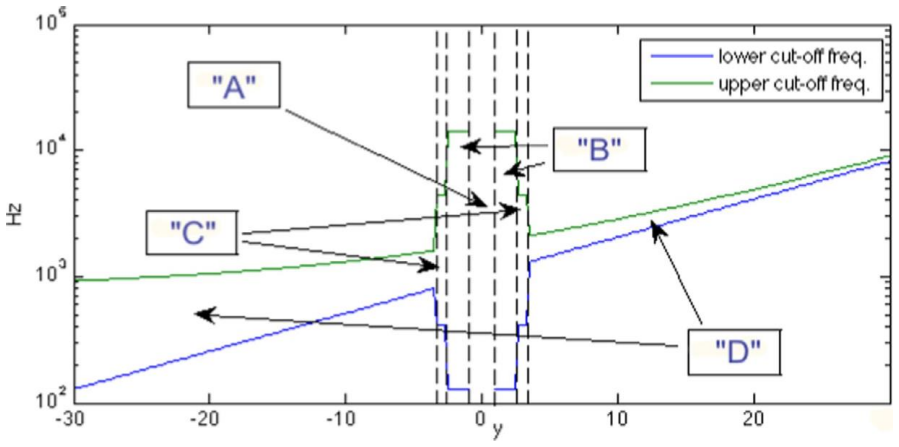
The audio-biofeedback mapping that converts measured trunk kinematics into graded pleasant-to-unpleasant headphone sound in real time.
If this is right
- Older adults show larger relative gains when visual or proprioceptive input is removed, consistent with the system supplying missing sensory information.
- The lumbar sensor placement is presented as practical and non-intrusive for continuous monitoring.
- The graded aversive sound is intended to drive corrective postural adjustments without requiring conscious interpretation of numbers or graphs.
- Effect size varies systematically with both age and surface/eye condition, suggesting that calibration or gain settings may need to differ by user group.
Where Pith is reading between the lines
- If the effect persists outside the laboratory, the same hardware could be explored for real-time alerts during walking or other daily activities that carry higher fall risk.
- The design choice of mapping instability to unpleasant sound could be compared directly against neutral-tone or positive-reinforcement variants to isolate the contribution of aversiveness.
- A larger, longer-term study would be required to determine whether the short-term sway reductions translate into fewer actual falls or improved confidence in daily life.
Load-bearing premise
Measured sway reductions are produced by the audio signals themselves rather than by practice, placebo, or the short repeated-testing protocol.
What would settle it
A within-subject comparison of identical balance trials performed once with the audio active and once with the device silent would show no difference in sway metrics if the feedback is not the active ingredient.
Figures
read the original abstract
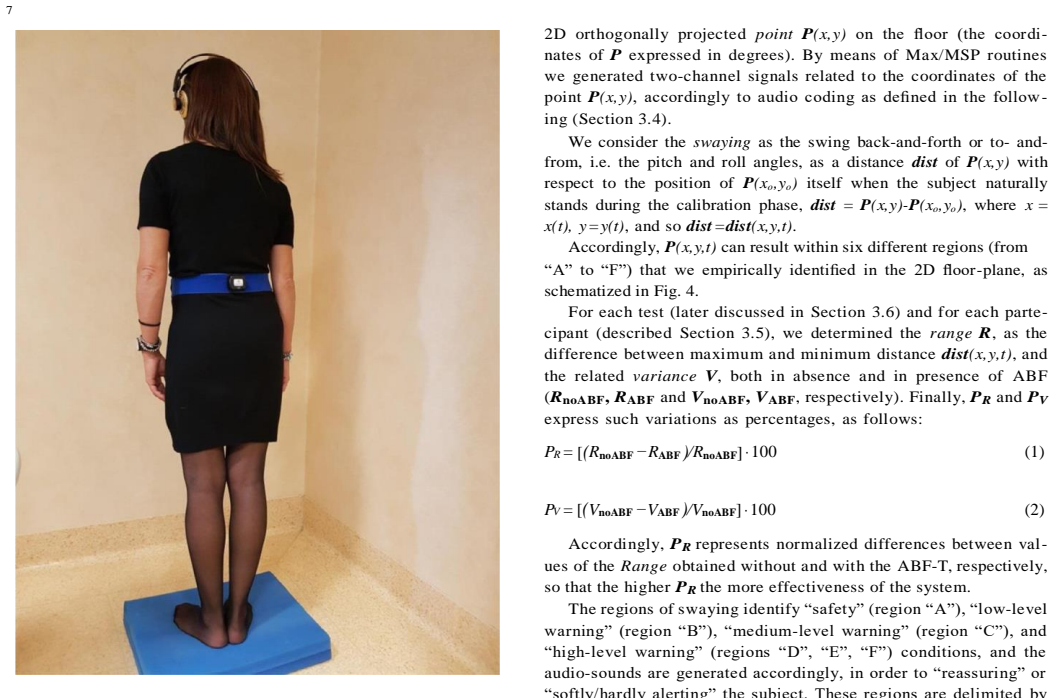
Human maintain their body balance by sensorimotor controls mainly based on information gathered from vision, proprioception and vestibular systems. When there is a lack of information, caused by pathologies, diseases or aging, the subject may fall. In this context, we developed a system to augment information gathering, providing the subject with warning audio-feedback signals related to his/her equilibrium. The system comprises an inertial measurement unit (IMU), a data processing unit, a headphone audio device and a software application. The IMU is a low-weight, small-size wireless instrument that, body-back located between the L2 and L5 lumbar vertebrae, measures the subject's trunk kinematics. The application drives the data processing unit to feeding the headphone with electric signals related to the kinematic measures. Consequently, the user is audio-alerted, via headphone, of his/her own equilibrium, hearing a pleasant sound when in a stable equilibrium, or an increasing bothering sound when in an increasing unstable condition. Tests were conducted on a group of six older subjects (59y-61y, SD = 2.09y) and a group of four young subjects (21y-26y, SD = 2.88y) to underline difference in effectiveness of the system, if any, related to the age of the users. For each subject, standing balance tests were performed in normal or altered conditions, such as, open or closed eyes, and on a solid or foam surface The system was evaluated in terms of usability, reliability, and effectiveness in improving the subject's balance in all conditions. As a result, the system successfully helped the subjects in reducing the body swaying within 10.65%-65.90%, differences depending on subjects' age and test conditions.
Editorial analysis
A structured set of objections, weighed in public.
Referee Report
Summary. The manuscript describes a wireless audio-biofeedback system that uses a low-weight IMU placed between L2-L5 to measure trunk kinematics and deliver auditory cues (pleasant tone for stability, increasingly unpleasant for instability) via headphones. It reports results from standing balance tests on 10 subjects (6 older, 4 young) across eyes-open/closed and solid/foam conditions, claiming the system reduced body sway by 10.65%–65.90% depending on age and test condition.
Significance. If the reported reductions prove attributable to the audio feedback rather than practice effects, the low-cost, wireless IMU-based design could provide a practical sensory-augmentation tool for fall prevention in aging or balance-impaired populations. The prototype integrates standard signal-processing components in a wearable form factor, which is a modest but positive engineering contribution.
major comments (2)
- [Abstract] Abstract: the effectiveness claim rests on percentage reductions (10.65%–65.90%) with no accompanying statistical tests, confidence intervals, or definition of the sway metric (RMS, range, velocity, etc.). With n=10 this leaves the central result unquantified and vulnerable to sampling variability.
- [Evaluation protocol] Evaluation protocol (described in Abstract and implied in full text): multiple standing trials are performed per subject under varied sensory conditions, yet the protocol contains no within-subject no-feedback control arm, counterbalanced order, or washout. This directly undermines attribution of any observed reduction to the biofeedback signal itself rather than repeated-testing or learning effects.
minor comments (3)
- [Abstract] Abstract: grammatical error ('Human maintain' should be 'Humans maintain').
- The mapping from IMU kinematics to audio-signal parameters (frequency, amplitude, or pleasantness scaling) is not specified, preventing replication or comparison with other biofeedback schemes.
- No dedicated limitations paragraph addresses the small convenience sample, absence of blinding, or generalizability beyond the laboratory protocol.
Simulated Author's Rebuttal
We thank the referee for the detailed and constructive comments. We address each major comment below and indicate the revisions we will make to strengthen the manuscript.
read point-by-point responses
-
Referee: [Abstract] Abstract: the effectiveness claim rests on percentage reductions (10.65%–65.90%) with no accompanying statistical tests, confidence intervals, or definition of the sway metric (RMS, range, velocity, etc.). With n=10 this leaves the central result unquantified and vulnerable to sampling variability.
Authors: We agree that the abstract (and manuscript) should define the sway metric and report statistical support for the reported reductions. In the revised version we will explicitly define the metric as the root-mean-square (RMS) of the anterior-posterior and medio-lateral trunk angular velocity obtained from the IMU. We will add paired statistical tests (Student’s t-test or Wilcoxon signed-rank test, as appropriate after normality checks) together with p-values and 95 % confidence intervals for the percentage reductions. We will also note the small sample size as a limitation. revision: yes
-
Referee: [Evaluation protocol] Evaluation protocol (described in Abstract and implied in full text): multiple standing trials are performed per subject under varied sensory conditions, yet the protocol contains no within-subject no-feedback control arm, counterbalanced order, or washout. This directly undermines attribution of any observed reduction to the biofeedback signal itself rather than repeated-testing or learning effects.
Authors: The referee correctly identifies that the protocol description does not include an explicit within-subject no-feedback control condition, counterbalancing, or washout interval. This is a genuine limitation of the original study design that prevents definitive attribution of sway reductions to the audio feedback alone. In the revision we will expand the Methods section with a clearer protocol description, add an explicit Limitations subsection that discusses possible practice or learning effects, and moderate the language of the Results and Conclusions to reflect this uncertainty. We cannot re-acquire data with a new control arm, so the revision will be textual and interpretive only. revision: partial
Circularity Check
No derivation chain or fitted model present; purely empirical prototype report
full rationale
The paper describes hardware, a simple audio mapping from IMU trunk sway, and direct percentage reductions measured in a small convenience sample. No equations, parameters, or predictions are defined that could reduce to the authors' own inputs by construction. The reported 10.65–65.90 % figures are raw observational outcomes, not outputs of any model fitted to the same data. No self-citation load-bearing step, uniqueness theorem, or ansatz is invoked. The methodological concern (missing no-feedback control) is a validity issue, not a circularity issue.
Axiom & Free-Parameter Ledger
Reference graph
Works this paper leans on
-
[1]
Knoefel JE. Clinical neurology of aging. Oxford University Press; 2011
work page 2011
-
[2]
Developmental motor disorders: a neuropsychological perspective
Dewey D, Tupper DE. Developmental motor disorders: a neuropsychological perspective. The Guildford Press; 2004
work page 2004
-
[3]
Clinical evaluation of elderly people with chronic vestibular disorder
Gazzola JM, Freitas Ganança F, Aratani MC, Rodrigues Perracini M, Malavasi Ganança M. Clinical evaluation of elderly people with chronic vestibular disorder. Braz J Oto rhinolaryngol 2006;72(4):515 –22
work page 2006
-
[4]
Global report on falls prevention in older age
WHO. Global report on falls prevention in older age. World Health Organiza - tion; 2008
work page 2008
-
[5]
The drop attack: a common geriatric symptom
Lipsitz LA. The drop attack: a common geriatric symptom. J Am Geriatr 1983;31:617–20
work page 1983
-
[6]
A new integrated kinematic sensor for the classification of sit-to-stand locomotion task
Costantini G, Carota M, Maccioni G, Giansanti D. A new integrated kinematic sensor for the classification of sit-to-stand locomotion task. In: Proceedings of the IEEE international workshop on advances in sensors and interfaces; 2007. p. 38– 42
work page 2007
-
[7]
Toward the design of a wearable system for fall -risk detection in telerehabilitation
Giansanti D, Morelli S, Maccioni G, Costantini G. Toward the design of a wearable system for fall -risk detection in telerehabilitation. Telemed e -Health 2009;15(3):296–9
work page 2009
-
[8]
Giansanti D, Maccioni G, Costantini G, Carota M. Towards the investigation of kinematic parameters from an integrated measurement unit for the classification of the rising from the chair. In: Proceedings of the IEEE EMBS annual international conference, New York City, USA; 2006. p. 1742–5
work page 2006
-
[9]
Costantini G, Carota M, Maccioni G, Giansanti D. Discrimination between hu - man functional ability/disability by means of different classification method - ologies. In: Proceedings of the european conference on circuit theory and de - sign; 2007. p. 424–7
work page 2007
-
[10]
Long term measurement of human joint movements for health care and rehabilitation purposes
Saggio G, De Sanctis M, Cianca E, Latessa G, De Santis F, Giannini F. Long term measurement of human joint movements for health care and rehabilitation purposes. wireless communications, vehicular technology, Proceedings of the information theory and aerospace & electronics systems Technology. Aalborg (Denmark). 2009:674–678
work page 2009
-
[11]
Introduction to quantitative EEG and neurofeedback
James RE, Abarbanel A. Introduction to quantitative EEG and neurofeedback. Academic Press; 1999
work page 1999
-
[12]
The handbook of neurofeedback, dynamics and clinical applications
Evans JR. The handbook of neurofeedback, dynamics and clinical applications. The Haworth Medical Press; 2007
work page 2007
-
[13]
Tomographic neurofeedback: a new technique for the self - regulation of brain electrical activity
Congedo M. Tomographic neurofeedback: a new technique for the self - regulation of brain electrical activity. Dissertation Presented for the Philosophy Doctor Degree, The University of Tennessee. 2003:17–18
work page 2003
-
[14]
Vibrotactile biofeedback im - proves tandem gait in patients with unilateral vestibular loss
Horak FB, Dozza M, Peterka R, Chiari L, Wall C. Vibrotactile biofeedback im - proves tandem gait in patients with unilateral vestibular loss. Ann NY Acad Sci 2009;1164:279 –81
work page 2009
-
[15]
An auditory display system for aiding interjoint coordination
Ghez C, Rikakis T, DuBois RL, Cook P. An auditory display system for aiding interjoint coordination. In: Proceedings of the international conference on auditory display; 2000
work page 2000
-
[16]
Towards the improvement of postural stability through audio biofeedback
Costantini G, Saggio G, Casali D, Todisco M, Giansanti D, Maccioni G. Towards the improvement of postural stability through audio biofeedback. In: IEEE in - ternational symposium on intelligent signal processing; 2015. p. 171–6
work page 2015
-
[17]
Interactive multimodal biofeedback for task -oriented neural rehabilitation
Huang H, Ingalls T, Olson L, Ganley K, Rikakis T, He J. Interactive multimodal biofeedback for task -oriented neural rehabilitation. In: Proceedings of the in - ternational conference of IEEE engineering in medicine and biology society; 2005
work page 2005
-
[18]
Audio -Biofeedback training for posture and balance in Patients with Parkinson’s disease
Mirelman A , Herman1 T , Nicolai S , Zijlstra A , Zijlstra W , Becker C , Chiari L , Hausdorff JM. Audio -Biofeedback training for posture and balance in Patients with Parkinson’s disease. J NeuroEng Rehabil 2011;8(35):1–7
work page 2011
-
[19]
The use of electromyogram biofeedback to reduce Trendelenburg gait
Petrofsky JS. The use of electromyogram biofeedback to reduce Trendelenburg gait. Eur J Appl Physiol 2001;85(5):491 –5
work page 2001
-
[20]
Influence of a portable audio -biofeedback device on structural properties of postural sway
Dozza M, Chiari L, Chan B, Rocchi L, Horak F B, Cappello A. Influence of a portable audio -biofeedback device on structural properties of postural sway. J NeuroEng Rehabil 2005;2(13) :1–12
work page 2005
-
[21]
Dozza M, Chiari L, Hlavacka F, Cappello A, Horak FB. Effects of linear versus sigmoid coding of visual or audio biofeedback for the control of upright stance. IEEE Trans Neural Syst Rehabil Eng 2006;14(4):505 –12
work page 2006
-
[22]
Dozza M, Chiari L, Peterka RJ, Wall C, Horak FB. What is the most effective type of audio-biofeedback for postural motor learning ? Gait Posture 2011;34(3):313–19
work page 2011
-
[23]
Alessandrini M , Micarelli A , Viziano A , Ottaviani F , Costantini G , Casali D , Paolizzo F, Saggio G. Body -worn triaxial accelerometer coherence and reliabil - ity related to static posturography in unilateral vestibular failure. Acta Otorhi - nolaryngol Italica 2017;37:231–6
work page 2017
-
[24]
Cycling74 Max/MSP, Documentation available on the web at: http://cycling74. com/ [accessed 09.01.2018]
work page 2018
-
[25]
A new parameter for characterizing balancing ability on an unstable oscillatory platform
Kiss RM. A new parameter for characterizing balancing ability on an unstable oscillatory platform. Med Eng Phys 2011;33(9):1160–6
work page 2011
-
[26]
Validation of a wireless portable biofeedback system for b alance control: preliminary results
Rocchi L, Benocci M, Farella E, Benini L, Chiari L. Validation of a wireless portable biofeedback system for b alance control: preliminary results. In: Pro - ceedings of the second international conference on pervasive computing tech - nologies for healthcare; 2008. p. 254–7
work page 2008
discussion (0)
Sign in with ORCID, Apple, or X to comment. Anyone can read and Pith papers without signing in.