REVIEW 4 major objections 6 minor 53 references
Holistic Construction Automation with Modular Robots: From High-Level Task Specification to Execution
T0 review · 4 major / 6 minor · reviewed 2026-08-10 · deepseek-v4-flash
Pith's one-line read The paper claims that a BIM-to-execution framework can turn a high-level construction task into a task-tailored modular robot, and that the resulting system drills with repeatability within 1 cm.
desk verdict A credible systems-integration paper whose 'robustly enables' claim overreaches its six-run validation, but it deserves peer review. read the letter →
The pith
A machine-rendered reading of the paper's core claim, the machinery that carries it, and where it could break.
The reading
What carries the argument
The load-bearing mechanism is a mixed Pareto-lexicographic genetic optimizer. Each candidate morphology is scored by a fitness sequence whose first entries are cheap-to-evaluate constraint violations (reach, module availability, base immobility after calibration, joint limits, self-collision, environment collision, and torque limits), followed by the NSGA-II nondomination rank and crowding distance of the multiobjective scores. The two explicit objectives in the experiments are compactness and a robustness score $f_r$, defined as the maximum fraction $\delta \in [0,1]$ of a worst-case base displacement $\Delta_{\max} = (20\text{ cm}, 20\text{ cm}, 15^\circ)$ that the motion planner can still compensate by online replanning. That robustness measure is what lets the optimizer reason about calibration error before the robot is built.
What would settle it
Repeat the drilling mission dozens of times on sandstone brick while injecting known base-position errors up to the full 20 cm and 15 degrees, and record whether the online replanning keeps the holes within the stated tolerances; if success rates do not track the simulated robustness score $f_r$, the simulation-to-reality model underlying morphology selection is wrong.
Extended reading notes
Core claim
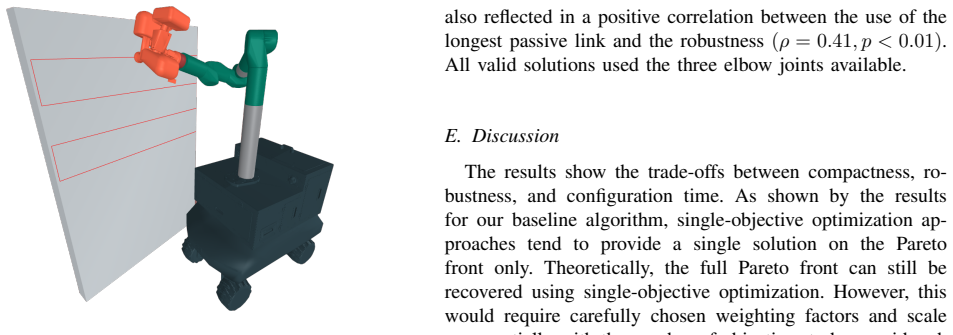
On its own terms, the paper's central claim is that a single framework can take a high-level construction instruction, derive a formal task from BIM data, search the space of modular robot configurations for a task-tailored arm, and then execute the mission on real hardware with minimal human input. The search is multiobjective: it returns a set of Pareto-optimal morphologies trading compactness, robustness to base-positioning error, and reconfiguration time, rather than one optimal robot. The paper further claims that this transfer-aware design pays off in the field: a six-DoF and a five-DoF arm selected from the Pareto front completed autonomous drilling on sandstone brick with repeatability within 1 cm after navigation and calibration, and the planner compensated base-position errors between 6 cm and 16 cm and up to 12.6 degrees of orientation error.
Load-bearing premise
The load-bearing premise is that the simulation used for fitness evaluation, including the black-box motion planner and the constant 13 N and 15 Nm drilling loads, predicts which modular configurations will actually succeed on site; if the simulation is optimistic, the Pareto-optimal arms chosen in simulation may be the wrong ones in the field.
Editorial extensions
If this is right
- Workers need no robotics expertise: they specify the task via a BIM interface and assemble the modules shown by the optimizer.
- A fixed module set can be reused across tasks; reconfiguration from one drilling arm to another took about five minutes when the first five modules were shared.
- Optimizing with competing objectives surfaces designs that human intuition misses, such as preferring long passive links over extra joints for calibration robustness.
- The multiobjective front supports situation-dependent choices, for example a compact arm when precision demands are low and a more robust arm when base positioning is uncertain.
- The same pipeline transfers to other tasks in simulation, with spray painting requiring a different robustness semantics (fewer recalibrations) than drilling.
Reading between the lines
- Editorial inference: if the robustness score transfers, the same objective could be reused for other drilling tasks by replacing the constant payload model with a time-varying force profile; the paper leaves that extension open.
- Editorial inference: the reported correlations suggest a practical rule that adding long passive links buys robustness more cheaply than adding joints, but the paper presents this as an observed pattern rather than a design law.
- Editorial inference: because the Pareto front gives operators a menu of robots, an implicit decision rule emerges to choose a less compact arm when site calibration is uncertain; the paper does not formalize that rule.
Signed reviews
Editorial analysis
A structured set of objections, weighed in public.
Referee Report
Summary. The paper proposes an end-to-end framework for construction automation using a mobile modular reconfigurable robot. A user specifies a task through a BIM-based interface; a multiobjective genetic algorithm optimizes the robot morphology (module sequence) and a nominal trajectory, balancing compactness, robustness to base-positioning errors, and reconfiguration time subject to constraints (joint limits, self-collision, environment collision, torque limits; Eqs. (13)-(19)). The optimized configuration is then assembled and executed using navigation, ArUco-based calibration, online trajectory adjustment, and impedance control. The framework is demonstrated in simulation for drilling and spray painting and in real experiments for drilling: six successful runs on a sandstone brick with two morphologies (5-DoF and 6-DoF), base-position errors of 6-16 cm and orientation errors of 0.7-12.6 degrees, and a claimed repeatability of about 1 cm.
Significance. If the claims hold, the framework is a meaningful step toward non-expert deployment of task-specific modular robots in construction: it integrates BIM with morphology optimization and explicitly models the sim-to-real gap through a robustness objective. The manuscript's strengths include the explicit constraint formulation in Eqs. (13)-(19), the honest acknowledgment that the evolutionary optimization is non-complete, the reproducible specification of modules and tolerances, and a real-world feasibility demonstration that exercises the full pipeline from task specification to drilling. The main weakness is that the load-bearing robustness score Eq. (21) is not calibrated against real-world outcomes, and the empirical base (six runs, one material) is narrower than the abstract's 'robustly enables' claim. These issues are addressable by additional experiments or by tempering the claims.
major comments (4)
- [Section V-C, Eq. (21)] The headline claim that the approach 'robustly enables the autonomous execution of robotic drilling' is not supported by the empirical design. The robustness score f_r is computed in simulation, but no experiment compares robots with different f_r values, and no deliberate sweep of base-position errors is reported; the six successful runs on a single sandstone brick all used morphologies with f_r >= 0.8 (Section V-C). These runs therefore cannot distinguish predictive robustness optimization from the possibility that any reachable configuration would have succeeded. Please either add a low-f_r comparison or a controlled error sweep, or explicitly reframe the real-world results as a feasibility demonstration.
- [Section IV-D, Eq. (21)] The definition of f_r relies on replan(xi, delta*Delta_max) returning true, but the manuscript does not specify which constraints replan revalidates. In particular, there is no statement that the adjusted trajectory is rechecked against the torque limits in Eq. (12) or against self-collision and environment constraints after the base-position perturbation is applied. Since torque feasibility of the nominal trajectory is computed under the constant 13 N / 15 Nm payload model of Section V-B, f_r may be overconfident for real drilling. Please define replan formally and state which constraints it rechecks, or verify the score against real base-error perturbations.
- [Section V-C, Fig. 6] The caption claims that the 'repeatability precision of the whole approach, including navigation and calibration is within 1 cm,' but no measurement procedure, per-hole data, or statistics are provided for this claim, and the text refers to a horizontal line while the caption says vertical. Please support the precision claim with quantitative hole-position measurements or downgrade it to a qualitative observation from the six-hole demonstration.
- [Section V-B and V-C, Eq. (12)] The simulation models the drill payload as a constant 13 N force and 15 Nm torque (Section V-B), but the real drilling interaction is time-varying and the controller uses intentionally reduced impedance gains (Section V-C). Consequently, the torque constraint in Eq. (12) is not validated for the actual drilling phase, and the real-world results do not confirm that the simulated payload model is representative. Please either instrument the real drilling forces and torques or explicitly state that torque feasibility during contact remains unverified.
minor comments (6)
- [Eq. (1)] The constraint index 'j in [m]' uses m both for the robot morphology and for the number of constraints; rename the constraint index set, for example 'j in [n_c]'.
- [Eq. (23)] The variable q-hat is used but never defined; clarify that it denotes the joint configuration observed during real execution.
- [Section V-C, Fig. 6] Resolve the inconsistency between the text (holes in a horizontal line) and the figure caption (holes in a vertical line), and specify to which spatial direction the reported 1 cm precision refers.
- [Section IV-D, after Eq. (21)] The vector for Delta_max is typeset incorrectly with a missing bracket; correct the notation for the 20 cm, 20 cm, 15 deg vector.
- [Appendix C, Eq. (27)] The tolerance definition uses epsilon_i without clearly explaining its role in the disjunction; clarify the numerical threshold semantics.
- [Section V-B] The baseline comparison with the lexicographic genetic approach reports only average normalized compactness and robustness over ten runs; adding variances or per-run values would make the comparison more informative.
Circularity Check
No significant circularity: the simulation-based morphology optimization is checked against independent physical drilling outcomes, and the paper's self-citations are engineering dependencies rather than load-bearing derivations.
full rationale
The central derivation chain is not circular. The paper's key technical contribution is the multiobjective morphology optimizer (Section IV), whose robustness objective fr in Eq. (21) measures, in simulation, the maximum base-positioning error δΔmax that the black-box planner replan() can compensate. This fr is used to select candidate robots for deployment, but the real-world success criterion is independent: the physical experiments (Section V-C) are evaluated by hole placement on a sandstone brick, not by re-running the optimizer's own robustness score. No fitted parameter is renamed as a prediction, and no success threshold is tuned after the fact to match the observed holes. The reported 'repeatability precision within 1 cm' (Fig. 6 and Section V-E) is an empirical measurement, not a quantity forced by the simulation tolerances in Appendix C; those tolerances were fixed before deployment. The paper's self-citations, including [15] for the BIM user interface, [36] for the lexicographic genetic algorithm, and [44]-[46] for the Timor/CoBRA tooling and robot modules, are reused components or algorithmic building blocks, not cited 'uniqueness theorems' used to forbid alternatives. The baseline comparison against [36] is an experimental benchmark, not a circular justification. The strongest legitimate concern is that fr is never calibrated against real-world outcomes, so the 'robustly enables' claim rests on only six successful drilling runs on one material; however, that is a correctness/evidence-strength risk, not circularity. The paper's own Conclusion and Limitations section acknowledges dependence on the motion planner, BIM data, and sensors, further indicating that the authors do not claim the derivation is forced by its own assumptions. Therefore, no step reduces to its own inputs by construction.
Assumptions & free parameters
free parameters (5)
- Drilling payload force and torque model =
13 N, 15 Nm
- Maximum base positioning error Delta_max =
20 cm, 20 cm, 15 deg
- Goal tolerances =
x=y=0.2 mm, z=10 mm, theta=2 deg, axis z
- Objective weighting factors w_t and w_R
- Minimum robustness threshold delta =
0.8
assumptions (6)
- domain assumption The black-box motion planner returns feasible trajectories that truthfully model the robot's kinematic and dynamic limits when invoked inside the optimizer.
- domain assumption The constant-force drilling payload model (13 N, 15 Nm) adequately represents the real drilling interaction for the purpose of morphology selection.
- domain assumption The BIM model and ArUco calibration provide a sufficiently accurate world model for the task tolerances.
- domain assumption The modular robot modules and Timor dynamic models accurately represent the physical hardware.
- domain assumption Evolutionary optimization output approximates the true Pareto front sufficiently for practical selection.
- standard math Definitions of partial order, lexicographic order, Pareto optimality, crowding distance, and nondomination rank from Refs. [50]-[52] and [43] are correct.
Cite this review
Pith. "Pith review of Holistic Construction Automation with Modular Robots: From High-Level Task Specification to Execution." pith.science (2026). https://pith.science/paper/ILUYY6BD
@misc{pith2026241220867,
  author       = {Pith},
  title        = {Pith review of: Holistic Construction Automation with Modular Robots: From High-Level Task Specification to Execution},
  year         = {2026},
  howpublished = {\url{https://pith.science/paper/ILUYY6BD}},
  note         = {Machine review of arXiv:2412.20867}
}
read the original abstract
In situ robotic automation in construction is challenging due to constantly changing environments, a shortage of robotic experts, and a lack of standardized frameworks bridging robotics and construction practices. This work proposes a holistic framework for construction task specification, optimization of robot morphology, and mission execution using a mobile modular reconfigurable robot. Users can specify and monitor the desired robot behavior through a graphical interface. In contrast to existing, monolithic solutions, we automatically identify a new task-tailored robot for every task by integrating \acf{bim}. Our framework leverages modular robot components that enable the fast adaption of robot hardware to the specific demands of the construction task. Other than previous works on modular robot optimization, we consider multiple competing objectives, which allow us to explicitly model the challenges of real-world transfer, such as calibration errors. We demonstrate our framework in simulation by optimizing robots for drilling and spray painting. Finally, experimental validation demonstrates that our approach robustly enables the autonomous execution of robotic drilling.
Figures


Figures from the paper (4 more)



Reference graph
Works this paper leans on
-
[36]
Optimizing modular robot composition: A lexicographic genetic algorithm approach,
J. K ¨ulz and M. Althoff, “Optimizing modular robot composition: A lexicographic genetic algorithm approach,” in Proc. of the IEEE Int. Conf. on Robotics and Automation (ICRA) , 2024, pp. 16 752–16 758
work page 2024
-
[1]
G. Graetz and G. Michaels, “Robots at work,” The Review of Economics and Statistics, vol. 100, no. 5, pp. 753–768, 2018
work page 2018
-
[2]
Automation and robotics in construction and civil engineering,
M. J. Kim, et al. , “Automation and robotics in construction and civil engineering,” Journal of Intelligent & Robotic Systems , vol. 79, no. 3, pp. 347–350, 2015
work page 2015
-
[3]
J. M. D. Delgado, et al., “Robotics and automated systems in construc- tion: Understanding industry-specific challenges for adoption,” Journal of Building Engineering , vol. 26, 2019, article no. 100868
work page 2019
-
[4]
Construction automation and smart buildings,
D. Castro-Lacouture, “Construction automation and smart buildings,” in Springer Handbook of Automation , 2nd ed., S. Y . Nof, Ed., 2023, pp. 1035–1053
work page 2023
-
[5]
Advances in form- work automation, structure and materials in concrete construction,
P. Gappmaier, S. Reichenbach, and B. Kromoser, “Advances in form- work automation, structure and materials in concrete construction,” Automation in Construction , vol. 162, 2024, article no. 105373
work page 2024
-
[6]
T. Bock and T. Linner, Robot-Oriented Design, T. Bock, Ed. Cambridge University Press, 2015, vol. 1
work page 2015
-
[7]
Construction automation with autonomous mobile robots: A review,
H. Ardiny, S. Witwicki, and F. Mondada, “Construction automation with autonomous mobile robots: A review,” in Proc. of the RSI Int. Conf. on Robotics and Mechatronics (ICROM) , 2015, pp. 418–424
work page 2015
Show all 53 references
-
[8]
Integrating automation into construction site: A system approach for the brick cutting use case,
C. Slongo, et al. , “Integrating automation into construction site: A system approach for the brick cutting use case,” in Proc. of the Int. Symp. on Automation and Robotics in Construction (ISARC) , 2024, pp. 251–258
2024
-
[9]
A fully-integrated sensing and control system for high- accuracy mobile robotic building construction,
A. Gawel, et al., “A fully-integrated sensing and control system for high- accuracy mobile robotic building construction,” in Proc. of the IEEE/RSJ Int. Conf. on Intelligent Robots and Systems (IROS) , 2019, pp. 2300– 2307
2019
-
[10]
Mobile robotic brickwork,
K. D ¨orfler, et al., “Mobile robotic brickwork,” in Robotic Fabrication in Architecture, Art and Design , D. Reinhardt, R. Saunders, and J. Burry, Eds., 2016, pp. 204–217
2016
-
[11]
Robot-assisted after-process progress-monitoring system based on BIM and computer vision,
H. Liao, et al., “Robot-assisted after-process progress-monitoring system based on BIM and computer vision,” in Proc. of the IEEE Int. Conf. on Robotics and Biomimetics (ROBIO) , 2023, pp. 1–6
2023
-
[12]
Measuring the impact of BIM on labor productivity in a small specialty contracting enterprise through action-research,
E. A. Poirier, S. Staub-French, and D. Forgues, “Measuring the impact of BIM on labor productivity in a small specialty contracting enterprise through action-research,” Automation in Construction , vol. 58, pp. 74– 84, 2015
2015
-
[13]
BALTO: A BIM-integrated mobile robot manipulator for precise and autonomous disinfection in buildings against COVID- 19,
A. Giusti, et al., “BALTO: A BIM-integrated mobile robot manipulator for precise and autonomous disinfection in buildings against COVID- 19,” in IEEE Int. Conf. on Automation Science and Engineering (CASE), 2021, pp. 1730–1737
2021
-
[14]
Construction automation: Research areas, industry concerns and suggestions for advancement,
Q. Chen, B. Garc ´ıa de Soto, and B. T. Adey, “Construction automation: Research areas, industry concerns and suggestions for advancement,” Automation in Construction , vol. 94, pp. 22–38, 2018
2018
-
[15]
A facilitated construction robot programming approach using building information modelling,
M. Terzer, et al., “A facilitated construction robot programming approach using building information modelling,” in Proc. of the Int. Conf. on Control, Decision and Information Technologies (CoDIT) , 2024, pp. 2656–2661
2024
-
[16]
A perching and tilting aerial robot for precise and versatile power tool work on vertical walls,
R. Dautzenberg, et al. , “A perching and tilting aerial robot for precise and versatile power tool work on vertical walls,” in Proc. of the IEEE/RSJ Int. Conf. on Intelligent Robots and Systems (IROS) , 2023, pp. 1094–1101
2023
-
[17]
Influence of different parameters on drilling forces in automated drilling of concrete with industrial robots,
M. Ortner and B. Kromoser, “Influence of different parameters on drilling forces in automated drilling of concrete with industrial robots,” Automation in Construction , vol. 150, 2023
2023
-
[18]
Mobile robotic fabrication on construction sites: dimRob,
V . Helm, et al. , “Mobile robotic fabrication on construction sites: dimRob,” in Proc. of the IEEE/RSJ Int. Conf. on Intelligent Robots and Systems (IROS), 2012, pp. 4335–4341
2012
-
[19]
Innovative mobile manipulator solution for modern flexible manufacturing processes,
J. Out ´on, et al. , “Innovative mobile manipulator solution for modern flexible manufacturing processes,” Sensors, vol. 19, no. 24, 2019, article no. 5414
2019
-
[20]
Mobile manipulator for autonomous localization, grasping and precise placement of construction material in a semi- structured environment,
P. ˇStibinger, et al. , “Mobile manipulator for autonomous localization, grasping and precise placement of construction material in a semi- structured environment,” IEEE Robotics and Automation Letters , vol. 6, no. 2, pp. 2595–2602, 2021
2021
-
[21]
Design and motion planning for a reconfigurable robotic base,
J. Pankert, et al. , “Design and motion planning for a reconfigurable robotic base,” IEEE Robotics and Automation Letters , vol. 7, no. 4, pp. 9012–9019, 2022
2022
-
[22]
Digital in situ fabrication - challenges and opportunities for robotic in situ fabrication in architecture, construction, and beyond,
J. Buchli, et al., “Digital in situ fabrication - challenges and opportunities for robotic in situ fabrication in architecture, construction, and beyond,” Cement and Concrete Research , vol. 112, pp. 66–75, 2018
2018
-
[23]
Synthesis methodology for task based reconfiguration of modular manipulator systems,
C. J. J. Paredis and P. K. Khosla, “Synthesis methodology for task based reconfiguration of modular manipulator systems,” in Proc. of the Int. Symp. on Robotics Research (ISRR) , 1993
1993
-
[24]
Task based design of modular robot manipulator using efficient genetic algorithm,
J. Han, et al. , “Task based design of modular robot manipulator using efficient genetic algorithm,” in Proc. of the IEEE Int. Conf. on Robotics and Automation (ICRA) , 1997, pp. 507–512
1997
-
[25]
Automatic design and manufacture of robotic lifeforms,
H. Lipson and J. B. Pollack, “Automatic design and manufacture of robotic lifeforms,” Nature, vol. 406, pp. 974–978, 2000
2000
-
[26]
Modular self-reconfigurable robot systems [grand challenges of robotics],
M. Yim, et al. , “Modular self-reconfigurable robot systems [grand challenges of robotics],” IEEE Robotics and Automation Magazine , vol. 14, no. 1, pp. 43–52, 2007
2007
-
[27]
Effortless creation of safe robots from mod- ules through self-programming and self-verification,
M. Althoff, et al. , “Effortless creation of safe robots from mod- ules through self-programming and self-verification,” Science Robotics, vol. 4, no. 31, 2019, article no. eaaw1924
2019
-
[28]
Enumerating the non-isomorphic as- sembly configurations of modular robotic systems,
I.-M. Chen and J. W. Burdick, “Enumerating the non-isomorphic as- sembly configurations of modular robotic systems,” The International Journal of Robotics Research , vol. 17, no. 7, pp. 702–719, 1998
1998
-
[29]
Cost-optimal composition synthesis for modular robots,
E. Icer and M. Althoff, “Cost-optimal composition synthesis for modular robots,” in Proc. of the IEEE Conf. on Control Applications (CCA), 2016, pp. 1408–1413
2016
-
[30]
Optimizing performance in automation through modular robots,
S. B. Liu and M. Althoff, “Optimizing performance in automation through modular robots,” in Proc. of the IEEE Int. Conf. on Robotics and Automation (ICRA) , 2020, pp. 4044–4050
2020
-
[31]
Evolutionary cost-optimal composition synthesis of modular robots considering a given task,
E. Icer, et al. , “Evolutionary cost-optimal composition synthesis of modular robots considering a given task,” in Proc. of the IEEE/RSJ Int. Conf. on Intelligent Robots and Systems (IROS) , 2017, pp. 3562–3568
2017
-
[32]
Modular robot design synthesis with deep rein- forcement learning,
J. Whitman, et al. , “Modular robot design synthesis with deep rein- forcement learning,” in Proc. of the AAAI Conf. on Artificial Intelligence (AAAI), vol. 34, no. 06, 2020, pp. 10 418–10 425
2020
-
[33]
Computational design of modular robots based on genetic algorithm and reinforcement learning,
J. H. Park and K. H. Lee, “Computational design of modular robots based on genetic algorithm and reinforcement learning,” Symmetry, vol. 13, no. 3, 2021
2021
-
[34]
Evolving virtual creatures,
K. Sims, “Evolving virtual creatures,” in Proc. of the Ann. Conf. on Computer Graphics and Interactive Techniques (SIGGRAPH) , vol. 21, 1994, pp. 15–22
1994
-
[35]
An optimization study on modular reconfigurable robots: Finding the task-optimal design,
E. Romiti, et al. , “An optimization study on modular reconfigurable robots: Finding the task-optimal design,” in IEEE Int. Conf. on Automa- tion Science and Engineering (CASE) , 2023, pp. 1–8
2023
-
[37]
Crossing the reality gap in evolutionary robotics by promoting transferable controllers,
S. Koos, J.-B. Mouret, and S. Doncieux, “Crossing the reality gap in evolutionary robotics by promoting transferable controllers,” in Proc. of the Conf. on Genetic and Evolutionary Computation (GECCO) , 2010, pp. 119–126
2010
-
[38]
Domain randomization for transferring deep neural networks from simulation to the real world,
J. Tobin, et al. , “Domain randomization for transferring deep neural networks from simulation to the real world,” in Proc. of the IEEE/RSJ Int. Conf. on Intelligent Robots and Systems (IROS) , 2017, pp. 23–30
2017
-
[39]
Ensemble-CIO: full-body dynamic motion planning that transfers to physical humanoids,
I. Mordatch, K. Lowrey, and E. Todorov, “Ensemble-CIO: full-body dynamic motion planning that transfers to physical humanoids,” in Proc. of the IEEE/RSJ Int. Conf. on Intelligent Robots and Systems (IROS) , 2015, pp. 5307–5314
2015
-
[40]
Active domain randomization,
B. Mehta, et al., “Active domain randomization,” in Proc. of the Conf. on Robot Learning (CoRL) , L. P. Kaelbling, D. Kragic, and K. Sugiura, Eds., vol. 100, 2020, pp. 1162–1176
2020
-
[41]
Learning dexterous in-hand manipulation,
M. Andrychowicz, et al. , “Learning dexterous in-hand manipulation,” The International Journal of Robotics Research , vol. 39, no. 1, pp. 3– 20, 2019
2019
-
[42]
Simulation aided co-design for robust robot opti- mization,
G. Fadini, et al. , “Simulation aided co-design for robust robot opti- mization,” IEEE Robotics and Automation Letters , vol. 7, no. 4, pp. 11 306–11 313, 2022
2022
-
[43]
A fast and elitist multiobjective genetic algorithm: NSGA-II,
K. Deb, et al. , “A fast and elitist multiobjective genetic algorithm: NSGA-II,” IEEE Transactions on Evolutionary Computation , vol. 6, no. 2, pp. 182–197, 2002
2002
-
[44]
Timor Python: A toolbox for industrial modular robotics,
J. K ¨ulz, M. Mayer, and M. Althoff, “Timor Python: A toolbox for industrial modular robotics,” in Proc. of the IEEE/RSJ Int. Conf. on Intelligent Robots and Systems (IROS) , 2023, pp. 424–431
2023
-
[45]
CoBRA: A composable benchmark for robotics applications,
M. Mayer, J. K ¨ulz, and M. Althoff, “CoBRA: A composable benchmark for robotics applications,” in Proc. of the IEEE Int. Conf. on Robotics and Automation (ICRA) , 2024, pp. 17 665–17 671
2024
-
[46]
Toward a plug-and-work reconfigurable cobot,
E. Romiti, et al. , “Toward a plug-and-work reconfigurable cobot,” Transactions on Mechatronics, vol. 27, no. 5, pp. 2319–3231, 2022
2022
-
[47]
The Marathon 2: A navigation system,
S. Macenski, et al. , “The Marathon 2: A navigation system,” in Proc. of the IEEE/RSJ Int. Conf. on Intelligent Robots and Systems (IROS) , 2020, pp. 2718–2725
2020
-
[48]
Open-source, cost-aware kinematically feasible planning for mobile and surface robotics,
S. Macenski, M. Booker, and J. Wallace, “Open-source, cost-aware kinematically feasible planning for mobile and surface robotics,” arXiv:2401.13078, 2024
2024 arXiv
-
[49]
Generation of fiducial marker dictionaries using mixed integer linear programming,
S. Garrido-Jurado, et al. , “Generation of fiducial marker dictionaries using mixed integer linear programming,” Pattern Recognition, vol. 51, pp. 481–491, 2016
2016
-
[50]
Schr ¨oder, Ordered Sets
B. Schr ¨oder, Ordered Sets . Birkh ¨auser Cham, 2016, vol. 2, ch. 1, Basics, pp. 1–21
2016
-
[51]
Harzheim, Ordered Sets
E. Harzheim, Ordered Sets. Springer, 2005, ch. 4, Products of orders, pp. 85–141
2005
-
[52]
S. P. Boyd, Convex optimization. Cambridge University Press, 2023, vol. 7, ch. 4, Convex optimization problems, pp. 141–227
2023
-
[53]
An updated survey of GA-based multiobjective optimiza- tion techniques,
C. A. Coello, “An updated survey of GA-based multiobjective optimiza- tion techniques,” ACM Computing Surveys, vol. 32, no. 2, pp. 109–143, 2000. APPENDIX A. NSGA-II metrics Nondominated fronts. The Pareto front F0 ⊂ F consists of the Pareto-optimal elements of a set F, i.e., ...
2000
Reviewed August 10, 2026 · model on record in the stance chip above.
Discussion (0). Continue with ORCID to comment.