Computable measures of fermionic non-Gaussianity from the covariance matrix
Pith reviewed 2026-07-03 12:17 UTC · model grok-4.3
The pith
A Tsallis entropy of fermionic occupation numbers is monotonic under Gaussian protocols and lower-bounds the number of non-Gaussian gates needed for state preparation.
A machine-rendered reading of the paper's core claim, the machinery that carries it, and where it could break.
Core claim
From the Williamson normal form of the covariance matrix of a pure fermionic state, occupation number entropies are defined as the Tsallis-α entropy of the resulting occupation numbers; one member of this family is monotonic under Gaussian protocols and hence a computable convex resource monotone for fermionic non-Gaussianity that lower-bounds the number of non-Gaussian gates needed for state preparation. A second family of natural-orbital participation entropies, given by the Rényi-α entropy of the squared amplitudes in the natural-orbital basis, quantifies compressibility and upper-bounds classical simulation cost.
What carries the argument
The occupation number entropies, obtained as the Tsallis-α entropy of the occupation numbers that appear in the Williamson normal form of the covariance matrix.
If this is right
- The monotone lower-bounds the number of non-Gaussian gates required to prepare any given pure fermionic state.
- The natural-orbital measures upper-bound the classical simulation cost of the state in an orthonormal Gaussian basis.
- Both families become simple explicit functions for stabilizer states and for translation-invariant states.
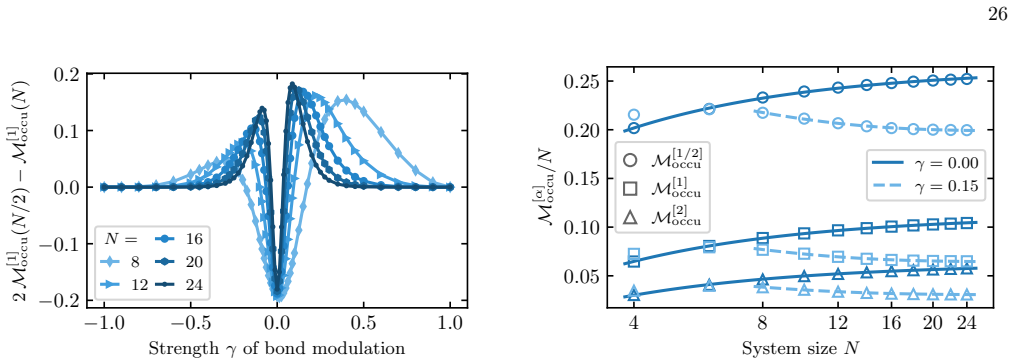
- The measures can be evaluated on states generated by random SWAP-doped matchgate circuits and on ground states of the bond-modulated XXZ model.
- The resource-theoretic framework supplies practical tools for assessing classical simulability of fermionic states.
Where Pith is reading between the lines
- If the covariance matrix ceases to be sufficient for mixed states, the monotonicity and bounding properties would require additional correlation terms.
- The same construction might be tested for its ability to detect non-Gaussianity in open-system dynamics where Gaussian noise is added.
- The upper bound on simulation cost could be compared directly with existing tensor-network contraction costs for the same states.
Load-bearing premise
The measures are defined only for pure fermionic states and assume that the covariance matrix alone encodes all information needed to quantify the relevant non-Gaussianity.
What would settle it
A concrete Gaussian operation that strictly increases the value of the proposed Tsallis monotone on some pure fermionic state, or an explicit state preparation sequence whose non-Gaussian gate count falls below the lower bound supplied by the monotone.
Figures



read the original abstract
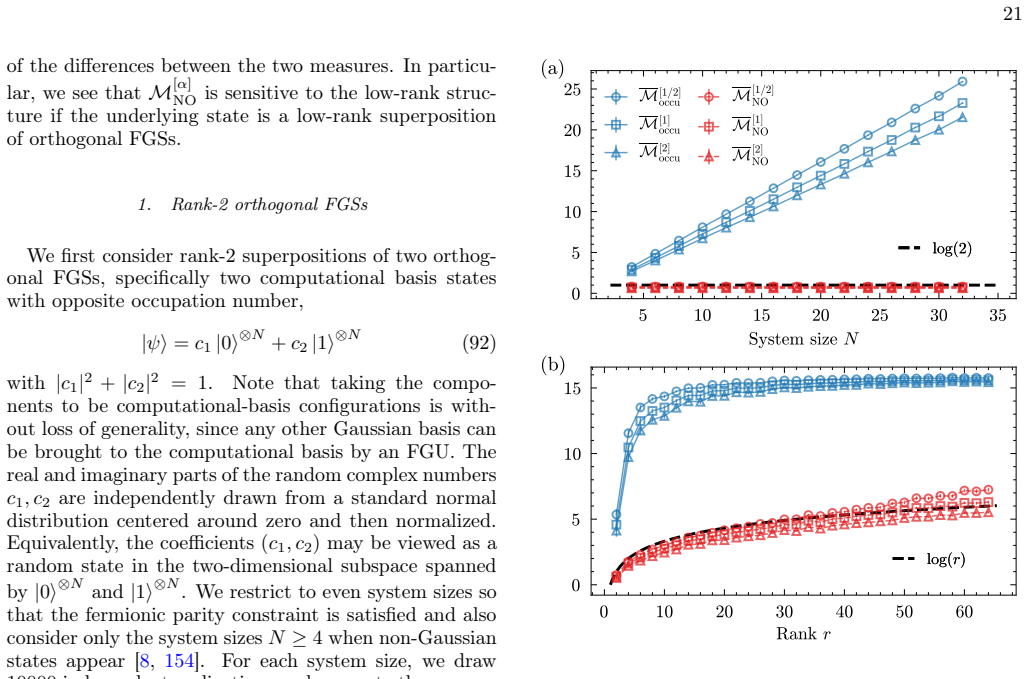
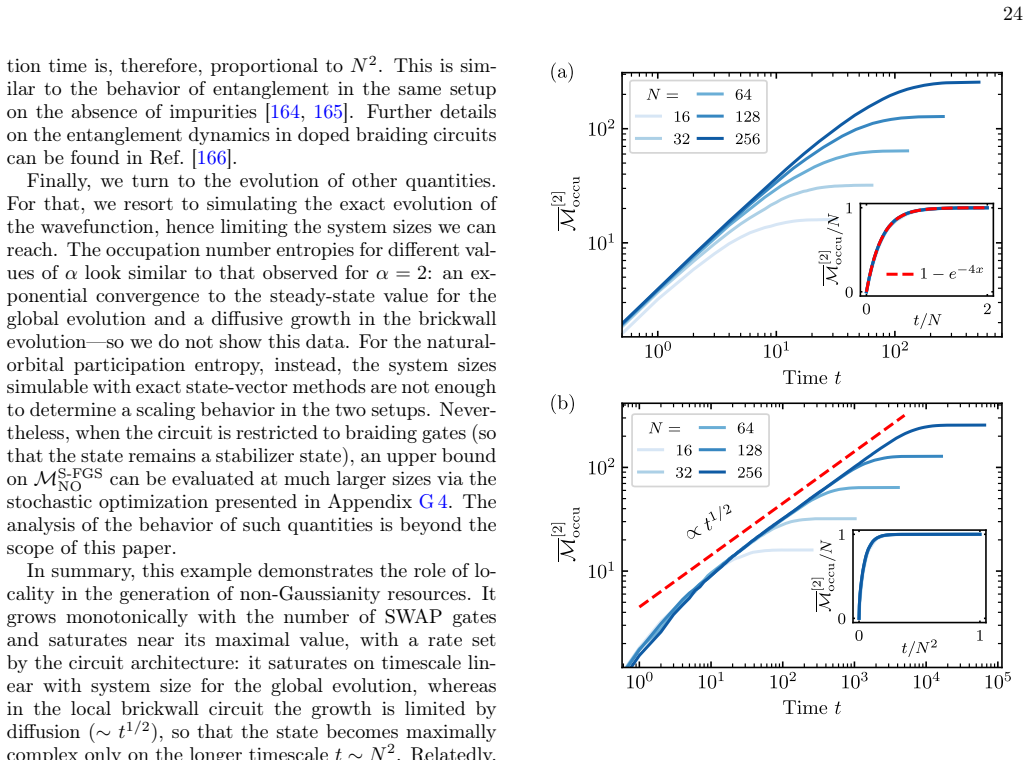
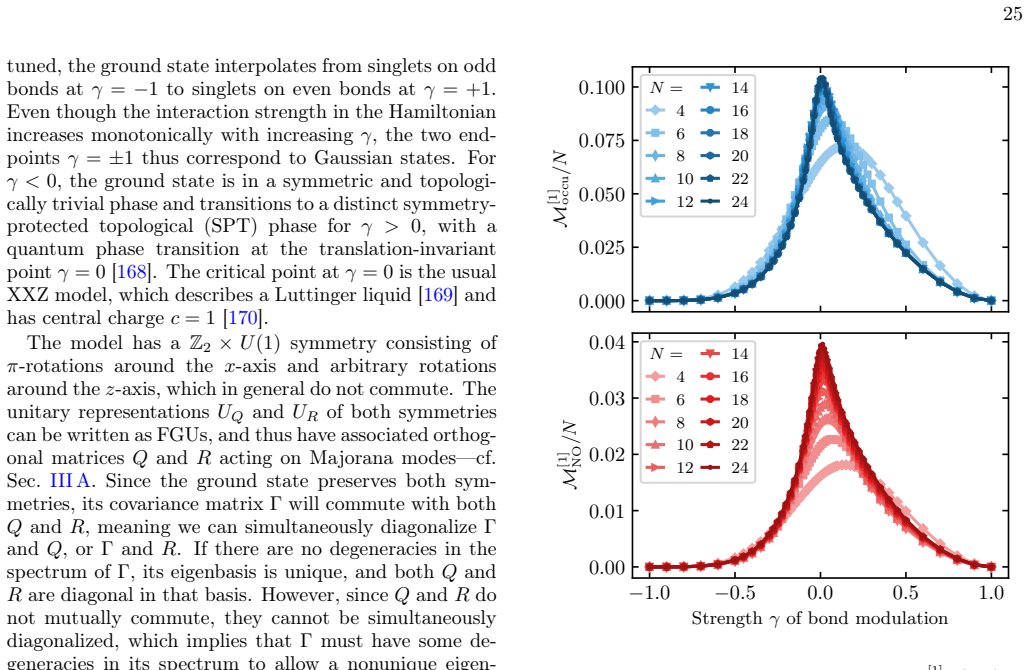
Fermionic non-Gaussianity, or fermionic magic, is a key resource underlying the computational complexity of fermionic quantum systems, yet tractable and operationally meaningful ways to quantify it remain limited. We address this challenge by developing a convex resource theory of fermionic non-Gaussianity and introducing two families of computable measures for pure fermionic states, both derived from the Williamson normal form of the covariance matrix. The first family, occupation number entropies, is defined as the Tsallis-$\alpha$ entropy of the occupation numbers. We prove that one member of this family is monotonic under Gaussian protocols, establishing it as a computable convex resource monotone. It consequently lower bounds the number of non-Gaussian gates needed for state preparation. The second family, natural-orbital participation entropies, is given by the R\'enyi-$\alpha$ entropy of the squared amplitudes of the state in the natural-orbital basis, defined by the eigenvectors of the covariance matrix. These measures quantify state compressibility in this basis and thus upper bound the classical simulation cost in an orthonormal Gaussian basis. We analyze both families for stabilizer and translation-invariant states, where they simplify and reveal additional structure. We further study representative examples, including random SWAP-doped matchgate circuits and the bond-modulated XXZ model, highlighting the role of non-Gaussianity in many-body phenomena. Our work establishes a resource-theoretic framework for computable fermionic non-Gaussianity that unifies notions arising across quantum information, condensed-matter physics, and quantum chemistry, opening new directions for studying the complexity of quantum many-body systems and providing practical tools to assess the classical simulability of fermionic states relevant for quantum advantage.
Editorial analysis
A structured set of objections, weighed in public.
Referee Report
Summary. The paper develops a convex resource theory for fermionic non-Gaussianity and proposes two families of computable measures for pure fermionic states derived from the Williamson normal form of the covariance matrix. The first family consists of occupation-number entropies given by the Tsallis-α entropy of the occupation numbers; the authors prove that one specific member (Tsallis-2) is monotonic under Gaussian protocols and hence a convex resource monotone that lower-bounds the number of non-Gaussian gates required for state preparation. The second family consists of natural-orbital participation entropies given by the Rényi-α entropy of the squared amplitudes of the state in the natural-orbital basis; these are shown to upper-bound classical simulation cost. The measures are evaluated on stabilizer states, translation-invariant states, random SWAP-doped matchgate circuits, and the bond-modulated XXZ model.
Significance. If the central monotonicity result holds, the work supplies the first explicitly computable convex monotones for fermionic magic that are directly obtainable from the covariance matrix, together with operational interpretations (gate lower bound and simulation-cost upper bound). The unification of resource-theoretic, condensed-matter, and quantum-chemistry perspectives, together with the concrete analyses of physically relevant states, would make the framework immediately usable for assessing simulability and complexity in fermionic many-body systems.
major comments (2)
- [§4] §4 (proof of monotonicity): The claim that the Tsallis-2 occupation-number entropy is a convex resource monotone rests on the covariance matrix (via its Williamson eigenvalues) being a sufficient statistic. Because a pure fermionic state is not uniquely determined by its covariance matrix, two states can share identical occupation numbers yet differ in higher-order correlators. The proof must therefore demonstrate that any Gaussian protocol (matchgate circuit) cannot increase the underlying non-Gaussianity resource while leaving the measure unchanged; the manuscript does not explicitly address this case.
- [Abstract, §3.2] Abstract and §3.2: The statement that the Tsallis-2 measure 'consequently lower bounds the number of non-Gaussian gates needed for state preparation' assumes that the resource cost is fully captured by the occupation-number entropy. If states with identical covariance but different higher-order magic require different numbers of non-Gaussian gates, the bound remains valid but its tightness and operational meaning require explicit justification or a counter-example check.
minor comments (2)
- [§2] Notation for the Williamson eigenvalues and occupation numbers should be unified across §2 and §3 to avoid ambiguity between the covariance-matrix spectrum and the one-body reduced-density-matrix eigenvalues.
- [§5] Figure captions for the XXZ-model and SWAP-doped-circuit plots should state the system size, boundary conditions, and exact parameter values used, as these affect the reported entropy values.
Simulated Author's Rebuttal
We thank the referee for their careful reading and constructive comments on our manuscript. We address each major comment point by point below, providing the strongest honest defense of the results while acknowledging where additional clarification is warranted.
read point-by-point responses
-
Referee: [§4] §4 (proof of monotonicity): The claim that the Tsallis-2 occupation-number entropy is a convex resource monotone rests on the covariance matrix (via its Williamson eigenvalues) being a sufficient statistic. Because a pure fermionic state is not uniquely determined by its covariance matrix, two states can share identical occupation numbers yet differ in higher-order correlators. The proof must therefore demonstrate that any Gaussian protocol (matchgate circuit) cannot increase the underlying non-Gaussianity resource while leaving the measure unchanged; the manuscript does not explicitly address this case.
Authors: We agree that the manuscript would benefit from an explicit remark on this point. The proof in §4 proceeds by showing that Gaussian operations (matchgate circuits) induce orthogonal transformations on the Majorana covariance matrix, which in the Williamson basis act as permutations and sign flips on the eigenvalues (occupation numbers). The Tsallis-2 entropy is Schur-concave, hence non-increasing under these transformations, establishing monotonicity under free operations. Because the free operations depend only on the covariance matrix and cannot access or create higher-order correlators, states sharing the same covariance matrix necessarily share the same value of the monotone; any apparent difference in higher-order magic is invisible to the free operations and therefore does not affect the resource-theoretic accounting. We will add a clarifying paragraph in §4 making this reasoning explicit. revision: partial
-
Referee: [Abstract, §3.2] Abstract and §3.2: The statement that the Tsallis-2 measure 'consequently lower bounds the number of non-Gaussian gates needed for state preparation' assumes that the resource cost is fully captured by the occupation-number entropy. If states with identical covariance but different higher-order magic require different numbers of non-Gaussian gates, the bound remains valid but its tightness and operational meaning require explicit justification or a counter-example check.
Authors: The lower-bound claim follows directly from the definition of a convex resource monotone: the minimal number of non-Gaussian gates required to prepare a state is at least the value of any monotone. This inequality holds irrespective of whether two states with identical covariance matrices possess different higher-order correlators; the monotone supplies a valid (if possibly loose) lower bound based solely on the covariance. We will revise the abstract and §3.2 to state explicitly that the bound is derived from the Tsallis-2 monotone within the resource theory and is not asserted to be tight for every state. revision: partial
Circularity Check
No circularity: definitions and monotonicity proof are independent of inputs
full rationale
The paper defines the occupation-number entropies explicitly as the Tsallis-α entropy applied to the occupation numbers extracted from the Williamson normal form of the covariance matrix, then separately states that monotonicity under Gaussian protocols is proved for one member. This is a standard resource-theoretic construction rather than a self-definitional loop, fitted parameter renamed as prediction, or load-bearing self-citation. No equations or claims in the abstract reduce the central result to its own inputs by construction; the covariance-to-occupation mapping is a standard fact for pure fermionic states and does not presuppose the monotonicity result. The derivation is therefore self-contained.
Axiom & Free-Parameter Ledger
Reference graph
Works this paper leans on
-
[1]
(88), with χ×χtensorsA s (s∈ {0,1}), taken to be injective [147] and of definite parity
Occupation number entropy in translation-invariant MPSs As an explicit setting of gapped systems with transla- tion invariance, we consider the TI MPS of Eq. (88), with χ×χtensorsA s (s∈ {0,1}), taken to be injective [147] and of definite parity. We recall the elements of the covariance matrix in the thermodynamic limit (derived in Sec. VB4) as ⟨Zj⟩= (L 1...
-
[2]
A naive algorithm would consist on calculating the ex- pectation value of each pair of Majoranas
Efficient construction of the covariance matrix for stabilizer states In this section we are interested in the complexity of computing the covariance matrix for a stabilizer state. A naive algorithm would consist on calculating the ex- pectation value of each pair of Majoranas. Since there areO(N 2)such pairs, and computing each expectation value for a st...
-
[3]
In this section, we show thatMS−FGS NO satisfies mono- tonicity under stabilizer Gaussian protocols for stabilizer states
Monotonicity ofM S−FGS NO The stabilizer natural-orbital participation entropy MS−FGS NO is defined to be the participation entropy in the natural-orbital basis, with the particularity that the min- imization is performed over FGUs that are also Clifford 45 unitaries. In this section, we show thatMS−FGS NO satisfies mono- tonicity under stabilizer Gaussia...
-
[4]
Computation ofM S−FGS NO Here we will prove that computingMS−FGS NO (i.e., min- imizing the participation entropy of the stabilizer state over braiding gates) corresponds to finding the stabilizer FGS|ϕ FGS⟩whose stabilizer groupS(|ϕ FGS⟩)has the maximal number of stabilizers in common with the sta- bilizer group of the original state,S(|ψ⟩). To prove thi...
-
[5]
Here we pro- vide an efficient algorithm to find an upper bound for this quantity by using a stochastic optimization, with a method similar to simulated annealing [213]
Heuristic algorithm forM S−FGS NO Since the total number of stabilizer FGSs is(2N−1)!!, a brute-force algorithm to findM S−FGS NO by trying all possibilities is exponentially hard inN. Here we pro- vide an efficient algorithm to find an upper bound for this quantity by using a stochastic optimization, with a method similar to simulated annealing [213]. Le...
-
[6]
Select two random (and different) Majorana oper- atorsγ i andγ j, and letU ij be the braiding gate that exchanges them
-
[7]
Compute the quantity p=e −(Spart(Uij UB |ψ⟩)−S part(UB |ψ⟩))/T ,(G7) with a given temperatureT
-
[8]
We define a sweep to beNof such steps
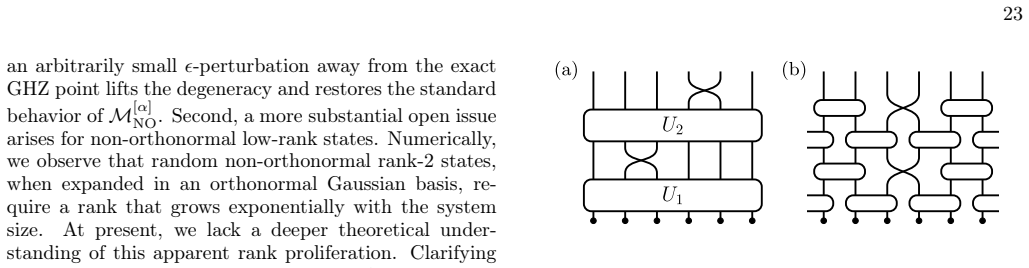
The braiding gateUij is applied with probabilityp. We define a sweep to beNof such steps. After each sweep the temperature is reduced. As an illustration of this method, we discuss the evo- lution of the non-Gaussianity in a random circuit. We consider the following set-up, as depicted in Figure 3a: At each time step we apply a random braiding gate act- i...
-
[9]
Construction of the FGS superposition In this appendix, we demonstrate how an arbitrary parity-preservingstabilizerstate|ψ⟩withstabilizergroup 0 50 100 150 200 250 Time t 0 25 50 75 100Upper bound of MS−FGS NO 0 2 t/N 0.0 0.5 MS−FGS NO /N N = 16 32 64 128 FIG. 10. Evolution of the upper bound ofMS−FGS NO calculated viathesimulatedannealingmethod. Theinset...
-
[10]
There are2Nparticles partitioned into pairs (Gaussian modes)
-
[11]
At each step, 4 distinct particles are chosen uni- formly at random
-
[12]
If a chosen particle belongs to a surviving pair, that pair is “broken” (i.e., the mode becomes non- Gaussian). We neglect higher-order recovery processes (for example, a SWAP acting twice on the exact same set of Majoranas and accidentally restoring a quadratic mode), since such events are statistically suppressed in the large-Nlimit. LetY t denote the e...
-
[13]
Quantum computing and the entanglement frontier
J. Preskill, Quantum computing and the entanglement frontier, arXiv:1203.5813 (2012)
work page internal anchor Pith review Pith/arXiv arXiv 2012
-
[14]
A. W. Harrow and A. Montanaro, Quantum computa- tional supremacy, Nature549, 203–209 (2017)
2017
-
[15]
Horodecki, P
R. Horodecki, P. Horodecki, M. Horodecki, and K. Horodecki, Quantum entanglement, Reviews of Mod- ern Physics81, 865–942 (2009)
2009
-
[16]
Gottesman, Theory of fault-tolerant quantum com- putation, Physical Review A57, 127 (1998)
D. Gottesman, Theory of fault-tolerant quantum com- putation, Physical Review A57, 127 (1998)
1998
-
[17]
Aaronson and D
S. Aaronson and D. Gottesman, Improved simulation of stabilizer circuits, Physical Review A70, 052328 (2004)
2004
-
[18]
Bravyi and A
S. Bravyi and A. Kitaev, Universal quantum computa- tionwithidealCliffordgatesandnoisyancillas,Physical Review A71, 022316 (2005)
2005
-
[19]
Surace and L
J. Surace and L. Tagliacozzo, Fermionic Gaussian states: an introduction to numerical approaches, Sci- Post Physics Lecture Notes (2022)
2022
-
[20]
Hebenstreit, R
M. Hebenstreit, R. Jozsa, B. Kraus, S. Strelchuk, and M. Yoganathan, All pure fermionic non-Gaussian states are magic states for matchgate computations, Physical Review Letters123, 080503 (2019)
2019
-
[21]
Chitambar and G
E. Chitambar and G. Gour, Quantum resource theories, Reviews of Modern Physics91, 025001 (2019)
2019
-
[22]
Gour, Resources of the quantum world, arXiv:2402.05474 (2024)
G. Gour, Resources of the quantum world, arXiv:2402.05474 (2024)
-
[23]
It becomes a stronger requirement when the quantity is convex or in the pure-state setting, in which case strong monotonicity implies monotonicity
-
[24]
In entangle- ment theory, what is called a (strong) monotone here 51 is often called a measure (monotone) respectively
Terminology differs across communities. In entangle- ment theory, what is called a (strong) monotone here 51 is often called a measure (monotone) respectively
-
[25]
Leone, S
L. Leone, S. F. E. Oliviero, and A. Hamma, Stabilizer Rényi entropy, Physical Review Letters128, 050402 (2022)
2022
-
[26]
Leone and L
L. Leone and L. Bittel, Stabilizer entropies are mono- tones for magic-state resource theory, Physical Review A110, L040403 (2024)
2024
-
[27]
Operational interpretation of the Stabilizer Entropy
L. Bittel and L. Leone, Operational interpretation of the stabilizer entropy, arXiv:2507.22883 (2025)
work page internal anchor Pith review Pith/arXiv arXiv 2025
-
[28]
Haug and L
T. Haug and L. Piroli, Quantifying nonstabilizerness of matrix product states, Physical Review B107, 035148 (2023)
2023
-
[29]
P. S. Tarabunga, E. Tirrito, T. Chanda, and M. Dal- monte, Many-body magic via Pauli-Markov chains— from criticality to gauge theories, PRX Quantum4, 040317 (2023)
2023
-
[30]
P. S. Tarabunga and C. Castelnovo, Magic in general- ized rokhsar-kivelson wavefunctions, Quantum8, 1347 (2024)
2024
-
[31]
P. R. N. Falcão, P. S. Tarabunga, M. Frau, E. Tir- rito, J. Zakrzewski, and M. Dalmonte, Nonstabilizerness in u(1) lattice gauge theory, Physical Review B111, L081102 (2025)
2025
-
[32]
Y.-M. Ding, Z. Wang, and Z. Yan, Evaluating many- body stabilizer rényi entropy by sampling reduced pauli strings: Singularities, volume law, and nonlocal magic, PRX Quantum6(2025)
2025
-
[33]
H.Timsina, Y.-M.Ding, E.Tirrito, P.S.Tarabunga, B.- B. Mao, M. Collura, Z. Yan, and M. Dalmonte, Robust- ness of nonstabilizerness in the quantum ising chain via quantum monte carlo tomography, Phys. Rev. B112, 165135 (2025)
2025
-
[34]
G. Lami, T. Haug, and J. De Nardis, Quantum state designs with Clifford-enhanced matrix product states, PRX Quantum6, 010345 (2025)
2025
-
[35]
T. Haug, L. Aolita, and M. Kim, Probing quantum com- plexity via universal saturation of stabilizer entropies, Quantum9, 1801 (2025)
2025
-
[36]
Turkeshi, E
X. Turkeshi, E. Tirrito, and P. Sierant, Magic spreading in random quantum circuits, Nature Communications 16, 2575 (2025)
2025
-
[37]
Tirrito, X
E. Tirrito, X. Turkeshi, and P. Sierant, Anticon- centration and nonstabilizerness spreading under er- godic quantum dynamics, Physical Review Letters135, 220401 (2025)
2025
-
[38]
P. R. N. Falcão, P. Sierant, J. Zakrzewski, and E. Tir- rito,Nonstabilizernessdynamicsinmany-bodylocalized systems, Physical Review Letters135, 240404 (2025)
2025
-
[39]
Dowling, P
N. Dowling, P. Kos, and X. Turkeshi, Magic resources of the heisenberg picture, Physical Review Letters135, 050401 (2025)
2025
-
[40]
E. Tirrito, P. S. Tarabunga, D. S. Bhakuni, M. Dal- monte, P. Sierant, and X. Turkeshi, Universal spread- ing of nonstabilizerness and quantum transport, arXiv:2506.12133 (2025)
-
[41]
G. E. Fux, E. Tirrito, M. Dalmonte, and R. Fazio, Entanglement – nonstabilizerness separation in hybrid quantum circuits, Physical Review Research6, L042030 (2024)
2024
-
[42]
Bejan, C
M. Bejan, C. McLauchlan, and B. Béri, Dynamical magic transitions in monitored Clifford+tcircuits, PRX Quantum5, 030332 (2024)
2024
-
[45]
M. Frau, P. S. Tarabunga, M. Collura, E. Tirrito, and M. Dalmonte, Stabilizer disentangling of conformal field theories, SciPost Phys.18, 165 (2025)
2025
-
[46]
P. S. Tarabunga, E. Tirrito, M. C. Bañuls, and M. Dal- monte, Nonstabilizerness via matrix product states in the pauli basis, Physical Review Letters133, 010601 (2024)
2024
- [47]
-
[48]
P. Sierant and X. Turkeshi, Theory of magic phase transitions in encoding-decoding circuits (2026), arXiv:2603.00235 [quant-ph]
-
[49]
Diffusive Dynamics of Nonstabilizerness
Z. Xiao and S. Ryu, Diffusive dynamics of nonstabiliz- erness (2026), arXiv:2606.13606 [quant-ph]
work page internal anchor Pith review Pith/arXiv arXiv 2026
-
[50]
A. D. Gottlieb and N. J. Mauser, Properties of nonfree- ness: an entropy measure of electron correlation, Inter- national Journal of Quantum Information5, 815 (2007)
2007
-
[51]
A. D. Gottlieb and N. J. Mauser, Correlation in fermion or boson systems as the minimum of entropy relative to all free states, arXiv:1403.7640 (2014)
work page internal anchor Pith review Pith/arXiv arXiv 2014
-
[52]
C. J. Turner, K. Meichanetzidis, Z. Papić, and J. K. Pa- chos, Optimal free descriptions of many-body theories, Nature communications8, 14926 (2017)
2017
-
[53]
J. K. Pachos and Z. Papic, Quantifying the effect of interactions in quantum many-body systems, SciPost Phys. Lect. Notes , 4 (2018)
2018
-
[54]
Meichanetzidis, C
K. Meichanetzidis, C. J. Turner, A. Farjami, Z. Pa- pić, and J. K. Pachos, Free-fermion descriptions of parafermion chains and string-net models, Physical Re- view B97, 125104 (2018)
2018
-
[55]
Patrick, V
K. Patrick, V. Caudrelier, Z. Papić, and J. K. Pachos, Interactiondistanceintheextendedxxzmodel,Physical Review B100, 235128 (2019)
2019
-
[56]
P. Echenique and J. L. Alonso, A mathematical and computational review of hartree–fock scf methods in quantum chemistry, Mol. Phys.105, 3057 (2007), https://doi.org/10.1080/00268970701757875
-
[57]
V. Bach, E. H. Lieb, and J. P. Solovej, Generalized hartree-fock theory and the hubbard model, J. Stat. Phys.76, 3 (1994)
1994
-
[58]
Bardeen, L
J. Bardeen, L. N. Cooper, and J. R. Schrieffer, Theory of superconductivity, Phys. Rev.108, 1175 (1957)
1957
-
[59]
P. A. Lee, N. Nagaosa, and X.-G. Wen, Doping a mott insulator: Physics of high-temperature superconductiv- ity, Rev. Mod. Phys.78, 17 (2006)
2006
-
[60]
Keimer, S
B. Keimer, S. A. Kivelson, M. R. Norman, S. Uchida, and J. Zaanen, From quantum matter to high- temperature superconductivity in copper oxides, Nature 518, 179–186 (2015)
2015
-
[61]
D. C. Tsui, H. L. Stormer, and A. C. Gossard, Two- dimensional magnetotransport in the extreme quantum limit, Phys. Rev. Lett.48, 1559 (1982)
1982
-
[62]
R. B. Laughlin, Anomalous quantum hall effect: An incompressible quantum fluid with fractionally charged excitations, Phys. Rev. Lett.50, 1395 (1983)
1983
-
[63]
J. K. Jain,Composite Fermions(Cambridge University Press, 2007). 52
2007
-
[64]
Dias and R
B. Dias and R. Koenig, Classical simulation of non- Gaussian fermionic circuits, Quantum8, 1350 (2024)
2024
-
[65]
J. Cudby and S. Strelchuk, Gaussian decomposi- tion of magic states for matchgate computations, arXiv:2307.12654 (2023)
-
[66]
Reardon-Smith, M
O. Reardon-Smith, M. Oszmaniec, and K. Korzekwa, Improved simulation of quantum circuits dominated by free fermionic operations, Quantum8, 1549 (2024)
2024
-
[67]
Lumia, E
L. Lumia, E. Tirrito, R. Fazio, and M. Collura, Measurement-induced transitions beyond Gaussianity: A single particle description, Physical Review Research 6, 023176 (2024)
2024
- [68]
-
[69]
Sierant, P
P. Sierant, P. Stornati, and X. Turkeshi, Fermionic magic resources of quantum many-body systems, PRX Quantum7, 010302 (2026)
2026
-
[70]
L. Coffman, G. Smith, and X. Gao, Measuring non- Gaussian magic in fermions: Convolution, entropy, and the violation of Wick’s theorem and the matchgate iden- tity, arXiv:2501.06179 (2025)
-
[71]
P. Sierant, X. Turkeshi, and P. S. Tarabunga, Theory of the matchgate commutant (2026), arXiv:2603.12392
-
[72]
P. S. Tarabunga, Fermionic non-gaussianity via bell sampling: monotones and efficient quantum algorithms, arXiv:2606.05066 (2026)
work page internal anchor Pith review Pith/arXiv arXiv 2026
-
[73]
P. Ziesche, Correlation strength and in- formation entropy, International Journal of Quantum Chemistry56, 363 (1995), https://onlinelibrary.wiley.com/doi/pdf/10.1002/qua.560560422
-
[74]
de Melo, P
F. de Melo, P. Ćwikliński, and B. M. Terhal, The power of noisy fermionic quantum computation, New Journal of Physics15, 013015 (2013)
2013
-
[75]
By anensemble of pure stateswe mean a collection {(pk,|ψ k⟩)}of pure states|ψk⟩occurring with probabili- tiesp k; a Gaussian protocol with intermediate measure- ments produces such an ensemble, returning the pure state|ϕ k⟩conditioned on the measurement outcomek
-
[76]
Rev.80, 268 (1950)
G.C.Wick,Theevaluationofthecollisionmatrix,Phys. Rev.80, 268 (1950)
1950
-
[77]
V. Bach, E. H. Lieb, and J. P. Solovej, Generalized hartree-fock theory and the hubbard model, Journal of Statistical Physics76, 3–89 (1994)
1994
- [78]
-
[79]
K. Modi, T. Paterek, W. Son, V. Vedral, and M. Williamson, Unified view of quantum and classi- cal correlations, Physical Review Letters104, 080501 (2010)
2010
-
[80]
D. A. Meyer and N. R. Wallach, Global entanglement in multiparticle systems, Journal of Mathematical Physics 43, 4273–4278 (2002)
2002
-
[81]
Löwdin, Quantum theory of many-particle sys- tems
P.-O. Löwdin, Quantum theory of many-particle sys- tems. i. physical interpretations by means of density ma- trices, natural spin-orbitals, and convergence problems in the method of configurational interaction, Physical Review97, 1474 (1955)
1955
-
[82]
McArdle, S
S. McArdle, S. Endo, A. Aspuru-Guzik, S. C. Benjamin, and X. Yuan, Quantum computational chemistry, Re- views of Modern Physics92, 015003 (2020)
2020
discussion (0)
Sign in with ORCID, Apple, or X to comment. Anyone can read and Pith papers without signing in.