AONA: A Comprehensive Architecture and Workflow Design for Global Agentic Collaboration
Pith reviewed 2026-07-01 07:54 UTC · model grok-4.3
The pith
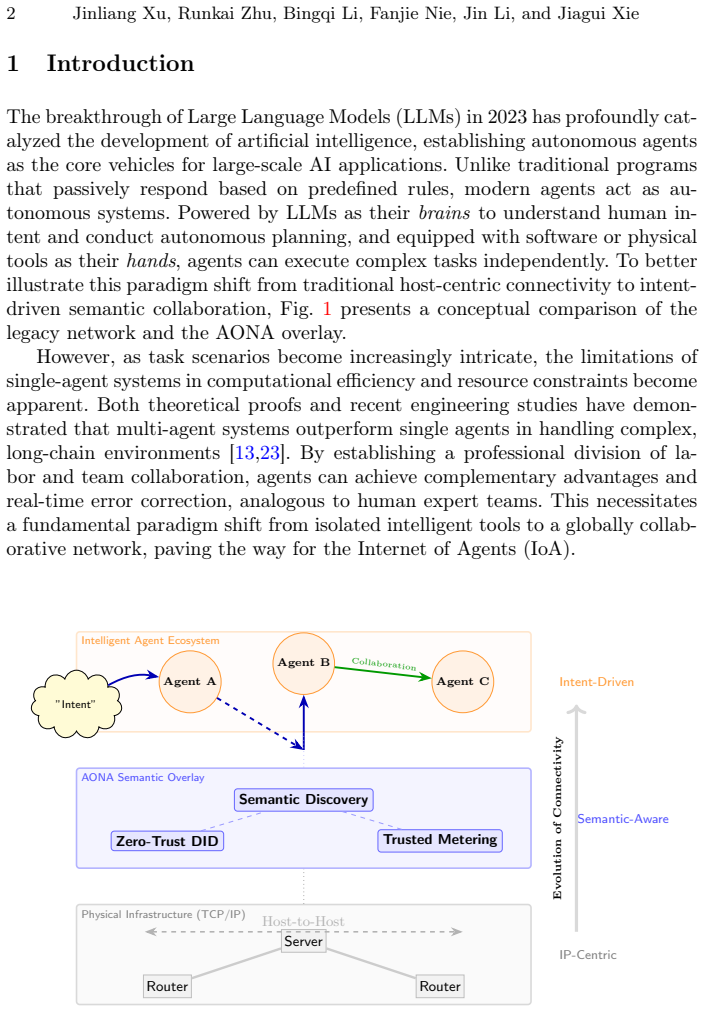
AONA supplies a four-layer overlay on the existing Internet to give autonomous agents semantic awareness, dynamic discovery, and decentralized trust.
A machine-rendered reading of the paper's core claim, the machinery that carries it, and where it could break.
Core claim
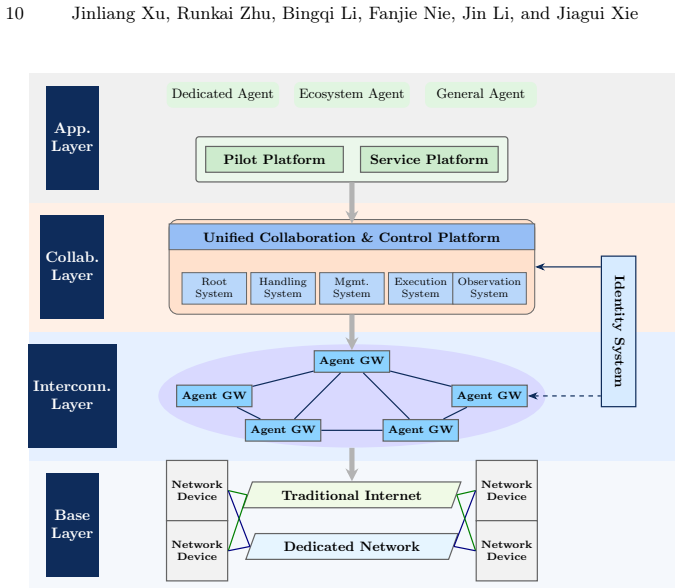
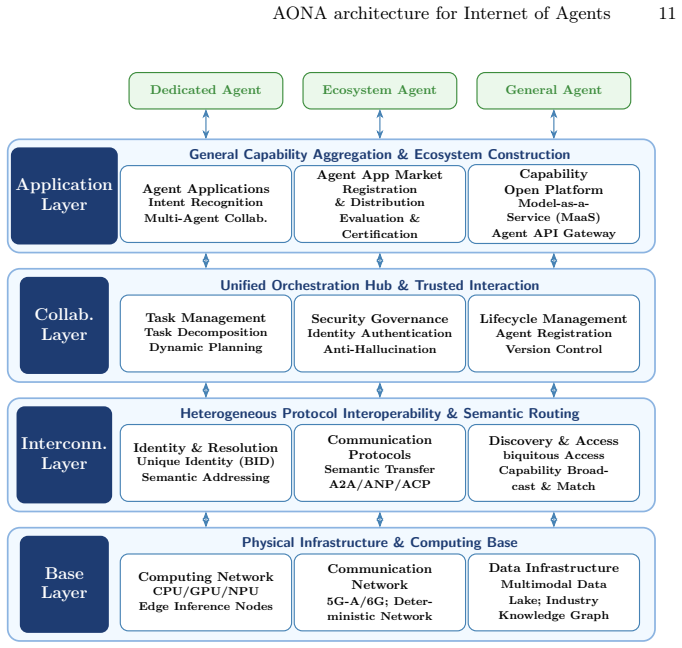
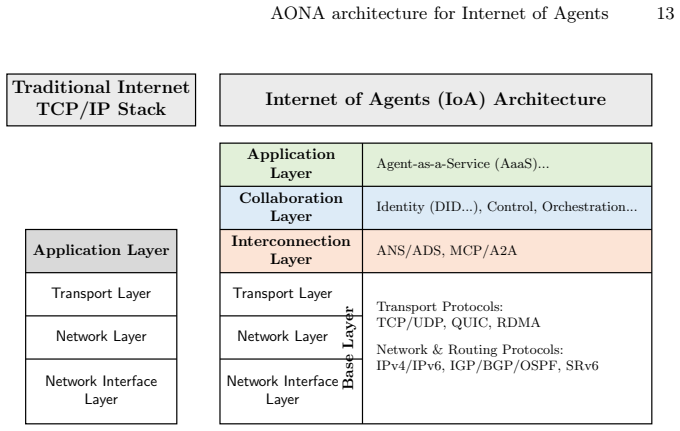
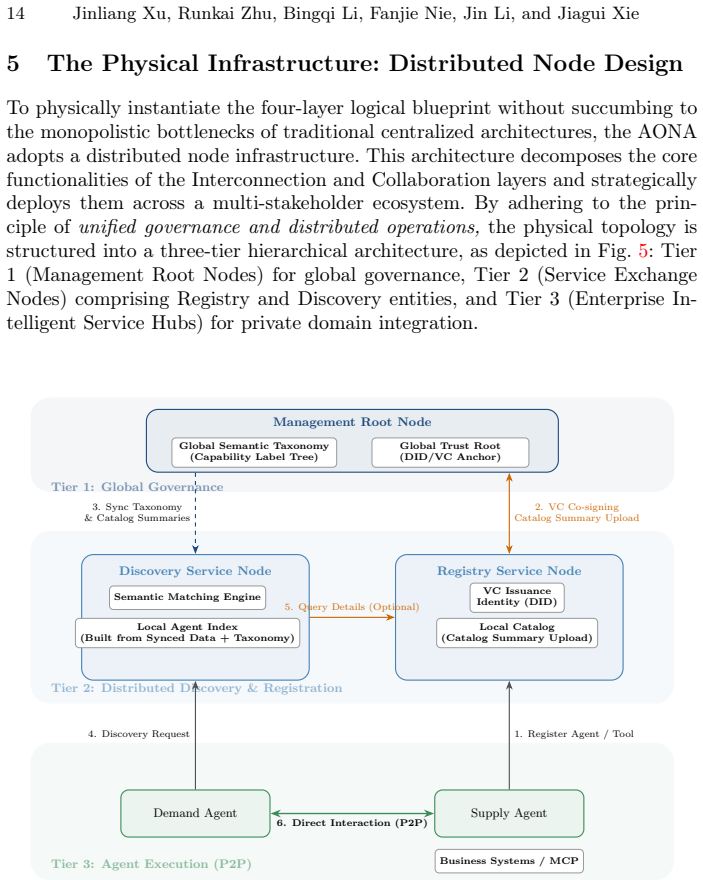
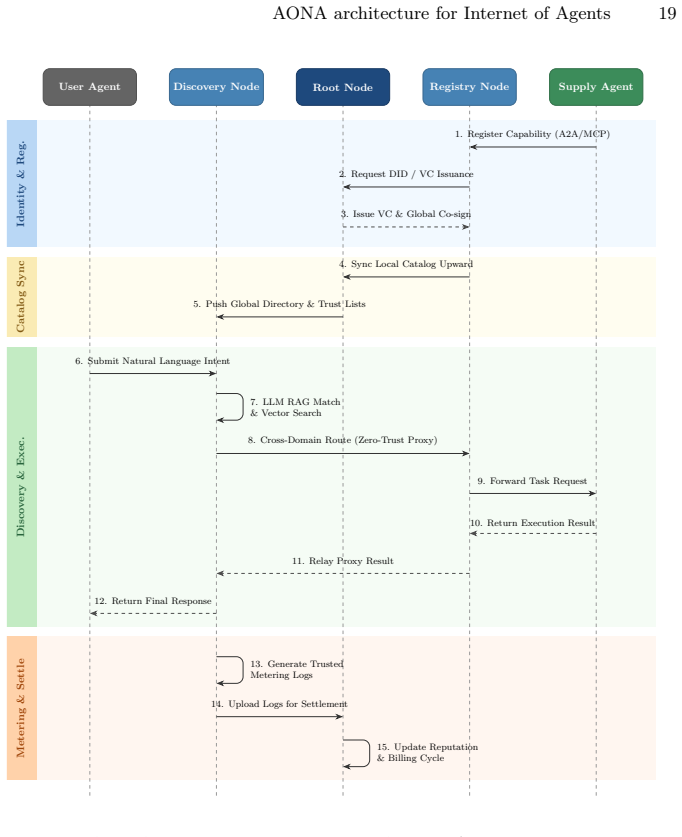
AONA is a novel overlay network architecture for the Internet of Agents structured as a four-layer logical blueprint comprising the Base, Interconnection, Collaboration, and Application layers, which facilitates cross-protocol and cross-platform interoperability without disrupting the underlying physical network. The architecture is instantiated through a distributed node infrastructure anchored by Management Root Nodes, Registry Service Nodes, Discovery Service Nodes, and Enterprise Intelligent Service Hubs. Operational workflows for zero-trust identity issuance, globally coordinated semantic taxonomy synchronization, intent-driven semantic discovery, and trusted metering complete the syste
What carries the argument
The four-layer blueprint (Base, Interconnection, Collaboration, Application) together with the distributed node infrastructure (Management Root Nodes, Registry Service Nodes, Discovery Service Nodes, Enterprise Intelligent Service Hubs) that together add semantic and trust functions as an overlay.
If this is right
- Agents from different vendors can discover and invoke one another's capabilities through shared semantic taxonomies without prior bilateral agreements.
- Zero-trust identity issuance and trusted metering enable commercial settlement between autonomous agents across organizational boundaries.
- Multi-agent collaboration becomes feasible at global scale because the overlay handles coordination that single super-intelligent models cannot achieve efficiently.
- Private enterprise domains integrate via Enterprise Intelligent Service Hubs while still participating in the public agent network.
- The design preserves all existing physical and protocol layers, so deployment requires no changes to routers, cables, or DNS.
Where Pith is reading between the lines
- Standardized agent discovery and metering could create an open marketplace for AI services analogous to app stores but without a single gatekeeper.
- If the overlay succeeds, future network standards bodies may adopt similar semantic and identity layers as extensions rather than replacements for TCP/IP.
- Testing the workflows at modest scale with agents from two or more unrelated LLM providers would expose whether the proposed taxonomy synchronization actually reduces integration effort.
- The same node types could later support non-commercial agent collectives such as scientific simulation swarms that currently lack shared discovery mechanisms.
Load-bearing premise
Existing Internet infrastructures inherently lack the semantic awareness, dynamic capability discovery, and decentralized trust mechanisms that autonomous agents require, and an overlay can add them without disrupting the physical network.
What would settle it
A working demonstration that unmodified TCP/IP and DNS already allow agents from separate vendors to perform intent-driven capability discovery and zero-trust settlement at scale, or an implementation of AONA that measurably interferes with ordinary host-to-host traffic.
Figures
read the original abstract
The rapid advancement of Large Language Models (LLMs) has established autonomous agents as the core vehicles for artificial intelligence applications. However, existing Internet infrastructures, primarily relying on TCP/IP and DNS, are designed for human-centric, host-to-host data transmission, inherently lacking the semantic awareness, dynamic capability discovery, and decentralized trust mechanisms required for autonomous agent interactions. To address these limitations and break the closed ecosystems of single vendors, this paper proposes AONA (Agentic Overlay Network Architecture), a novel overlay network architecture for the Internet of Agents (IoA). We first provide a multi-disciplinary scientific defense for multi-agent collaboration, demonstrating its theoretical necessity over single super-intelligence through the lenses of organizational economics, scaling principles, and the Price of Anarchy. AONA is then structured as a four-layer logical blueprint comprising the Base, Interconnection, Collaboration, and Application layers, which facilitates cross-protocol and cross-platform interoperability without disrupting the underlying physical network. To physically instantiate this blueprint, we design a distributed node infrastructure anchored by Management Root Nodes, Registry Service Nodes, Discovery Service Nodes, and Enterprise Intelligent Service Hubs for private domain integration. Finally, we detail the dynamic operational workflows-including zero-trust identity issuance, globally coordinated semantic taxonomy synchronization, intent-driven semantic discovery, and trusted metering for commercial settlement-that drive the network. This comprehensive architecture provides a robust, scalable, and secure foundation for the future of global agentic collaboration.
Editorial analysis
A structured set of objections, weighed in public.
Referee Report
Summary. The paper proposes AONA (Agentic Overlay Network Architecture) as an overlay for the Internet of Agents to address limitations in TCP/IP and DNS for autonomous agent interactions. It includes a multi-disciplinary defense of multi-agent collaboration (via organizational economics, scaling principles, and Price of Anarchy), a four-layer logical blueprint (Base, Interconnection, Collaboration, Application), a distributed node infrastructure (Management Root Nodes, Registry Service Nodes, Discovery Service Nodes, Enterprise Intelligent Service Hubs), and workflows such as zero-trust identity issuance, semantic taxonomy synchronization, intent-driven discovery, and trusted metering, claiming this provides a robust, scalable, and secure foundation for global agentic collaboration without disrupting the physical network.
Significance. If the architecture can be shown to meet its stated requirements, the work would offer a potentially significant conceptual contribution to enabling large-scale, interoperable autonomous agent systems by introducing semantic and trust layers atop existing infrastructure. The multi-disciplinary motivation adds theoretical breadth, though its direct influence on design decisions remains to be demonstrated.
major comments (2)
- [Abstract] Abstract: The central claim that AONA 'provides a robust, scalable, and secure foundation' via the four-layer blueprint and node infrastructure is unsupported by any analysis; the manuscript supplies no threat model, performance equations, simulation results, formal properties, or error analysis to show that the layers and nodes achieve semantic discovery, decentralized trust, and cross-protocol operation without new failure modes or disruption to TCP/IP.
- [multi-disciplinary scientific defense] multi-disciplinary scientific defense: The abstract states that this section demonstrates theoretical necessity of multi-agent collaboration over single super-intelligence, but provides no quantitative linkage or derivation connecting these arguments (organizational economics, scaling, Price of Anarchy) to the specific choices of layers, nodes, or workflows such as zero-trust issuance.
minor comments (1)
- The abstract would benefit from explicit references to prior overlay network or multi-agent system architectures to better situate the novelty of the four-layer blueprint.
Simulated Author's Rebuttal
We thank the referee for their constructive feedback on our conceptual architecture proposal. We address the major comments point by point below, with revisions where the concerns identify areas for clarification or strengthening of the presentation.
read point-by-point responses
-
Referee: [Abstract] Abstract: The central claim that AONA 'provides a robust, scalable, and secure foundation' via the four-layer blueprint and node infrastructure is unsupported by any analysis; the manuscript supplies no threat model, performance equations, simulation results, formal properties, or error analysis to show that the layers and nodes achieve semantic discovery, decentralized trust, and cross-protocol operation without new failure modes or disruption to TCP/IP.
Authors: We agree that the manuscript is a high-level design proposal and does not include quantitative analysis, threat models, or simulations to substantiate the robustness claims. The claims rest on the logical structure and motivation presented. We will revise the abstract to use more qualified language (e.g., 'is designed to provide') and add a limitations subsection in the conclusion outlining the need for future threat modeling and empirical evaluation. This is a partial revision focused on textual adjustments rather than new analysis. revision: partial
-
Referee: [multi-disciplinary scientific defense] multi-disciplinary scientific defense: The abstract states that this section demonstrates theoretical necessity of multi-agent collaboration over single super-intelligence, but provides no quantitative linkage or derivation connecting these arguments (organizational economics, scaling principles, and Price of Anarchy) to the specific choices of layers, nodes, or workflows such as zero-trust issuance.
Authors: We concur that the linkages between the theoretical arguments and concrete architectural elements could be articulated more explicitly. In the revision, we will augment the multi-disciplinary section with a new subsection that maps each argument (e.g., scaling principles to the distributed Registry and Discovery Service Nodes, Price of Anarchy to the zero-trust workflows in the Collaboration layer) to the design decisions. This will make the rationale for the specific node types and workflows clearer without altering the core content. revision: yes
Circularity Check
No significant circularity; architecture proposal is self-contained design specification
full rationale
The manuscript is a design proposal for an overlay network architecture. It identifies limitations in TCP/IP/DNS for agent interactions and defines a four-layer blueprint plus node types and workflows to address them. No equations, fitted parameters, or derivation steps are present that reduce a claimed result to the inputs by construction. The multi-disciplinary defense is referenced only at a high level without self-citation chains or uniqueness theorems that bear the central load. The proposal does not rename known results or smuggle ansatzes via prior work. As a conceptual architecture paper without quantitative validation or predictive claims that loop back to fitted data, it falls under the normal non-circular case for design descriptions.
Axiom & Free-Parameter Ledger
axioms (2)
- domain assumption Existing Internet infrastructures inherently lack the semantic awareness, dynamic capability discovery, and decentralized trust mechanisms required for autonomous agent interactions
- domain assumption Multi-agent collaboration has theoretical necessity over single super-intelligence through organizational economics, scaling principles, and the Price of Anarchy
invented entities (2)
-
AONA four-layer logical blueprint (Base, Interconnection, Collaboration, Application)
no independent evidence
-
Distributed node infrastructure (Management Root Nodes, Registry Service Nodes, Discovery Service Nodes, Enterprise Intelligent Service Hubs)
no independent evidence
Reference graph
Works this paper leans on
- [1]
-
[2]
Agentdns: A root domain naming system for llm agents,
Cui, E., Cheng, Y., She, R., Liu, D., Liang, Z., Guo, M., Li, T., Wei, Q., Xing, W., Zhong, Z.: Agentdns: A root domain naming system for llm agents. arXiv preprint arXiv:2505.22368 (2025)
-
[3]
arXiv preprint arXiv:2512.22135 (2025)
Cui, Z., Jian, Z., Liu, W., Zhang, W.: Soda: An efficient interaction paradigm for the agentic web. arXiv preprint arXiv:2512.22135 (2025)
-
[4]
arXiv preprint arXiv:2511.19699 (2025)
Fleming, C., Muscariello, L., Pandey, V., Kompella, R.: A layered protocol archi- tecture for the internet of agents. arXiv preprint arXiv:2511.19699 (2025)
-
[5]
The coral protocol: Open infrastructure connecting the internet of agents,
Georgio, R.J., Forder, C., Deb, S., Rahimov, A., Carroll, P., Gürcan, Ö.: Coral protocol: Open infrastructure connecting the internet of agents. arXiv preprint arXiv:2505.00749 (2025)
-
[6]
Technical report, Google (2024), https://github.com/google/agent2agent, accessed: 2026-04-11
Google: Agent2agent protocol specification. Technical report, Google (2024), https://github.com/google/agent2agent, accessed: 2026-04-11
2024
-
[7]
Google Open Source Blog / Technical Announcement (May 2024),https://opensource.googleblog.com/, accessed: 2026-04-11
Google: Announcing the agent2agent protocol (a2a). Google Open Source Blog / Technical Announcement (May 2024),https://opensource.googleblog.com/, accessed: 2026-04-11
2024
-
[8]
Huang, K., Narajala, V.S., Habler, I., Sheriff, A.: Agent name service (ans): A uni- versaldirectoryforsecureaiagentdiscoveryandinteroperability.In:2026IEEE5th International Conference on AI in Cybersecurity (ICAIC). pp. 1–9. IEEE (2026)
2026
- [9]
-
[10]
Towards a Science of Scaling Agent Systems
Kim, Y., Gu, K., Park, C., Park, C., Schmidgall, S., Heydari, A.A., Yan, Y., Zhang, Z., Zhuang, Y., Malhotra, M., et al.: Towards a science of scaling agent systems. arXiv preprint arXiv:2512.08296 (2025)
work page internal anchor Pith review Pith/arXiv arXiv 2025
-
[11]
Computer science re- view3(2), 65–69 (2009)
Koutsoupias, E., Papadimitriou, C.: Worst-case equilibria. Computer science re- view3(2), 65–69 (2009)
2009
-
[12]
Lemieux, V.: Economic theory of teams (1972)
1972
-
[13]
In: 2025 9th IEEE International Conference on Network Intelligence and Digital Content (IC-NIDC)
Li, C., Wu, J., Du, Q., Yu, S., Zou, R., Yu, K., Chen, K., Li, K., Qian, Y., Guo, X., et al.: Acps: Agent collaboration protocols for the internet of agents. In: 2025 9th IEEE International Conference on Network Intelligence and Digital Content (IC-NIDC). pp. 342–346. IEEE (2025)
2025
-
[14]
arXiv preprint arXiv:2510.13467 (2025)
Li,E.,Du,H.,Huang,K.:Netmcp:Network-awaremodelcontextprotocolplatform for llm capability extension. arXiv preprint arXiv:2510.13467 (2025)
-
[15]
arXiv preprint arXiv:2512.17538 (2025)
Lin, Z., Zhang, S., Liao, G., Tao, D., Wang, T.: Binding agent id: Unleash- ing the power of ai agents with accountability and credibility. arXiv preprint arXiv:2512.17538 (2025)
-
[16]
Artificial Intelligence161(1-2), 149–180 (2005) 28 Jinliang Xu, Runkai Zhu, Bingqi Li, Fanjie Nie, Jin Li, and Jiagui Xie
Modi, P.J., Shen, W.M., Tambe, M., Yokoo, M.: Adopt: Asynchronous distributed constraint optimization with quality guarantees. Artificial Intelligence161(1-2), 149–180 (2005) 28 Jinliang Xu, Runkai Zhu, Bingqi Li, Fanjie Nie, Jin Li, and Jiagui Xie
2005
-
[17]
In: 2026 IEEE 5th International Conference on AI in Cybersecurity (ICAIC)
Narajala, V.S., Habler, I.: Enterprise-grade security for the model context protocol (mcp): Frameworks and mitigation strategies. In: 2026 IEEE 5th International Conference on AI in Cybersecurity (ICAIC). pp. 1–8. IEEE (2026)
2026
-
[18]
arXiv preprint arXiv:2504.10915 (2025)
Ranjan, R., Gupta, S., Singh, S.N.: Loka protocol: A decentralized framework for trustworthy and ethical ai agent ecosystems. arXiv preprint arXiv:2504.10915 (2025)
-
[19]
Raskar, R., Chari, P., Lambe, M., Lincourt, R., Bala, R., Joshi, A., Grogan, J.J., Singh, A., Chopra, A., Ranjan, R., et al.: Upgrade or switch: Do we need a next-gen trusted architecture for the internet of ai agents? In: 2025 IEEE 7th International Conference on Trust, Privacy and Security in Intelligent Systems, and Applications (TPS-ISA). pp. 1–10. IE...
2025
- [20]
-
[21]
In: Proceedings of the 14th annual conference on Computer graphics and interactive techniques
Reynolds, C.W.: Flocks, herds and schools: A distributed behavioral model. In: Proceedings of the 14th annual conference on Computer graphics and interactive techniques. pp. 25–34 (1987)
1987
-
[22]
Roughgarden, T., Tardos, É.: How bad is selfish routing? Journal of the ACM (JACM)49(2), 236–259 (2002)
2002
-
[23]
Position: Collaborative Agentic AI Needs Interoperability Across Ecosystems
Sharma, R., de Vos, M., Chari, P., Raskar, R., Kermarrec, A.M.: Collab- orative agentic ai needs interoperability across ecosystems. arXiv preprint arXiv:2505.21550 (2025)
work page internal anchor Pith review Pith/arXiv arXiv 2025
-
[24]
Organization sci- ence2(1), 125–134 (1991)
Simon, H.A.: Bounded rationality and organizational learning. Organization sci- ence2(1), 125–134 (1991)
1991
-
[25]
IEEE Network35(4), 213–219 (2021)
Sun, Q., Xu, J., Ma, X., Zhou, A., Hsu, C.H., Wang, S.: Edge-enabled distributed deep learning for 5g privacy protection. IEEE Network35(4), 213–219 (2021)
2021
-
[26]
arXiv preprint arXiv:2508.03101 (2025)
Wang, S., Raskar, R., Lambe, M., Chari, P., Singhal, R., Gupta, S., Ranjan, R., Huang, K.: Using the nanda index architecture in practice: An enterprise perspec- tive. arXiv preprint arXiv:2508.03101 (2025)
-
[27]
DarwinNet: An Evolutionary Network Architecture for Agent-Driven Protocol Synthesis
Xu, J., Li, B.: Darwinnet: An evolutionary network architecture for agent-driven protocol synthesis. arXiv preprint arXiv:2604.01236 (2026)
work page internal anchor Pith review Pith/arXiv arXiv 2026
-
[28]
IEEE Transactions on Industrial Informatics15(6), 3538–3547 (2019)
Xu, J., Wang, S., Bhargava, B.K., Yang, F.: A blockchain-enabled trustless crowd- intelligence ecosystem on mobile edge computing. IEEE Transactions on Industrial Informatics15(6), 3538–3547 (2019)
2019
-
[29]
IEEE Transactions on Mobile Computing 18(4), 974–985 (2018)
Xu, J., Wang, S., Zhang, N., Yang, F., Shen, X.: Reward or penalty: Aligning incen- tives of stakeholders in crowdsourcing. IEEE Transactions on Mobile Computing 18(4), 974–985 (2018)
2018
-
[30]
China Communications17(4), 10 (2020)
Xu, J., Wang, S., Zhou, A., Yang, F.: Edgence: A blockchain-enabled edge- computing platform for intelligent iot-based dapps. China Communications17(4), 10 (2020)
2020
-
[31]
arXiv preprint arXiv:2504.16736 (2025)
Yang, Y., Chai, H., Song, Y., Qi, S., Wen, M., Li, N., Liao, J., Hu, H., Lin, J., Chang, G., et al.: A survey of ai agent protocols. arXiv preprint arXiv:2504.16736 (2025)
discussion (0)
Sign in with ORCID, Apple, or X to comment. Anyone can read and Pith papers without signing in.