Statistical analysis of the relative orientations between filaments and magnetic fields using Herschel and Planck data in star-forming regions
Pith reviewed 2026-06-28 05:33 UTC · model grok-4.3
The pith
Low-column-density filaments align parallel to magnetic fields while high-column-density ones align perpendicular or randomly, with a transition at roughly 10^{21} cm^{-2}.
A machine-rendered reading of the paper's core claim, the machinery that carries it, and where it could break.
Core claim
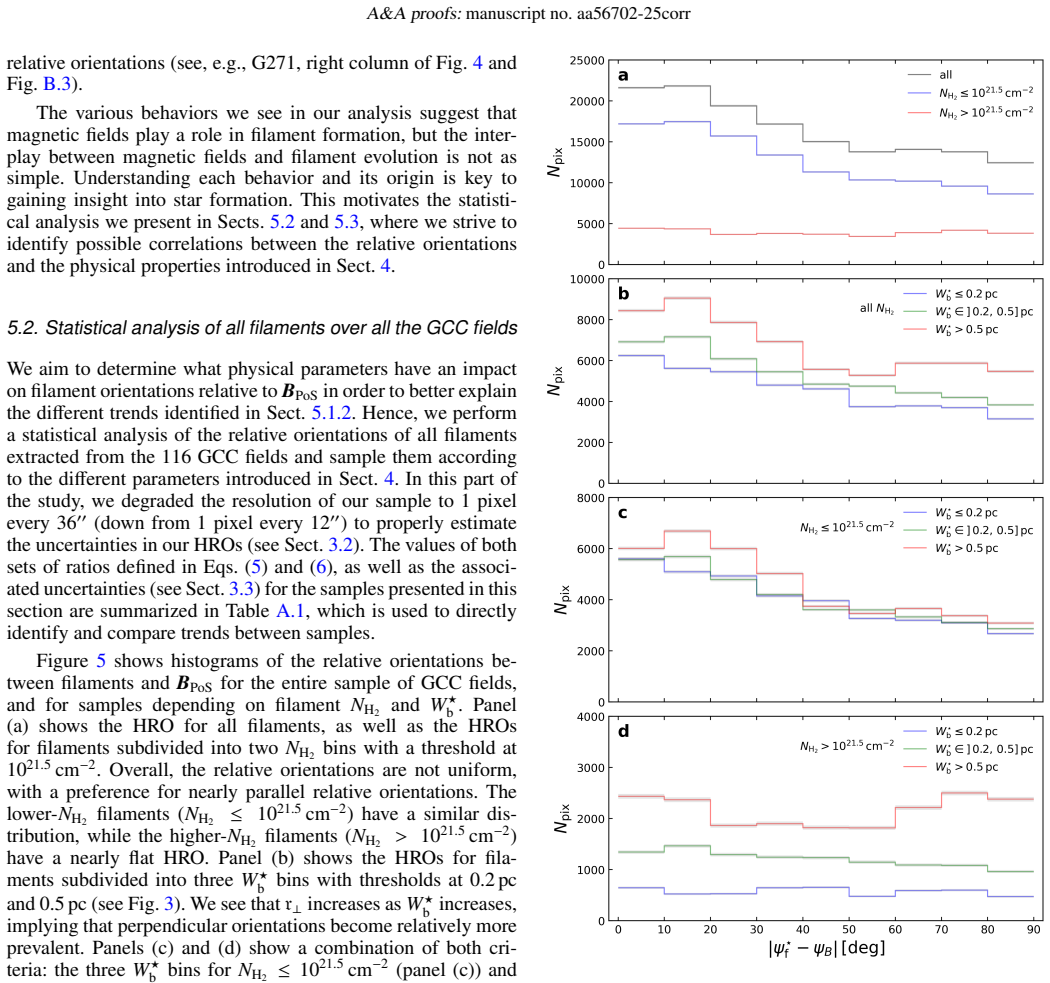
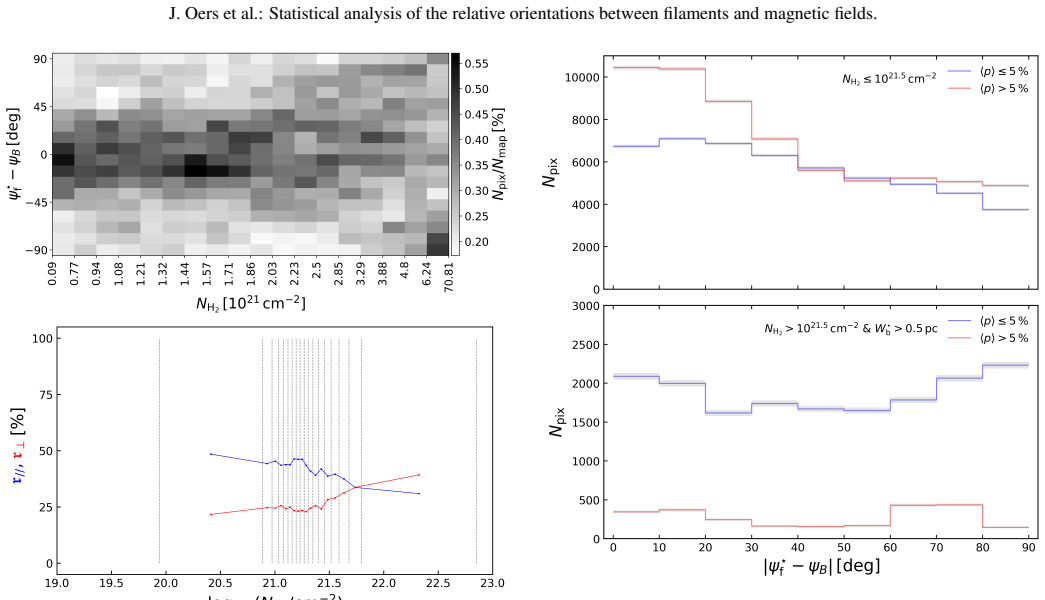
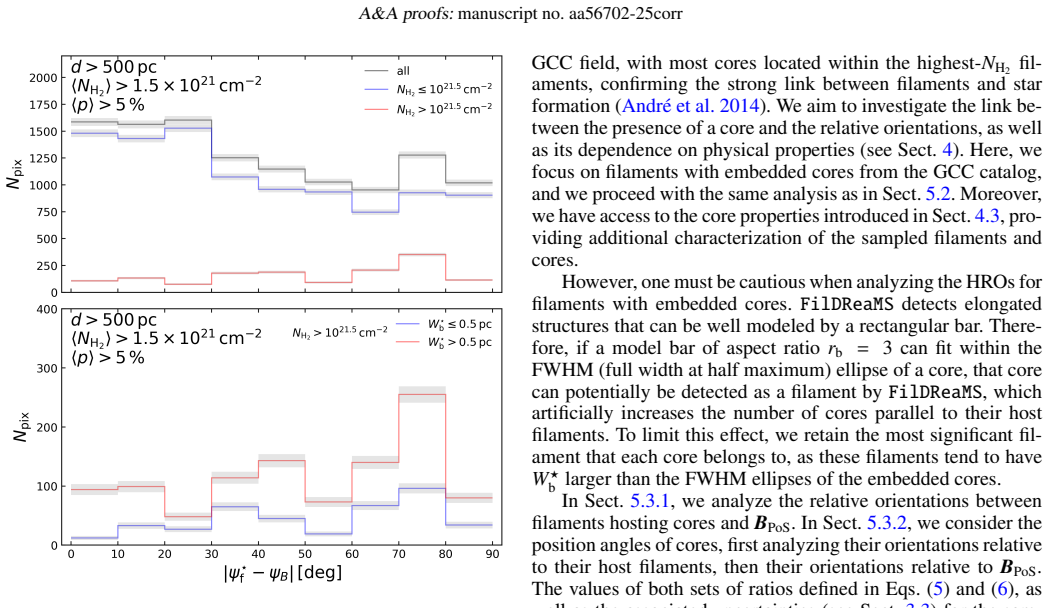
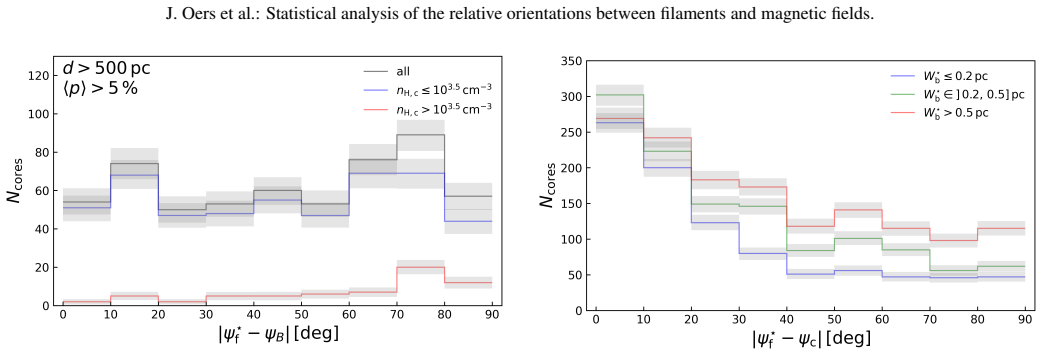
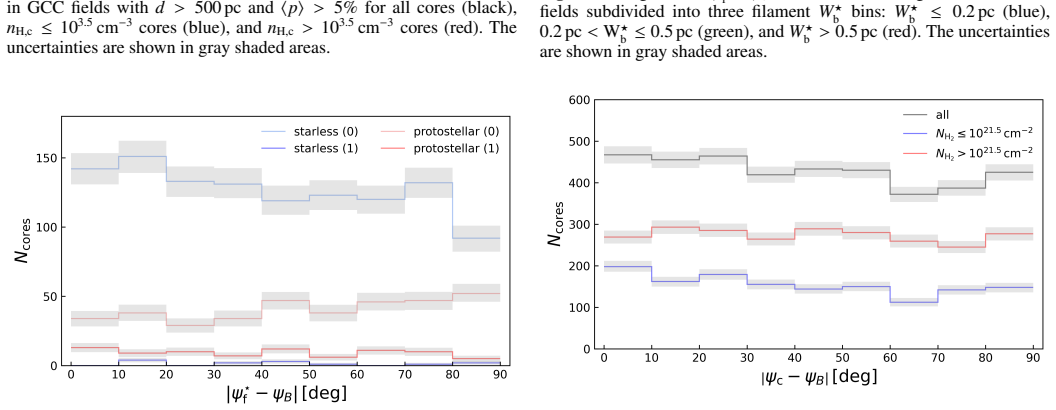
Low-N_H2 filaments tend to be roughly parallel to B_PoS at all scales, while narrow high-N_H2 filaments do not have any preferred orientations and wide high-N_H2 filaments tend to be roughly perpendicular; this change occurs at a transition column density typically in the range [0.8, 8] x 10^{21} cm^{-2}, consistent with prior Planck studies, and HROs for filaments with embedded cores match those of high-N_H2 filaments.
What carries the argument
FilDReaMS multi-scale filament extraction applied to Herschel Galactic Cold Cores fields, followed by histograms of relative orientations (HROs) against Planck-derived B_PoS maps.
If this is right
- The transition column density range matches results from earlier Planck studies.
- Filaments containing embedded cores exhibit HROs consistent with those of high-N_H2 filaments overall.
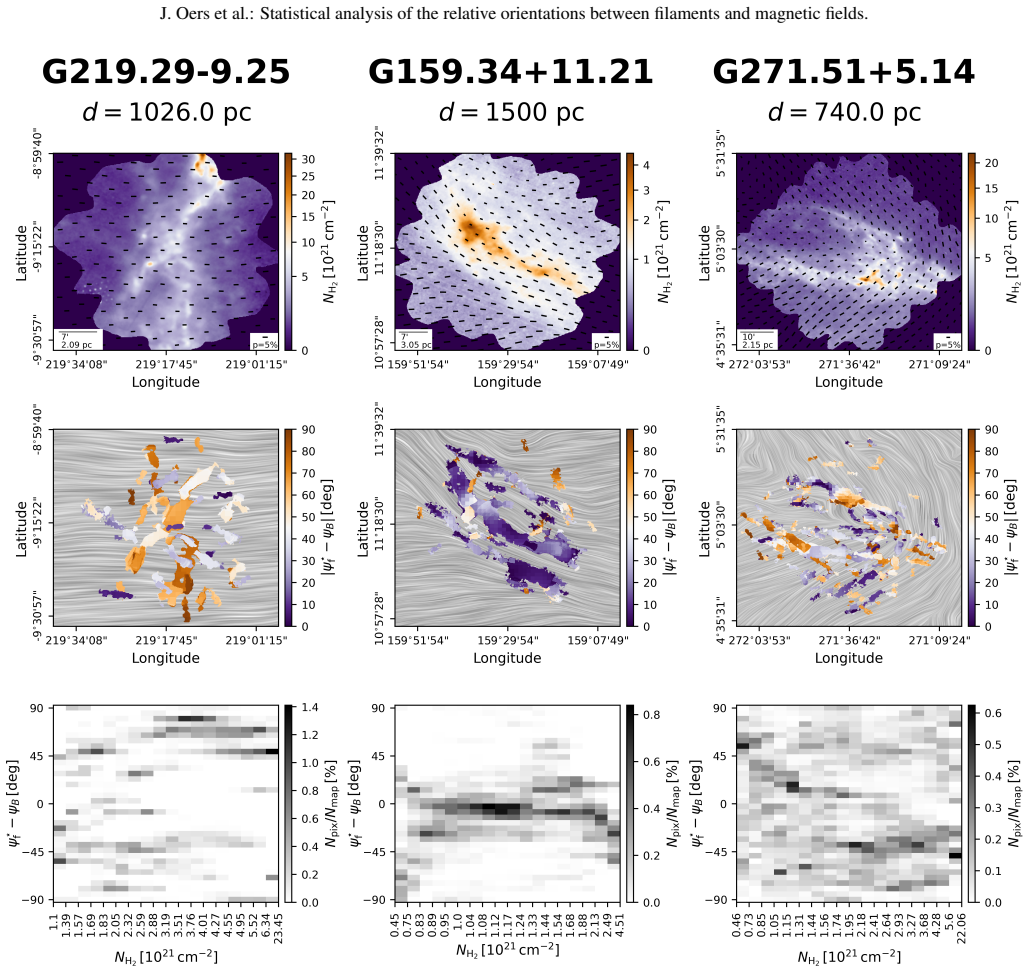
- Several individual fields deviate from the average trends, attributable to projection effects, line-of-sight confusion, or magnetic field tangling.
- Statistically, preferred orientations measured in the plane of the sky indicate true preferred orientations in three dimensions.
- Higher polarization fractions correspond to weaker projection effects, supporting the link between polarization fraction and magnetic-field inclination to the line of sight.
Where Pith is reading between the lines
- The density-dependent switch may mark where self-gravity begins to dominate over magnetic support in shaping filament evolution.
- Applying the same multi-scale extraction and HRO analysis to magnetohydrodynamic simulations could test whether the transition density is a universal feature.
- The finding that higher polarization fractions reduce projection bias suggests prioritizing high-p regions for future studies of three-dimensional field geometry.
Load-bearing premise
The 7-arcmin Planck magnetic-field map can be compared directly to 18-36-arcsec Herschel filaments without major bias from resolution mismatch or line-of-sight confusion, and FilDReaMS recovers true filament orientations at multiple scales.
What would settle it
A larger sample of filaments with independent three-dimensional orientation constraints showing no orientation transition at column densities near 10^{21} cm^{-2} would falsify the reported change in preferred alignment.
Figures
read the original abstract
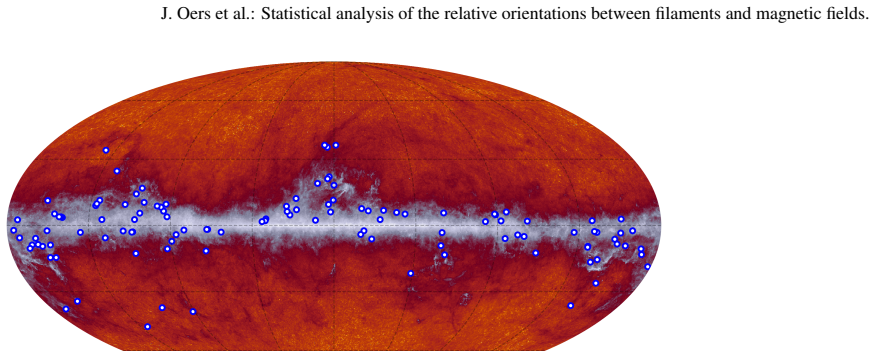
Observations and simulations of the interstellar medium both suggest that magnetic fields play a key role in the formation and evolution of filaments and in the process of star formation, yet their exact role is still poorly understood. Here, we aim to statistically examine the relative orientations between filaments and magnetic fields in various star-forming regions with different physical properties and Galactic environments. We used a dedicated method, FilDReaMS, to detect and extract filaments at multiple scales, and we applied it to the 116 fields of the Herschel "Galactic Cold Cores" key project (18"-36" resolution). We then compared the filament orientations to the orientation of the plane-of-sky (PoS) magnetic field (B_PoS), inferred from Planck observations (7' resolution) using histograms of relative orientations (HROs). We find that low-N_H2 filaments tend to be roughly parallel to B_PoS at all scales, while narrow high-N_H2 filaments do not have any preferred orientations and wide high-N_H2 filaments tend to be roughly perpendicular. This change in preferred orientations occurs at a transition column density typically in the range [0.8, 8] x 10^{21} cm^{-2}, a range consistent with results of previous Planck studies. We also analyzed the HROs for filaments with embedded cores and find them to be consistent with HROs for high-N_H2 filaments. However, several fields do not follow the general trends, with a variety of behaviors that can be due to factors such as projection effects, confusion along the line of sight (LoS), or magnetic field tangling. Our analysis of projection effects shows that, statistically, preferred orientations in the PoS are indicative of true preferred orientations in 3D. Our results suggest that higher polarization fractions, p, entail weaker projection effects, consistent with the presumed link between p and the magnetic field inclination to the LoS.
Editorial analysis
A structured set of objections, weighed in public.
Referee Report
Summary. The manuscript reports a statistical analysis of filament orientations relative to the plane-of-the-sky magnetic field (B_PoS) in 116 Herschel Galactic Cold Cores fields. Filaments are extracted at multiple scales from Herschel data (18-36 arcsec resolution) using FilDReaMS and compared to Planck-derived B_PoS (7 arcmin resolution) via histograms of relative orientations (HROs). The central claim is that low-N_H2 filaments are preferentially parallel to B_PoS at all scales, narrow high-N_H2 filaments show no preferred orientation, and wide high-N_H2 filaments are preferentially perpendicular, with the transition occurring at column densities typically in [0.8, 8] × 10^{21} cm^{-2}; results for embedded cores are consistent with high-N_H2 trends, and projection effects are analyzed to argue that PoS preferences indicate 3D preferences.
Significance. If the reported orientation trends and transition column density survive quantitative tests for resolution effects, the results would provide a valuable multi-scale, multi-environment observational constraint on the role of magnetic fields in filament evolution, extending prior Planck HRO studies with explicit scale dependence and core-specific analysis. The large sample size and explicit treatment of projection effects are strengths that would support the paper's contribution to the field.
major comments (1)
- [Data analysis and results sections (HRO construction and multi-scale comparison)] The central empirical claim (low-N_H2 parallel, high-N_H2 scale-dependent orientations with transition at [0.8,8]×10^{21} cm^{-2}) rests on direct comparison of 18-36 arcsec filaments to 7 arcmin B_PoS maps. No validation is described using synthetic observations or a B-field map degraded to match the filament resolution to test whether beam averaging over ~10-20 times larger scales biases the HROs or drives the reported parallel-to-perpendicular shift, especially for narrow high-N_H2 filaments.
minor comments (2)
- [Abstract] The abstract quotes a transition range but does not specify the per-field or aggregate method used to identify the transition column density; adding this detail would improve reproducibility.
- [Methods (FilDReaMS application)] Clarify in the methods whether FilDReaMS parameters (e.g., scale selection, width thresholds for narrow vs wide) were held fixed across all 116 fields or tuned per field.
Simulated Author's Rebuttal
We thank the referee for the constructive report and for highlighting the importance of testing resolution effects. We address the single major comment below and will revise the manuscript accordingly to strengthen the presentation of the results.
read point-by-point responses
-
Referee: [Data analysis and results sections (HRO construction and multi-scale comparison)] The central empirical claim (low-N_H2 parallel, high-N_H2 scale-dependent orientations with transition at [0.8,8]×10^{21} cm^{-2}) rests on direct comparison of 18-36 arcsec filaments to 7 arcmin B_PoS maps. No validation is described using synthetic observations or a B-field map degraded to match the filament resolution to test whether beam averaging over ~10-20 times larger scales biases the HROs or drives the reported parallel-to-perpendicular shift, especially for narrow high-N_H2 filaments.
Authors: We agree that explicit validation against beam-averaging bias would strengthen the analysis. The manuscript does not currently include synthetic observations or degraded B maps. However, the multi-scale filament extraction (18–36 arcsec) already demonstrates that the parallel preference for low-N_H2 filaments persists across all extracted scales, while the transition column density range matches independent Planck HRO results obtained at comparable resolutions. The statistical projection-effect analysis further indicates that observed PoS preferences are indicative of 3D alignments. We will add a dedicated subsection in the discussion that (i) explicitly acknowledges the resolution mismatch, (ii) argues that the scale-independent low-N_H2 trend and consistency with prior studies make a pure beam-averaging artifact unlikely, and (iii) notes that narrow high-N_H2 filaments showing no preferred orientation is the opposite of what a simple averaging bias would produce. If the referee deems it essential, we can also outline a future synthetic test using MHD simulations convolved to Planck resolution. revision: partial
Circularity Check
No circularity: purely observational comparison of independent datasets
full rationale
The paper applies the FilDReaMS filament extractor to Herschel maps and computes HROs against Planck B_PoS angles. All reported trends (parallel at low N_H2, perpendicular at high N_H2 for wide filaments, transition column-density range) are direct statistical outputs from the two datasets. No equations, fitted parameters, or predictions are defined in terms of the target result; no uniqueness theorem or ansatz is imported via self-citation to force the outcome. The single reference to consistency with prior Planck studies is incidental and not load-bearing for the central empirical claim.
Axiom & Free-Parameter Ledger
axioms (2)
- domain assumption Planck 353 GHz polarization reliably traces the plane-of-sky magnetic field orientation
- domain assumption FilDReaMS extracts filaments whose orientations reflect true 3D structures at the stated scales
Reference graph
Works this paper leans on
-
[1]
Statistical analysis of the interplay between interstellar magnetic fields and filaments hosting Planck Galactic cold clumps. , keywords =. doi:10.1093/mnras/stz508 , archivePrefix =. 1712.09325 , primaryClass =
work page internal anchor Pith review Pith/arXiv arXiv doi:10.1093/mnras/stz508
-
[2]
Large-scale magnetic field in the Monoceros OB 1 east molecular cloud. , keywords =. doi:10.1051/0004-6361/202039065 , archivePrefix =. 2007.15344 , primaryClass =
-
[3]
, year = 2015, month = aug, volume =
Interstellar Dust Grain Alignment. , year = 2015, month = aug, volume =. doi:10.1146/annurev-astro-082214-122414 , adsurl =
-
[4]
From filamentary clouds to prestellar cores to the stellar IMF: Initial highlights from the Herschel Gould Belt Survey. , keywords =. doi:10.1051/0004-6361/201014666 , archivePrefix =. 1005.2618 , primaryClass =
work page internal anchor Pith review Pith/arXiv arXiv doi:10.1051/0004-6361/201014666
-
[5]
From Filamentary Networks to Dense Cores in Molecular Clouds: Toward a New Paradigm for Star Formation. Protostars and Planets VI , year = 2014, editor =. doi:10.2458/azu_uapress_9780816531240-ch002 , archivePrefix =. 1312.6232 , primaryClass =
work page internal anchor Pith review Pith/arXiv arXiv doi:10.2458/azu_uapress_9780816531240-ch002 2014
-
[6]
Interstellar Polarization Survey. V. Galactic Magnetic Field Tomography of the Spiral Arms Using Optical and Near-infrared Starlight Polarization. , keywords =. doi:10.3847/1538-3881/addecc , archivePrefix =. 2506.01564 , primaryClass =
-
[7]
Formation and evolution of interstellar filaments; Hints from velocity dispersion measurements
Formation and evolution of interstellar filaments. Hints from velocity dispersion measurements. , keywords =. doi:10.1051/0004-6361/201220822 , archivePrefix =. 1303.3024 , primaryClass =
work page internal anchor Pith review Pith/arXiv arXiv doi:10.1051/0004-6361/201220822
-
[8]
Characterizing the properties of nearby molecular filaments observed with Herschel
Characterizing the properties of nearby molecular filaments observed with Herschel. , keywords =. doi:10.1051/0004-6361/201832725 , archivePrefix =. 1810.00721 , primaryClass =
work page internal anchor Pith review Pith/arXiv arXiv doi:10.1051/0004-6361/201832725
-
[9]
Thermal condensation in a turbulent atomic hydrogen flow
Thermal condensation in a turbulent atomic hydrogen flow. , keywords =. doi:10.1051/0004-6361:20041474 , archivePrefix =. astro-ph/0410062 , primaryClass =
work page internal anchor Pith review Pith/arXiv arXiv doi:10.1051/0004-6361:20041474
-
[10]
Interstellar Molecular Clouds. Science , keywords =. doi:10.1126/science.232.4747.185 , adsurl =
-
[11]
Overview of the Orion Complex. Handbook of Star Forming Regions, Volume I , year = 2008, editor =. doi:10.48550/arXiv.0812.0046 , adsurl =
work page internal anchor Pith review Pith/arXiv arXiv doi:10.48550/arxiv.0812.0046 2008
-
[12]
A turbulent MHD model for molecular clouds and a new method of accretion on to star-forming cores. , keywords =. doi:10.1046/j.1365-8711.2001.04787.x , archivePrefix =. astro-ph/0105327 , primaryClass =
-
[13]
A Survey for Circumstellar Disks around Young Stellar Objects. , keywords =. doi:10.1086/115385 , adsurl =
-
[14]
FilDReaMS. II. Application to the analysis of the relative orientations between filaments and the magnetic field in four Herschel fields. , keywords =. 2022b , month = dec, volume =. doi:10.1051/0004-6361/202244550 , archivePrefix =. 2208.14843 , primaryClass =
-
[15]
FilDReaMS. I. Presentation of a new method for Filament Detection and Reconstruction at Multiple Scales. , keywords =. 2022a , month = dec, volume =. doi:10.1051/0004-6361/202243506 , archivePrefix =. 2208.14826 , primaryClass =
-
[16]
Anisotropic Formation of Magnetized Cores in Turbulent Clouds
Anisotropic Formation of Magnetized Cores in Turbulent Clouds. , keywords =. doi:10.1088/0004-637X/810/2/126 , archivePrefix =. 1508.02710 , primaryClass =
work page internal anchor Pith review Pith/arXiv arXiv doi:10.1088/0004-637x/810/2/126
-
[17]
Change of Magnetic Field-gas Alignment at the Gravity-driven Alfv \'e nic Transition in Molecular Clouds: Implications for Dust Polarization Observations. , keywords =. doi:10.3847/0004-637X/829/2/84 , archivePrefix =. 1605.00648 , primaryClass =
work page internal anchor Pith review Pith/arXiv arXiv doi:10.3847/0004-637x/829/2/84
-
[18]
Geometry, Kinematics, and Magnetization of Simulated Prestellar Cores
Geometry, Kinematics, and Magnetization of Simulated Prestellar Cores. , keywords =. doi:10.3847/1538-4357/aad905 , archivePrefix =. 1808.02483 , primaryClass =
work page internal anchor Pith review Pith/arXiv arXiv doi:10.3847/1538-4357/aad905
-
[19]
Magnetically Aligned HI Fibers and the Rolling Hough Transform
Magnetically Aligned H I Fibers and the Rolling Hough Transform. , keywords =. doi:10.1088/0004-637X/789/1/82 , archivePrefix =. 1312.1338 , primaryClass =
work page internal anchor Pith review Pith/arXiv arXiv doi:10.1088/0004-637x/789/1/82
-
[20]
A new probe of line-of-sight magnetic field tangling
A New Probe of Line-of-sight Magnetic Field Tangling. , keywords =. doi:10.3847/2041-8213/aabb54 , archivePrefix =. 1802.00011 , primaryClass =
work page internal anchor Pith review Pith/arXiv arXiv doi:10.3847/2041-8213/aabb54 2041
-
[21]
Filamentary structure and magnetic field orientation in Musca. , keywords =. doi:10.1051/0004-6361/201527068 , adsurl =
-
[22]
, year = 1951, month = sep, volume =
The Polarization of Starlight by Aligned Dust Grains. , year = 1951, month = sep, volume =. doi:10.1086/145464 , adsurl =
-
[23]
Efron , title =
B. Efron , title =. The Annals of Statistics , number =. 1979 , doi =
1979
-
[24]
1993 , Address =
An Introduction to the Bootstrap , Author =. 1993 , Address =
1993
-
[25]
Relative Alignment between the Magnetic Field and Molecular Gas Structure in the Vela C Giant Molecular Cloud Using Low- and High-density Tracers. , keywords =. doi:10.3847/1538-4357/ab1eb0 , archivePrefix =. 1804.08979 , primaryClass =
work page internal anchor Pith review Pith/arXiv arXiv doi:10.3847/1538-4357/ab1eb0
-
[26]
, keywords =
The spiral structure of our Galaxy determined from H II regions. , keywords =
-
[27]
Alignment of the magnetic field in star-forming regions and why it might be difficult to observe. , keywords =. doi:10.1093/mnras/stab2157 , archivePrefix =. 2106.12596 , primaryClass =
-
[28]
Large-Scale Structure of the Molecular Gas in Taurus Revealed by High Linear Dynamic Range Spectral Line Mapping. , keywords =. doi:10.1086/587166 , archivePrefix =. 0802.2206 , primaryClass =
work page internal anchor Pith review Pith/arXiv arXiv doi:10.1086/587166
-
[29]
Filaments in Simulations of Molecular Cloud Formation
Filaments in Simulations of Molecular Cloud Formation. , keywords =. doi:10.1088/0004-637X/791/2/124 , archivePrefix =. 1308.6298 , primaryClass =
work page internal anchor Pith review Pith/arXiv arXiv doi:10.1088/0004-637x/791/2/124
-
[30]
The Herschel-SPIRE instrument and its in-flight performance
The Herschel-SPIRE instrument and its in-flight performance. , keywords =. doi:10.1051/0004-6361/201014519 , archivePrefix =. 1005.5123 , primaryClass =
work page internal anchor Pith review Pith/arXiv arXiv doi:10.1051/0004-6361/201014519
-
[31]
Protostars and Planets VII , year = 2023, editor =
Initial Conditions for Star Formation: a Physical Description of the Filamentary ISM. Protostars and Planets VII , year = 2023, editor =. doi:10.48550/arXiv.2203.09562 , archivePrefix =. 2203.09562 , primaryClass =
-
[32]
On the origin of non self-gravitating filaments in the ISM
On the origin of non-self-gravitating filaments in the ISM. , keywords =. doi:10.1051/0004-6361/201321292 , archivePrefix =. 1306.5452 , primaryClass =
work page internal anchor Pith review Pith/arXiv arXiv doi:10.1051/0004-6361/201321292
-
[33]
Frontiers in Astronomy and Space Sciences , keywords =
The role of magnetic field in molecular cloud formation and evolution. Frontiers in Astronomy and Space Sciences , keywords =. doi:10.3389/fspas.2019.00005 , archivePrefix =. 1902.00798 , primaryClass =
-
[34]
Magnetically Aligned Velocity Anisotropy in the Taurus Molecular Cloud
Magnetically Aligned Velocity Anisotropy in the Taurus Molecular Cloud. , keywords =. doi:10.1086/587510 , archivePrefix =. 0802.2084 , primaryClass =
work page internal anchor Pith review Pith/arXiv arXiv doi:10.1086/587510 2084
-
[35]
, year = 1983, month = sep, volume =
The determination of cloud masses and dust characteristics from submillimetre thermal emission. , year = 1983, month = sep, volume =
1983
-
[36]
, keywords =
Magnetic fields and stardust. , keywords =
-
[37]
Grain Alignment Induced by Radiative Torques: Effects of Internal Relaxation of Energy and Complex Radiation Field. , keywords =. doi:10.1088/0004-637X/697/2/1316 , archivePrefix =. 0812.4576 , primaryClass =
work page internal anchor Pith review Pith/arXiv arXiv doi:10.1088/0004-637x/697/2/1316
-
[38]
Unveiling the Role of the Magnetic Field at the Smallest Scales of Star Formation
Unveiling the Role of the Magnetic Field at the Smallest Scales of Star Formation. , keywords =. doi:10.3847/2041-8213/aa71b7 , archivePrefix =. 1706.03806 , primaryClass =
work page internal anchor Pith review Pith/arXiv arXiv doi:10.3847/2041-8213/aa71b7 2041
-
[39]
Gravity versus Magnetic Fields in Forming Molecular Clouds. , keywords =. doi:10.3847/1538-4357/ac3b58 , archivePrefix =. 2108.04967 , primaryClass =
-
[40]
A Production Mechanism for Clusters of Dense Cores. , keywords =. doi:10.1086/303982 , adsurl =
-
[41]
Relative alignment between gas structures and magnetic field in Orion A at different scales using different molecular gas tracers. , keywords =. doi:10.1051/0004-6361/202449182 , archivePrefix =. 2403.04274 , primaryClass =
-
[42]
An application of an optimal statistic for characterising relative orientations
An application of an optimal statistic for characterizing relative orientations. , keywords =. doi:10.1093/mnras/stx2736 , archivePrefix =. 1708.04063 , primaryClass =
work page internal anchor Pith review Pith/arXiv arXiv doi:10.1093/mnras/stx2736
-
[43]
Galactic cold cores: Herschel study of first Planck detections. , keywords =. doi:10.1051/0004-6361/201014619 , adsurl =
-
[44]
Galactic cold cores. III. General cloud properties. , keywords =. doi:10.1051/0004-6361/201118640 , archivePrefix =. 1202.1672 , primaryClass =
work page internal anchor Pith review Pith/arXiv arXiv doi:10.1051/0004-6361/201118640
-
[45]
Template matching method for the analysis of interstellar cloud structure
Template matching method for the analysis of interstellar cloud structure. , keywords =. doi:10.1051/0004-6361/201628727 , archivePrefix =. 1607.01931 , primaryClass =
work page internal anchor Pith review Pith/arXiv arXiv doi:10.1051/0004-6361/201628727
-
[46]
Galactic cold cores. IX. Column density structures and radiative-transfer modelling. , keywords =. doi:10.1051/0004-6361/201630304 , archivePrefix =. 1801.02419 , primaryClass =
work page internal anchor Pith review Pith/arXiv arXiv doi:10.1051/0004-6361/201630304
-
[47]
Low Mass Star Formation in the Taurus-Auriga Clouds
Low Mass Star Formation in the Taurus-Auriga Clouds. Handbook of Star Forming Regions, Volume I , year = 2008, editor =. doi:10.48550/arXiv.0810.1298 , adsurl =
work page internal anchor Pith review Pith/arXiv arXiv doi:10.48550/arxiv.0810.1298 2008
-
[48]
Modeling Dust Polarization Observations of Molecular Clouds through MHD Simulations
Modelling dust polarization observations of molecular clouds through MHD simulations. , keywords =. doi:10.1093/mnras/stx3096 , archivePrefix =. 1709.08641 , primaryClass =
work page internal anchor Pith review Pith/arXiv arXiv doi:10.1093/mnras/stx3096
-
[49]
The Aquila prestellar core population revealed by Herschel
The Aquila prestellar core population revealed by Herschel. , keywords =. doi:10.1051/0004-6361/201014689 , archivePrefix =. 1005.2981 , primaryClass =
work page internal anchor Pith review Pith/arXiv arXiv doi:10.1051/0004-6361/201014689
-
[50]
A census of dense cores in the Aquila cloud complex: SPIRE/PACS observations from the Herschel Gould Belt survey. , keywords =. doi:10.1051/0004-6361/201525861 , archivePrefix =. 1507.05926 , primaryClass =
work page internal anchor Pith review Pith/arXiv arXiv doi:10.1051/0004-6361/201525861
-
[51]
Star Forming Regions in Cepheus
Star Forming Regions in Cepheus. Handbook of Star Forming Regions, Volume I , year = 2008, editor =. doi:10.48550/arXiv.0809.4761 , adsurl =
work page internal anchor Pith review Pith/arXiv arXiv doi:10.48550/arxiv.0809.4761 2008
-
[52]
Radiative torques: analytical model and basic properties. , keywords =. doi:10.1111/j.1365-2966.2007.11817.x , archivePrefix =. 0707.0886 , primaryClass =
-
[53]
The link between magnetic fields and filamentary clouds: bimodal cloud orientations in the Gould Belt. , keywords =. doi:10.1093/mnras/stt1849 , archivePrefix =. 1310.6261 , primaryClass =
work page internal anchor Pith review Pith/arXiv arXiv doi:10.1093/mnras/stt1849
-
[54]
The Link between Magnetic Fields and Cloud/Star Formation
The Link Between Magnetic Fields and Cloud/Star Formation. Protostars and Planets VI , year = 2014, editor =. doi:10.2458/azu_uapress_9780816531240-ch005 , archivePrefix =. 1404.2024 , primaryClass =
work page internal anchor Pith review Pith/arXiv arXiv doi:10.2458/azu_uapress_9780816531240-ch005 2014
-
[55]
The Cobwebs of Ophiuchus. I. Strands of 13CO: The Mass Distribution. , keywords =. doi:10.1086/167244 , adsurl =
-
[56]
The Cobwebs of Ophiuchus. II. 13CO Filament Kinematics. , keywords =. doi:10.1086/167245 , adsurl =
-
[57]
Matching dust emission structures and magnetic field in high-latitude cloud L1642: comparing Herschel and Planck maps. , keywords =. doi:10.1093/mnras/stw1061 , archivePrefix =. 1512.03775 , primaryClass =
work page internal anchor Pith review Pith/arXiv arXiv doi:10.1093/mnras/stw1061
-
[58]
Magnetic Fields in Star-forming Molecular Clouds. II. The Depolarization Effect in the OMC-3 Filament of Orion A. , keywords =. doi:10.1086/323375 , archivePrefix =. astro-ph/0106394 , primaryClass =
work page internal anchor Pith review Pith/arXiv arXiv doi:10.1086/323375
-
[59]
Filamentary structures and compact objects in the Aquila and Polaris clouds observed by Herschel
Filamentary structures and compact objects in the Aquila and Polaris clouds observed by Herschel. , keywords =. doi:10.1051/0004-6361/201014668 , archivePrefix =. 1005.3115 , primaryClass =
work page internal anchor Pith review Pith/arXiv arXiv doi:10.1051/0004-6361/201014668
-
[60]
A multi-scale, multi-wavelength source extraction method: getsources
A multi-scale, multi-wavelength source extraction method: getsources. , keywords =. doi:10.1051/0004-6361/201218797 , archivePrefix =. 1204.4508 , primaryClass =
work page internal anchor Pith review Pith/arXiv arXiv doi:10.1051/0004-6361/201218797
-
[61]
Dust polarization studies on MHD simulations of molecular clouds: comparison of methods for the relative-orientation analysis. , keywords =. doi:10.1051/0004-6361/201834490 , archivePrefix =. 1810.10014 , primaryClass =
-
[62]
Polarization measurement analysis. I. Impact of the full covariance matrix on polarization fraction and angle measurements. , keywords =. doi:10.1051/0004-6361/201322271 , archivePrefix =. 1406.6536 , primaryClass =
work page internal anchor Pith review Pith/arXiv arXiv doi:10.1051/0004-6361/201322271
-
[63]
Polarization measurement analysis. II. Best estimators of polarization fraction and angle. , keywords =. doi:10.1051/0004-6361/201424451 , archivePrefix =. 1407.0178 , primaryClass =
work page internal anchor Pith review Pith/arXiv arXiv doi:10.1051/0004-6361/201424451
-
[64]
Galactic cold cores. IV. Cold submillimetre sources: catalogue and statistical analysis. , keywords =. doi:10.1051/0004-6361/201424063 , adsurl =
-
[65]
Multi-scale analysis of the Monoceros OB 1 star-forming region. I. The dense core population. , keywords =. doi:10.1051/0004-6361/201936377 , archivePrefix =. 1909.03781 , primaryClass =
-
[66]
Multi-scale analysis of the Monoceros OB 1 star-forming region. II. Colliding filaments in the Monoceros OB1 molecular cloud. , keywords =. doi:10.1051/0004-6361/201834903 , archivePrefix =. 1909.06145 , primaryClass =
-
[67]
Dense Cores in Dark Clouds. VI. Shapes. , keywords =. doi:10.1086/170305 , adsurl =
-
[68]
The Five College Radio Astronomy Observatory CO Mapping Survey of the Taurus Molecular Cloud
The Five College Radio Astronomy Observatory CO Mapping Survey of the Taurus Molecular Cloud. , keywords =. doi:10.1086/587786 , archivePrefix =. 0802.2556 , primaryClass =
work page internal anchor Pith review Pith/arXiv arXiv doi:10.1086/587786
-
[69]
A 3D Model of the Local Bubble's Magnetic Field: Insights from Dust and Starlight Polarization. , keywords =. doi:10.3847/1538-4357/ade306 , archivePrefix =. 2410.17341 , primaryClass =
-
[70]
Theoretical Models of Polarized Dust Emission from Protostellar Cores
Theoretical Models of Polarized Dust Emission from Protostellar Cores. , keywords =. doi:10.1086/322504 , archivePrefix =. astro-ph/0104231 , primaryClass =
work page internal anchor Pith review Pith/arXiv arXiv doi:10.1086/322504
-
[71]
Herschel view of the Taurus B211/3 filament and striations: Evidence of filamentary growth?
Herschel view of the Taurus B211/3 filament and striations: evidence of filamentary growth?. , keywords =. doi:10.1051/0004-6361/201220500 , archivePrefix =. 1211.6360 , primaryClass =
work page internal anchor Pith review Pith/arXiv arXiv doi:10.1051/0004-6361/201220500
-
[72]
$\rm^{13}CO$ Filaments in the Taurus Molecular Cloud
^ 13 CO filaments in the Taurus molecular cloud. , keywords =. doi:10.1093/mnras/stu1601 , archivePrefix =. 1408.4809 , primaryClass =
work page internal anchor Pith review Pith/arXiv arXiv doi:10.1093/mnras/stu1601
-
[73]
The JCMT BISTRO Survey: the magnetized evolution of star-forming cores in the Ophiuchus molecular cloud interpreted using histograms of relative orientation. , keywords =. doi:10.1093/mnras/stae2659 , archivePrefix =. 2411.17659 , primaryClass =
-
[74]
Protostars and Planets VII , year = 2023, editor =
Magnetic Fields in Star Formation: from Clouds to Cores. Protostars and Planets VII , year = 2023, editor =. doi:10.48550/arXiv.2203.11179 , archivePrefix =. 2203.11179 , primaryClass =
-
[75]
The first degree-scale starlight-polarization-based tomography map of the magnetized interstellar medium. , keywords =. doi:10.1051/0004-6361/202349015 , archivePrefix =
-
[76]
Herschel Space Observatory - An ESA facility for far-infrared and submillimetre astronomy
Herschel Space Observatory. An ESA facility for far-infrared and submillimetre astronomy. , keywords =. doi:10.1051/0004-6361/201014759 , archivePrefix =. 1005.5331 , primaryClass =
work page internal anchor Pith review Pith/arXiv arXiv doi:10.1051/0004-6361/201014759
-
[77]
Planck intermediate results. XIX. An overview of the polarized thermal emission from Galactic dust. , keywords =. doi:10.1051/0004-6361/201424082 , archivePrefix =. 1405.0871 , primaryClass =
work page internal anchor Pith review Pith/arXiv arXiv doi:10.1051/0004-6361/201424082
-
[78]
Planck intermediate results. XX. Comparison of polarized thermal emission from Galactic dust with simulations of MHD turbulence. , keywords =. doi:10.1051/0004-6361/201424086 , archivePrefix =. 1405.0872 , primaryClass =
work page internal anchor Pith review Pith/arXiv arXiv doi:10.1051/0004-6361/201424086
-
[79]
Planck 2015 results. XXVIII. The Planck Catalogue of Galactic cold clumps. , keywords =. doi:10.1051/0004-6361/201525819 , archivePrefix =. 1502.01599 , primaryClass =
work page internal anchor Pith review Pith/arXiv arXiv doi:10.1051/0004-6361/201525819 2015
-
[80]
Planck intermediate results. XXXII. The relative orientation between the magnetic field and structures traced by interstellar dust. , keywords =. doi:10.1051/0004-6361/201425044 , archivePrefix =. 1409.6728 , primaryClass =
work page internal anchor Pith review Pith/arXiv arXiv doi:10.1051/0004-6361/201425044
discussion (0)
Sign in with ORCID, Apple, or X to comment. Anyone can read and Pith papers without signing in.