On the universality of late-time ringdown tail
Pith reviewed 2026-05-22 15:07 UTC · model grok-4.3
The pith
The late-time ringdown tail falls off universally for any effective potential decaying as 1/r squared.
A machine-rendered reading of the paper's core claim, the machinery that carries it, and where it could break.
Core claim
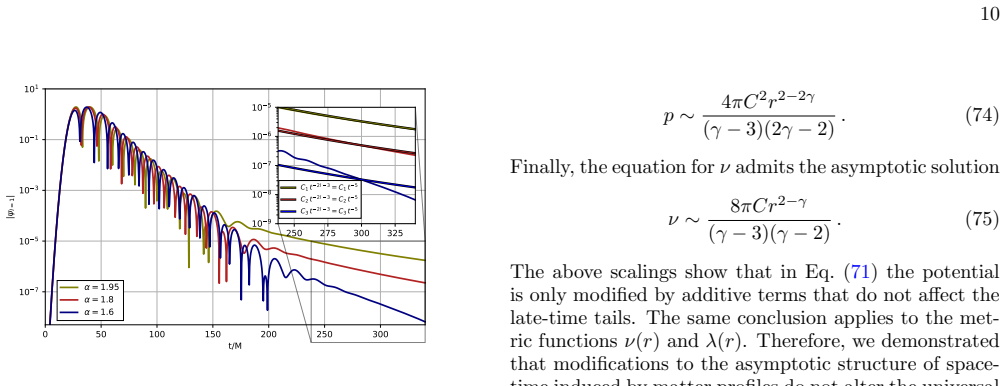
The late-time response of vacuum black holes is governed by power-law tails arising from wave scattering off the curved spacetime geometry far from the black hole. We provide an analytical proof that the tail fall-off is universal for any effective potential asymptotically decaying as 1/r², while the power-law decay is different if the potential decays as 1/r^α with 1<α<2. The proof rests on analytical evaluation of the branch-cut contribution to the Green function and covers charged black holes, different kinds of perturbations, the Teukolsky equation for the Kerr metric, exotic compact objects, extensions of general relativity, and environmental effects including the Navarro-Frenk-White d
What carries the argument
Analytical evaluation of the branch-cut contribution to the Green function, which fixes the late-time power-law index independently of near-zone details.
If this is right
- Tails are insensitive to a wide range of matter distributions around black holes, such as the Navarro-Frenk-White profile used for dark matter.
- The same universal fall-off applies to charged black holes, Kerr perturbations through the Teukolsky equation, and exotic compact objects.
- Extensions of general relativity and environmental effects do not change the tail decay when the potential falls as 1/r².
- The power-law index differs only when the potential decays more slowly than 1/r² but faster than 1/r.
Where Pith is reading between the lines
- Ringdown observations may be unable to distinguish certain dark-matter profiles or other environmental effects using only the tail index.
- The same branch-cut analysis could be applied to wave equations in other asymptotically flat spacetimes.
- High-precision gravitational-wave data might directly constrain the large-distance decay rate of the effective potential through the observed tail.
Load-bearing premise
The late-time signal is dominated by the branch-cut term in the Green function rather than by other singularities or the precise near-zone shape of the potential.
What would settle it
Numerical evolution of a wave equation with an effective potential that decays exactly as 1/r² at large radii, showing a power-law index different from the one predicted by the branch-cut calculation.
Figures




read the original abstract
The late time response of vacuum black holes in General Relativity is notoriously governed by power law tails arising from the wave scattering off the curved spacetime geometry far from the black hole. While it is known that such tails are universal to a certain extent, a precise characterization of their key ingredients is missing. Here we provide an analytical proof that the tail fall-off is universal for any effective potential asymptotically decaying as $1/r^2$, while the power law decay is different if the potential decays as $1/r^\alpha$ with $1<\alpha<2$. This result extends and revises some previous work and is in agreement with numerical analyses. Our proof is based on an analytical evaluation of the branch cut contribution to the Green function, and includes charged black holes, different kinds of perturbations, Teukolsky equation for the Kerr metric, exotic compact objects, extensions of General Relativity, and environmental effects. In the latter case, our results indicate that tails are largely insensitive to a wide range of physically motivated matter distributions around black holes, including the Navarro Frenk White profile commonly used to model dark matter.
Editorial analysis
A structured set of objections, weighed in public.
Referee Report
Summary. The paper claims to provide an analytical proof that late-time power-law tails in black-hole ringdown are universal for any effective potential decaying asymptotically as 1/r², while the decay exponent changes for potentials decaying as 1/r^α with 1<α<2. The proof rests on an explicit analytical evaluation of the branch-cut contribution to the retarded Green function. The result is stated to extend to charged black holes, scalar/vector/gravitational perturbations, the Teukolsky equation on Kerr, exotic compact objects, modified-gravity theories, and environmental matter distributions (including the NFW profile), and is reported to agree with existing numerical work while revising some earlier claims.
Significance. If the branch-cut evaluation is rigorous and the claimed insensitivity to near-zone and sub-leading terms is demonstrated, the result would be significant: it would supply an analytical explanation for the observed universality of tails, show that many physically motivated modifications (including dark-matter halos) leave the leading late-time exponent unchanged, and thereby sharpen the interpretation of ringdown signals in gravitational-wave data. The explicit analytical treatment and the breadth of examples constitute a clear strength.
major comments (2)
- [§4] §4 (Branch-cut evaluation): the derivation of the leading late-time power from the low-frequency asymptotics of the radial solutions is presented for the exact 1/r² tail, but the manuscript does not supply an explicit estimate or contour-deformation argument showing that 1/r^{2+ε} corrections (or matter-induced modifications at large r) leave both the branch-point location and the leading exponent unaltered; this step is load-bearing for the universality statement across the full range of cases listed in the abstract.
- [§6] §6 (Environmental profiles): while the NFW and other matter distributions are discussed, no concrete calculation is given that maps the modified potential back to the same branch-cut integral; without this, the claim that tails remain “largely insensitive” to a wide range of environmental effects rests on an unverified extrapolation of the vacuum result.
minor comments (2)
- [Abstract] The abstract asserts agreement with numerical analyses but does not indicate which specific numerical studies or which quantitative measures (e.g., fitted exponents) are being compared.
- [§3] Notation for the branch-cut integral (Eq. (17) and following) would benefit from an explicit statement of the contour orientation and the principal-value prescription used.
Simulated Author's Rebuttal
We thank the referee for their careful reading of the manuscript and for the constructive comments, which have helped us improve the clarity and rigor of our presentation. We address each major comment below and have revised the manuscript to incorporate additional arguments and explicit calculations where needed.
read point-by-point responses
-
Referee: [§4] §4 (Branch-cut evaluation): the derivation of the leading late-time power from the low-frequency asymptotics of the radial solutions is presented for the exact 1/r² tail, but the manuscript does not supply an explicit estimate or contour-deformation argument showing that 1/r^{2+ε} corrections (or matter-induced modifications at large r) leave both the branch-point location and the leading exponent unaltered; this step is load-bearing for the universality statement across the full range of cases listed in the abstract.
Authors: We agree that an explicit estimate strengthens the universality claim. The leading late-time exponent is controlled by the 1/r² asymptotic of the effective potential, which fixes the branch point at ω = 0. In the revised manuscript we have added a contour-deformation argument and error estimates in §4 showing that any correction decaying as 1/r^{2+ε} (ε > 0) or any matter-induced term that is sub-dominant at large r produces only analytic contributions to the low-frequency radial solutions. These corrections do not shift the branch point or change the leading power extracted from the branch-cut integral; they affect only sub-leading terms in the late-time expansion. The argument proceeds by bounding the perturbation inside a suitable contour that avoids the branch cut. revision: yes
-
Referee: [§6] §6 (Environmental profiles): while the NFW and other matter distributions are discussed, no concrete calculation is given that maps the modified potential back to the same branch-cut integral; without this, the claim that tails remain “largely insensitive” to a wide range of environmental effects rests on an unverified extrapolation of the vacuum result.
Authors: We acknowledge that an explicit mapping for a representative profile such as NFW would make the claim more concrete. In the revised manuscript we have added an appendix to §6 that performs this calculation: we construct the effective potential for an NFW halo, verify that its large-r expansion begins with the same 1/r² term plus higher-order corrections, and explicitly evaluate the resulting branch-cut integral. The leading late-time power remains identical to the vacuum case, while the amplitude receives only a multiplicative constant. This explicit example supports the broader statement that tails are insensitive to a wide class of physically motivated environmental distributions whose potentials share the same leading asymptotic. revision: yes
Circularity Check
Minor self-citation to prior ringdown work; central branch-cut evaluation remains independent
full rationale
The paper derives the claimed universality directly from an explicit analytical evaluation of the branch-cut integral in the Green function for potentials with 1/r^2 or 1/r^α asymptotics. This calculation uses the standard wave equation, low-frequency radial solutions, and contour deformation, without any reduction of the target exponent to a fitted parameter or self-referential definition. The abstract notes that the result 'extends and revises some previous work,' indicating a self-citation, but this citation is not load-bearing for the new proof; the central claim rests on the fresh contour-integral analysis rather than on the cited result alone. The derivation is therefore self-contained against external benchmarks such as the mentioned numerical analyses and applies to the listed extensions (Teukolsky, ECOs, environmental profiles) without circularity.
Axiom & Free-Parameter Ledger
axioms (2)
- domain assumption The late-time behavior is governed by the branch-cut contribution to the Green function for the wave equation with the given effective potential.
- standard math Standard properties of contour integration and asymptotic expansion apply to the radial wave equation in asymptotically flat or weakly curved spacetimes.
Lean theorems connected to this paper
-
IndisputableMonolith/Foundation/RealityFromDistinction.leanreality_from_one_distinction unclear?
unclearRelation between the paper passage and the cited Recognition theorem.
Our proof is based on an analytical evaluation of the branch cut contribution to the Green function... for any effective potential asymptotically decaying as 1/r²
-
IndisputableMonolith/Cost/FunctionalEquation.leanwashburn_uniqueness_aczel unclear?
unclearRelation between the paper passage and the cited Recognition theorem.
the tail fall-off is universal for any effective potential asymptotically decaying as 1/r²
What do these tags mean?
- matches
- The paper's claim is directly supported by a theorem in the formal canon.
- supports
- The theorem supports part of the paper's argument, but the paper may add assumptions or extra steps.
- extends
- The paper goes beyond the formal theorem; the theorem is a base layer rather than the whole result.
- uses
- The paper appears to rely on the theorem as machinery.
- contradicts
- The paper's claim conflicts with a theorem or certificate in the canon.
- unclear
- Pith found a possible connection, but the passage is too broad, indirect, or ambiguous to say the theorem truly supports the claim.
Forward citations
Cited by 2 Pith papers
-
Nonlinear tails of massive scalar fields around a black hole
Nonlinear tails of massive scalar fields around black holes decay at the same rate as linear tails during intermediate times, independent of sources or initial conditions.
-
Excitation factors for horizonless compact objects: long-lived modes, echoes, and greybody factors
Excitation factors of long-lived quasinormal modes in horizonless compact objects scale with their small imaginary frequency, suppressing early contributions and producing a hierarchy where prompt ringdown uses ordina...
Reference graph
Works this paper leans on
-
[1]
On the universality of late-time ringdown tail
Branch cut of ψr− 16 C. Numerical methods 16 D. Perturbations of the Kerr metric 17 References 17 I. INTRODUCTION Binary black hole (BH) mergers serve as a natural testbed to investigate the full nonlinear dynamics of Ein- stein’s theory of gravity [1–4]. These systems, long stud- ied for their theoretical and astrophysical relevance [5], have gained rene...
work page internal anchor Pith review Pith/arXiv arXiv 2025
-
[2]
In the approximation p ≈ 0, follow- ing [42, 43] we can consider the case a Schwarzschild-like space-time, described by ds2 = −g(r)dt2 + 1 g(r) dr2 + r2dΩ2 . (77) The gravitational axial perturbations are described by Eq. (1) with the tortoise coordinate defined as dr∗/dr = g(r) and the effective potential [42] V (r) = g(r) g′′(r) + g′(r) r + 2g(r) + l(l ...
-
[3]
Branch cut of ψr− Consider Eqs. (7) and (8). Clearly, ψr−(r∗, ωe2πi) = Aout(ω) ψ∞+(r∗, ω) − K(ω) ψ∞−(r∗, ω) + Ain(ω) ψ∞−(r∗, ω) − K(−ω) ψ∞+(r∗, ω) . (B23) However, due to the way ψr− is constructed (see Eq. (25)), it does not exhibit any branch cut, since it in- volves only the Coulomb wave function Fl(η, ρ), which is monodromic (see Appendix A 9). It fol...
-
[4]
Moreover, it holds that lim |z|→∞ U(a, b, z) ∼ z−a + O(z−a−1)
at the horizon ( r = r+), Ψ 1 satisfies the boundary condition of a purely ingoing wave, up to a normalization constant. Moreover, it holds that lim |z|→∞ U(a, b, z) ∼ z−a + O(z−a−1) . (D5) Consequently, in the limit ω → 0 and r → ∞, the func- tion Ψ2 behaves as a purely outgoing wave at spatial in- finity, up to a normalization constant. We now turn our ...
-
[5]
Tests of General Relativity with GWTC-3
R. Abbott et al. (LIGO Scientific, VIRGO, KAGRA), (2021), arXiv:2112.06861 [gr-qc]
work page internal anchor Pith review Pith/arXiv arXiv 2021
-
[6]
Testing General Relativity with Present and Future Astrophysical Observations
E. Berti et al. , Class. Quant. Grav. 32, 243001 (2015), arXiv:1501.07274 [gr-qc]
work page internal anchor Pith review Pith/arXiv arXiv 2015
-
[7]
Extreme Gravity Tests with Gravitational Waves from Compact Binary Coalescences: (II) Ringdown
E. Berti, K. Yagi, H. Yang, and N. Yunes, Gen. Rel. Grav. 50, 49 (2018), arXiv:1801.03587 [gr-qc]
work page internal anchor Pith review Pith/arXiv arXiv 2018
-
[8]
Testing the nature of dark compact objects: a status report
V. Cardoso and P. Pani, Living Rev. Rel. 22, 4 (2019), arXiv:1904.05363 [gr-qc]. 18
work page internal anchor Pith review Pith/arXiv arXiv 2019
-
[9]
Black holes, gravitational waves and fundamental physics: a roadmap
L. Barack et al., Class. Quant. Grav. 36, 143001 (2019), arXiv:1806.05195 [gr-qc]
work page internal anchor Pith review Pith/arXiv arXiv 2019
-
[10]
B. P. Abbott et al. (LIGO Scientific, Virgo), Phys. Rev. Lett. 116, 061102 (2016), arXiv:1602.03837 [gr-qc]
work page internal anchor Pith review Pith/arXiv arXiv 2016
-
[11]
R. H. Price, Phys. Rev. D 5, 2419 (1972)
work page 1972
-
[12]
R. H. Price, Phys. Rev. D 5, 2439 (1972)
work page 1972
-
[13]
B. S. DeWitt and R. W. Brehme, Annals Phys. 9, 220 (1960)
work page 1960
-
[14]
C. T. Cunningham, R. H. Price, and V. Moncrief, As- trophys. J. 224, 643 (1978)
work page 1978
-
[15]
C. T. Cunningham, R. H. Price, and V. Moncrief, As- trophys. J. 230, 870 (1979)
work page 1979
-
[16]
E. W. Leaver, J. Math. Phys. 27, 1238 (1986)
work page 1986
-
[17]
R. G´ omez and J. Winicour, Journal of Mathematical Physics 33, 1445 (1992)
work page 1992
-
[18]
Late-Time Behavior of Stellar Collapse and Explosions: I. Linearized Perturbations
C. Gundlach, R. H. Price, and J. Pullin, Phys. Rev. D 49, 883 (1994), arXiv:gr-qc/9307009
work page internal anchor Pith review Pith/arXiv arXiv 1994
-
[19]
Late-Time Behavior of Stellar Collapse and Explosions: II. Nonlinear Evolution
C. Gundlach, R. H. Price, and J. Pullin, Phys. Rev. D 49, 890 (1994), arXiv:gr-qc/9307010
work page internal anchor Pith review Pith/arXiv arXiv 1994
-
[20]
E. S. C. Ching, P. T. Leung, W. M. Suen, and K. Young, Phys. Rev. Lett. 74, 2414 (1995), arXiv:gr-qc/9410044
work page internal anchor Pith review Pith/arXiv arXiv 1995
-
[21]
L. M. Burko and A. Ori, Phys. Rev. D 56, 7820 (1997), arXiv:gr-qc/9703067
work page internal anchor Pith review Pith/arXiv arXiv 1997
- [22]
-
[23]
Dynamical excitation of space-time modes of compact objects
S. Bernuzzi, A. Nagar, and R. De Pietri, Phys. Rev. D 77, 044042 (2008), arXiv:0801.2090 [gr-qc]
work page internal anchor Pith review Pith/arXiv arXiv 2008
-
[24]
How pure is the tail of gravitational collapse ?
S. Hod, Class. Quant. Grav. 26, 028001 (2009), arXiv:0902.0237 [gr-qc]
work page internal anchor Pith review Pith/arXiv arXiv 2009
-
[25]
M. De Amicis, S. Albanesi, and G. Carullo, Phys. Rev. D 110, 104005 (2024), arXiv:2406.17018 [gr-qc]
-
[26]
De Amicis et al., (2024), arXiv:2412.06887 [gr-qc]
M. De Amicis et al., (2024), arXiv:2412.06887 [gr-qc]
- [27]
-
[28]
D. Chiaramello and A. Nagar, Phys. Rev. D 101, 101501 (2020), arXiv:2001.11736 [gr-qc]
-
[29]
S. Albanesi, S. Bernuzzi, T. Damour, A. Nagar, and A. Placidi, Phys. Rev. D 108, 084037 (2023), arXiv:2305.19336 [gr-qc]
- [30]
-
[31]
E. W. Leaver, Phys. Rev. D 34, 384 (1986)
work page 1986
-
[32]
N. Andersson, Phys. Rev. D 55, 468 (1997), arXiv:gr- qc/9607064
-
[33]
P. Pani, L. Gualtieri, T. Abdelsalhin, and X. Jim´ enez-Forteza, Phys. Rev. D 98, 124023 (2018), arXiv:1810.01094 [gr-qc]
work page internal anchor Pith review Pith/arXiv arXiv 2018
- [34]
-
[35]
S. A. Teukolsky, Phys. Rev. Lett. 29, 1114 (1972)
work page 1972
-
[36]
W. H. Press and S. A. Teukolsky, Astrophys. J. 185, 649 (1973)
work page 1973
-
[37]
S. A. Teukolsky and W. H. Press, Astrophys. J. 193, 443 (1974)
work page 1974
-
[38]
R. J. Gleiser, R. H. Price, and J. Pullin, Class. Quant. Grav. 25, 072001 (2008), arXiv:0710.4183 [gr-qc]
work page internal anchor Pith review Pith/arXiv arXiv 2008
-
[39]
L. M. Burko and G. Khanna, Class. Quant. Grav. 26, 015014 (2009), arXiv:0711.0960 [gr-qc]
work page internal anchor Pith review Pith/arXiv arXiv 2009
-
[40]
L. M. Burko and G. Khanna, Phys. Rev. D 89, 044037 (2014), arXiv:1312.5247 [gr-qc]
work page internal anchor Pith review Pith/arXiv arXiv 2014
-
[41]
Eigenvalues and eigenfunctions of spin-weighted spheroidal harmonics in four and higher dimensions
E. Berti, V. Cardoso, and M. Casals, Phys. Rev. D 73, 024013 (2006), [Erratum: Phys.Rev.D 73, 109902 (2006)], arXiv:gr-qc/0511111
work page internal anchor Pith review Pith/arXiv arXiv 2006
- [42]
- [43]
- [44]
-
[45]
J. F. Navarro, C. S. Frenk, and S. D. M. White, The Astrophysical Journal 490, 493–508 (1997)
work page 1997
- [46]
-
[47]
Z. Xu, X. Hou, X. Gong, and J. Wang, JCAP 09, 038 (2018), arXiv:1803.00767 [gr-qc]
work page internal anchor Pith review Pith/arXiv arXiv 2018
- [48]
-
[49]
L. Pezzella, K. Destounis, A. Maselli, and V. Cardoso, Phys. Rev. D 111, 064026 (2025), arXiv:2412.18651 [gr- qc]
- [50]
-
[51]
V. Cardoso, K. Destounis, F. Duque, R. P. Macedo, and A. Maselli, Phys. Rev. D 105, L061501 (2022), arXiv:2109.00005 [gr-qc]
- [52]
-
[53]
V. Cardoso, S. Hopper, C. F. B. Macedo, C. Palen- zuela, and P. Pani, Phys. Rev. D 94, 084031 (2016), arXiv:1608.08637 [gr-qc]
work page internal anchor Pith review Pith/arXiv arXiv 2016
-
[54]
Is the gravitational-wave ringdown a probe of the event horizon?
V. Cardoso, E. Franzin, and P. Pani, Phys. Rev. Lett. 116, 171101 (2016), [Erratum: Phys.Rev.Lett. 117, 089902 (2016)], arXiv:1602.07309 [gr-qc]
work page internal anchor Pith review Pith/arXiv arXiv 2016
-
[55]
Tests for the existence of horizons through gravitational wave echoes
V. Cardoso and P. Pani, Nature Astron. 1, 586 (2017), arXiv:1709.01525 [gr-qc]
work page internal anchor Pith review Pith/arXiv arXiv 2017
-
[56]
Oshita, (2023), arXiv:2309.05725 [gr-qc]
N. Oshita, Phys. Rev. D 109, 104028 (2024), arXiv:2309.05725 [gr-qc]
-
[57]
K. Okabayashi and N. Oshita, Phys. Rev. D 110, 064086 (2024), arXiv:2403.17487 [gr-qc]
- [58]
-
[59]
R. F. Rosato, S. Biswas, S. Chakraborty, and P. Pani, Phys. Rev. D 111, 084051 (2025), arXiv:2501.16433 [gr- qc]
work page internal anchor Pith review Pith/arXiv arXiv 2025
-
[60]
F. W. J. Olver, A. B. O. Daalhuis, D. W. Lozier, B. I. Schneider, R. F. Boisvert, C. W. Clark, B. R. Miller, B. V. Saunders, H. S. Cohl, and M. A. McClain, NIST Digital Library of Mathematical Functions, release 1.1.17 ed. (National Institute of Standards and Technology,
-
[61]
https://dlmf.nist.gov/
-
[62]
Connection formulas between Coulomb wave functions
D. Gaspard, J. Math. Phys. 59, 112104 (2018), arXiv:1804.10976 [math-ph]
work page internal anchor Pith review Pith/arXiv arXiv 2018
- [63]
discussion (0)
Sign in with ORCID, Apple, or X to comment. Anyone can read and Pith papers without signing in.